Bhagavad Gita - Chapter 10 - Shloka (Verse) 17
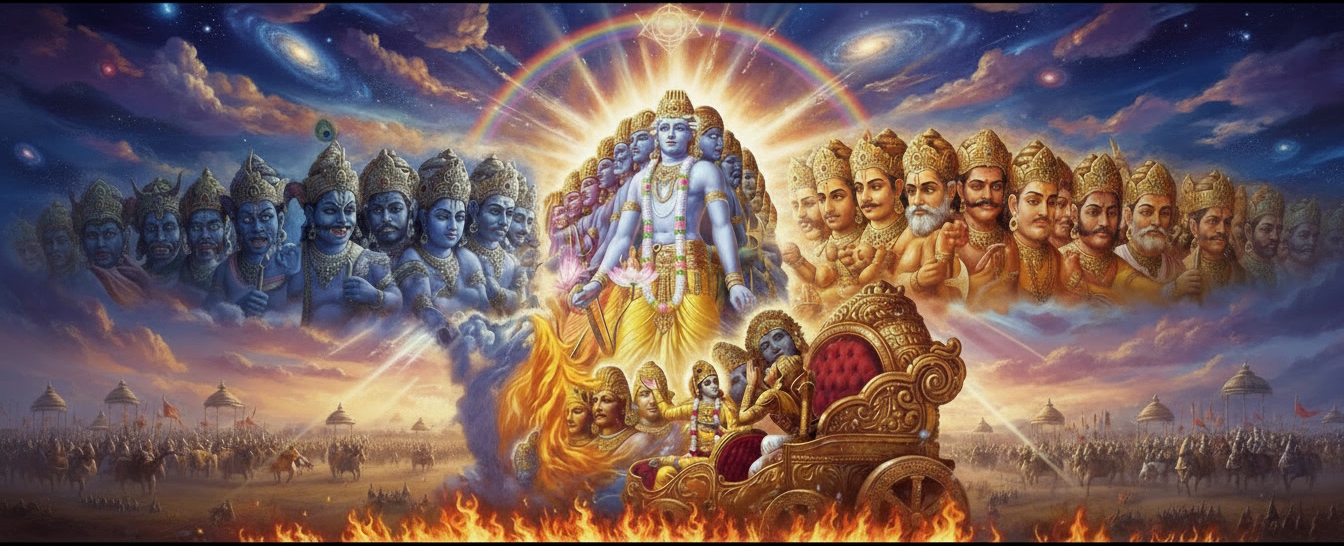
कथं विद्यामहं योगिंस्त्वां सदा परिचिन्तयन्।
केषु केषु च भावेषु चिन्त्योऽसि भगवन्मया।।10.17।।
kathaṃ vidyāmahaṃ yogiṃstvāṃ sadā paricintayan|
keṣu keṣu ca bhāveṣu cintyo'si bhagavanmayā||10.17||
Translation
How shall I, ever meditating, know Thee, O Yogin? In what aspects or things, O blessed
Lord, art Thou to be thought of by me?
हिंदी अनुवाद
हे योगिन् ! हरदम साङ्गोपाङ्ग चिन्तन करता हुआ मैं आपको कैसे जानूँ ? और हे भगवन् ! किन-किन भावोंमें आप मेरे द्वारा चिन्तन किये जा सकते हैं अर्थात् किन-किन भावोंमें मैं आपका चिन्तन करूँ ?
Commentaries & Translations
Swami Ramsukhdas
व्याख्या--'कथं विद्यामहं योगिंस्त्वां सदा परिचिन्तयन्'--सातवें श्लोकमें भगवान्ने कहा कि जो मेरी विभूति और योगको तत्त्वसे जानता है, वह अविचल भक्तियोगसे युक्त हो जाता है। इसलिये अर्जुन भगवान्से पूछते हैं कि हरदम चिन्तन करता हुआ मैं आपको कैसे जानूँ?
Sri Harikrishnadas Goenka
हे योगिन् आपका सदा चिन्तन करता हुआ मैं आपको किस प्रकार जानूँ हे भगवन् आप किनकिन भावोंमें अर्थात् वस्तुओंमें मेरे द्वारा चिन्तन किये जानेयोग्य हैं।
Sri Anandgiri
Suspecting 'Why do you wish to hear the Vibhutis?', he states the fruit through a question regarding the mode of facilitating meditation—'Katham' etc.
Yoga means Opulence/Power; one who possesses it is a Yogi; O Yogin! How may I, of gross intellect, constantly contemplating on You, become purified in intellect and know You in Your unconditioned state?—this is the question.
He introduces another question—'Keshu keshu' etc. The plural is used due to the distinction between sentient and insentient and the multiplicity of adjuncts (upadhis).
Sri Dhanpati
O Yogin! How may I, of gross intellect, contemplating You on all sides (pari - samantat), become of subtle intellect and know You? Yoga is bringing about the impossible; You possess that. You are capable of making even me, who am unfit to know You, fit; this is the intent of the address.
In what various states or objects are You to be meditated upon by me? Tell me the objects endowed with Your opulence etc. among those respective objects—indicating this, he says 'O Bhagavan' etc.
Sri Neelkanth
Yoga means lordship; possessing that—O Yogin! How can I know You with physical eyes? Not in any way; thinking thus of the rarity of the vision of the Universal Form,
'I shall contemplate the Lord only in a few places to establish eligibility for the vision of the Universal Form'—with this intention he says 'Keshu' etc.
Sri Ramanuja
I, being a Yogi—established in Bhakti Yoga—constantly contemplating You with devotion, engaged in thinking,
how may I know You, the object of thought, who are the fullness of opulence and hosts of auspicious qualities?
Apart from the previously mentioned states like intelligence, knowledge etc., in what other unmentioned states are You to be thought of by me as the Controller?
Sri Sridhara Swami
Showing the purpose of the narration, he prays—with two verses starting with 'Katham'.
O Yogin! How, by what distinct vibhutis, constantly contemplating, may I know You?
Even though You are to be thought of through distinct vibhutis, in what particular objects are You to be contemplated by me?
Sri Vedantadeshikacharya Venkatanatha
The word 'Yogi' (in 'Aham Yogi' reading), due to the specific context and the force of 'constantly contemplating You', refers to a specific kind of Yogi; he explains—'Being established in Bhakti Yoga'.
By 'San' (being/becoming), the state of an accomplished Yogi is also excluded (implying a seeker). Here, the reading 'Yogin' (Vocative: O Yogi) by others (like Shankara) is considered non-Arsha (not original/scriptural).
By the force of the adjective 'Sada' (always), 'with devotion' is established. Since contemplation is impossible before knowing; and since 'How may I know' is the cause for contemplation; and because of the grammatical rule for the Shatri affix (present participle 'Parichintayan') in the sense of 'characteristic or cause' (Ashtadhyayi 3.2.126)—it is explained as 'engaged in thinking'.
Since the specific Subject (Dharmi - You) is known by 'Tvam', the desire is to know the specific modes; to indicate this, 'Paripurna...' etc. is said.
Thinking that a question is for making known the unknown details, he says—'Purvokta...' etc.
Explaining the intended meaning of the locative 'Bhaveshu', or dragging from the context, he says—'Niyantritvena' (as the Controller).
Swami Chinmayananda
किस प्रकार मैं आपका चिन्तन या ध्यान करूँ जिससे कि मैं आपको साक्षात् जान सकूँ साधक का लक्ष्य है एकत्व भाव से आत्मा को साक्षात् जानना। अब तक के अध्यायों में कहीं भी गीता ने ध्यानाभ्यास के लिए किसी नदी के तट पर या एकान्त गुफा में जाकर संन्यास का जीवन व्यतीत करने का समर्थन नहीं किया है। श्रीकृष्ण का मनुष्य को आह्वान कर्त्तव्य कर्म करने के लिए है और अपने इसी व्यावहारिक जीवन में ईश्वरानुभूति में जीने के लिए है। हमें यह नहीं भूलना चाहिए कि गीताशास्त्र का उद्घोष महाभारत के समरांगण में उस क्षण हुआ था? जब तत्कालीन समस्त राष्ट्र अपने समय की सबसे बड़ी ऐतिहासिक क्रांति वेला का सामना करने के लिए उद्यत थे। यह क्रांति वेला लौकिक और आध्यात्मिक दोनों ही मूल्यों की निर्णायक थी।अर्जुन कर्त्तव्य पालन के गीताधर्म में पूर्णतया परिवर्तित हो गया था। उसका यह परिवर्तन श्रीकृष्ण को सम्बोधित किये योगिन शब्द से विशेष रूप से दर्शाया गया है। श्रीकृष्ण ऐसे सर्वश्रेष्ठ कर्मयोगी थे? जिन्होंने विविध घटनाओं से परिपूर्ण जीवन में अत्यन्त व्यस्त रहते हुए भी कभी अपने शुद्ध दिव्यस्वरूप का विस्मरण नहीं होने दिया।इस श्लोक में अर्जुन अपने अनुरोध का कारण भी बताते हुए कहता है? आप किनकिन भावों में मेरे द्वारा चिन्तन करने योग्य हैं व्यावहारिक जीवन जीते हुए और उसकी चुनौतियों का सामना करते हुए? यदि सर्वत्र व्याप्त आत्मा का अखण्ड स्मरण बनाये रखना हो? तो साधक को निश्चित रूप से यह जानना आवश्यक होगा कि वह उस तत्त्व को प्रत्येक वस्तु? वस्तुओं के समूह और मनुष्यों के समाज में कहाँ और कैसे देखे।अर्जुन अपनी इच्छा को और अधिक स्पष्ट करते हुए कहता है कि यदि भगवान् का उत्तर विस्तृत भी हो? तब भी उन्हें सुनने और समझने में वह थकान नहीं अनुभव करेगा
Sri Madhusudan Saraswati
What is the purpose of that narration? He states that in two verses. 'Yoga' is the power of unsurpassable opulence etc.; he who has it is a Yogi; O Yogin—O Possessor of unsurpassable opulence and power!
How may I, of very gross intellect, know You who are impossible to be known even by gods etc.? 'Sada parichintayan'—meditating always.
(Objection:) Meditating on Me in My Vibhutis, you will know? To this he says—In what various 'bhavas'—sentient and insentient objects which are Your Vibhutis—are You to be thought of by me, O Bhagavan?
Sri Purushottamji
He states the purpose of the narration—'Katham' etc. O Yogin—All-pervading, Capable of doing everything! While constantly contemplating on You—Your manifest blissful form—'Paritah' meaning thinking inside and out—how shall I know Your Vibhutis?
Here the idea is: While contemplating directly on the Lord, if I engage in knowing Vibhutis and placing the mind there, there will be a break in contemplation; so how can I know? (Objection:) Then why the question? Anticipating this—based on what was said before from 'Etam vibhutim' (10.7) up to 'Yena mam upayanti te' (10.10)—I ask for the sake of attaining You.
Even there, according to my eligibility, tell me what is necessary for me—he requests this with 'Keshu' etc. In what worlds? And again in what 'bhavas'—objects—O Bhagavan (Full of six opulences, All-pervading)! are You to be contemplated by me?
Sri Shankaracharya
O Yogin! How may I know You fully, constantly contemplating on You?
And in what various 'bhavas'—objects—are You to be thought of, to be meditated upon, by me, O Lord?
Sri Vallabhacharya
With the expectation 'What is the purpose of that revelation?', he says 'Katham vidyam' etc.
I am being made a Yogi by You (or 'I am a Yogi'), and thinking is appropriate for him. In what various dual kinds of states are You to be thought of by me?
In the reading 'Yogin' (Vocative)—because You possess Yoga—the question 'How may I know Your Yoga too?' is obtained. Then with 'Vistarena' (in detail - next verse), the entire question is clarified—'Vibhutim yogam cha'.
Although You mentioned the Vibhuti before, it was brief; so now tell me in detail—thus he asks.
Swami Sivananda
कथम् how? विद्याम् shall know? अहम् I? योगिन् O Yogin? त्वाम् Thee? सदा always? परिचिन्तयन् meditating? केषु केषु in what and what? च and? भावेषु aspects? चिन्त्यः to be thought of? असि (Thou) art? भगवन् O blessed Lord? मया by me.Commentary Arjuna says O Lord? how may I know Thee by constant meditation In what aspects art Thou to be thought of by me Even when I think of external objects I can meditate on Thee in Thy particular manifestations in them if I have a detailed knowledge of Thy glories. Therefore deign to tell me? without reserve? of Thy own glories. Then only can I behold oneness everywhere.
Swami Gambirananda
O Yogi, katham, how; aham vidyam, shall I know tvam, You; sada pari-cintayan, by remaining ever-engaged in meditation? Ca, and; kesu kesu bhavesu, through what objects; bhagvan, O Lord; cintah asi, are You to be meditated on; maya, by me?
Swami Adidevananda
I, 'Your devotee' (Yogin), namely, one engaged in Bhakti Yoga, and 'constantly meditating on You' with devotion, namely, embarked on meditation on You, - how am I to know You, the object of meditation, as possessing a multitude of auspicious attributes like sovereignty etc.? And in what varied modes of mental dispositions, which are as yet untold and which are different from the intelligence, knowledge etc., described earlier, are You the Controller of all, to be meditated upon by me.