Bhagavad Gita - Chapter 10 - Shloka (Verse) 19
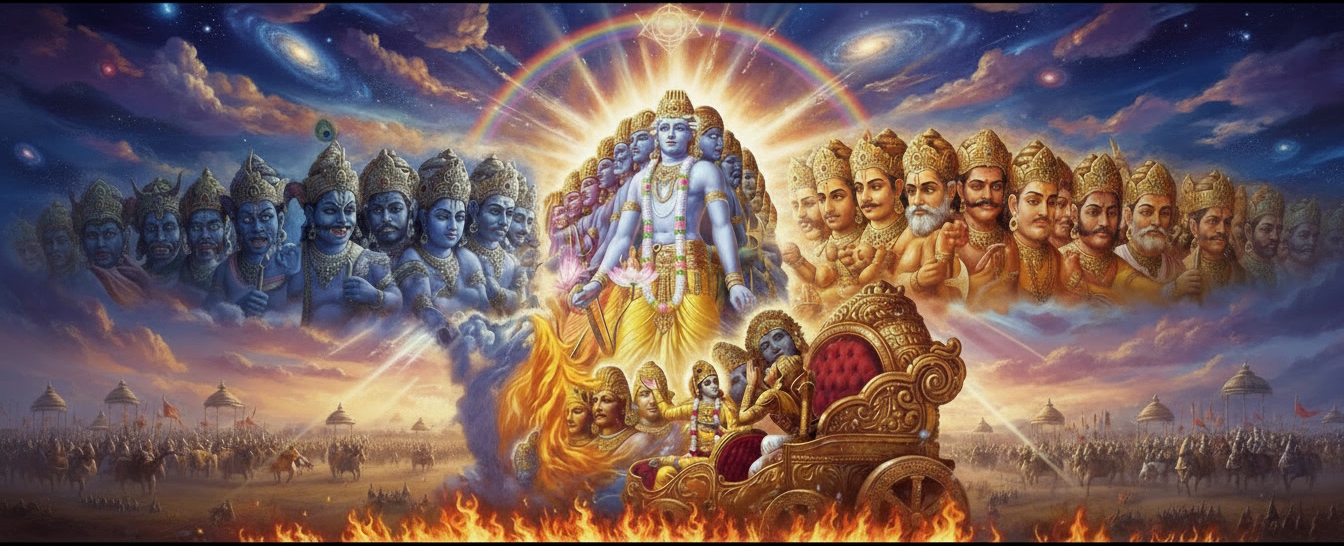
श्री भगवानुवाच हन्त ते कथयिष्यामि दिव्या ह्यात्मविभूतयः।
प्राधान्यतः कुरुश्रेष्ठ नास्त्यन्तो विस्तरस्य मे।।10.19।।
śrī bhagavānuvāca
hanta te kathayiṣyāmi divyā hyātmavibhūtayaḥ|
prādhānyataḥ kuruśreṣṭha nāstyanto vistarasya me||10.19||
Translation
The Blessed Lord said Very well! Now I will declare to thee My divine glories in their prominence, O Arjuna; there is no end to their detailed description.
हिंदी अनुवाद
श्रीभगवान् बोले -- हाँ, ठीक है। मैं अपनी दिव्य विभूतियोंको तेरे लिये प्रधानतासे (संक्षेपसे) कहूँगा; क्योंकि हे कुरुश्रेष्ठ ! मेरी विभूतियोंके विस्तारका अन्त नहीं है।
Commentaries & Translations
Swami Ramsukhdas
व्याख्या--'हन्त ते कथयिष्यामि दिव्या ह्यात्मविभूतयः'--योग और विभूति कहनेके लिये अर्जुनकी जो प्रार्थना है, उसको 'हन्त' अव्ययसे स्वीकार करते हुए भगवान् कहते हैं कि मैं अपनी दिव्य, अलौकिक, विलक्षण विभूतियोंको तेरे लिये कहूँगा (योगकी बात भगवान्ने आगे इकतालीसवें श्लोकमें कही है)।'दिव्याः' कहनेका तात्पर्य है कि जिस किसी वस्तु, व्यक्ति, घटना आदिमें जो कुछ भी विशेषता दीखती है, वह,वस्तुतः भगवान्की ही है। इसलिये उसको भगवान्की ही देखना दिव्यता है और वस्तु, व्यक्ति आदिकी देखना अदिव्यता अर्थात् लौकिकता है।
'प्राधान्यतः कुरुश्रेष्ठ नास्त्यन्तो विस्तरस्य मे'-- जब अर्जुनने कहा कि भगवन्! आप अपनी विभूतियोंको विस्तारसे, पूरी-की-पूरी कह दें, तब भगवान् कहते हैं कि मैं अपनी विभूतियोंको संक्षेपसे कहूँगा; क्योंकी मेरी विभूतियोंका अन्त नहीं है। पर आगे ग्यारहवें अध्यायमें जब अर्जुन बड़े संकोचसे कहते हैं कि मैं आपका विश्वरूप देखना चाहता हूँ; अगर मेरे द्वारा वह रूप देखा जाना शक्य है तो दिखा दीजिये, तब भगवान् कहते हैं --'पश्य मे पार्थ रूपाणि' (11। 5) अर्थात् तू मेरे रूपोंको देख ले। रूपोंमें कितने रूप? क्या दो-चार? नहीं-नहीं, सैकड़ों-हजारों रूपोंको देख! इस प्रकार यहाँ अर्जुनकी विस्तारसे विभूतियाँ कहनेकी प्रार्थना सुनकर भगवान् संक्षेपसे विभूतियाँ सुननेके लिये कहते हैं और वहाँ अर्जुनकी एक रूप दिखानेकी प्रार्थना सुनकर भगवान् सैकड़ों-हजारों रूप देखनेके लिये कहते हैं!
Sri Harikrishnadas Goenka
श्रीभगवान् बोले -- हे कुरुवंशियोंमें श्रेष्ठ अब मैं तुझे अपनी दिव्य -- देवलोकमें होनेवाली विभूतियाँ प्रधानतासे बतलाता हूँ अर्थात् मेरी जहाँजहाँपर जोजो प्रधानप्रधान विभूतियाँ हैं? उनउन प्रधान विभूतियोंका ही मैं प्रधानतासे वर्णन करता हूँ। सम्पूर्णतासे तो वे सैकड़ों वर्षोंमें भी नहीं कही जा सकतीं क्योंकि मेरे विस्तारका अर्थात् मेरी विभूतियोंका अन्त नहीं है।
Sri Anandgiri
To reassure the questioner, the Lord spoke; this is stated with 'Sri Bhagavan uvacha'. By 'Hanta' (Well/Now), excluding mere permission, He indicates the time delimited by the desire to know—'Idanim' (Now).
'Being in the Div' (Divine) means being supernatural, beyond our perception. He illumines the syntax of the sentence—with 'Ya ta' (Those which) etc. Since it would imply that all vibhutis are to be spoken of, He says—'Yatra' (Where) etc. (meaning only principal ones).
Why are the vibhutis not spoken of entirely without residue? To this He says—'Asheshatastu' (Entirely, however...) etc. The reason for that is 'Yatah' (Because) etc.
Sri Dhanpati
Thus asked, the Blessed Lord spoke. 'Hanta'—Now; whatever Vibhutis are Mine, I shall tell them 'Pradhanyatah'—principally. Meaning, each principal Vibhuti.
Addressing him as 'Kurushreshtha' (Best of Kurus), He indicates that he is qualified.
To the request 'Tell me in detail', He replies. There is no end to the extent of My Vibhutis.
Sri Neelkanth
To this, the Blessed Lord answered—'Hanta' etc. 'Hanta' means Now; or 'Hanta' is in the sense of permission.
'Divyah'—those which are famous as excellent even in other Puranas, those Vibhutis of Mine, I shall tell—this is the construction.
'Pradhanyatah'—since Vibhutis are helpful to Yoga, they are spoken of here principally; Yoga is spoken of only briefly. The idea is that it (Yoga) will be described later. Otherwise, when asked 'Tell me Yoga and Vibhuti', by telling only Vibhuti, it would imply inattention on the Lord's part.
'There is no end to the extent of My Vibhutis'—here connection should be made by changing the case (of 'Me' to 'Vibhutinam' - of Vibhutis).
Sri Ramanuja
The Blessed Lord said—O Best of Kurus! I shall tell you My auspicious Vibhutis 'Pradhanyatah' (principally). By the word 'Pradhanya', excellence/eminence is intended; for it will be said 'Know me as the Chief among priests' (10.24). I shall tell some Vibhutis that are excellent in the world; it is not possible to speak or hear in full detail, because they are infinite.
'Vibhutitva' (nature of Vibhuti) means 'being controlled/ruled' (niyamyatva); having said 'Intelligence etc. of all beings arise from Me alone', He stated 'He who knows this Vibhuti and Yoga of Mine...' (10.7).
Thus, it is appropriate that there 'Yoga' refers to creatorship etc., and 'Vibhuti' refers to being impelled by Him. And again it was said 'I am the origin of all, everything proceeds from Me...' (10.8). There, the regulation in the form of impelling all beings is by abiding as their Self—this meaning, and the creatorship, protectorship, and destroyer-ship of all indicated by the word 'Yoga', He states clearly—
Sri Sridhara Swami
Thus requested, the Blessed Lord said—'Hanta' etc. 'Hanta' is an address of compassion.
My Vibhutis which are divine, I shall tell you principally.
Since there is no end to the extent of My detailed Vibhutis, therefore I shall describe a few which are principal.
Sri Vedantadeshikacharya Venkatanatha
To Arjuna asking thus with insatiability, the very pleased Lord, showing his competence through description of lineage etc., and since it is impossible to speak and hear each vibhuti in detail, says He will speak of vibhutis grouped by some specific attribute—'Hanta' etc. 'Te' (to you)—who are full of qualities like non-envy, being dear, and insatiability; this is the idea.
If 'Pradhanya' meant 'Sheshitva' (Principal/Mastery) as correlative to subordinateness, it would not cover all future examples; and since groups (ganas) are also to be mentioned by prominence, he gives a comprehensive specific meaning—'By the word Pradhanya' (Excellence is intended). He confirms that this is intended by citing a future verse 'Purodhasam' etc. He gives the condensed meaning—'Jagati' etc.
To the one asking 'Tell in detail', how is it said 'I will tell principally'? Answering this doubt—'Nastyanto vistarasya me' is said. 'Of vibhutis' is implied. For it will be said 'Vibhuter vistaro maya' (10.40).
He shows the 'impossibility' intended by the word 'Nasti'—'Vistarena vaktum' (Impossible to speak in detail). This is not due to the incapacity of the speaker or listener, he says—'Tasam anantyat' (Due to their infinity). This is what is said by 'Nastyantah'.
He states the basis for using the word Vibhuti for the objects to be mentioned—'Vibhutitvam nama' etc. The word Vibhuti regarding other objects to be controlled refers to the object of 'Vibhavana' (manifestation/rule). Elsewhere also, in 'Brahma, Daksha etc. are Time...' (VP 1.22.31-33), the word Vibhuti is seen used for controlled beings (niyantavya); this is the idea.
From where (is this derived)? He says—'Sarvesham' etc. The presented 'dependence on Him' is referred to by the word 'Etat'; this is the idea. He shows that the immediate verse also has that purport—'Tatha' etc.
Objection: In the commentary of this verse earlier, 'Connection with auspicious qualities like Saushilya, Vatsalya etc.' was said (for Yoga); here 'Creatorship etc. indicated by the word Yoga' is said; how does this fit? Answer: Thus—in both places, both are included by the word 'Adi' (etc.), so there is unity of meaning. That is why in 'Etam vibhutim yogam cha' (10.7), it was included by the determinant 'My Yoga in the form of a host of auspicious qualities opposed to evil'.
Even if 'Etam vibhutim' etc. is interpreted as 'control' (niyamana) as before, its mention here is to exclude other meanings like 'prosperity' and to reveal the meaning of the root with the prefix. In 'Vistarena atmano yogam vibhutim cha' (10.18), the meaning of 'control' was stated due to the naturalness of unity of meaning with the word Vibhuti in the preceding question 'Yabhir vibhutibhih' (10.16). Therefore, a slight difference between the words of the question and the answer is tolerable.
Swami Chinmayananda
प्रस्तुत अध्याय को बृहत् आकार देने वाला भगवान् श्रीकृष्ण का यह विस्तृत एवं व्याख्यापूर्ण उत्तर? एकएक वस्तु और व्यक्ति में तथा उनके समूह में आत्मा की वास्तविक पहचान का वर्णन करता है। यहाँ विशेष ध्यान देने योग्य बात यह है कि अपनी विभूति और योग का वर्णन करते समय भगवान् श्रीकृष्ण निम्नलिखित दो बातों को बताने का विशेष ध्यान रखते हैं। (क) प्रत्येक वस्तु में अपना सर्वोच्च महत्त्व? (ख) उनके बिना किसी भी एक वस्तु या समूह का सामञ्जस्यपूर्ण अस्तित्व सम्भव नहीं हो सकता।इस खण्ड का प्रारम्भ जिस हन्त शब्द से होता है? वह अर्जुन के प्रति गीताचार्य के प्रेमपूर्ण सहानुभूति को दर्शाता है? तथा उससे अर्जुन में प्रतीत होने वाली अक्षमता के प्रति भगवान् की चिन्ता भी व्यक्त होती है? क्योंकि उस अक्षमता के कारण वह उस तत्त्व को नहीं अनुभव कर पा रहा था जो उसके अत्यन्त समीप है? उसका स्वरूप ही है। हन्त शब्द को इस खण्ड के प्रारम्भ का केवल सूचक मानने में उसमें निहित गूढ़ अभिप्राय का लोप हो जाने के कारण वह अर्थ स्वीकार्य नहीं हो सकता।समष्टि और व्यष्टि उपाधियों के द्वारा इस बहुविध सृष्टि के रूप में व्यक्त हुए आत्मा के विस्तार का अन्त नहीं हो सकता। इसलिए उसका वर्णन करना असंभव है? तथापि करुणासागर भगवान् श्रीकृष्ण अपने शरणागत् शिष्य अर्जुन के प्रति अपनी असीम अनुकम्पा के कारण इस असंभव कार्य को अपने हाथ में लेते हैं। वे स्वीकार करते हैं कि उनके विस्तार का कोई अन्त नहीं है फिर भी वे अर्जुन को अपनी प्रधान विभूतियाँ बतायेंगे।भौतिक जगत् में यह एक अनुभूत सत्य है कि सूर्यप्रकाश सभी वस्तुओं की सतह पर से परावर्तित होता है चाहे वह पाषाण हो या दर्पण किन्तु दर्पण में उसका प्रतिबिम्ब या परावर्तन अधिक स्पष्ट और तेजस्वी होता है। भगवान् वचन देते हैं कि वे ऐसे दृष्टान्त देंगे जिनमें दिव्यता की अभिव्यक्ति के साक्षात् दर्शन हो सकते हैं।परन्तु? उन विभूतियों के वर्णन में प्रवेश करने के पूर्व एक मूलभूत सत्य को बताते हैं
Sri Abhinavgupta
From 'Hanta te kathayishyami' up to 'Jagat sthitah' (10.42).
By 'Aham atma' (10.20), He wards off exclusion/limitation. Otherwise, in sentences like 'Among immovables I am the Himalayas', the exclusion 'Himalaya alone is God, not others' would create a lack of indivisibility, and the vision of Brahman would be fragmented.
Since for one whose mind does not grasp the indivisible pervasion as it is, and who desires to know it, this instructional text is meant.
Thus, in the conclusion, having stated the doctrine of difference-cum-non-difference with 'Yadyad vibhutimat sattvam' (10.41), He finally concludes with non-difference alone with 'Athava bahunaitena... vishtabhyahamidam... ekamshena jagat sthitah' (10.42). For it is said: 'All beings are a quarter of Him, three-quarters are Immortal in Heaven' (Rig Veda 10.90.3).
The cause of the creation of beings, this entire Reality of God, appearing in those various forms, becomes the object of all.
Sri Madhusudan Saraswati
To this, the Blessed Lord answered—'Hanta' is in permission. 'I will do what you requested, do not be agitated'—comforting Arjuna thus, He begins to do just that.
'Kathayishyami'—I shall tell; 'Pradhanyatah'—principally; those Vibhutis which are 'Divyah'—famous/divine, 'Atmanah'—My own unique Vibhutis, O Best of Kurus!
It is impossible to tell in full detail. Because there is no end to the extent of My Vibhutis; therefore, I shall speak only of some principal Vibhutis; this is the meaning.
Sri Purushottamji
Thus requested by the inquisitive Arjuna, He spoke—'Hanta' etc. Due to such a prayer for the knowledge of His own nature, 'Hanta' is in joy. O Kurushreshtha—born in a lineage of devotees! 'Divyah'—Vibhutis in the form of sport; 'Te'—to you; 'Pradhanyatah'—those suitable for you, I shall tell for your sake.
Objection: Why not tell in full detail? To this He says—'Nasti' etc. There is no end to the extent of My Vibhutis. Therefore, since asked by you, I shall tell only those suitable (for you); this is the purport.
Sri Shankaracharya
'Hanta'—Now; 'Te'—to you; 'Divyah'—existing in the divine; 'Atmavibhutayah'—those which are My own Vibhutis, I shall tell—this is the idea.
'Pradhanyatah'—wherever, whichever is the principal Vibhuti, that principal one I shall tell principally, O Best of Kurus!
It is impossible to speak entirely even in a hundred years; because there is no end to the extent of My Vibhutis; this is the meaning.
Among them, first of all, hear this—
Sri Vallabhacharya
Thus requested, the Blessed Lord said—'Hanta' etc. An address in compassion. The Divine Vibhutis of Mine, I shall speak.
Even there 'Pradhanyatah'—not in entirety, due to being infinite; He says 'Nastyantah' etc.
'Vibhuti' indeed means manifestation ('Bhuti' - 'Avirbhuti') in nature in diverse ways as His own portions; or His own diverse existence everywhere endowed with some specialty. By stating that all are to be controlled (by Him), the statement of them being His own portions is intended.
Thus, while everything is a form of Vibhuti, principal Vibhutis are spoken of here. The principal nature should be understood in the manner of 'Know Me as the Chief among priests' (10.24).
Even so, the Lord is Immutable, having inconceivable opulence etc. as attributes—this is 'Yoga'; and that will be stated at the end—'Supporting this entire universe with a single portion, I stand' (10.42).
Swami Sivananda
हन्त now? very well? ते to thee? कथयिष्यामि (I) will declare? दिव्याः divine? हि indeed? आत्मविभूतयः My glories? प्राधान्यतः in their prominence? कुरुश्रेष्ठ O best of the Kurus? न not? अस्ति is? अन्तः end? विस्तरस्य of detail? मे of Me.Commentary Now I will tell you of My most prominent divine glories. My glories are illimitable it is not possible to describe all of them.
Swami Gambirananda
Kuru-srestha, O best of the Kurus; hanta, now; since, on the other hand, it is not possible to speak exhaustively of them even in a hundred years, (there-fore) pradhanyatah, according to their importance, according as those manifestations are pre-eminent in their respective spheres; kathayisyami, I shall described; te, to you; atma-vibhutayah, My own glories; which are (hi, indeed) divyah, divine, heavenly. Na asti there is no; antah, end; me, to My; vistarasya, manifestations.
'Of those, now listen to the foremost:'
Swami Adidevananda
The Lord said O Arjuna, I shall tell you My auspicious manifestations - those that are prominent among these. The term 'Pradhanya' connotes pre-eminence. For it will be said, 'Know Me to be the chief among family priests' (10.24). I shall declare to you those that are prominent in the world. For it would not be possible to tell or listen to them in detail, because there is no limit to them. To be a Vibhuti, the manifestation referred to should be under the control of the Lord; because it is stated: 'He who in truth knows this supernal manifestation and the seat of auspicious attributes' (10.7), after listing the various kinds of mental dispositions like intelligence etc., of all beings. Similarly it has been stated there that 'being the creator etc.,' is meant by the term Yoga, and that their 'being actuated,' meant by the term Vibhuti. Again it is stated: 'I am the origin of all; from me proceed everything; thinking thus, the wise worship Me with all devotion' (10.8).
Sri Krsna clearly declares that he rules over all creatures by actuating them from within as their Self. He also declares His being the creator, sustainer and destroyer of everything, as connected by the term Yoga.