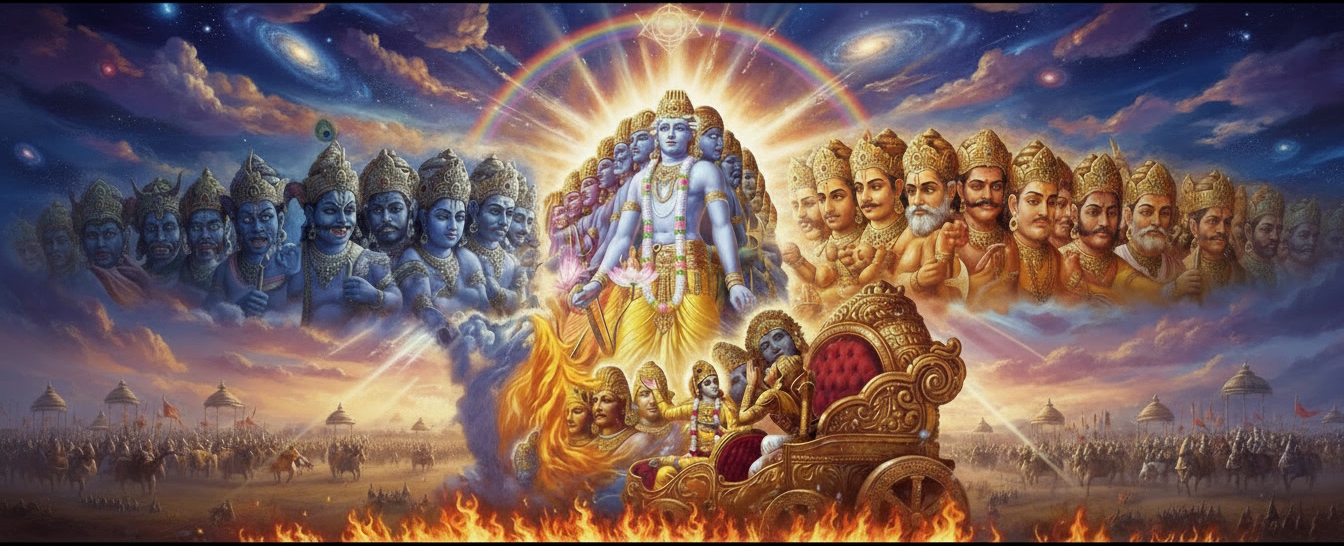
Bhagavad Gita - Chapter 11 - Shloka (Verse) 3
एवमेतद्यथात्थ त्वमात्मानं परमेश्वर।
द्रष्टुमिच्छामि ते रूपमैश्वरं पुरुषोत्तम।।11.3।।
evametadyathāttha tvamātmānaṃ parameśvara|
draṣṭumicchāmi te rūpamaiśvaraṃ puruṣottama||11.3||
Translation
(Now) O Supreme Lord, as Thou hast thus described Thyself, O Supreme Person, I wish to see Thy divine form.
हिंदी अनुवाद
हे पुरुषोत्तम ! आप अपने-आपको जैसा कहते हैं, यह वास्तवमें ऐसा ही है। हे परमेश्वर ! आपके ईश्वर-सम्बन्धी रूपको मैं देखना चाहता हूँ।
Commentaries & Translations
Swami Ramsukhdas
व्याख्या --'पुरुषोत्तम'--यह सम्बोधन देनेका तात्पर्य है कि हे भगवन् !मेरी दृष्टिमें इस संसारमें आपके समान कोई उत्तम, श्रेष्ठ नहीं है अर्थात् आप ही सबसे उत्तम, श्रेष्ठ हैं। इस बातको आगे पन्द्रहवें अध्यायमें भगवान्ने भी कहा है कि मैं क्षरसे अतीत और अक्षरसे उत्तम हूँ; अतः मैं शास्त्र और वेदमें पुरुषोत्तम नामसे प्रसिद्ध हूँ (15। 18)।
Sri Harikrishnadas Goenka
हे परमेश्वर आप अपनेको जिस प्रकारसे बतलाते हैं? आप ठीक वैसे ही हैं अन्यथा नहीं। तथापि हे पुरुषोत्तम ज्ञान? ऐश्वर्य? शक्ति? बल? वीर्य और तेजसे युक्त आपके ऐश्वर्यमय वैष्णवरूपको मैं देखना चाहता हूँ।
Sri Anandgiri
It is not out of a lack of faith in the meaning stated by You that the desire to see arises, but rather from a desire to be fulfilled; thus he says—'Evam etat' (It is thus). 'By whatever mode'—meaning, whether with attributes (upadhis) or without attributes.
[Implicit objection:] If, having determined My trustworthiness, My word is authoritative for you, then why do you wish to see what has been spoken by Me? [Response:] Thinking it is because of the desire to be fulfilled, he says—'Tathapi' (Even so).
To exclude forms like the four-armed one, he says—'Aishvaram' (Divine/Sovereign). He explains that with—'Jnana etc.'.
Sri Dhanpati
Applauding that everything said by You is accurate, he reveals his desire—'Evam' (Thus).
Just as You say, it is exactly so; there is no impossibility or contrary notion in my mind regarding You, the speaker, the Supreme Lord, because the existence of impossibility etc. is not possible [in You]—indicating this, he addresses Him—'O Parameshvara.'
Even though it is so, still, out of a desire to be fulfilled, I wish to see Your form.
Implying the impossibility of seeing the attributeless [Absolute], he qualifies the form. 'Aishvaram' means endowed with lordship, power, etc.
By addressing Him as 'Purushottama,' he implies: 'Actually, You are beyond the perishable (Kshara) and imperishable (Akshara), but I have a great longing to see Your divine form which encompasses the perishable and imperishable and is extremely wonderful.'
Sri Neelkanth
'Evam' (Thus). And that which You stated—'Supporting this entire universe with a single fraction, I remain'—speaking of Yourself as the support of the universe, that is exactly so; I have no doubt regarding this.
'O Parameshvara,' [I wish to see] 'Te'—Your form. 'Aishvaram' means this form of Ishvara which constitutes the universe and consists of Maya. 'O Purushottama' means one who is beyond the Perishable (Kshara) and Imperishable (Akshara). The Universal Form consists of Maya; but the Real Form is beyond Maya—this is understood from the two words 'Aishvaram' and 'Purushottama.'
And so He will say [in the Mahabharata]: 'O Narada, this Maya has been created by Me, by which you see Me; endowed with the qualities of all beings, you cannot know Me thus.'
And regarding the Pure Form, it is said: 'This is unmanifest, this is unthinkable.'
Sri Ramanuja
'O Parameshvara,' 'Evam etat'—this is certainly as 'yatha attha'—as You describe Yourself.
'O Purushottama'—O Ocean of affection for those who take refuge in You! I wish 'drashtum'—to see, to directly perceive—Your 'Aishvaram' form, which is unique to You, and which abides in the governance, protection, creation, destruction, and support of all, which is the mine of auspicious qualities, which is higher than the highest, and which is distinct in kind from everything else.
Sri Sridhara Swami
Moreover—'Evam' (Thus). 'The origin and dissolution of beings...' etc., which I have heard from Me [You], and as You now speak of Yourself saying 'Supporting this entire universe...'—O Parameshvara,
it is exactly so. It means I have no disbelief in this.
Even so, O Purushottama, out of curiosity, I wish to see Your 'Aishvaram' form—Your form endowed with knowledge, sovereignty, power, strength, valor, and splendor.
Sri Vedantadeshikacharya Venkatanatha
'Parameshvara'—by this word, the supreme trustworthiness etc., which is the cause of faith in the meaning of the statement, is intended; with this intent, he says—'O Parameshvara.' To express that, and to exclude the idea that he is merely agreeing politely (samvada-matra), and to establish what has been heard, he says—'Evam etat' (This is thus, ascertained).
It is said that 'Kapurushas' (base men) are those who see faults in those who seek refuge. Therefore, here, the unsurpassable masculinity (Paurusha) consisting of disregarding the faults in himself (Arjuna) who is desirous of seeing, is intended by the word 'Purushottama'; with this intent, it is stated [in Ramanuja Bhashya]—'O Ocean of affection for the dependent.' Or the etymology 'Puru sanoti' (He gives abundantly) is intended here; or 'Entering, He supports' [Gita 15.17]—which will be stated later—is indicated. Thus, having stated His Supremacy and Accessibility through the two titles,
even though the instruction 'Te' (Your) exists, the word 'Aishvaram' is meant to express the nature of His Lordship; with this intent, it is stated—'Unique to You.' The details of that same [nature] are given by 'Sarvasya etc.' [in the Bhashya] according to the process explained earlier. The idea is that the meaning of the word 'Ishvara' is qualified by such a nature.
The 'abiding of the form in administration etc.' means its expressiveness of those respective functions through qualities, preparations, and actions suitable to them. Or, 'abiding in administration' implies being the cause of proper activity by removing contrary determination merely by one's vision, according to the maxim: 'Helplessly, they adopted an attitude towards Keshava as was befitting' [Mahabharata 2.68.11]. 'Abiding in being a mine of auspicious qualities' means being unfit for feigning ignorance etc., unlike avatar forms [where human traits are mimicked]. 'Abiding in protection' is through the promotion of Sattva, etc. 'Abiding in creation' is through the production of Brahma, Rudra, etc., and the four varnas, etc., from His own limbs. 'Abiding in destruction' is through the swallowing etc. to be described later. 'Abiding in support' will become clear by 'Tatraikastham' [11.13] etc. Since the abiding of Brahma, Rudra, etc., who are suspected of being supreme, in a single part of Him will be described later by 'Brahmanam isham' [11.15] etc., 'abiding in being higher than the highest' is appropriate. 'Being distinct in kind from all others'—this is the conclusion of all that has been said, or its result, or the statement of the intent behind the addresses 'Parameshvara' and 'Purushottama.'
'Behold My Yoga, Aishvaram (Divine)'—in accordance with the prayer to see the meaning which was superficially understood when stated by Himself at the beginning of the most secret [chapter], the phrase 'Rupam Aishvaram' is used. In the interpretation regarding His essential nature (Svarupa), 'Aishvaram' is figurative, and everything else is literal. Through the connection with the essential nature, the desire to see the specific form (Vigraha) is implied. The word 'Rupa' refers to the essential nature, form, and all all-extraordinary aspects. Or, 'Rupa' means mode/manner. When saying 'Drashtum' (to see), since the word 'seeing' is also used for 'knowledge' which has a form similar to seeing, to exclude that and to limit it to visual knowledge only, it is stated [in the Bhashya]—'Sakshat-kartum' (to directly perceive/visualize).
Swami Chinmayananda
संस्कृत से वाक्प्रचार एवमेतत् (यह ठीक ऐसा ही है) के द्वारा अर्जुन तत्त्वज्ञान के सैद्धान्तिक पक्ष को स्वीकार करता है। समस्त नाम और रूपों में ईश्वर की व्यापकता की सिद्धि बौद्धिक दृष्टि से संतोषजनक थी। फिर भी बुद्धि को अभी भी प्रत्यक्षीकरण की प्रतीक्षा थी। इसलिए अर्जुन कहता है कि? मैं आपके ईश्वरीय रूप को देखना चाहता हूँ। हमारे शास्त्रों में ईश्वर का वर्णन इस प्रकार किया गया है कि वह ज्ञान? ऐश्वर्य? शक्ति? बल? वीर्य और तेज इन छ गुणों से सम्पन्न है।इस अवसर पर भगवान् ने अर्जुन को यह दर्शाने का निश्चय किया कि वे न केवल समस्त व्यष्टि रूपों में व्याप्त हैं वरन् वे वह समष्टिरूपी पात्र हैं? जिसमें ही समस्त नाम और रूपों का अस्तित्व है। भगवान् सर्वव्यापक होने के साथहीसाथ सर्वातीत भी हैं।यद्यपि कट्टर बुद्धिवाद के अत्युत्साह में आकर अर्जुन ने विश्वरूप दर्शन की अपनी मांग भगवान् के समक्ष रखी? किन्तु उसे तत्काल यह भान हुआ कि उसकी यह धृष्टता है और उसने सद्व्यवहार की मर्यादा का उल्लंघन किया है।अगले श्लोक में वह अधिक नम्रता से कहता है
Sri Madhusudan Saraswati
'Evam etat.' O Parameshvara! 'Yatha'—in whatever manner—whether with attributes or without attributes—You describe Yourself through unsurpassable sovereignty, 'Evam etat'—it is exactly so, not otherwise. There is absolutely no suspicion of disbelief in me regarding Your words anywhere—this is the meaning.
Although it is so, still, out of a desire to be fulfilled, I wish to see Your 'Aishvaram' form—endowed with knowledge, sovereignty, power, strength, valor, and splendor, and which is wonderful.
By the address 'O Purushottama,' he indicates: 'That I have no disbelief in Your words and that my desire to see is intense—You know this because You are omniscient and because You are the Inner Controller of all.'
Sri Purushottamji
How is it known that his delusion is destroyed? Anticipating this doubt, [the answer is] that faith in the Lord's words is certain for those whose delusion is destroyed; hence he says—'Evam' (Thus). 'O Parameshvara'—O Ruler of all! Just as You describe 'Atmanam'—Your own nature—(e.g., being unknown to all via 'Na me viduh' [10.2], being the Self of all via 'Vishtabhya-aham' [10.42], and being known only by Your own grace via 'Dadami buddhiyogam tam' [10.10])—'Evam etat'—this is exactly true.
By stating its truthfulness, he expresses his own experience: 'Previously I was one to whom Your nature was unknown; now, through the description of Your glories and the gracious statement 'Vishtabhya-aham' and reflection upon it, I have become endowed with the knowledge of Your being the Self of all.'
Now, since the nature is known, show that form; so he says—'Drashtum' (To see). 'O Purushottama,' I wish to see the 'Aishvaram' form—consisting of various pastimes/manifestations—of You and those related to You.
Sri Shankaracharya
'Evam etat'—It is exactly this way, not otherwise; 'yatha'—in whatever manner You, O Parameshvara, 'attha'—speak of Yourself.
Even so, I wish to see Your 'Aishvaram'—Vaishnava form—endowed with knowledge, sovereignty, power, strength, valor, and splendor, O Purushottama.
Sri Vallabhacharya
'Evam etat.' This is indeed true; I have no disbelief in this.
However, I wish to see that Divine ('Aishvara') form of Yours where that opulence/sovereignty, termed as Yoga, is present.
'O Purushottama'—the sentiment is that while You exist, it is not fitting that someone like me should remain with unfulfilled desires.
Swami Sivananda
एवम् thus? एतत् this? यथा as? आत्थ hast declared? त्वम् Thou? आत्मानम् Thyself? परमेश्वर O Supreme Lord? द्रष्टुम् to see? इच्छामि (I) desire? ते Thy? रूपम् form? ऐश्वरम् sovereign? पुरुषोत्तम O Supreme Purusha.Commentary Some commentators take the two halves of this verse as two independent sentences and interpret it thusSo it is? O Supreme Lord? as Thou hast declared Thyself to be. (But still) I desire to see Thy form as Isvara? O Supreme Person.Rupamaisvaram Thy form as Isvara? that of Vishnu as possessed of infinite knowledge? sovereignty? power? strength? prowess and splendour.
Swami Gambirananda
Parama-isvara, O supreme Lord; evam, so; etat, it is-not otherwise; yatha, as; tvam, You; attha, speak; atmanam, about Yourself. Still, purusottama, O supreme Person; iccahmi, I wish; drastum, to see; the aisvaram, divine; rupam, form; te, of Yours, of Visnu, endowed with Knowledge, Sovereignty, Power, Strength, Valour and Formidability.
Swami Adidevananda
O Supreme Lord, it is certain that it is even as you have described Yourself. O Supreme Person, O ocean of compassion for your dependants! I, however, wish to see or wish to realise directly, Your Lordly form peculiar to you - the form as the sovereign, protector, creator, destroyer, supporter of all, the mine of auspicious attributes, supreme and distinct from all other entities.