Bhagavad Gita - Chapter 11 - Shloka (Verse) 33
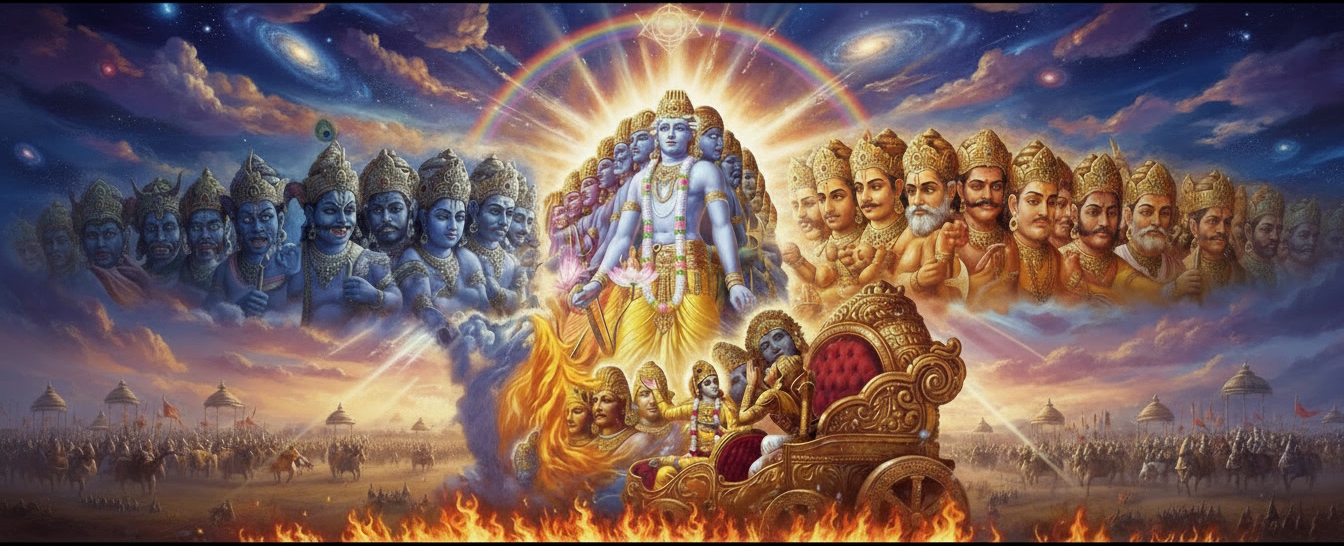
तस्मात्त्वमुत्तिष्ठ यशो लभस्व जित्वा शत्रून् भुङ्क्ष्व राज्यं समृद्धम्।
मयैवैते निहताः पूर्वमेव निमित्तमात्रं भव सव्यसाचिन्।।11.33।।
tasmāttvamuttiṣṭha yaśo labhasva
jitvā śatrūn bhuṅkṣva rājyaṃ samṛddham|
mayaivaite nihatāḥ pūrvameva
nimittamātraṃ bhava savyasācin||11.33||
Translation
Therefore, stand up and obtain fame. Coner the enemies and enjoy the unrivalled kingdom. Verily by Me have they been already slain; be thou a mere instrument, O Arjuna.
हिंदी अनुवाद
इसलिये तुम युद्धके लिये खड़े हो जाओ और यशको प्राप्त करो तथा शत्रुओंको जीतकर धन-धान्यसे सम्पन्न राज्यको भोगो। ये सभी मेरे द्वारा पहलेसे ही मारे हुए हैं। हे सव्यसाचिन् ! तुम निमित्तमात्र बन जाओ।
Commentaries & Translations
Swami Ramsukhdas
व्याख्या--'तस्मात्त्वमुत्तिष्ठ यशो लभस्व'--हे अर्जुन ! जब तुमने यह देख ही लिया कि तुम्हारे मारे बिना भी ये प्रतिपक्षी बचेंगे नहीं, तो तुम कमर कसकर युद्धके लिये खड़े हो जाओ और मुफ्तमें ही यशको प्राप्त कर लो। इसका तात्पर्य है कि यह सब होनहार है, जो होकर ही रहेगी और इसको मैंने तुम्हें प्रत्यक्ष दिखा भी दिया है। अतः तुम युद्ध करोगे तो तुम्हें मुफ्तमें ही यश मिलेगा और लोग भी कहेंगे कि अर्जुनने विजय कर ली?
'यशो लभस्व' कहनेका यह अर्थ नहीं है कि यशकी प्राप्ति होनेपर तुम फूल जाओ कि 'वाह' ! मैंने विजय प्राप्त कर ली', प्रत्युत तुम ऐसा समझो कि जैसे ये प्रतिपक्षी मेरे द्वारा मारे हुए ही मरेंगे, ऐसे ही यश भी जो होनेवाला है, वही होगा। अगर तुम यशको अपने पुरुषार्थसे प्राप्त मानकर राजी होओगे, तो तुम फलमें बँध जाओगे -- 'फले सक्तो निबध्यते' (गीता 5। 12)। तात्पर्य यह हुआ कि लाभ-हानि, यश-अपयश सब प्रभुके हाथमें है। अतः मनुष्य इनके साथ अपना सम्बन्ध न जो़ड़े; क्योंकि ये तो होनहार हैं।
'जित्वा शत्रून् भुङ्क्ष्व राज्यं समृद्धम्'--समृद्ध राज्यमें दो बातें होती हैं -- (1) राज्य निष्कण्टक हो अर्थात् उसमें बाधा देनेवाला कोई भी शत्रु या प्रतिपक्षी न रहे और (2) राज्य धन-धान्यसे सम्पन्न हो अर्थात् प्रजाके पास खूब धन-सम्पत्ति हो; हाथी, घोड़े, गाय, जमीन, मकान, जलाशय आदि आवश्यक वस्तुएँ भरपूर हों प्रजाके खाने के लिये भरपूर अन्न हो। इन दोनों बातोंसे ही राज्यकी समृद्धता, पूर्णता होती है। भगवान् अर्जुनसे कहते हैं कि शत्रुओंको जीतकर तुम ऐसे निष्कण्टक और धन-धान्यसे सम्पन्न राज्यको भोगो।यहाँ राज्यको भोगनेका अर्थ अनुकूलताका सुख भोगनेमें नहीं है, प्रत्युत यह अर्थ है कि साधारण लोग जिसे भोग मानते हैं, उस राज्यको भी तुम अनायास प्राप्त कर लो।
Sri Harikrishnadas Goenka
क्योंकि ऐसा है --, इसलिये तू खड़ा हो और देवोंसे भी न जीते जानेवाले भीष्म? द्रोण आदि महारथियोंको अर्जुनने जीत लिया ऐसे निर्मल यशको लाभ कर। ऐसा यश पुण्योंसे ही मिलता है। दुर्योधनादि शत्रुओंको जीतकर समृद्धिसम्पन्न निष्कण्टक राज्य भोग। ये सब ( शूरवीर ) मेरेद्वारा निःसन्देह पहले ही मारे हुए हैं अर्थात् प्राणविहीन किये हुए हैं। हे सव्यसाचिन् तू केवल निमित्तमात्र बन जा। बायें हाथसे भी बाण चलानेका अभ्यास होनेके कारण अर्जुन सव्यसाची कहलाता है।
Sri Anandgiri
Since it is certain that even if you remain indifferent, those in the opposing army will cease to exist due to My opposition alone, therefore your indifference is of no consequence; He says this -- with 'Yasmat' (Since) etc.
'Uttishtha' -- Arise, become ready for war; this is the meaning.
He portrays the gain of fame -- with 'Bhishma' etc. (conquering Bhishma etc.).
Anticipating the doubt 'What is the use of that which is not the [main] goal of man (purushartha)?' He says -- 'Punyaih' (by merits).
Anticipating the doubt 'When enjoyment of kingdom is desired, what is the use of the undesired (fame)?' He says -- 'Jitva' (Having conquered) [enjoy the prosperous kingdom].
Anticipating the doubt 'How can there be hope of victory when great car-warriors (Atirathas) like Bhishma exist?' He says -- 'Mayaivaite' (By Me alone these [are killed]).
Then [Arjuna might say] 'I have no inclination to kill the dead'; to this He says -- 'Nimitta' (Be a mere instrument).
He explains the word 'Savyasachi' -- with 'Vamena' (With the left hand) etc.
Sri Dhanpati
Since even without you they will certainly not exist, therefore, you arise, stand up and fight. [Objection:] If the task is accomplished even without me, why do You engage me in war? [Answer:] If asked thus, it is to proclaim your fame; with this intention He speaks.
Obtain fame -- 'Bhishma and other Atirathas, invincible even by gods, were conquered by Arjuna' -- obtain such fame, generated by merits born of My worship etc. Having conquered enemies like Duryodhana etc., enjoy a prosperous kingdom free from rivals and thorns.
In conquering them, you have no [real] exertion; with this intention He says. These enemies of yours have indeed been killed by Me alone already. [Objection:] How then do they stand? [Answer:] To grant you fame by making you an instrument; with this intention He says. You be a mere instrument.
O Savyasachin -- he whose nature is to fit arrows even with the left (savya) hand; addressing him thus. Becoming a mere instrument, make your title 'Savyasachin' meaningful; He suggests this.
Sri Neelkanth
'Tasmat' (Therefore) -- Since even without you they will die, therefore you arise for war. The rest is clear.
Sri Ramanuja
Therefore, you arise for battle against them. Having conquered those enemies, obtain fame. And enjoy a prosperous kingdom consistent with Dharma.
By Me alone, these -- who have committed offenses -- are already 'nihatah' (killed), meaning appointed/destined for killing. You, however, become a mere instrument in their killing.
Become like a weapon etc. for those being killed by Me.
'Savyasachin' -- the root 'Shach' is used in the sense of combination/fitting (Dhatupatha 1.1022); one whose nature is to fit ('sachana') arrows with the left ('savya') hand is Savyasachi; meaning one who effects the combination of arrows even with the left hand; capable of fighting with both hands, this is the meaning.
Sri Sridhara Swami
'Tasmat' (Therefore) -- Since it is so, therefore you arise for war. 'Bhishma, Drona and others, invincible even by gods, were conquered by Arjuna' -- obtain/attain such fame. Conquering enemies effortlessly, enjoy a prosperous kingdom.
And these enemies of yours are practically killed by Me, the Time-self, even before your fighting; nevertheless, you become a mere instrument.
O Savyasachin -- 'One whose nature is to fit arrows with the left hand' -- by this etymology, because of shooting arrows even with the left hand, you are called Savyasachi.
Sri Vedantadeshikacharya Venkatanatha
'If the Dhritarashtras and others will cease to exist even without my effort, then why do You urge me?' -- the answer to this is in the verse 'Tasmat tvam' (Therefore you). The intent of the solution is: 'Your urging is for the benefit of victory, fame, kingdom, etc. for you, My devotee.' 'Having conquered the enemies' is the common cause for both fame and kingdom. To avoid the charge of partiality and cruelty (in God), and to show the reason for the desire to kill, 'kritaparadhah' (those who have committed offenses) is said [in Bhashya].
Objection: 'Killed already' contradicts direct perception; and if that is so, the urging 'be a mere instrument for their killing' is futile? To this [Ramanuja] says -- 'Hanane viniyuktah' (Appointed for killing). Appointment for killing means the resolve for it; meaning they are resolved as 'to be killed'. Since the [Lord's] resolve is unfailing, the result is inevitable, hence the expression 'killed'. Even so, the past tense suffix (nishtha) is applicable -- because in the aggregate of actions from the Lord's resolve up to the result, the portion of resolve is accomplished, and it is appropriate to use the word for the aggregate for a part; just as in the activities of the pot, wood, etc., the usage 'cooks' is applied to each.
Some say here the suffix 'Kta' is used in the sense of desire or beginning of action. 'Nimittamatram' -- this seems to negate material causality (upadanatva); and since there is no possibility of that [in Arjuna], its negation is also not appropriate; to this he says -- 'Maya hanyamananam' (For those being killed by Me). Being made an instrument by Me and understanding that, you should not entertain doubts of sin, cruelty, defeat, etc.; this is the idea. The word 'matra' (mere/only) is to exclude principal agency; with this intention he says -- 'Shastradisthaniyah' (Like a weapon etc.).
The address by 'Savyasachi' is to indicate the extraordinary excellence useful for war; with this intention he explains the etymology -- 'Shacha samavaye' etc. He shows the instrumental sense of 'Savya', the specific object of the root suitable to the context, and the habit-sense of the suffix -- with 'Savyena' (With the left). 'Samavaya' here means fitting arrows. Removing the doubt (by Parisankhya logic) that 'he is unable to fit arrows with the right hand', and specifying the noun for 'Savya' (which is common to foot etc.) useful for the context, he says -- 'Savyenapi karena' (Even with the left hand). The mention of 'Savya' is to exclude 'non-connection' [inability with left], not to exclude 'connection with other' [ability with right]; this is the idea. He states the resultant meaning -- 'Karadvayena' (With both hands).
Your such capability is willed by Me for removing the earth's burden; this is the intention of the word 'Samartha' (Capable).
Swami Chinmayananda
See commentary under 11.34
Sri Abhinavgupta
'Tasmat' etc. 'Dronam' etc. [referring to next verses]. Here, the answer is given by the Lord that 'by the devouring force of Consciousness which is pure, impure, and mixed, pertaining to the world consisting of knowledge and ignorance' -- this secret has been mostly aphorized in this chapter.
Let this be enough for those capable of understanding from a mere hint; why should we undertake the trouble/strain of writing many lines?
And here, what the Lord said -- 'Become famous as an instrument regarding those killed by Me' -- that is the counter-statement/answer to what was said earlier by Arjuna, 'We do not know this, which is better for us' (2.6) etc.
Sri Madhusudan Saraswati
Since it is so -- since even without your activity they will certainly perish -- therefore, 'Tasmat' (Therefore) you arise, become ready for war.
'Bhishma, Drona and other Atirathas, invincible even by gods, were conquered quickly by Arjuna' -- obtain such fame. Indeed, fame is obtained only by great merits. And having completely conquered the 'shatrun' (enemies) Duryodhana etc., 'bhunkshva' (enjoy) -- make available for enjoyment as subordinate to yourself -- the prosperous and thornless kingdom.
And these enemies of yours are 'nihatah' (killed) -- their lifespans withdrawn -- by Me, the Time-self, alone, even before your fighting. They haven't been thrown down from their chariots only for the sake of your gaining fame. Therefore, you be 'nimittamatram' (a mere instrument) -- the object of the universal designation that 'these were conquered by Arjuna'.
O Savyasachin -- one whose nature is to fit arrows even with the left hand; for such a one as you, the victory over Bhishma, Drona, etc. is not impossible; therefore, when they are thrown down from chariots by Me following your activity, people will attribute the agency to you alone; this is the intention.
Sri Purushottamji
Therefore, you take the fame effortlessly; He says this -- with 'Tasmat' etc.
O Savyasachin -- one whose nature is to fit [arrows] with the left hand, you 'uttishtha' -- get ready for war. Obtain fame -- of the form 'All were killed even with the left hand'. Conquering enemies Duryodhana etc., enjoy a prosperous kingdom.
These have been killed by Me already -- even before your killing; therefore, be a 'nimittamatram' (mere instrument) for the sake of the worldly statement that 'All were killed by Arjuna'.
Sri Shankaracharya
'Tasmat tvam uttishtha' -- Therefore you arise. 'Bhishma and other Atirathas, invincible even by gods, were conquered by Arjuna' -- obtain such 'yashah' (fame); indeed that is obtained only by merits.
'Jitva shatrun' -- Conquering enemies like Duryodhana etc., 'bhunkshva rajyam samriddham' -- enjoy a prosperous, rival-less, thornless kingdom.
'Maya eva ete nihatah' -- By Me alone these are killed, meaning surely killed, separated from life, 'purvameva' (already).
'Nimittamatram bhava tvam' -- You be a mere instrument, 'O Savyasachin'; one who shoots arrows even with the left ('savya') hand is called 'Savyasachi' (Arjuna).
Sri Vallabhacharya
Therefore you arise,
but be a mere instrument.
Swami Sivananda
तस्मात् therefore? त्वम् thou? उत्तिष्ठ stand up? यशः fame? लभस्व obtain? जित्वा having conered? शत्रून् enemies? भुङ्क्ष्व enjoy? राज्यम् the kingdom? समृद्धम् the unrivalled? मया by Me? एव even? एते these? निहताः have been slain? पूर्वम् before? एव even? निमित्तमात्रम् a mere instrument? भव be? सव्यसाचिन् O ambidexterous one.Commentary Be thou merely an apparent or nominal cause. I have already killed them in advance. I have destroyed them long ago.Fame People will think that Bhishma? Drona and the other great warriors whom even the gods cannot kill have been defeated by you and so you will obtain great fame. Such fame is due to virtuous Karma only.Satrun Enemies such as Duryodhana.Savyasachi Arjuna who could shoot arrows even with the left hand.
Swami Gambirananda
Tasmat, therefore; tvam, you; uttistha, rise up; (and) labhasva, gain; the yasah, fame, that Arjuna has conered the Atirathas [Atiratha-see note under 1.4.6.-Tr.], Bhisma, Drona and others, who are unconerable even by the gods. Such fame can be acired only by virtuous actions. Jitva, by defeating; satrun, the enemies, Duryodhana and others; bhunksva, enjoy; a rajyam, kingdom; that is samrddham, propersous, free from enemies and obstacles. Ete, these; nihatah, have been definitely killed, made lifeless; eva maya, verily by Me; eva purvam, even earlier. Bhava, be you; nimitta-matram, merely an instrument, O Savyasachin. Arjuna was called so because he could shoot arrows even with his left hand.
Swami Adidevananda
Therefore, arise for fighting against them. Conering your enemies, win glory and enjoy a prosperous and righteous kingdom. All those who have sinned have been already annihilated by Me. Be you merely an instrument (Nimitta) of Mine in destroying them - just like a weapon in my hand, O Savyasacin! The root 'Sac' means 'fastening'. A 'savyasacin' is one who is capable of fixing or fastening the arrow even with his left hand. The meaning is that he is so dexterous that he can fight with a bow in each hand.