Bhagavad Gita - Chapter 11 - Shloka (Verse) 40
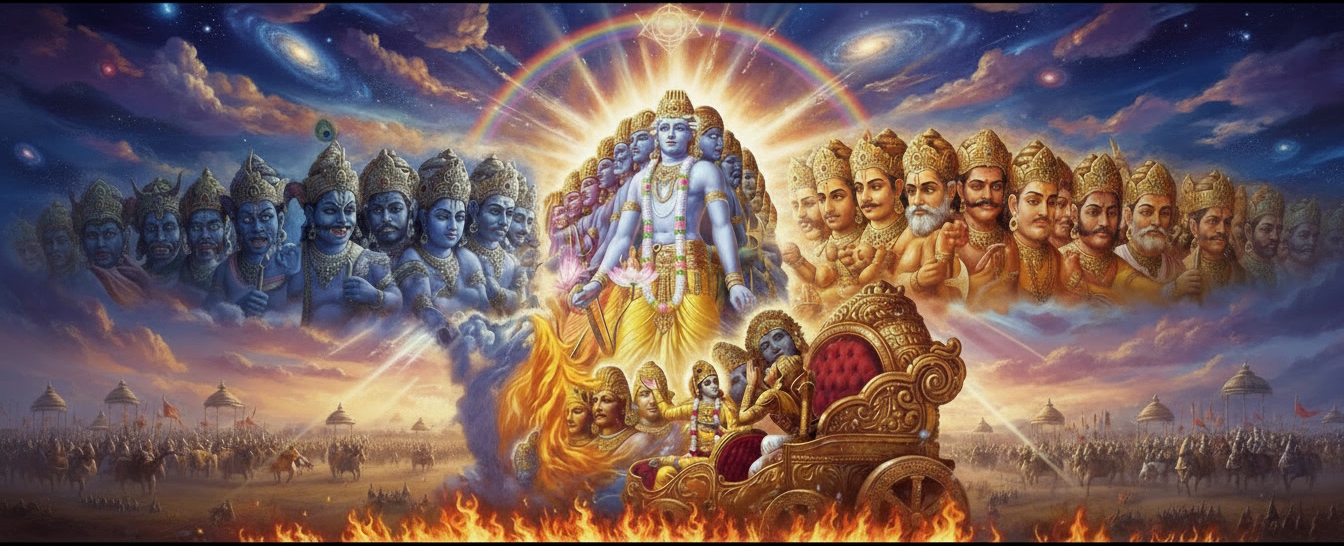
नमः पुरस्तादथ पृष्ठतस्ते नमोऽस्तु ते सर्वत एव सर्व।
अनन्तवीर्यामितविक्रमस्त्वं सर्वं समाप्नोषि ततोऽसि सर्वः।।11.40।।
namaḥ purastādatha pṛṣṭhataste
namo'stu te sarvata eva sarva|
anantavīryāmitavikramastvaṃ
sarvaṃ samāpnoṣi tato'si sarvaḥ||11.40||
Translation
Salutations to Thee, in front and behind! Salutations to Thee on every side! O All!! Thou infinite in power and prowess, pervadest all; wherefore Thou art all.
हिंदी अनुवाद
हे सर्व ! आपको आगेसे भी नमस्कार हो ! पीछेसे भी नमस्कार हो ! सब ओरसे ही नमस्कार हो ! हे अनन्तवीर्य ! अमित विक्रमवाले आपने सबको समावृत कर रखा है; अतः सब कुछ आप ही हैं।
Commentaries & Translations
Swami Ramsukhdas
व्याख्या--'नमः पुरस्तादथ पृष्ठतस्ते नमोऽस्तु ते सर्वत एव सर्व'--अर्जुन भयभीत हैं। मैं क्या बोलूँ-- यह उनकी समझमें नहीं आ रहा है। इसलिये वे आगेसे, पीछेसे सब ओरसे अर्थात् दसों दिशाओंसे केवल नमस्कारहीनमस्कार कर रहे हैं।
Sri Harikrishnadas Goenka
तथा --, आपको आगसे अर्थात् पूर्वदिशामें और पीछेसे भी नमस्कार है। हे सर्वरूप आपको सब ओरसे नमस्कार है अर्थात् सर्वत्र स्थित हुए आपको सब दिशाओंमें नमस्कार है। आप अनन्तवीर्य और अपार पराक्रमवाले हैं। वीर्य सामर्थ्यको कहते हैं और विक्रम पराक्रमको। कोई व्यक्ति सामर्थ्यवान् होकर भी शस्त्रादि चलानेमें पराक्रम नहीं दिखा सकता? अथवा मन्दपराक्रमी होता है। परन्तु आप तो अनन्तवीर्य और अमित पराक्रमसे युक्त हैं। इसलिये आप अनन्तवीर्य और अमितपराक्रमी हैं। आप अपने एक स्वरूपसे सारे जगत्को व्याप्त किये हुए स्थित हैं? इसलिये आप सर्वरूप हैं? अर्थात् आपसे अतिरिक्त कुछ भी नहीं है।,
Sri Anandgiri
विधान्तरेण भगवन्तं स्तुत्या नमस्कुर्वन्नभिमुखीकरोति -- तथेति। यस्यां दिशि सवितोदेति सा पूर्वा दिगुच्यते। तस्यां व्यवस्थितं सर्वं त्वमेव तस्मै ते तुभ्यं ननोऽस्त्वित्याह -- नम इति। अथशब्दः समुच्चये। पश्चादपि स्थितं सर्वं त्वमेव तस्मै ते तुभ्यं नमोऽस्त्वित्याह -- अथेति।
किं बहुना यावन्त्यो दिशस्तत्र सर्वत्र यद्वर्तते तदशेषं त्वमेव तस्मै तुभ्यं प्रह्वीभावः स्यादित्याह -- नमोऽस्त्विति।
फलितं सर्वात्मत्वं सूचयति -- हे सर्वेति। वीर्यविक्रमयोर्न पौनरुक्त्यमित्याह -- वीर्यमित्यादिना। वीर्यवतो विक्रमाव्यभिचारादर्थपौनरुक्त्यमाशङ्क्याह -- वीर्यवानिति।
भगवति लोकतो विशेषमाह -- त्वं त्विति। उक्तं सर्वात्मत्वं प्रपञ्चयति -- सर्वमिति। सप्रपञ्चत्वं वारयति -- त्वयेति।
Sri Dhanpati
Purastāt (in front), in the eastern direction, obeisance be to You ('te tubhyam') who abide in those respective forms. Atha (and) pṛṣṭhataḥ (behind), obeisance be to You ('te tubhyam'). Sarvata eva (from all sides indeed), to You who abide in all directions. O Sarva (All-Form)!
Or, purastāt (before), at the beginning of actions, pṛṣṭhataḥ (behind), at the conclusion of those (actions), sarvataḥ (from all sides), even in the middle, obeisance be to You, this is the meaning. In this view, the flaw of supplying (adhyāhāra) the word 'karmaṇām' (of actions) is present, and also, the lack of authority (mānābhāva) for restricting the meaning of 'sarvataḥ' etc. should be understood.
He elucidates what is meant by 'O Sarva!' Whose might (sāmarthya) is infinite (ananta); whose valor (parākramaḥ) in the matter of weapons etc. is unmeasured (amitaḥ). That You are Anantavīrya (of infinite might) and Amitavikramaḥ (of unmeasured valor). The analysis of 'O Anantavīrya' as separate words was not shown by the Ācāryas due to the principle of reverence and the absence of any difference in meaning.
You completely (samyak) attain (āpnoṣi), that is, pervade (vyāpnoṣi), the entire universe (sarvam akhilaṃ viśvaṃ). Since You pervade, therefore You are Sarva (All). It means that there is nothing existing without You.
Sri Madhavacharya
How is this 'sthāne' (proper)? Then he speaks—starting with 'Kasmāt' (why), etc. The Ātman (Self) who is Pūrṇa (complete/full) is the Mahātmā (Great Soul).
The word 'Ātman' is also stated in the Mahābhārata: 'Because He attains (āpnoti), because He accepts (ādatte), and because He enjoys (atti) the objects here (in this body), and because His existence (bhāva) is continuous (santataḥ), therefore He is called Ātman.'
'Tat Param' (That which is beyond that) means beyond Sat and Asat. 'The universe, which is of the nature of Asat and Sat (unmanifest and manifest), is Param (beyond) Sat and Asat.' [M.Bh. 1.1.23] This is in the Mahābhārata. (Note: This commentary fragment appears to belong to verse $37$.)
Sri Neelkanth
O Anantavīrya (of infinite might)! Since You encompass (samāpnoṣi) everything, pervading everywhere (asāmantaḥ vyāpnoṣi) with a sense of oneness (ekībhāvena), for that reason 'Sarva' (All) is Your name.
Purastāt (in front), at the beginning of actions. Pṛṣṭhataḥ (behind), at the conclusion of those (actions). Sarvataḥ (from all sides), even in the middle, obeisance be to You.
Sri Ramanuja
You, Anantavīrya (of infinite might) and Amitavikramaḥ (of unmeasured valor), encompass (samāpnoṣi) everything as the Self (ātmatayā); therefore, You are Sarva (All). Because You encompass the entire aggregate of sentient (cit) and non-sentient (acit) objects as the Self.
Hence, since the entire aggregate of sentient and non-sentient objects constitutes Your body (tvaccharīratayā) and is Your mode (tvatprakāratvāt), You alone are all modes (sarvaprakāraḥ) and are denoted by the word Sarva (All), this is the meaning.
It is clearly stated that the pervasion as the Self (ātmatayā vyāptiḥ) is the sole reason for all the appositional statements (sarvasāmānādhikaraṇyanirdeśasya hetuḥ), such as 'Tvam akṣaraṃ sadasat' (You are the imperishable, the manifest, and the unmanifest) ($11.37$) and 'Vāyur yamo'gniḥ' (Vāyu, Yama, Agni) ($11.39$).
And also, (it is stated) 'Tvayā tataṃ viśvam anantarūpa' (The universe is pervaded by You, of infinite form) ($11.38$) and 'Sarvaṃ samāpnoṣi tato'si sarvaḥ' (You encompass everything, therefore You are All).
Sri Sridhara Swami
And furthermore—with 'Namaḥ' (Obeisance). O Sarva (All-Form)! O Sarvātman (Self of all)! Let there be obeisance to You in all directions also.
Establishing the quality of being the Self of all (sarvātmakatvam), he says. Whose Vīrya (might/power) is infinite (ananta); and yet, whose Vikramaḥ (valor/prowess) is unmeasured (amitaḥ), that You are. Being such, You completely (samyak) encompass (samāpnoṣi) the entire universe (sarvaṃ viśvaṃ), both internally and externally (antaś ca bahiś ca), even as the form of all selves (sarvātmāpi), You pervade (vyāpnoṣi).
Just as gold remains pervading its product like bracelets and earrings (kaṭaka-kuṇḍalādi), so You are the form of all (sarvarūpo'si).
Sri Vedantadeshikacharya Venkatanatha
With the intention of supporting (upabṛṃhaṇa) the Śrutis (Vedic texts) like 'They call Him Indra, Mitra, Varuṇa, Agni, and He is the divine Suparṇa Garutmān. The wise speak of the one Being in many ways: They call Him Agni, Yama, and Mātariśvan' [Ṛk Saṃ. 2.3.22.6/Tai. Brā. 3.7.9.3] and 'That is Agni, that is Vāyu, that is Sūrya, that is Candramāḥ. That is Śukra, Amṛta, that is Brahman, that is water, He is Prajāpati' [Tai. Nā. 1.7]—He states the Śarīrātma Bhāva (body-soul relationship) indicated by 'Tvayā tataṃ viśvam' [$11.38$] (The world is pervaded by You) as the reason for the apposition (sāmānādhikaraṇya) in 'Vāyuḥ Yamaḥ Agniḥ,' etc.—with 'Ataḥ tvam eva' (Therefore You alone).
Since no specific relative is mentioned, the Prapitāmahatvam (being the Great Grandfather) is related to all, with this intention, he says—'Sarveṣāṃ Prapitāmahaḥ tvam eva' (You are the Prapitāmaha of all). The word 'ca' is for the accumulation (samuccaya) of Pitamaha, etc.; holding this intention, he says—'Pitamahādayaś ca' (and Pitamaha, etc.).
Since there is no one who is the Great Grandfather of all, and hence Prapitāmahatvam is inappropriate (ayogāt) due to His being the body (śarīrakatvena) of such a one, He states otherwise—starting with 'Sarvāsāṃ prajānāṃ pitaraḥ' (the fathers of all creatures). Prajāpatayaḥ are Daksha, etc. The Pitamahatvam accumulated by the word 'ca' is due to His being the body of those (Pitamahas), this he says—'Pitamahādīnām ātmatayā' (by being the Self of the Pitamahas, etc.).
The fear and joy generated by the experience of His manifested supremacy (paratva) and accessibility (saulabhya) through the display of the Universal Form are the sole reasons for the obeisance expressed by 'Namo Namas te' (Obeisance, obeisance to You), etc.; with this intention, he says—'Atyadbhutākāram' (of extremely wondrous form).
To prevent the misapprehension that 'His power is like the power of the Infinite' ('Anantasya vīryam iva vīryaṃ yasya'), he says—'Aparimita-vīrya' (of unmeasured power). Since taking the word 'amita' to mean 'unproven' would restrict the establishment of the Śāstras, etc., it is stated as 'aparimita-parākramaḥ' (of unmeasured might).
To exclude the pervasion (vyāpti) being like that of space, etc., in 'Sarvaṃ samāpnoṣi' (You pervade everything), the pervasion intended is that for the purpose of control (niyamanārtha-vyāpti), which culminates in the Ātmatva (being the Self) mentioned in Śrutis like 'Antaḥ praviṣṭaḥ śāstā janānāṃ sarvātmā' [Citu. $11.1$] (Having entered within, the ruler of men, the Self of all); with this intention, he says—'Sarvam ātmatayā' (everything as the Self).
To support the apposition of the word 'sarva' (all) in Śrutis like 'Puruṣa evedaṃ sarvam' [Ṛk Saṃ. 8.4.17.2/Yaju S. 31.2] (Puruṣa is all this), 'Ātmaivedaṃ sarvam' [Chā. U. 7.25.2] (The Self is all this), 'Nārāyaṇa evedaṃ sarvam' [Nā. U. 2] (Nārāyaṇa is all this), the apposition of the word 'sarva' previously mentioned in 'Sarvata eva sarvaḥ' (All from all sides) is not for the purpose of sublation (bādha), etc., but refers to the specific oneness established by the Śarīrātma Bhāva (body-soul relationship), this is stated with the intention that—starting with 'Yataḥ tvam' (Because You).
The conclusion of this section is that the Śarīrātma Bhāva alone is the basis for the apposition of all general and specific words denoting all sentient and non-sentient objects with the words denoting the Bhagavān in all Vedas, Vedāntas, and their supporting texts; with this intention, he says—'Tvam akṣaraṃ sadasat,' etc. (Note: This commentary fragment appears to pertain to verses $38-40$).
Swami Chinmayananda
परमात्मा सर्वत्र व्याप्त है अन्तर्बाह्य? अधउर्ध्व? समस्त दिशाओं में व्याप्त है। उससे रिक्त कोई स्थान नहीं है। यह कोई अकेले अर्जुन का मौलिक विचार नहीं है। उपनिषद् के महान् ऋषिगण तो इस अनुभव में अखण्ड वास करते थे।जिस परमात्मा को अर्जुन अपने मन से सब दिशाओं में प्रणाम करता है? वह परमात्मा न केवल आकाश के समान सर्वव्यापक ही है? वरन् वह सम्पूर्ण सार्मथ्य एवं विक्रम का स्रोत भी है। जहाँ कहीं भी कार्य़ करने की प्रेरणा या सफलता पाने की क्षमता दृष्टिगोचर होती हैं? वह सब अनन्तवीर्य और अमितविक्रम परमात्मा की ही एक झलक है? किरण है। परमात्मा सत्स्वरूप से सर्वत्र समस्त वस्तुओं और प्राणियों में विद्यमान है क्योंकि सत् के बिना किसी भी वस्तु का अस्तित्व नहीं हो सकता? इसलिए? वस्तुत परमात्मा ही सर्वरूप है। जल ही सब तरंगें हैं और मिट्टी ही सब घट है।क्योंकि आपके महात्म्य के अज्ञान के कारण? पूर्व में मैंने आपके प्रति अपराध किया है? इसलिए
Sri Jayatritha
Since Arjuna himself said that 'Sarve namasyanti' [$11.36$] (All bow down) is proper, how does he ask the contradictory question, 'Kasmācca te na nameran' (And why should they not bow down to You)? Therefore, indicating that this is an objection (ākṣepa) only, he introduces the verse by presenting the doubt to be resolved—with 'Katham' (how). 'When there is this doubt' is the implied remainder. 'Tat' (that) is its answer.
To dispel the limited meaning of 'Mahātman' (Great Soul) as 'having a non-petty mind' (akṣudracitta), he says—with 'Pūrṇaś ca' (and Pūrṇa/Complete). To prevent the apprehension that 'Ātman' means the individual soul (Jīva), he says—with 'Ātmā.' 'Uktaḥ' (stated), derived. 'Yat' (that which) because. The suffix 'man' from 'āpnoti' (attains). And the change of 'pa' to 'ta.' The same suffix from the root 'dāñ' (to give) preceded by 'āṅ,' with the deletion of 'ā' and the quality of 'tat.' The suffix 'man' from the root 'ad' (to eat) preceded by 'āṅ.' And the quality of 'tat.' Iha dehe (in this body). 'Santato bhāvaḥ' (continuous existence) is eternal existence. The suffix 'ṅman' from the root 'tan' (to spread) preceded by 'āṅ.'
The universe, which is of the nature of Sat and Asat bhāva (manifest and unmanifest states), is said to be You alone only because You are the giver of existence, etc. Not otherwise, because in that case there would be a contradiction with the following sentence, with this idea, he recites that (sentence) and explains it with proof—with 'Tat Param' (that which is beyond that). (Note: This commentary fragment appears to belong to verse $37$.)
Sri Madhusudan Saraswati
Let there be obeisance to You purastāt (in the front part), or 'Tubhyaṃ puro namahstāt' (Let there be obeisance to You in front). The word Atha is in the sense of accumulation (samuccaya). Pṛṣṭhataḥ (behind) also, let there be namahstāt (obeisance) to You, obeisance be.
To You, who are present sarvata eva (from all sides indeed), in all directions. O Sarva (All-Form)!
Vīrya (might) is physical strength, Vikramaḥ (valor) is training and skill in the use of weapons. As stated, 'Ekaṃ vīryādhikaṃ manya utaikaṃ śikṣayādhikam' (One is considered superior in strength, and another in training), in Bhīma and Duryodhana and others, one quality (either strength or training) is established (in each).
But You are Anantavīrya (of infinite might) and Amitavikramaḥ (of unmeasured valor); this is a single compounded word (samastam ekaṃ padam). Or, 'Anantavīrya' is a vocative (sambodhanaṃ).
You encompass (samāpnoṣi) the entire universe (sarvaṃ samastaṃ jagat), You attain (āpnoṣi) it completely (samyak) by being the one form of existence (sad-rūpeṇa), You pervade it as the Self of all (sarvātmanā). Tataḥ (therefore), for that reason, You are Sarva (All). It means that nothing exists apart from You.
Sri Purushottamji
And furthermore—with 'Namaḥ' (Obeisance). O Sarva (All-Form)! O Sarvātman (Self of all)! Purastāt (in front), in the eastern direction, pṛṣṭhataḥ (behind), in the western direction, sarvataḥ (from all sides), in the south, north, corners, etc., in all directions, let there be obeisance, obeisance to You alone ('eva'). The sentiment is that nothing else is possible to do, as indicated by statements like 'Kim āsanaṃ te Garuḍāsanāya' (What seat is proper for You, who have Garuḍa as Your seat). This is expressed by the word 'eva' (alone/indeed).
Or, the obeisance offered pṛṣṭhataḥ (behind), afterwards, sarvataḥ (from all sides), in the south, north, etc., parts, let that obeisance be purastāt eva (in the front part only), in front—this is also the meaning.
The question is, how can the obeisance offered in the back part belong to the front part? Upon this, he says—with 'Ananta' (Infinite). Ananta (Infinite) Vīrya (might/power). Whose Vikramaḥ (valor/prowess) is very abundant (bahutaraḥ) from all sides (amitaḥ), such as You encompass (samāpnoṣi) the entire world (sarvaṃ jagat), You exist by becoming the form of all (sarvarūpo bhūtvā) through the difference in those respective forms and names. Tataḥ (therefore), You are Sarva (All-Form). Hence, the front part is not obstructed even when obeisance is made from behind, this is the meaning.
Sri Shankaracharya
Obeisance to You purastāt (in front), in the eastern direction. Atha (and) pṛṣṭhataḥ (behind), and obeisance be to You even pṛṣṭhataḥ (behind). To You, who are present sarvata eva (from all sides indeed), in all directions, everywhere, O Sarva (All-Form).
Anantavīrya (of infinite might) and Amitavikramaḥ (of unmeasured valor): Whose Vīrya (might) is infinite (ananta); whose Vikramaḥ (valor) is unmeasured (amitaḥ). Vīrya (might) is ability, Vikramaḥ (valor) is prowess. Even a mighty person sometimes does not exert prowess in the matter of killing an enemy, etc., or his prowess is weak. But You are both Anantavīrya and Amitavikramaḥ, thus You are Anantavīryāmitavikramaḥ.
You completely (samyak) pervade the entire world (sarvaṃ samastaṃ jagat) with the one Self (ātmā), since You encompass it (samāpnoṣi). Tataḥ (therefore), for that reason, You are Sarva (All). The intention is that nothing exists without You.
Since I have committed an offense due to not knowing Your greatness (tvad-māhātmyāparijñānāt), therefore—
Sri Vallabhacharya
He establishes His Vīrya (might) through the quality of being the form of all (sarvarūpatvena)—with the statements: 'Paraṃ Brahma tu Kṛṣṇo hi saccidānandakaṃ bṛhat. Dvirūpaṃ tad dhi sarvaṃ syād ekaṃ tasmād vilakṣaṇam' (The Supreme Brahman is indeed Kṛṣṇa, the great one, whose nature is existence, consciousness, and bliss. That, though of two forms, is verily all, and the one form is distinct from that). With the intention that even though He is one, He is all (sarvam), He addresses Him as Anantavīrya (of infinite might) and O Sarva (All-Form).
You pervade the universe (viśvaṃ vyāpnoṣi); the meaning is that You alone are the form of the entire manifestation (sarvaprapañcarūpas tvam eva).
Swami Sivananda
नमः salutation? पुरस्तात् (from) front? अथ also? पृष्ठतः (from) behind? ते to Thee? नमः salutation? अस्तु be? ते to Thee? सर्वतः on every side? एव even? सर्व O all? अनन्तवीर्य infinite power? अमितविक्रमः infinite in prowess? त्वम् Thou? सर्वम् all? समाप्नोषि pervadest? ततः wherefore? असि (Thou) art? सर्वः all.Commentary The words I prostrate myself before Thee? behind Thee and on every side indicate the allpervading nature of the Lord. How can the allpervading Self have front and back Finite objects only have front and back sides Arjuna imagined that there were front and back sides to the Lord and so prostrated himself in his extreme faith and devotion.O All Nothing exists without Thee. As the Self is allpervading? He is called the All. There is nothing except the Self.On every side? as Thou art present everywhere or in all arters.One may be powerful but may not possess the courage to kill the enemies or he may be endowed with a mild form of courge but the Lord is infinite in courage and infinite in power.Pervadest by Thy One Self.
Swami Gambirananda
Namah, salutation to You; purastat, in the East; atha, and; even prsthatah, behind. Salutation be sarvatah, on all sides; eva, indeed; te, to You who exist everywhere; sarva, O All! Tvam, You; are ananta-virya-amita-vikramah, possessed of infinite strength and infinite heroism. virya is strength, and vikramah is heroism. Someone though possessing strength for the use of weapons etc. [Ast. reads 'satru-vadha-visaye, in the matter of killing an enemy'.-Tr.] may lack heroism or have little heroism. But You are possessed of infinite strength and infinite heroism.
Samapnosi, You pervade, interpenetrate; sarvam, everything, the whole Universe, by Your single Self. Tatah, hence; asi, You are; sarvah, All, i.e., no entity exists without You.
'Since I am guilty of not knowing Your greatness, therefore,'-
Swami Adidevananda
You, of infinite prowess and measureless heroic action, pervade all beings as their very Self and therefore, are, in reality all of them. Terms, naming all other entities, are truly naming You; for they, both sentient as well as non-sentient, constitute Your body, and as such are just Your modes. Therefore You alone, having them all as Your modes, are signified by all terms standing for them. In the texts, 'O by You of infinite form, is the cosmos pervaded' (11.38) and 'You pervade all, and hence are all' (11.40), it is clearly stated that the pervasion as the Self is the only rationale for speaking of them as one with You, in the sense of co-ordinate predication as in the text, 'You are the imperishable and also being and non-being' (11.37) and 'You are Vayu, Yama and Agni' (11.39).