Bhagavad Gita - Chapter 11 - Shloka (Verse) 42
यच्चावहासार्थमसत्कृतोऽसि विहारशय्यासनभोजनेषु।
एकोऽथवाप्यच्युत तत्समक्षं तत्क्षामये त्वामहमप्रमेयम्।।11.42।।
yaccāvahāsārthamasatkṛto'si
vihāraśayyāsanabhojaneṣu|
eko'thavāpyacyuta tatsamakṣaṃ
tatkṣāmaye tvāmahamaprameyam||11.42||
Translation
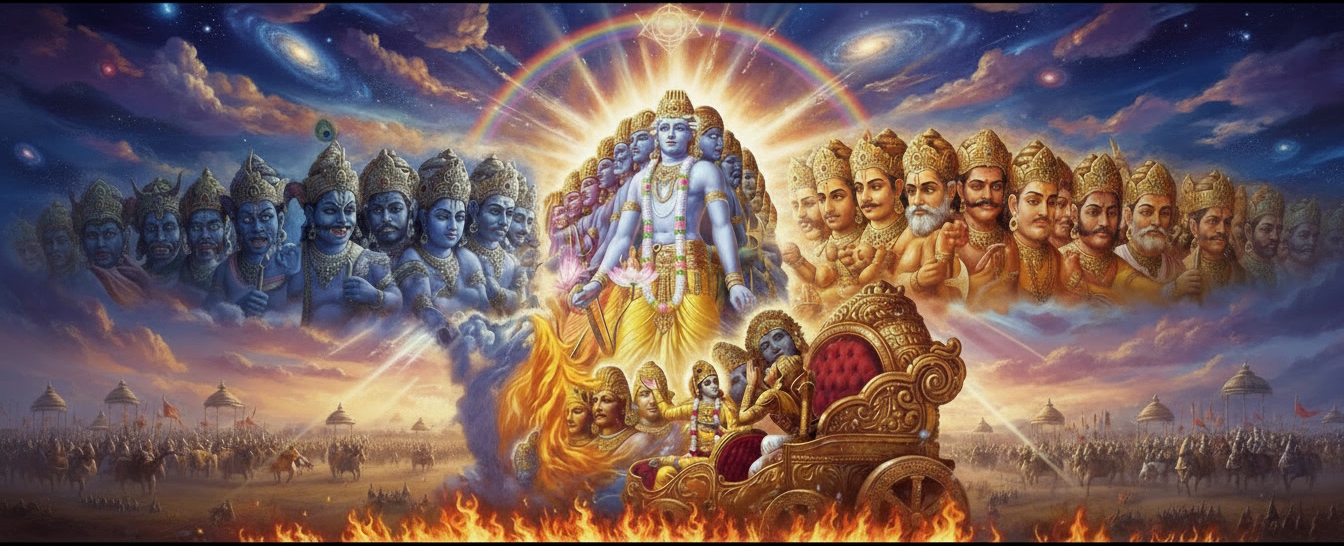
In whatever way I may have insulted Thee for the sake of fun, while at play, reposing, sitting or at meals, when alone (with Thee), O Krishna, or in company that I implore Thee, immeasurable one, to forgive.
हिंदी अनुवाद
आपकी महिमा और स्वरूपको न जानते हुए 'मेरे सखा हैं' ऐसा मानकर मैंने प्रमादसे अथवा प्रेमसे भी हठपूर्वक (बिना सोचे-समझे) 'हे कृष्ण ! हे यादव ! हे सखे !' इस प्रकार जो कुछ कहा है; और हे अच्युत ! हँसी-दिल्लगीमें, चलते-फिरते, सोते-जागते, उठते-बैठते, खाते-पीते समयमें अकेले अथवा उन सखाओं, कुटुम्बियों आदिके सामने मेरे द्वारा आपका जो कुछ तिरस्कार किया गया है, वह सब अप्रमेस्वरूप आपसे मैं क्षमा करवाता हूँ ।
Commentaries & Translations
Swami Ramsukhdas
व्याख्या--[जब अर्जुन विराट् भगवान्के अत्युग्र रूपको देखकर भयभीत होते हैं, तब वे भगवान्के कृष्णरूपको भूल जाते हैं और पूछ बैठते हैं कि उग्ररूपवाले आप कौन हैं परन्तु जब उनको भगवान् श्रीकृष्णकी स्मृति आती है कि वे ये ही हैं, तब भगवान्के प्रभाव आदिको देखकर उनको सखाभावसे किये हुए पुराने व्यवहारकी याद आ जाती है और उसके लिये वे भगवान्से क्षमा माँगते हैं।]
'सखेति मत्वा प्रसभं यदुक्तं हे कृष्ण हे यादव हे सखेति'--जो बड़े आदमी होते हैं, श्रेष्ठ पुरुष होते हैं, उनको साक्षात् नामसे नहीं पुकारा जाता। उनके लिये तो 'आप', महाराज आदि शब्दोंका प्रयोग होता है। परन्तु मैंने आपको कभी 'हे कृष्ण' कह दिया, कभी 'हे यादव' कह दिया और कभी हे सखे कह दिया। इसका कारण क्या था? 'अजानता महिमानं तवेदम्' (टिप्पणी प0 603.1) इसका कारण यह था कि मैंने आपकी ऐसी महिमाको और स्वरूपको जाना नहीं कि आप ऐसे विलक्षण हैं। आपके किसी एक अंशमें अनन्तकोटि ब्रह्माण्ड विराजमान हैं--ऐसा मैं पहले नहीं जानता था। आपके प्रभावकी तरफ मेरी दृष्टि ही नहीं गयी। मैंने कभी सोचा-समझा ही नहीं कि आप कौन हैं और कैसे हैं।
Sri Harikrishnadas Goenka
तथा जो हँसीके लिये भी आप मुझसे असत्कृत -- अपमानित हुए हैं कहाँ विहार? शय्या? आसन और भोजनादिमें। विचरनारूप पैरोंसे चलनेफिरनेकी क्रियाका नाम विहार है? शयनका नाम शय्या है? स्थित होनेबैठनेका नाम आसन है और भक्षण करनेका नाम भोजन है। इन सब क्रियाओंके करते समय ( मुझसे ) अकेलेमें -- आपके पीछे अथवा आपके सामने आपका जो कुछ अपमान -- तिरस्कार हुआ है हे अच्युत उस समस्त अपराधोंके समुदायको मैं आप अप्रमेयसे अर्थात् प्रमाणातीत परमेश्वरसे क्षमा कराता हूँ। समक्षम् शब्दके पहलेका तत् शब्द क्रियाविशेषण है।,
Sri Anandgiri
It is not just that what was improperly said should be forgiven, but also what disrespect (tiraskaraṇaṃ) was done to You in sports (krīḍā) etc. for the sake of jest (parihāsārthaṃ), that too should be tolerated, this he states—with 'Yac ca' (and what).
Viharaṇaṃ (recreation) is sport (krīḍā) or exercise (vyāyāmo). Śayanaṃ (sleeping) is couch etc., āsanaṃ (sitting) is a sitting place (āsthāyikā), or an indication of a throne etc. In these which are the objects (viṣayabhūteṣv iti yāvat).
The word 'ekaḥ' (alone) speaks of one who is alone (ekākinaṃ) residing in private (rahasi sthitam), this he says—with 'parokṣaḥ sann' (being absent/behind the back).
Whether it is directly present (pratyakṣaṃ) or absent (parokṣaṃ), that act of disrespect (asatkaraṇaṃ) or humiliation (paribhavanaṃ) may occur, and what was thus done disrespectfully to You by me, 'tat sarvam' (all that)—accepting this construction (yojanāṃ), he says—with 'tat' (that) word.
He states immeasurability (aparimitatvam) as the reason for seeking forgiveness—with 'aprameyam' (immeasurable).
Sri Dhanpati
यच्चावहासार्थं परिहासप्रयोजनायासत्कृतोऽसि परिभूतोऽसि। विहरणं विहारः क्रीडा पादव्यायमो वा? शयनं शय्या? आसनमास्थायिका सिंहासनादि? भोजनमदनमित्येतेषु विहारदिषु असत्करणं चोत्कृष्टेन सह निकृष्टस्य समानतया प्रवृत्तिः। एक परोक्षः रहसि सन्नसत्कृतोऽसि। अथवा समक्षं प्रत्यक्षमपि यत् असत्कृतोसि परोक्षं वा प्रत्यक्षं वा तदसत्करणं यन्मया परिभूतोऽसि तत्सर्वमपराधजाते त्वामहं क्षामये क्षमां कारये।
पूर्वं मातुलोयं स्वसमानं ज्ञात्वाऽसत्कृत्येदानीमप्रमेयं बुद्ध्वा क्षामय इत्याशयेनाह -- अप्रमेयमिति।
असत्कृतोऽहं क्षमां न करोमीति न वाच्यम्। यतोऽसत्करणएन स्वपदात्सर्वोत्तमात् सदैवाप्रच्युत इति ध्वनयन् संबोधयति -- हेऽच्युतेति।
Sri Madhavacharya
You alone are the one who causes the forgiveness ('kārayitā').
There is no other, nevertheless.
Sri Neelkanth
And also what disrespect (asatkṛto'si) or humiliation (paribhūto'si) was shown to You for the sake of jest (avahāsārthaṃ) in recreation (vihāra) etc.
Either when alone (ekaḥ) during the separation from friends (sakhīnāṃ viyoga-kāle); or in their presence (tat-samakṣaṃ), in the presence of the friends (sakhijana-samakṣaṃ), disrespect was shown to You, for all that, I seek forgiveness (kṣāmaye), I cause forgiveness (kṣamāpaye).
Because You are immeasurable (aprameyaḥ), of inconceivable nature (acintya-svabhāvaḥ), and supreme in compassion (karuṇāparaḥ). Since You granted the supreme state (uttamāṃ gatiṃ) even to enemies (śiśupālādyebhyaḥ), that is the meaning.
Sri Ramanuja
Your glory (mahimā) which consists of Anantavīryatva (being of infinite might), Amitavikramatva (being of unmeasured valor), Sarvāntarātmatva (being the Inner Self of all), Sraṣṭṛtva (being the Creator), etc., that this (imam) glory not knowing (ajānata), by me, due to pramādāt (negligence), mohāt (delusion), or due to praṇayena (affection), or due to long acquaintance (cira-paricayena), thinking of You as 'Sakhā' (friend), i.e., 'my companion/of my age' ('mama vayasyah'), what was said forcibly (prasabhaṃ) and devoid of respect (vinayāpetaṃ) towards You—'O Kṛṣṇa, O Yādava, O Sakhe';
and what was disrespectful (asatkṛtaḥ) to You, who are always worthy of honor (satkārārhaḥ), even for the sake of jest (parihāsārthaṃ); and what disrespect was shown to You when You were together (sahakṛteṣu) in recreation (vihāra), on the couch (śayyā), sitting (āsana), and at meals (bhojaneṣu), either in private (ekānte) or in the presence (samakṣaṃ);
for all that, I seek forgiveness from You, the immeasurable (aprameyam). (Note: This commentary provides a combined meaning for verses $41$ and $42$, as is common in the Rāmānuja tradition.)
Sri Sridhara Swami
And furthermore—with 'Yac ca' (and what). O Acyuta (Infallible One)! And what disrespect (tiraskṛto'si) was shown to You for the sake of jest (parihāsārthaṃ) in sports (krīḍā) etc.
Ekaḥ (alone), meaning only (kevalaḥ). It means being in private (rahasi sthitaḥ) without friends (sakhīn vinā).
Or, in their presence (tat-samakṣaṃ), in the presence (samakṣaṃ) of those jesting friends (parihasatāṃ sakhīnāṃ),
for all that accumulation of offenses (tat sarvam aparādhajātaṃ), I seek forgiveness (kṣāmaye), I cause forgiveness (kṣamāpaye) from You, the immeasurable (aprameya), whose influence is inconceivable (acintya-prabhāvaṃ).
Sri Vedantadeshikacharya Venkatanatha
The word 'mahiman' (glory) qualified by the word 'idam' (this) is a repetition (anuvāda) of the present glory (prakṛta-mahimā), with this intention he says—starting with 'anantavīryatva, amitavikramatva' (infinite might, unmeasured valor) etc.
Since taking the word pramāda to mean ignorance would lead to redundancy (paunaruktyāt) with 'ajānata' (not knowing), and with the intention that it refers to the delusion of similarity (sajātīyatva-bhrama), it is stated as 'pramādāt mohāt' (due to negligence, due to delusion).
Since the thought 'sakhā' (friend) is naturally a cause (hetutva-svārasyāt), even though the word praṇaya denotes love (prīti), the euphemism (upacāra) of long acquaintance (cira-paricaya) suitable for that (friendship) is proper, with this intention he says—'praṇayena cira-paricayena' (due to affection, due to long acquaintance) iti.
Since the notion of friendship (sakhitvabuddhi) established by the Śruti (Vedic text) 'Sayujā Sakhāyā' (Two birds that are always united, companions) [Ṛk Saṃ. 2.3.17.5/Muṇ. U. 3.1/Śve. U. 4.6] cannot be born of delusion, etc., the statement 'sakhā iti matvā' (thinking You to be a friend) is concerned with the notion of being a worldly companion (laukika-vayasyatva-buddhi), with this intention he says—'mama vayasya iti matvā' (thinking You to be my companion).
'He Kṛṣṇa' etc. is indicative of the form of the forcible utterance (prasabhoktyākāra-samarpakam), with this intention, showing the connection (anvaya), he speaks of its reference to the absence of proper respect (vinayābhāva)—starting with 'He Kṛṣṇa' etc.
In 'yac ca' (and what), to establish the abundance (bahutva) of disrespect (asatkāra) intended by the word 'ca', he explains the meaning by accepting a separation of sentences (vākyabhedaṃ aṅgīkṛtya) through the repetition of 'yad asatkṛto'si' (what disrespect was shown to You)—starting with 'yac ca parihāsārtham' (and what for the sake of jest) etc.
From that alone, its abundance (bahutvam) is stated by 'tat sarvam' (all that).
The disrespect, even for the sake of jest, is an offense in the matter of a great being (mahat-viṣaye), with this intention, he states the implied meaning (ākṣiptārtha) by the middle person (madhyama-puruṣa)—'sarvadaiva satkārārhas tvam' (You are always worthy of honor) iti.
The concluded statement (phalitoktiḥ) of the word 'eka' (alone) is 'ekānte' (in private). (Note: This commentary provides a combined meaning for verses 41 and 42, as is common in the Vedantadeshikacharya tradition.)
Swami Chinmayananda
जब कोई सामान्य व्यक्ति अकस्मात् ही परमात्मा के महात्म्य का परिचय पाता है? तब उसके मन में जिन भावनाओं का निश्चित रूप से उदय होता है? उन्हें इन दो सुन्दर श्लोकों के द्वारा नाटकीय यथार्थता के साथ सामने लाया गया है। अब तक अर्जुन? भगवान् श्रीकृष्ण को एक बुद्धिमान् गोपाल से अधिक कुछ नहीं समझता था? जिसे उसने बड़ी उदारता से अपनी राजमैत्री का आश्रय लाभ दिया था। परन्तु? अब श्रीकृष्ण के अनन्तस्वरूप का वास्तविक परिचय पाकर अर्जुन में स्थित जीवभाव उनके समक्ष दृढ़ निष्ठा एवं सम्मान के साथ प्रणिपात करके उनसे दया और क्षमा की याचना करता है।इन दो श्लोकों में अत्यन्त घनिष्ठता का स्पर्श है। यहाँ बौद्धिक दार्शनिक चिन्तन का घनिष्ठ परिचय के भावुक पक्ष के साथ सुन्दर संयोग हुआ है। गीता का प्रयोजन ही यह है कि वेद प्रतिपादित सत्यों की सुमधुर ध्वनि का व्यावहारिक जगत् की सुखद लय के साथ मिलन कराया जाये। घनिष्ठ परिचय के इन भावुक स्पर्शों के द्वारा व्यासजी की कुशल लेखनी? वेदान्त के विचारोत्तेजक महान् सत्यों को? अचानक? अपने घर की बैठक में होने वाले वार्तालाप के परिचित वातावरण में ले आती है। एक घनिष्ठ मित्र के रूप में प्रमाद या प्रेमवश अर्जुन ने भगवान् श्रीकृष्ण की महिमा को न जानते हुए उन्हें प्रिय नामों से सम्बोधित किया होगा? जिसके लिए उनसे अब्ा वह क्षमायाचना करता है।क्योंकि
Sri Jayatritha
एकः परोक्ष इति क्लिष्टं व्याख्यानमिति ज्ञापयितुं तदर्थमन्वयं च दर्शयति -- एक इति।
आद्याक्षरग्रहणेन एशब्दः एकस्य द्योतकः। कशब्दः कारयितृत्वद्योतकः। अन्तर्णीतण्यर्थात्करोतेर्डः।
अथापि एवमसत्कारानर्होऽप्यसत्कृतोऽसि।
Sri Madhusudan Saraswati
And what disrespect (asatkṛto'si) was shown to You for the sake of ridicule (avahāsārthaṃ), for the sake of jest (parihāsārthaṃ), in recreation (vihāra), on the couch (śayyā), sitting (āsana), and at meals (bhojaneṣu); Vihāra is sport (krīḍā) or exercise (vyāyāmo). Śayyā is a special kind of mattress (tūlikā-ādy-āstaraṇa-viśeṣaḥ). Āsana is a throne (siṃhāsanādi). Bhojanaṃ is eating in a line (paṅktāv aśanaṃ) with many (bahūnām). In those objects, You were disrespected (asatkṛto'si), You were humiliated (paribhūto'si) by me.
Either You were alone (ekaḥ) and in private (rahasi sthito), having left Your friends; or in their presence (tat-samakṣaṃ), in the presence of those jesting friends (parihasatāṃ sakhīnām).
O Acyuta (Infallible One), who is always immutable (sarvadā nirvikāra)! I seek forgiveness (kṣāmaye), I cause forgiveness (kṣamayāmi) for all that mass of offenses (aparādhajātaṃ) in the form of words (vacana-rūpaṃ) and in the form of disrespect (asatkaraṇa-rūpaṃ).
From You, the immeasurable (aprameyam), of inconceivable influence (acintya-prabhāvaṃ). The meaning is that my offenses, of one who is ignorant of Your greatness, should be forgiven by the Bhagavān, who is of inconceivable influence, immutable, and supremely compassionate.
Sri Purushottamji
Ca (and) punaḥ (again). Thinking of You as a friend (sakhā iti matvā), for the sake of ridicule (avahāsārthaṃ), by false statements (mithyā-vādādibhiḥ) etc., or by statements like 'You alone (ekaḥ kevalaḥ) engage in recreation (vihārādikaṃ karosīti) having left me' etc.
Or in my presence (mat-samakṣaṃ), in recreation (vihāre), gambling (dyūta), hunting (mṛgayā) etc., by expressing one's own relationship (svajanatvam udbhāvayatā)? In the couch (śayyāyāṃ) by sleeping together (saha-śayanena)? In the seat (āsane) by sitting together (saho-paveśena)? In the meal (bhojane) by eating together (saha-bhuñjatā)? In these (situations) what disrespect (asatkṛto'si) or humiliation (avamānito'si) was shown to You. O Acyuta (Infallible One), Protector of what is accepted by You (svāṅgīkṛta-paripālaka).
I seek forgiveness (kṣāmaye), I cause forgiveness (kṣamāṃ kārayāmi) from You, the immeasurable (aprameyaṃ), who is unfit to be known by proofs (pramātum ayogyaṃ), for all that (tat sarvaṃ). The cessation of offenses born of ignorance is indicated by Your immeasurability (aprameyatvena).
Sri Shankaracharya
And what disrespect (asatkṛtaḥ) or humiliation (paribhūtaḥ) was shown to You for the sake of ridicule (avahāsārthaṃ), for the purpose of jest (parihāsa-prayojanāya). Where? In recreation (vihāra), on the couch (śayyā), sitting (āsana), and at meals (bhojaneṣu).
Viharaṇaṃ (recreation) is walking (pāda-vyāyāmaḥ). Śayanaṃ (sleeping) is the couch (śayyā). Āsanaṃ (sitting) is the sitting place (āsthāyikā). Bhojanaṃ (meal) is eating (adanaṃ). In these recreation, couch, sitting, and meals.
Ekaḥ (alone), being absent/behind the back (parokṣaḥ sann), You were disrespected (asatkṛtaḥ) or humiliated (paribhūtaḥ). Or also, O Acyuta (Infallible One)! Tat samakṣam (in their presence)?
The word 'tat' is for the purpose of an adverb (kriyā-viśeṣaṇārthaḥ). Or You were disrespected (asatkṛtaḥ) directly (pratyakṣaṃ). I seek forgiveness (kṣāmaye), I cause forgiveness (kṣamāṃ kāraye) from You, the immeasurable (aprameyam), who is beyond proof (pramāṇātītam), for all that accumulation of offenses (tat sarvam aparādhajātaṃ).
Since You are—
Sri Vallabhacharya
And furthermore? Having known You previously, who were engaged in Tāmasa acts (acts of ignorance) like hunting (mṛgayā) and recreation (vihāra) etc., to be endowed with the quality of Tamas (tamo-guṇa-yuktaṃ), for what disrespect (asatkr̥to'si) was shown to You by me, for that also, I, alone (ekaḥ), now (sāmprataṃ) cause You to forgive (kṣamāṃ kārayāmi).
Swami Sivananda
यत् whatever? च and? अवहासार्थम् for the sake of fun? असत्कृतः disrespected? असि (Thou) art? विहारशय्यासनभोजनेषु while at play? on bed? while sitting or at meals? एकः (when) one? अथवा or? अपि even? अच्युत O Krishna? तत् so? समक्षम् in company? तत् that? क्षामये implore to forgive? त्वाम् Thee? अहम् I? अप्रमेयम् immeasurable.Commentary Arjuna? beholding the Cosmic Form of Lord Krishna? seeks forgiveness for his past familiar conduct. He says? I have been stupid. I have treated Thee with familiarity? not knowing Thy greatness. I have taken Thee as my friend on account of misconception. I have behaved badly with Thee. Thou art the origin of this universe and yet I have joked with Thee. I have taken undue liberties with Thee. Kindly forgive me? O Lord.Tat All those offences.Achyuta He who is unchanging.In company In the presence of others.Aprameyam Immeasurable. He Who has unthinkable glory and splendour.
Swami Gambirananda
And, yat, that; asi, You have been; asatkrtah, discourteously treated, slighted; avahasa-artham, out of fun, with a veiw to mocking;-where?-in these, Acyuta, viz vihara-sayya-asana-bhojanesu, while walking [Walking, i.e. sports or exercise], while on a bed, while on a seat, and while eating;-that You have been insulted ekah, in privacy, in the absence of others; adhava, or; that You have been insulted api, even; tat-samaksam, in public, in the very presence of others-(-tat being used as an adverb); tat, for that, for all those offences; O Acyuta, aham, I; ksamaye, beg pardon; tvam, of You; aprameyam, the incomprehensible One, who are beyond the means of knowledge.
(I beg Your pardon) because,
Swami Adidevananda
Infinite power, boundless valour, being the Inner Self of everything, being the creator etc., these constitute Your majesty. Being ignorant of this, and considering You only as a friend, and out of conseent love, or negligence born of life-long familiarity, whatever has been said rudely, without showing courtesy, such as 'O Krsna, O Yadava, O Comrade'; and whatever disrespect has been shown to You in jest, while playing or resting, while sitting or eating, while alone or in the sight of others - for all these I beseech forgiveness of You who are in incomprehensible.