Bhagavad Gita - Chapter 11 - Shloka (Verse) 55
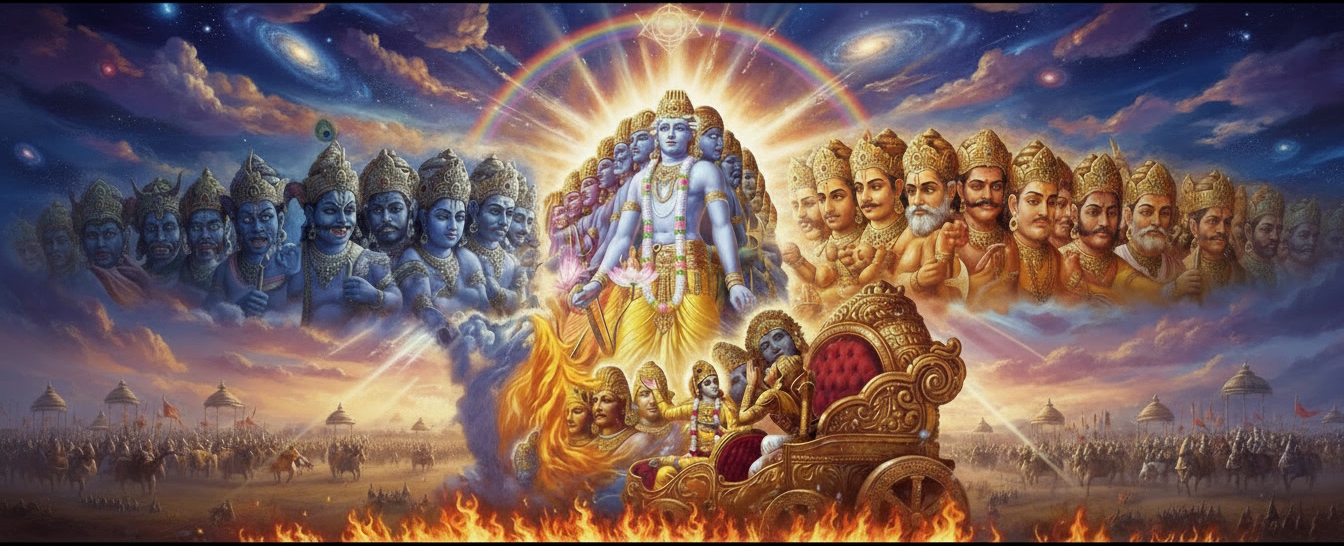
मत्कर्मकृन्मत्परमो मद्भक्तः सङ्गवर्जितः।
निर्वैरः सर्वभूतेषु यः स मामेति पाण्डव।।11.55।।
matkarmakṛnmatparamo madbhaktaḥ saṅgavarjitaḥ|
nirvairaḥ sarvabhūteṣu yaḥ sa māmeti pāṇḍava||11.55||
Translation
He who does all actions for Me, who looks upon Me as the Supreme, who is devoted to Me, who is free from attachment, who bears enmity towards no creature, he comes to Me, O Arjuna.
हिंदी अनुवाद
हे पाण्डवन ! जो मेरे लिये ही कर्म करनेवाला, मेरे ही परायण और मेरा ही भक्त है तथा सर्वथा आसक्तिरहित और प्राणिमात्रके साथ निर्वैर है, वह भक्त मेरेको प्राप्त होता है।
Commentaries & Translations
Swami Ramsukhdas
व्याख्या--[इस श्लोकमें पाँच बातें आयी हैं। इन पाँचोंको 'साधनपञ्चक' भी कहते हैं। इन पाँचों बातोंके दो विभाग हैं। (1) भगवान्के साथ घनिष्ठता और (2) संसारके साथ सम्बन्ध-विच्छेद। पहले विभागमें 'मत्कर्मकृत्', 'मत्परमः' और 'मद्भक्तः' -- ये तीन बातें हैं; और दूसरे विभागमें 'सङ्गवर्जितः' और'निर्वैरः सर्वभूतेषू'--ये दो बातें हैं।
Sri Harikrishnadas Goenka
अब समस्त गीताशास्त्रका सारभूत अर्थ संक्षेपमें कल्याणप्राप्तिके लिये कर्तव्यरूपसे बतलाया जाता है --, जो मुझ परमेश्वरके लिये कर्म करनेवाला है और मेरे ही परायण है -- सेवक स्वामीके लिये कर्म करता है परंतु मरनेके पश्चात् पानेयोग्य अपनी परमगति उसे नहीं मानता और यह तो मेरे लिये ही कर्म करनेवाला,और मुझे ही अपनी परमगति समझनेवाला होता है? इस प्रकार परमगति मैं ही हूँ ऐसा जो मत्परायण है। तथा मेरा ही भक्त है अर्थात् जो सब प्रकारसे सब इन्द्रियोंद्वारा सम्पूर्ण उत्साहसे मेरा ही भजन करता है? ऐसा मेरा भक्त है। तथा जो धन? पुत्र? मित्र? स्त्री और बन्धुवर्गमें सङ्ग -- प्रीति -- स्नेहसे रहित है। तथा सब भूतोंमें वैरभावसे रहित है अर्थात् अपना अत्यन्त अनिष्ट करनेकी चेष्टा करनेवालोंमें भी जो शत्रुभावसे रहित है। ऐसा जो मेरा भक्त है? हे पाण्डव वह मुझे पाता है अर्थात् मैं ही उसकी परमगति हूँ? उसकी दूसरी कोई गति कभी नहीं होती। यह मैंने तुझे तेरे जाननेके लिये इष्ट उपदेश दिया है।
Sri Anandgiri
By the qualifier 'bhaktyā tu' (but by devotion), (the author) raises the doubt about the non-causality (ahetutvam) of others (other means) and (the Lord) says -- 'adhunā' (now) etc. 'Samuccitya' (collecting), 'saṃkṣipya' (summarizing), i.e., puñjīkṛtya (massing together). When 'matkarmakṛt' (one who performs work for Me) is said, 'matparamatvam' (being supremely devoted to Me) is implied (ārthikam), so there is repetition (punaruktiḥ) – raising this doubt, (the commentator) says -- 'karoti' (performs) etc. The conviction that the Lord alone is the supreme goal establishes steadfastness in Him alone – thus (the commentator) says -- 'tathā' (similarly). That worship cannot be of all kinds (sarvaprakāraiḥ) in Him alone due to attraction to the affection for wealth etc. – raising this doubt, (the Lord) says -- 'saṅga' (attachment) etc. Vairam (hostility) is acting against the welfare (aniṣṭācaraṇam) preceded by hatred; though absent in those who do no harm, it certainly exists even towards those who do harm – raising this doubt, (the Lord) says -- 'ātmanaḥ' (of the self) etc.
All this was stated concisely for the purpose of practice (anuṣṭhāna); attainment of the Lord is inevitable for one who practices thus – this is concluded by 'ayam' (this) etc.
Thus, the meaning denoted by the word 'Tat' (That Supreme Reality) is established by articulating the contemplation (abhidhyānam) which results in gradual liberation (kramamukti-phalam), based on the maxim starting with 'matkarmakṛt' (one who performs work for Me), concerning the Lord Viśvarūpa, who is the Soul of all, the Omniscient, and the Lord of all.
Thus ends the eleventh chapter in the commentary (bhāṣyaṭīkā) composed by Ānandagiri, the disciple of Śrīmat Paramahaṃsa Parivrājakācārya Śrīmat Śuddhānand Pūjyapāda.
Sri Dhanpati
Now, the Blessed Lord, being extremely compassionate, summarizes the essence of the Gītā śāstra (scripture), which is the essence of all śāstras, and whose purpose is supreme good (niḥśreyasa), for necessary practice, and says. 'Matkarmakṛt' is one who performs actions prescribed by the Vedas for Me, for My pleasure. 'Matparamaḥ' is one for whom I alone am the Supreme, the excellent goal to be attained, not Svarga (heaven) etc. Such a person is endowed with devotion to Me in all aspects, by the means of attaining Me, with all kinds (of effort), with full enthusiasm.
Devotion to the Lord is not achieved by attachment to wealth etc., therefore (the Lord) says. 'Saṅgavarjitaḥ' is one who is devoid of attachment to wealth, son, friend, wife etc. If hostility exists towards beings, exclusive devotion to Me is very far away – this (the Lord) says. 'Nirvairaḥ sarvabhūteṣu' (devoid of enmity towards all beings) is one who is devoid of the feeling of enmity even towards common people and even towards those who cause extreme harm to oneself. The devotee of Mine who is of this kind, devoid of hypocrisy, attains Me. He realizes Me directly with non-difference (abhedena). I alone am his supreme goal, not any other – this is the meaning.
This collection of the essence has been instructed by Me to you. Since you are the son of My father's sister and thus an object of extreme love – with this intention, (the Lord) says -- 'Pāṇḍava' (O Pāṇḍava).
Thus, by this eleventh chapter, which expounds the Universal Form, the meaning denoted by the word 'Tat' (That Supreme Reality) is described by demonstrating the knowledge of His nature etc. through exclusive devotion to the Lord of all, the Soul of all, and the Omniscient.
I bow to Kṛṣṇa, who is Consciousness and Bliss (cidānande), in whom the three worlds, consisting of Āditya, human beings, Yakṣas, and Asuras, shine forth, and whose (existence) is not surprising; who is the support of infinite universes, the unborn (aja), the ageless (ajara) Self, the immortal (amṛta), the auspicious (śiva), who resides in all hearts, and who is fearless to see.
Thus ends the eleventh chapter in the Śrī Gītā Bhāṣyotkarṣa Dīpikā composed by Dhanapati, the scholar, the son of Rāmakumāra, the ornament of the Datta lineage, and the disciple of Śrī Paramahaṃsa Parivrājakācārya Śrī Bālasvāmī Śrīpāda.
Sri Neelkanth
He summarizes the entire essence of the scriptures -- with 'matkarmakṛt' (one who performs work for Me) etc. 'Matkarmakṛt' is one who performs actions for Me alone. 'Matparamaḥ' is one for whom I alone am the Supreme, the indivisible (niṣkalaḥ), the goal to be attained. By this, the entire Karma Yoga and Dhyāna Yoga, which investigate the meaning of the word 'tvaṃ' (thou), is stated.
'My devotee' is one who performs worship – this is the summary of the meaning of the Upāsanā Kāṇḍa (section on worship).
By 'saṅgavarjitaḥ' (devoid of attachment), it is stated that he is solely devoted to meditation on the Lord. 'Nirvairaḥ' (devoid of enmity) states that he should see the universe as the nature of the Lord. Otherwise, non-enmity (nirvairatvam) is impossible for one who has the notion of difference.
He who is of this kind attains Me (mām), the one mass of unbroken bliss (akhaṇḍānandaikaghana), who is the implied meaning of the word 'Tat' (That Supreme Reality), with non-difference (abhedena) from the innermost Self (pratyagātmā). O Pāṇḍava (born in a pure lineage)! You alone are capable of knowing this -- this is the intention.
Sri Ramanuja
'Matkarmakṛt' is one who performs all actions, beginning with Veda study etc., as forms of My worship. 'Matparamaḥ' is one for whom I alone am the supreme goal of all undertakings. 'Madbhaktaḥ' (My devotee) is one who, due to extreme love for Me, cannot sustain his self without My glorification, praise, meditation, worship, salutation etc., and constantly performs those (acts) with Me as his sole purpose.
'Saṅgavarjitaḥ' (devoid of attachment) is one who, due to Me being his sole beloved, cannot endure attachment to others. 'Nirvairaḥ sarvabhūteṣu' (devoid of enmity towards all beings) is one who is devoid of enmity towards them (all beings) because his sole nature of happiness and misery comes from union with Me and separation from Me respectively, and from realizing his own suffering is caused by his own offenses, and from realizing all beings are dependent on the Supreme Person (Paramapuruṣa), thus having no cause for enmity towards all beings.
He who is of this nature attains Me. He attains Me, who is truly situated. The meaning is that he becomes one whose experience is solely Me, being completely rid of the taint (gandha) of all faults, beginning with ignorance (avidyā).
Sri Sridhara Swami
Therefore, listen to the essence of all scriptures, the supreme secret – thus (the Lord) says -- with 'matkarmakṛt' (one who performs work for Me) etc.
'Matkarmakṛt' is one who performs actions for Me. 'Matparamaḥ' is one for whom I alone am the supreme goal of life (Puruṣārtha). He is My devotee alone, devoted to Me alone. 'Saṅgavarjitaḥ' (devoid of attachment) in son etc., and 'nirvairaḥ' (devoid of enmity) in all beings. He who is of this nature attains Me, not anyone else.
Sri Vedantadeshikacharya Venkatanatha
To resolve the contradiction with the Śruti (Vedic statement) like 'vedānuvacanena' (by recitation of the Veda) [Bṛhadāraṇyaka Upaniṣad 4.4.22] etc., arising from [the Gītā verse] 'nāhaṃ vedaiḥ' (I am not by the Vedas) etc., (Rāmānuja) distinguishes the specific state of devotion which is the cause of attainment (prāptihetuṃ) mentioned in 'praveṣṭum' (to enter) by the statement 'matkarmakṛt' (one who performs work for Me) etc., stating the utility of Veda recitation etc. as an auxiliary part of devotion. The same actions mentioned by 'nāhaṃ vedaiḥ' (I am not by the Vedas) etc. are called 'matkarma' (My actions) due to their dedication to the Lord? But the glorification (kīrtana) etc. mentioned earlier are fit to be included in the word 'madbhakta' (My devotee) due to their inclusion within devotion – with this intention, (Rāmānuja) says -- 'vedādhyayana' (Veda study) etc.
The result (phalam) which is present in the mind as the object to be achieved (sādhyatayā) due to the context of action (karma-prasaṅgāt) is stated here by the word 'matparama' (supremely devoted to Me) – thus (Rāmānuja) says -- 'sarveṣām' (of all) etc. With the intention that Kīrtana (glorification) etc. holds the place of food, drink etc. for ordinary people (in sustaining life), (Rāmānuja) says -- 'ātmadhāraṇam alabhamānaḥ' (one who cannot sustain the self).
The kind of freedom from attachment (nissaṅgatā) that exists at the stage of the culmination of devotion (bhakti-kāṣṭhā) is shown with its cause -- with 'madekapriyatvena' (due to Me being his sole beloved) etc. Just as a thirsty (person) avoids attachment (saṅga) by considering it like an obstruction (nirodhavat) of straw etc. in a stream of nectar, being himself detached (viraktaḥ), similarly (the devotee) is self-generated aversion (jātodvega) towards attachment – with this intention the phrase 'itarasaṅgam asamahamānaḥ' (not enduring attachment to others) is stated. In such a culmination of devotion, the absence of enmity (nirvairatā) is not merely due to being compliant with the scriptures, but the absence of the effect (kārya) is due to the absence of the cause (kāraṇa) – this (Rāmānuja) says -- 'matsaṃśleṣa' (union with Me) etc. Due to attachment to the Supreme Self (Paramātmani), and detachment from everything else (tad-itara), and indifference (upekṣakatvāt) towards worldly trivial pleasure and pain, hostility is not possible for him towards those who remove them and those who promote them. And one who knows his own offense does not make the other (paro) an object of hatred. And no one who is not insane (anunmattaḥ) gets angry at someone understood to be dependent (paratantratayā) like a whip (kaśā) etc. How can there be room for hostility when others are also understood to be the form of the Universal Lord (viśvarūpa-bhagavadrūpatvānu sandhāne) just like oneself? -- This is the intention.
'Evaṃbhūtaḥ' (being such), 'evaṃvidhaḥ' (of this kind). By referencing the previously stated (prāgukta) context in 'praveṣṭum' (to enter) [11.54], (Rāmānuja) says -- 'māṃ yathāvad avasthitam' (Me, who is truly situated). To reject the opinion (abhimatām) of evil viewpoints (kudṛṣṭi) that the words 'praveśa' (entry), 'prāpti' (attainment) etc. have other meanings (anyārthatām), He purifies the nature of attainment, which is of the form of supreme bliss (Parama-niśśreyasa-rūpāyāḥ) -- with 'nirasta' (removed) etc. 'Nirastatvam' (state of being removed) is destruction that prevents re-sprouting (apunar-aṅkura-vinaṣṭatvam). 'Avidyā' (Ignorance) is of the nature of non-knowledge, mis-knowledge (anyathā-jñāna), and Karma etc. which is its cause. The word 'aśeṣa' (without remainder) is used to exclude the partial removal of ignorance etc. that may exist even in the previous state. The word 'gandha' (taint/trace) is used to indicate the removal along with the latent impressions (samskāra/vāsanā).
'Madekānubhavaḥ' (whose experience is solely Me) -- in the statement 'The seer sees everything' [Chāndogya Upaniṣad 7.26.2], everything (sarvam api) and the body of all (sarva-śarīro) is Me alone. And another Śruti also says so: 'Those who are wise, united in self, having attained the omnipresent one from all sides, enter into all' [Muṇḍaka Upaniṣad 3.3.5] -- This is the intention. Thus ends the eleventh chapter in the Tātparya-Cāndrikā, the gloss on the Śrīmadbhagavadgītā-Bhāṣya, a work of Śrīmadveṅkaṭanātha, the Vedāntācārya, who is the lion among poets and logicians and independent in all systems (sarvatantra-svatantra).
Swami Chinmayananda
अर्जुन ने यह सुना कि अनन्यभक्ति के द्वारा कोई भी भक्त? भगवान् के समष्टि वैभव को न केवल पहचान ही सकता है? वरन् स्वयं में ही उसका साक्षात् अनुभव भी कर सकता है। तब पाण्डव राजपुत्र के मुख पर उस अनुभव या पद को प्राप्त करने की उत्सुकता दिखाई दी। यद्यपि उसने स्पष्ट प्रश्न नहीं किया तथापि उसके मुख के भाव से ही उसे समझकर भगवान् श्रीकृष्ण यहाँ वर्णन करते हैं कि कोई साधक जीवन में इस पूर्णत्व को कैसे प्राप्त कर सकता है।किसी जीव को ईश्वरत्व प्राप्त करने का श्रीकृष्ण द्वारा उपदिष्ट योजना के पांच अंग हैं। उन पांच अंगों या आवश्यक गुणों को इस श्लोक में बताया गया है। वे गुण हैं (1) जो ईश्वरार्पण बुद्धि से कर्म करता है? (2) जिसका परम लक्ष्य ईश्वर ही है? (3) जो ईश्वर का भक्त है? (4) जो आसक्तियों से रहित है? तथा (5) जो भूतमात्र के प्रति वैरभाव से रहित है।इन पांच आवश्यक गुणों में आत्मसंयम की सम्पूर्ण साधना का सारांश दिया गया है। ईश्वर के अखण्ड स्मरण से ही समस्त उपाधियों के कर्मों में अनासक्ति का भाव दृढ़ होता है। किसी व्यक्ति के प्रति वैरभाव तभी होता है? जब हम उसे पराया समझते हैं। मेरे ही दोनों हाथों के मध्य कोई वैरभाव नहीं हो सकता। आत्मैकत्व के बोध से जब सर्वत्र एकता का दर्शन और अनुभव होता है? केवल तभी समस्त भूतों के प्रति पूर्ण निर्वैरभाव प्राप्त हो सकता है।मन और बुद्धि के स्तर पर सर्वथा अनासक्ति होना असंभव है। मन और बुद्धि किसी वस्तु या व्यक्ति के प्रति आसक्ति के बिना नहीं रह सकते हैं। इसलिए एक साधक? सर्वप्रथम? ईश्वरार्पण की भावना के द्वारा विषयासक्ति को त्यागना सीखता है? और तत्पश्चात् अपने मन को भक्ति के साथ ईश्वर में स्थित कर देता है। इस अंग की पूर्णता के लिए पूर्व कथित गुण निश्चय ही सहायक होते हैं।इस प्रकार? सम्पूर्ण योजना का पुनरावलोकन करने पर ज्ञात होगा कि वह पूर्ण मनोवैज्ञानिक होने के कारण सर्वथा स्वीकार्य है। प्रत्येक उत्तर अंग अपने पूर्व अंग से पोषित होता है। इस श्लोक से यह भी स्पष्ट ज्ञात होता है कि अध्यात्म के साधक की महान् पवित्र तीर्थयात्रा ईश्वरार्पण बुद्धि से कर्म करने से प्रारम्भ होती है। तत्पश्चात् स्वयं ईश्वर ही उसके जीवन का परम लक्ष्य बन जाता है। इसका परिणाम होगा ईश्वर के प्रति परम प्रेम। स्वाभाविक है कि जगत् की अनित्य? परिच्छिन्न वस्तुओं के साथ उसकी आसक्ति समाप्त हो जायेगी और वह आत्मा का दर्शन कर सकेगा। जब स्वयं आत्मस्वरूप ही बनकर वह स्वयं को सर्वत्र? सब भूतों में पहचानेगा? तब उसका किसी भी प्राणी से किसी प्रकार का वैर नहीं होगा।गीता के अनुसार साधना के द्वारा प्राप्त आत्मसाक्षात्कार की पूर्णता की कसौटी है सबसे प्रेम और किसी से द्वेष नहीं होना।conclusion तत्सदिति श्रीमद्भगवद्गीतासूपनिषस्तु ब्रह्मविद्यायां योगशास्त्रेश्रीकृष्णार्जुनसंवादे विश्वरूपदर्शनयोगो नाम एकादशोऽध्याय।।इस प्रकार श्रीकृष्णार्जुनसंवाद के रूप में ब्रह्मविद्या और योगशास्त्रस्वरूप श्रीमद्भगवद्गीतोपनिषद् का विश्वरूप दर्शनयोग नामक ग्यारहवां अध्याय समाप्त होता है।इस अध्याय का विश्वरूपदर्शनयोग यह नाम सार्थक है। वेदान्तशास्त्र की परिभाषिक शब्दावली के अनुसार यहाँ प्रयुक्त विश्वरूप शब्द का वास्तविक अर्थ विराट्रूप है। आत्मा एक व्यष्टि स्थूल देह के साथ तादात्म्य को प्राप्त होकर जाग्रत् अवस्था की घटनाओं का अनुभव करता है। इस अवस्था में स्थित आत्मा को वेदान्त में विश्व कहा जाता है। वही आत्मा समष्टि स्थूल देह अर्थात् ब्रह्माण्ड के साथ तादात्म्य प्राप्त कर विराट् कहलाता है। यद्यपि यहाँ भगवान् ने अपना विराट्रूप दिखाया है? तथापि इस अध्याय का नाम विश्वरूपदर्शनयोग है। इससे विश्व और विराट् के पारमार्थिक एकत्व का बोध होता है।
Sri Abhinavgupta
'Bhaktyā' (By devotion) etc. 'Matkarma' (work for Me) etc. For those whose devotion shines forth, for whom no other object is worth knowing or delighting in, [the knowledgeable one] attains Me (? 'māṃ prapadyate' is omitted in the N recension).
Due to the marvel of the instruction previously stated like 'Vāsudevaḥ sarvam' (Vāsudeva is everything) (Gītā 7.19) etc., the essence of Vāsudeva, which is the soul of the universe, descends into the state of knowledge effortlessly.
Sri Madhusudan Saraswati
Now, the essential meaning of the entire Gītā śāstra is summarized (puñjīkṛtya) and stated for the practice of those seeking supreme good (niḥśreyasa) -- with 'matkarmakṛt' (one who performs work for Me) etc. 'Matkarmakṛt' is one who performs actions prescribed by the Vedas for Me. If the desire for Svarga (heaven) etc. exists, how can this be? – No, (the Lord) says. 'Matparamaḥ' is one for whom I alone am conclusively determined as the Supreme goal to be attained, not Svarga etc.
Therefore, My devotee is intent on worshipping Me in all ways with the hope of attaining Me. If affection for son etc. exists, how can this be? – No, (the Lord) says -- with 'saṅga' (attachment) etc. 'Saṅgavarjitaḥ' (devoid of attachment) is one who is devoid of craving for external objects.
If hatred exists towards enemies, how can this be? – No, (the Lord) says -- with 'nirvairaḥ' (devoid of enmity) etc. 'Nirvairaḥ sarvabhūteṣu' (devoid of enmity towards all beings) is one who is devoid of hatred even towards those who cause harm, and he attains Me with non-difference (abhedena). O Pāṇḍava! This meaning, desired to be known by you, has been instructed by Me. There is nothing further to be done – this is the meaning.
That which is the object of sight, that universe, reveals itself (rūpyate) by itself, and that form is not obtained from any other (means). I worship that King of Kāśī (Śiva) who, having removed the world by His own light, reverently grants the nature of the Self.
Sri Purushottamji
So how is the exclusive devotee to be known? -- On this desire to know (ākāṅkṣāyām), (the Lord) says -- with 'matkarmakṛt' (one who performs work for Me) etc. 'Matkarmakṛt' is one who performs actions of the nature of service (sevā-ādi-rūpaṃ) for Me, out of his innate nature as a servant (sahaja-dāsatvena), not out of desire (kāmanayā). 'Matparamaḥ' is one for whom I alone am the Supreme, the everything (sarvasvam). 'Madbhaktaḥ' is one who performs My worship (bhajana-kṛt) or is dependent on Me (madāśritaḥ). 'Saṅgavarjitaḥ' is one who is devoid of attachment (saṅga) to worldly things like son etc. and to non-Vaiṣṇavas etc. 'Nirvairaḥ sarvabhūteṣu' (devoid of enmity towards all beings) is devoid of hatred. O Pāṇḍava! He who is a devotee of this kind by birth (utpattyaiva) attains Me. The intention is that he should be known as the exclusive (ananya) devotee.
Having shown His Universal Form and made it firm for Arjuna, Śrī Kṛṣṇa revealed His own nature, which is unattainable by mere means.
Sri Shankaracharya
'Matkarmakṛt' (One who performs work for Me) -- Action for Me is 'matkarma'. He who performs that is 'matkarmakṛt'.
'Matparamaḥ' (Supremely devoted to Me) -- A servant performs the master's work, but he does not regard the master as his supreme goal to be attained after death. But this 'matkarmakṛt' regards Me alone as the supreme goal, therefore he is 'matparamaḥ'. He for whom I am the Supreme, the supreme goal, that one is 'matparamaḥ'.
And 'madbhaktaḥ' (My devotee) -- He worships Me alone in all ways, with his whole self (sarvātmanā), with all enthusiasm, therefore he is 'madbhaktaḥ'.
'Saṅgavarjitaḥ' (Devoid of attachment) -- Devoid of attachment in wealth, son, friend, wife, and relative groups. 'Saṅgaḥ' (Attachment) is affection, love, devoid of that.
'Nirvairaḥ' (Devoid of enmity) -- Free from hostility, devoid of the feeling of enmity towards all beings, even towards those who are intensely engaged in causing harm to oneself.
The devotee of Mine who is of this kind attains Me. I alone am his supreme goal, no other goal exists for him. This instruction, desired by you, has been given by Me, O Pāṇḍava! Thus ends the eleventh chapter in the Commentary on the Śrīmadbhagavadgītā composed by Śrīmat Śaṅkara Bhagavat, the disciple of Śrīmat Paramahaṃsa Parivrājakācārya Śrī Govinda Bhagavat Pūjyapāda.
Sri Vallabhacharya
Although it is so, nevertheless, since you are favored (anugṛhītatvāt) in My Vedic tradition (nigama-maryādā), attainment of Me occurs when one performs one's own duty (svadharma-karaṇe) only with devotion to Me, by My command – this (the Lord) says -- with 'matkarmakṛt' (one who performs work for Me) etc. Performing action preceded by service to the Lord is prescribed for a devotee of the Lord (bhagavadīyasya). He who determines that 'there is the Lord's will in my performance of action', he performs.
One who holds the opposite view does not perform, like Śuka (Rishi) and Jaḍa (Bharata) etc. This determination is also dependent on the Lord, therefore there is no fixed rule for that determination even among devotees, hence action must be performed. For modern people, when that determination is absent, action is obligatory even for one who has desire and knowledge and one who has doubt about it. The lack of fixed rule for that determination, its separateness, its obstruction, its result – all this is decided in the Sūtra Bhāṣya (Brahma Sūtras commentary) and should be known.
'Matparamaḥ' (Supremely devoted to Me) -- He for whom I alone am the supreme goal, that supreme devotee of Mine attains Me. The meaning is that attainment of the Puruṣottama is his result.
Swami Sivananda
मत्कर्मकृत् does actions for Me? मत्परमः looks on Me as the Supreme? मद्भक्तः is devoted to Me? सङ्गवर्जितः is freed from attachment? निर्वैरः without enmity? सर्वभूतेषु towards all creatures? यः who? सः he? माम् to Me? एति goes? पाण्डव O Arjuna.Commentary This is the essence of the whole teaching of the Gita. He who practises this teaching will attain Supreme Bliss and Immortality. This verse contains the summary of the entire philosophy of the Gita.He who performs actions (duties) for the sake of the Lord? who consecrates all his actions to Him? who serves the Lord with his heart and soul? who regards the Lord as his supreme goal? who lives for Him alone? who works for Him alone? who sees the Lord in everything? who sees the whole world as the Cosmic Form of the Lord and therefore cherishes no feeling of hatred or enmity towards any creature even when great injury has been done by others to him? who has no attachment or love to wealth? children? wife? friends and relatives? and who seeks nothing else but the Lord? realises Him and enters into His Being. He becomes one with Him.Thus in the Upanishads of the glorious Bhagavad Gita? the science of the Eternal? the scripture of Yoga? the dialogue between Sri Krishna and Arjuna? ends the eleventh discourse entitledThe Yoga of the Vision of the Cosmic Form.,
Swami Gambirananda
Pandava, O son of Pandu; yah, he who; mat-karma-krt, works for Me: work for Me is mat-karma; one who does it is mat-karma-krt-.
Mat-paramah, who accepts Me as the supreme Goal: A servant does work for his master, but does not accept the master as his own supreme Goal to be attained after death; his one, however, who does work for Me, accepts Me alone as the supreme Goal. Thus he is matparamah-one to whom I am the supreme Goal-.
So also he who is madbhaktah, devoted to me: He adores Me alone in all ways, with his whole being and full enthusiasm. Thus he is madbhaktah-.
Sanga-varjitah, who is devoid of attachment for wealth, sons, friends, wife and relatives, Sanga means fondness, love; devoid of them-.
Nirvairah, who is free from enmity; sarva-bhutesu, towards all beings-berefit of the idea of enmity even towards those engaged in doing unmost harm to him-.
Sah, he who is such a devotee of Mine; eti, attains; mam, Me. I alone am his supreme Goal; he does not attain any other goal. This is the advice for you, given by Me as desired by you.
Swami Adidevananda
Whosoever performs all acts like the study of the Vedas described above, considering them as several modes of worship, 'he works for Me.' He who 'looks upon Me as the highest,' namely, one to whom I alone am the highest purpose in all his enterprises, has Me as 'the highest end.' He who is 'devoted to me,' i.e., is greatly devoted to me and hence unable to sustain himself without reciting My names, praising Me, meditating upon Me, worshipping Me, saluting Me etc., he who performs these always considering Me as the supreme end - he is My devotee. He is 'free from attachments,' as he is attached to me alone, and is therefore unable to have attachment to any other entity. He who is without hatred towards any being, is one who fulfils all the following conditions: his nature is to feel pleasure or pain solely on account of his union or separation from Me; he considers his own sins to be the cause of his sufferings (and not the work of others); he is confirmed in his faith that all beings are dependent on the Parama-purusa. For all these reasons he has no hatred for any one.