Bhagavad Gita - Chapter 11 - Shloka (Verse) 8
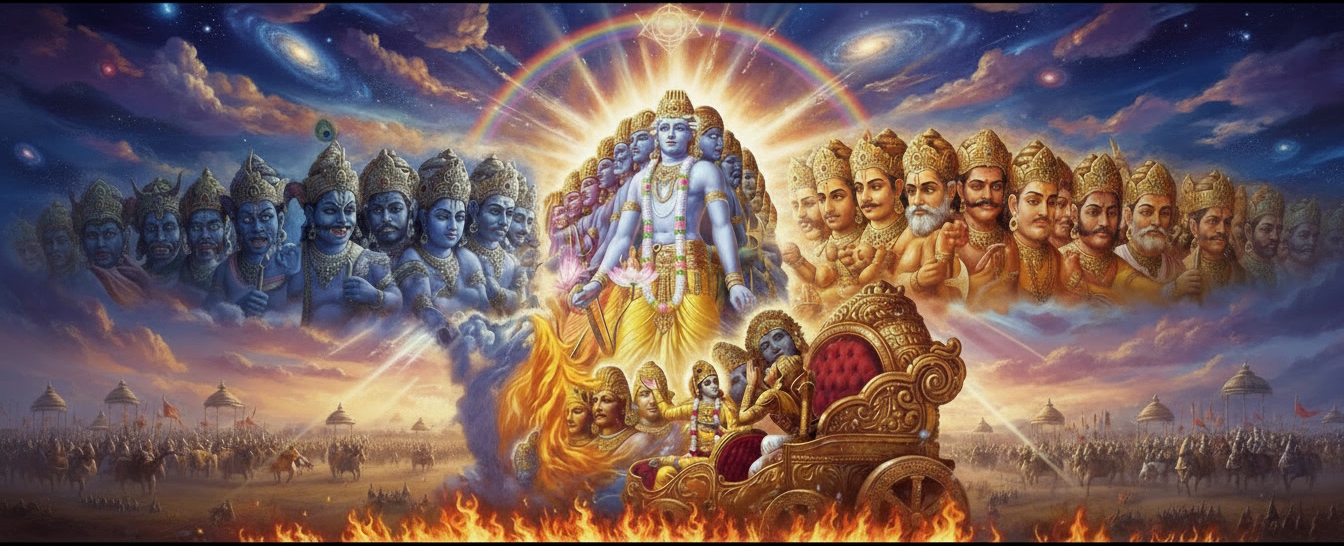
न तु मां शक्यसे द्रष्टुमनेनैव स्वचक्षुषा।
दिव्यं ददामि ते चक्षुः पश्य मे योगमैश्वरम्।।11.8।।
na tu māṃ śakyase draṣṭumanenaiva svacakṣuṣā|
divyaṃ dadāmi te cakṣuḥ paśya me yogamaiśvaram||11.8||
Translation
But thou art not able to behold Me with these thine own eyes; I give thee the divine eye; behold My lordly Yoga.
हिंदी अनुवाद
परन्तु तू अपनी इस आँखसे अर्थात् चर्मचक्षुसे मेरेको देख ही नहीं सकता, इसलिये मैं तुझे दिव्य चक्षु देता हूँ, जिससे तू मेरी ईश्वर-सम्बन्धी सामर्थ्यको देख।
Commentaries & Translations
Swami Ramsukhdas
व्याख्या--'न तु मां शक्यसे द्रष्टुमनेनैव स्वचक्षुषा'--तुम्हारे जो चर्मचक्षु हैं, इनकी शक्ति बहुत अल्प और सीमित है। प्राकृत होनेके कारण ये चर्मचक्षु केवल प्रकृतिके तुच्छ कार्यको ही देख सकते हैं अर्थात् प्राकृत मनुष्य, पशु, पक्षी आदिके रूपोंको, उनके भेदोंको तथा धूप-छाया आदिके रूपोंको ही देख सकते हैं। परन्तु वे मन-बुद्धि-इन्द्रियोंसे अतीत मेरे रूपको नहीं देख सकते।
Sri Harikrishnadas Goenka
किंतु --, तू मुझ विश्वरूपधारी परमेश्वरको अपने इन प्राकृत नेत्रोंसे नहीं देख सकेगा। जिन दिव्य नेत्रोंद्वारा तू मुझे देख सकेगा? वे दिव्य नेत्र ( मैं ) तुझे देता हूँ? उनके द्वारा तू मुझ ईश्वरके ऐश्वर्य और योगको अर्थात् अतिशय योगसामर्थ्यको देख।,
Sri Anandgiri
He restates what was said in 'Manyase yadi' (If You think)—with 'Kintu' (However).
You are not able to see Me, who am accompanied by the manifestation and am unlimited, with your own eyes; thus He says—'Na tu' (But not).
Anticipating the doubt, 'How then may I be able to see You?', He says—'Yena' (By which).
He shows the application of the divine eye in seeing the excess of Yoga power that is about to be described—with 'Tena' (With that).
Sri Dhanpati
When this was said, observing Arjuna, who proceeded to see with his own eyes but saw nothing and was therefore distressed, He says—'Na' (Not).
'You are not able to see Me, the bearer of the Universal Form, the Supreme, with this very material eye of yours. [Objection:] Then why did You say 'Behold'?' To this He says:
'I give you a divine eye—supernatural, capable of seeing the Divine Form; with that eye, behold My Aishvara Yoga, the excess of power.'
Sri Neelkanth
Regarding what was said—'If You think it is possible to be seen by me'—He says 'Na tu' (But not).
'Shakyase' means 'Shaknoshi' (you are able). The change in voice (pada) and conjugation marker (vikarana) is archaic/Vedic usage (Arsha).
'Anena' means with this material (eye). 'Divyam' means supernatural.
'Aishvaram' means related to the Lord; 'Yoga' means the capability characterized by being the support of the universe.
Sri Ramanuja
I shall show the entire universe in a single part of My body; but 'Anena'—with this natural eye of yours which perceives only limited and finite objects—you are not able to see Me 'Tathabhutam'—who am thus, distinct in kind from everything else, and immeasurable.
I give you 'Divyam'—a supernatural eye, the means to see Me.
'Pashya me yogam aishvaram'—behold My unique Yoga;
meaning, behold My Yoga of infinite knowledge etc., and the Yoga of infinite glories.
Sri Sridhara Swami
Regarding what was said by Arjuna, 'If You think it is possible', He says 'Na tu' etc. 'Anenaiva'—with this very physical eye (eye of flesh) of yours, you will not be able to see Me.
Therefore, I give you a 'Divyam'—supernatural, knowledge-based eye.
Behold My 'Aishvaram'—extraordinary—'Yogam'—method/skill, meaning the capability to make the impossible happen (aghatita-ghatana-samarthyam).
Sri Vedantadeshikacharya Venkatanatha
In 'Na tu mam shakshyase' (But you will not be able to see Me), the cause of the inability indicated by the word 'Tu' is drawn from the previous verse and shown [in Ramanuja's commentary] with 'Aham' (I). He states the intended meaning of 'Anenaiva' (with this very) as 'Niyata' etc. (perceiving limited objects). It is called 'Prakrita' (natural/material) because it is the opposite of Divine.
'Tathabhutam' (Such a being) etc. By 'Mam' (Me), the state of being qualified by a specific form (Vigraha) etc. is intended here. He states the intended meaning of the word 'Divya' here as 'Aprakrita' (supernatural). 'The means to see Me' is the resultant meaning of its supernatural nature.
He states the intent of the word 'Aishvara' as 'Madasadharanam' (Unique to Me). He states the meaning of the word 'Yoga', as supported by the context and the word 'Aishvara', as 'Ananta' etc. (Infinite knowledge etc.). Lordship (Ishvaratva) is the power to rule, and the Yoga connected with that is the association with qualities and glories befitting that.
Because the eye is divine, there is the vision of qualities like knowledge. The idea is that he (Arjuna) will say 'Pashyami' (I see) [11.19] later, qualifying Him with infinite valor etc.
Swami Chinmayananda
हम पहले ही वर्णन कर चुके हैं कि एक सारतत्व को उससे बनी विभिन्न वस्तुओं में देख पाना अपेक्षत सरल कार्य है? किन्तु इसके विपरीत अनेक को एक तत्त्व में देखने के लिए दर्शनशास्त्र के सम्यक् ज्ञान से सम्पन्न सूक्ष्म बुद्धि की आवश्यकता होती है। किसी कविता को पढ़ने मात्र के लिए केवल वर्णमाला का ज्ञान होना आवश्यक है परन्तु उसके सूक्ष्म सौन्दर्य को समझने के लिए तथा उसी के समान अन्य कविताओं के साथ उसका तुलनात्मक अध्ययन करने के लिए एक ऐसे प्रवीण मन की आवश्यकता होती है? जिसने सर्वश्रेष्ठ साहित्यिक रचनाओं के रसास्वादन के आनन्द में अपने आप को डुबो दिया हो। इसी प्रकार? एक को अनेक में देखना श्रद्धा से परिपूर्ण हृदय का कार्य है परन्तु अनेक को एक में अनुभव करने के लिए हृदय के अतिरिक्त ऐसी शिक्षित बुद्धि की आवश्यकता होती है? जिसे दार्शनिकों की युक्तियों को समझने की योग्यता प्राप्त हुई हो। जानने और अनुभव करने की क्षमता का विकास होने पर ही एक शिक्षित बुद्धि को असाधारण का दर्शन करने की विशिष्ट सार्मथ्य प्राप्त होती है।एक सर्वविदित प्रत्यक्ष तथ्य को बताते हुए भगवान् कहते हैं? तुम मुझे अपने इन्हीं नेत्रों के द्वारा नहीं देख सकते मैं तुम्हें दिव्यचक्षु देता हूँ। अनेक समालोचक या व्याख्याकार हैं? जो इस दिव्यचक्षु का वर्णन अनेक हास्यास्पद कल्पनाओं तथा असंभव सिद्धांतों के द्वारा करने का प्रयत्न करते हैं। इससे प्रतीत होता है कि इन व्याख्याकारों ने हिन्दू शास्त्रोंउपनिषदों की शैली का भलीभाँति अध्ययन नहीं किया है। सभी उपनिषदों में प्रत्यक्ष या अप्रत्यक्ष रूप से बारम्बार इस बात पर बल दिया गया है कि मनुष्य अपनी ज्ञानेन्द्रियों के द्वारा सूक्ष्म वस्तुओं का अवलोकन नहीं कर सकता है। इन्द्रियां केवल बाह्य जगत् की स्थूल वस्तुओं को ही ग्रहण कर सकती हैं। सामान्य व्यवहार में जब हम कहते हैं? इस विचार को देखो तो यह देखना इन दो नेत्रों से नहीं होता है। वहाँ देखने से तात्पर्य बौद्धिक ग्रहण से है तथा ऐसे सूक्ष्म विषय का ग्रहण करने की बौद्धिक क्षमता को ही दिव्यचक्षु कहा गया है।अर्जुन को यह दिव्यचक्षु भगवान् के ईश्वरीय योग को देखने के लिए प्रदान किया गया है। इस योग के द्वारा सम्पूर्ण विश्व भगवान् के रूप में धारण किया गया है। इसके पूर्व भी इस योगशक्ति का उल्लेख प्राय समान शब्दों में दो विभिन्न स्थानों पर आ चुका है।अब दृश्य परिवर्तन होता है। हस्तिनापुर के राजमहल में बैठा संजय धृतराष्ट्र से कहता है
Sri Madhusudan Saraswati
Regarding what was said—'If You think it is possible to be seen'—He states a specific point with 'Na tu'. 'Anenaiva'—with this very natural/material eye of yours, the eye established by nature, you are 'Na tu shakyase'—not able to see Me of divine form; indeed not able. If the reading is 'Shakshyase' (future tense), the meaning is 'You will not be able.' Although the root 'Shak' belongs to Bhvadi group, the usage of the suffix 'Shyan' (of Divadi group) is a Vedic irregularity (Chhandasa), or it is read in the Divadi group—this is the traditional view.
'Then how may I be able to see You?' To this He says—'Divyam'. I give you a 'Divyam'—supernatural eye, capable of seeing My divine form; with that divine eye, behold My 'Yogam'—the excess of capability to make the impossible happen, which is 'Aishvaram'—Divine, unique to Me, the Lord.
Sri Purushottamji
Being thus spoken to, He says to the one ready to see—'Na tu'. 'Tu' (But)—again, you are 'Na shakyase'—not able to see in this very manner. Therefore, I give you a 'Divyam'—supernatural eye. With 'Tena'—that eye (given by Me), which becomes yours, through My grace-filled vision, behold Me, the Supreme Person (Purushottama).
Therefore, with this very (eye) which has seen the Purushottama, behold My 'Aishvaram'—endowed with Yoga, which is the capability to do, not to do, and to do otherwise.
In the absence of the vision/knowledge of the Purushottama's essential nature, the vision of the Universal Form (Sarva-svarupa) cannot happen; and the vision of Purushottama can only happen through an extraordinary vision—this is the sentiment.
Sri Shankaracharya
'Na tu'—But you are not able to see Me, the bearer of the Universal Form, 'Anenaiva'—with this very natural/material 'Svachakshusha'—eye of your own.
'Yena tu'—But that by which you will be able to see, which is divine, that 'Divyam Chakshu' (Divine eye) I give to you.
'Tena'—With that, 'Pashya'—behold My 'Yogam Aishvaram'—the Divine Yoga of Me, the Lord; meaning, the excess of Yoga power.
Sanjaya said—
Sri Vallabhacharya
Regarding what was said by Arjuna—'If You think it is possible' [11.4]—He says 'Na tu mam' etc. 'Anenaiva tu'—With this very natural eye of yours, which by rule perceives only finite objects, you are not able to see Me, the form of Imperishable Sovereignty.
Therefore, I give you a 'Divyam'—supernatural eye, a means of vision consisting of knowledge;
with that, behold—directly perceive—My 'Aishvaram Yogam'—the support of all diverse attributes inherent in My nature.
Swami Sivananda
न not? तु but? माम् Me? शक्यसे (thou) canst? द्रष्टुम् to see? अनेन with this? एव even? स्वचक्षुषा with own eyes? दिव्यम् divine? ददामि (I) give? ते (to) thee? चक्षुः the eye? पश्य behold? मे My? योगम् Yoga? ऐश्वरम् lordly.Commentary No fleshly eyes can behold Me in My Cosmic Form. One can see It through the divine eye or the eye of intuition. It should not be confused with seeing through the eye or the mind. It is an inner experience.Lord Krishna says to Arjuna I give thee the divine eye? by which you will be able to behold My sovereign form. By it see My marvellous power of Yoga.Anena With this the fleshly eye or the physical eye? the earthly eye. (Cf.VII.25IX.5X.7)
Swami Gambirananda
Tu, but; na sakyase, you are not able; drastum, to see; mam, Me, who have assumed the Cosmic form; eva, merely; anena, with this natural; sva-caksusa, eye of yours. However, dadami, I grant; te, you; the divyam, supernatural; caksuh, eye, by which supernatural eye you shall be able to see Pasya, behold with that; me, My, God's aisvaram, divine; yogam, Yoga, i.e. the superabundance of the power of Yoga [The power of accomplishing the impossible.-M.S.].
Swami Adidevananda
I shall reveal to you the whole universe in one part of my body. But, with your physical eye, which can see only limited and conditioned things, you cannot behold Me, such as I am, different in kind from everything else and illimitable. So I bestow on you, a divine, namely, supernatural, eye by which you may perceive Me. Behold My Lordly Yoga' (sovereign endowment)! Behold My unie Yoga (special power)! The meaning is, 'Behold My Yoga such as infinite knowledge and such other attributes and endless manifestations of lordly power!'