Bhagavad Gita - Chapter 12 - Shloka (Verse) 6
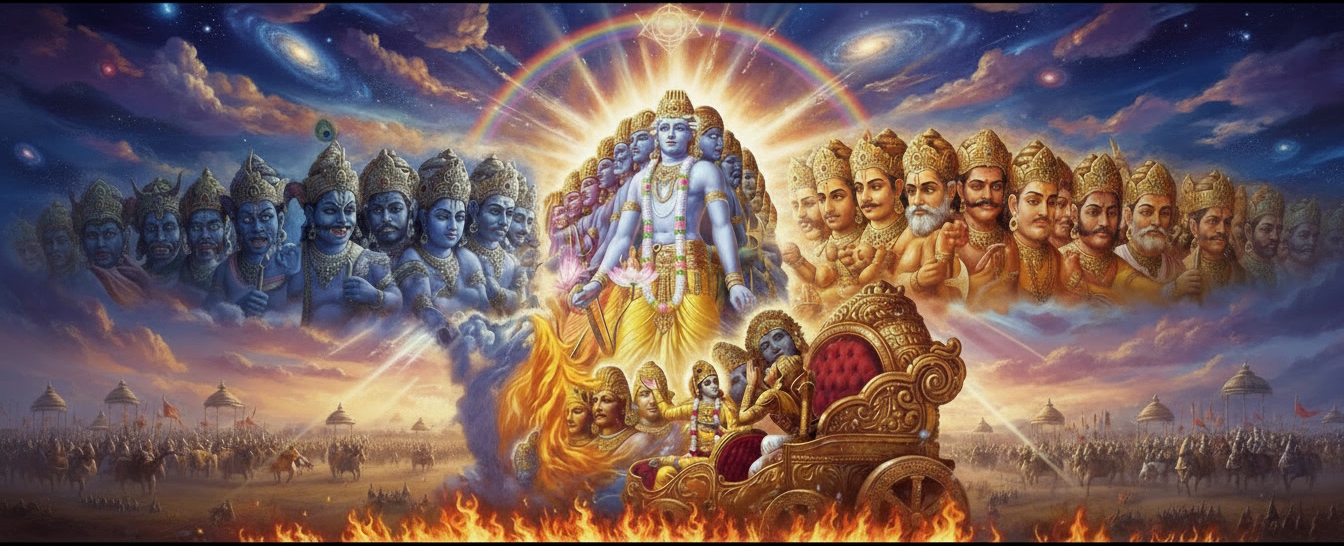
ये तु सर्वाणि कर्माणि मयि संन्यस्य मत्पराः।
अनन्येनैव योगेन मां ध्यायन्त उपासते।।12.6।।
ye tu sarvāṇi karmāṇi mayi saṃnyasya matparāḥ|
ananyenaiva yogena māṃ dhyāyanta upāsate||12.6||
Translation
But to those who worship Me, renouncing all actions in Me, regarding Me as the supreme gaol, meditating on Me with single-minded Yoga.
हिंदी अनुवाद
परन्तु जो कर्मोंको मेरे अर्पण करके और मेरे परायण होकर अनन्ययोगसे मेरा ही ध्यान करते हुए मेरी उपासना करते हैं।
Commentaries & Translations
Swami Ramsukhdas
व्याख्या--[ग्यारहवें अध्यायके पचपनवें श्लोकमें भगवान्ने अनन्य भक्तके लक्षणोंमें तीन विध्यात्मक '(मत्कर्मकृत्, मत्परमः और मद्भक्तः)' और दो निषेधात्मक '(सङ्गवर्जितः' और 'निर्वैरः') पद दिये थे। उन्हीं पदोंका संकेत इस श्लोकमें इस प्रकार किया गया है --
Sri Harikrishnadas Goenka
परंतु जो समस्त कर्मोंको मुझ ईश्वरके समर्पण करके मेरे परायण होकर अर्थात् मैं ही जिनकी परमगति हूँ ऐसे होकर केवल अनन्ययोगसे अर्थात् विश्वरूप आत्मदेवको छोड़कर जिसमें अन्य अवलम्बन नहीं है? ऐसे अनन्य समाधियोगसे ही मेरा चिन्तन करते हुए मेरी उपासना करते हैं।
Sri Anandgiri
If the worshipers of the Imperishable are distinguished thus, by attaining Me alone, then do the worshipers of Saguna not attain You? No, their (the Saguna worshipers') attainment of Me is also gradual, he says -- Ye tviti (But those who).
The word 'tu' is for the removal of doubt.
Sri Dhanpati
By the statement that the worshipers of the Imperishable attain Me alone, their fitness for direct self-attainment is stated. But the former ones (worshipers of Saguna) are liberated from the world by the knowledge given by Me, without greater effort from much hearing etc., with this intention he says -- Ye tviti dvābhyām (with two verses).
But those who are worshipers of Saguna, having fully surrendered all actions (sarvāṇi karmāṇi) to Me, the Supreme Lord (mayi parameśvare), they are devoted to Me (matparāḥ), for whom I (ahaṁ paraḥ) am the object of worship as the supreme human goal, not devoted to heaven etc. Being such, by non-exclusive Yoga -- having no other support except the universal form of the God, the Self, the Lord, the repository of infinite qualities, who has descended to the earth in those respective forms -- by that Yoga (meditation), contemplating (dhyāyantaḥ), thinking (chintayantaḥ), they worship Me. For those whose minds are fixed (āveśitaṁ) on Me, the Supreme Lord in universal form, I become the deliverer (uddharta) from the ocean of Saṁsāra (transmigration) associated with death, quickly. Being satisfied with non-exclusive devotion, giving the Yoga of intellect, I deliver them from the Saṁsāra, which is the form of its effects along with the root ignorance, this is the intention.
That is said -- 'maccittā madgataprāṇā bodhayantaḥ parasparam. kathayantaś ca māṁ nityaṁ tuṣyanti ca ramanti ca. teṣāṁ satatayuktānānāṁ bhajatāṁ prītipūrvakam. dadāmi buddhiyogaṁ taṁ yena mām upayānti te.' (Those whose minds are in Me, whose life-breaths are in Me, enlightening each other, and speaking of Me constantly, they are content and rejoice. To those ever-devoted, who worship Me with love, I give that Yoga of intellect by which they attain Me).
By the address 'O Pārtha', He suggests that just as He is subdued by the devotion of the sons of Pṛthā (you all) and is their deliverer from those respective dangers, so too.
Sri Madhavacharya
He shows that there is no effort for the devotees who worship Me -- Ye tvityādinā (by 'But those who' etc.).
And it is said in the Saukarāyaṇa Shruti -- 'upāsate ye puruṣaṁ vāsudevamavyaktāderīpsitaṁ kinnuteṣāṁ' iti (What is there for those who worship the Puruṣa Vāsudeva, who is desired even by the unmanifest etc.?)
And in the Mokṣadharma (Mahābhārata 12) (it is said) -- 'teṣām ekāntinaḥ śreṣṭhās te caivānanyadevatāḥ. aham eva gatis teṣāṁ nirāśīḥ karmakāriṇām' iti (Among them, the exclusive devotees are the best, and they have no other deity. I alone am the goal for those who perform action without desire).
Sri Neelkanth
Now, even though the effort is greater for those whose minds are attached to the unmanifest, the attainment of immediate liberation (kaivalya siddhi) occurs at the end of the effort, so what is the purpose of the worship of the manifest which is attained with delay? Fearing this, he says -- Ye tviti dvābhyām (with two verses).
Having renounced (sannyasya) and surrendered (samarpya) all (sarvāṇi) Nitya (daily), Naimittika (occasional), Svābhāvika (natural) etc. (actions). Matparāḥ -- I alone am the Supreme (paraḥ), the object to be attained by all actions for them, they are Matparāḥ, or devoted to My meditation.
By non-exclusive (non-dual) Yoga -- characterized by the identity-grasp (ahaṁgraha) in the Supreme Lord, 'I am Lord Vāsudeva' -- by that concentration of mind, meditating on Me (māṁ dhyāyantaḥ), they worship (upāsate), they gain stability in that very meditation.
Sri Ramanuja
But those who surrender (saṁnyasya) all actions, the worldly actions which are remnants of the body's sustenance, such as eating etc., for the purpose of maintaining the body, and the Vedic actions such as sacrifice, charity, oblation, penance etc., with their causes and with their purposes (so-uddeśyāni), in Me, by a spiritualized mind (adhyātmacetasā -- the mind fixed on the Supreme Self in the self). Matparāḥ -- those for whom I am the sole object to be attained, they are Matparāḥ. By non-exclusive Yoga alone, meditating on Me (māṁ dhyāyantaḥ), they worship (upāsate).
The sense is that they worship Me by performing dhyāna (meditation), archana (worship), praṇāma (prostration), stuti (praise), kīrtana (chanting) etc., which are themselves exceedingly dear and equal to the goal.
For them, I (aham) become the deliverer (samuddharta) from the ocean called Saṁsāra (transmigration), which is of the nature of death due to its opposition to My attainment, in a very short time (acireṇa eva kālena).
Sri Sridhara Swami
The attainment (siddhiḥ) occurs effortlessly for My devotees through My grace, he says -- Ye tviti dvābhyām (with two verses).
Having renounced (saṁnyasya) and surrendered (samarpya) all actions (sarvāṇi karmāṇi) in Me, the Supreme Lord (mayi parameśvare), having become devoted to Me (matparāḥ), meditating on Me (māṁ dhyāyantaḥ). By non-exclusive (ananayena) -- that in which there is no other object of devotion -- by that exclusive Bhaktiyoga alone they worship (upāsate), this is the meaning.
Sri Vedantadeshikacharya Venkatanatha
'Ye tu sarvāṇi' iti. Krishi (agriculture) etc., which are remnants of the body's sustenance, with their causes. So-uddeśyāni (with purposes), including Sandhyāvandana, enjoined with the purpose of heaven etc.
Adhyātmacetasā -- the mind which is in the Self, in the Supreme Self, that is Adhyātma, by that mind. Matparāḥ -- I am the Supreme, the ultimate goal for them, they are Matparāḥ, having placed this in the heart, 'mād-ekaprāpyāḥ' (I am the sole object to be attained by them) is said. Ananyaprayojanena iti -- this is illustrative of the means stated in 'bhagavat dhyānaṁ satataṁ kīrtayantaḥ' (constantly chanting and meditating on the Lord) etc. The notion of the means being the purpose exists in the means of attaining the Lord, that is the injunction of the intellect, this is the sense.
'Svayam eva' iti -- not with the expectation of fruit, this is the meaning.
Mṛtyubhūtāt saṁsārākhyāt (from the one called Saṁsāra which is the nature of death) iti -- the appositional compound is proper by the Nyāya of Niṣādasthapati. The qualifier is also appropriate here for the meaning of rejectability, this is the sense. 'Matprāptivirodhitayā' iti -- this is the cause for the metaphor of death. Immortality exists only when there is attainment of the Lord.
To dispel the confusion of the separate connection of 'na' with the verb, the connection 'acireṇa eva kālena samuddharta' (the deliverer in a very short time) is stated.
Swami Chinmayananda
See Commentary under 12.7
Sri Abhinavgupta
"Ye tu" (But those who) etc. up to "Asthitah" (resorting - end of 12.7). But those who, by the previously stated instruction, renounce everything in Me; of them I am the Deliverer from all troubles like obstacles etc. The entering of the mind has been explained.
And thus, this indeed is the Supreme Yoga, due to being natural (non-artificial). And thus in my Stotra: "When by the possibility of specific instruments, posture, state, and Samadhi—being produced, it manifests some knowledge; that is not Your eternally risen, naturally flowing Consciousness; because in the presence of the triad (states?), it is clearly experienced here also. But when, fuel-less, resorting to self-control; followed by natural surging horripilation, trembling, and tears; clearly accepting the body-independence of Consciousness; the Fire of Knowledge wakes up by itself, instantly, simultaneously. Then alone, O Devi, that Form devoid of supports/adjuncts; knows the Great Lord (Mahesha) who destroys the binding fetters." Etc.
Sri Jayatritha
He shows that there is no effort for the devotees who worship Me -- Ye tvityādinā (by 'But those who' etc.). And it is said in the Saukarāyaṇa Shruti -- 'upāsateyepuruṣam vā́sudevamavyaktāderī́psítaṁ kinnuteṣām' iti (What is there for those who worship the Puruṣa Vāsudeva, who is desired even by the unmanifest etc.?).
By 'bhaktānām' (of the devotees), he suggests that there is no extreme respect for anything else. Here, by 'ananayena eva yogena' (by non-exclusive Yoga alone) etc., 'vinā'vyaktopāsanam' (without the worship of the unmanifest) is understood. By the single statement 'upāsana' (worship), the absence of excessive worship etc. is indicated. By 'na cirāt' (not long), 'tatrāpi' (even there) etc. is indicated.
By 'teṣām ahaṁ samuddharta bhavāmi' (I become the deliverer of them), it is shown that that (meaning) was stated for the ascent into the intellect earlier, by anticipating the forthcoming Gītā statement 'devastu' (but the Lord) etc.
Here he also states the agreement of Shruti etc. -- Uktaṁ cha iti (And it is said). Among those (ārti etc.), Gatiḥ (path) is the one that accomplishes the means etc.
Sri Madhusudan Saraswati
Now, if the fruit is one, the superiority and inferiority would be due to the lesser or greater effort, but that is not the case. The fruit of the knowers of Nirguna Brahman is the nature of the qualityless supreme bliss and consciousness Brahman by the cessation of Avidyā (ignorance) and its effects, whereas the fruit of the knowers of Saguna Brahman, due to the absence of the knowledge of the substratum (adhiṣṭhānapramā), is specific power (aiśvaryaviśeṣa) for those who have gone to the world of Kārya Brahma (conditioned Brahman), due to the absence of the cessation of Avidyā. Therefore, if it is argued that the greater effort for the sake of greater fruit does not cause inferiority, no.
For those whose all obstacles are removed by the worship of Saguna, the attainment of the supreme liberation which is the fruit of the knowledge of Nirguna occurs at the end of the enjoyment of power in Brahmaloka by the rise of the knowledge of reality, which is accompanied by the grace of Īśvara, by the Vedānta statement that arises spontaneously, without the instruction of a preceptor and without the effort of repetition of śravaṇa (hearing), manana (reflection), nididhyāsana (deep contemplation) etc., and by the cessation of Avidyā and its effects. By the Shruti 'saetasmājjīvaghanātparātparampuruṣayaṃpuruṣamīkṣate' (He sees the Puruṣa dwelling in the city, who is higher than the higher, from this mass of living beings), he who has attained the power of Hiranyagarbha, at the end of enjoyment, from 'etasmāj jīvaghanāt' -- from the aggregate form of all living beings, from 'parāt' -- from the superior Hiranyagarbha, 'paraṃ' -- the distinct and superior 'puriśayaṃ' -- the Puruṣa dwelling in one's heart-cave, complete, non-different from the inner Self, non-dual Supreme Self, 'īkṣate' -- directly realizes by the spontaneously manifested Vedānta proof, and by that he becomes liberated, this is the meaning.
And thus, even without the previously mentioned effort, the knowers of Saguna Brahman attain the fruit of the knowledge of Nirguna Brahman by the grace of Īśvara, this meaning is stated by two (verses) -- Ye tvityādinā (by 'But those who' etc.). The word 'tu' is for the removal of the mentioned doubt.
Ye (Those who) saṁnyasya (renouncing), samarpya (surrendering) sarvāṇi karmāṇi (all actions) mayi saguṇe vāsudeve (in Me, the qualified Vāsudeva). Matparāḥ -- I, Lord Vāsudeva, am the Supreme, the object of greatest love for them, being such, ananyenaiva yogena -- by that same Yoga (meditation) which has no other support (ālambana) than Me, the Lord, also named Ekaanta Bhakti Yoga, they dhyāyantaḥ (meditating), chintayantaḥ (thinking of) upāsate (worship) Me, Lord Vāsudeva, the repository of the essence of all beauty, the embodiment of bliss (ānandaghanavigraham), two-armed or four-armed, or one filling the flute that charms the mind of all people with seven very charming notes, or one whose tender hands are accompanied by the conch, lotus, Kaumodakī (mace), and the part of the chariot (disc), or one in the form of Narasiṁhatva etc., or the supremely compassionate, most beautiful, form of Śrīmad Raghunandana, or the form of Varāha etc., or the Viśvarūpa (Universal Form) shown, they santanvate (extend) an unbroken flow of mental modifications of similar form, or they upāsate (worship) by being near.
Teṣāṁ mayyāveśitacetasāṁ -- for those whose mind is fixed (āveśitaṁ) on Me as described, I, the constantly worshiped Lord, samuddharta (deliverer) bhavāmi (become) from the mṛtyusaṁsārasāgarāt -- from the Saṁsāra (transmigration), which is accompanied by death (the illusion and the world of its effects), which is like an ocean, difficult to cross, I become the holder (dhārayitā) in the pure Brahman, which is beyond all limitations, by giving the support of knowledge, nacirāt -- quickly, in that very life. The address 'O Pārtha' is for reassurance.
Sri Purushottamji
Even in the realization of Akshara-worshippers there is trouble; but for My devotees, by meditation on My nature, even those serving My image etc., I deliver them—He says this with "Ye tu" (But those who) etc. by two (verses).
"Ye tu" (But those who)—"Sarvani"—worldly and Vedic etc. (actions); "Mayi"—for My sake; "Sannyasya"—having renounced; "Matparah"—I alone am "Para"—excellent, attainable—for whom, being such; "Ananyenaiva yogena"—
by that Bhakti Yoga in which there is no 'other' worshipable; "Mam dhyayantah"—meditating on Me; "Upasate"—serve/worship, in images etc.—is the remainder.
Sri Shankaracharya
Ye tu sarvāṇi karmāṇi (But those who surrender all actions) mayi īśvare (in Me, the Lord) saṁnyasya (surrendering). Matparāḥ -- I (ahaṁ paraḥ) am the Supreme for whom, being such Matparāḥ (devoted to Me).
Ananyenaiva (by non-exclusive) -- that which has no other support (ālambana) than the universal form of God, the Self, that is Ananyaḥ, by that Ananyenaiva, by which Yoga (concentration) dhyāyantaḥ (meditating on Me) chintayantaḥ (thinking of Me) upāsate (worship).
Teṣāṁ kim -- What of them (the devotees)?
Sri Vallabhacharya
Having thus stated the path of the worshipers of the Imperishable, he states the path of His devotees with two (verses) -- Ye tviti (But those who). The word 'tu' is for indicating the distinction from the former ones.
Having surrendered (sannyasya) all one's own actions (sarvāṇi karmāṇi), worldly and Vedic, in Me, the Lord (svāmini) who is to be served (sevye). By the non-exclusive Eka Bhakti Yoga of the described characteristic, meditating on Me (māṁ dhyāyantaḥ) they worship (upāsate) -- performing dhyāna, archana, sevā (service), praṇāma, śruti (hearing), kīrtana (chanting) etc., which are themselves exceedingly dear and equal to the goal, they worship Me, this is the meaning. Of them (teṣāṁ), I (aham) am the deliverer (samuddharta) quickly (acireṇaiva) from the ocean of Saṁsāra (transmigration) which is the form of death, opposed to My attainment.
Or, when I, the Supreme Self, am eternally dear, having abandoned all actions (sarvāṇi karmāṇi), worldly or Vedic, for My sake, having abandoned them externally and internally too, the beloved ones in the virtuous Vraja (sadvrajapriyāḥ), denoted by the word 'yat', they are Matparāḥ (devoted to Me). By non-exclusive (entirely independent) Yoga -- by the mere relation of following -- thinking of Me, the beloved of the Supreme Self, they stay near Me (matsamīpāsate).
Swami Sivananda
ये who? तु but? सर्वाणि all? कर्माणि actions? मयि in Me? संन्यस्य renouncing? मत्पराः regarding Me as the supreme goal? अनन्येन singleminded? एव even? योगेन with the Yoga? माम् Me? ध्यायन्तः meditating? उपासते worship.Commentary Ananya Yoga Unswerving Yoga exclusive? having no other objects of worship or support save the Lord Samadhi.Even in Bhakti Yoga one should not abandon actions. He must perform actions but he will have to dedicate the merits or the fruits to the Lord. (Cf.IX.27)
Swami Gambirananda
Tu, as for; ye, those who; sannyasya, having dedicated; sarvani, all; karmani, actions; mayi, to Me who am God; and matparah, having accepted Me as the supreme; upasate, meditate; dhyayantah, by thinking; mam, of Me; ananyena, with single-minded; yogena, concentration; eva, only-. That (yoga) is single-minded which has no other object than the Cosmic Deity, the Self. By thinking exclusively with that single-minded [The Ast. and the A.A. read 'kena, what?' in place of 'kevalena, exclusively'.-Tr.] (yoga)-.
What comes to them?
Swami Adidevananda
But those who, with a mind 'focused on Me,' the Supreme Self, and 'intent upon Me,' namely, holding Me as their sole object, dedicating to Me all their actions - i.e., including all worldly actions like eating which are meant for supporting the body, as also Vedic rites like sacrifices, gifts, fire-offerings, austerities etc., generally done by worldly-minded people for other purposes - worship Me and meditate on Me with exclusive devotion, namely, with devotion without any other purpose, adoring Me by all such acts as meditation, worship, prostration, praises and hymns which are by themselves exceedingly dear to them and are eal to the end itself - to these I become soon their saviour from the sea of Samsara which, on account of its being antagonistic to the attainment of Myself, is deadly.