Bhagavad Gita - Chapter 13 - Shloka (Verse) 14
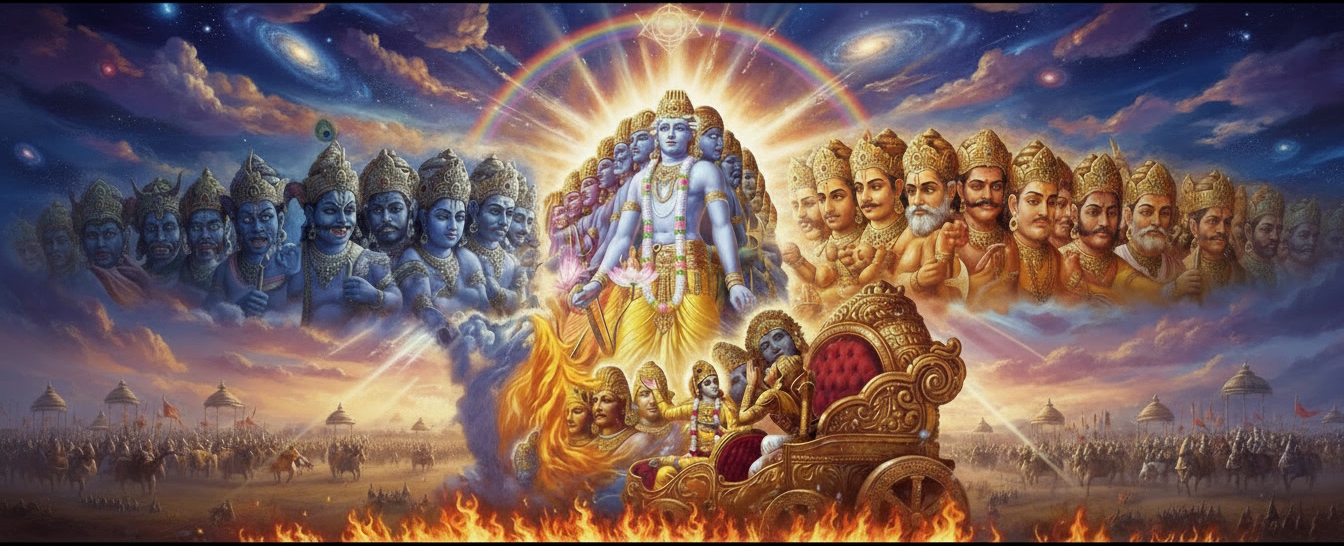
सर्वतः पाणिपादं तत्सर्वतोऽक्षिशिरोमुखम्।
सर्वतः श्रुतिमल्लोके सर्वमावृत्य तिष्ठति।।13.14।।
sarvataḥ pāṇipādaṃ tatsarvato'kṣiśiromukham|
sarvataḥ śrutimalloke sarvamāvṛtya tiṣṭhati||13.14||
Translation
With hands and feet everywhere, with eyes, heads and mouths everywhere, with ears everywhere, He exists in the worlds enveloping all.
हिंदी अनुवाद
वे (परमात्मा) सब जगह हाथों और पैरोंवाले, सब जगह नेत्रों, सिरों और मुखोंवाले तथा सब जगह कानोंवाले हैं। वे संसारमें सबको व्याप्त करके स्थित हैं।
Commentaries & Translations
Swami Ramsukhdas
व्याख्या -- सर्वतः पाणिपादं तत् -- जैसे स्याहीमें सब जगह सब तरहकी लिपियाँ विद्यमान हैं अतः लेखक स्याहीसे सब तरहकी लिपियाँ लिख सकता है। सोनेमें सब जगह सब तरहके गहने विद्यमान हैं अतः सुनार सोनेमें किसी भी जगहसे जो गहना बनाना चाहे? बना सकता है। ऐसे ही भगवान्के सब जगह ही हाथ और पैर हैं अतः भक्त भक्तिसे जहाँकहीं जो कुछ भी भगवान्के हाथोंमें देना चाहता है? अर्पण करना चाहता है? उसको ग्रहण करनेके लिये उसी जगह भगवान्के हाथ मौजूद हैं। भक्त बाहरसे अर्पण करना चाहे अथवा मनसे? पूर्वमें देना चाहे अथवा पश्चिममें? उत्तरमें देना चाहे अथवा दक्षिणमें? उसे ग्रहण करनेके लिये वहीं भगवान्के हाथ मौजूद हैं। ऐसे ही भक्त जलमें? स्थलमें? अग्निमें? जहाँकहीं जिस किसी भी संकटमें पड़नेपर भगवान्को पुकारता है? उसकी रक्षा करनेके लिये वहाँ ही भगवान्के हाथ तैयार हैं अर्थात् भगवान् वहाँ ही अपने हाथोंसे उसकी रक्षा करते हैं।भक्त जहाँकहीं भगवान्के चरणोंमें चन्दन लगाना चाहता है? पुष्प चढ़ाना चाहता है? नमस्कार करना चाहता है? उसी जगह भगवान्के चरण मौजूद हैं। हजारोंलाखों भक्त एक ही समयमें भगवान्के चरणोंकी अलगअलग पूजा करना चाहें? तो उनके भावके अनुसार वहाँ ही भगवान्के चरण मौजूद हैं।सर्वतोऽक्षिशिरोमुखम् -- भक्त भगवान्को जहाँ दीपक दिखाता है? आरती करता है? वहाँ ही भगवान्के नेत्र हैं। भक्त जहाँ शरीरसे अथवा मनसे नृत्य करता है? वहाँ ही भगवान् उसके नृत्यको देख लेते हैं। तात्पर्य है कि जो भगवान्को सब जगह देखता है? भगवान् भी उसकी दृष्टिसे कभी ओझल नहीं होते (गीता 6। 30)।भक्त जहाँ भगवान्के मस्तकपर चन्दन लगाना चाहे? पुष्प चढ़ाने चाहे? वहाँ ही भगवान्का मस्तक है।भक्त जहाँ भगवान्को भोग लगाना चाहे? वहाँ ही भगवान्का मुख है अर्थात् भक्तद्वारा भक्तिपूर्वक दिये हुए पदार्थको भगवान् वहाँ ही खा लेते हैं (गीता 9। 26)।सर्वतःश्रुतिमत् -- भक्त जहाँकहीं जोरसे बोलकर प्रार्थना करे? धीरेसे बोलकर प्रार्थना करे अथवा मनसे प्रार्थना करे? वहाँ ही भगवान् अपने कानोंसे सुन लेते हैं।मनुष्योंके सब अवयव (अङ्ग) सब जगह नहीं होते अर्थात् जहाँ नेत्र हैं? वहाँ कान नहीं होते और जहाँ कान,हैं? वहाँ नेत्र नहीं होते जहाँ हाथ हैं? वहाँ पैर नहीं होते और जहाँ पैर हैं? वहाँ हाथ नहीं होते इत्यादि। परन्तु भगवान्की इन्द्रियाँ? उनके अवयव सब जगह हैं। अतः भगवान् नेत्रोंसे सुन भी सकते हैं? बोल भी सकते हैं? ग्रहण भी कर सकते हैं इत्यादि। तात्पर्य है कि वे सभी अवयवोंसे सभी क्रियाएँ कर सकते हैं क्योंकि उनके सभी अवयवोंमें सभी अवयव मौजूद हैं। उनके छोटेसेछोटे अंशमें भी सबकीसब इन्द्रियाँ हैं।भगवान्के सब जगह हाथ? पैर? नेत्र? सिर? मुख और कान कहनेका तात्पर्य है कि भगवान् किसी भी प्राणीसे दूर नहीं हैं। कारण कि भगवान् सम्पूर्ण देश? काल? वस्तु? व्यक्ति? घटना? परिस्थिति आदिमें परिपूर्णरूपसे विद्यमान हैं। संतोंने कहा है -- चहुँ दिसि आरति चहुँ दिसि पूजा। चहुँ दिसि राम और नहिं दूजा।।संसारी आदमीको जैसे बाहरभीतर? ऊपरनीचे सब जगह संसारहीसंसार दीखता है? संसारके सिवाय दूसरा कुछ दीखता ही नहीं? ऐसे ही परमात्माको तत्त्वसे जाननेवाले पुरुषको सब जगह परमात्माहीपरमात्मा दीखते हैं।लोके सर्वमावृत्य तिष्ठति -- अनन्त सृष्टियाँ हैं? अनन्त ब्रह्माण्ड हैं? अनन्त ऐश्वर्य हैं और उन सबमें देश? काल? वस्तु? व्यक्ति आदि भी अनन्त हैं? वे सभी परमात्माके अन्तर्गत हैं। परमात्मा उन सबको व्याप्त करके स्थित हैं। दसवें अध्यायके बयालीसवें श्लोकमें भी भगवान्ने कहा है कि मैं सारे संसारको एक अंशसे व्याप्त करके स्थित हूँ। सम्बन्ध -- पूर्वश्लोकमें सगुणनिराकारका वर्णन करके अब आगेके तीन श्लोकोंमें उसकी विलक्षणता? सर्वव्यापकता और सर्वसमर्थताका वर्णन करते हैं।
Sri Harikrishnadas Goenka
वह ज्ञेय सत् शब्दद्वारा होनेवाली प्रतीतिका विषय नहीं है? इससे उसके न होनेकी आशङ्का होनेपर उस आशङ्काकी निवृत्तिके लिये? समस्त प्राणियोंकी इन्द्रियादि उपाधियोंद्वारा उस ज्ञेयके अस्तित्वका प्रतिपादन करते हुए कहते हैं --, वह ज्ञेय सब ओर हाथपैरवाला है अर्थात् उसके हाथपैर सर्वत्र फैले हुए हैं। सब प्राणियोंकी इन्द्रियरूप उपाधियोंद्वारा क्षेत्रज्ञका अस्तित्व प्रकट होता है। क्षेत्ररूप उपाधिके कारण ही वह ज्ञेय क्षेत्रज्ञ कहा जाता है। क्षेत्ररूप उपाधि हाथ? पैर आदि भेदसे अनेक प्रकार विभक्त है। वास्तवमें? क्षेत्रकी उपाधियोंके भेदसे किये हुए समस्त भेद क्षेत्रज्ञमें मिथ्या ही हैं? अतः उनको हटाकर ज्ञेयका स्वरूप वह न सत् कहा जा सकता है और न असत् ही कहा जा सकता है ऐसे बतलाया गया है। तथा ज्ञेयका अस्तित्व समझानेके लिये उपाधिकृत मिथ्यारूपको भी उसके धर्मकी भाँति कल्पना करके उसको सब ओरसे हाथपैरवाला है? इत्यादि प्रकारसे बतलाया जाता है। सम्प्रदायपरम्पराको जाननेवालोंका भी यही कहना है कि अध्यारोप और अपवादद्वारा प्रपञ्चरहित परमात्माकी व्याख्या की जाती है। सर्वत्र अर्थात् सब शरीरोंके अंगरूपसे स्थित हाथ? पैर आदि इन्द्रियाँ? ज्ञेय शक्तिकी सत्तासे ही स्वकार्यमें समर्थ हो रही हैं? अतः ये सब ज्ञेयकी सत्ताके चिह्न होनेके कारण उपचारसे ज्ञेयके ( धर्म ) कहे जाते हैं। ऐसे ही और सबकी भी व्याख्या कर लेनी चाहिये। वह ज्ञेय सब ओर हाथपैरवाला है? तथा सब ओर नेत्र? शिर और मुखवाला है -- जिसके आँख? शिर और मुख सर्वत्र हों? वह सर्वतोऽक्षिशिरोमुख कहलाता है तथा वह सब ओर कानवाला है -- जिसके श्रुति अर्थात् श्रवणेन्द्रिय हो वह श्रुतिमत् ( कानवाला ) कहा जाता है। इस लोकमें -- समस्त प्राणिसमुदायमें वह सबको व्याप्त करके स्थित है।
Sri Anandgiri
Doubting that the Knowable possesses hands etc. directly even without superimposition, he says -- "Adjuncts" (Upadhi). Because of the word "all" (sarva) which qualifies the senses, and because the logic of being an adjunct of the Knowable is not different, intellect etc. are also included here, so he says -- "And internal organ". Since the status of ears etc. as adjuncts of the Knowable is through the mind and intellect, they are also included here, so he says -- "Moreover". Stating the result of including those two also here, he says -- "Therefore".
Having stated the literal meaning, he states the sentence meaning -- "All". He states the proof regarding having imagined activity through adjuncts -- "Meditates" (dhyayati). Showing through expectation (questioning) that the Lord also agrees that His possession of activity is only imagined and not real, he says -- "From what" etc. He states the result of being devoid of all instruments (senses) -- "Therefore".
Doubting "Since possession of actions like fast moving etc. is described in the Mantra for the Knowable directly, how is He not engaged in the functions of the instruments?", and translating (the Mantra), he states the conformity of the Mantra to the present context -- "But he who". Doubting that "Without partaking of the conformity to the qualities of the instruments, if the Mantra is meant to show possession of actions like running etc. directly, then the Mantra would have primary meaning", and stating that it is not so because that is impossible, he says -- "Blind". Since the eulogy (Arthavada) has no purport in the literal meaning heard, there is no contradiction with the context, this is the meaning.
Accepting that absence of all instruments implies absence of their functions, and making that very thing the reason, he states the state of being devoid of all attachment in reality -- "Because". Even though there is absence of all attachment in reality, he states the status of being the substratum of all -- "Although". He explains that by His own existence alone, as the substratum, He nourishes everything -- "Sat" (Existence). The disputed (world) is imagined in the Real (Sat), because each thing is known by a cognition permeated by 'Sat' (Existence), just like the difference in moons known by cognition permeated by difference in moon, this is the meaning. Doubting that "Everything has Sat as substratum" is incorrect because mirages etc. do not have that, he says -- "Not". Since even for them, being imagined, it is impossible to be without a substratum, when examined, their substratum is Existence (Sat) alone, so everything being imagined in the Real is not contradictory, this is the meaning. He concludes the stated existence of the Knowable Brahman as the substratum of all -- "Therefore".
And for this reason also the Knowable Brahman exists, he says -- "And this would be". For His status as the Perceiver is not established if He is non-existent, this is the meaning.
Sri Dhanpati
(Objection): Regarding the doubt of non-existence of the One devoid of all specifics and beyond speech etc. due to not being the object of the word 'Sat' (Existence), although it was briefly resolved by "Not Sat", still, propounding the existence of the Knowable by being the Inner Self, by being the cause of the activity of senses etc., and by bestowing existence and manifestation to the imagined duality, and (showing) that just as the activity of inert chariots etc. is dependent on a sentient being, so is the activity of the inert instruments (senses) of all living beings, and that Inner Consciousness is Brahman alone -- to resolve that doubt in detail, He says.
'Everywhere' (Sarvatah) meaning in all places, whose are 'hands' and 'feet', that Knowable is so. Although hands etc. are not properties of the Self due to being in the body, still, the activity of instruments is preceded by the presidency of a sentient being, because of being activity preceded by foresight, like the activity of a chariot etc. -- thus the existence of the Knower of the Field is indicated by the adjuncts of the instruments of all living beings.
Objection: Even if the existence of a sentient being is established by the stated method, how is the existence of the Knower of the Field established? (Answer): If you ask thus -- the sentient alone conditioned by the Field is called the Knower of the Field, therefore His existence is indeed the existence of the Knower of the Field.
Objection: Even if Consciousness conditioned by the Field is the Knower of the Field, how does He possess hands etc.? (Answer): Since the Field is divided in many ways by hands etc., due to conditioning by that, the possession of hands etc. by the Knower of the Field also is easily stated.
But the statement of being the Knowable as attributeless by "Neither Sat nor Asat is That called" is easily stated by removing that (attribute) of the Knower of the Field, because the group of specifics created by the adjunct of the Field is false.
Objection: Since the possession of hands etc. created by adjuncts is itself false, its mention in the section on expounding the Knowable is meaningless? (Answer): No. Because for teaching the existence of the Knowable, imagining them as properties of the Knowable, the mention of such hands etc. is meaningful. That is said by the knowers of tradition: "By superimposition and negation, the Prapancha-less (worldless) is expounded".
Whose eyes, heads, and mouths are everywhere, That. Everywhere 'Shruti', meaning organ of hearing, exists for It, That. Possession of hands, feet, and mouth is an indication (Upalakshana) for possession of the remaining organs of action, and possession of eyes and ears is for possession of the remaining organs of knowledge and possession of mind, intellect, etc. Hands, feet, etc., perceived everywhere as limbs of all bodies, become possessed of their own functions by making the existence of the Knowable Supreme Self, who is capable of impelling by mere proximity, the cause; therefore, being signs of the existence of the Knowable, they are metaphorically said to belong to the Knowable.
'In the world', in the community of all living beings, 'enveloping' (Avritya), meaning pervading everything moving and unmoving by the superimpostional relation of Existence etc., 'It stands' (Tishthati), attains a state of attributelessness indeed, and does not move. The meaning is that in the expansion of superimposed attributes, It does not attain specificity.
Sri Neelkanth
Thus, having established the nature of the Knower of the Field as devoid of all specifics by 'And who he is' etc., he establishes his 'power' -- which was promised as 'Of what power' -- characterized by the universal form, with 'Everywhere' etc. 'Everywhere' -- in all directions, inside and outside, his hands and feet exist, thus 'With hands and feet everywhere'. Similarly, whose eyes, heads, and mouths are everywhere, that is 'With eyes, heads, and mouths everywhere'. 'Possessing ears everywhere' means possessing hearing. 'In the world', enveloping, meaning pervading 'everything', it stands.
Just as the dreamer (Taijasa) experiences the dream world with hands, feet, etc. consisting only of impressions (Vasanas). And for him, the very hands, feet, etc. existing in the physical body which are the limiting adjuncts in the waking time, that alone is the cause of the world consisting of Vasanas through the imparting of impressions of the experience of the gross world. And the (world) consisting of Vasanas is the cause of the gross world -- thus by the logic of seed and sprout, there is mutual existence in each other and mutual causality between these two.
Similarly, Consciousness conditioned by Ignorance colored by the Vasanas of the intellects of all living beings illuminates the collective subtle world consisting of the Vasanas of the intellects of all living beings. And the limiting adjunct for this is indeed the feet etc. of all living beings within the universe. And thus, intending the mutual causality by the seed and sprout logic and the mutual existence in each other of the gross and subtle collective worlds as before, it was said by the Lord Commentator (Shankara) that 'The existence of the Knowable Brahman is propounded through the limiting adjuncts of the instruments of all living beings'.
And when the existence of the instrument (cause) is established through the effect, the absence of cause is also refuted (which was suspected from) 'The beginningless Supreme Brahman is called neither Sat nor Asat'. (Objection): Well, by the logic 'Better is not touching mud from afar than washing it off', then the mention of the cause (attributes) is useless? (Answer): No. Because without that, the understanding of the Pure is impossible. For by the logic of the branch and the moon, the Saguna (with qualities) is the indicator of the Nirguna (attributeless) reality.
As stated in the Commentary: 'Even the false form created by adjuncts is spoken of as if it were a property of the Knowable, imagining it for the sake of understanding Its existence, as 'With hands and feet everywhere' etc.' For thus is the saying of the knowers of tradition: 'By superimposition and negation, the Worldless is expounded.'
Sri Ramanuja
'Shining by the functions of all senses' -- whose shining (manifestation/knowledge) is by the functions of all senses, that is 'Sarvendriyagunabhasam'. 'Senses' qualities' means functions of senses; meaning It is capable of knowing objects even through the functions of the senses. By nature 'devoid of all senses' -- meaning It knows everything by Itself indeed, even without the functions of the senses.
'Unattached' -- by nature indeed devoid of attachment to bodies of gods etc. 'And supporter of all indeed' -- and capable of supporting all bodies of gods etc. From Sruti texts like 'He becomes one (becomes two) becomes three' (Cha. U. 7.26.2) etc.
'Attributeless' -- similarly by nature devoid of qualities like Sattva etc.; 'and enjoyer of qualities' -- and capable of experiencing qualities like Sattva etc.
Sri Sridhara Swami
(Objection): Well, if Brahman is thus distinct from Sat and Asat, it would contradict Srutis like 'All this is indeed Brahman', 'Brahman alone is all this'? Doubting this... showing His nature of being the Self of all through the inconceivable power well-known in Srutis like 'His supreme power is heard to be various indeed, natural, consisting of knowledge, strength, and action', He says -- 'Everywhere' etc. in five (verses).
'Everywhere' -- in all places whose hands and feet are, That; whose eyes, heads, and mouths are everywhere, That; 'Possessing ears everywhere' -- being endowed with organs of hearing, enveloping, pervading everything in the world, It stands.
Through the adjuncts like hands etc. characterized by the activities of all living beings, It stands in the state of being the ground of all transactions, this is the meaning.
Sri Vedantadeshikacharya Venkatanatha
Since the nature of the Self is bodiless, partless, and sense-less, there is no occasion for hands and feet at all. Nor does this refer to the previously mentioned (Universal Form) having many arms etc., because it has been established that the context is of the Jiva. Therefore, the imagination that 'the connection of the Brahman, who is the Self of the universe, with hands etc. taken by Jiva's karma or taken by His own will is stated' is also refuted. And since hands etc. are absent in feet etc., 'Everywhere' also does not fit. Then how is there 'having hands and feet everywhere' etc.? To this he says -- 'Pure'.
To show the Sruti regarding the possession of power indicated by words hands etc. for the pure Self even though devoid of hands etc., he first shows the possession of that power for the Supreme Self even though devoid of them -- 'Without hands'. 'Without hands and feet' [Sve. U. 3.19] is an indication of the class of organs of action to be negated; 'Without eyes, without ears' [Sve. U. 3.19] of the class of organs of knowledge.
Then how is the specific nature of the Supreme Self designated here in the Jiva of little power? To this he says -- 'For the individual Self also'. The sense is that it is reasonable because of the power of uncontracted knowledge due to connection with the eight qualities of Brahman in the liberated state. Since there is no restriction in the Sruti of equality, even without specific explicit statement, 'having hands and feet everywhere' etc. is established indeed -- with this intention is the word 'Indeed' (Eva).
In mere attainment of equality, how is equality in all respects established by Sruti? To this he says -- 'Then'. This supreme equality is regarding everything except the business of (creating/sustaining) the world -- this has been deliberated in the Phalapada (chapter on fruit in Brahma Sutras), this is the sense. And that meaning of Sruti will be taught here also, so intending that is appropriate here, he says -- 'This knowledge'.
In 'Stands', non-deviation from pervasion is intended. How is there all-pervading existence for the atomic (Jiva) whose knowledge is enveloped by karma? To this he says -- 'Pure'. And this pervasiveness is through knowledge-attribute, thus it is determined in the Sariraka (Sutras) by 'Entrance like a lamp, for thus it shows' [Br. Su. 4.4.15] etc.; because the nature of the Jiva is defined by atomic size only, and because modification of essence is impossible due to Sruti of immutability.
Swami Chinmayananda
सर्वत पाणिपादम् उत्तम अधिकारी तो आत्मा के निर्गुण स्वरूप को पहचान लेता है? परन्तु मध्यम अधिकारी को अज्ञात और अव्यक्त का बोध? ज्ञात और व्यक्त वस्तुओं के द्वारा कराने में सरलता होती है। यद्यपि प्रणियों के हाथ और पैर जड़ तत्त्व के बने हैं? तथापि वे चेतन और कार्यक्षम प्रतीत हो रहे हैं। इन सबके पीछे इन्हें चेतनता प्रदान करने वाला आत्मतत्त्व सर्वत्र एक ही है। इसीलिए यहाँ कहा गया है कि ब्रह्म समस्त हाथ और पैरों को धारण करने वाला है।इसी प्रकार? समस्त नेत्र? शिर और मुख भी इस चैतन्य के कारण ही स्वव्यापार करने में समर्थ होते हैं। इसलिए आत्मा का निर्देश इस प्रकार करते हैं कि वह सब ओर नेत्र? शिर और मुख वाला है। चैतन्य से धारण किये होने पर ही प्राणियों में विषय ग्रहण तथा विचार करने की क्रियाएं होती रहती हैं। अत चैतन्य ब्रह्म सब ओर से श्रोत वाला कहा गया है।यह सबको व्याप्त करके स्थित है यहाँ जब आत्मा के उपाधियुक्त स्वरूप और प्रभाव को दर्शाया गया है? तो कोई यह मान सकता है कि जहाँ उपाधियाँ हैं? वहीं पर आत्मा का अस्तित्व है और अन्यत्र नहीं। इस प्रकार की विपरीत धारणा को दूर करने के लिए यहाँ पर अत्यन्त उचित ही कहा गया है कि वह परम सत्य सबको व्याप्त करके स्थित है। यह श्लोक वैदिक साहित्य से परिचित विद्यार्थियों को ऋग्वेद के प्रसिद्ध पुरुषसूक्तम् का स्मरण कराता है।भगवान् आगे कहते हैं
Sri Abhinavgupta
By this knowledge, that which is to be known is stated -- beginning with 'The Knowable' etc. ending with 'situated' (verse 17).
By adjectives like 'Beginningless Supreme Brahman' etc., He states the non-separateness from the consciousness mentioned in all doctrines, which favors the suggestion of the nature of Brahman.
And these adjectives have been explained before indeed, so what is the use of fruitless repetition?
Sri Madhusudan Saraswati
Thus, for the Unconditioned Brahman, due to not being the object of the word or cognition 'Sat' (Existence), regarding the doubt of non-existence, although it was refuted by 'not Asat', to remove that doubt in detail, propounding Its existence as the form of the sentient Knower of the Field through the limiting adjuncts of the instruments of all living beings, He says -- 'Everywhere' etc.
'Everywhere' -- in all bodies, whose hands and feet, which are inert, are to be impelled in their respective functions -- the sentient Knower of the Field -- That is 'With hands and feet everywhere', the Knowable Brahman. Because all activities of the non-sentient are preceded by a sentient presiding agent, in that Knower of the Field, the sentient Brahman, the Knowable, who is the cause of activity of the entire aggregate of non-sentients, there is no suspicion of non-existence, this is the meaning.
Similarly, whose eyes, heads, and mouths are everywhere -- to be impelled; similarly whose ears, organs of hearing, exist as to be impelled everywhere, That is 'With eyes, heads, and mouths everywhere'.
'Possessing ears everywhere'; in the world, in the community of all living beings; One alone, Eternal, and All-pervading; enveloping the entire non-sentient group; by Its own existence and manifestation through superimpositional relation; pervading, It stands; attains a changeless state indeed; meaning It is not connected even by an atom with the defect or quality of the inert world superimposed on Itself.
And how there is One alone sentient, eternal, and all-pervading in all bodies, not different in each body, that has been elaborated before.
Sri Purushottamji
Thus, if It is not an object of anything, Its knowability is obstructed -- (thinking) thus, He states the nature as the Knowable -- 'Everywhere' etc. Whose hands and feet are everywhere, That. Thus by these two adjectives, the power of action everywhere and the state of being worthy of service by all is described.
Whose eyes, heads, and mouths are everywhere. Thus by these three adjectives, omniscience and being the principal of all is made known.
'Possessing ears everywhere' -- endowed with organs of hearing everywhere. By this, compassion is demonstrated by the fitness to hear the praises etc. of devotees.
'In the world' -- 'in His own' is to be supplied. Then It would be limited? Doubting this, He says -- enveloping all, pervading, It stands indeed endowed with all senses etc., this is the sense.
Sri Shankaracharya
'With hands and feet everywhere' -- everywhere are Its hands and feet, thus 'With hands and feet everywhere', That Knowable. The existence of the Knower of the Field is indicated by the limiting adjuncts of the instruments of all living beings. And the Knower of the Field is spoken of due to the adjunct of the Field. And the Field is divided in many ways by hands, feet, etc.
The group of specifics created by the division of the adjuncts of the Field is indeed false for the Knower of the Field; thus by removing that, knowability was stated as 'Neither Sat nor Asat is That called'. Even the false form created by adjuncts is spoken of as if it were a property of the Knowable, imagining it for the sake of understanding Its existence, as 'With hands and feet everywhere' etc. For thus is the saying of the knowers of tradition -- 'By superimposition and negation, the Worldless is expounded'.
Hands, feet, etc., perceived everywhere as limbs of all bodies, perform their own functions caused by the existence of the power of the Knowable; thus they are signs for the existence of the Knowable, so they are metaphorically said to belong to the Knowable. Similarly the rest is to be explained.
'With hands and feet everywhere', That Knowable. 'With eyes, heads, and mouths everywhere' -- whose eyes, heads, and mouths are everywhere, That 'With eyes, heads, and mouths everywhere'. 'Possessing ears everywhere' -- 'Shruti' is the organ of hearing; That whose that is, is 'Srutimat'; in the world, in the community of living beings; enveloping 'all', pervading; 'stands', attains a state.
To ensure that the doubt does not arise that the Knowable possesses those (hands etc.) due to the superimposition of the senses like hands, feet, etc. which are adjuncts, for this purpose is the beginning of the (next) verse --
Sri Vallabhacharya
Doubting whether It is with form or formless, He says -- 'With hands and feet everywhere' (sarvatah-pani-padantam). With form indeed; in every place whose hands, feet are the ends (extremities). Actions characterized by motion and doing (are implied); everywhere by the word 'end', the appearance of limitation by His own will is also stated.
By 'eyes, heads, and mouths everywhere', knowledge, primacy, and enjoyments are stated everywhere.
To expand on the name, He says -- 'Possessing ears everywhere in the world'. Meaning He hears from everywhere.
For such a One, limitation might occur? He says -- 'Enveloping all It stands'.
These properties become clear only after the creation of the world; still, to declare their eternity, is the statement at the outset.
Swami Sivananda
सर्वतः everywhere? पाणिपादम् with hands and feet? तत् that? सर्वतः everywhere? अक्षिशिरोमुखम् with eyes? heads and mouths? सर्वतः everywhere? श्रुतिमत् with ears? लोके in the world? सर्वम् all? आवृत्य having enveloped? तिष्ठति exists.Commentary He (the knower of the field or Para Brahman) pervades everything in this world. He fills and surrounds this world with Himself. He abides in the universe enveloping everything.In the previous verse it is said that the Brahman Which is to be known is neither being nor nonbeing. One may think that It is nonentity or void or nothing. In order to remove this misapprehension? the Lord says in this verse that the knowable has hands and feet everywhere? etc. It directs the mind and the senses to do their proper functions. This is only the manifest aspect of Saguna Brahman (Brahman with attributes).Just as the enginedriver drives the engine? so also the knowable or the knower of the field drieves the bodyengine. It is the Inner Ruler. It is the innermost Self. It is the support? substratum or basis for this world? body? mind? lifeforce and the senses. The existence of Brahman is determined or ascertained or indicated by the existence of the limiting adjuncts? viz.? body? mind and senses? because there must be selfconsciousness behind their activities. How can you call It nonexistence thenJust as the rope is not affected by the alities or the defects of the illusory superimposed snake? so also Para Brahman (the knower of the field) is not affected by the superimposed world? body? senses? mind and the lifeforce. There is only one common consciousness is eternal? selfluminous and allpervading. That common consciousness is Para Brahman.The body? mind? senses and the lifeforce are by nature insentient. But they are moved by Brahman to action. They act on account of the mere presence of Brahman or the knower of the field. (The limiting adjuncts are illusory.) Hence they put on the semblance of consciousness? just as the iron piece puts on the semblance of a magnet when it is in the presence of a magnet.The whole world is superimposed on Brahman like the snake on the rope. This is called Adhyaropa. It is sublated by the method (Yukti) of Apavada (negation or denial).This verse is taken from the Svetasvataropanishad 3.16.
Swami Gambirananda
Tat, That-the Knowable; sarvatah-pani-padam, which has hands and feet everywhere-.
The existence of the Knower of the field is revealed through th adjuncts in the form of the organs of all creatures. And the Knower of the field is spoken of as such because of the limiting adjuncts of the field. The field, too, is diversely differentiated as hands, feet, etc. All diversity in the Knower of the field, caused by the differences in the adjunct-the field-, is certainly unreal. Hence, by denying it, the nature of the Knowable has been stated, in, 'That is called neither being nor non-being.' Although the unreal form is caused by the limiting adjuncts, still, for the comprehension of Its existence it is said, '(It) has hands and feet everywhere, etc., by assuming this as a ality of the Knowable. Thus, as is well known, there is saying of the people versed in tradition, 'The Transcendental is described with the help of superimposition and its refutation'. Everywhere the hands, feet, etc., which are perceived as limbs of all bodies, perform, their duties due to the presence of the power of the Knowable (Brahman). Thus the grounds for the inference of the existence of the Knowable are metaphorically spoken of as belonging to the Knowable. The others have to be explained similarly.
That Knowable has hands and feet everwhere. That which has eyes, heads, and mouths everywhere is sarvatoksi-siro-mukham. That which has ears every-where is sarvatah-srutimat: sruti means the organs of hearing; that which has it is sruti-mat. Tisthati, It exists, remains established; loke, in the multititude of creatures; avrtya, by pervading; sarvam, them all.
With this purpose is view, that as a result of the superimposition of the organs like hands, feet, etc., which are adjuncts, there may not be the misconception that the Knowable is possessed of them (adjuncts), the (next) verse is begun:
Swami Adidevananda
Everywhere are Its hands and feet i.e., the self in Its pure form is able to perform everywhere the works of hands and feet. Its eyes, heads and mouths are everywhere; It performs everywhere the task of eyes etc. The Sruti declares; 'Without feet or hands, He moves swiftly and seizes things; He sees without eyes, He hears without ears? (Sve. U., 3.19). It may be said that it means that the Supreme Brahman performs everywhere the task of hands, feet etc., even though He is devoid of hands and feet. If 'Brahman' is taken to mean the self, it can be asked how this power of the Supreme Brahman (namely, having hand, feet, eyes, etc., everywhere) can be attributed to the self, then the answer is that it is established in the Srutis that the pure individual self has the capacity of performing the task of hands, feet etc., because It is eal to Him. Sruti also declares: 'Then, the wise seer, shaking off good and evil, stainless, attains the supreme eality with Him' (Mun. U., 3.1.3). Sri Krsna will also teach later on: 'Resorting to this knowledge, It partakes of My nature' (14.2). It exists encompassing all things, whatever aggregate of things that exist in the world; It encompasses them. The sense is that in Its pure state, It is all-pervasive, as It has no limitation of space etc.