Bhagavad Gita - Chapter 13 - Shloka (Verse) 17
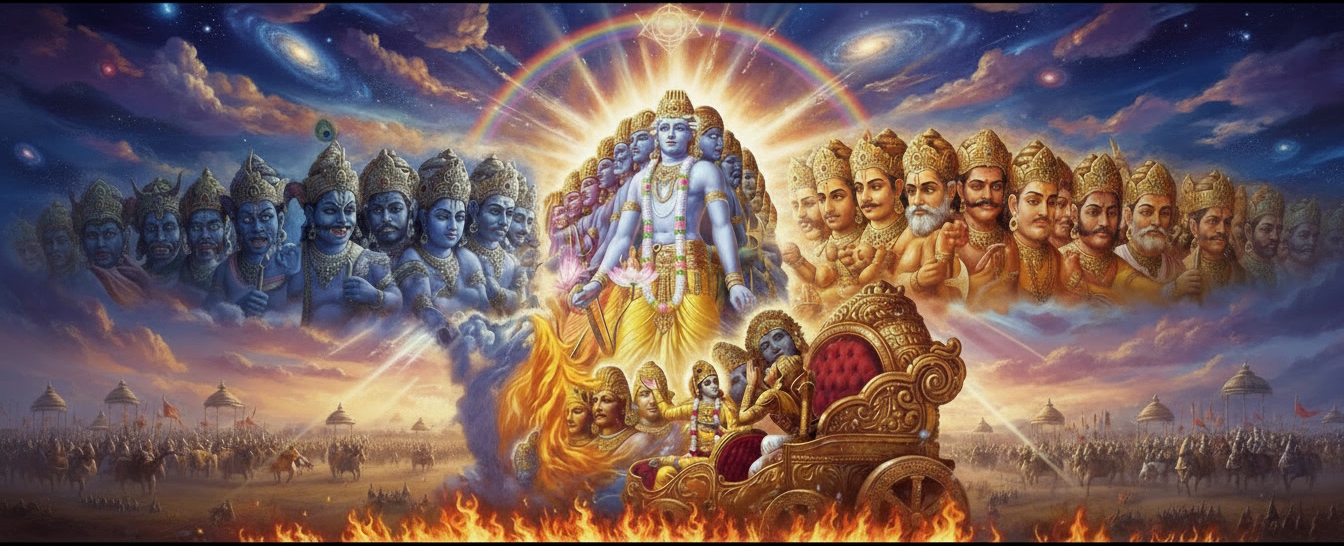
अविभक्तं च भूतेषु विभक्तमिव च स्थितम्।
भूतभर्तृ च तज्ज्ञेयं ग्रसिष्णु प्रभविष्णु च।।13.17।।
avibhaktaṃ ca bhūteṣu vibhaktamiva ca sthitam|
bhūtabhartṛ ca tajjñeyaṃ grasiṣṇu prabhaviṣṇu ca||13.17||
Translation
And undivided, yet It exists as if divided in beings; It is to be known as the supporter of being; It devours and It generates.
हिंदी अनुवाद
वे परमात्मा स्वयं विभागरहित होते हुए भी सम्पूर्ण प्राणियोंमें विभक्तकी तरह स्थित हैं। वे जाननेयोग्य परमात्मा ही सम्पूर्ण प्राणियोंको उत्पन्न करनेवाले, उनका भरण-पोषण करनेवाले और संहार करनेवाले हैं।
Commentaries & Translations
Swami Ramsukhdas
व्याख्या -- अविभक्तं च भूतेषु विभक्तमिव च स्थितम् -- इस त्रिलोकीमें देखने? सुनने और समझनेमें जितने भी स्थावरजङ्गम प्राणी आते हैं? उन सबमें परमात्मा स्वयं विभागरहित होते हुए भी विभक्तकी तरह प्रतीत होते हैं। विभाग केवल प्रतीति है।जिस प्रकार आकाश घट? मठ आदिकी उपाधिसे घटाकाश? मठाकाश आदिके रूपमें अलगअलग दीखते हुए भी तत्त्वसे एक ही है? उसी प्रकार परमात्मा भिन्नभिन्न प्राणियोंके शरीरोंकी उपाधिसे अलगअलग दीखते हुए भी तत्त्वसे एक ही हैं।इसी अध्यायके सत्ताईसवें श्लोकमें समं सर्वेषु भूतेषु तिष्ठन्तं परमेश्वरम् पदोंसे परमात्माको सम्पूर्ण प्राणियोंमें समभावसे स्थित देखनेके लिये कहा गया है। इसी तरह अठारहवें अध्यायके बीसवें श्लोकमें अविभक्तंविभक्तेषु पदोंसे सात्त्विक ज्ञानका वर्णन करते हुए भी परमात्माको अविभक्तरूपसे देखनेको ही सात्त्विक ज्ञान कहा गया है।भूतभर्तृ च तज्ज्ञेयं ग्रसिष्णु प्रभविष्णु च -- इसी अध्यायके दूसरे श्लोकमें विद्धि पदसे जिस परमात्माको जाननेकी बात कही गयी है और बारहवें श्लोकमें जिस ज्ञेय तत्त्वका वर्णन करनेकी प्रतिज्ञा की गयी है? उसीका यहाँ ब्रह्मा? विष्णु और शिवके रूपसे वर्णन हुआ है। वस्तुतः चेतन तत्त्व (परमात्मा) एक ही है। वे ही परमात्मा रजोगुणकी प्रधानता स्वीकार करनेसे ब्रह्मारूपसे सबको उत्पन्न करनेवाले सत्त्वगुणकी प्रधानता स्वीकार करनेसे विष्णुरूपसे सबका भरणपोषण करनेवाले और तमोगुणकी प्रधानता स्वीकार करनेसे रुद्ररूपसे सबका संहार करनेवाले हैं। तात्पर्य है कि एक ही परमात्मा सृष्टि? पालन और संहार करनेके कारण ब्रह्मा? विष्णु और शिव नाम धारण करते हैं (टिप्पणी प0 691)। यहाँ यह समझ लेना आवश्यक है कि परमात्मा सृष्टिरचनादि कार्योंके लिये भिन्नभिन्न गुणोंको स्वीकार करनेपर भी उन गुणोंके वशीभीत नहीं होते। गुणोंपर उनका पूर्ण आधिपत्य रहता है। सम्बन्ध -- पूर्वश्लोकमें भगवान्ने ज्ञेय तत्त्वका आधाररूपसे वर्णन किया? अब आगेके श्लोकमें उसका प्रकाशकरूपसे वर्णन करते हैं।
Sri Harikrishnadas Goenka
तथा --, वह ज्ञेय प्रत्येक शरीरमें आकाशके समान अविभक्त और एक है। तो भी समस्त प्राणियोंमें विभक्त हुआसा स्थित है क्योंकि उसकी प्रतीति शरीरोंमें ही हो रही है। तथा वह ज्ञेय स्थितिकालमें भूतभर्तृ -- भूतोंका धारणपोषण करनेवाला? प्रलयकालमें ग्रसिष्णु -- सबका संहार करनेवाला और उत्पत्तिके समय प्रभविष्णु -- सबको उत्पन्न करनेवाला है? जैसे कि मिथ्याकल्पित सर्पादिके ( उत्पत्ति? स्थिति और नाशके कारण ) रज्जु आदि होते हैं।
Sri Anandgiri
'From this also' the existence of the Knowable is established, He says -- 'Moreover'.
To clarify another reason indeed, he doubts -- 'Everywhere'. That should not be considered darkness, he says -- 'No'. Then what is Its form? he asks -- 'What then'. The answer there -- 'Of lights'.
Because of being the illuminator of sun etc. and intellect etc., the Knowable Brahman exists, he says -- 'Of lights'. He justifies that very thing -- 'Self'. He cites two Srutis as proof there -- 'By whom'. He shows the remainder of the sentence also in the said meaning -- 'And from Smriti'.
Doubting that even if the Knowable is not darkness, It might be touched by darkness, it is said -- 'From darkness'. He states the purport of the second half -- 'Of knowledge etc.'. 'Uttambhanam' means stimulating, manifesting. 'Knowledge' is humility etc., by instrumental derivation -- this is to be supplied.
Doubting repetition in 'To be reached by knowledge' and 'Knowable', it is said -- 'Knowable'. He reveals the manifestation of the said three by being established in the intellect -- 'That this'. He makes experience favorable there -- 'There itself'.
Sri Dhanpati
'Moreover', 'from this also' the existence of the Knowable is established, He says. 'Undivided' means devoid of division; One in every body like the sky; because of the absence of proof for Its difference, and if different, the contingency of being non-Self like a pot would arise. And so the Sruti: "One alone without a second", "There is no diversity here whatsoever", "From death to death he goes who sees diversity here as it were", etc. Therefore, the view of Sankhya etc. that the Self is different in each body is opposed to Sruti and Smriti and should not be respected.
How then is there the idea of difference? Doubting this, He says it is by imagination. 'In beings', in all living entities, 'situated as if divided'; appearing like a false difference; because It is perceived (as divided) only in bodies like the moon in water vessels. From the Sruti: "One Self alone is situated in every being. It is seen as one and many like the moon in water."
Thus having stated the existence of the Knowable as the individual Self, He states Its existence as the Supreme Lord. 'And Supporter of beings' -- at the time of sustenance, That is the Knowable. It supports, holds and protects beings. At the time of dissolution, That alone is 'Devouring', having the nature of devouring. At the time of origin, 'Generating', having the nature of generating. Just as for imagined snakes etc., the rope alone supports them during their existence; and at the time of sublation (it is) devouring, and at the time of origin (it is) generating; this is the meaning.
Therefore, since the cause-effect relationship is the Reality (Vastu), duality should not be suspected.
Sri Neelkanth
He explains this very thing by half (the verse) -- 'And Undivided'. "One Self alone is situated in every being. It is seen as one and many like the moon in water" -- from this Sruti, in beings -- in water vessels which have attained the aggregate of cause and effect -- the Jivas are reflections of Brahman like the moon; and they are non-different from the Bimba (original) as stated; therefore in that form 'And Undivided' in beings -- though not having attained division -- the Knowable object appears 'as if divided', as if situated in a distant place, and as if split in two, by deluded vision.
(Objection): If so, then there is a contingency of separate existence of beings from Brahman, like water vessels from the moon? Raising this doubt, He says -- 'And Supporter of beings'. Because It supports all beings by being the substratum, therefore they do not have separate existence from It; like snake, stick, water-stream etc. superimposed on a rope; this is the meaning.
He says this very thing -- 'Devouring and Generating'. Just as the rope devours snakes etc. in the state of non-ignorance (knowledge of rope), and in the state of ignorance (of rope) generates them indeed; similarly, the known Brahman is 'Devouring' all beings, having the nature of devouring; and the unknown (Brahman) is 'Generating' all beings, having the nature of producing.
Sri Ramanuja
Of lights -- like lamp, sun, gem, etc. also; 'That alone is the Light' (i.e.) the Illuminator; for even of lamp, sun, etc., Knowledge itself, which is the light of the Self, is the illuminator.
Lamps etc. only perform the removal of the dense darkness which opposes the contact between the object and the sense; only to that extent is their status as illuminators.
'It is said to be beyond darkness' -- the word 'darkness' denotes Nature (Prakriti) in its subtle state; meaning It is said to be beyond Nature.
'Therefore Knowledge, Knowable' -- It is 'Knowable' because It has the sole form of Knowledge; and 'To be reached by Knowledge' -- meaning attainable by the means of knowledge described as Humility etc.
'Situated in the heart of all' -- situated specially in the heart of all humans etc., near.
Sri Sridhara Swami
Moreover -- 'Undivided' etc. 'Undivided' in beings -- consisting of moving and unmoving -- non-different in the form of the Cause; and 'Divided' in the form of the effect, and situated as if different. Foam etc. born from the ocean is not different from the ocean, that aforesaid nature is the Knowable.
'And Supporter of beings' -- nourisher at the time of sustenance; and at the time of dissolution 'Devouring' -- having the nature of swallowing; and at the time of creation 'Generating' -- having the nature of originating in the form of various effects.
Sri Vedantadeshikacharya Venkatanatha
Just like the difference in nature, since the word 'undivided' is used regarding one's own body, field, etc., the equality mentioned before in 'Pundits are those who see the same' [5.18] is intended here too, he says -- 'Gods, humans, etc.'. 'Undivided' -- devoid of divisions like god-hood etc. by nature, this is the meaning. 'As if divided' -- by the word 'as if' (iva), the form which is the object of deluded perception is indicated -- 'To the ignorant'.
Thus the pure state has been stated; there, to remove the delusion of (being the cause of) world-activity by 'Supporter of beings' etc., stating that the context is indeed about the distinctness of the Enjoyer, and avoiding the previously mentioned repetition, he explains -- with two texts starting with 'I am a god' etc. The distinction in the form of I-ness/not-I-ness, knowership/ignorance etc. was stated before; but here, the discrimination is being made through the relation of supporter-supported, enjoyer-enjoyed, mutable and cause of mutation, this is the meaning.
Here, the word 'element' (Bhuta), referring to what is to be supported by the Jiva, refers to the mere non-sentient; even there, complying with fame, even if it refers to the Great Elements, due to the context of the Field, it refers to elements possessing such modifications, he says -- 'Of beings'. And the word 'Knowable', though introduced by 'I shall declare that which is to be known' [13.13], since it is being spoken of again here, is explained as having a meaning distinct from that. He states the resultant meaning of being the supporter and the supported -- 'A distinct entity'. 'Cause of generation' -- since the purport is in justifying distinctness from the body, this very meaning is appropriate, this is the sense. 'Generation' (Prabhava) here is transformation in the form of semen, foetus, etc. 'By another form' -- means in the form of chyle, waste, tissues, etc.
(Objection): Well, eating etc. is seen being done by the body alone? And without the aggregate of body and senses, devouring etc. is not possible for the partless (Self); then how is it designated as a property of the Self? regarding this doubt, he strengthens the stated meaning by negative concomitance -- 'In a dead body'. Is the Field the cause of devouring etc. in the guise of being a body? Or merely as an aggregate of elements? In the first case, since body-ness implies a relation to the Self (as the owner), the dependence of devouring etc. on the Self is established. In the second, there is unreasonableness because it is not seen in dead bodies etc. Although some changes are seen even in a dead body, still, due to the absence of devouring, supporting, etc. preceded by the Jiva's knowledge, they are not dependent on the Jiva. But the dependence on the Lord is universal, so there is no distinction there, this is the sense. Here, those who say that supporting, devouring, etc. are like snake etc. in rope etc. (illusory) are refuted by (faults like) abandoning what is heard and imagining what is not heard.
Swami Chinmayananda
यद्यपि विद्युत् सर्वत्र विद्यमान है? तथापि प्रकाश के रूप में वह केवल बल्ब में ही प्रकट होती है। उसी प्रकार आत्मा सर्वगत होते हुए भी जहाँ उपाधियाँ हैं वहीं पर विशेष रूप से प्रकट होता है। एक ही व्यापक आकाश घट और मठ की उपाधियों से घटाकाश और मठाकाश के रूप में प्रतीत होता है।पूर्व के अध्यायों में भी अनेक स्थलों पर वर्णन किया जा चुका है कि किस प्रकार विश्वाधिष्ठान परमात्मा विश्व की उत्पत्ति? स्थिति और संहार का कर्ता है। यहाँ मिट्टी? स्वर्ण? समुद्र और जाग्रतअवस्था के मन के दृष्टान्त स्मरणीय हैं? जो क्रमश घट? आभूषण? तरंग और स्वप्न की उत्पत्ति? स्थिति और लय के कारण होते हैं।यह ज्ञेय वस्तु है। प्रस्तुत प्रकरण के श्लोकों में उस ज्ञेय वस्तु का निर्देशात्मक वर्णन किया गया है? जिसे आत्मरूप से जानने के लिए अमानित्वादि गुणों के पालन से अन्तकरण को सुपात्र बनाने का उपदेश दिया गया था।आत्मतत्त्व हमारे अन्तर्बाह्य सर्वत्र व्याप्त होते हुए भी यदि अनुभव का विषय नहीं बनता हो? तो वह अन्धकारस्वरूप होगा। ऐसी शंका प्राप्त होने पर कहते हैं कि ऐसा नहीं है? क्योंकि
Sri Abhinavgupta
By this knowledge, that which is to be known is stated -- beginning with 'The Knowable' etc. ending with 'situated' (verse 17).
By adjectives like 'Beginningless Supreme Brahman' etc., He states the non-separateness from the consciousness mentioned in all doctrines, which favors the suggestion of the nature of Brahman.
And these adjectives have been explained before indeed, so what is the use of fruitless repetition?
Sri Madhusudan Saraswati
What was stated as 'One alone stands enveloping all', He explains that, to refute those who argue for the difference of Self in every body -- 'Undivided'. In beings, in all living creatures, 'Undivided', non-different, One alone is That; not different in every body, because of being all-pervading like the sky. Still, due to being perceived with identification with the body, 'situated as if divided' in every body; meaning the appearance of difference there is due to limiting adjuncts and is not real, like in the sky.
(Objection): Well, let the Knower of the Field be all-pervading and one, but Brahman the cause of the world is indeed different from Him? He says No -- 'Beings' etc. 'And Supporter of beings' -- It supports all beings at the time of sustenance; similarly at the time of dissolution 'Devouring', having the nature of swallowing; at the time of creation 'Generating', having the nature of originating. Of all, just as the rope etc. is for the snake etc. imagined by Maya. Therefore, Brahman which is the cause of sustenance, dissolution, and origin of the world, That alone is the Knower of the Field, One in every body, the Knowable, not other than That, this is the meaning.
Sri Purushottamji
Moreover -- 'Undivided' etc. 'In beings' -- moving and non-moving -- because everything is manifested as consisting of His own nature for the sake of His sport, (He is) 'Undivided'; because of having made a second form for the sake of Rasa (taste/bliss), He is situated 'as if divided', meaning as if different. By the word 'as if', it is made known that He displays it so by His own will.
Moreover, that previously mentioned Knowable is the 'Supporter of beings' -- protector, nourisher. By the word 'Supporter' (Bhartri), the nature of sporting is made known; by that, the meaning is He is the protector at the time of sustenance only for the sake of sport.
At the time of dissolution which is of the nature of separation, 'Devouring', having the nature of swallowing; meaning obstructing (holding back) within Himself.
'And' again at the time of creation -- which consists of giving Rasa of the nature of sport -- 'Generating', having the nature of originating in various forms.
Sri Shankaracharya
'And undivided' -- One in every body like space. Situated 'as if divided' 'in beings', in all living creatures, because of being perceived in bodies alone.
'And Supporter of beings' -- because It supports beings, that Knowable is the 'Supporter of beings' and at the time of sustenance. At the time of dissolution, 'Devouring', having the nature of swallowing. At the time of origin, 'And Generating', having the nature of originating; like rope etc. of the snake etc. falsely imagined.
Moreover, even though existing everywhere, if the Real (Sat) is not perceived, is the Knowable darkness then? No. What then? --
Sri Vallabhacharya
Then It would be in pieces? Raising this doubt, He says -- 'Undivided'. Even in infinite forms, there is no mutual distinction; only by Will, to manifest that much, It stands 'as if divided'. As the protector, 'Supporter of beings'; as the destroyer, 'Devouring'; and as Prajapati, 'Generating'.
As said in the Nibandha -- "That Brahman of infinite forms is Undivided (yet) possessing division. 'May I be many, may I be born', such seeing (thought) of His was indeed real. Created merely by His will, parts of Brahman, conscious beings. At the beginning of creation, all emerged formless by His will. Like sparks from fire, however, the inert ones also by the 'Sat' (existence) part. By the form of the 'Ananda' (bliss) part, the inner controllers of all." Etc.
Its meaning is -- 'May I be many', thus He contemplated multiplicity, high and low status. His contemplation does not deviate from the object. Created merely by His will, 'became Brahman'; not manifested by power of Yoga; 'parts', of dim light, having form, subtle limitations; 'conscious ones', having Chit (consciousness) as predominant. All innumerable in the first creation. Then, though having form and being of the nature of Bhagavan, because they emerged by the will for high and low states, they became 'formless'; like sparks from fire.
Nature (Prakriti) and its qualities by the predominance of Sat; the Inner Controllers by the form of the Ananda part. Just as there is manifoldness of Jivas, so also of Inner Controllers; because of the entry of both in one heart in the form of Hamsa (Swan/Soul). Therefore indeed here also 'Seated in the heart of all' is said.
But there is no difference in the Jiva also, so there is no inconsistency; thus threefoldness by parts. Even there the consideration -- in 'Sat', there is concealment of Chit and Ananda attributes; in 'Chit', of Ananda; but the indicator of the concealment of the Ananda part is (the word) 'formless' (nirakara).
And the form of Bhagavan, the form consisting of bliss like four-armed etc., is denoted by the word 'form'; because Bliss alone offers the form in Bhagavan. Thus in nature, there is absence of heterogeneity; heterogeneity is by name; the usage is 'inert, sentient, and inner controllers'.
Swami Sivananda
अविभक्तम् undivided? च and? भूतेषु in beings? विभक्तम् divided? इव as if? च and? स्थितम् existing? भूतभर्तृ the supporter of beings? च and? तत् That ज्ञेयम् to be known? ग्रसिष्णु devouring? प्रभविष्णु generating? च and.Commentary Brahman must be regarded as That which supports? swallows up and also creates all beings? in the three forms of Brahma who creates the world of names anf forms? Vishnu who preserves or sustains? and Rudra who destroys. It is undivided in the various bodies. It is like ether. It is allpervding like space (Akasa). It is indivisible and the One? but It seems to divide Itself in forms and appears as all the separate existing things and beings. It is essentially unbroken. Yet? It is? as it were? divided among all beings.It devours this world during the cosmic dissolution. It generates it at the time of the origin of the next age. It supports all beings during the period of sustenance of this world.Just as fire is hidden in the wood? so also Brahman is hidden in all bodies. Just as the one space appears to be different through the limiting adjuncts (pot? house? etc.) so also the one indivisible Brahman appears to be different through the limiting adjuncts (the body? etc.). (Cf.XVIII.20)An objector says The knowable Brahman? the Knower of the field? is allpervading. It exists everywhere and yet It is not perceived. Therefore It must be of the nature of darkness or Tamas.The answer is No. It cannot be.What? then It is the Light of Lights.
Swami Gambirananda
And further, tat, that; jneyam, Knowable; though avibhaktam, undivided, remaining the same in all beings like space; iva sthitam, appears to be existing; as vibhaktam, divided; bhutesu, in all beings, because It is perceived as existing in the bodies themselves. And just as a rope etc. are with regard to a snake etc. That are falsely imagined, similarly that Knowable is bhutabhartr, the sustainer of all beings, sinced It sustains all during the period of their existence; grasisnu, the devourer, at the time of dissolution; and prabhavisnu, the originator, at the time of creation.
Further, it the Knowable is not perceived though existing everywhere, then It is darkness? Not! What then?
Swami Adidevananda
Though the entity called the self is present everywhere in the bodies of divinities, men etc., It is 'undivided' because of Its form being that of the knower. However, to those who are ignorant, It appears divided, by such forms as those of divinities etc. - 'I am a divinity,' 'man' etc. Though the self can be contemplated by way of co-ordinate predication as one with the body in such significations as, 'I am divinity, I am a man,' It can be known as being different from the body, because of Its being a knower. That is why it has already been pointed out at the beginning: 'He who knows It? (13.1).
Now Sri Krsna says that It can be known as different also on other grounds - as the 'supporter of elements' etc. Because It supports the earth and other elements combined in the shape of the body, the self can be known as being different from the elements supported. The sense is that It can be known as a separate entity. Likewise, It is that which 'devours', namely, the consumer of physical food etc. Because, It 'devours' the food, It can be known as an entity different from the elements. It causes 'generation' - It is the cause of transformation of consumed food etc., into other forms like blood etc. As eating, generating etc., are not seen in a corpse, it is settled that the body, an aggregate of elements, cannot be the cause of devouring food, generating of species and supporting them.