Bhagavad Gita - Chapter 13 - Shloka (Verse) 25
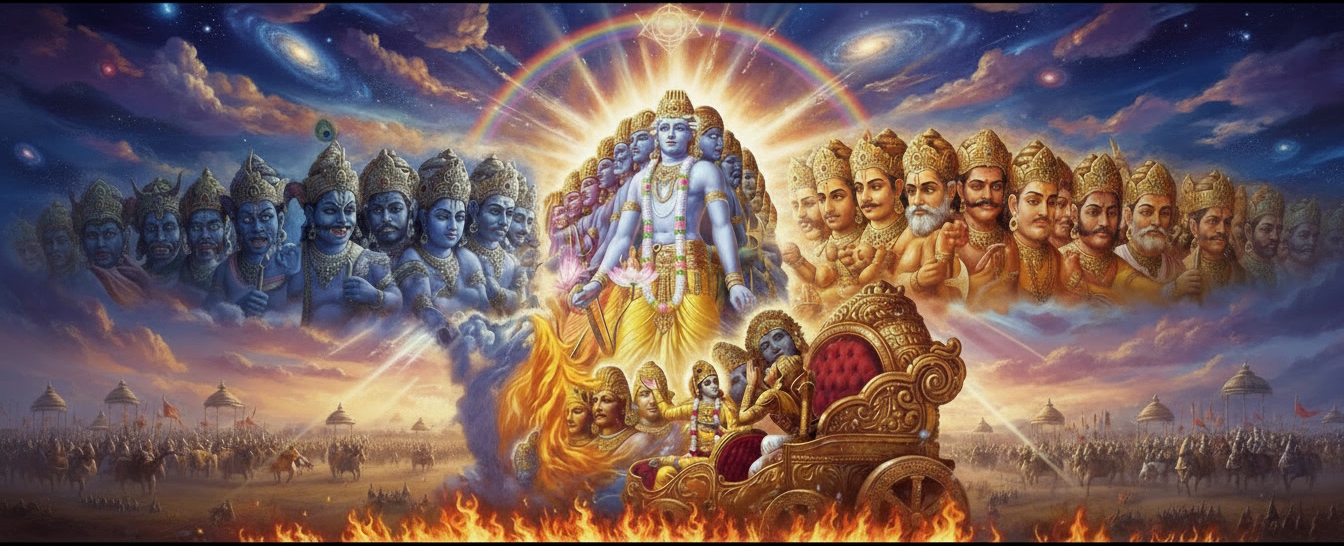
ध्यानेनात्मनि पश्यन्ति केचिदात्मानमात्मना।
अन्ये सांख्येन योगेन कर्मयोगेन चापरे।।13.25।।
dhyānenātmani paśyanti kecidātmānamātmanā|
anye sāṃkhyena yogena karmayogena cāpare||13.25||
Translation
Some by meditation behold the Self in the self by the self, others by the Yoga of knowledge, and still others by the Yoga of action.
हिंदी अनुवाद
कई मनुष्य ध्यानयोगके द्वारा, कई सांख्ययोगके द्वारा और कई कर्मयोगके द्वारा अपने-आपसे अपने-आपमें परमात्मतत्त्वका अनुभव करते हैं।
Commentaries & Translations
Swami Ramsukhdas
व्याख्या -- ध्यानेनात्मनि पश्यन्ति केचिदात्मानमात्मना -- पाँचवें अध्यायके सत्ताईसवेंअट्ठाईसवें श्लोकोंमें छठे अध्यायके दसवेंसे अट्ठाईसवें श्लोकतक और आठवें अध्यायके आठवेंसे चौदहवें श्लोकतक जो सगुणसाकार? निर्गुणनिराकार आदिके ध्यानका वर्णन हुआ है? उस ध्यानमें जिसकी जैसी रुचि? श्रद्धाविश्वास और योग्यता है? उसके अनुसार ध्यान करके कई साधक अपनेआपसे अपनेमें परमात्मतत्त्वका अनुभव करते हैं।जो सम्बन्धविच्छेद प्रकृति और पुरुषको अलगअलग जाननेसे होता है? वह सम्बन्धविच्छेद ध्यानसे भी होता है। ध्यान न तो चित्तकी मूढ़ वृत्तिमें होता है और न क्षिप्त वृत्तिमें होता है। ध्यान विक्षिप्त वृत्तिमें आरम्भ होता है। चित्त जब स्वरूपमें एकाग्र हो जाता है? तब समाधि हो जाती है। एकाग्र होनेपर चित्त निरुद्ध हो जाता है। इस तरह जिस अवस्थामें चित्त निरुद्ध हो जाता है। उस अवस्थामें चित्त संसार? शरीर? वृत्ति? चिन्तन आदिसे भी उपरत हो जाता है। उस समय ध्यानयोगी अपनेआपसे अपनेआपमें अपना अनुभव करके सन्तुष्ट हो जाता है (गीता 6। 19 20)।अन्ये सांख्येन योगेन -- दूसरे अध्यायके ग्यारहवेंसे तीसवें श्लोकतक चौथे अध्यायके तैंतीसवेंसे उन्तालीसवें श्लोकतक पाँचवें अध्यायके आठवें? नवें तथा तेरहवेंसे छब्बीसवें श्लोकतक और बारहवें अध्यायके चौथेपाँचवें आदि श्लोकोंमें कहे हुए सांख्ययोगके द्वारा कई साधक अपनेआपसे अपनेमें परमात्मतत्त्वका अनुभव करते हैं।सांख्ययोग नाम है विवेकका। उस विवेकके द्वारा सत्असत्का निर्णय हो जाता है कि सत् नित्य है? सर्वव्यापक है? स्थिर स्वभाववाला है? अचल है? अव्यक्त है? अचिन्त्य है और असत् चल है? अनित्य है? विकारी है? परिवर्तनशील है। ऐसे विवेकविचारसे सांख्ययोगी प्रकृति और उसके कार्यसे बिलकुल अलग हो जाता है और अपनेआपसे अपनेआपमें परमात्मतत्त्वका अनुभव कर लेता है।कर्मयोगेन चापरे -- दूसरे अध्यायके सैंतालीसवेंसे तिरपनवें श्लोकतक तीसरे अध्यायके सातवेंसे उन्नीसवें श्लोकतक चौथे अध्यायके सोलहवेंसे बत्तीसवें श्लोकतक पाँचवें अध्यायके छठेसातवें आदि श्लोकोंमें कहे हुए कर्मयोगके द्वारा कई साधक अपनेआपसे अपनेमें परमात्मतत्त्वका अनुभव करते हैं।जो सम्बन्धविच्छेद प्रकृति और पुरुषको अलगअलग जाननेसे होता है? वह सम्बन्धविच्छेद कर्मयोगसे भी होता है। कर्मयोगी जो कुछ भी करे? वह केवल संसारके हितके लिये ही करे। यज्ञ? दान? तप? तीर्थ? व्रत आदि जो कुछ भी करे? वह सब मात्र प्राणियोंके कल्याणके लिये ही करे? अपने लिये नहीं। ऐसा करनेसे स्वयंका उन क्रियाओंसे? पदार्थ? शरीर आदिसे सम्बन्धविच्छेद हो जाता है और अपनेआपसे अपनेमें परमात्मतत्त्वका अनुभव हो जाता है।मनुष्यने स्वाभाविक ही अपनेमें देहको स्वीकार किया है? माना है। इस मान्यताको दूर करनेके लिये अपनेमें,परमात्माको देखना अर्थात् देहकी जगह अपनेमें परमात्माको मानना बहुत आवश्यक है।अपनेमें परमात्माको देखना करणनिरपेक्ष होता है। करणसापेक्ष ज्ञान प्रकृतिके सम्बन्धसे होता है। इसलिये साधक किसी करणके द्वारा परमात्मामें स्थित नहीं होता? प्रत्युत स्वयं ही स्थित होता है स्वयंकी परमात्मामें स्थिति किसी करणके द्वारा हो ही नहीं सकती।
Sri Harikrishnadas Goenka
यहाँ आत्मदर्शनके विषयमें ये ध्यान आदि भिन्नभिन्न साधन विकल्पसे कहे जाते हैं --, शब्दादि विषयोंसे श्रोत्रादि इन्द्रियोंको हटाकर उनका मनमें निरोध करके और मनको अन्तरात्मामें ( निरोध करके ) जो एकाग्रभावसे चिन्तन करते रहना है? उसका नाम ध्यान है। तथा जैसे बगुला ध्यान करता है जैसे पृथिवी ध्यान करती है जैसे पर्वत ध्यान करते हैं इत्यादि उपमा दी जानेके कारण तैलधाराकी भाँति निरन्तर अविच्छिन्नभावसे चिन्तन करनेका नाम ध्यान है? उस ध्यानद्वारा कितने ही योगीलोग आत्मामें -- बुद्धिमें? आत्माको यानी प्रत्यक्चेतनको आत्मासे -- ध्यानाभ्यासद्वारा शुद्ध हुए अन्तःकरणसे -- देखते हैं। अन्य कई योगीजन सांख्ययोगके द्वारा ( देखते हैं ) -- सत्त्व? रज और तम -- ये तीनों गुण मुझसे देखे जानेवाले हैं और मैं उनसे भिन्न उनके व्यापारका साक्षी? उन गुणोंसे विलक्षण और नित्य ( चेतन ) आत्मा हूँ इस प्रकारके चिन्तनका नाम सांख्य है? यही योग है? ऐसे सांख्ययोगके द्वारा -- आत्मामें आत्माको देखते हैं। तथा अपर योगीजन कर्मयोगके द्वारा -- ईश्वरार्पणबुद्धिसे अनुष्ठान की हुई चेष्टाका नाम कर्म है? वही योगका साधन होनेके कारण गौणरूपसे योग कहा जाता है? उस कर्मयोगके द्वारा -- अन्तःकरणकी शुद्धि और,ज्ञानप्राप्तिके क्रमसे? ( आत्मामें आत्माको देखते हैं )।
Sri Anandgiri
He enables the lowest unqualified ones to attain engagement in the path of liberation -- 'Others indeed'.
He enacts the hearing dependent on a teacher -- 'This'.
He explains worship (Upasana) itself -- 'Faithful'.
He states the fruitfulness of the engagement even of those engaged by others' instruction -- 'They also'.
He excludes them from being primary qualified aspirants -- 'Hearing'.
He states the meaning indicated by 'also' (api) in 'They also' -- 'What'.
Sri Dhanpati
Thus having purified and propounded the meanings of 'That' and 'Thou', now He propounds the alternatives of means for the vision of the Self according to qualification -- 'By Meditation'.
Some best qualified 'Yogis' -- freed from defects like improbability etc. by hearing (Shravana) and reflection (Manana) done in this birth or another birth; having withdrawn instruments like ears etc. from objects like sound etc. into the mind; and fixing the mind one-pointedly on the Inner Self; by 'Meditation' (Dhyana) which is a synonym for Nididhyasana, consisting of continuous uninterrupted cognition like a stream of oil; see, directly realize, the 'Self', the Inner Consciousness, 'in the self', i.e., in the intellect, 'by the self', i.e., by the internal organ refined by meditation.
But in the explanation 'in the self means in the body', the consistency relative to the stated meaning is questionable.
'Others', middling qualified aspirants -- devoted to hearing and reflection; 'These Gunas Sattva, Rajas, and Tamas with modifications are non-Self, false; the Self is the witness of their activity, changeless, eternal, distinct from Gunas, all-pervading, a mass of Existence-Consciousness-Bliss' -- thus by 'Sankhya' consisting of contemplation generated by Vedanta enquiry, which is 'Yoga'; through the generation of meditation; they see the Self in the self by the self -- as before.
'Others', dull qualified aspirants -- 'Action itself is 'Yoga' by the quality of being for the sake of Yoga'; by that Karma Yoga performed with the intellect of offering to God; through the purification of Sattva (mind), hearing, reflection, meditation, and the generation of direct knowledge; they see the Self in the self by the self -- as before.
Sri Madhavacharya
'By Sankhya' -- by the knowledge of the nature of the Lord stated in the Vedas.
For the performers of action (Karmis) also, the vision is by hearing, knowing, and meditating. And for the hearers (Shravakas), by knowing and meditating. And for the Sankhyas, by meditating.
And thus the Gaupavana Sruti -- 'Having performed action, and hearing that, knowing, and meditating, one sees. The hearer also similarly having known and meditated; the knower also sees. Otherwise, his vision indeed does not arise somehow' -- thus.
'Others' is for showing the means even for the incapable.
Sri Neelkanth
He states the alternatives of means for such a vision of the Self based on the difference of qualified persons -- 'By meditation'. Here, those who desire to know the Self, they worship the Supreme Lord by desireless action; they are Karma Yogis. From that indeed, having the desire to know generated, they engage in hearing Vedanta. Then, upon the cessation of the improbability regarding the valid means (Pramana), they engage in reflection (Manana) on that very meaning to remove the improbability regarding the object of knowledge (Prameya); they are Sankhyas. Then, after the cessation of improbability regarding the means and the object, for the removal of the contrary feeling which is of the form of the idea of Self in the non-Self body etc., they engage to perform 'Nididhyasana' (contemplation), characterized by making a stream of similar cognitions preceded by the rejection of dissimilar cognitions. Then, upon its maturity, 'in the self', i.e., in the mental modification, they see the Self, the Supreme Lord; they are the Meditators (Dhyayins).
There, those who are adept in Karma and Sankhya, they 'by meditation' see 'in the self', i.e., in the body, the Self, the Supreme Lord, 'by the self', i.e., by the intellect. But 'others', who have not performed actions, see 'by Sankhya Yoga', i.e., by Yoga consisting of enquiry, through meditation. 'Others again' by Karma Yoga alone -- characterized as before -- [becoming] Sankhyas, see through meditation -- thus there is a combination of the three means, not an option.
Sri Ramanuja
'But others' -- who are unqualified for means of seeing the Self like Karma Yoga etc.; having 'heard' from 'others' -- from knowers who see the Truth -- worship the Self by Karma Yoga etc.; 'they too' cross over death by the vision of the Self -- who are 'devoted to hearing', established in hearing alone; and they, established in hearing, having sins purified, gradually commencing Karma Yoga etc., cross over death indeed. And from the word 'also' (api), the difference in stages is understood.
Now, to speak of the mode of inquiry into discrimination of the Self associated with Nature, He says 'All moving and unmoving being is born of the union of Sentient and Insentient' --
Sri Sridhara Swami
Regarding the knowledge of the distinct Self of such nature, He states the alternatives of means -- with 'By meditation' in two (verses).
'By meditation' -- by the repetition of the cognition of the form of the Self. 'In the self' i.e. in the body; 'by the self' i.e. by the mind; 'some' see the Self thus. 'But others' 'by Sankhya' -- by reflection on the distinctness of Nature and Person; 'by Yoga' -- by the eight-limbed one; 'and others' by Karma Yoga see -- this is the connection everywhere.
And of these, meditation etc., even though there is a sequential combination as appropriate, the statement of option is with the intention of the difference in respective commitments.
Sri Vedantadeshikacharya Venkatanatha
Explaining the very stated meaning with two verses, he states the differences in stages of Self-knowledge -- 'By meditation'.
Since there is indication as location, object, and instrument, the three words 'Atma' here have different subjects -- thus he states what is appropriate for each with 'In the self, the body' etc.
Due to the sequence of indicating successively lower stages, the word 'Dhyana' (Meditation) here denotes the stage named direct Yoga which is superior even to Sankhya.
The demonstration of the sequence of stages like 'unaccomplished in Yoga' etc. is to remove the doubt of independent means regarding the vision of the Self.
Following what was said before as 'By the Yoga of Knowledge for the Sankhyas' [3.3], he states the meaning of 'By Sankhya Yoga' as 'By Jnana Yoga'.
By 'Others', the intention is the class of those qualified for Karma Yoga mentioned before -- with this intention he says 'Not qualified for Jnana Yoga' etc.
Swami Chinmayananda
सर्वोपाधिविनिर्मुक्त आत्मा का शुद्ध स्वरूप में अनुभव करना ही आध्यात्मिक साधना का अन्तिम लक्ष्य है? जिसके सम्पादन के लिए अनेक उपाय? विकल्प यहाँ बताये गये हैं। मानव का व्यक्तित्व सुगठन उसी स्थिति से प्रारम्भ होना चाहिए जहाँ वर्तमान काल में मनुष्य स्वयं को पाता है। क्रमबद्ध पाठों के बिना कोई भी शिक्षा सफल नहीं हो सकती।अत्यन्त अशुद्ध एवं चंचल मन के व्यक्ति के आत्मविकास के लिए भी अनुकूल साधन का होना आवश्यक है। पूर्णत्व के सिद्धांत को केवल बौद्धिक स्तर पर समझने से ही आत्मिक उन्नति नहीं हो सकती। ज्ञान के अनुरूप ही व्यक्ति का जीवन होने पर वास्तविक विकास संभव होता। इसलिए? अपने वैचारिकजीवन को नियन्त्रित करने तथा पुनर्शिक्षा के द्वारा उसे सही दिशा प्रदान करने में साधक को विवेक तथा उत्साह से पूर्ण सक्रिय साधना का अभ्यास करने की आवश्यकता होती है। यही कारण है कि प्रत्येक व्यक्ति को आत्मोन्नति के इस मार्ग में कठिनाई का अनुभव होता है।विभिन्न प्रकार एवं स्तर के मनुष्यों के विकास के लिए? प्राचीनकाल के महान् ऋषियों नेविभिन्न साधन मार्गों को खोज निकाला? जिन सबका साध्य एक ही है। प्रत्येक मार्ग के अनुयायी के लिए वही मार्ग सबसे उपयुक्त है। किसी एक मार्ग को अन्यों की अपेक्षा श्रेष्ठ नहीं कहा जा सकता है। एक औषधालय में अनेक औषधियाँ रखी होती हैं प्रत्येक औषधि किसी रोग विशेष के लिए होती है और उस रोग से पीड़ित रोगी के लिए स्वास्थ्यलाभ होने तक वही औषधि सर्वोत्तम होती है।विभिन्न साधकों में प्रतीयमान भेद उनके मानसिक सन्तुलन और बौद्धिक क्षमता के भेद के कारण होता है। शास्त्रीय भाषा में इसे अन्तकरण की अशुद्धि कहते हैं। वे सब साधन? जिनके द्वारा चित्तशुद्धि प्राप्त होती है? बहिरंग साधन या गौण साधन कहलाते हैं। चित्त के शुद्ध होने पर आत्मसाक्षात्कार का अन्तरंग या साक्षात् साधन ध्यान है।कोई पुरुष ध्यान के द्वारा आत्मा को देखते हैं ध्यान के विषय में शंकराचार्य जी लिखते हैं कि शब्दादि विषयों से श्रोत्रादि इन्द्रियों को मन में उपरत करके मन को चैतन्यस्वरूप आत्मा में एकाग्र करके चिन्तन करना ध्यान कहलाता है। इस चिन्तन में ध्येयविषयक वृत्तिप्रवाह तैलधारा के समान अखण्ड और अविरल बना रहता है। स्वाभाविक है कि यह मार्ग उन उत्तम साधकों के लिए हैं? जिनका हृदय और विवेक समान रूप से विकसित होता है।आत्मा को देखने का अर्थ नेत्रों से रूपवर्ण देखना नहीं है? अन्यथा यह तो वेदान्त के सिद्धांत का ही खंडन हो जायेगा। आत्मा तो द्रष्टा है? दृश्य नहीं। अत? आत्मदर्शन से तात्पर्य स्वस्वरूपानुभूति से है। वह अनुभव करतलामलक के दर्शन के समान स्पष्ट और सन्देह रहित होने के कारण यह कहने की प्रथा पड़ गयी कि वे आत्मा को देखते हैं।आत्मा के द्वारा आत्मा को देखते हैं शंकराचार्य जी इस भाग के भाष्य में कहते हैं ध्यान के द्वारा आत्मा में अर्थात् ध्यान से सुसंस्कृत हुए अन्तकरण के द्वारा देखते हैं। शुद्धांतकरण में ही आत्मा का स्पष्ट अनुभव होता है।किसी को इस बात पर आश्चर्य़ हो सकता है कि यहाँ बुद्धि और अन्तकरण (मन) के लिए भी आत्मा शब्द का ही प्रयोग क्यों किया गया है इसका कारण यह है कि जब साधक को अपने पारमार्थिक सत्यस्वरूप का अनुभव होता है? तब उस सत्य की दृष्टि से मन? बुद्धि आदि का कोई पृथक अस्तित्व नहीं रह जाता है। सब आत्मस्वरूप ही बन जाते हैं। सभी तरंगें? फेन आदि समुद्र के अतिरिक्त कुछ नहीं है। स्वप्नद्रष्टा? स्वप्न जगत् और स्वप्न के अनुभव ये सब वस्तुत जाग्रत्पुरुष का मन ही है। इसी दृष्टि से हमारे आध्यात्मिक ग्रन्थों में हमारे व्यक्तित्व के बाह्यतम पक्ष शरीरादि को भी आत्मा शब्द से निर्देशित किया गया है।उपर्युक्त ध्यानयोग का मार्ग विवेक और वैराग्य से सुसम्पन्न उत्तम अधिकारियों के ही उपयुक्त है। अत मध्यम प्रकार के साधकों के लिए उपायान्तर बताते हैं।सांख्य योग विवेक के होते हुए भी वैराग्य की कमी होने के कारण जिन साधकों का मन ध्यान में स्थिर नहीं हो पाता और उनका तादात्म्य मन में उठने वाली वृत्तियों के साथ हो जाता है? उनको सांख्य योग का अभ्यास करने को कहा गया है। क्रमबद्ध युक्तियुक्त विचार का वह मार्ग जिसके द्वारा? हम किसी निश्चित सिद्धांत पर पहुँचते हैं? जो कभी प्रमाणान्तर या युक्ति से अन्यथा सिद्ध नहीं हो सकता अर्थात् अकाट्य रहता है? सांख्य योग कहलाता है।इस साधना के अभ्यास में साधक को इस ज्ञान को दृढ़ बनाये रखना चाहिए कि मन में उठने वाली ये वृत्तियाँ सत्व? रज और तमोगुण के कार्यरूप हैं तथा दृश्य हैं मैं इनका साक्षी इन से भिन्न और नित्य हूँ। इस प्रकार? मन का ध्यान वृत्तियों से हटकर साक्षी में स्थिर हो जाने पर अन्य वृत्तियाँ स्वत लीन हो जायेंगी और निर्विकल्प आत्मा का बोधमात्र रह जायेगा।कर्मयोग जिन पुरुषों के अन्तकरण में वासनाओं की प्रचुरता होती है? वे अध्ययनरूप सांख्ययोग का पालन नहीं कर सकते हैं और उनके लिए ध्यानयोग का प्रश्न ही नहीं उठता है। ऐसे साधकों के लिए प्रथम वासना क्षय के उपाय के रूप में कर्मयोग का उपदेश दिया जाता है जिसका गीता के तीसरे अध्याय में विशद् वर्णन किया गया है। अहंकार और स्वार्थ को त्यागकर ईश्वरार्पण की भावना से कर्म करने से पूर्वसंचित वासनाओं का क्षय हो जाता है और नई वासनाएं उत्पन्न नहीं होतीं। इस प्रकार? चित्त के शुद्ध होने पर आत्मज्ञान की जिज्ञासा जागृत होने पर वह व्यक्ति शास्त्राध्ययन के (सांख्य योग) योग्य बन जाता है। तत्पश्चात् विवेक और वैराग्य के दृढ़ होने पर ध्यान योग के द्वारा अध्यात्म साधना के सर्वोच्च शिखर ब्रह्मात्मैक्यबोध को प्राप्त हो जाता है।संक्षेप में? सत्त्वगुणप्रधान व्यक्ति के लिए ध्यानयोग उपयुक्त है। रजोगुण का आधिक्य और सत्त्वगुण की न्यूनता से युक्त पुरुष के लिए सांख्य योग है और सर्वथा रजोगुण प्रधान पुरुष के लिए कर्मयोग का साधन है।तब फिर? तमोगुण प्रधान अर्थात् जिसमें विचारशक्ति का अभाव हो? ऐसे व्यक्ति के लिए कौन सा उपाय है भगवान् बताते हैं कि
Sri Abhinavgupta
'By meditation'. 'Others'. And such knowledge is principal.
By some [the Self] is worshipped as the Self; by others by the Sankhya method stated before; by others by action; by others also -- not knowing such knowledge themselves, being devoted to hearing -- it is worshipped exactly as heard.
They too cross death, Samsara. The Lord's principle, being worshipped by whatever means, saves (delivers).
Therefore, it is stated 'one should remain thus in every way'.
Sri Jayatritha
Regarding 'Others by Sankhya Yoga', the explanation that 'Sankhya' is the knowledge of discrimination between Nature and Person stated in the Kapila-system is incorrect; because of the impropriety of accepting the non-Vedic Kapila-system here; and because of its impropriety as the principal means for the vision of God -- with this intention he explains differently -- 'By Sankhya'. By knowledge, i.e., by indirect knowledge.
Regarding 'By meditation', to refute the misunderstanding that meditation etc. alone by themselves are stated as the means for the vision of God, he says -- 'Of the performers of action'. The vision is attainable -- this is to be supplied. Because the order of meaning is more important than the order of reading, the statement is in reverse order. From where is this? To this he says -- 'And so'. 'Having meditated' is connected with the subsequent 'knower also'.
(Objection): Well, if everything is combined everywhere, this would be only one mode, and thus saying 'Some, others, others' would be improper? To this he says -- 'Other'. To show the knowledge etc. of respective means even for those directly incapable of the higher and higher means like meditation etc., relying on the difference in stages, 'others' etc. is stated, this is the meaning.
Sri Madhusudan Saraswati
Here, these alternatives of means for the vision of the Self are stated -- 'By meditation'. Here indeed there are four kinds of people: some Best, some Middling, some Dull, some Duller; there He states the means of Self-knowledge for the Best. 'By meditation' -- by the stream of similar cognitions uninterrupted by dissimilar cognitions, by the contemplation on the Self which is the fruit of hearing and reflection, denoted by the word Nididhyasana; 'in the self', i.e., in the intellect, 'they see', directly realize, the 'Self', the Inner Consciousness; 'by the self', i.e., by the internal organ refined by meditation; 'some' Best Yogis.
He states the means of Self-knowledge for the Middling. 'Others', the Middling, 'by Sankhya Yoga' -- which precedes Nididhyasana, consisting of hearing (Shravana) and reflection (Manana), preceded by discrimination between eternal and non-eternal etc. -- 'These modifications of the three Gunas are non-Self, all false; the Witness of them, Eternal, All-pervading, Changeless, Real, devoid of all connection with the inert, is the Self, I am' -- by the contemplation generated by the enquiry into Vedanta sentences thus; 'see the Self in the self' follows. Through the generation of meditation, this is the meaning.
He states the means of knowledge for the Dull. 'By Karma Yoga' -- by the group of actions enjoined by Vedas suitable for respective Varnas and Ashramas, performed with the intellect of offering to God, devoid of desire for fruit; 'and others', the Dull; 'see the Self in the self' follows. Through the purification of the mind leading to the generation of hearing, reflection, and meditation, this is the meaning.
Sri Purushottamji
(Objection): Well, if liberation is by knowledge alone, then there would be uselessness of other means? -- doubting thus, He states the nature of other means -- with 'By meditation' in two (verses).
'Some' knowers 'by meditation' -- by imagination/visualization -- in their 'self' (heart), 'by the self' (mind), see the 'Self', i.e., the Lord in the form of the Self. 'Others' 'by Sankhya' -- by the Yoga consisting of discrimination between eternal and non-eternal objects -- see (Him) similarly. 'Others' 'by Karma Yoga' -- by the Yoga in the form of His manifestation in actions -- see that Form.
Sri Shankaracharya
'By meditation' -- 'Meditation' is the contemplation with one-pointedness, having withdrawn instruments like ears etc. from objects like sound etc. into the mind, and (fixing) the mind in the inner Conscious Self. Similarly, from the use of the simile 'The crane meditates as if, the earth meditates as if, the mountains meditates as if' (Cha. U. 7.6.1).
Meditation is the continuous uninterrupted cognition like a stream of oil; by that meditation, they see 'in the self', i.e., in the intellect, the 'Self', the Inner Consciousness; 'by the self', i.e., by their own inner conscious internal organ refined by meditation; 'some' Yogis.
'Others by Sankhya Yoga' -- 'Sankhya' is the contemplation 'These qualities Sattva, Rajas, and Tamas are objects seen by me; I am other than them, the Witness of their functions, Eternal, distinct from qualities, the Self'; this is Sankhya Yoga; by that, 'they see the Self by the self' follows.
'By Karma Yoga' -- Action itself is Yoga; performed with the intellect of offering to God, of the nature of activity; it is called 'Yoga' because it is for the sake of Yoga, metaphorically (gunatah); by that -- through purification of the mind and generation of knowledge -- 'and others'.
Sri Vallabhacharya
He states the alternatives of means for such a vision -- with two (verses) 'By meditation' etc.
'In the self', i.e., in oneself, 'by the self', i.e., by oneself.
'Others' by Sankhya. 'By Yoga', i.e., by the Eight-limbed (Ashtanga) Yoga.
And 'by Karma Yoga', i.e., by desireless (action), 'others' see the Self.
Swami Sivananda
ध्यानेन by meditation? आत्मनि in the self? पश्यन्ति behold? केचित् some? आत्मानम् the Self? आत्मना by the self? अन्ये others? सांख्येन योगेन by the Yoga of knowledge (by the Sankhya Yoga)? कर्मयोगेन by Karma Yoga? च and? अपरे others.Commentary There are severla paths to reach the knowledge of the Self according to the nature or temperament and capacity of the individual. The first path is the Yoga of meditation taught by Maharshi Patanjali. The Raja Yogins behold the Supreme Self in the self (Buddhi) by the self (purified mind). Meditation is a continous and unbroken flow of thought of the Self like the flow of oil from one vessel to another. Through concentration hearing and the other senses are withdrawn into the mind. The senses are not allowed to run towards their respective sensual objects. They are kept under proper check and control through the process of abstraction. Then the mind itself is made to abide in the Self through constant meditation on the Self. The mind is refined or purified by meditation. The mind that is rendered pure will naturally move towards the Self. It is not attracted by nor is it attached to the sensual objects.Sankhya Yoga is Jnana Yoga. The aspirant does Vichara (analysis? reflection) and separates himself from the three alities of Nature? the three bodies and the five sheaths and identifies himself with the witness (Self). He thinks and feels? I am distinct from the three alities. I am the silent witness. I am unattached. I am nondoer. I am nonenjoyer. I am immortal? eternal? selfexistent? selfluminous? indivisible? unborn and unchanging.The Karma Yogi surrenders his actions and their fruits to the Lord. He has Isvarapana Buddhi (intelligence that offers everything to God). This produces purity of mind which gives rise to knowledge of the Self. Karma Yoga brings about concentration of the mind through the purification of the mind. It leads to Yoga through the purification of the mind and so it is spoken of as Yoga itself.Those who practise Sankhya Yoga are the highest class of spiritual aspirants. Those who practise the Yoga of meditation are aspirants of the middling class. Those who practise Karma Yoga are the lowest class of spiritual aspirants. The aspirants of the middling and lowest class soon become aspirants of the highest class through rigorous Sadhana or spiritual practices. (Cf.V.5VI.46)
Swami Gambirananda
Dhyanena, through meditation: Meditation means contemplation (on the Self) after withdrawing into the mind with concentration the organs of hearing etc. from the objects like sound etc., and then withdrawing the mind into the indwelling conscious Self. Thus, from the citation of such illustrations as, 'the crane meditates, as it were, 'the earth meditates, as it were; the mountains meditate, as it were' (Ch. 7.6.1), it follows that meditation is a constant and uninterrupted current of thought like a line of pouring oil. Through that meditation, kecit, some yogis; pasyanti, realize; the indwelling conscious atmanam, Self; atmani, in (their) intellect; atmana, with the help of the internal organ that has been purified by meditation.
Anye, others; sankhyena yogena, through Sankhya-yoga: Sankhya means thinking, 'These alities, viz sattva, rajas and tamas, are objects of my perception; I am the Self, distinct from them, a witness of their functions, eternal and different from the alities.' This Sankhya is Yoga. [By Sankhya is meant that knowledge which arises from the foregoing reflection. This knowledge is itself called Yoga (concentration of mind) inasmuch as it is similar to Yoga in leading to the realization of the Self.] Through that they realize the Self with the help of the internal organ. This is how it is to be construed.
And anye, others; karma-yogena, through Karma-yoga-action itself being the Yoga: Action performed with the idea of dedication to God is figuratively called Yoga since it leads to Yoga. (others realize) with the help of that (action), through purification of the mind and rise of Knowledge. [The best among the yogis are competent for meditation (dhyana); the modiocre for reflection (Sankhya); and the lowest for Karma-yoga.]
Swami Adidevananda
The different type of Yogis are described herein:
(1) Some with perfect Yoga perceive the self (Atmanam) in the body with the mind (Atmana) by meditation. (2) Others with imperfect Yoga see the self, with mind rendered fit for Yoga, by Sankhya Yoga, namely, Jnana Yoga, (3) Still others, (a) unalified to practise Jnana Yoga, and (b alified but preferring an easier method, and (c) also distinguished persons like Janaka - all these perceive the self after being alified for Yoga by Karma Yoga which contains within itself knowledge (Jnana).