Bhagavad Gita - Chapter 13 - Shloka (Verse) 31
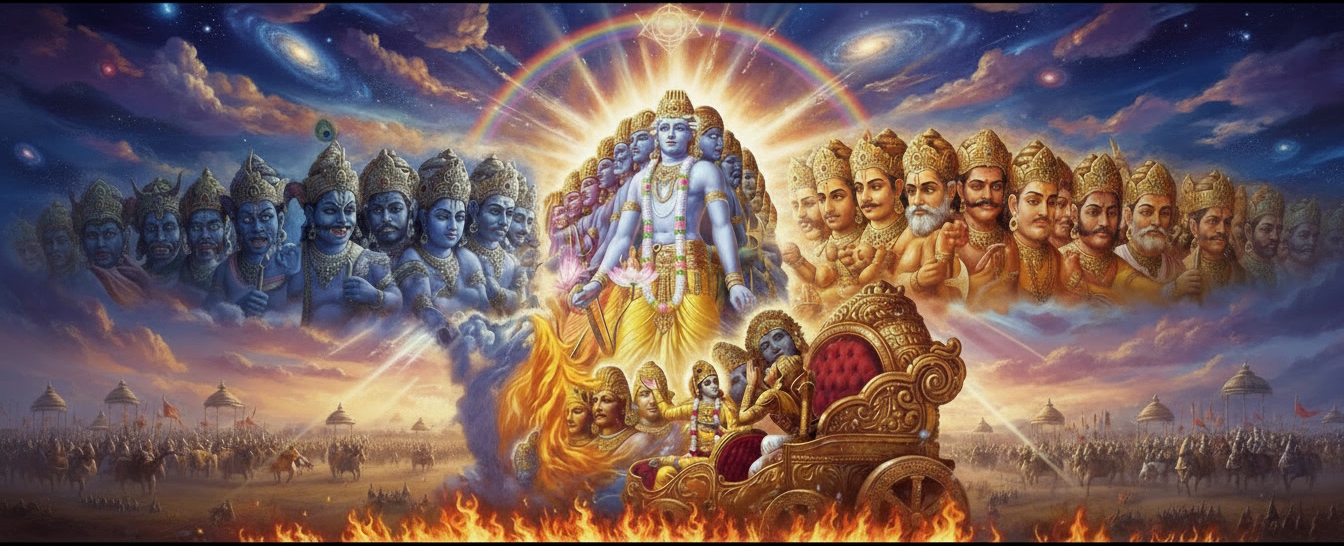
यदा भूतपृथग्भावमेकस्थमनुपश्यति।
तत एव च विस्तारं ब्रह्म सम्पद्यते तदा।।13.31।।
yadā bhūtapṛthagbhāvamekasthamanupaśyati|
tata eva ca vistāraṃ brahma sampadyate tadā||13.31||
Translation
When a man sees the whole variety of beings as resting in the One, and spreading forth from That alone, he then becomes Brahman.
हिंदी अनुवाद
जिस कालमें साधक प्राणियोंके अलग-अलग भावोंको एक प्रकृतिमें ही स्थित देखता है और उस प्रकृतिसे ही उन सबका विस्तार देखता है, उस कालमें वह ब्रह्मको प्राप्त हो जाता है।
Commentaries & Translations
Swami Ramsukhdas
व्याख्या -- [प्रकृतिके दो रूप हैं -- क्रिया और पदार्थ। क्रियासे सम्बन्धविच्छेद करनेके लिये उनतीसवाँ श्लोक कहा? अब पदार्थसे सम्बन्धविच्छेद करनेके लिये यह तीसवाँ श्लोक कहते हैं।]यदा भूतपृथग्भावं ৷৷. ब्रह्म सम्पद्यते तदा -- जिस कालमें साधक सम्पूर्ण प्राणियोंके अलगअलग भावोंको अर्थात् त्रिलोकीमें जितने जरायुज? अण्डज? उद्भिज्ज और स्वेदज प्राणी पैदा होते हैं? उन प्राणियोंके स्थूल? सूक्ष्म और कारणशरीरोंको एक प्रकृतिमें ही स्थित देखता है? उस कालमें वह ब्रह्मको प्राप्त हो जाता है।त्रिलोकीके स्थावरजङ्गम प्राणियोंके शरीर? नाम? रूप? आकृति? मनोवृत्ति? गुण? विकार? उत्पत्ति? स्थिति? प्रलय आदि सब एक प्रकृतिसे ही उत्पन्न हैं। सम्पूर्ण प्राणियोंके शरीर प्रकृतिसे ही उत्पन्न होते हैं? प्रकृतिमें ही स्थित रहते हैं और प्रकृतिमें ही लीन होते हैं। इस प्रकार देखनेवाला ब्रह्मको प्राप्त हो जाता है अर्थात् प्रकृतिसे अतीत स्वतःसिद्ध अपने स्वरूप परमात्मतत्त्वको प्राप्त हो जाता है। वास्तवमें वह पहलेसे ही प्राप्त था? केवल प्रकृतिजन्य पदार्थोंके साथ अपना सम्बन्ध माननेसे ही उसको अपने स्वरूपका अनुभव नहीं होता था। परन्तु जब वह सबको प्रकृतिमें ही स्थित और प्रकृतिसे ही उत्पन्न देखता है? तब उसको अपने स्वतःसिद्ध स्वरूपका अनुभव हो जाता है।जैसे पृथ्वीसे उत्पन्न होनेवाले स्थावरजङ्गम जितने भी शरीर हैं तथा उन शरीरोंमें जो कुछ भी परिवर्तन होता है? रूपान्तर होता है (टिप्पणी प0 705.1) क्रियाएँ होती हैं (टिप्पणी प0 705.2) वे सब पृथ्वीपर ही होती हैं। ऐसे ही प्रकृतिसे उत्पन्न होनेवाले जितने गुण? विकार हैं तथा उनमें जो कुछ परिवर्तन होता है? घटबढ़ होती है? वह सबकीसब प्रकृतिमें ही होती है। तात्पर्य है कि जैसे पृथ्वीसे पैदा होनेवाले पदार्थ पृथ्वीमें ही स्थित रहनेसे और पृथ्वीमें लीन होनेसे पृथ्वीरूप ही हैं? ऐसे ही प्रकृतिसे पैदा होनेवाला सब संसार प्रकृतिमें ही स्थित रहनेसे और प्रकृतिमें ही लीन होनेसे प्रकृतिरूप ही है। इसी प्रकार स्थावरजङ्गम प्राणियोंके रूपमें जो चेतनतत्त्व है? वह निरन्तर परमात्मामें ही स्थित रहता है। प्रकृतिके सङ्गसे उसमें कितने ही विकार क्यों न दीखें? पर वह सदा असङ्ग ही रहता है। ऐसा स्पष्ट अनुभव हो जानेपर साधक ब्रह्मको प्राप्त हो जाता है।यह नियम है कि प्रकृतिके साथ अपना सम्बन्ध माननेके कारण स्वार्थबुद्धि? भोगबुद्धि? सुखबुद्धि आदिसे प्राणियोंको अलगअलग भावसे देखनेपर रागद्वेष पैदा हो जाते हैं। राग होनेपर उनमें गुण दिखायी देते हैं और द्वेष होनेपर दोष दिखायी देते हैं। इस प्रकार दृष्टिके आगे रागद्वेषरूप परदा आ जानेसे वास्तविकताका अनुभव नहीं होता। परन्तु जब साधक अपने कहलानेवाले स्थूल? सूक्ष्म और कारणशरीरसहित सम्पूर्ण प्राणियोंके शरीरोंकी उत्पत्ति? स्थिति और विनाशको प्रकृतिमें ही देखता है तथा अपनेमें उनका अभाव देखता है? तब उसकी दृष्टिके आगेसे रागद्वेषरूप परदा हट जाता है और उसको स्वतःसिद्ध परमात्मतत्त्वका अनुभव हो जाता है। सम्बन्ध -- बाईसवें श्लोकमें जिसको देहसे पर बताया है और पीछेके (तीसवें) श्लोकमें जिसका ब्रह्मको प्राप्त होना बताया है? उस पुरुष(चेतन) के वास्तविक स्वरूपका वर्णन आगेके श्लोकमें करते हैं।
Sri Harikrishnadas Goenka
फिर भी? उसी यथार्थ ज्ञानकी दूसरे शब्दोंसे व्याख्या करते हैं --, जिस समय ( यह विद्वान् ) भूतोंके अलगअलग भावोंको -- भूतोंकी पृथक्ताको? एक आत्मामें ही स्थित देखता है अर्थात् शास्त्र और आचार्यके उपदेशसे मनन करके आत्माको इस प्रकार प्रत्यक्षभावसे देखता है कि यह सब कुछ आत्मा ही है। तथा उस आत्मासे ही सारा विस्तार -- सबकी उत्पत्ति -- विकास देखता है अर्थात् जिस समय आत्मासे ही प्राण? आत्मासे ही आशा? आत्मासे ही संकल्प? आत्मासे ही आकाश? आत्मासे ही तेज? आत्मासे ही जल? आत्मासे ही अन्न? आत्मासे ही सबका प्रकट और लीन होना इत्यादि प्रकारसे सारा विस्तार आत्मासे ही हुआ देखने लगता है उस समय वह ब्रह्मको प्राप्त हो जाता है -- ब्रह्मरूप ही हो जाता है।
Sri Anandgiri
Regarding the doubt -- 'Due to fullness, the status of being the Self of all belongs to the Self, and thus connection with the body etc.; by that, possession of that (impurity) through agency etc. (might occur); for it is seen that even pure Panchagavya etc. becomes impure by the defect of contact with the impure' -- restating this doubt, he introduces the verse as an answer -- 'Of the One'.
He proves the beginninglessness itself -- 'Beginning'. Doubting 'Still what would happen?', he says that absence of decay caused by being an effect is established -- 'For what' (Yaddhi). Doubting 'Still there will be decay through the reduction of qualities', he says no -- 'So'. Doubting 'Because of being partless indeed, there is absence of decay through parts, and because of being attributeless, there is absence of decay through qualities, still there might be decay by nature', he says -- 'Supreme Self'. When decay is absent for the Supreme Self by Itself or from another, he states the result -- 'Since'.
How is one established in His own glory situated in bodies? To this he says -- 'In bodies'. Though situated in the body etc. due to omnipresence and being the Self of all, He does not act by Himself or identified with body etc., because of being immutable and because the body etc. are imagined, this is the meaning. Doubting 'Even in the absence of agency, there might be experiencership', he says -- 'Because of not doing that'. He justifies that very thing -- 'For he who'.
If agency etc. are absent for the Supreme, whose is it desired to be? he asks -- 'Who then'. He translates the doubt that agency etc. belong to some Jiva other than the Supreme -- 'If'. He faults that in that view there would be a break in context -- 'Then'. He doubts that there is no contradiction with the introduction because a Jiva distinct from the Lord is not accepted -- 'Now'. Then the locus of the perceived agency etc. must be stated, says the opponent -- 'Who'. Doubting 'Since the Supreme alone is the locus of agency etc., nothing needs to be said', he says -- 'Or the Supreme'. 'Is not to be said' is connected with the previous. The sense is: for if He possesses agency etc., the Supreme would not be the Lord like us.
Since if agency etc. is not distinct for the Supreme or another, it is impossible to know or speak of the root of Sruti 'Though situated in the body' etc., it must be abandoned indeed -- thus he concludes with the agreement of examiners -- 'In every way'. He resolves that since it is superimposed by ignorance on the Supreme Reality which is non-doer and non-enjoyer, the Lord's view is indeed acceptable -- 'There'. He elaborates that very solution -- 'Ignorance'.
If transactional agency etc. is accepted, why is the real one not accepted? To that he says -- 'But not'. He presents a sign (reason) for the absence of real agency etc. -- 'Therefore'.
Sri Dhanpati
Refuting the contingency of distinctness of Nature and modifications from the Person like the Sankhyas, He elaborates that same right vision again with other words -- 'When' (Yada).
'When', at which time, he 'sees' the 'separate existence', distinctness, of beings as 'situated in One' -- in one Self, the substratum of the entire world like Nature etc., non-different from the inner self, Brahman, existing as Reality. Since the imagined does not exceed the substratum, following ('anu') the instruction of scripture and teacher, afterwards he sees it as not distinct from the Self -- 'The Self alone is all this', 'All this is indeed Brahman', 'There is no diversity here', 'I am Brahman' -- thus he directly realizes. 'And from That alone', from the Supreme Self alone, 'the expansion' -- 'From whom indeed these beings are born', 'From Bliss indeed...', 'From that, from this Self, ether was born', 'That saw', 'That created fire' -- thus he sees the expansion of the entire world. 'Then', at that time, he 'attains Brahman'. Meaning he becomes Brahman indeed. From the Sruti 'He who knows Brahman becomes Brahman indeed'.
(The interpretation) 'Seeing it situated in Nature alone which is the form of God's power during dissolution. And from that alone, from that very Nature, seeing the expansion of beings at the time of creation' -- this view was not explained by the Teachers (Shankara), intending that it does not refute the stated contingency (of duality) and because the statement 'attains Brahman' would be inappropriate.
Sri Madhavacharya
'Situated in one' -- situated in one Vishnu.
'And from That alone' -- and the expansion from Vishnu.
Sri Neelkanth
(Objection): Well, how does agency belong to Nature alone and not to the Self? Doubting this, He says -- 'When' (Yada). 'Separate existence', existence in manifold forms, of 'beings' -- ether etc. and viviparous etc. -- this visible (world), 'when' he 'sees' 'situated in One', situated in one Self, like snake etc. in a rope, or ear-rings etc. in gold, dissolved, following ('anu') the instruction of scripture and teacher.
'And' he sees the 'expansion' 'from That alone', from the One, following the waking state (manifestation) of the separate existence of beings, like dream etc. 'Then he attains Brahman', he becomes Brahman indeed.
This is the sense: Agency is indeed possession of action, and action is movement; and that is possible only for the limited, distinct, material intellect etc., but not for the All-pervading Self who devours the separate existence of all beings -- thus.
Sri Ramanuja
This Supreme Self, extracted from the body, has been described by His nature; though 'situated in the body', 'because of beginninglessness' -- because of not being originated -- He is 'Immutable', devoid of decay.
'Because of attributelessness' -- because of being devoid of qualities like Sattva etc. -- He 'does not act', 'nor is tainted'. He is not tainted by the natures of the body, not bound.
Although He does not act because of attributelessness, how is He not tainted by the natures of the body while being eternally connected? To this He says --
Sri Sridhara Swami
Now, however, since beings are non-different (from Prakriti) by being just Prakriti, not seeing the difference of the Self created by the difference of beings, he attains Brahmanhood -- he says this with 'When' (Yada).
'When' he sees, reflects on, the 'separate existence' (prithagbhavam) -- the difference, separateness -- of beings, moving and non-moving, as 'situated in one' (ekastham) -- situated in the one Nature (Prakriti) alone which is the form of the Lord's power -- during dissolution; 'and from that alone' (tata eva) -- from that very Nature -- (sees) the 'expansion' of beings at the time of creation;
'then' (tada), seeing the non-difference of beings also due to their being just that much (Prakriti), he 'attains' the perfect 'Brahman'. Meaning he becomes Brahman indeed.
Sri Vedantadeshikacharya Venkatanatha
Now the distinction characterized by mutability and immutability is stated -- with the verse 'When' (Yada). To determine one or the other by the word 'One' (Eka), the word 'Bhuta' (being) here refers to the aggregate of Sentient and Insentient mixed together like sesame and oil -- with this intention he says 'Nature and Person'. The word 'separate existence' (prithagbhava) here collects difference in the form of species and qualities etc. without distinction. And all that, being of the form of attaining another state, is distinct from the changeless Person -- so he says 'separate existence like godhood, manhood, shortness, length etc.'.
The word 'One' (Eka) here is to determine one of the two in context -- so he says 'Situated in one principle'. What is that one? To this he says 'Situated in Nature'. If the Self were intended by the word 'One' here, then seeing the inequality of gods etc. in Him alone would be stated; and that would contradict the introduction 'Seeing equally' [13.29] etc. and other Smritis like 'Pundits are equal-sighted' [5.18] -- with this intention he says 'Not situated in the Self'. The prattle of others that 'Only the one Brahman, Pure Being, is stated here as the locus of all variations and all transformations' is already refuted, this is also the intention.
In 'You are the Self named son' [Kau. U. 2.11] etc., whatever modification of the Self in the form of son etc. appears, that too, for one considering 'From limb to limb you are born' [Kau. U. 2.11] etc., shines as belonging only to the Nature-part -- so it is said 'And the expansion from That alone'. He explains that -- 'From Nature alone'. In the initial variegated transformation of the principle of Nature into forms of gods etc., and in the transformation rooted in that which takes the name of progeny, only the proximity of the Enjoyer Person is required for enjoyment, not that he becomes the locus of modifications existing in the abode of enjoyment etc. -- this is the intention of 'Eva' (alone).
Regarding 'attains Brahman', since becoming the Supreme Self is contradictory, and the state of individual self is eternally established, it means attaining supreme equality with Supreme Brahman, consistent with 'Attains supreme equality' [Mun. U. 3.1.3] and 'Attained unity of nature with Me' [14.2] -- with this intention he says 'Unlimited'. Or the intention is that direct attainment of Supreme Self would not happen merely by discriminative knowledge of body and Self. 'Brahma sampadyate' means becomes Brahman. There the resultant meaning is stated as 'Attains the Self'. Or 'Brahma' is accusative, 'sampadyate' means fully attains.
Swami Chinmayananda
किसी वस्तु या घटना के वैज्ञानिक अध्ययन की पूर्णता उसके बौद्धिक विश्लेषण तथा प्रायोगिक प्रत्यक्षीकरण से ही होती है।जब भौतिक विज्ञान में यह ज्ञात होता है कि परमाणु पदार्थ की इकाई है? तब इस ज्ञान के साथ यह भी समझना चाहिए कि ये परमाणु ही विभिन्न संख्या एवं प्रकारों में संयोजित होकर असंख्य रूप और गुणों वाली वस्तुओं के इस जगत् की रचना करते हैं। इसी प्रकार समस्त नाम और रूपों के पीछे एक आत्मतत्त्व ही सत्य है? यह जानना मात्र आंशिक ज्ञान है। ज्ञान की पूर्णता तो इसमें होगी कि जब हम यह भी जानेंगे कि इस एक आत्मा से विविधता की यह सृष्टि किस प्रकार प्रकट हुई है।जिस प्रकार? समुद्र को जानने वाला पुरुष असंख्य और विविध तरंगों का अस्तित्व एक समुद्र में ही देखता है? इसी प्रकार आत्मज्ञानी पुरुष भी भूतों के पृथक्पृथक् भाव को एक परमात्मा में ही स्थित देखता है। समस्त तरंगें समुद्र का ही विस्तार होती हैं। ज्ञानी पुरुष का भी यही अनुभव होता है कि एक आत्मा से ही इस सृष्टि का विस्तार हुआ है। स्वस्वरूपानुभूति के इन पवित्र क्षणों में ज्ञानी पुरुष स्वयं ब्रह्म बनकर यह अनुभव करता है कि एक ही आत्मतत्त्व अन्तर्बाह्य सबको व्याप्त और आलिंगन किए है? सबका पोषण करते हुए स्थित है न केवल गहनगम्भीर और असीमअनन्त में वह स्थित है? वरन् सभी सतही नाम और रूपों में भी वह व्याप्त है।स्वयं आत्मस्वरूप बनकर ही आत्मा का अनुभव होता है। जिसने यह पूर्णत जान लिया है कि स्वहृदय में स्थित आत्मा ही सर्वत्र भूतमात्र में स्थित आत्मा (ब्रह्म) है तथा किस प्रकार अविद्या के आवरण के कारण विविध नामरूपों में सत्य का दीप्तिमान स्वरूप आवृत हो जाता है? वही पुरुष तत्त्वज्ञ और सम्यक्दर्शी कहा जाता है। उस अनुभव में वह स्वयं उपाधियों से परे ब्रह्म से तादात्म्य को प्राप्त होता है।एक ही आत्मा के समस्त देहों में स्थित होने से उसे भी उपाधियों के दोष प्राप्त होते होंगे। ऐसी शंका के निवारण के लिए भगवान् कहते हैं
Sri Abhinavgupta
Or else -- 'When' (Yada) etc. up to 'is not tainted' (na upalipyate).
Due to extensiveness, by all-pervasiveness, when he sees the separateness, difference, of beings in the Self alone; and thinks of it as arisen from the Self alone; even then, due to being the doer of all, He does not partake of taint; because this Supreme Self alone, though situated in the body, is not tainted like the sky.
Sri Jayatritha
The explanation of 'Ekastham' as 'consisting of the One (Self)' is opposed to all proofs -- with this thought he says -- 'Situated in One (Vishnu)'.
The explanation of 'And expansion from That alone' as 'expansion of the universe from oneself alone' is incorrect -- with this thought he says -- 'From That alone'.
'Expansion' means origin.
Sri Madhusudan Saraswati
Thus, having tentatively accepted the vision of difference in the Field (Kshetra), the vision of difference in the Knower of the Field (Kshetrajna) has been refuted.
But now, he refutes even the vision of difference in the Field because it is a product of Maya — with 'Yada' (when), etc. 'Yada' means at which time he 'anupashyati' (sees/perceives) — meaning he contemplates himself following the instruction of the scriptures and the teacher that 'All this is indeed the Self' — the 'prithag-bhavam' (separate existence) of beings, i.e., of all inanimate classes both moving and unmoving, their mutual distinctness, as 'ekastham' (situated in one), meaning situated or imagined in the one Self which is Existence; because the imagined is not different from its substratum, he sees it as not different from the nature of the Self which is Existence. Even so, he perceives the 'expansion' from that one Self alone and the 'separate existence' of beings due to the influence of Maya, like the magic of a dream.
'Brahma sampadyate' (he attains/becomes Brahman); then, due to the absence of the vision of differences whether of the same species or different species, he becomes Brahman Itself, void of all evil.
At that time — according to the Sruti: 'In which all beings have become the very Self of the knower, there what is delusion, what is sorrow, for one seeing unity?'
In 'Prakrityaiva ca' (13.29), the difference of the Self was refuted; but in 'Yada bhutaprithagbhavam', even the difference of the non-Self is refuted; this is the distinction.
Sri Purushottamji
Similarly, subtlety in dissolution and expansion in origin of all, when he sees that form from Brahman alone, then he attains Brahmanhood -- he says this with 'When' (Yada).
'When' he sees the 'separate existence' (prithagbhavam) -- the difference from Brahman -- of 'beings' (bhutanam) -- moving and non-moving, consisting of wonderful manifold forms -- as 'ekastham' (situated in One) -- situated in the nature of Brahman consisting of enjoyment in the form of the will to dissolve -- during dissolution; 'and' (cha) again 'from That alone', from Brahman alone desiring to enjoy the world, he sees the 'expansion' at the time of creation; 'then' he 'attains Brahman', meaning attains Brahmanhood.
Sri Shankaracharya
'When' (Yada) -- at which time; he 'sees' (anupashyati) -- sees directly following the instruction of scripture and the teacher -- the 'separate existence' (prithagbhavam) -- the separateness -- of beings as 'situated in One' (ekastham) -- situated in the one Self alone; thinking 'The Self alone is all this' (Cha. U. 7.25.2); 'and from That alone' (tata eva cha) -- and from that very Self -- the 'expansion' (vistaram) -- origin, evolution -- 'From the Self is Prana, from the Self is hope, from the Self is memory, from the Self is ether, from the Self is fire, from the Self is water, from the Self are appearance and disappearance, from the Self is food' (Cha. U. 7.26.1) -- when he sees the expansion in such ways; he 'attains Brahman' (Brahma sampadyate) -- becomes Brahman, 'then' (tada), at that time, this is the meaning.
Since the one Self is the Self of all bodies, regarding the contingency of connection with their defects, this is said.
Sri Vallabhacharya
In the third (view/aspect of Self) also, He shows the fruit -- 'When' etc. In beings like gods etc. which consist of the principles of Nature and Person, seeing their 'separate existence' -- like godhood, manhood, etc., and long, short, gross, thin, etc. -- or the dual nature known by separateness -- as 'situated in One', situated in Nature and situated in the collective Person; 'and from That alone' realizes the emergence and 'expansion' -- which is heard in 'Just as small sparks from fire... so from this Self... beings emerge' [Bri. U. 2.1.20] etc.; then he 'attains Brahman', the Imperishable (Akshara) -- attains unity with the unlimited Imperishable Self.
This is the meaning -- 'The individual is like a small stream, the collective is like the Ganges water. The Imperishable is like the power of that (water), the Supreme Hari is like the Deity (of the river). The Sruti speaks of the unity of the Person with the Imperishable. But unity with the Supreme Person (Purushottama) is considered as entry by His will.' [Va. Si. Mu.]
Regarding this, the false-theorists (Advaitins), imagining a difference caused by Avidya, teach by accepting the dealing of seer and seen -- that should be ignored; because of the saying of the expert 'For followers of Sruti, dealing is according to Sruti alone, not logical'. The details should be understood from the Nibandha.
Swami Sivananda
यदा when? भूतपृथग्भावम् the whole variety of beings? एकस्थम् resting in the One? अनुपश्यति sees? ततः from that? एव alone? च and? विस्तारम् the spreading? ब्रह्म Brahman? सम्पद्यते (he) becomes? तदा then.Commentary A man attains to unity with the Supreme when he knows or realises through intuition that all these manifold forms are rooted in the One. As waves in water? atoms in the earth? rays in the sun? organs in the body? emotions in the mind? sparks in the fire? so verily are all forms rooted in the One. Wherever he turns his gaze he beholds only the one Self and enjoys the bliss of the Self.When he beholds the diversity of beings rooted in the One in accordance with the teachings of the scriptures and the preceptor? he realises through intuitive experience that all that he beholds is nothing but the Self and that the origin and the evolution of all is from That One alone. Compare with the Chhandogya Upanishad? 7.26.1.आत्मतः प्राण आत्मत आशा आत्मतः स्मरआत्मत आकाश आत्मतस्तेज आत्मत आपःआत्मत आविर्भावतिरोभावावात्मतोऽन्नम्।।Atmatah prana atmata asa atmatah smaraAtmata akasa atmatasteja atmata apahAtmata avirbhavatirobhavavatmatonnam.From the Self is life from the Self is desire from the Self is love from the Self is ether from the Self is light from the Self are the waters from the Self is appearance and disappearance from the Self is food.
Swami Gambirananda
Yada, when, at the time when; anupasyati, one realizes-having reflected in accordance with the instructions of the scriptures and the teachers, one realizes as a matter of one's own direct experience that 'All this is but the Self' (Ch. 7.25.2); that bhuta-prthak-bhavam, the state of diversity of living things; is ekastham, rooted in the One, existing in the one Self; and their vistaram, manifestation, origination; tatah, eva, is also from That-when he realizes that origination in such diverse ways as, 'the vital force is from the Self, hope is from the Self, memory [Smara, memory; see Sankaracarya's Comm. on Ch. 7.13.1.-Tr.] is from the Self, space is from the Self, fire is from the Self, water is from the Self, coming into being and withdrawal are owing to the Self, food is from the Self' (op. cit. 7.26.1); tada, then, at that time; brahma sampadyate, one becomes identified with Brahman Itself. This is the import.
If the same Self be the Self in all the bodies, then there arises the possiblity of Its association with their defects. Hence this is said:
Swami Adidevananda
When he perceives that the diversified 'modes of existence' of all beings as men, divinities etc., are founded on the two principles of Prakrti and Purusa; when he perceives that their existence as divine, human, short, tall etc., is rooted in 'one' common foundation, namely, in the Prakrti, and not in the self; when he sees that 'their expansion', i.e., the successive proliferaton into sons, grandsons and such varieties of beings, is from Prakrti alone - then he reaches the brahman. The meaning is that he attains the self devoid of limitations, in Its pure form of knowledge.