Bhagavad Gita - Chapter 18 - Shloka (Verse) 1
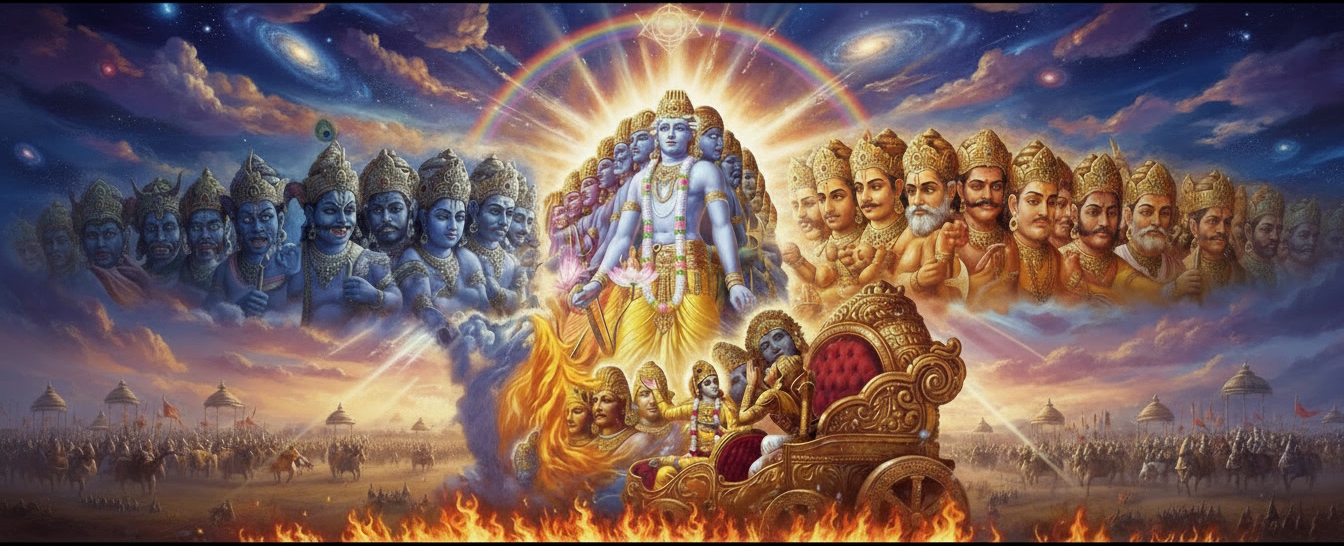
अर्जुन उवाच संन्यासस्य महाबाहो तत्त्वमिच्छामि वेदितुम्।
त्यागस्य च हृषीकेश पृथक्केशिनिषूदन।।18.1।।
arjuna uvāca
saṃnyāsasya mahābāho tattvamicchāmi veditum|
tyāgasya ca hṛṣīkeśa pṛthakkeśiniṣūdana||18.1||
Translation
Arjuna said I desire to know severally, O mighty-armed, the essence or truth of renunciation, O Hrishikesa, as also of abandonment, O slayer of Kesi.
हिंदी अनुवाद
अर्जुन बोले -- हे महाबाहो ! हे हृषीकेश ! हे केशिनिषूदन ! मैं संन्यास और त्यागका तत्त्व अलग-अलग जानना चाहता हूँ।
Commentaries & Translations
Swami Ramsukhdas
संन्यासस्य महाबाहो ৷৷. पृथक्केशिनिषूदन -- यहाँ महाबाहो सम्बोधन सामर्थ्यका सूचक है। अर्जुनद्वारा इस सम्बोधनका प्रयोग करनेका भाव यह है कि आप सम्पूर्ण विषयोंको कहनेमें समर्थ हैं अतः मेरी जिज्ञासाका समाधान आप इस प्रकार करें? जिससे मैं विषयको सरलतासे समझ सकूँ।
हृषीकेश सम्बोधन अन्तर्यामीका वाचक है। इसके प्रयोगमें अर्जुनका भाव यह है कि मैं संन्यास और त्यागका तत्त्व जानना चाहता हूँ अतः इस विषयमें जोजो आवश्यक बातें हों? उनको आप (मेरे पूछे बिना भी) कह दें।केशिनिषूदन सम्बोधन विघ्नोंको दूर करनेवालेका सूचक है। इसके प्रयोगमें अर्जुनका भाव यह है कि जिस प्रकार आप अपने भक्तोंके सम्पूर्ण विघ्नोंको दूर कर देते हैं? उसी प्रकार मेरे भी सम्पूर्ण विघ्नोंको अर्थात् शङ्काओँ और संशयोंको दूर कर दें।जिज्ञासा प्रायः दो प्रकारसे प्रकट की जाती है --,(1) अपने आचरणमें लानेके लिये और (2) सिद्धान्तको समझनेके लिये। जो केवल पढ़ाई करनेके लिये (सीखनेके लिये) सिद्धान्तको समझते हैं? वे केवल पुस्तकोंके विद्वान् बन सकते हैं और नयी पुस्तक भी बना सकते हैं? पर अपना कल्याण नहीं कर सकते (टिप्पणी प0 869)। अपना कल्याण तो वे ही कर सकते हैं? जो सिद्धान्तको समझकर उसके अनुसार अपना जीवन बनानेके लिये तत्पर हो जाते हैं।यहाँ अर्जुनकी जिज्ञासा भी केवल सिद्धान्तको जाननेके लिये ही नहीं है? प्रत्युत सिद्धान्तको जानकर उसके अनुसार अपना जीवन बनानेके लिये है।
एषा तेऽभिहिता सांख्ये (गीता 2। 39) में आये सांख्य पदको ही यहाँ संन्यास पदसे कहा गया है। भगवान्ने भी सांख्य और संन्यासको पर्यायवाची माना है जैसे -- पाँचवें अध्यायके दूसरे श्लोकमें संन्यासः? चौथे श्लोकमें सांख्ययोगौ? पाँचवें श्लोकमें यत्सांख्यैः और छठे श्लोकमें संन्यासस्तु पदोंका एक ही अर्थमें प्रयोग हुआ है। इसलिये यहाँ अर्जुनने सांख्यको ही संन्यास कहा है।
इसी प्रकार बुद्धिर्योगे त्विमां श्रृणु (गीता 2। 39) में आये योग पदको ही यहाँ त्याग पदसे कहा गया है। भगवान्ने भी योग (कर्मयोग) और त्यागको पर्यायवाची माना है जैसे -- दूसरे अध्यायके अड़तालीसवें श्लोकमें सङ्गं त्यक्त्वा तथा इक्यावनवें श्लोकमें फलं त्यक्त्वा? तीसरे अध्यायके तीसरे श्लोकमें कर्मयोगेन योगिनाम्? चौथे अध्यायके बीसवें श्लोकमें त्यक्त्वा कर्मफलासङ्गम्? पाँचवें श्लोकमें तद्योगैरपि गम्यते? ग्यारहवें श्लोकमें सङ्गं त्यक्त्वा तथा बारहवें श्लोकमें त्यागात् पदोंका एक ही अर्थमें प्रयोग हुआ है। इसलिये यहाँ अर्जुनने कर्मयोगको ही त्याग कहा है।अच्छी तरहसे रखनेका नाम संन्यास है -- सम्यक् न्यासः संन्यासः। तात्पर्य है कि प्रकृतिकी चीज सर्वथा प्रकृतिमें देने (छोड़ देने) और विवेकद्वारा प्रकृतिसे अपना सर्वथा सम्बन्धविच्छेद कर लेनेका नाम संन्यास है।कर्म और फलकी आसक्तिको छोड़नेका नाम त्याग है। छठे अध्यायके चौथे श्लोकमें आया है कि जो कर्म और फलमें आसक्त नहीं होता? वह योगारूढ़ हो जाता है।
सम्बन्ध -- अर्जुनकी जिज्ञासाके उत्तरमें पहले भगवान् आगेके दो श्लोकोंमें अन्य दार्शनिक विद्वानोंके चार मत बताते हैं।
Sri Harikrishnadas Goenka
इस अध्यायमें पहलेके सभी अध्यायोंमें कहा हुआ अभिप्राय मिलता है। तथापि अर्जुन केवल संन्यास और त्याग -- इन दो शब्दोंके अर्थोंका भेद जाननेकी इच्छासे ही प्रश्न करता है --,अर्जुन बोला -- हे महाबाहो हे हृषीकेश हे केशिनिषूदन मैं संन्यासका अर्थात् संन्यासशब्दके अर्थका और त्यागका अर्थात् त्यागशब्दके अर्थका तत्त्व -- यथार्थ स्वरूप अलगअलग विभागपूर्वक जानना चाहता हूँ। भगवान् वासुदेवने छलसे घोड़ेका रूप धारण करनेवाले केशि नामक असुरको मारा था? इसलिये वे उस,( केशिनिषूदन ) नामसे अर्जुनद्वारा सम्बोधित किये गये हैं।,
Sri Anandgiri
To state the meaning, which was spoken in detail and scattered here and there in the previous chapters, by summarizing it briefly for easy understanding, [he] introduces another chapter — with 'of all indeed'. The connection is that it is to be spoken after summarizing.
Moreover, for the ease of understanding the meaning spread here and there in the Upanishads, a brief statement must be made in this chapter, because the Upanishads and the Gitas have the same meaning; thus he says — 'and all'.
How is the entire meaning of the scripture summarized and concluded in this chapter? To that, he says — 'In all indeed'.
If the meaning of the Vedas is desired to be summarized here entirely, then why is the question and answer regarding a partial subject of the Vedic meaning, like 'some by tyaga' and 'from sannyasa yoga'? To that, he says — 'But Arjuna'.
From the qualification 'I wish to know the truth of these two separately', it is understood that they have a non-separate meaning. The idea is that the stated question is justified because what is desired to be known is what is to be asked, and that is absent in a part.
Sri Dhanpati
Salutations to Sama, Soma, the one worthy of sacrifice worship, the enemy of the sacrifice, Krishna, the non-black form, Vishnu, Shambhu.
To state the meaning spoken in detail and scattered here and there in previous chapters, and the meaning spread here and there in the Upanishads, by summarizing it for easy understanding, this chapter is started. Because the entire meaning of the Vedas spoken in the past chapters is understood in this chapter.
But Arjuna, desiring to know the distinction of the meanings of the words Sannyasa and Tyaga only, spoke. I wish to know 'veditum' the 'tattvam' reality, of 'sannyasa'—the meaning of the word sannyasa, and of 'tyaga'—the meaning of the word tyaga, 'pṛthak'—by mutual division.
Addressing as 'O Mahabaho' (Mighty-armed), he implies: I wish to know separately the truth of Sannyasa and Tyaga performed by Ksatriyas born from your arms who are mighty-armed, and by others qualified for actions achievable by arms, and by the ignorant.
Indicating that this explanation is easy for You, the controller of all senses, the inner ruler, the omniscient, according to my intention, he says — Hrishikesha. Implying that it is proper for You, the slayer of the demon Keshi and other wicked beings for the happiness of Your own people, to slay the ignorance of me, Your devotee, he addresses as Keshinishudana.
Sri Madhavacharya
Salutations to the One full of infinite qualities.
By this chapter, [He] summarizes and concludes all the means spoken of previously.
Sri Neelkanth
In this eighteenth chapter, this final chapter is begun for the purpose of concluding in their entirety the meanings introduced in the first, aphorized in the second, and elaborated in the remaining (chapters).
There, at the end of the previous chapter, it was said 'All done without faith is useless'. There, 'Shraddha' (faith) is the certainty of the inevitability of the fruit, and that is a limb of fruitful actions only, not of Sannyasa which is of the form of cessation of action and devoid of positive fruit. Because the origination of a positive entity (bhava) from non-existence (abhava) is impossible.
Therefore, compared to action which depends on faith, Sannyasa which does not depend on faith is superior. Nor is a threefold nature possible for this (Sannyasa) of such form based on distinctions like Sattvic etc. caused by the threefold nature of faith. Whereby there would be gradation in fruit. Because its fruit -- in the form of cessation of seen distractions -- is equal everywhere.
And if that Sannyasa is indeed renunciation of action (Karma-tyaga), then our desire is accomplished. But if they are different, then their distinction is to be considered; with this intention Arjuna said -- 'Sannyasasya' (Of Renunciation...).
Addressing many times as 'O Mahabaho', 'O Hrishikesha', 'O Keshinishudana', he shows extreme respect in the matter desired to be known. 'Of Sannyasa' -- the essence, the reality -- I wish to know as distinct from Tyaga. 'Of Tyaga' -- the reality -- I wish to know as distinct from Sannyasa; this follows from the word 'ca' (and).
Sri Ramanuja
Arjuna said — Tyaga and Sannyasa are indeed prescribed as means to liberation — 'Not by action, not by progeny, nor by wealth, but by renunciation (tyaga) some attained immortality', 'Ascetics (sannyasis) well-ascertained in the meaning of Vedanta knowledge, pure in mind through Sannyasa-yoga...', etc.
I wish to know the 'tattvam', the true nature, of this Sannyasa and Tyaga 'pṛthak', separately. This is the intention: Do these two words Sannyasa and Tyaga have separate meanings? Or the same meaning? If they have separate meanings, then I wish to know the nature of these two separately. Even if there is unity, its nature should be stated.
Now, do these two have one and the same nature? To decide that 'it is such', showing the conflicting views of disputants, Sri Bhagavan said —
Sri Sridhara Swami
Through the division of Nyasa and Tyaga, the summary of the entire meaning of the Gita is clearly spoken in the eighteenth [chapter] for the determination of the supreme truth.
Here, in 'Renouncing all actions mentally, he sits happily, the self-controlled one', 'Self engaged in Sannyasa-yoga', etc., renunciation of action (Karma-sannyasa) is taught. And in 'Having abandoned attachment to the fruit of action, ever content, independent', 'Renunciation of the fruit of all actions, then do, self-controlled', etc., the performance of action with the renunciation of fruit only is taught. And the omniscient, supremely compassionate Lord would not teach mutually contradictory things.
Therefore, desiring to know the non-contradictory mode of renunciation of action and its performance, Arjuna said — 'Of Sannyasa'. O Hrishikesha, controller of all senses? O Keshinishudana — because He killed the demon named Keshi who had the form of a great horse, coming to devour with mouth wide open in battle, by entering the left arm into the extremely wide open mouth and tearing him apart like a cucumber fruit with that very arm grown instantly. Therefore the address 'O Mahabaho' (Mighty-armed). I wish to know the truth of Sannyasa and Tyaga 'pṛthak', by discrimination.
Sri Vedantadeshikacharya Venkatanatha
To indicate that this chapter comes later in the final triad of chapters (16-18) which is predominantly about the clarification of duties, and intending the unity of the section (praghattaka) in the sixteenth and seventeenth due to their focus on dividing the rejectable and acceptable through the statement of Divine and Demoniac division etc., he says — 'Atitena' (By the past...).
The general characteristic of Vedic action is 'connection with Pranava'; there, the distinction between means for liberation and means for prosperity is by the designation of 'Tat' and 'Sat'; this view of the one dividing thus is — this division is obtained by the force of adjectives etc. Due to the indirectness (parokshya) of Brahman, the designation is 'Tat'. But in the knowledge of That, intending the Pure Existence (Sanmatra), the word 'Sat' is used. But the division that 'these are sequentially Sattvic, Rajasic, and Tamasic' is imagined by someone's fancy — thus.
Even though meanings have been stated thus, the clarification of the nature of the portion which is the means to liberation is done by the subsequent chapter; intending this connection, he says — 'Anantaram' (Afterwards).
'The idea of doership in the Lord, the acceptability of Sattva in the final (chapter); and the transformation of one's own action is called the essential meaning of the Shastra' [Gita Sangraha 22] — in this summary verse, the non-mention of the unity of Tyaga and Sannyasa and their nature is because they are introduced as subsidiary to the idea of doership in the Lord; this should be understood. That the acceptability of Sattva is stated here by the function of purport (tatparya-vritti); with this intention he says — 'Sattvarajastamasam karyavarnanena' (By describing the effects of Sattva, Rajas, and Tamas).
'The sole object of Bhakti achievable by Swadharma, Jnana, and Vairagya' [Gita Sangraha 1] — the word 'Shastrasarartha' (essential meaning of Shastra) here refers to the primary duty mentioned at the beginning of the summary; with this intention he says — 'Sarartho bhaktiyogah' (The essential meaning is Bhakti Yoga).
Although the nature of sacrifices, charities etc. which are means to heaven etc. is not different, by what connection do they become means to liberation? To clarify that specifically now, Arjuna asks; with this intention he connects the question to the context — 'Tatra tavat' (There, first of all).
The statement of the increase of Sattva and means thereto etc. is for the sake of action which is the means to liberation qualified by Tyaga etc. Since the word 'Sannyasa' is conventional for a specific stage of life (Ashrama) etc., and also capable of meaning mere renunciation, there is doubt about distinctness or unity. Due to the disagreement of disputants etc., there is uncertainty about the specific nature. He states the cause for the desire to know the truth of Tyaga and Sannyasa specifically — 'Tyagasannyasau hi' (For Tyaga and Sannyasa...).
While the nature of action is common to heaven and liberation etc., the instrumentality for liberation is indeed due to the connection with the qualification named Tyaga etc. Therefore, by discriminating between the obtained and unobtained, the designation of instrumentality is in the qualification.
The specific feature which crushes doubt and error is intended here by the word 'Tattva'; he says — 'Yathatmyam' (True nature).
If said 'I wish to know the distinctness', it would imply the desire to know the respective natures of those whose distinctness is already determined; and that is not proper; because of the absence of cause for determining distinctness before, and because unity alone will be stated later. Therefore this question is inappropriate and the answer inconsistent? Regarding this, he says — 'Ayamabhiprayah' (This is the intention). 'I wish to know the truth' — this alone is intended; the mention of distinctness is merely to suggest one of the alternatives of the doubt. Or the sentence repetition is 'If there is distinctness, I wish to know that'; with this intention he says — 'Kim' (Whether/What...).
Swami Chinmayananda
यद्यपि अर्जुन की जिज्ञासा शैक्षणिक रुचि की है? तथापि भगवान् श्रीकृष्ण पूर्ण गम्भीरता के साथ उसका उत्तर देते हैं। जब शिष्य अपना सन्देह या जिज्ञासा प्रकट करता है? तब निश्चय ही वह स्वयं अपनी कठिनाई नहीं जान पाता है। अत गुरु का यह कर्तव्य हो जाता है कि शिष्य की कठिनाई को समझकर उसका समाधान करे। यहाँ भगवान् श्रीकृष्ण का यही प्रयत्न है।यह सम्पूर्ण अध्याय त्याग और संन्यास के अर्थ के चारों ओर घूमता रहता है। त्याग के बिना संन्यास अनाकलनीय है? असम्भव है? और यदि कोई ऐसा प्रयत्न करता है? तो उसका संन्यास केवल पाखण्ड ही कहा जायेगा। यह अध्याय हमारी उन वासनाओं? प्रवृत्तियों? उद्देश्यों आदि का वर्णन करता है? जो सर्वथा त्याज्य है। इनके ज्ञान से अवांछनीय गुणों का वास्तविक त्याग संभव हो सकता है। इस तथ्य को ध्यान में रखकर इस अध्याय का अध्ययन करना चाहिए? अन्यथा? निश्चय ही? यह हमें प्रभावित नहीं कर पायेगा।केशनिषूदन केशि नामक एक असुर अश्व का रूप धारण करके बालकृष्ण की हत्या करने आया था? परन्तु भगवान् ने उसे ही दो भागों में विदीर्ण कर दिया था। अत वे केशिनिषूदन के नाम से प्रसिद्ध हुए।इन शब्दों के तत्त्वनिर्णय हेतु
Sri Abhinavgupta
'Of Sannyasa'. Previously it was said 'He is the renouncer (tyagi) and he is wise'.
Also 'He is a Sannyasi and a Yogi, not the one without fire', etc.
Therefore, due to the hearing of both 'Tyagi' and 'Sannyasi', this question is from one desiring to know the distinction.
Sri Jayatritha
He states the subject matter of the chapter — 'spoken previously'. Means means means of knowledge.
To remove the doubt that the statement of what has been spoken is useless, it is said 'summarizes and concludes'.
It should also be understood that He speaks of the three Gunas not spoken of [fully] before.
Sri Madhusudan Saraswati
In the previous chapter, the threefold nature of performers of action was stated through the threefold nature of faith, food, sacrifice, austerity, and charity, for the acceptance of the Sattvic and the rejection of the Rajasic and Tamasic. Now, however, by the statement of the threefold nature of Sannyasa, the threefold nature of Sannyasis also must be stated.
There, the total renunciation of all actions which is the result after the realization of Truth, since it is explained as being beyond the Gunas in the fourteenth chapter, does not merit the division of Sattvic, Rajasic, and Tamasic. Even the renunciation of all actions for that purpose before the realization of Truth, for the inquiry into Vedanta sentences by the desire to know Truth, that too is explained as being attributeless (Nirguna) by 'The Vedas act within the three Gunas, be free from the three Gunas, O Arjuna', etc.
But the renunciation of action of those in whom knowledge of Truth has not arisen and in whom the desire to know Truth has not arisen, which is explained as secondary by 'He is a Sannyasi and a Yogi', etc., since its threefold nature is possible, desiring to know its distinction, Arjuna said — 'Of Sannyasa'.
Of the ignorant and those without the desire to know, who are qualified for action only, the abandonment of some action while undertaking some action, which is called by the word Sannyasa due to the connection with the quality of abandonment (Tyaga)—I wish to know the truth, the nature, of such Sannyasa performed by one qualified for ignorant action for the purification of the mind, 'pṛthak', separately, by the division of Sattvic, Rajasic, and Tamasic. And I wish to know the truth of Tyaga. Do the words Sannyasa and Tyaga have meanings of different classes like the words 'pot' and 'cloth', or do they have meanings of the same class like 'Brahmana' and 'Parivrajaka'? If the first, then I wish to know the truth of Tyaga separately from Sannyasa. If the second, then only the difference of intermediate limiting adjuncts should be stated; both will be explained by a single explanation.
By the two addresses 'O Mahabaho' and 'O Keshinishudana', the result-oriented capability to remove external calamities is shown. By 'Hrishikesha', the ability to remove internal calamities; this is the difference. Three addresses out of extreme affection.
Here, Arjuna's doubts arise regarding the possibility or impossibility of the three Gunas due to the agent being qualified for action, due to similarity with previously mentioned sacrifice etc., due to being the meaning of the word Sannyasa, and due to similarity with the two Sannyasas beyond Gunas; this is the seed of the first question. The doubt of the second is due to the words Sannyasa and Tyaga being synonyms and the statement of difference as renunciation of fruit of action.
Sri Purushottamji
"This is considered the fruit of the eighteen sciences... Krishna spoke to Partha in the chapter named Eighteenth about the refuge in Himself."
Here, Arjuna, whose darkness of delusion of heart has been torn by the rays of the sun of the Lord's words through the seventeen chapters, whose lotus-heart is illuminated by the certainty that only Sannyasa and renunciation of fruit of action are the causes for attaining the Lord, although having the highest knowledge of Sannyasa by his own intellectual certainty, wishing to establish that by the knowledge of His own (the Lord's) main doctrine spoken by the Lord, asks the truth of those two — 'Of Sannyasa'.
O Hrishikesha, inspirer of my senses for this knowledge of Truth. 'Renouncing all actions mentally, he sits happily, the self-controlled one', 'Self engaged in Sannyasa-yoga, liberated, you shall come to Me', etc., the attainment of Self is spoken of for Sannyasa. There, its 'tattvam'—by which kind attainment of You happens, that kind of truth—O Mahabaho, I wish 'veditum', to know. The meaning is: make that known. 'Mahat' (great) means having power of action; 'O You capable of redeeming Your own', it is said 'redeem me by this instruction of Truth through relation with You'.
And again, O Keshinishudana, remover of demons. I wish to know 'veditum' the truth, the main form, of Tyaga, which is Tyaga done for the service of You, separate from Tyaga done out of bodily trouble etc. due to possession by demons.
Sri Shankaracharya
'Of Sannyasa', meaning of the meaning of the word Sannyasa, O Mahabaho; 'tattvam', the nature of that is 'tattvam', meaning the reality; I wish 'veditum', to know. And 'of Tyaga', meaning of the meaning of the word Tyaga, O Hrishikesha; 'pṛthak', separately, by mutual division, O Keshinishudana. A certain demon named Keshi disguised as a horse, Lord Vasudeva killed him; He is addressed by that name by Arjuna.
The words Sannyasa and Tyaga were mentioned here and there; their meanings were not clearly distinguished in the previous chapters. Therefore, to Arjuna who asked, for the decision of that, the Lord said —
Sri Bhagavan said —
Sri Vallabhacharya
In the eighteenth [chapter], the meaning of His own Gita is [determined] through the decision on Tyaga and Nyasa. 'Abandoning all Dharmas, in surrender liberation is spoken of'. ||1||
Here indeed, in 'Renouncing all actions mentally, he sits happily, the self-controlled one' [5.13], 'Self engaged in Sannyasa-yoga' [9.28], etc., the word 'Sannyasa' is stated; and in 'Having abandoned attachment to fruit of action' [4.20], etc., the word 'Tyaga'.
There, desiring to know the remaining truth whether the words Sannyasa and Tyaga have meaning regarding the same subject or is there some distinction, Arjuna said — 'Of Sannyasa'.
I wish to know the truth of Sannyasa and Tyaga 'pṛthak', by discrimination? To destroy the demon of doubt, he addresses as 'O Mahabaho', 'O Keshinishudana'.
Swami Sivananda
संन्यासस्य of renunciation? महाबाहो O mightyarmed? तत्त्वम् the essence of truth? इच्छामि (I) wish? वेदितुम् to know? त्यागस्य of Tyaga or abandonment? च and? हृषीकेशः O Krishna? पृथक् severally? केशिनिषूदन् slayer of Kesi.Commentary The teaching of the whole of the GitaSastra is summed up beautifully in this discourse. This last discourse is a brief masterly summary of all that is told in the previous chapters. Arjuna wishes to know the distinction between Sannyasa and Tyaga.Kesi was an Asura whom Lord Krishna slew. So Lord Krishna is addressed as Kesinishudana by Arjuna.The words Sannyasa and Tyaga have been used here and there in the preceding discourses but their connotations are not lucidly distinguished. Therefore Lord Krishna clearly explains to Arjuna the right significance of the two terms in the following verse.
Swami Gambirananda
O mighty-armed Hrsikesa, kesi-nisudana, O slayer of (the demon) Kesi; icchami, I want; veditum, to know; prthak, severally, through their mutual distinctions; tattvam, the truth, the intrinsic nature, i.e. the real meaning; sannyasasya, of sannyasa, i.e. the meaning of the word sannyasa, ca, as also; tyagasya, of tyaga, i.e. the meaning of the word tyaga.
Kesi was a demon who had assumed the form of a horse, and Lord Vasudeva had killed him. Hence He is addressed by that name (Kesi-nisudana) by Arjuna.
The word sannyasa and tyaga, used in various places in the preceding chapters, are not explicit in their implications. Therefore, in order to determine them for Arjuna who had put the estion,-
Swami Adidevananda
Arjuna said Both Sannyasa and Tyaga as a means for release are enjoined in such Srutis: 'Not by rituals, nor by progeny, nor by rituals, nor by progeny, nor by wealth but by Tyaga alone do some attain immortality ৷৷.' (Ma. Na., 5.14). Ascertaining the truth about the Supreme Reality from a knowledge of Vedanta, and becoming purified in mind by the means of Sannyasa Yoga, these Yatis (ascetics), at the dissolution of their bodies, attain the Lord who is higher than the freed selves and become liberated from bondage' (Man. U., 3.2.6). I want to know separately the truth, viz., whether Tyaga and Sannyasa are synonymous or not.
The import is this. Do these two terms Sannyasa and Tyaga have different meanings or do they signify the same thing? If they signify different things, I want to know their different natures. If they are synonymous, their identical nature should be elucidated.
Then, in order to prove that the nature of both is identical and that it is such and such, the Lord explains, showing the disagreements among some disputants: