Bhagavad Gita - Chapter 18 - Shloka (Verse) 15
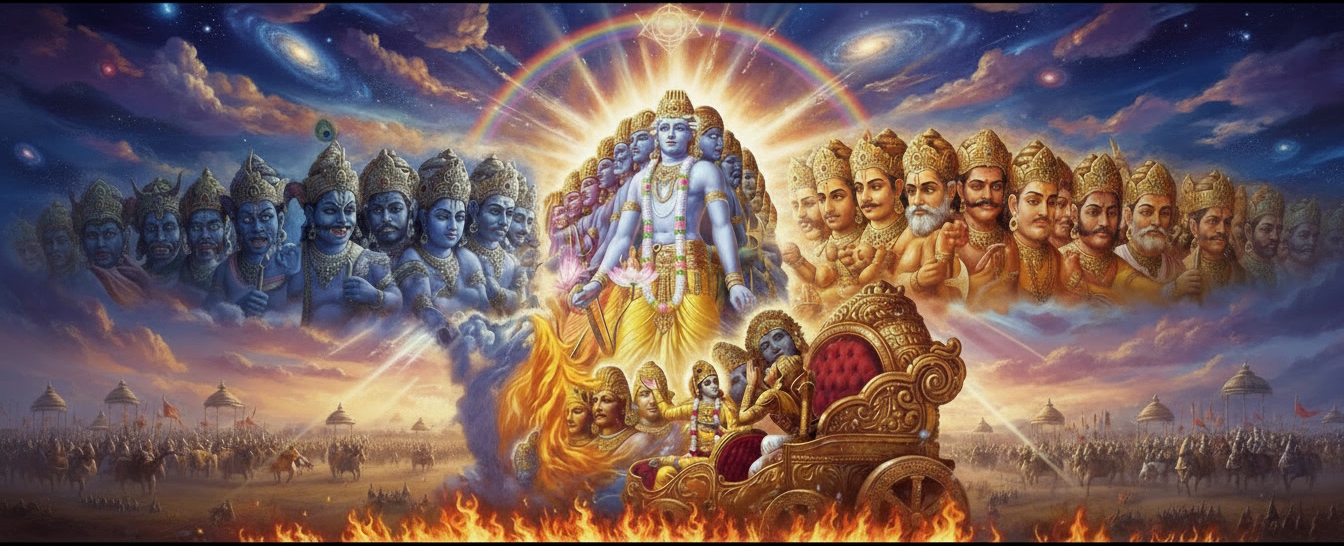
शरीरवाङ्मनोभिर्यत्कर्म प्रारभते नरः।
न्याय्यं वा विपरीतं वा पञ्चैते तस्य हेतवः।।18.15।।
śarīravāṅmanobhiryatkarma prārabhate naraḥ|
nyāyyaṃ vā viparītaṃ vā pañcaite tasya hetavaḥ||18.15||
Translation
Whatever action a man performs with his body, speech and mind whether right or the reverse these five are its causes.
हिंदी अनुवाद
मनुष्य, शरीर वाणी और मनके द्वारा शास्त्रविहित अथवा शास्त्रविरुद्ध जो कुछ भी कर्म आरम्भ करता है, उसके ये (पूर्वोक्त) पाँचों हेतु होते हैं।
Commentaries & Translations
Swami Ramsukhdas
शरीरवाङ्मनोभिर्यत्कर्म ৷৷. पञ्चैते तस्य हेतवः -- पीछेके (चौदहवें) श्लोकमें कर्मोंके होनेमें जो अधिष्ठान आदि पाँच हेतु बताये गये हैं? वे पाँचों हेतु इन पदोंमें आ जाते हैं जैसे -- शरीर पदमें अधिष्ठान आ गया? वाक् पदमें बहिःकरण और मन पदमें अन्तःकरण आ गया? नरः पदमें कर्ता आ गया? और प्रारभते पदमें सम्पूर्ण इन्द्रियोंकी चेष्टा आ गयी। अब रही दैव की बात। यह दैव अर्थात् संस्कार अन्तःकरणमें ही रहता है परन्तु उसका स्पष्ट रीतिसे पता नहीं लगता। उसका पता तो उससे उत्पन्न हुई वृत्तियोंसे और उसके अनुसार किये हुए कर्मोंसे ही लगता है।मनुष्य शरीर? वाणी और मनसे जो कर्म आरम्भ करता है अर्थात् कहीं शरीरकी प्रधानतासे? कहीं वाणीकी प्रधानतासे और कहीं मनकी प्रधानतासे जो कर्म करता है? वह चाहे न्याय्य -- शास्त्रविहित हो? चाहे विपरीत, -- शास्त्रविरुद्ध हो? उसमें ये (पूर्वश्लोकमें आये) पाँच हेतु होते हैं।शरीर? वाणी और मन -- इन तीनोंके द्वारा ही सम्पूर्ण कर्म होते हैं। इनके द्वारा किये गये कर्मोंको ही कायिक? वाचिक और मानसिक कर्मकी संज्ञा दी जाती है। इन तीनोंमें अशुद्धि आनेसे ही बन्धन होता है। इसीलिये इन तीनों(शरीर? वाणी और मन) की शुद्धिके लिये सत्रहवें अध्यायके चौदहवें? पन्द्रहवें और सोलहवें श्लोकमें क्रमशः कायिक? वाचिक और मानसिक तपका वर्णन किया गया है। तात्पर्य यह है कि शरीर? वाणी और मनसे कोई भी शास्त्रनिषिद्ध कर्म न किया जाय? केवल शास्त्रविहित कर्म ही किये जायँ? तो वह तप हो जाता है। सत्रहवें अध्यायके ही सत्रहवें श्लोकमें अफलाकाङ्क्षिभिः पद देकर यह बताया है कि निष्कामभावसे किया हुआ तप सात्त्विक होता है। सात्त्विक तप बाँधनेवाला नहीं होता? प्रत्युत मुक्ति देनेवाला होता है। परन्तु राजसतामस तप बाँधनेवाले होते हैं।इन शरीर? वाणी आदिको अपना समझकर अपने लिये कर्म करनेसे ही इनमें अशुद्धि आती है? इसलिये इनको शुद्ध किये बिना केवल विचारसे बुद्धिके द्वारा सांख्यसिद्धान्तकी बातें तो समझमें आ सकती हैं परन्तु कर्मोंके साथ मेरा किञ्चिन्मात्र भी सम्बन्ध नहीं है -- ऐसा स्पष्ट बोध नहीं हो सकता। ऐसी हालतमें साधक शरीर आदिको अपना न समझे और अपने लिये कोई कर्म न करे तो वे शरीरादि बहुत जल्दी शुद्ध हो जायँगे अतः चाहे कर्मयोगकी दृष्टिसे इनको शुद्ध करके इनसे सम्बन्ध तोड़ ले? चाहे सांख्ययोगकी दृष्टिसे प्रबल विवेकके द्वारा इनसे सम्बन्ध तोड़ ले। दोनों ही साधनोंसे प्रकृति और प्रकृतिके कार्यके साथ अपने माने हुए सम्बन्धका विच्छेद हो जाता है और वास्तविक तत्त्वका अनुभव हो जाता है।जिस समष्टिशक्तिसे संसारमात्रकी क्रियाएँ होती हैं? उसी समष्टिशक्तिसे व्यष्टि शरीरकी क्रियाएँ भी स्वाभाविक होती हैं। विवेकको महत्त्व न देनेके कारण स्वयं उन क्रियाओंमेंसे खानापीना? उठनाबैठना? सोनाजगना आदि जिन क्रियाओंका कर्ता अपनेको मान लेता है? वहाँ कर्मसंग्रह होता है अर्थात् वे क्रियाएँ बाँधनेवाली हो जाती हैं। परन्तु जहाँ स्वयं अपनेको कर्ता नहीं मानता? वहाँ कर्मसंग्रह नहीं होता। वहाँ तो केवल क्रियामात्र होती है। इसलिये वे क्रियाएँ फलोत्पादक अर्थात् बाँधनेवाली नहीं होतीं। जैसे? बचपनसे जवान होना? श्वासका आनाजाना? भोजनका पाचन होना तथा रस आदि बन जाना आदि क्रियाएँ बिना कर्तृत्वाभिमानके प्रकृतिके द्वारा स्वतःस्वाभाविक होती हैं और उनका कोई कर्मसंग्रह अर्थात् पापपुण्य नहीं होता। ऐसे ही कर्तृत्वाभिमान न रहनेपर सभी क्रियाएँ प्रकृतिके द्वारा ही होती हैं -- ऐसा स्पष्ट अनुभव हो जाता है। सम्बन्ध -- भगवान्ने सांख्यसिद्धान्त बतानेके लिये जो उपक्रम किया है? उनमें कर्मोंके होनेमें पाँच हेतु बतानेका क्या आशय है -- इसका वर्णन आगेके श्लोकमें करते हैं।
Sri Harikrishnadas Goenka
मन? वाणी और शरीरसे अर्थात् इन तीनोंके द्वारा मनुष्य जो कुछ न्याययुक्त -- धर्ममयशास्त्रीय अथवा धर्मविरुद्ध -- अशास्त्रीय कर्म करता है? उन सबके ये उपर्युक्त पाँच हेतु यानी कारण हैं। जीवनके लिये जो कुछ आँख खोलनेमूँदने आदिकी भी चेष्टाएँ की जाती हैं? वे भी? पहले किये हुए पुण्य और पापका ही परिणाम हैं। अतः न्याय और विपरीत ( अन्याय ) के ग्रहणसे ऐसी समस्त चेष्टाओंका भी ग्रहण हो जाता,है। पू0 -- जब कि अधिष्ठानादि ही समस्त कर्मोंके कारण हैं? तब यह कैसे कहा जाता है कि मन? वाणी और शरीरसे कर्म करता है उ0 -- यह दोष नहीं है। विहित और निषेधरूप सारे कर्म शरीर? वाणी और मन इन्हीं तीनोंकी प्रधानतासे होनेवाले हैं? तथा देखनासुनना आदि जीवननिमित्तक चेष्टाएँ भी उन्हीं कर्मोंकी अङ्गभूत हैं? इसलिये समस्त कर्मोंको तीन भागोंमें बाँटकर ऐसा कहते हैं कि जो कुछ भी शरीर आदिद्वारा कर्म करता है ( क्योंकि ) फलभोगके समय भी शरीर आदि प्रधान कारणोंद्वारा ही फल भोगा जाता है। सुतरां उपर्युक्त अधिष्ठानादि पाँच कारणोंकी हेतुता ठीक है? इसमें विरोध नहीं है।
Sri Anandgiri
He clarifies that the stated five, Adhishtana etc., are for the accomplishment of all actions — by 'Śarīra' etc. Objection: There is other ordinary action like blinking etc. caused by life, so how is making two heaps [rightful and contrary] proper? To this he says — 'Yacca' (And whatever).
Objection: Having promised causeness of Adhishtana etc. in action merely, stating causeness in threefold action like physical etc. is improper? He doubts thus — 'Nanu'. He removes the contradiction between earlier and later — 'Naiṣa doṣaḥ' (This is not a fault).
Objection: Natural actions caused by life like seeing etc. are outside injunction and prohibition, so they are not accomplishable by body etc.? Doubting thus he says — 'Tadaṅgatayā' (As auxiliary to that). Since eye etc. are auxiliary to the principal triad of body etc., and since seeing etc. caused by life are accomplished by them, they are included in the principal action — thus threefold nature is not contradictory, this is the meaning.
Even if all actions are included in the threefold action starting with body etc., how is there causeness of only the five Adhishtana etc. there, because requirement of other causes is possible at the time of enjoyment of fruit? Doubting thus, because all causes existing at birth-time and enjoyment-time are included in those very [five], 'not so', he says — 'Phala'.
Sri Dhanpati
Having stated the nature of the five, He states their causeness in action — 'Śarīra' etc. Whatever action is 'nyāyyam' — righteous, scriptural; or 'viparītam' — unrighteous, non-scriptural; and whatever also. Blinking, effort etc. caused by life, that too is the effect of previously done Dharma etc., so it is to be grasped by taking 'righteous' and 'contrary' — whatever righteous etc. action a man 'ārabhate' — starts/performs — by three, body, speech and mind; of which entire action indeed these five mentioned Adhishtana etc. are 'hetavaḥ' — causes.
Objection: By 'Pañcaitāni' etc. Adhishtana etc. were stated as executors of all actions, but here it is said 'starts action by body, speech and mind', therefore there is contradiction between earlier and later?
Answer: This is not a fault. Because the causeness of the five Adhishtana etc. in the threefold action starting with body etc. is intended. Seeing, hearing etc. and signs of life are included in the threefold action itself, so it is said as grouped in three ways only.
Objection: Since requirement of other causes is possible at the time of enjoyment of fruit, how is there causeness of only the five Adhishtana etc. there? Answer: Since all expected causes are included in these indeed, the causeness of the five is not contradictory.
Sri Madhavacharya
'Adhiṣṭhāna' is the body etc. 'Kartā' is Vishnu; for He is indeed the doer of all, thus it is said; and the proof for the non-doership of the Jiva has been stated.
'Karaṇa' is the sense organs etc. 'Ceṣṭāḥ' are actions; by actions of hands etc. works like Homa etc. are produced. Mental effort is also the cause of meditation etc. Previous effort also exists as the cause of impressions (Samskaras).
'Daivam' is the unseen (Adrishta/destiny). And so the Ayasya Shruti — 'The body, Brahman (Soul/Vishnu), objects, senses etc., actions, and the unseen as the fifth cause of action'.
Sri Neelkanth
'Śarīra'. 'Nyāyyam' righteous, scriptural. 'Viparītam' unrighteous, unscriptural.
Objection: It is said contradictorily that 'it is started by three, body etc.' and 'these five are its causes'. Answer: This is not a fault.
Here also, by the word body Adhishtana is included, by the word man (Nara) the agent, by speech-mind the instruments, by 'starts' the efforts, and by 'righteous' the Daiva in the form of Dharma and Adharma.
Although the use of the five is equal in all actions, only the threefold action characterized by injunction and prohibition is well known in scripture.
'This is physical action, this is mental, this is verbal' — such designation is with respect to the predominance of body etc., so there is no contradiction.
Sri Ramanuja
In rightful — scriptural, or contrary — prohibited, in all action — physical, verbal, and mental — these five are the causes. 'Adhiṣṭhānam' is the body; since it is presided over by the Jivatma, the body which is an aggregate of great elements is Adhishtana. And 'Kartā' is the Jivatma; the knowership and doership of this Jivatma is established by Sutras like 'He is knower, for that very reason' [B.S. 2.3.18] and 'Agent, on account of scripture having a purport' [B.S. 2.3.33].
And 'Karaṇam' is of various kinds — the pentad of speech, hands, feet etc. along with mind, the organs of action; 'pṛthagvidham' — having separate operation in the accomplishment of action. And 'vividhāḥ' separate 'ceṣṭāḥ' — by the word Cheshta the fivefold Vayu is denoted, because it expresses its function; of the fivefold Vayu which sustains body and senses and is distinct by divisions like Prana, Apana etc., the vividha cheshta — various function.
And 'Daivam' indeed is the fifth here; here in the group of causes of action, Daiva is the fifth — the Supreme Self, the Inner Controller, is the principal cause in the accomplishment of action, this is the meaning; for it is said — 'I am seated in the hearts of all, from Me comes memory, knowledge, and their loss' [Gita 15.15]. And He will say — 'The Lord resides in the heart region of all beings, O Arjuna. Causing all beings to revolve mounted on a machine by Maya' [Gita 18.61].
And the agency of Jivatma is dependent on the Supreme Self — established by 'But from the Supreme, because of scriptural statement' [B.S. 2.3.41].
Objection: If the agency of Jivatma is thus dependent on the Supreme Self, the Jivatma would not be fit for injunction in action, so scriptures of injunction and prohibition would become meaningless.
This objection is also refuted by the Sutrakara himself — 'But He depends on the effort made, on account of non-futility of injunctions and prohibitions etc.' [B.S. 2.3.42]. This is what is said — With instruments, body etc. given by the Supreme Self and supported by Him, with powers instilled by Him, and the Jivatma himself being supported by Him and having power instilled by Him, for the accomplishment of action, by his own will starts the effort in the form of presiding over instruments etc.; the Supreme Self situated within him impels him by giving His permission; thus the Jiva also has causeness of activity by his own intelligence. Just as in activities resulting in movement of very heavy stones, trees etc. achievable by many men, there is causeness and sharing of injunction and prohibition for many.
Sri Sridhara Swami
He states the causeness of these very ones in all actions — 'Śarīra'.
Action being started by the mentioned five, including it in the three only, it is said 'by body, speech and mind'; because of the fame of threefold action as physical, verbal and mental.
Whatever action, righteous or unrighteous, a man does by body etc., these five are the causes of all that action.
Sri Vedantadeshikacharya Venkatanatha
Intending the non-repetition of the two verses as an elaboration of what was stated (in verse 13), and the contradiction in the opponent's view, he says — 'Tadidam aha' (He said this very thing...). 'Tat' refers to what is established by Shruti; 'Idam' means what is intended here; this is the meaning. 'Nyayyam' means not departing from Nyaya (logic/propriety) — according to the rule [Ashtadhyayi 4.4.92] 'Dharmapathyarthanyayadanapete' (The suffix Yat is used in the sense of not departing from Dharma, Pathin, Artha, and Nyaya). And the word 'Nyaya' here, due to the impropriety of other meanings and following the etymology, indicates the Shastra alone; with this intention he says — 'Shastrasiddhe' (Established by Shastra...). When wishing to express worldly action along with scriptural, one should have said 'or other than that'. When 'enjoined' is specified, the word 'Viparita' (opposite) naturally refers to the 'prohibited'; and by the logic of 'how much more' (kaimutya), the worldly action is also obtained; with this intention he says — 'Pratishiddhe va' (Or prohibited...). 'Sarvasmin karmani' (In all action) — this is a statement of the result.
Just as in bodily, mental, and verbal actions there is a restriction based on the predominance of body etc., these five causes are not like that; but rather all five are required in every action; with this intention the statement of 'bodily' etc. is made. For the division of 'bodily' etc. in all actions having five causes is indeed due to predominance.
Although in the creation of the world etc., the Supreme Self alone is the cause; still, in actions where the Knower of the Field (Jiva) is the agent, these (five) have been made instruments by the Supreme Self by His own will; with this intention the 'other cause' is mentioned. 'They call the Adhisthana the Kshetra' [Mahabharata 12.307.14] — thus Vasistha says to Karala; following that he says — 'Adhishthanam shariram' (Adhishthana is the body...). And the Shruti — 'O Maghavan, this body is indeed mortal, grasped by death; that is the Adhisthana (abode) of this immortal, bodiless Self' [Chandogya 8.12.1] — uses the word 'Adhishthana' for the body. According to [Ashtadhyayi 3.3.113] 'Krityalyuto bahulam', he derives the word 'Adhishthana' in the body in the sense of the object (Karma) — 'Adhishthiyate' (Is presided over/occupied...). Since even the Jiva who is the presider is presided over by the Supreme Self, to exclude Him, it is qualified as 'Jivatmana' (By the Jiva-self). Since instruments etc. which are also presided over by the Jiva are mentioned separately, to restrict its (Adhisthana's) scope, he says — 'Mahabhutasanghatarupam' (Of the form of the aggregate of great elements...).
Since the Creator of the Universe is grasped separately here by the word 'Daiva', and since the word 'Karta' (Doer) here is for indicating the maxim 'The fruit of the Shastra belongs to the performer' [Purva Mimamsa 3.7.18], 'Karta Jivatma' (The doer is the Jiva-self) is stated. Objection: Doership is indeed being endowed with effort preceded by knowledge and desire to do; since the Self which is mere Knowledge cannot be a Knower, the Doership rooted in that would also not exist? To this he says — 'Asya jivatmono jnatritvam kartritvam ca' (Of this Jiva-self, knowership and doership...). 'The knower, for that very reason' [Brahma Sutra 2.3.18] etc. — the Sutra is cited; because the Shruti etc. are also drawn from there itself.
Since the causes for the origination of action are being presented, the word 'Karana' here refers only to the organs of action; with this intention he says — 'Vak' (Speech...). Although the organs of knowledge are causes of action traditionally through generating the knowledge of respective objects; still, since action is performed only after resolving with the mind upon mere objects being perceived, and since there is no intervention of other activities of the mind — 'Samanaskam' (Along with the mind) is stated. Although the mind is an organ of knowledge, due to its commonality in the activities of organs of action also, it is mentioned as an organ of action. Or because it is stated right here as 'Body, Speech, Mind', the argument for its being an organ of action is relative to actions like resolution etc. Even the Sankhyas have said so — 'The organs of intellect are called Eye, Ear, Nose, Tongue, and Skin. They call Speech, Hands, Feet, Anus, and Genitals the organs of action. The Mind here is of the nature of both, a resolver and an organ, due to similarity' [Sankhyakarika 26, 27].
While the causes of action are being taken up, the adjective 'Prithagvidham' (of various kinds) refers to the modes called activities useful for that; he says — 'Karmanishpattau prithagvyaparam' (Distinct activity in the accomplishment of action...). For in speech etc., the activity of action like speaking, taking, moving, excreting, rejoicing, resolving etc. of each one is indeed mutually distinct. Activity of the body etc. rooted in effort is indeed called 'Chesta' (Exertion/Movement); therefore, since that itself is the cause of action here, there would be 'self-dependence' (at-mashraya - infinite regress?); regarding this he says — 'Cheshtashabdena pancatma vayuh' (By the word Chesta, the five-fold vital air...). By the word 'Abhidhiyate' (Is named/denoted), mere indication is intended. Here, when another cause of that (action/chesta) is to be indicated, since speech etc. are taken by words like Karana etc., and since in the dialogue of Pranas etc., the sustenance and activity of the organs and body are heard to be dependent on Prana; it is appropriate here to imply Prana by the word denoting 'Chesta' which is the cause of Prana's activity; with this intention he says — 'Tadvrittivacina' (By the word denoting its function...). 'Cheshtashabdena' connects with the preceding. By reminding of the dialogue of Pranas etc., he explains the propriety of implying Prana and the diversity of its function — 'Sharirendriya' (Body and senses...). To avoid repetition of the words 'Prithak' (distinct) and 'Vividha' (diverse), he says — 'Sharirendriyadharakasya pranapanadibhedabhinnasya' (Of the sustainer of body and senses, divided by distinctions of Prana, Apana etc.). The distinctness is relative to the activities of Adhisthana, Karta, and Karana, and due to the difference in objects in the form of the group of body and senses; and the diversity is by the activities like specific breathing, winking, opening eyes etc. regulated by the difference in functions like Prana etc.; this is the idea. The word 'Pancatma' here refers to having five functions; and so is the Sutra — 'The five-fold (Prana) is designated like the mind' [Brahma Sutra 2.4.12]. The mention of five functions is also indicative of the other pentad of functions like Naga, Kurma, Krikara, Devadatta, and Dhananjaya.
In 'Daivam caivatra pancamam' (And Daiva indeed is the fifth here), 'Atra' (Here) is a restatement to determine the principal named Daiva; he says — 'Atra karmahetukalape' (Here in the aggregate of causes of action...). In counting the Supreme Self as the fifth, since a sequence based on Shruti, meaning, reading etc. is impossible, and since speech functions sequentially, even if counted as possible, there is no purpose in the specification 'Fifth' for completing (the count); just as in Kathavalli — starting with 'Objects are higher than senses', and saying 'Beyond Mahat is Avyakta, beyond Avyakta is Purusha. Nothing is higher than Purusha, He is the culmination, He is the Supreme Goal' [1.3.10, 11], the Supreme Person, the principal cause in all activities of senses etc., is designated as the limit to be controlled/attained; similarly here too; with this intention he says — 'Paramatmantaryami' (The Supreme Self, the Inner Ruler...).
Objection: In 'Daivam is action done in the past', 'Daivam is destiny/fate, portion' [Amara 1.4.28] etc., they read the word 'Daiva' as a synonym for the object of enjoyment in the form of ancient Karma; and its causality is established; therefore how is it said here as 'Supreme Self'? Thus — for the causality of actions destroyed long ago is not possible in their own form; therefore, the causality of the Will of the Supreme Person in the form of 'Adrishta' (unseen potency) generated by karma must be stated; better than that is to designate Him alone by the word 'Daiva'. And there is fame of the word 'Daiva' as a synonym for 'Daivata' (Deity) in the world and Veda; as — 'Truth, Truth, again Truth, raising the arm it is said; there is nothing higher than the Veda-Shastra, there is no Daiva higher than Keshava' [Naradiya Purana 18.33]. No other meaning is possible here. Similarly in Srimad Ramayana also — 'Having transgressed the mother, father, and teacher who are under one's control (svadhina); how is the Daiva who is not under one's control (asvadhina) worshipped by modes?' [Valmiki Ramayana 2...]. Similarly in Sabha Parva — 'Let the Supreme Daiva be heard, who is difficult to know even by me; Narayana is indeed the Person, Universal Form, Great Effulgence'. Similarly in the Yoga Shastra composed by Yajnavalkya — 'The Arsha (Seer), Chanda (Meter), and Daivata (Deity) of Mantras, and the Brahmana (Application)'. The same meaning is again designated by 'Arsha, Chanda, and Daiva' etc. There itself, in the translation of Prajapati's instruction for deluding the demons — 'One should always worship the Self with ornaments, coverings etc.; One's own body alone would be the Daiva, no other Daiva exists' [Yoga Yajnavalkya?]. Similarly — 'The whole world depends on Daiva, and Daivata depends on Mantra; that Mantra depends on the Brahmana, therefore Vipras are indeed the Daivata' [Vishnu Samhita? 22]. Even in this Shastra, proposing 'Me along with Adhibhuta and Adhidaiva' [7.30], He answers the question 'What is called Adhidaivata?' [8.1] with 'And the Purusha is Adhidaivata' [8.4]. And in Chandogya (?), the name 'Adhidaivata' is stated for the Person abiding in the deity named Aditya — 'Its Upanishad is Ahar' [Brihadaranyaka 5.5.3] is Adhidaivata; 'Its Upanishad is Aham' [Brihadaranyaka 5.5.4] is Adhyatma. Thus. Similarly it should be seen elsewhere also. And by others also the word 'Daiva' here has been interpreted as referring to Aditya etc. who are the favorers of the eye etc. We, however, say that 'Daiva' here is the Supreme Self who is the favorer even of Aditya etc.; this is the distinction. And it is used in the Stotra — 'By the views of the knowers of the famous Daiva and Paramartha' [Stotra Ratna 15]. And in Lakshmi Kalyana — 'In Dharma the authority is His system (Samaya), and Vedas, and the Reality is His chosen Daiva'. Therefore, the word 'Deva' here is a synonym for 'Devata'. And since here it refers to the cause impelling everything, and due to the absence of a restrictor, it is appropriate to refer to the Supreme Deity; therefore 'Paramatmantaryami' (Supreme Self, Inner Ruler) is stated as the principal cause in the accomplishment of action. Just as He is the Self of all; there is no one else for Him like that; therefore 'Paramatma' (Supreme Self). Just as the Jiva is the principal cause in the activity of the body etc.; so is He for him (Jiva) too; with this intention 'Antaryamitva' (Inner Rulership) is stated. He establishes the intention of that here through the preceding and succeeding contexts — with 'Uktam hi' (For it is said...), etc.
Objection: 'The independent one is the agent (Karta)' [Ashtadhyayi 1.4.54] — thus the definition of agent is taught; and here the Knower of the Field alone is designated as 'Karta'; therefore, his being the employer of other factors and not being employed by other factors must be accepted. Therefore, Daiva also should be stated here as subordinate to him like Adhishthana etc.? To this he says — 'Paramatmayattam ca' (And dependent on the Supreme Self...). For the user-ship of other factors etc. belongs to the person who has generated knowledge, desire to do, and effort; but since the origination of knowledge etc. itself is dependent on the Supreme Self, as established by Shruti; there is no contradiction between the Jiva's dependent doership and independence; this is established in the Shariraka (Brahma Sutras); this is the idea.
Not knowing this intention, objecting that the Supreme Self is an impeller like wind, water etc. — 'Nanu evam' (Objection: Thus...). If the Supreme Self impels in Jyotishtoma etc.? Then there is nothing to be enjoined for the Jiva; for there is no injunction for movement for one being carried away by a strong person. If He restrains? Even then nothing to be enjoined; for there is no injunction for movement for a weak person restrained by a strong one. Thus, where the Supreme Self impels, since withdrawal is impossible, prohibition is useless; and where He does not impel, since activity itself is impossible, there is no need for prohibition; this is the idea. This is the limit of objection here clinging to all doctrines other than Charvaka — 'Impelled by the unseen (karma) of the past declared as (cause of) punishment and grace; how is this consistent that he is fit for punishment and grace etc.?'
Like the objection of absence of dependence in knowership and doership of the Jiva; the objection of the contingency of uselessness of injunction and prohibition even if there is dependence, has been removed by Lord Badarayana himself, the seer of the fifth Veda (Mahabharata) and its Upanishad (Gita) — he says 'Idamapi' (This also...). The meaning of the Sutra is that the Supreme Self impels in subsequent actions expecting the effort made by the sentient being, precisely for reasons like the non-uselessness of enjoined and prohibited etc. There, when all activities depend on the Supreme Self, how is 'expecting the effort made' stated? And if the remedy for the objection of uselessness is for establishing non-uselessness, there would be non-distinction of what is to be established (Sadhya); in this doubt, he states the intended meaning of the Sutra — 'Etaduktam' (This is said...).
This is the intention — As for the offering by the Lord of instruments and bodies whose powers of activity are conceived by His will, like machines etc.; and His abiding as the support of all by His nature and will, favorable to all activity and inactivity, like the ground etc.; and also the bestowing of power to preside over instruments and bodies etc.; and the presentation of external objects which are the support of activity; all that is favorable to the Jiva's doership and common to all activity and inactivity, so there is no room for objection there. By this much, the Lord's neutrality common to all activity and inactivity is stated. Thus, at the time of activity of the Purusha who has obtained power, the Lord's permissiveness (anumantritva) for the accomplishment of the effect; that too does not prevent the Jiva's doership, but rather supports it; so from that too there is no uselessness of injunction and prohibition. Nor is the association of another agent named Supreme Self in the same action a cause for the Jiva's unfitness for injunction; because in the world, even in actions impossible for one individually but performed by many together, injunctions and prohibitions and their fruits etc. are seen; and because for one capable of activity, independence etc. are established by his desire not being preventable by others. Similarly in 'He is made to perform action helplessly' [3.5] etc. also, since impelling is by placing knowledge and desire in front, and since specific desires etc. are rooted in specific own vasanas etc., the doership of the Jiva is well-established. Therefore indeed, here in the pentad of causes, the Jiva is described as the agent alone by the justification of the name 'Karta'.
And as for the unequal bestowal regarding instruments, bodies, power, knowledge, desire etc.; non-prevention in harmful activity; permission; and generation of sin; that too, being conditioned by the inequality of beginningless past karma, does not bring about inequality and cruelty in the Lord. Even if the inequality of tendency is rooted in the inequality of Adrishta (unseen karma), that very Adrishta begins its seen (effects) etc. by placing Shastra in front. That too is 'thus' — so there is room for injunction and prohibition. For it is not that because Adrishta which is the cause of sacrifice etc. was done before, therefore sacrifice etc. is accomplished now by that itself; because it (Adrishta/Action) depends on intellect etc. generated by Shastra. Similarly, even the Adrishta which is the cause of sin, having brought about a state unfit for instruction due to fitness for withdrawal by one's own intellect, impels into sin; that too is 'like that'; otherwise, if one argues that due to being rooted in Adrishta, tendencies towards beneficial and harmful do not require Shastra, there would be contradiction with one's own statement because the same would apply to the previous Adrishta also. Now, if you think that if rooted in Adrishta there is contingency of uselessness of Shastra, and Shastra is accepted as meaningful by others, therefore being rooted in Adrishta itself is not proper; that too is not so; because the same contingency would apply to worldly injunctions and prohibitions also. For there too, if the variety of activity and inactivity is rooted in the variety of causal aggregate, what is the use of the command 'Bring the cow' etc.? If you see that that command also, brought by its own causal aggregate, sits in the middle of the causal aggregate of activity and inactivity? You should see that the Vedic command is also like that. Then if you say 'We abandon worldly command also' — Alas, since mutual interaction, learning etc. would be impossible, it is dissolved even by the Lokayata (Materialist), so become mute.
Thus generally in all actions, even if rooted in inequality of Adrishta, when Shastra has scope; if that very Shastra teaches that Adrishta is a specific Will of the Lord? Such a Lord is understood on the strength of proof; so there is no room for objection there. And this is not a fault — as stated by the Acharyas, the Vadi-Hamsa-Ambuvahas (Cloud for the swans of disputants - Vedantadeshika's Guru?) — 'When there is inequality of actions, what indeed can the impartial Lord do? Or what can the Bestower of Boons give generously if they desire bad state?' Thus. So this is the essence of the common remedy for those standing in all doctrines other than Charvaka — 'Due to the connection with the state subservient to Shastra rooted in respective desired and unseen (causes); again seen prosperity occurs in such and such ways. Since it is understood as a means to human goal, man engages by his own will; therefore, due to being for that purpose, the injunction (Chodana) has scope here.' Thus.
Here, the dependence of Jiva's doership on another, due to expecting common help like bestowal of instruments and body etc., has been stated up to 'San' (Being) [18.14]. But by 'Karmanishpattaye' (For the accomplishment of action) etc., the independence of the Jiva in specific activity is shown. Even there, the 'somewhat-doing' (kinchit-kara) of the Supreme is stated by 'Tadantaravasthita' (Situated within him) etc. 'Tam' — meaning 'Kritaprayatnam' (one who has made effort).
Swami Chinmayananda
न्याय्य और विपरीत कर्मों से तात्पर्य क्रमश धर्म के अनुकूल और प्रतिकूल कर्मों से है। निरपवाद रूप से सब प्रकार कर्मों की सिद्धि के लिए शरीरादि पाँच कारणों की आवश्यकता होती है।यहाँ विशेष ध्यान देने योग्य बात यह है कि कर्मों के पञ्चविध कारणों का वर्णन केवल बोनट के नीचे स्थित इंजन का ही है? पेट्रोल का नहीं। पेट्रोल के बिना इंजन कार्य नहीं कर सकता और न ही केवल पेट्रोल के द्वारा यात्रा सफल और सुखद हो सकती है। इंजन और पेट्रोल के सम्बन्ध से वाहन में गति आती है और तब स्वामी की इच्छा के अनुसार चालक उसे गन्तव्य तक पहुँचा सकता है। इस उदाहरण को समझ लेने पर भगवान् श्रीकृष्ण के कथन का अभिप्राय स्पष्ट हो जायेगा।अकर्म चैतन्य स्वरूप आत्मा देहादि उपाधियों से तादात्म्य करके जीव के रूप में अनेक प्रकार की इच्छाओं से प्रेरित होकर उचितअनुचित कर्म करता है। इन समस्त कर्मों के लिए पूर्वोक्त पाँच कारणों की आवश्यकता होती है।पूर्व के दो श्लोकों का निष्कर्ष यह है कि मनुष्य का कर्तृत्वाभिमान मिथ्या है। भगवान् कहते हैं
Sri Abhinavgupta
Now, even in the state of transaction, although the five causes of action exist, by force indeed these men blinded by ignorance superimpose the burden of the state of entire doership on their own Self only. Therefore, by their own intellect they bind the Self; but in reality there is no bondage for it — this is taught — from 'Pañca' etc. up to 'Na nibadhyate'.
Wherein 'anta' — decision — is made, that is 'Kṛtānta' — doctrine. 'Adhiṣṭhāna' — object. 'Daiva' — previously earned good and bad [karma]. These five, Adhishtana etc., attaining the state of a collection of means, are causes in all actions.
Others, however [hold that] — 'By this all action is presided over' — thus the Adhishtana residing in intellect, having modification obtained from Rajas, transforming into the pentad of fortitude, faith, pleasure, desire to know, and absence of desire to know, denoted by the word Karma-Yoga, is sometimes spoken of by the word 'Prayatna' (effort). 'Kartā' — the contemplator, characterized by intellect. 'Karaṇa' — mind, eye etc.; and also external sword etc. 'Ceṣṭā' — Prana, Apana etc. By the word 'Daiva', Dharma and Adharma, and by them all states residing in intellect are implied.
Others consider 'Adhiṣṭhāna' as God. 'Akṛtabuddhitvāt' — due to un-ascertained wisdom. But he who performs actions with firmness of separation from ego, purified by hundreds of reasonings stated before, he is not a partaker of bondage — due to being of cultivated intellect, this is the intention.
Sri Jayatritha
He will say that Adhishtana etc. are included in Karana itself? To indicate that, He specifies Adhishtana — 'Adhiṣṭhānam'. By the word 'adi' (etc.), earth etc. The explanation that 'Karta' is Jiva is false, with this idea he says — 'Kartā'. How is Vishnu the doer of actions performed by body, speech, and mind? To this he says — 'Sa hi'. It is explained as stated.
Still, why shouldn't Jiva be the doer here? To this he says — 'Jīvasya ca'. This refutation is with the intention of [denying] independence? Accepting dependent agency, the Jiva is explained elsewhere, so there is no contradiction.
To refute the perception of abstract instrumentation (bhāva-sādhana), he says — 'Karaṇam'. By 'adi', ladle (Sruva) etc. Because the meaning of abstract means is an effect (sādhya), and because it is grasped by taking 'Cheshta'. 'Aerial Prana, Apana etc. are Cheshta' (Shankara) — this is false. Because in designating a substance (Vayu), the nature of effort (Cheshta) is inapplicable. In designating breathing etc., being effects, they cannot be causes (Karakas) — intending this he says — 'Ceṣṭā'.
Since actions are means, how are they causes? To this he says — 'Hastādi'. The instrument along with intermediate operation is called Karaka. There by words like Adhishtana etc., the possessors of operation are specified. By the word 'Kriya' (action), the intermediate operations. And the generation of the primary action by intermediate actions resting on the causes is indeed well known, this is the meaning.
Objection: In the context of stating causes, only Adhishtana etc. are mentioned, why are Object (Karma), Recipient (Sampradana), and Source (Apadana) not mentioned? Because Adhishtana etc. follow in all actions, and Karma etc. lack that — thus we say. And so He will say — 'By body, speech and mind whatever' [18.15].
[Objection:] If so, then Cheshta also should not be mentioned. Because in generating meditation etc., the instrument mind follows as [having] effort? To this he says — 'Dhyānāderapi'. By 'adi', remembrance is grasped? Meditation happens only on a known object? And knowledge arises only by the mind in contact with Self and senses? And contact is generated by mental effort? Therefore, for meditation etc. also, effort related to mind is the cause, this is the idea.
Objection: A cause is what exists in the immediately preceding moment, but there is no action in the mind in the moment preceding meditation etc., because it passed long ago. Since meditation etc. are achievable by steadiness of mind. Nor is it an instrument through contact-knowledge, because that too passed long ago? To this he says — 'Pūrvatanī'. Mental action, even if passed long ago, becomes a cause through contact as the cause of impression (Samskara) which is the cause of meditation etc.? Because the impression which is the cause of meditation etc. is permanent, this is the meaning.
'Daiva' is the operation of the Inner Controller, so says someone? That is false, because it is stated by 'Karta' itself. Others say Sun etc. favorers of eye etc. [Venkatanatha]? That too is false, because they are grasped by words like Karana etc. — with this idea he says — 'Daivam adṛṣṭam'. He supports the stated meaning by agreement of Shruti also — 'Tathā ca'. 'Deha' is an indicator. 'Hetu' means cause. 'Karma hetuḥ' is the reading in some places? There the gender change is Vedic license.
Sri Madhusudan Saraswati
Having stated the nature, He states the causeness of action of those five by the third [verse].
Physical, verbal, and mental threefold action characterized by injunction and prohibition is well known in Dharma Shastras and stated by Akshapada — 'Activity is the undertaking of speech, intellect, and body' — here intellect is mind, so it is stated with the intention of predominance.
Whatever action a man 'prārabhate' — performs — by body, speech, or mind — since the scripture is for human qualification [man is mentioned]. What kind of action? 'Nyāyyam vā' — scriptural Dharma; 'viparītam vā' — non-scriptural Adharma; and whatever blinking, movement etc. caused by life, or other equal to enjoined and prohibited, all that is the effect of previously done Dharma and Adharma only, so it is included in righteous and contrary only.
These five mentioned Adhishtana etc. are the 'hetavaḥ' — causes — of all that action indeed.
Sri Purushottamji
He states the causeness of only the five in all actions — 'Śarīra'. Action is threefold — physical, verbal, mental.
Therefore, whatever action a man — human — starts by body, speech and mind; 'nyāyyam vā' — by My command, of the form of My will; 'viparītam' — contrary, unrighteous, of the form of purpose of enjoying own fruit, or starts; of that, these aforementioned five are the 'hetavaḥ' — forms of causes, this is the meaning.
By the two words 'vā' denoting alternative — it is made known that in the absence of knowledge of My will, even the righteous [action] necessarily obtained by Vedic statement is contrary, and in the knowledge of That [will], even the contrary is righteous.
Sri Shankaracharya
By body, speech, and mind — whatever action by these three a man 'prārabhate' — performs/accomplishes; 'nyāyyam vā' — righteous, scriptural; 'viparītam vā' — non-scriptural, unrighteous; and whatever blinking, movement etc. is cause of life, that too is indeed the effect of previously done Dharma and Adharma — thus it is grasped by taking righteous and contrary alone. Five these mentioned are the 'hetavaḥ' — causes — of all that action indeed.
Objection: 'These Adhishtana etc. are executors of all actions' — how is this said [when it is said] 'action which he starts by body, speech and mind'? Answer: This is not a fault. All action characterized by injunction and prohibition has the triad of body etc. as principal. As auxiliary to that, seeing, hearing etc. and signs of life are grouped in three ways only and said as 'starts by body etc.'.
Even at the time of fruit, it is enjoyed by instruments with those as principal, therefore the causeness of the five only is not contradictory.
Sri Vallabhacharya
To explain 'Adhiṣṭhānam'. By body, speech, mind — rightful (scriptural), or contrary (prohibited), all other action — physical, verbal, and mental — has these five causes. He states them — 'Adhiṣṭhāna' first body is the cause? 'Kartā' Jivatma, with ego, knower; 'He is knower' therefore 'Agent, on account of scripture having a purport' [B.S. 2.3.33] from this Sutra. And 'Karaṇam' with mind, eye-ear etc. distinct by difference of knowledge and action grasped as various; 'ceṣṭā' diverse by nature of effect — functions of Prana etc. are causes in action here. 'Daivam' and fifth is 'Adrishta' (destiny/unseen) so some (Madhvas) [say]. But in reality, the completer of number five, the Supreme Inner Controller form, is the principal cause in the accomplishment of action alone, this is the meaning. It was stated before by Lord Purushottama about the greatness of His nature within — 'Established in the heart of all' [13.17]. It is said by Srimad Acharya (Vallabhacharya) also — 'There is no Daiva beyond Krishna, in reality free from defects'.
And so in Sutras also, the agency of Jivatma, body, senses etc. dependent on that Inner Self is established as 'from the will of the Supreme' — by 'And as the carpenter in both ways' [B.S. 2.3.40].
Here the commentator: — Objection: The difference between doership and enjoyership is seen in performers of action, and thus there will be difference between doership and enjoyership — if you say so? Answer: No, just as a carpenter having made a chariot enjoys riding on it or on a seat, does not operate by himself, but through adze etc. By 'ca', others are selfish agents. Objection: He acts for others also — if you say? [Answer:] In the context also, because He strives for the welfare of all. And mere agency is not of the nature of pain, because drinking milk etc. is of the nature of pleasure. And thus selfish and altruistic agency and causal agency (making others do) is established.
Moreover — 'But from the Supreme, because of scriptural statement' [B.S. 2.3.41]. Agency belongs to Brahman indeed; only by connection with That is agency in Jiva? Because of being His part, like Lordship etc., not belonging to the inert alone. Therefore 'There is no other seer than this' [Bri. Up. 3.7.23] — this universal agency fits. Whence this? From Shruti; because His doership and causal agency is heard — 'Whom He wants to lead up He makes him do good action, whom He wants to lead down He makes him do bad action'. All-doer? All-enjoyer? All-controller — thus due to being all-forms, there is no defect in the Lord.
And so the Sutra — 'But He depends on the effort made, on account of non-futility of injunctions and prohibitions etc.' [B.S. 2.3.42]. Objection: There is no avoidance of partiality and cruelty? Because due to beginninglessness, the causal agency is His own — the word 'tu' (but) refutes this view. Up to effort is the Jiva's work, beyond that due to his inability, He Himself makes him do. Just as seeing a son striving, or a child, even while describing virtues and faults of an object, seeing his adherence to effort, He makes him do exactly that; because He is the cause of that everywhere; at that time, whatever desire is in fruit-giving, that alone He translates as 'wants to lead up, wants to lead down'. Otherwise there would be contingency of futility of enjoined and prohibited? And lack of authority. Dependent on action in giving fruit, dependent on effort in cause of action, dependent on flow in desire — thus He created Vedas to protect the boundary (Maryada)? Therefore there is not even a scent of defect in Brahman? Nor lack of Lordship, because the path of Maryada is decided exactly so; where it is otherwise, that is within Pushti (Grace) path.
Swami Sivananda
शरीरवाङ्मनोभिः by (his) body? speech and mind? यत् whatever? कर्म action? प्रारभते performs? नरः man? न्याय्यम् right? वा or? विपरीतम् the reverse? वा or? पञ्च five? एते these? तस्य its? हेतवः causes.Commentary Nyayyam Right Not opposed to Dharma conformable to the scriptures justifiable.Viparitam The opposite What is opposite to Dharma and opposed to the scriptures unjustifiable.Even those actions? -- acts like winking and the like which are necessary conditions of life? are indicated by the term the right and the reverse? as they are effects of past Dharma and Adharma.Tasya Hetavah Its Causes The causes of every action.An objector argues In the previous verse it is said that the body? actor? various organs? etc.? are the necessary factors of every action. Why do you then make a distinction in actions by saying whatever action a man does by the body? speech and mindOur answer is In the performance of every action? one of the three -- body? speech or mind -- has a more prominent share than the others while seeing? hearing and other activities which accompany or go along with life are subordinate to that one.Therefore all actions are classified under three groups and are spoken of as done by the body or speech or mind. The fruit of an actions also is enjoyed through the body? speech and mind and one of the three takes a more prominent share than the rest. Therefore? it is proper to say Whatever action a man performs with his body? speech and mind৷৷.
Swami Gambirananda
Yat, whatever; karma, action; narah, a man; prarabhate, performs; with these three-sarira-van-manobhih, with the body, speech and mind; be it nyayyam, just, rigtheous, conforming to the scriptures; va, or; viparitam, its reverse, not conforming to the scriptures, unrighteous; and even such activities like closing the eyes etc. whch are conseent on the fact of living (i.e. instinctive acts)-they also are certainly the result of righteous and unrighteous acts done in earlier lives, and hence they are understood by the very, use of the words 'just and its reverse'-; tasya, of it, of all activities without exception; ete, these; panca, five, as mentioned; are the hetavah, causes.
Objection: Well, are not the locus etc. the cause of all actions? Why is it said, '৷৷.performs with the body, speech and mind'?
Reply: This fault does not arise. All actions described as 'enjoined' or 'prohibited' are mainly based on the three, body etc. Seeing, hearing, etc., which are characteristics of life and are subsidiaries to these (body etc.) [Seeing etc. are accomplished by the eye etc., which are part and parcel of the body etc.] , are divided into three groups and spoken of in, 'performs with the body,' etc. Even at the time of reaping the fruits (of actions), they are experienced mainly through these (three). Hence, there is no contradiction with the assertion that the five are the causes.
Swami Adidevananda
For all actions, performed through body, words or mind, whether they be authorized by the Sastras or not, the causes are these five. (1) The body, which is a conglomeration of the 'great elements,' is known as the seat, since it is governed by the individual self. (2) The agent is the individual self. That this individual self is the knower and the agent is established in the Vedanta-Sutras: 'For this reason, (the individual self) is the knower' (2.3.18) and 'The agent, on account of the scripture having a purport' (2.3.33.). (3) The organs of various kinds are the five motor organs like that of speech, hands, feet etc., along with the mind. They are of various kinds, viz., they have different functions in completing an action. (4) The different and distinctive functions of vital air - here the expression 'functions' (Cesta) means several functions. Distinctive are the functions of this fivefold vital air which sustains the body and senses through its divisions of Prana, Apana etc. (5) Divinity is the fifth among these causes. The purport is this: Among these, which constitute the conglomeration of causes of work the Divinity is the fifth. It is the Supreme Self, the Inner Ruler, who is the main cause in completing the action.
It has been already affirmed: 'I am seated in the hearts of all. From Me are memory, knowledge and their removal also' (15.15), and He will say further: 'The Lord, O Arjuna, lives in the heart of every being casuing them to spin round and round by His power as if set on a wheel' (18.61). The agency of the individual self is dependent on the Supreme Self as established in the aphorism: 'But from the Supreme, because the scripture says so' (B. S., 2.3.41).
Now an objection may be raised in this way: If the agency of the individual self is dependent on the Supreme Self and the individual self cannot be charged with moral responsibility, then the scriptures containing injunctions and prohibitions become useless, as the individual self cannot be enjoined to act in regard to any action. The objection is disposed off by the author of the Vedanta-Sutras in the aphorism: 'But with a view to the effects made on account of the purposelessness of injunctions and prohibitions' (2.3.42).
The purport is this: By means of his senses, body etc., granted by the Supreme Self - having Him for their support, empowered by Him, and thus deriving power from Him - the individual self begins, of his own free will, the effort for directing the senses etc., for the purpose of performing actions conditioned by his body and organs. The individual self Itself, of Its own free will, is responsible for activity, since the Supreme Self, abiding within, causes It to act only by granting His permission, just as works such as moving heavy stones and timber are collectively the labour of many persons and they are together responsible for the effect. But each one of them (severally) also is responsible for it. In the same way each individual is answerable to Nature's law in the form of positive and negative ?ndments.