Bhagavad Gita - Chapter 2 - Shloka (Verse) 12
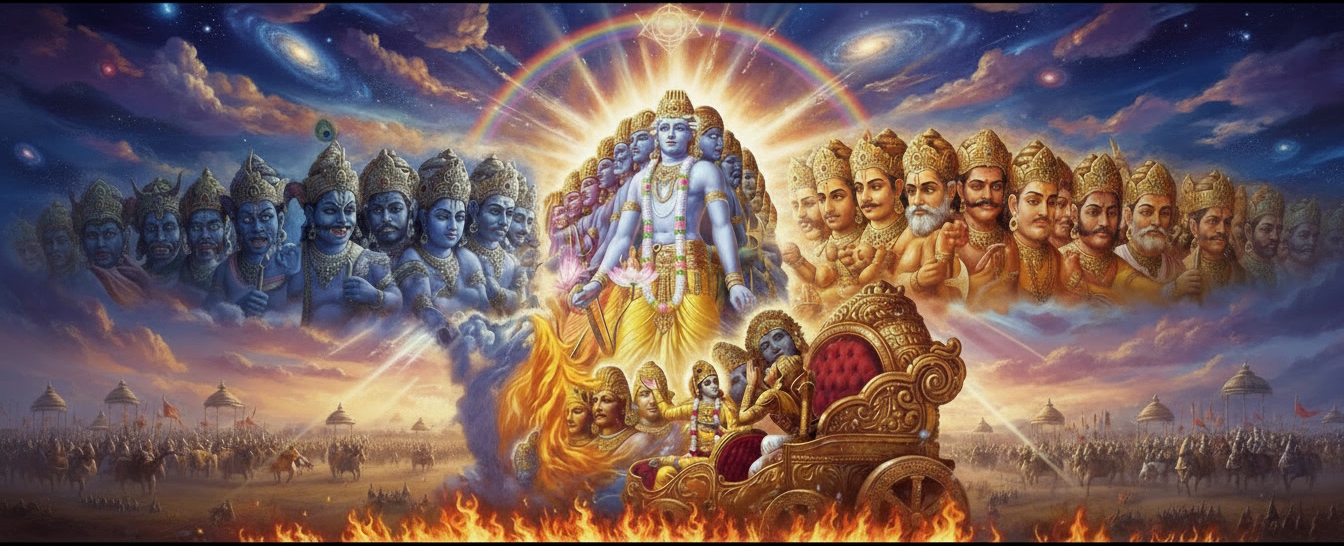
न त्वेवाहं जातु नासं न त्वं नेमे जनाधिपाः।
न चैव न भविष्यामः सर्वे वयमतः परम्।।2.12।।
na tvevāhaṃ jātu nāsaṃ na tvaṃ neme janādhipāḥ|
na caiva na bhaviṣyāmaḥ sarve vayamataḥ param||2.12||
Translation
Nor at any time indeed was I not, nor thou, nor these rulers of men, nor verily shall we ever cease to be hereafter.
हिंदी अनुवाद
किसी कालमें मैं नहीं था और तू नहीं था तथा ये राजालोग नहीं थे, यह बात भी नहीं है; और इसके बाद (भविष्य में) मैं, तू और राजलोग - हम सभी नहीं रहेंगे, यह बात भी नहीं है।
Commentaries & Translations
Swami Ramsukhdas
व्याख्या-- [मात्र संसारमें दो ही वस्तुएँ हैं--शरीरी (सत्) और शरीर (असत्)। ये दोनों ही अशोच्य हैं अर्थात् शोक न शरीरी-(शरीरमें रहनेवाले-) को लेकर हो सकता है और न शरीरको लेकर ही हो सकता है। कारण कि शरीरीका कभी अभाव होता ही नहीं और शरीर कभी रह सकता ही नहीं। इन दोनोंके लिये पूर्वश्लोकमें जो 'अशोच्यान्' पद आया है, उसकी व्याख्या अब शरीरीकी नित्यता और शरीरकी अनित्यताके रूपमें करते हैं।]
'न त्वेहाहं जातु ৷৷. जनाधिपाः'-- लोगोंकी दृष्टिसे मैंने जबतक अवतार नहीं लिया था, तबतक मैं इस रूपसे (कृष्णरूपसे) सबके सामने प्रकट नहीं था और तेरा जबतक जन्म नहीं हुआ था, तबतक तू भी इस रूपसे (अर्जुनरूपसे) सबके सामने प्रकट नहीं था तथा इन राजाओंका भी जबतक जन्म नहीं हुआ था, तबतक ये भी इस रूपसे (राजारूपसे) सबके सामने प्रकट नहीं थे। परन्तु मैं, तू और ये राजालोग इस रूपसे प्रकट न होनेपर भी पहले नहीं थे--ऐसी बात नहीं है।
यहाँ 'मैं, तू और ये राजालोग पहले थे--ऐसा कहनेसे ही काम चल सकता था, पर ऐसा न कहकर 'मैं, तू और ये राजालोग पहले नहीं थे, ऐसी बात नहीं' ऐसा कहा गया है। इसका कारण यह है कि 'पहले नहीं थे' ऐसी बात नहीं' ऐसा कहनेसे 'पहले हम सब जरूर थे'--यह बात दृढ़ हो जाती है। तात्पर्य यह हुआ कि नित्य-तत्त्व सदा ही नित्य है। इसका कभी अभाव था ही नहीं। 'जातु' कहनेका तात्पर्य है कि भूत, भविष्य और वर्तमान-कालमें तथा किसी भी देश, परिस्थिति, अवस्था, घटना, वस्तु आदिमें नित्यतत्त्वका किञ्चिन्मात्र भी अभाव नहीं हो सकता।
Sri Harikrishnadas Goenka
वे भीष्मादि अशोच्य क्यों है इसलिये कि वे नित्य हैं। नित्य कैसे हैं किसी कालमें मैं नहीं था ऐसा नहीं किंतु अवश्य था अर्थात् भूतपूर्व शरीरोंकी उत्पत्ति और विनाश होते हुए भी मैं सदा ही था। वैसे ही तू नहीं था सो नहीं किंतु अवश्य था ये राजागण नहीं थे सो नहीं किंतु ये भी अवश्य थे। इसके बाद अर्थात् इन शरीरोंका नाश होनेके बाद भी हम सब नहीं रहेंगे सो नहीं किन्तु अवश्य रहेंगे। अभिप्राय यह है कि तीनों कालोंमें ही आत्मरूपसे सब नित्य हैं। यहाँ बहुवचनका प्रयोग देहभेदके विचारसे किया गया है आत्मभेदके अभिप्रायसे नहीं।
Sri Anandgiri
To distinguish/explain that "Eternal-ness is the cause of being unworthy of grief"—which was indicated (previously)—He makes a proposition preceded by a question, starting with "Kutah" etc. (in the intro).
Objection: "Eternal-ness is unestablished due to lack of proof"—raising this query with "Katham" (How). Answer: "The Self is not born, because it is devoid of antecedent non-existence (pragabhava) [unlike a pot]; (and it is real), unlike a human horn"—He refutes with "Na tveva" (Never was I not).
Moreover, "The Self is eternal, because being a positive entity (bhava), it is unborn; by contrast, like a pot (which is born and non-eternal)"—He states this second inference with "Na chaiva" (Nor is it that...).
(Critique): Some say that "The Lord teaches the true nature of the Self to someone who inquired about it, through the four verses starting with 'Na tveva'." This is incorrect (asat). Because there is no reason for a "special statement" (just for one inquirer); the exposition of the Self's nature is uniform everywhere (for all). With this intent, the commentator explains the verse "Na tveva" demonstrating the three (actually four) components of explanation: word-separation (padaccheda), word-meaning (padarthokti), compound-analysis (vigraho), and sentence-construction (vakya-yojana).
Objection: "Since the origin and destruction of the Self along with the body's origin and destruction is well-known (prasiddha), the two inferences mentioned would be contradicted by common knowledge and thus fallacious (kalatyayapadishta)?" Answer: "No"—He says with "Atiteshu" (In the past) etc. According to the maxim "Charachara-vyapashrayastu syat" (Birth/death refer to the moving and unmoving bodies), the fame of the Self's birth and destruction refers to the "Auphadhika" (conditional/adjunct-based) birth and destruction. Therefore, the unconditional (Nirupadhika) Self is devoid of birth etc.—this is the sentiment.
Objection: "Although Your (Ishvara's) birthlessness is true, how does it apply to me?" Answer: Anticipating this, He says "Tatha" (So too). Objection: "Still, how is there absence of birth for Bhishma and others?" Answer: To that, He says "Tatha cha neme" (And nor were these kings not...).
Expanding on the second inference, he explains the second half of the verse with "Tatha" etc.
Objection: "Even if there is no birth/death of Self with the body's birth/death, still, in 'Great Heaven' (Creation) and 'Great Dissolution' (Pralaya), the birth and destruction of the Self should be accepted based on the Shruti of the 'Fire and Sparks' example?" Answer: He refutes this with the maxim "Na atma shruteh" (The Self is not born, per Shruti), saying "Trishvapi" (In all three times).
Objection: "According to the maxim 'Wherever there is modification, there is division, as in the world,' since Selves are distinct (divided), their mutability (non-eternality) is inferred; and their distinctness is proven by the use of the 'plural number' (we/they)?" Answer: Anticipating this, he says "Deha..." (Due to the distinction of bodies...).
Sri Dhanpati
He states their unworthiness of grief due to their eternality with "Na" etc. "Jatu"—at any time—it is not that I "Na asam" (was not); rather, I "Asam eva" (verily was). Similarly, it is not that you "Na asih" (were not); but "Asih eva" (verily were). Similarly, it is not that these kings "Na asan" (were not); but "Asan eva" (verily were). Similarly, it is not that "Na cha bhavishyamah" (we shall not be); but "Bhavishyama eva" (we verily shall be). Therefore, even after the destruction of this body, and in all three times, (the Self) is eternal. "In terms of the nature of the Self"—this is the meaning.
The use of the plural number while counting Himself amidst (you and these kings) is with the intent of the Oneness of the Self (at the absolute level); however, the plural usage regarding Jiva-distinction is based on the continuity of body-distinction, referring to the Jivas identifying with those respective bodies, and not with the intent of a real (paramarthatah) distinction of Selves.
As stated in the Shariraka Bhashya (Brahma Sutra Bhashya): "Difference is caused by adjuncts (upadhi), imagined by false knowledge, and is not absolute/real"—this should be understood.
Sri Madhavacharya
"Why/How (are they eternal)?" (The verse says) "Na tvevaham."
Since the eternality of Ishvara is not the primary subject here (but accepted), He mentions it as an "example" with "Na tveva."
Just as I am eternal—which is well-known in all Vedantas—so too are you and these kings eternal.
Sri Neelkanth
In response to the expectation "What happened next?", the verse says "Tam uvacha" (He spoke to him). "Prahasanniva" (as if smiling) means having a pleasant or cheerful face.
Sri Ramanuja
To show that he was worthy of ridicule, the one referred to by "Tam" (Him) is described by "Evam" etc. What is indicated by "Ubhayoh" (of both) is explained as "ready for war." By this, the attainment of the opportunity for instruction is suggested. By "Sidamanam" (despairing), "inactivity" (nirudyogatva) is implied. Explaining the intent of the word "Madhye" (in the middle)—which indicates a state unfit for withdrawing from war—he says "Akasmat" (Suddenly). The sentiment is: there is no valid cause here for withdrawing from war, such as unrighteousness or defeat; and abandoning an undertaken task without cause is indeed a matter for ridicule. Here, the "distinctiveness of the speaker from all others"—implied by the term "Hrishikesha" and useful for the authority of the scripture to be spoken—is shown as "Parama Purusha" (Supreme Person).
Although, being Hrishikesha, He is capable of controlling all of Partha's senses by mere will and impelling him to relieve the earth's burden, He performs the benefit to the world in a human form through the instruction of the scripture, which is the means to the human goal common to Partha and others—this is the idea.
Alternatively, having Himself agitated the courageous Arjuna in His capacity as Hrishikesha, He spoke the scripture for the world's benefit "as if smiling"; due to this special relationship and considering the immediate context where a joking tone is appropriate, the object of the "laughter" is stated to be Partha.
Alternatively, considering that ridicule is impossible towards one who has surrendered due to looking at his faults, and that in spiritual instruction to a disciple there is only a "gentle smile" (prahasa-matra), and that a simile (of laughing) is useless (if not real), the word "Partha" is used.
Thus, by "Prahasanniva" (as if smiling), He shows the sweetness, easy graspability, and the effortless articulation of the great collection of meanings hidden in the caves of all the Upanishads.
The scope of the word "Idam" (This) covers all the Lord's words to be spoken, and shows the indication of the intended meaning even by gesture—this is shown by "Parihasa" etc.
Even the verse "Ashochyan" (2.11) is merely the introduction to the scripture, having the "shadow of ridicule" to draw attention to the teaching; since it is not the scripture directly, it is stated that the scripture begins with "Na tvevaham" (2.12).
Alternatively, the verse "Ashochyan" (2.11) is the object of "Prahasanniva," and the text starting with "Na tvevaham" (2.12) is the meaning of the word "Idam."
Here, the instruction extends up to "Ma shuchah" (18.66) and is designated as the "subject of Bhakti Yoga," because the "Surrender" (Prapadana) mentioned in the final verse (Charama Shloka)—which achieves everything—will be cited.
as the remover of obstacles to Bhakti by connecting it to the present context.
Sri Sridhara Swami
"Karpanya" etc. With the phrase "Between the two armies" etc., this is indicated:
Arjuna, possessed by doubt, has not desisted from war based on a single [decided] view (but is rather confused).
For he says thus:
"Instruct me who have surrendered to You."
Therefore, standing in the middle of both Knowledge and Ignorance,
he is instructed by the Supreme Lord.
Sri Vedantadeshikacharya Venkatanatha
Thus, towards one ignorant of the nature of the means (Upaya), the goal (Upeya), and what is to be abandoned (Nivartya), in order to teach this triad, and having generated a desire to know, to qualify him for the performance of the means for other-worldly results, and to generate a desire for the means to attain the Self—which must be known as distinct from the body and is the goal (Upeya) as a human purpose—through the desire to attain it, He teaches right at the beginning; with this intention, (the commentator) says 'Prathamam' (First), etc.
'Shrinu' (Listen)—By this word, in order to remove the sense that the current verse is merely for reproach (taunting) like the opponent's speech, the meaning of securing attention is suggested. Regarding the eternal nature of the selves in the forms of the Jiva (individual soul) and Ishvara (God), He speaks first of the part that is capable of quick agreement; with this intention, he says 'Aham' (I), etc. The use of 'I' for Ishvara contains within it the concept of being the Controller of all; thus, he states the meaning resulting from that designation—'Sarveshvarah' (The Lord of All).
'Tavat' (Then/So long)—This is an indication of agreement. 'Atah param' (After this)—Here, the meaning of the word 'Atah', its appropriate connection to the previous sentence, and the meaning intended by the word 'Jatu' are stated by 'Atah' etc. For the negation of the unwanted view, even in a sentence that is in a negative form (Vyatireka), he states the positive connection (Anvaya) indicated by the word 'Tu'—'Apitu asam' (But I was), etc.
'Na tvam neme' (Not that you, nor these)—Even in this indication of difference, by grouping them together in the form of 'Knowers of the Field' (Kshetrajna), and showing the common form of 'being fit to be ruled' implied by the meanings of 'Yushmad' (You) and 'Idam' (This/These) in relation to Ishvara; and stating that the partial utterance based on the proximate example (Arjuna, etc.) actually intends all Knowers of the Field beginning with Brahma—he says 'Tvanmukhah' (You, etc.).
He shows the connection of the word 'Tu' and the change in the case-ending of the verb—'Apitu asan' (But they were), etc. 'Na tvam neme janadhipah' (Not that you, nor these rulers of men)—Here, by connecting 'Na tveva' (Not that indeed)—the connection is 'Na tvam na asih' (Not that you were not), 'Neme janadhipah na asan' (Nor that these rulers of men were not). 'Sarve vayam' (We all)—By this, he distinguishes the portion to be accepted within the aforementioned community of Jivas and Ishvara—'Aham cha' (I and), etc.
'Tyadadinim mithah sahoktau yatparam tachchhisshyate' (Panini Vartika 1.2.72)—By this rule, the 'Ekashesha' (retention of one) of 'Yushmad' and 'Asmad' results in (We) here. Thus, it should be understood in 'Bhavantah' (You all) later on as well. He removes the fancy (Utpreksha) that due to the infinity of time, even extremely stable things like mountains might eventually perish—'Apitu bhavishyamah eva' (But we shall indeed exist), etc.
He states the purpose of using His own (Ishvara's) designation, though not the subject of the context (since Arjuna's grief is about friends, not God), as an illustration (Drishtanta); and therein, the justification of eternity in the form of Lordship-of-all and Selfhood-of-all intended by the designation 'Aham' (I); and the probability of eternity in the illustrated subject (the Jivas)—he says 'Yatha' (Just as), etc. The Lord of All is the ruler of everything existing in the three times; how could He not exist in the three times? And how could the Controller of all ever be obstructed by anyone? This is the sentiment. 'Paramatma' (Supreme Self)—defined as 'Pervasion unlimited by space, time, and nature'—this is the derivation of the word Paramatma. And thus, due to being pervaded, there is no destruction of Him by the pervaded objects, and due to being the Self of all, existence in all times is proven; this is the meaning.
Objection: He who doubts even the Jiva which is distinct from the body and capable of perception—how can he be free of doubt regarding the Paramatma who is distinct from that and totally imperceptible? Answer: This Arjuna is not ordinary. He is the speaker of 'Purusham shashvatam divyam' (Gita 10.12); he knows the nature of the Supreme Person who is the Supreme Brahman, known through the words of hundreds of supreme sages like Narada, Asita, Devala, Vyasa, etc.; he has directly perceived the world of Purandara (Indra), all weapons, mantras, penance, power, etc.; he has unsurpassed devotion to the Guru and Deity; his conduct in all Varnas and Ashramas is falter-free; he is overwhelmed by the fear of the loss of Dharma. He does not wander in error thinking the soul and Ishvara distinct from the body do not exist due to extreme impermanence, nor does he doubt. His grief is solely due to being ignorant of the specific mode (Prakara) of that. Therefore, he accepts Ishvara and His eternity generally established by His Lordship over all, but due to seeing birth and destruction in the worldly view, and due to a superficial understanding of scriptural meanings like 'Na pretya samjna asti' (Brihadaranyaka Upanishad 2.4.12), he does not know the specific modes of the Jiva in reality; thus there is no fault.
'Kshetrajnah atmanah' (The Knowers of the Field are souls)—Just as due to the distinction of the Paramatma from the Jiva, the characteristics of the Jiva do not exist in Him, similarly, due to the distinction from the Kshetra (Field/Body) which will be described, the impermanence etc. existing in the Field should not be suspected in its controller, the Jiva; this is the meaning.
Now (The Commentator speaks): Demonstrating the faults in the treatises constructed by tailors of evil intellect (Kumati)—treatises smelling like a quilt (Kantha) made of pieces of old, worn-out rags that are disjointed and mismatched from top to bottom—using the maxim of the boiling rice (Sthalipulaka Nyaya: checking one grain to test the whole pot), he first states the contradiction with the commencement of the scripture and the impossibility of the scripture's engagement—'Evam' (Thus), etc. Meaning: In the manner of the statement of the commencement of the scripture engaged in teaching the Reality.
'Bhagavatah sarveshvarat' (From the Lord, the Ruler of All)—Meaning: From the one designated as 'Aham' (I), who possesses both characteristics (ubhayalinga: absence of defects and presence of auspicious qualities) and is the Controller of all.
If the distinction of Jivas from Ishvara were not real (Paramarthika), there would be a mixture of natures like 'dual-characteristics' (of God) and 'suffering' (of Jiva). And if the mutual distinction of souls were not true, the arrangement of bound, liberated, student, teacher, etc., would not be possible; this is the meaning.
'Bhagavataiva' (By the Lord Himself)—Not by someone like a man on the street. Or, based on statements like 'You alone know Yourself, who You are, You are' and 'He, the Anga, knows, or perhaps He knows not'—it is understood that the Truth of Himself and the Jivas who are His body was spoken by the Lord Himself; this is the intention.
'Ajnanamohitam' (Deluded by ignorance)—For, indeed, delusion should not be produced even by a trustworthy person in one who is already wandering in confusion (if difference is false, teaching difference increases delusion); this is the meaning. Why could this teaching not be like the delusion of Asuras by the incarnation of Buddha, etc.? To this, he says—'Tannivrittaye' (For its removal). The Gita-Upanishad is for the sake of removing delusion—this is accepted and commented upon even by you (Advaitins); this is the meaning.
He refutes the statement spoken by Shankara that the plural number is intended for the bodies, not for the distinction of souls—'Paramarthika' (Real), etc. For this text 'Na tveva aham' etc. is not a recitation of a mantra for the removal of error such that we might consider the indication of difference to mean something else; rather, this is a form of instruction on Reality; this is the meaning.
'Aham' (I) implies inwardness; 'Tvam' (You) implies another conscious being facing oneself; 'Ime' (These) implies many conscious beings turned away from oneself; 'Sarve' (All) implies many individuals grasped by a single collective attribute; 'Vayam' (We) implies infinite individuals classified into one group along with oneself; this is the meaning.
'Iti vyapadeshat' (Because of such designation)—Here, there is no denial made such as 'I am not, nor are you, nor is there another'; this is the meaning.
In Bhaskara's view, since difference is caused by real limiting conditions (Upadhis), the instruction of difference is justifiable; in response to this doubt, he says that the defect stated generally applies there too and is unavoidable—'Aupadhika' (Conditioned), etc. The word 'Hi' implies the acceptance that the portion of difference is unreal even in examples cited by others like 'pot-ether' (Ghatakasha), which is conditioned by a limiting adjunct. Even if the Upadhi is real, just as the difference of the single moon-face caused by real Upadhis like gems, swords, rivers, oceans, etc., is not real (Paramarthika); and just as the difference of the single ether caused by real Upadhis like pots and jars is not a difference distinct from the difference in conjunction and is not dependent on the Upadhi (in reality); similarly, it must be accepted that the difference of Brahman—who is partless and thus unfit for cutting or splitting and is full everywhere—caused by real Upadhis like the internal organ (Antahkarana) is not real. And consequently, at the time of teaching the Truth, teaching the opposite of that (i.e., difference) is not fitting for one who instructs for the welfare; this is the meaning.
In both views (Shankara and Bhaskara), contradiction with Shruti is also a defect. In his own view (Visishtadvaita), since there is oneness of meaning with Shruti, there is no suspicion of it being for the sake of delusion like the Buddha-Agama; with this intent, he says—'Bhagavat' (By the Lord), etc. Or, the Shruti is cited specifically to refute Bhaskara's view, and by the logic of 'Kaimutya' (how much more so), Shankara's view is also refuted. The word 'Api' implies the combination of two proofs (Smriti/Gita and Shruti).
'Bhagavadukta-atmabheda' (The difference of souls spoken by the Lord)—This suggests independence from other proofs, just like the Shruti. Shruti is also eternal and is authority precisely because it is His command. 'Nityo nityanam' (Eternal among the eternal - Shvetashvatara Upanishad 6.13)—Here too, by planning the interpretation like 'Pavitranam pavitram' (Holy among the holy), rejecting the error of a different meaning that results in the impermanence of Jivas; demonstrating the unconditioned plurality and consciousness of souls through the grammatical coordination (Samanadhikaranya) of eternity, plurality, and consciousness; and thereby intending the refutation of the Saugatas (Buddhists) who argue for the impermanence of the self, of Shankara and others who argue for difference rooted in Avidya, of Vaisheshikas and others who argue for consciousness that comes and goes, and of others who argue for the eternity of mere consciousness-energy; establishing the oneness of Ishvara through the force of the coordination of the four words ending in the nominative case; rejecting the view of a 'Pravaha-Ishvara' (Stream-God/Post-holder God) since His oneness is not breakable by distinctions of time like Hiranyagarbha, Rudra, Indra, etc.; indicating the eternal consciousness and pervasiveness etc. well-known in other Shrutis; and implying a specific injunction (Visishta-vidhi) by the force of novelty (Apraptatva) even though there is a sign of restatement (Anuvada) like in 'Yadagneyah'; He states the meaning of the Shruti: That there is only one Ishvara for all conscious beings everywhere and always, who, worshipped by their respective actions, performs the expected results corresponding to them—'Nityanam' etc.
Again, by the logic of 'Simhavalokita' (The Lion's Backward Glance), he states the 'blow to the root of the commencement of scripture' which is the impossibility of instruction in Shankara's doctrine—'Ajnana' (Ignorance), etc. Does this Lord teach a meaning known to Himself or unknown? If known, is it directly realized or merely heard? in both cases, is His ignorance removed or unremoved? Even if removed, does the effect of ignorance (difference-delusion) cease or not?—Presupposing this dilemma, he states the defect in the view that ignorance and its effects are removed by realization—'Paramapurushasya' (Of the Supreme Person), etc. For the Knower of the Field (Jiva) might have an unreal view, this is the sentiment.
'Nirvishesha' (Attribute-less), etc.—'Nirvisheshatva' means absence of homogeneous, heterogeneous, and internal differences; being immutable; being based in Maya; universality; or being changeless. Just as the anvil (Kuta), though itself unchanging, is the cause of change in things like iron that come in contact with it, so is this. From that alone comes eternity, i.e., being unlimited by time. 'Yathatmyam' (True Nature)—The stated manner. Since the 'Ayatha-sakshatkara' (Incorrect realization) is accepted by the opponents even for people like us, to exclude that, 'Yathatmya-sakshatkara' is said. 'Ajnanam' is Avidya; its effect is the delusion of difference. The word 'Adi' (etc.) includes inducing others to action, etc. The behavior of teaching, etc., is rooted in the perception of various differences like 'meaning to be taught', 'the speaker of that', 'the qualified student', 'teacher', 'purpose', etc. And perception of difference is created only by ignorance, according to your view. Then, upon the cessation of ignorance and its effects, how can the lineage of its effects (teaching) persist? Thus, hundreds of faults would emerge, such as contradiction, deviating from one's own doctrine (Apasiddhanta), non-commencement of scripture, absence of teaching, fruitless exertion, contradiction of Shruti, etc.
Doubt: Even upon the cessation of ignorance by Advaita-knowledge, the delusion of difference persists due to traces (Vasana), but it is not binding—he anticipates this—'Atha' (Now/But). 'Dagdha-patadivat' (Like a burnt cloth), etc.—Just as a burnt cloth etc., though being the object of the perception of a cloth, does not perform the function of a cloth; similarly here, the delusion of difference, though persisting, is not the cause of Samsara; this is the meaning.
'Naitad upapadyate' (This is not appropriate)—Only an example has been given, but no logical justification; rather, there is logical impossibility; this is the meaning. He states the impossibility with an example—'Marichika' (Mirage), etc. The context is thus: If the disputed knowledge of difference is determined to be about a false object because it is sublated (contradicted) by Advaita-knowledge, then it cannot be the cause of activity appropriate to its object; just as the knowledge of mirage-water, which persists though contradicted (does not cause one to fetch water). And thus, the contradicted-persisting knowledge of difference, like the burnt cloth, does not perform its function; so, due to the absence of the fruit of 'contradicted-persistence', your desired objective is defeated.
Even in the 'merely heard' (Shrutamata) view, since the realization of the attribute-less object and the hearing of it do not differ in terms of the object, the removal of ignorance is impossible; thinking this, he now refutes the nature of 'contradicted-persistence' (Badhitanuvritti) in the Lord of All—'Na cha' (And not), etc.
One cannot say He was ignorant before precisely because of His Lordship, for that would imply non-Lordship. If the Lord was ignorant before, His learning of scripture is also not possible, due to the absence of another instructor of scripture who possesses greater knowledge. Even if assumed, how did that Lord, being a non-Lord, become a perfect knower? This leads to infinite regress. Nor is there a lineage of Stream-Gods (Pravaha-Ishvara), for that has been refuted. Nor does the Lord understand the Truth through a scripture created by Himself, for that leads to the impermanence of Vedas and mutual dependence. Nor did He remember the beginningless Vedas and learn the meaning from them, for due to the cause of memory etc. being a prior experience, the absence of an instructor makes the situation bad. Intending these faults, he said 'Purvam ajnasya' (Of one who was ignorant before), etc.
He states the contradiction with Shruti and Smriti regarding the Lord being ignorant before, having knowledge dependent on scripture, having another instructor, and having persistence of delusion—'Yah sarvajnah' (He who is all-knowing), etc. He knows everything by nature and by mode—with this intent, 'Sarvajna' and 'Sarvavit' are not repetitive. Or, 'Sarvavit' means He who obtains (Vindati) everything.
Thus, the impossibility of the cause of instruction has been stated. Now, the status of being an instructor is also not possible; he says—'Kincha' (Moreover), etc. 'Idanimtana' (Modern/Current)—Not only is the first instruction by the Lord impossible, but even the current one; thus, because of the absence of disciples etc. for the lineage of Abbots of evil-minded (Kumati) Monasteries who merely fill their bellies with disciples' food, a 'fast unto death' (Prayopaveshana) is implied; this is the sentiment. Intending the impossibility of the view of 'teaching without knowing', he says—'Svarupanishchaya' (Determination of nature), etc. For these (teachers) are not people who haven't found the meaning, nor are they doubtful, nor deceivers, nor merely repeating what others said, nor prattling whatever comes to mind like children or madmen; this is the meaning.
'Kasmai' (To whom?)—To Himself or to another? If the former (to Himself): as determined to be distinct? or otherwise (non-distinct)? If 'as distinct', is it decided as real or unreal? In 'to another': to a real one or an unreal one? Even if unreal, to one perceived as such or otherwise? Thus offering alternatives, the answer must be given to the questioner. There, in the certainty of Himself being distinct and real, there is the fault of deviating from doctrine and ignorance. In the certainty of unreality, there can be no teaching, just as to a barren woman's son. If to Himself decided as non-distinct, then instruction would happen always without the appearance of Arjuna etc., and there is no purpose for instruction there. 'To a real other'—this you do not accept even though there is bodily difference. 'To another perceived only as unreal'—then, as before, the instruction would apply even to reflections, barren women's sons, etc., who are determined as indefinable or unreal. If the unreal 'other' is understood to be real (by the teacher), then he is not a Knower of Truth, so the status of a Teacher of Truth is not established. Standing thus, he doubts the view: 'Even though strictly one, instruction is given to those perceived as distinct due to delusion, and who are (then) determined as non-distinct by the force of sublatig knowledge'—'Pratibimbavat' (Like a reflection), etc.
He refutes it—'Na' (No). He explains the impossibility—'Na hi' (For indeed not), etc.
'Anunmatta' (Not mad)—The implication is that you would have accepted that God etc. are indeed mad. 'Ko'pi' (Anyone)—What to speak of God; this is the meaning. 'Ananyatvam janan' (Knowing non-difference)—Children etc. who do not know non-difference may well teach; here, if the instructor decides on difference, there is the contingency of being deluded; this is the meaning. 'Kamapi' (Any)—Worldly or other-worldly, for seen results or unseen results; what to speak of for the sake of Moksha; this is the meaning.
Having accepted the nature of 'contradicted-persistence' (Badhitanuvritti), another defect was stated earlier. Now, in their view, that (Badhitanuvritti) itself is not established; he says—'Badhita' etc. He explains—'Badhakena' etc. For it is not proper to say that without a cause the effect would occur, nor that upon the cessation of the defect, the delusion would not cease.
'Anadeh' (Of the beginningless)—Beginningless by nature or by stream; if the defect which is the cause of difference-knowledge, which has persisted for this long and is not removable by anything else, is not destroyed even by Advaita-knowledge, then Brahman would be an eternal Samsarin; this is the sentiment. Here, there is a reading 'Ajnanadeh', where the word 'Adi' includes the delusion of difference and its object. He states the justification for 'contradicted-persistence' in the example cited by the opponents—'Dvichandra' (Two moons), etc.
'Paramarthika'—For the Real cannot be sublated; if it were, there would be chaos regarding what is sublated and what is not. 'Dvichandrajnanahetoh'—For the cause of the previous knowledge is not sublated by the sublatig knowledge (the eye defect remains), otherwise there would be the contingency of the destruction of the senses etc. Therefore, (in the two-moon example) only the object is superimposed and is sublated by the knowledge of the substrate-object which grasps the contrary form. And here (in the world), darkness (Timira) etc. is not the object of the two-moon knowledge or the one-moon knowledge. But for you (Advaitin), the material cause of all difference-delusion (Ignorance/Vasana) is the object of the Witness-Consciousness, and the sublatig knowledge has as its scope everything other than the Non-dual Self; therefore, the beginningless cause must indeed be sublated.
'Yukta'—If the aggregate of causes persists, the persistence of the effect is reasonable. If the delusion persists, how then is there cessation of its effects like wonder, fear, etc.? To this he says—'Anuvartamanam api' (Even though persisting), etc.
By the word 'Prabala' (Strong), it is indicated that in the opponent's view, there is no difference between the difference-delusion and its sublator. For the causality of ignorance is resorted to by them for both; otherwise, there would be a contingency of 'Two Truths'. And such being the case, what is the sublator of what, or what is the sublated? It cannot be said that the 'defect-based nature' of the sublatig knowledge (Scripture) is unknown, for right at the time of hearing, there is the cognition of the falsity of everything other than Brahman. And 'being unknown' does not establish truth; the knowledge of the shell which sublates the real silver, even if its defect is unknown, does not inherently sublate the nature of silver. (Objection:) Even if both are based on defects, the arrangement of sublated-sublator is based on 'earlier' and 'later'? (Answer:) No, when 'being based on defect' is known, being 'later' is of no consequence, just like the aforementioned 'Universal-Sublator' sentence understood as erroneous. Otherwise, the Madhyamika sentence 'Void alone is Reality', even though known to be based on a defect, would sublate Pure Consciousness merely by being 'later'.
Now, explaining the difference from the example (burnt cloth/mirage) characterized by the unreality of the object since the cause is also sublated, he concludes the impossibility of 'contradicted-persistence'—'Iha tu' (But here), etc. 'Na kathanchid api' (Not in any way)—Meaning: Neither by beginningless ignorance nor by traces of difference-knowledge. He concludes the 'impossibility of the cause of instruction etc.' which was started with the alternative 'Known or Unknown', by clarifying the alternative—'Atah' (Therefore), etc.
'Sutaram' (Even more so)—For one who knows, there is at least an example (however flawed) for 'contradicted-persistence'; for instruction by one who does not know, even that does not exist.
The impossibility of the cause etc. of instruction has been stated. Now he states its pointlessness—'Kincha' (Moreover), etc. Since the view of 'Ignorance of the Jiva' was already refuted earlier by 'Appearing like a reflection' etc., this additional defect is stated regarding the view of 'Ignorance of Brahman'. They indeed describe: 'One Brahman alone is spotted with Avidya; there is only one Jiva; like a dreamer, due to the error of that one alone, other Jivas etc. appear like men seen in a dream. By the knowledge of Truth—which will happen at an undecided time and whose location is uncertain—functioning as an awakening for that one alone, the entire universe is sublated like a dream-universe.'
There, this instructor—Guru Vasudeva etc.—is he that same (One Jiva)? Or is he seen (dreamt) by him? Or is the disciple too—Arjuna etc.—that same one? Or seen by him?—Intending this dilemma, he states the defect in the view 'The Guru is that same one'—'Guroh' (Of the Guru), etc. 'Sakaryasya' (Along with his effects)—Meaning: Of the status of disciple, teacher, etc. too; by this, the absence of the instructor, the absence of the questioner, and the absence of the paraphernalia of instruction are stated. He restates the view that the Guru is 'seen by him' (dreamt)—'Guruh' (The Guru), etc. For a dream is not sublated by the knowledge of a man invented by the dreamer; similarly here, since the universe is not sublated by the Guru's knowledge, instruction for its sublation is purposeful; this is the sentiment. He refutes this—'Shishya' (The disciple), etc.
Ayam bhavah (The sentiment is this): We do not find any proof for the third hypothesis that 'Arjuna etc. is that same (one) Jiva'. Nor does the Teacher think 'This disciple of mine, a Jiva, will be liberated; I am but presumed by him like a figure in a dream'; if so, he would not teach that one who is his destroyer and does him great harm. For he (the disciple/dreamer) would be liberated by the nature of sleep naturally, so he (the Guru) would not practice the means of Liberation. If the disciple too considers the Guru like one seen in a dream, he would not listen. Knowing the Guru and his specific knowledge to be invented by his own delusion, why would he listen to him? To say 'My own delusion is removed by the delusion of instruction generated by a teacher invented by me' is laughable; for its removal is possible even by his own direct perceptual error without him (the teacher). Nor is the removal of delusion seen in Arjuna, who (supposedly) knows the meaning, even up to today. Therefore, the fourth hypothesis remains: that the disciple too, like the teacher, is seen (dreamt) by someone else who is the dreamer of the entire universe-dream. And thus, just as the knowledge of Shuka, Vamadeva, etc. (did not end the world), the knowledge of Arjuna etc. also is not the remover of ignorance; thus the effort of the disciple and teacher, Krishna and Arjuna etc., for Liberation by abandoning the three goals of life (Dharma, Artha, Kama) is fruitless; thus the commencement of scripture is impossible.
Now, anticipating the 'Apachcheda-naya' (logic of the later sublatig the earlier) with a sarcastic tone, he refutes it—by 'Kalpitatve'pi' (Even if invented), etc. Thus, upon the impossibility of instruction, since Liberation is never possible for that one Jiva who sees everything, there is no purpose for the scripture either; thus it results in the impossibility of the commencement of scripture due to that reason as well. Thus, having refuted the opponent's view generally in every way—due to the impossibility of the scriptural instruction, its instructor, its hearer, and its purpose—what is the use of subsidiary refutations? Thus, turning to another matter, he concludes—'Iti kritam' (So, enough/done). 'Kritam' means 'Alam' (Enough).
By 'Asamichinavadaih' (By unsound arguments), hundreds of such defects in the views of Bhaskara and others, which were stated in the Shariraka Bhashya etc., are brought to mind.
Swami Chinmayananda
यहाँ भगवान् स्पष्ट घोषणा करते हैं कि देह को धारण करने वाली आत्मा एक महान तीर्थयात्रा के लिये निकल पड़ी है जो इस यात्रा के मध्य कुछ काल के लिये विभिन्न शरीरों को ग्रहण करते हुये उनके साथ तादात्म्य कर विशेष अनुभवों को प्राप्त करती है। श्रीकृष्ण अर्जुन और अन्य राजाओं का उन विशेष शरीरों में होना कोई आकस्मिक घटना नहीं थी। न वे शून्य से आये और न ही मृत्यु के बाद शून्य रूप हो जायेंगे। प्रामाणिक तात्त्विक विचार के द्वारा मनुष्य भूत वर्तमान और भविष्य की घटनाओं की सतत शृंखला समझ सकता है। आत्मा वहीं रहती हुई अनेक शरीरों को ग्रहण करके प्राप्त परिस्थितियों का अनुभव करती प्रतीत होती है।
यही हिन्दू दर्शन का प्रसिद्ध पुनर्जन्म का सिद्धान्त है। इस सिद्धान्त के सबसे बड़े विरोधियों ने अपने स्वयं के धर्मग्रन्थ का ही ठीक से अध्ययन नहीं किया प्रतीत होता है। स्वयं ईसा मसीह ने यदि प्रत्यक्ष नहीं तो अप्रत्यक्ष रूप से इस सिद्धान्त को स्वीकार किया है। जब उन्होंने अपने शिष्यों से कहा था कि जान ही एलिजा था। ओरिजेन नामक विद्वान ईसाई पादरी ने स्पष्ट रूप से कहा है प्रत्येक मनुष्य को अपने पूर्व जन्म के पुण्यों के फलस्वरूप यह शरीर प्राप्त हुआ है।
कोईभी ऐसा महान विचारक नहीं है जिसने पूर्व जन्म के सिद्धान्त को प्रत्यक्ष या अप्रत्यक्ष रूप से स्वीकार नहीं किया गया है। गौतम बुद्ध सदैव अपने पूर्व जन्मों का सन्दर्भ दिया करते थे। वर्जिल और ओविड दोनों ने इस सिद्धान्त को स्वत प्रमाणित स्वीकार किया है। जोसेफस ने कहा है कि उसके समय यहूदियों में पुनर्जन्म के सिद्धान्त पर पर्याप्त विश्वास था। सालोमन ने बुक आफ विज्डम में कहा है एक स्वस्थ शरीर में स्वस्थ अंगों के साथ जन्म लेना पूर्व जीवन में किये गये पुण्य कर्मों का फल है। और इस्लाम के पैगम्बर मोहम्मद के इस कथन को कौन नहीं जानता जिसमें उन्होंने कहा कि मैं पत्थर से मरकर पौधा बना पौधे से मरकर पशु बना पशु से मरकर मैं मनुष्य बना फिर मरने से मैं क्यों डरूँ मरने से मुझमें कमी कब आयी मनुष्य से मरकर मैं देवदूत बनूँगा
इसके बाद के काल में जर्मनी के विद्वान दार्शनिक गोथे फिख्टे शेलिंग और लेसिंग ने भी इस सिद्धान्त को स्वीकार किया। बीसवीं शताब्दी के ही ह्यूम स्पेन्सर और मेक्समूलर जैसे दार्शनिकों ने इसे विवाद रहित सिद्धान्त माना है। पश्चिम के प्रसिद्ध कवियों को भी कल्पना के स्वच्छाकाश में विचरण करते हुये अन्त प्रेरणा से इसी सिद्धान्त का अनुभव हुआ जिनमें ब्राउनिंग रोसेटी टेनिसन वर्डस्वर्थ आदि प्रमुख नाम हैं।
पुनर्जन्म का सिद्धान्त तत्त्वचिन्तकों की कोई कोरी कल्पना नहीं है। वह दिन दूर नहीं जब मनोविज्ञान के क्षेत्र में तेजी से हो रहे विकास के कारण जो तथ्य संग्रहीत किये जा रहें हैं उनके दबाव व प्रभाव से पश्चिमी राष्ट्रों को अपने धर्म ग्रन्थों का पुनर्लेखन करना पड़ेगा। बिना किसी दुराग्रह और दबाव के जीवन की यथार्थता को जो समझना चाहते हैं वे जगत् में दृष्टिगोचर विषमताओं के कारण चिन्तित होते हैं। इन सबको केवल संयोग कहकर टाला नहीं जा सकता। यदि हम तर्क को स्वीकार करते हैं तो देह से भिन्न जीव के अस्तित्व को मानना ही पड़ता है। मोझार्ट का एक दर्शनीय दृष्टान्त है। उसने 4 वर्ष की आयु में वाद्यवृन्द की रचना की और पांचवें वर्ष में लोगों के सामने कार्यक्रम प्रस्तुत किया और सात वर्ष की अवस्था में संगीत नाटक की रचना की। भारत के शंकराचार्य आदि का जीवन देखें तो ज्ञात होता है कि बाल्यावस्था में ही उनको कितना उच्च ज्ञान था। पुनर्जन्म के सिद्धान्त को स्वीकार न करने पर इन आश्चर्यजनक घटनाओं को संयोग मात्र कहकर कूड़ेदानी में फेंक देना पड़ेगा
पुनर्जन्म को सिद्ध करने वाली अनेक घटनायें देखी जाती हैं परन्तु उन्हें प्रमाण के रूप में संग्रहीत बहुत कम किया जाता है। जैसा कि मैंने कहा आधुनिक जगत् को इस महान स्वत प्रमाणित जीवन के नियम के सम्बन्ध में शोध करना अभी शेष है। अपरिपक्व विचार वाले व्यक्ति को प्रारम्भ में इस सिद्धान्त को स्वीकार करने में संदेह हो सकता है। जब भगवान् ने कहा कि उन सबका नाश होने वाला नहीं है तब उनके कथन को जगत् का एक सामान्य व्यक्ति होने के नाते अर्जुन ठीक से ग्रहण नहीं कर पाया। उसने प्रश्नार्थक मुद्रा में श्रीकृष्ण की ओर देखकर अधिक स्पष्टीकरण की मांग की।
"इनका शोक क्यों नहीं करना चाहिये ? क्योंकि स्वरूप से ये सब नित्य हैं। कैसे ?"...भगवान् कहते हैं।
Sri Abhinavgupta
'Aśocyān' etc. The body is impossible to grieve for, because it is always perishable. And you grieve for the Self which is unworthy of grief. No one, 'gatāsuḥ' (dead) or 'agatāsuḥ' (living), is to be grieved for. Thus indeed, the Self is imperishable. While moving in various bodies, what mournability is there for it? Nor is there mournability just in moving to another body. For in this way, there would be mournability even in youth etc.
Sri Jayatritha
In response to the expectation "What did the Lord answer then?", he says "Tam uvacha" etc.
Hrishikesha, "as if smiling," spoke "Idam vachah" (these words)—which will be stated ahead—
to the despairing Arjuna in the middle of both armies.
Even to His own people ("Sviyeshu") who may not be acting according to His words ("Svoktakarishu api"),
the Lord speaks again
to create confidence—
hence the address "Bharata" (O descendant of Bharata).
Sri Madhusudan Saraswati
"What happened next?"—To this, it says "Tam uvacha" (He spoke to him).
"Alas, what kind of cowardice (klaibya) is this due to ignorance of the reality of the Self!"—
laughing (prahasan) at this;
and yet with the sentiment that "Because he is extremely righteous (dharmishtha), this (compassion/grief) is also fitting for him"—
thus it is stated.
Sri Purushottamji
Having stated "lack of devotion" as the cause for being unworthy of grief (in the previous context), He now states another reason for unworthiness of grief with "Na tu" etc. "I—such as you see Me now—was never not so at any time 'Jatu'; rather, I always was and am thus"—this is the meaning. By this, His own eternality is stated.
Objection: "Even if You are eternal, how does that make these people unworthy of grief?" To this He says: "Nor were you not." "Nor were these kings not"; rather, everything is eternal indeed because it is of the nature of My Lila (divine play)—this is the meaning. Thereby, the death of demons is also eternal (ordained in the play)—this is the meaning. Therefore, the idea is that these are merely Maya (forms of the play), and thus unworthy of grief.
Objection: "If I die in the war, then there will be separation from Your feet, or due to performing unrighteousness (Adharma) that separation will happen; therefore I grieve"—if this is said, to this He says: "Na chaiva" (Nor indeed...). "Atah param"—meaning after the present time—it is not that we all shall not be; rather, we shall indeed be. Thus, since everyone is eternal, everyone is unworthy of grief; therefore, you ought not to grieve—this is the sentiment.
Sri Shankaracharya
It is not indeed that at any time "I was not"; rather, I certainly was. The intention is: Just as Space (Akasha) exists eternally (even when enclosed) in pots etc. despite the origin and destruction of the pots in the past, similarly I existed eternally. Similarly, it is not that "you were not"; rather, you certainly were. Similarly, it is not that "these kings were not"; rather, they certainly were. Similarly, it is not that "we all shall not be" "Atah param"—after the destruction of this body in the future; rather, we shall certainly be.
The meaning is that in all three times, we are eternal in the nature of the Self. The plural number is used due to the continuity of the distinction of bodies, not with the intention of distinction in the Self.
In that regard, He gives an example of how the Self is eternal:
Sri Vallabhacharya
In response to the expectation "Why?", He implies: Those are indeed worthy of grief who, having been born, die; but since these are Selves, their birth itself is impossible. Refuting birth through the doctrine of the Self, He states their unworthiness of grief with "Na tvevaham" etc.
Like the verse "I, you, this water, and these residents of Dwaraka..." (Bhagavatam 10.14.23), the Lord negates the 'becoming' (birth/change) of the Self in all three times, unlike the body.
It is not that I—the Supreme Self—am born, or was ever not there, or did not exist in that way; nor is it that you are not born or were not there; nor is it that these kings standing before us are not born (i.e., new creations). Rather, the Selves are always eternal, pure, and conscious; hence they are unworthy of grief.
By Shrutis like "The Eternal among the eternal, the Conscious among the conscious" (Katha Up. 5.13, Shvet. Up. 6.13), the modification called 'birth' for the Selves is refuted.
Swami Sivananda
न not? तु indeed? एव also? अहम् I? जातु at any time? न not? आसम् was? न not? त्वम् thou? न not? इमे these? जनाधिपाः rulers of men? न not? च and? एव also? न not? भविष्यामः shall be? सर्वे all? वयम् we? अतः from this time? परम् after.Commentary -- Lord Krishna speaks here of the immortality of the Soul or the imperishable nature of the Self (Atman). The Soul exists in the three periods of time (past? present and future). Man continues to exist even after the death of the physical body. There is life beyond.
Swami Gambirananda
Why are they not to be grieved for? Because they are eternal. How? Na tu eva, but certainly it is not (a fact); that jatu, at any time; aham, I ; na asam, did not exist; on the contrary, I did exist. The idea is that when the bodies were born or died in the past, I existed eternally. [Here Ast. adds ghatadisu viyadiva, like Space in pot etc.-Tr.] Similarly, na tvam, nor is it that you did not exist; but you surely existed. Ca, and so also; na ime, nor is it that these ; jana-adhipah, rulers of men, did not exist. On the other hand, they did exist. And similarly, na eva, it is surely not that; vayam, we; sarve, all; na bhavisyamah, shall cease to exist; atah param, after this, even after the destruction of this body. On the contrary, we shall exist. The meaning is that even in all the three times (past, present and future) we are eternal in our nature as the Self. The plural number (in we) is used following the diversity of the bodies, but not in the sense of the multiplicity of the Self.
Swami Adidevananda
Indeed, I, the Lord of all, who is eternal, was never non-existent, but existed always. It is not that these selves like you, who are subject to My Lordship, did not exist; you have always existed. It is not that 'all of us', I and you, shall cease to be 'in the future', i.e., beyond the present time; we shall always exist. Even as no doubt can be entertainted that I, the Supreme Self and Lord of all, am eternal, likewise, you (Arjuna and all others) who are embodied selves, also should be considered eternal.
The foregoing implies that the difference between the Lord, the sovereign over all, and the individual selves, as also the differences among the individual selves themselves, are real. This has been declared by the Lord Himself. For, different terms like 'I', 'you', 'these', 'all' and 'we' have been used by the Lord while explaining the truth of eternality in order to remove the misunderstanding of Arjuna who is deluded by ignorance.
[Now follows a refutation of the Upadhi theory of Bhaskara and the Ignorance theory of the Advaitins which deny any ultimate difference between the Lord and the Jivas.]
If we examine (Bhaskara's) theory of Upadhis (adjuncts), which states that the apparent differences among Jivas are due to adjuncts, it will have to be admitted that mention about differences is out of place when explaining the ultimate truth, because the theory holds that there are no such differences in reality. But that the differences mentioned by the Lord are natural, is taught by the Sruti also: 'Eternal among eternals, sentient among sentients, the one, who fulfils the desires of the many' (Sve. U. VI. 13, Ka. U. V. 13).
The meaning of the text is: Among the eternal sentient beings who are countless, He, who is the Supreme Spirit, fulfils the desires of all.'
As regards the theory of the Advaitins that the perception of difference is brought about by ignorance only and is not really real, the Supreme Being - whose vision must be true and who, therefore must have an immediate cognition of the differencelss and immutable and eternal consciousness as constituting the nature of the Atman in all authenticity, and who must thery be always free from all ignorance and its effects - cannot possibly perceive the so-called difference arising from ignornace. It is, therefore, unimaginable that He engages himself in activities such as teaching, which can proceed only from such a perception of differences arising from ignorance.
The argument that the Supreme Being, though possessed of the understanding of nom-duality, can still have the awareness of such difference persisting even after sublation, just as a piece of cloth may have been burnt up and yet continues to have the appearance of cloth, and that such a continuance of the subltated does not cause bondage - such an argument is invalid in the light of another analogy of a similar kind, namely, the perception of the mirage, which, when understood to be what it is, does not make one endeavour to fetch water therefrom. In the same way even if the impression of difference negated by the non-dualistic illumination persists, it cannot impel one to activities such as teaching; for the object to whom the instruction is to be imparted is discovered to be unreal. The idea is that just as the discovery of the non-existence of water in a mirage stops all effort to get water from it, so also when all duality is sublated by illumination, no activity like teaching disciples etc., can take place.
Nor can the Lord be conceived as having been previously ignorant and as attaining knowledge of unity through the scirptures, and as still being subject to the continuation of the stultified experiences. Such a position would stand in contradiction to the Sruti and the Smrti: 'He, who is all-comprehender' (Mun. U., 1. 1. 9); all knower and supreme and natural power of varied types are spoken of in Srutis, such as knowledge, strength and action' (Sve. U. 6. 8); 'I know, Arjuna, all beings of the past, present and future but no one knows Me,' etc. (Gita 7. 26).
And again, if the perception of difference and distinction are said to persist even after the unitary Self has been decisively understood, the estion will arise - to whom will the Lord and the succession of teachers of the tradition impart the knowledge in accordance with their understanding? The estion needs an answer. The idea is that knowledge of non-duality and perception of differences cannot co-exist. If it be replied by Advaitins holding the Bimba-Pratibimba (the original and reflections) theory that teachers give instructions to their own reflections in the form of disciples such as Arjuna, it would amount to an absurdity.
For, no one who is not out of his senses would undertake to give any instruction to his own reflections in mediums such as a precious stone, the blade of a sword or a mirror, knowing, as he does, that they are non-different from himself. The theory of the persistence of the sublated is thus impossible to maintain, as the knowledge of the unitary self destroys the beginningless ignorance in which differences falling outside the self are supposed to be rooted. 'The persistence of the sublated' does occur in cases such as the vision of the two moons, where the cause of the vision is the result of some real defect in eyesight, nor removable by the right understanding of the singleness of the moon. Even though the perception of the two moons may continue, the sublated cognition is rendered inconseential on the strength of strong contrary evidence. For, it will not lead to any activity appropriate for a real experience.
But in the present context (i.e. the Advaitic), the conception of difference, whose object and cause are admittedly unreal, is cancelled by the knowledge of reality. So the 'persistence of the sublated' can in no way happen. Thus, if the Supreme Lord and the present succession of preceptors have attained the understanding of (Non-dual) reality, their perception of difference and work such as teaching proceeding from that perception, are impossible. If, on the other hand, the perception of difference persists because of the continuance of ignorance and its cause, then these teachers are themselves ignorant of the truth, and they will be incapable of teaching the truth.
Further, as the preceptor has attained the knowledge of the unitary self and thery the ignorance concerning Brahman and all the effects of such ignorance are thus annihilated, there is no purpose in instructing the disciple. It it is held that the preceptor and his knowledge are just in the imagination of the disciple, the disciple and his knowledge are similarly the product of the imagination of the preceptor, and as such can not put an end to the ignorance in estion. If it is maintained that the disciple's knowledge destroys ignorance etc., because it contradicts the antecedent state of non-enlightenment, the same can be asserted of the preceptor's knowledge. The futility of such teachings is obvious. Enough of these unsound doctrines which have all been refuted.