Bhagavad Gita - Chapter 2 - Shloka (Verse) 32
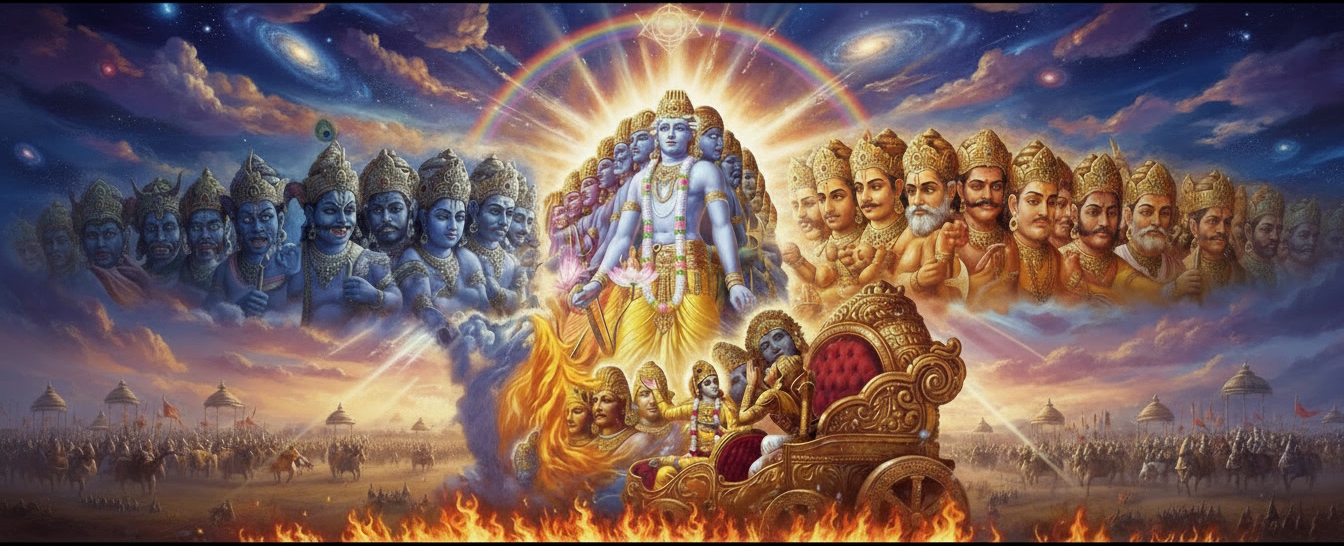
यदृच्छया चोपपन्नं स्वर्गद्वारमपावृतम्।
सुखिनः क्षत्रियाः पार्थ लभन्ते युद्धमीदृशम्।।2.32।।
yadṛcchayā copapannaṃ svargadvāramapāvṛtam|
sukhinaḥ kṣatriyāḥ pārtha labhante yuddhamīdṛśam||2.32||
Translation
Happy are the Kshatriyas, O Arjuna! who are called upon to fight in such a battle that comes of itself as an open door to heaven.
हिंदी अनुवाद
अपने-आप प्राप्त हुआ युद्ध खुला हुआ स्वर्गका दरवाजा भी है। हे पृथानन्दन ! वे क्षत्रिय बड़े सुखी (भाग्यशाली) हैं, जिनको ऐसा युद्ध प्राप्त होता है।
Commentaries & Translations
Swami Ramsukhdas
व्याख्या-- 'यदृच्छया चोपपन्नं स्वर्गद्वारमपावृतम्'-- पाण्डवोंसे जूआ खेलनेमें दुर्योधनने यह शर्त रखी थी कि अगर इसमें आप हार जायँगे, तो आपको बारह वर्षका वनवास और एक वर्षका अज्ञातवास भोगना होगा। तेरहवें वर्षके बाद आपको अपना राज्य मिल जायगा। परन्तु अज्ञातवासमें अगर हमलोग आपलोगोंको खोज लेंगे, तो आप-लोगोंको दुबारा बारह वर्षका वनवास भोगना पड़ेगा। जूएमें हार जानेपर शर्तके अनुसार पाण्डवोंने बारह वर्षका वनवास और एक वर्षका अज्ञातवास भोग लिया। उसके बाद जब उन्होंने अपना राज्य माँगा, तब दुर्योधनने कहा कि मैं बिना युद्ध किये सुईकी तीखी नोक-जितनी जमीन भी नहीं दूँगा। दुर्योधनके ऐसा कहनेपर भी पाण्डवोंकी ओरसे बार-बार सन्धिका प्रस्ताव रखा गया, पर दुर्योधनने पाण्डवोंसे सन्धि स्वीकार नहीं की। इसलिये भगवान् अर्जुनसे कहते हैं कि यह युद्ध तुमलोगोंको अपने-आप प्राप्त हुआ है। अपने-आप प्राप्त हुए धर्ममय युद्ध में जो क्षत्रिय शूरवीरतासे लड़ते हुए मरता है, उसके लिये स्वर्गका दरवाजा खुला हुआ रहता है
Sri Harikrishnadas Goenka
और भी वह युद्ध किसलिये कर्तव्य है सो कहते हैं हे पार्थ अनिच्छासे प्राप्त बिना माँगे मिले हुए ऐसे खुले हुए स्वर्गद्वाररूप युद्धको जो क्षत्रिय पाते हैं क्या वे सुखी नहीं हैं।
Sri Anandgiri
He raises the doubt—with "Kutascha" (And why)—that since war involves the killing of Gurus and many living beings and contradicts the scriptures on non-violence (Ahimsa), it is not a duty.
Like the violence in the Agnisomiya sacrifice, war is also to be performed because it is ordained for a Kshatriya, and because the special scriptural injunction is stronger than the general injunction; thus He says "Uchyate" (It is said).
Even so, raising the doubt that for those engaged in war there appears to be an absence of happiness both in this world and the next, and therefore cessation from it alone seems proper—He says 'Yadricchaya' (By chance/Unsolicited).
Performers of sacrifices (Yajna) become partakers of heaven etc. after a long or very long time, but fighting Kshatriyas, devoid of outward distraction, become enjoyers of the happiness of heaven etc. immediately; therefore, war is indeed your duty. He clarifies this with the explanation beginning with 'Yadricchaya'.
The meaning is that for Kshatriyas who are destined for future happiness in this world and the next, since the war which constitutes their own duty is established, rising up for that purpose, abandoning grief and delusion, is what must be done.
Sri Dhanpati
Being their own duty, war is acquired by Kshatriyas even with (great) effort; but for you, by the force of fortune, it has arrived without your own effort; therefore, it must be done—He says this with 'Yadricchaya'.
It has come unsolicited (unsought) and is bestowing immediate heaven, for it is an open door to heaven. Those Kshatriyas who obtain such a war are indeed happy—meaning they are partakers of the happiness of kingdom, heaven, etc.
Addressing him as 'Partha', He inspires him to an enthusiasm matching his own (inherent nature/zeal).
Sri Neelkanth
Moreover, the connection is that those Kshatriyas who obtain such a battle—which has arrived 'yadricchaya' (by chance), meaning even without being prayed for, present as an open (unlocked) door to heaven—
they become 'happy', that is, blessed.
Sri Ramanuja
Such a war, which has arrived without effort, which constitutes the means to unsurpassed happiness, and is free from obstacles—(only) 'happy', that is, meritorious Kshatriyas obtain it.
Sri Sridhara Swami
Moreover, when a great good has arrived of its own accord, why do you waver? He addresses this with 'Yadricchaya', etc.
Such a war, arrived at by chance—that is, indeed unasked for—is obtained only by 'happy', meaning fortunate, Kshatriyas; for this is indeed the unobstructed (open) door to heaven. Or else, the meaning is that those who obtain such a war, they alone are happy.
By this, the statement (made by Arjuna) "How can we be happy after killing our own people?" is refuted.
Sri Vedantadeshikacharya Venkatanatha
Once again, He uproots the delusion that war is unrighteous—even though it involves the killing of living beings—through praise, using the word 'Yadricchaya' (by chance).
Regarding the phrase "arrived by chance," in order to dispel the misconception that it is without a cause, the author explains it as "arrived without effort" (ayatnopanatam). Being attainable through the fruition of previously earned unsurpassed merit (punya), it has now arrived without effort.
"Being the means to unsurpassed happiness"—for the word 'Svarga' (Heaven) is indeed derived in the sense of a specific, unsurpassed happiness, as stated: "That happiness wherein there is neither heat nor cold, which is unmixed with sorrow and not eclipsed [by anything following it], and which is brought about merely by desire—that is the meaning of the word Svarga." A specific region is called 'Svarga' only because it is the locus for the enjoyment of such happiness.
The intrinsic nature of duties (Dharmas) is to be the means to unsurpassed happiness by themselves. Their becoming "otherwise" (yielding limited results) is due to obstacles like attachment to fruits; this is the intent behind not using the Chvi affix (which would imply a transformation into something it was not previously).
The meaning intended by the word 'apavrita' (open/unlocked) is "absence of obstacles." The gloss for 'Sukhinah' (happy ones) is 'meritorious ones' (punyavantah). For happiness alone cannot be the cause of obtaining such a war. Therefore, the idea is that by the word 'happiness', the "means to happiness" (i.e., merit) is implied here.
Alternatively, the word 'Sukhi' here refers to the relationship of being "fit for happiness." And the idea is that such fitness is indeed possessing merit.
Swami Chinmayananda
क्षत्रिय शब्द का तात्पर्य यहाँ जन्म से निश्चित की हुई क्षत्रिय जाति से नहीं है। यह व्यक्ति के मन की कतिपय विशिष्ट वासनाओं की ओर संकेत करता है। क्षत्रिय प्रवृति का व्यक्ति वह है जिसमें सार्मथ्य और उत्साह का ऐसा उफान हो कि वह दुर्बल और दरिद्र लोगों की रक्षा के साथ संस्कृति के शत्रुओं से राष्ट्र का रक्षण कर सके। हिन्दू नीतिशास्त्र के अनुसार ऐसे नेतृत्व के गुणों से सम्पन्न व्यक्ति को स्वयं ही संस्कृति का विनाशक और आक्रमणकारी नहीं होना चाहिये। किन्तु अधर्म का प्रतिकार न करने की कायरतापूर्ण भावना भी हिन्दुओं की परम्परा नहीं है। जब भी कभी ऐसा सुअवसर प्राप्त हो तो क्षत्रियों का कर्तव्य है कि वे इसे स्वर्ण अवसर समझ कर राष्ट्र का रक्षण करें। इस प्रकार के धर्मयुद्ध स्वर्ग की प्राप्ति के लिए खुले हुए द्वार के समान होते हैं।यहाँ ध्यान देने योग्य बात यह है कि भगवान् श्रीकृष्ण अपने तर्क प्रस्तुत करते हुए वेदान्त के सर्वोच्च सिद्धांत से उतर कर भौतिकवादियों के स्तर पर आये और उससे भी नीचे के स्तर पर आकर वे जगत् के एक सामान्य व्यक्ति के दृष्टिकोण से भी परिस्थिति का परीक्षण करते हैं। इन विभिन्न दृष्टिकोणों से वे अर्जुन को यह सिद्ध कर दिखाते हैं कि उसका युद्ध करना उचित है।निश्चय ही युद्ध करना तुम्हारा कर्तव्य है और अब यदि इसे छोड़कर तुम भागते हो तब
Sri Abhinavgupta
'Swadharmam', etc.
And since one's own duty (Swadharma) is inalienable (Variant reading: unavoidable/inevitable), trembling or wavering regarding the war is not proper.
Sri Madhusudan Saraswati
Raising the doubt that even if war is a duty, it is not proper to wage it against Gurus like Bhishma and Drona because it is highly censured, He says 'Yadricchaya', meaning without one's own effort. The particle 'cha' is for emphasis. Such a war—which has arrived without solicitation, featuring opponents like the heroic Bhishma and Drona, and which is the means to visible results like fame and kingdom—those Kshatriyas who obtain it as opponents are indeed partakers of happiness. For in victory, there is the attainment of fame and kingdom effortlessly, or in defeat, there is the attainment of heaven very quickly; hence He says 'the open door to heaven'. War is an unobstructed means to heaven, generating heaven immediately (without delay). Whereas sacrifices like Jyotishtoma take a very long time, as they require the fall of the body and the absence of obstacles; this is the meaning.
By the phrase 'door to heaven', the fear of sin (pratyavaya) similar to that in the Shyena sacrifice is removed. For Shyena and others, though enjoined, are defective due to the defect in their fruit. The fruit of Shyena is the killing of an enemy, which is prohibited by scriptures like "Do not kill any being" and "Do not kill a Brahmin"; thus, it generates sin. And since there is no injunction regarding the fruit (the killing itself), the maxim "Prohibition has no scope in what is touched by an injunction" does not apply there. However, the fruit of war is heaven, and that is not prohibited. Thus, Manu states: "Kings who, desirous of killing each other in battles, fight to the best of their ability and do not turn back, go to heaven." Since war is enjoined like the immolation in Agnisomiya rites, it cannot be touched by prohibition. Just as there is an option in the taking or not taking of the Shodashi cup (in a sacrifice) due to equal strength (of rules), here it is possible to restrict the general scripture (non-violence) by the special scripture (duty to fight). Thus, by the maxim "Prohibition has no scope in what is touched by an injunction," war does not generate sin.
Nor is there a fault caused by the killing of Gurus and Brahmins like Bhishma and Drona, because they are Atatayins (aggressors/desperados). It is said by Manu: "One should slay without hesitation an Atatayin who advances to attack, whether he be a Guru, a child, an old man, or a very learned Brahmin." And, "One should slay even a knower of Vedanta if he comes as an Atatayin intent on killing; one does not become a slayer of a Brahmin thereby." Also, "No fault attaches to the slayer for killing an Atatayin."
Objection: According to the statement of Yajnavalkya—"In a conflict between Smritis, reasoning is stronger in practice; but Dharma Shastra is stronger than Artha Shastra"—there is indeed sin in killing a Brahmin Atatayin. For "Do not kill a Brahmin" is Dharma Shastra as it is independent of visible purpose, while "One should slay the one intent on killing..." is Artha Shastra as it is for the purpose of one's own life. Here it is answered: Like the text "One desiring Bramavarchas should sacrifice a Brahmin," the text enjoining war is also indeed Dharma Shastra. As will be stated later in "Having made pleasure and pain equal..." (Gita 2.38), it is independent of visible purposes. The statement of Yajnavalkya, however, refers to killing done in treacherous warfare etc., aimed at visible purposes, so there is no fault in our argument.
The author of Mitakshara, however, says regarding "In the collision of Dharma and Artha..." that since Apastamba prescribes a twelve-year penance referring to this (killing a Brahmin Atatayin) by the word 'etat', the statement implies that in judicial matters involving four feet, one should not transgress Dharma Shastra even for the victory over an enemy according to Artha Shastra principles like gaining allies. Even if this be so, there is no loss to us. Thus, by stating that there is happiness in waging war, Arjuna's statement "How can we be happy having killed our kinsmen, O Madhava?" is refuted.
Sri Purushottamji
Therefore, He says with 'Yadricchaya' that only the fortunate obtain such a thing. 'Yadricchaya' means arrived by the will of the Lord (Bhagavad-ichchaya).
'Apavritam' means the door to heaven with its gates thrown open.
'Sukhinah', meaning fortunate, Kshatriyas obtain such a war. The state of being fortunate in obtaining such a war is due to its being in accordance with the Lord's will and due to the proximity of the Lord; this is the purport.
Sri Shankaracharya
And 'Yadricchaya', meaning arrived without being prayed for (unsolicited); 'Apavritam' meaning the opened door to heaven. Those Kshatriyas who obtain this—that is, such a war—
O Partha, are they not happy? (Meaning: They are indeed happy). Even though thus obtained as a duty...
Sri Vallabhacharya
He explains this very point with 'Yadricchaya'. 'Sukhinah' means fortunate ones. The war is the door to heaven.
This is in accordance with the statement from the Bhagavatam (6.10.33): "Two types of death in this world are acclaimed and are hard to attain..."
Swami Sivananda
यदृच्छया of itself? च and? उपपन्नम् come? स्वर्गद्वारम् the gate of heaven? अपावृतम् opened? सुखिनः happy? क्षत्रियाः Kshatriyas? पार्थ O Partha? लभन्ते obtain? युद्धम् battle? ईदृशम् such.Commentary The scriptures declare that if a Kshatriya dies for a righteous cause on the battlefield? he at once goes to heaven.
Swami Gambirananda
Why, again, does that battle become a duty? This is being answered (as follows) [A specific rule is more authoritative than a general rule. Non-violence is a general rule enjoined by the scriptures, but the duty of fighting is a specific rule for a Ksatriya.]: Partha, O son of Partha; are not those Ksatiryas sukhinah, happy [Happy in this world as also in the other.] who labhante, come across; a yuddham, battle; idrsam, of this kind; upapannam, which presents itself; yadrcchaya, unsought for; and which is an apavrtam, open; svarga-dvaram, gate to heaven? [Rites and duties like sacrifices etc. yield their results after the lapse of some time. But the Ksatriyas go to heaven immediatley after dying in battle, because, unlike the minds of others, their minds remaind fully engaged in their immediate duty.]
Swami Adidevananda
Only the fortunate Ksatriyas, i.e., the meritorious ones, gian such a war as this, which has come unsought, which is the means for the attainment of immeasurable bliss, and which gives an unobstructed pathway to heaven.