Bhagavad Gita - Chapter 4 - Shloka (Verse) 1
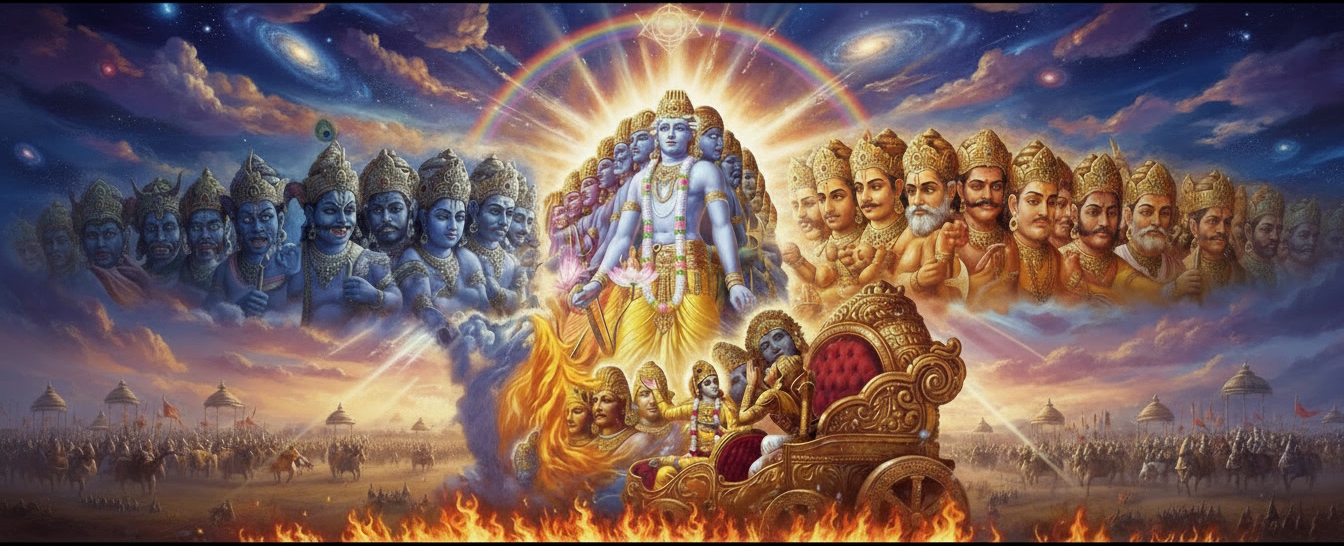
श्री भगवानुवाच इमं विवस्वते योगं प्रोक्तवानहमव्ययम्।
विवस्वान् मनवे प्राह मनुरिक्ष्वाकवेऽब्रवीत्।।4.1।।
śrī bhagavānuvāca
imaṃ vivasvate yogaṃ proktavānahamavyayam|
vivasvān manave prāha manurikṣvākave'bravīt||4.1||
Translation
The Blessed Lord said I taught this imperishable Yoga to Vivasvan; he told it to Manu; Manu proclaimed it to Ikshvaku.
हिंदी अनुवाद
श्रीभगवान् बोले - मैंने इस अविनाशी योगको सूर्यसे कहा था। फिर सूर्यने (अपने पुत्र) वैवस्वत मनुसे कहा और मनुने (अपने पुत्र) राजा इक्ष्वाकुसे कहा।
Commentaries & Translations
Swami Ramsukhdas
व्याख्या-- 'इमं विवस्वते योगं प्रोक्तवानहमव्ययम्'--भगवान्ने जिन सूर्य, मनु और इक्ष्वाकु राजाओंका उल्लेख किया है, वे सभी गृहस्थ थे और उन्होंने गृहस्थाश्रममें रहते हुए ही कर्मयोगके द्वारा परमसिद्धि प्राप्त की थी; अतः यहाँके 'इमम् अव्ययम्, योगम्' पदोंका तात्पर्य पूर्वप्रकरणके अनुसार तथा राजपरम्पराके अनुसार 'कर्मयोग' लेना ही उचित प्रतीत होता है।यद्यपि पुराणोंमें और उपनिषदोंमें भी कर्मयोगका वर्णन आता है, तथापि वह गीतामें वर्णित कर्मयोगके समान साङ्गोपाङ्ग और विस्तृत नहीं है। गीतामें भगवान्ने विविध युक्तियोंसे कर्मयोगका सरल और साङ्गोपाङ्ग विवेचन किया है। कर्मयोगका इतना विशद वर्णन पुराणों और उपनिषदोंमें देखनेमें नहीं आता।
भगवान् नित्य हैं और उनका अंश जीवात्मा भी नित्य है तथा भगवान्के साथ जीवका सम्बन्ध भी नित्य है। अतः भगवत्प्राप्तिके सब मार्ग (योगमार्ग, ज्ञानमार्ग, भक्तिमार्ग आदि) भी नित्य हैं (टिप्पणी प0 206)। यहाँ 'अव्ययम्' पदसे भगवान् कर्मयोगकी नित्यताका प्रतिपादन करते हैं।परमात्माके साथ जीवका स्वतःसिद्ध सम्बन्ध (नित्य-योग) है। जैसे पतिव्रता स्त्रीको पतिकी होनेके लिये करना कुछ नहीं पड़ता; क्योंकि वह पतिकी तो है ही, ऐसे ही साधकको परमात्माका होनेके लिये करना कुछ नहीं है, वह तो परमात्माका है ही; परन्तु अनित्य क्रिया, पदार्थ, घटना आदिके साथ जब वह अपनी सम्बन्ध मान लेता है, तब उसे 'नित्ययोग' अर्थात् परमात्माके साथ अपने नित्यसम्बन्धका अनुभव नहीं होता। अतः उस अनित्यके साथ माने हुए सम्बन्धको मिटानेके लिये कर्मयोगी शरीर, इन्द्रियाँ, मन, बुद्धि आदि मिली हुई समस्त वस्तुओंको संसारकी ही मानकर संसारकी सेवामें लगा देता है। वह मानता है कि जैसे धूलका छोटा-से-छोटा कण भी विशाल पृथ्वीका ही एक अंश है ,ऐसे ही यह शरीर भी विशाल ब्रह्माण्डका ही एक अंश है। ऐसा माननेसे 'कर्म' तो संसारके लिये होंगे पर 'योग' (नित्ययोग) अपने लिये होगा अर्थात् नित्ययोगका अनुभव हो जायगा।
भगवान् 'विवस्वते प्रोक्तवान्' पदोंसे साधकोंको मानो यह लक्ष्य कराते हैं कि जैसे सूर्य सदा चलते ही रहते हैं अर्थात् कर्म करते ही रहते हैं और सबको प्रकाशित करनेपर भी स्वयं निर्लिप्त रहते हैं, ऐसे ही साधकोंको भी प्राप्त परिस्थितिके अनुसार अपने कर्तव्य-कर्मोंका पालन स्वयं करते रहना चाहिये (गीता 3। 19) और दूसरोंको भी कर्मयोगकी शिक्षा देकर लोकसंग्रह करते रहना चाहिये; पर स्वयं उनसे निर्लिप्त (निष्काम, निर्मम और अनासक्त) रहना चाहिये।सृष्टिमें सूर्य सबके आदि हैं। सृष्टिकी रचनाके समय भी सूर्य जैसे पूर्वकल्पमें थे, वैसे ही प्रकट हुए-- 'सूर्याचन्द्रमसौ धाता यथापूर्वमकल्पयत्।' उन (सबके आदि) सूर्यको भगवान्ने अविनाशी कर्मयोगका उपदेश दिया। इससे सिद्ध हुआ कि भगवान् सबके आदिगुरु हैं और साथ ही कर्मयोग भी अनादि है। भगवान् अर्जुनसे मानो यह कहते हैं कि मैं तुम्हें जो कर्मयोगकी बात बता रहा हूँ, वह कोई आजकी नयी बात नहीं है। जो योग सृष्टिके आदिसे अर्थात् सदासे है, उसी योगकी बात मैं तुम्हें बता रहा हूँ।
प्रश्न-- भगवान्ने सृष्टिके आदिकालमें सूर्यको कर्म-योगका उपदेश क्यों दिया
उत्तर-- (1) सृष्टिके आरम्भमें भगवान्ने सूर्यको ही कर्मयोगका वास्तविक अधिकारी जानकर उन्हें सर्वप्रथम इस योगका उपदेश दिया।
(2) सृष्टिमें जो सर्वप्रथम उत्पन्न होता है, उसे ही उपदेश दिया जाता है; जैसे-- ब्रह्माजीने सृष्टिके आदिमें प्रजाओँको उपदेश दिया (गीता 3। 10)। उपदेश देनेका तात्पर्य है-- कर्तव्यका ज्ञान कराना। सृष्टिमें सर्वप्रथम सूर्यकी उत्पत्ति हुई, फिर सूर्यसे समस्त लोक उत्पन्न हुए। सबको उत्पन्न करनेवाले (टिप्पणी प0 207.1) सूर्यको सर्वप्रथम कर्मयोगका उपदेश देनेका अभिप्राय उनसे उत्पन्न सम्पूर्ण सृष्टिको परम्परासे कर्मयोग सुलभ करा देना था।
(3) सूर्य सम्पूर्ण जगत्के नेत्र हैं। उनसे ही सबको ज्ञान प्राप्त होता है एवं उनके उदित होनेपर प्रायः समस्त प्राणी जाग्रत् हो जाते हैं और अपने-अपने कर्मोंमें लग जाते हैं। सूर्यसे ही मनुष्योंमें कर्तव्य-परायणता आती है। सूर्यको सम्पूर्ण जगत्की आत्मा भी कहा गया है-- 'सूर्य आत्मा जगतस्तस्थुषश्च' (टिप्पणी प0 207.2)। अतः सूर्यको जो उपदेश प्राप्त होगा, वह सम्पूर्ण प्राणियोंको भी स्वतः प्राप्त हो जायगा। इसलिये भगवान्ने सर्वप्रथम सूर्यको ही उपदेश दिया।वास्तवमें नारायणके रूपमें उपदेश देना और सूर्यके रूपमें उपदेश ग्रहण करना जगन्नाट्यसूत्रधार भगवान्की एक लीला ही समझनी चाहिये, जो संसारके हितके लिये बहुत आवश्यक थी। जिस प्रकार अर्जुन महान् ज्ञानी नर-ऋषिके अवतार थे; परन्तु लोकसंग्रहके लिये उन्हें भी उपदेश लेनेकी आवश्यकता हुई, ठीक उसी प्रकार भगवान्ने स्वयं ज्ञानस्वरूप सूर्यको उपदेश दिया, जिसके फलस्वरूप संसारका महान् उपकार हुआ है, हो रहा है और होता रहेगा।
Sri Harikrishnadas Goenka
कर्मयोग जिसका उपाय है ऐसा जो यह संन्याससहित ज्ञाननिष्ठारूप योग पूर्वके दो अध्यायोंमें ( दूसरे और तीसरेमें ) कहा गया है जिसमें कि वेदका प्रवृत्तिधर्मरूप और निवृत्तिधर्मरूप दोनों प्रकारका सम्पूर्ण तात्पर्य आ जाता है आगे सारी गीतामें भी भगावन्को योग शब्दसे यही ( ज्ञानयोग ) विवक्षित है इसलिये वेदके अर्थको ( ज्ञानयोगमें ) परिसमाप्त यानी पूर्णरूपसे आ गया समझकर भगवान् वंशपरम्पराकथनसे उस ( ज्ञाननिष्ठारूप योग ) की स्तुति करते हैं श्रीभगवान् बोले जगत्प्रतिपालक क्षत्रियोंमें बल स्थापन करनेके लिये मैंने उक्त दो अध्यायोंमें कहे हुए इस योगको पहले सृष्टिके आदिकालमें सूर्यसे कहा था ( क्योंकि ) उस योगबलसे युक्त हुए क्षत्रिय ब्रह्मत्वकी रक्षा करनेमें समर्थ होते हैं तथा ब्राह्मण और क्षत्रियोंका पालन ठीक तरह हो जानेपर ये दोनों सब जगत्का पालन अनायास कर सकते हैं। इस योगका फल अविनाशी है इसलिये यह अव्यय है क्योंकि इस सम्यक् ज्ञाननिष्ठारूप योगका मोक्षरूप फल कभी नष्ट नहीं होता। उस सूर्यने यह योग अपने पुत्र मनुसे कहा और मनुने अपने पुत्र सबसे पहले राजा बननेवाले इक्ष्वाकुसे कहा।
Sri Anandgiri
Since the Yoga consisting of the two paths (Jñāna-niṣṭhā and Karma-niṣṭhā) was described in the first two chapters, and the meaning of the Veda was concluded, and there remained nothing further to be said, the Lord made a eulogy (praise) preceded by the narration of the lineage (of the teaching) in order to remove the doubt of the aforementioned Yoga being artificial (man-made); this is indicated by the phrase 'Śrī Bhagavān' (The Blessed Lord).
He introduces that very statement of the Lord by means of vṛttānuvāda (reiteration or translation of the past subject) - 'Which this' (Yoga is).
He reiterates the same Yoga by dividing it - 'By Jñāna' (etc.). The Yoga consisting of Knowledge, accompanied by renunciation as the itikartavyatā (the proper mode of procedure), has the Yoga called Action as its cause, and therefore, the two paths, functioning as the means (upāya) and the end (upeya), have been established; this is the meaning.
He presents the scriptural authority for the two aforementioned Yogas - 'In which' (etc.). Or, he clarifies the state of Jñāna-yoga having Karma-yoga as its means - 'In which' (etc.). Karma-yoga is indicated (known) by pravṛtti (action/engagement), and Jñāna-yoga is indicated by nivṛtti (cessation/detachment) - this is the distinction.
Although the two paths, as described, were explained in the first two chapters, anticipating that there might be something else to be said in the chapters that will follow, he says - 'And also in the Gītās'.
Then how does the pravṛtti (commencement) of the very next chapter occur? Regarding this, he says - 'Therefore' (for this reason).
The narration of the lineage, i.e., the teaching of the tradition (sampradāya), culminates in the praise of the Yoga by removing the doubt of its artificiality.
He sequentially mentions the teaching of the Guru-disciple tradition - 'This' (etc.). He shows the proximate subject of the word imam (this) - 'Chapter' (etc.). The Yoga, which is characterized by Jñāna-niṣṭhā and is attainable by the means of Karma-yoga, is the meaning.
For those who have not attained their goal (akṛtārtha), who are preoccupied with their own objectives, action for the benefit of others (parārtha-pravṛtti) is impossible; hence, seeing such action on the part of the Lord, His having attained the goal (kṛtārthatā) must be presumed, this he states - 'From Vivasvān' (etc.).
The imperishability (avyayatva) of the Yoga is to be understood because its source is the imperishable Veda. Why did the Lord, even though He had attained His goal, deliver the teaching of the Yoga? Regarding this, he says - 'The world' (etc.).
How is strength conferred upon the Kṣatriyas by the Yoga as described? Regarding this, he says - 'By that' (etc.). The remainder is: Kṣatriyas are yuktāḥ (connected/engaged). The word 'Brahma' refers to the caste of Brahmanahood. Although the Kṣatra (Kṣatriya class) was protected by the teaching of the Yoga, and thereby the Brahmanahood was protected, yet how was the entire world, which is to be protected, protected? Anticipating this, he says - 'Brahma' (etc.). The meaning is that the world, which is the fruit of action, can be protected by them (Brahma and Kṣatra) through anuṣṭhāna (the performance of duties).
He states another reason for the imperishability of the Yoga - 'Because its fruit is imperishable (avyayaphalatvāt)'. Is it inferred that the fruit of the said Yoga is also perishable, like the fruit of action, because it is something to be achieved? No, he says - 'Not indeed' (Na hi). The purport is that the inference, which is contradicted by the Vedic statement regarding non-return (to saṃsāra), does not become a valid means of knowledge.
Apprehending that the Yoga spoken by the Lord to Vivasvān might have ended there, he says - 'And he' (etc.). The phrase 'to his son' (svaputrāya) is connected with both (Manu and Ikṣvāku). By 'to the first king' (ādirājāya), the distinctiveness of Ikṣvāku as the founder of the Solar dynasty is mentioned.
Sri Dhanpati
Considering the conclusion of the meaning of the Veda, which consists of the two paths as stated in the two chapters, and praising it by demonstrating the tradition (saṃpradāya), Śrī Bhagavān spoke. 'This' (Imam) - the Yoga stated in the two chapters, which is Sāṅkhya-yoga, accompanied by the means in the form of Karma-yoga, and inclusive of saṃnyāsa (renunciation). In the interpretations of others: 'This' (Imam) - the Karma-yoga, extending from the performance of sandhyopāsanā (twilight worship) etc., up to the practice of non-conceptual samādhi (meditation), which is subsidiary to Jñāna-niṣṭhā (steadfastness in Knowledge), and is only suitable for kings who are not qualified for pārivrājya (monastic renunciation) - in this interpretation, there would arise the anomaly of the meaning of the second chapter not being included by the word idam (this).
And this is not desirable, as it would contradict the commentator's own statement: 'In order that the meaning stated in the two chapters should not be doubted as invalid, he shows the lineage-tradition of the knowledge by imam, etc.' This also refutes the (view) that it is 'only suitable for kings,' because it would lead to the unsuitability of Brāhmaṇas and others for the meaning of the Veda which is propounded in the two chapters and will be explained in detail later.
I, Kṛṣṇa, spoke to Vivasvān (Sūrya, the Sun) at the beginning of the creation, in order to confer strength capable of protecting Brahma (Brahmanahood/Brāhmaṇas). When Brahma and Kṣatra (Kṣatriyahood/Kṣatriyas) are protected, the entire world is protected.
'Imperishable' (avyayam) - because its fruit is imperishable. This Bhāṣya (commentary) is an indication (upalakṣaṇa) - because its root is the imperishable Veda. That which does not perish from its fruit is avyaya (unfailing fruit). As for (the interpretation) that 'imperishable' means 'with an unbroken tradition,' that is to be disregarded because it contradicts the subsequent statement: 'O Parantapa, that Yoga was lost in this world after a long time.'
And that Vivasvān spoke to Manu, his son, Śrāddhadeva. And that Manu spoke to Ikṣvāku, his son and the first king.
Sri Madhavacharya
Salutations to Śrī Amala Bodha. Hariḥ Oṃ.
In this chapter, the greatness of intellect (Buddhi), the distinction of action (Karma), and the glory of knowledge (Jñāna) are stated.
And this Dharma (righteous duty) was followed previously, this he says by 'This' (Imam).
Sri Neelkanth
In order that the meaning stated in the two chapters should not be doubted as invalid, he shows the lineage-tradition of the knowledge, and his own Godhood (Īśvaratva) and Omniscience (Sarvajñatva) in order to dispel the faults of delusion, deception, etc., by 'This' (Imam), etc. In the Bhāṣya (commentary, it is stated that it refers to) 'This' (Imam) Sāṅkhya-yoga, which is accompanied by the means in the form of Karma-yoga, and inclusive of saṃnyāsa.
'This' (Imam) Karma-yoga, extending from the performance of sandhyopāsanā etc., up to the practice of non-conceptual samādhi, which is subsidiary to Jñāna-niṣṭhā, and is only suitable for kings who are not qualified for pārivrājya. To Vivasvān, who is the presiding deity of the Solar Orb, the progenitor of all Kṣatriyas, I, the inner Self of the Sun, well-known in the Śrutis (Vedic texts) like 'This golden Person seen within the Sun, with a golden beard and golden hair, all golden down to the tips of His nails, whose eyes are like a lotus, whose name is Ut,' said (this) long ago.
'Imperishable' (avyayam) - (meaning) having an unbroken tradition. This also proves its beginninglessness.
Vivasvān spoke to Manu, his son. Manu spoke to Ikṣvāku, his son.
Sri Ramanuja
The Blessed Lord said: This Yoga which has been taught to you should not be considered as something taught just now merely to encourage you for battle.
At the beginning of the Manvantara (the period of a Manu), I Myself taught this Yoga to Vivasvān (the Sun-god) as the means to liberation, which is characterized as the highest human goal, for the deliverance of the entire universe.
And Vivasvān told it to Manu, and Manu to Ikṣvāku; thus, the royal sages of the past knew this Yoga, which was received through the continuous tradition of the teaching.
With the passage of a long time, owing to the dullness of intellect of the respective listeners, it was practically lost.
Sri Sridhara Swami
The Lord Hari Himself, in order to manifest the phenomena of āvirbhāva (manifestation) and tirobhāva (disappearance), praises Karma-yoga for the sake of realizing the meaning of the words Tat (That) and Tvam (Thou).
Thus far, by two chapters, Karma-yoga, which is a means, and Jñāna-yoga, which is also a means to liberation, have been stated. Intending to elaborate on that very (Yoga) by prescribing qualities such as dedication to Brahman, and by discriminating the meaning of the word Tvam, etc., the Blessed Lord first praises it as having been received through a tradition, and speaks with 'This' (Imam) and the following three (verses).
I told this Yoga, which is imperishable (avyayam) because its fruit is imperishable, to Vivasvān (the Sun-god) long ago. And he told it to Manu, his son, Śrāddhadeva. And that Manu spoke to Ikṣvāku, his son.
Sri Vedantadeshikacharya Venkatanatha
Now, to state the connection of the fourth [chapter], he briefly grasps the meaning of the third chapter—[saying] "In the third chapter..." "Sahetukam" (With reason)—meaning, accompanied by reasons such as Knowledge Yoga and Action Yoga being prone to negligence and free from negligence respectively. By this, the summary verse—"In the third [chapter], the obligation to perform action is stated [to be done] without attachment, for the protection of the world, by attributing agency to the Gunas, or by surrendering it to the Lord of All" (Gitarthasangraha 7)—is also explained.
For the incapable, and even for the capable but unrenowned person skilled in his own purpose (liberation), Karma Yoga alone is to be done; and for the renowned person—whether incapable or capable—for his own sake and for the protection of the world, that alone is to be done; thus by the third chapter, consideration of the qualified aspirant and consideration of the distinction of Karma Yoga from Jnana Yoga was done; this is the purport.
Now, regarding the Karma Yoga stated as being highly obligatory, six topics are spoken of here: (1) its authoritativeness, (2) its being mixed with knowledge, (3) its nature, (4) its varieties, (5) the predominance of the knowledge portion, and (6) the incidental incarnation of God; this he states with "by the fourth..."
(Objection) "But, 'Incidental statement of His own nature, the akarmata (actionlessness) of action, and its varieties, and the glory of knowledge—is spoken of in the fourth chapter' (Gitarthasangraha 8)—thus only four meanings are summarized; so how is there a mention of six meanings here?" (Answer) It is said—In "Incidental (prasangat) statement of His own nature," the "association" (sanga/context) is the context of authoritativeness. In "and its varieties," since the varieties are difficult to know without the "nature" (svarupa), the nature is also intended, or by the particle "cha" (and), it is included; thus, in the summary also, six meanings are indeed intended. "Statement of His own nature" means the statement of His nature such as His incarnation not being subject to Karma. "Akarmata of action" means the form of Knowledge Yoga due to knowledge being included within Karma Yoga. "Glory of knowledge" means the predominance of the knowledge portion included within Karma Yoga. Thus, with the commentary beginning with "By the fourth," this verse is also explained.
The obligation was indeed proclaimed in the third chapter; therefore, here, only its firmness is established by narrating the ancient history; this is the purport of "having strengthened the obligation."
Having shown the connection of the chapter's meanings directly, he mentions the incidental topic again with "and incidentally." He states the purport of narrating the tradition of instruction preceded by the indication "this" (imam), starting from "which this" up to "should be understood." Here "Yoga" means Karma Yoga. The explanation by others interpreting it as Knowledge Yoga is inconsistent with the context and contradictory to what will be stated later such as "Perform action" (4.15); this is the purport.
Since it was told to Vivasvan, who is the progenitor and instructor even of Manu, and since Arjuna will repeat "in the beginning," the implied meaning is stated as "at the beginning of the Manvantara." "For the deliverance of the whole world"—meaning, not merely for encouraging war or solely for Arjuna, but to grant liberation to the entire class of qualified aspirants. Because of the instruction at the beginning of the Manvantara, its universality for the whole world is indicated.
"Imperishability" (avyayatva) is due to its being established in the eternally omniscient Lord. Or, "imperishability" here is through the result. The indication "this" (imam) intends the status of being a means to liberation as mentioned before; to make this known, "supreme" etc. is said. The idea is that even previously, it was not spoken for any other result.
By "I proclaimed," it is intended that at the beginning of the Manvantara, at the beginning of the Mahakalpa, or at the beginning of the Mahabharata war, a knower and speaker of this exactly as it is, other than Me, is rare. To state the reality of His incarnation which must be known incidentally, and to suggest that a doubt regarding the contradiction of His time with that of Manu etc. has been raised, "I indeed" is said.
"Proclaimed to Vivasvan"—the meaning is: this is not the meaning of scriptures like those of Buddha etc. taught by Me to demons and the like, but rather [taught] to Vivasvan, the soul of all Vedas. "And Vivasvan to Manu, Manu to Ikshvaku"—Since "Whatever Manu said is medicine" (Taittiriya Samhita 2.2.10.2), the tradition of instruction has been received through the lineage of fathers etc. who are established in the category of authorities, clear in establishing the bounds of morality, famous for words that are medicine for the whole world; and not proceeded from contact with potential deceivers, tricksters, heretics, etc.; this is the purport. All this is expressed by "Thus by the tradition of the school." By the word "tradition" (parampara), since those subsequent to Ikshvaku are also included, the un-interruptedness of the school in the Krita (Satya) and other Yugas is intended; this is the idea.
Since the destruction [of the Yoga] is mentioned now, "ancient Royal Sages" is said here. "The Royal Sages knew"—Kings indeed have broad and unfathomable minds, and being Sages as well, they are capable of seeing supersensuous objects; and they are many; and they all, beginning with Ashvapati, Janaka, Ambarisha, practiced this Karma Yoga without dissent; this is the purport.
He states the manner in which the length of time becomes the cause of the break, indicated by the word "here" (iha), with "due to the dullness of intellect of the respective hearers." "Here"—in the world full of diverse aspirants, in the Yugas like Krita, Treta, etc., intelligence, power, and practice etc. are seen and heard to be diminishing in the course of time; this is the purport. In "destroyed," a total break is not intended, because Vyasa, Bhishma, Akrura, etc., are present even now; with this intention, it is said "became almost destroyed."
Swami Chinmayananda
जैसा कि इस अध्याय की प्रस्तावना में कहा गया है भगवान् यहाँ स्पष्ट करते हैं कि अब तक उनके द्वारा दिया गया उपदेश नवीन न होकर सनातन वेदों में प्रतिपादित ज्ञान की ही पुर्नव्याख्या है। स्वस्वरूप की स्मृति से स्फूर्त होकर भगवान् घोषणा करते हैं कि उन्होंने ही सृष्टि के प्रारम्भ में इस ज्ञान का उपदेश सूर्य देवता (विवस्वान्) को दिया था। विवस्वान् ने अपने पुत्र मनु जो भारत के प्राचीन स्मृतिकार हुए को यह ज्ञान सिखाया। मनु ने इसका उपदेश राजा इक्ष्वाकु को दिया जो सूर्यवंश के पूर्वज थे। इस वंश के राजाओं ने दीर्घकाल तक अयोध्या पर शासन किया।वेद शब्द संस्कृत के विद् धातु से बना है जिसका अर्थ है जानना। अत वेद का अर्थ है ज्ञान अथवा ज्ञान का साधन (प्रमाण)। वेदों का प्रतिपाद्य विषय है जीव के शुद्ध ज्ञान स्वरूप तथा उसकी अभिव्यक्ति के साधनों का बोध।जैसे हम विद्युत् को नित्य कह सकते हैं क्योंकि उसके प्रथम बार आविष्कृत होने के पूर्व भी वह थी और यदि हमें उसका विस्मरण भी हो जाता है तब भी विद्युत् शक्ति का अस्तित्व बना रहेगा इसी प्रकार हमारे नहीं जानने से दिव्य चैतन्य स्वरूप आत्मा का नाश नहीं होता। इस अविनाशी आत्मा का ज्ञान वास्तव में अव्यय है।आधुनिक विज्ञान भी यह स्वीकार करता है कि विश्व का निर्माण सूर्य के साथ प्रारम्भ होना चाहिये। शक्ति के स्रोत के रूप में सर्वप्रथम सूर्य की उत्पत्ति हुई और उसकी उत्पत्ति के साथ ही यह महान् आत्मज्ञान विश्व को दिया गया।वेदों का विषय आत्मानुभूति होने के कारण वाणी उसका वर्णन करने में सर्वथा असमर्थ है। कोई भी गम्भीर अनुभव शब्दों के द्वारा व्यक्त नहीं किया जा सकता। अत स्वयं की बुद्धि से ही शास्त्रों का अध्ययन करने से उनका सम्यक् ज्ञान तो दूर रहा विपरीत ज्ञान होने की ही सम्भावना अधिक रहती है। इसलिये भारत में यह प्राचीन परम्परा रही है कि अध्यात्म ज्ञान के उपदेश को आत्मानुभव में स्थित गुरु के मुख से ही श्रवण किया जाता है। गुरुशिष्य परम्परा से यह ज्ञान दिया जाता रहा है। यहाँ इस ब्रह्मविद्या के पूर्वकाल के विद्यार्थियों का परिचय कराया गया है।
Sri Abhinavgupta
From 'Thus' (Evam) etc. up to 'Supreme' (Uttamam). And even though this (knowledge) was obtained through the tradition of teachers, it is now lost - by this (statement), the Lord demonstrates the rarity and the glory of this knowledge.
'You are My devotee and friend,' (therefore). You are a devotee, devoted solely to Me, and a friend. The word ca (and) signifies anvācaya (subordination or secondary status).
The intended meaning, therefore, is that just as in begging, the begging is primary and the leading of the cow is secondary, similarly, here devotion (bhakti) is primary towards the Guru (the Lord), and friendship is secondary.
Sri Jayatritha
This chapter is of the nature of a specific and detailed exposition of both Jñāna (Knowledge) and Karma (Action) that have been stated – since the meaning of the connection with the previous chapter is thus established, he speaks with 'Of the intellect' (etc.) to propound a distinction in the topic here.
By the text preceding 'Having known thus' (4.15) and (4.32), the greatness of Viṣṇu, who is higher than the intellect, is stated. The phrase 'Of the intellect, the higher' (Buddheḥ Parasyā) is stated to indicate the connection of the first section with the preceding one. Before 'Superior' (Śreyān), there is the distinction of Karma (Action). The distinction of nivṛtta Karma (action characterized by renunciation) from the other (i.e., pravṛtta Karma, or engaged action). Or, the distinction within nivṛtta Karma itself in the form of worship, sacrifice, etc. The greatness of Jñāna (Knowledge) is with the remainder (of the chapter).
Since the statement of the teaching tradition, 'This Yoga to Vivasvān' (Imaṃ Vivasvate Yogaṃ), is not relevant to the current topic, he states its intention (purport) - 'By the ancients' (Pūrvaiḥ). (It was) practiced by the ancients. The word ca (and) here is for the purpose of cumulative connection with the reason stated in 'Those who follow My doctrine' (3.31). This Dharma (righteous duty) is that which was mentioned by 'All actions unto Me' (3.30). The word Yoga is also explained by this (statement). Not only the tradition of teaching is mentioned here, but also the practice of those (ancestors) is indicated. And the purport is that this is stated in order to establish that 'this (action) must also be performed by you.'
If it is argued that this is already covered by 'perfection is attained only by action' (3.20), the answer is No, because ācāra (conduct) was mentioned there to establish that you should not abandon the actions of a householder. However, here, good conduct (sadācāra) in the performance of nivṛtta Dharma (the path of renunciation) is being stated. It is for this reason that only ācāra was mentioned there, whereas here it is 'this Dharma.' The (topic) stated in 'In this world, there are two kinds' (3.3) is cited as an example by 'only by action,' so there is no fault there either.
Sri Madhusudan Saraswati
Although previously Jnana Yoga was described as the goal and Karma Yoga as the means to it, thus distinguishing two Yogas; nevertheless, following the maxim "He who sees Sankhya (Knowledge) and Yoga (Action) as one, he truly sees," and treating the means and the end as one because their ultimate result is identical, the Lord praises both the instrumental Karma Yoga and the ultimate Jnana Yoga to demonstrate their manifold merits by narrating their lineage.
I, Lord Vasudeva, the protector of the entire universe, taught this Yoga—which has been described in the preceding two chapters, which is characterized by steadfastness in knowledge, and which is attainable through the means of steadfastness in action—to Vivasvan (the Sun), who is the seed (progenitor) of the entire Kshatriya lineage. I taught it with excellence, in a manner that cuts asunder all doubts.
This was done at the beginning of creation to infuse strength into the kings, so that the entire world dependent on them might be protected. How is this achieved? He shows this by the adjective implying the infusion of strength. It is called 'Avyayam' (imperishable) because its root is the imperishable Veda and its fruit is imperishable Moksha; it does not deviate from its fruit, thus it implies unfailing results. The purport is that only by such a Yoga is the infusion of strength possible.
And that disciple of mine, Vivasvan, told it to his son, Vaivasvata Manu. And that Manu told it to his son, the first king, Ikshvaku.
Although this divine instruction is common to every Manvantara, such as that of Svayambhuva Manu, still, the tradition is here enumerated starting from Aditya (the Sun) with the specific intention of the current Vaivasvata Manvantara.
Sri Purushottamji
Salutations to Sri Krishna. In order that the Yoga of Karma-Sannyasa (renunciation of action) may be realized within oneself, Krishna, out of compassion, spoke to the son of Kunti.
To set the stage for the question regarding the description of Karma-Sannyasa, He restates the past history with the three verses beginning with 'Imam' (This).
"I told this aforesaid Yoga—which is imperishable and fruitful because it generates a relationship with Me—to Vivasvan." For the grace of the world, and for the manifestation of this Yoga in the world, he (Vivasvan) too told it to Manu, and Manu told it to Ikshvaku.
Sri Shankaracharya
I taught this Yoga, described in the two chapters, to Vivasvan (the Sun) at the beginning of creation. For what purpose? For the infusion of strength into the Kshatriyas, the protectors of the world, so that endowed with that power of Yoga, they become capable of protecting the Brahman (the spiritual order/Vedas). Only when the Brahma (spiritual power) and Kshatra (ruling power) are protected is there capacity to protect the world.
It is 'Avyayam' (imperishable) because its fruit is imperishable. For the fruit called Moksha (liberation) of this Yoga, which is characterized by steadfastness in perfect vision (right knowledge), never decays.
And that Vivasvan told it to Manu. Manu told it to his son, the first king, Ikshvaku.
Sri Vallabhacharya
It was previously determined that Yogis must perform action. Now, in the fourth chapter, the tradition is described to establish faith in that. (1)
Vishnu is described as the form of Yoga, and the Sun (Ravi) became the speaker. Since it is a position of instruction, Manu is the refuge of that instruction. (2) Also to the Ikshvakus, who share in the lineage of the avatar Ramachandra, the injunction is taught by way of its eternality. (3)
Abandoning the sense of fruit everywhere through Brahma-bhava (the feeling of Brahman), the Yogi, taking refuge in that alone, attains immortality through knowledge. (4)
Thus, in the two chapters, Swadharma (one's own duty) within Yoga was taught as the means to Moksha. Now, intending to expand upon that very subject through Brahma-bhava, and first praising it as having been received through tradition, the Blessed Lord spoke with the three verses beginning with 'Imam'.
"Because it yields imperishable fruit, I told this imperishable Yoga to Vivasvan." And implying, "I am not speaking this merely to encourage you for war, but rather, I told this at the very beginning of the Manvantara for the upliftment of the whole world," He speaks stating the tradition: "That very same ancient Yoga is today told by Me to you."
Swami Sivananda
इमम् this? विवस्वते to Vivasvan? योगम् Yoga? प्रोक्तवान् taught? अहम् I? अव्ययम् imperishable? विवस्वान् Vivasvan? मनवे to Manu? प्राह taught? मनुः Manu? इक्ष्वाकवे to Ikshvaku? अब्रवीत् taught.Commentary Vivasvan means the sun. Ikshvaku was the son of Manu. Ikshvaku was the reputed ancestor of the solar dynasty of Kshatriyas.This Yoga is said to be imperishable because the result or fruit? i.e.? Moksha? that can be attained through it is imperishable.If the rulers of dominions possess a knowledge of the Yoga taught by Me in the preceding two discourses? they can protect the Brahmanas and rule their kingdom with justice. So I taught this Yoga to the Sungod in the beginning of evolution.
Swami Gambirananda
In the beginning of creation, with a veiw to infusing vigour into the Ksatriyas who are the protectors of the world, aham, I; proktavan, imparted; imam, this; avyayam, imperishable; yogam, Yoga, presented in the (preceding) two chapters; vivasvate, to Vivasvan, the Sun. Being endowed with this power of Yoga, they would be able to protect the Brahmana caste. The protection of the world becomes ensured when the Brahmanas and the Ksatriyas are protected.
It (this Yoga) is avyayam, imperishable, because its result is undecaying. For, the result-called Liberation-of this (Yoga), which is characterized by steadfastness in perfect Illumination, does not decay. And he, Vivasvan, praha, taught (this); manave, to Manu. Manu abravit, transmitted (this); iksvakave, to Iksvaku, his own son who was the first king. [First king of the Iksvaku dynasty, otherwise known as the Solar dynasty.]
Swami Adidevananda
The Lord said This Karma Yoga declared to you should not be considered as having been taught now merely, for creating encouragement in you for war. I Myself had taught this Yoga to Vivasvan at the commencement of Manu's age as a means for all beings to attain release, which is man's supreme end. Vivasvan taught it to Manu, and Manu to Iksvaku. The royal sages of old knew this Yoga transmitted by tradition. Because of long lapse of time and because of the dullness of the intellect of those who heard it, it has been almost lost.