Bhagavad Gita - Chapter 4 - Shloka (Verse) 6
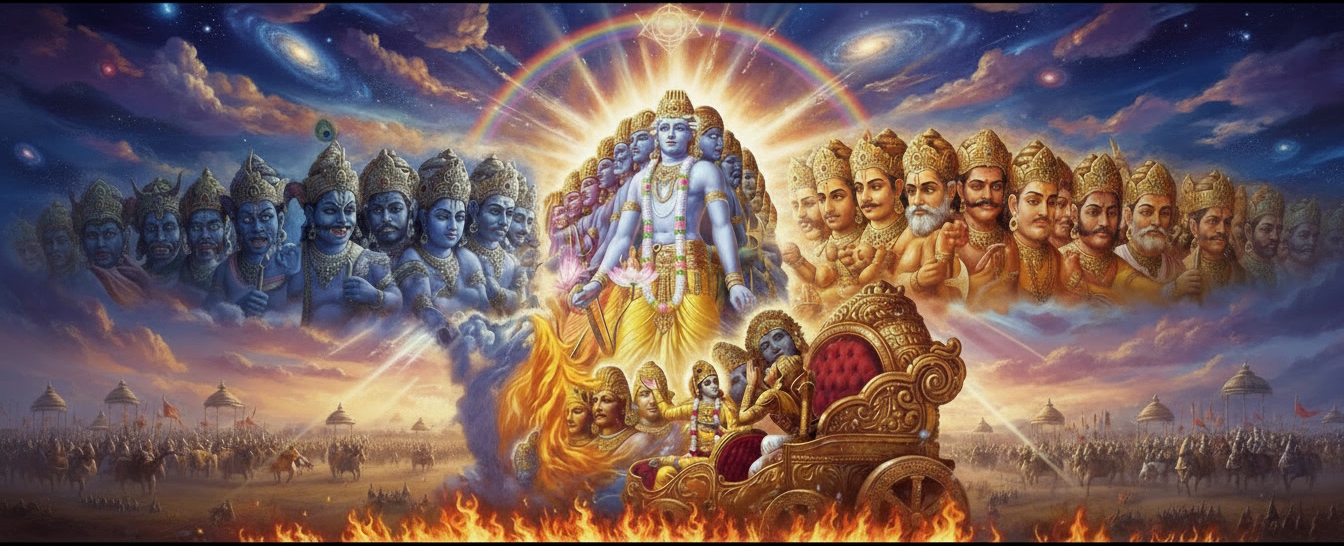
अजोऽपि सन्नव्ययात्मा भूतानामीश्वरोऽपि सन्।
प्रकृतिं स्वामधिष्ठाय संभवाम्यात्ममायया।।4.6।।
ajo'pi sannavyayātmā bhūtānāmīśvaro'pi san|
prakṛtiṃ svāmadhiṣṭhāya saṃbhavāmyātmamāyayā||4.6||
Translation
Though I am unborn, of imperishable nature, and though I am the Lord of all beings, yet, governing My own Nature, I am born by My own Maya.
हिंदी अनुवाद
मैं अजन्मा और अविनाशी-स्वरूप होते हुए भी तथा सम्पूर्ण प्राणियोंका ईश्वर होते हुए भी अपनी प्रकृतिको अधीन करके अपनी योगमायासे प्रकट होता हूँ।
Commentaries & Translations
Swami Ramsukhdas
व्याख्या--[यह छठा श्लोक है और इसमें छः बातोंका ही वर्णन हुआ है। अज, अव्यय और ईश्वर--ये तीन बातें भगवान्की हैं, (टिप्पणी प0 217) प्रकृति और योगमाया--ये दो बातें भगवान्की शक्तिकी हैं और एक बात भगवान्के प्रकट होनेकी है।]
Sri Harikrishnadas Goenka
तो फिर आप नित्य ईश्वरका पुण्यपापसे सम्बन्ध न होनेपर भी जन्म कैसे होता है इसपर कहा जाता है यद्यपि मैं अजन्मा जन्मरहित अव्ययात्मा अक्षीण ज्ञानशक्तिस्वभाववाला और ब्रह्मासे लेकर स्तम्बपर्यन्त सम्पूर्ण भूतोंका नियमन करनेवाला ईश्वर भी हूँ तो भी अपनी त्रिगुणात्मिका वैष्णवी मायाको जिसके वशमें सब जगत् बर्तता है और जिससे मोहित हुआ मनुष्य वासुदेवरूप अपनेआपको नहीं जानता उस अपनी प्रकृतिको अपने वशमें रखकर केवल अपनी लीलासे ही शरीरवालासा जन्म लिया हुआसा हो जाता हूँ अन्य लोगोंकी भाँति वास्तवमें जन्म नहीं लेता।
Sri Anandgiri
Since there is no cause (like Karma) for the Lord, birth itself is illogical, so having many past births is thrown far away (totally impossible)—raising this doubt, he asks "Katham" (How?). Answering that although there is actually no birth, birth is possible through the power of Maya, He says "Uchyate" (It is stated).
Having restated the reason for the impossibility of absolute birth in the first half [of the verse], He states the cause for the possibility of illusory (apparent) birth with "Prakritim". To refute that the word 'Prakriti' refers to His essential nature (Swarupa), the word "Atmamayaya" (by His own Maya) is used.
He explains the part restating the reason for the absence of actual birth with "Ajo'pi" etc. He analyzes the second half, which states the cause for the possibility of illusory birth, with "Prakritim" etc.
He prevents the word 'Prakriti' from being a synonym for 'Swarupa' (Essential Nature) by saying "Mayam". He refutes its (Maya's) independence and states its subordination to the Lord with "Mama" (Mine). And implies its limitation by a substratum by calling it "Vaishnavim" (of Vishnu). Anticipating the doubt that since the word 'Maya' is read in the list of names for 'Prajna' (wisdom), it might refer to the power of knowledge, He says "Trigunatmikam" (consisting of three Gunas). He indicates the inference of it (Maya) through its effect-sign with "Yasya" (Whose...) etc. He clarifies that the world is indeed under the control of Maya with "Yaya" (By which...).
Just as in the world someone appears to be born and embodied, similarly I too, resorting to Maya, "Sambhavami"—experience the behavior of birth under My own control; therefore, the Lord's birth is illusory (Mayamayam), this He says with "Tam prakritim" etc. He explains the stated word "Sambhavami" as "Dehavan" (Embodied).
Anticipating the doubt that "Like us, You too might have the misconception of reality regarding birth etc.," He says "Na paramarthatah" (Not in absolute reality), implying "Not so for the Lord," because He possesses the complete knowledge of His nature described before. He states that for the world (people) whose knowledge is covered, the misconception of reality regarding birth etc. is possible, with "Lokavat" (Like the world).
Sri Dhanpati
"Since You are Ishvara, devoid of Dharma and Adharma (merit and demerit) etc., birth itself is illogical for You. Then, possessedness of many past births is refuted from afar (totally out of the question)"—anticipating such a doubt, He says 'Ajo'pi' (Though unborn), meaning that even though there is no birth in reality, birth is possible through His own Maya. 'Ajo' (Unborn)—meaning being birthless; 'Avyayatma' (Imperishable Self)—meaning being of a nature where knowledge and power never decay, because there is never any cessation of Me; 'Bhutanam' (of beings)—meaning of all beings from Brahma down to a blade of grass; 'Ishvara' (Lord)—meaning being of the nature of a ruler; still, 'Prakritim' (Nature)—meaning My 'Vaishnavi' Maya composed of the three Gunas, under whose control the whole world exists and deluded by which one does not know his own Self or Me, Vasudeva—'Adhishtaya' (presiding over/controlling) that Maya, I 'Sambhavami' (come into being), like one embodied, like one born. The idea is: 'Atmanah'—meaning by My own Maya—the perception of possessing a body etc. in Me is for the grace of the aspirants (sadhakas), not in absolute reality.
This is stated in the Mokshadharma (Mahabharata): "This form that is seen by you as possessing a body, you should not understand it as real. Desiring so, I can disappear in a moment; I am the Lord, the Guru of the world." 'Nashyeyam' means I can become invisible. And: "O Narada, this Maya has been created by Me, that you see Me. You are not fit to see Me (in reality) associated with the qualities of all elements." 'Associated with the qualities of all elements' means having causal adjuncts.
Here, some (commentators), following the explanation of the Acharya (Shankara), say: "That eternal causal adjunct named Maya, possessing manifold powers, is itself the body of the Lord—this is the view of the Bhashyakaras"; after stating this view briefly, they show another view.
Others, however, do not accept the body-soul duality (deha-dehi-bhava) in the Supreme Lord. But (they say): "He who is the eternal, all-pervading, mass of Existence-Consciousness-Bliss, Lord Vasudeva, the Perfect, Quality-less (Nirguna), Supreme Self, free from birth and destruction, illuminator of all, and being the Lord of all beings by virtue of being the cause of all—I, that Lord, distinguish 'Prakriti'—meaning My nature (Svabhava) which is a homogeneous mass of Existence-Consciousness-Bliss—from Maya, by the word 'Svam' (My own). 'Svam' means My own form. According to the Shruti 'Sir, in what is He established? In His own glory,' establishing Myself in My own form, and remaining established in My true nature, I 'Sambhavami'—I behave like an embodied being even without the body-soul duality. Then how does the perception of embodiment arise in the bodiless Mass of Satchidananda? To this He says 'Atmamayaya' (By My own Maya). In Me, Lord Vasudeva, who am Attribute-less, Pure, Mass of Essence of Satchidananda, and devoid of body-soul duality, the perception as that (embodied) form is mere Maya; this is the meaning."
It is said: "Know this Krishna as the Self of all souls; He also appears here like an embodied being for the welfare of the world through Maya." And also: "Oh the fortune! Oh the fortune of the inhabitants of Nanda's Vraja; whose friend is the Supreme Bliss, the Full Brahman, the Eternal."
regarding this (other view), this must be noted: The statement that "There is no body-soul duality in the Supreme Lord" is contrary to the view of the Bhashyakara who accepts that "Body-soul duality is through Maya, not in reality." And as for the statement "Eternal etc."—He who is the Attribute-less Supreme Self established by the purport of Shrutis like "Therefore the instruction is 'Not this, Not this'", "Not this which people worship here", "One only without a second", "Truth, Knowledge, Infinite is Brahman", "Knowledge and Bliss is Brahman", "Not gross, not subtle, not short, not long", "Where one sees nothing else, hears nothing else, knows nothing else, that is the Infinite (Bhuma)", "That which is Infinite is Happiness", "From whom words return along with the mind without attaining", "This is that unprecedented, non-external, non-internal, immediate Brahman, the Self, the experiencer of all", "Partless, actionless, peaceful, faultless, taintless", "Without hands and feet"—He alone is that 'Body' (Vigraha) [according to the opponents]. And is that Body with form or formless? If the first (with form), is it a transformation (Parinama) of the Attribute-less or an illusory appearance (Vivarta)? Not the first. Because a modification in the form of transformation is not possible for the Changeless. Otherwise, He would become non-eternal. If the second (Vivarta), since 'Maya' is necessary to establish the illusory appearance, the statement that it is 'Mayic' (made of Maya) is not unreasonable. Not the second (formless). Because saying "He is devoid of all forms and yet is grasped by a specific form, hence He is a Body" is a contradiction. Furthermore, does that Body have hands, feet, etc., or is it devoid of them? If the first, are the hands etc. visible or invisible? If the first (visible), since the Body is not a product of elements (Bhuta-karya), its nature of being 'Mayic' must essentially be accepted. Not the second (invisible). Because there would be the contingency of devotees not seeing Him etc. (Objection) "Now, if you say they are invisible but visible through Maya?" (Answer) Then are they invisible like atoms etc., or invisible as Brahman? If the first, they would be objects of perception for Yogis (reducing God to an object). If the second (as Brahman), then saying "Parts like hands etc. and a Body possessing them"—what is the use of binding one's disciple with mere 'liberation' (a pun/irony implying confusing speech)? Not the second (devoid of hands/feet). Because "Devoid of them and yet a Body" is a contradiction. By this, the explanation of the verse by convoluted imagination following this view is also refuted. Both the cited quotes (from scriptures) are properly consistent only in the view of the Bhashyakara.
Therefore—"The Satchidananda Nature, delimited by Maya; proclaimed as the Cause of the world by Shruti, Smriti and Logic like 'From whom these beings are born...', 'By whom the born live...', 'Into whom they depart and enter', 'From whom all beings come at the arrival of the Yuga...', 'In whom they go to dissolution again at the end of the Yuga', 'From whom is the birth etc. of this'—the Pure, Aware, Free-natured, Bodiless Supreme Self, the Lord of All, the Controller of Maya, accepts a Playful Body (Lila-Vigraha) through His own Maya for the grace of seekers and appears 'as if born', 'as if embodied'"—this view of the omniscient Bhashyakaras, supported by Shruti, Smriti, Itihasa, Purana etc., should be taken as refuge; this is the direction.
Others (like Dualists/Visistadvaitins) however say: "The Lord's body is not a fruit of Karma, therefore it is not material (Bhautika). Therefore, saying 'Ajo'pi san' (Though unborn) is logical." (Objection) "Now, then what is the material cause (Upadana) of the Lord's body? If you say Avidya (Ignorance)?" (Answer) No, because of its absence in the Supreme Lord. "If you say Jiva's Avidya?" (Answer) No, because of the contingency of it being trivial/illusory like the shell-silver. "If you say Pure Consciousness (Chinmatra)?" (Answer) No, because Consciousness cannot have a form. Or if it were so, there is the contingency of it being supersensuous. (Objection) "Therefore, having what as its support is this Body of the Lord, which is the object of perception of entering Devaki's womb, birth, childhood, boyhood, pre-youth, youth etc.? If you ask this, Listen. 'Controlling My own Nature (Prakriti), I come into being by My own Maya.'
This is the meaning: Jivas indeed obtain birth etc. by taking shelter of Nature (Prakriti) which is non-self, composed of fire, water, food or the five elements. But I, taking shelter of 'Svam'—Nature which is not different from the Inner Self—meaning the Inner Consciousness; taking shelter of that alone, and not another material cause. 'Atmamayaya'—I come into being by My own Maya. Just as a magician (Mayavi), without deviating from his own place and nature, becoming invisible, and taking up gross and subtle elements merely for show, creates by mere magic a second magician exactly like himself climbing into the sky via a rope path; similarly I, the Immutable, Pure Consciousness, Ungraspable, create a Chinmaya (Conscious) body of Myself through My Maya and show its states like childhood etc. like the climbing of the rope. But this is the difference: A worldly magician, while withdrawing the magic, withdraws the second magician also; but I, not withdrawing that (Maya/Prakriti), do not withdraw My body either." Only if this is so, the status of being the Lord of All characterized by being the material cause of Space (Akasha) etc.—which is established by the Nyaya (logic/aphorism) "Because His attributes are taught inside" (Brahma Sutra 1.1.20) regarding the Conscious Being possessing a body characterized by 'Golden Beard' etc.—is logical, not otherwise. Therefore, it is established that the Supreme Lord's body is made of Maya (Mayamayam) and is eternal.
(They say) "With one and the same body characterized by Golden Beard etc., having taught Vivasvan, I am teaching you" etc. they describe. Regarding this, it must be said: Due to the absence of a 'Controller Body' distinct from the 'Controlled Body', the statement "with the one and same" etc. is not established. Furthermore, if the body of the Inner Ruler of the Sun (Aditya-Antaryami) characterized by Golden Beard etc. were the very body of Krishna etc., then it would appear exactly like that, and not characterized by dark-cloud complexion etc. (Objection) "Now, if you say it is like that (dark etc.) due to Maya?" (Answer) It is better to describe the stationing of the Bodiless Supreme Lord Himself as the Inner Ruler of the Sun and as the body of Krishna etc. through Maya for the grace of the aspirant; rather than imagining the bodies of Krishna etc. to be 'Mayic' indirectly (through a hierarchy) which is contrary to the Bhashya; because even the (Golden Bearded form) qualified by attributes is 'Mayic' due to being 'with attributes' (Savisesha).
And regarding "Just as a magician..." etc., that is also not correct. Because it is well known that Lord Vasudeva Himself, having shown the four-armed form in the beginning, showed the two-armed form again. And having concealed that too, He revealed it (the Universal Form etc.) again. Otherwise, there would be the contingency of simultaneous perception of infinite bodies of the Lord like Mohini etc. (if the body were one and eternal). Therefore, it must be accepted that the Lord manifests and conceals specific bodies for the sake of the devotee.
By this, the objection regarding "Aham" (I) etc. is also refuted. Because by adjectives like "Ajo'pi" (Though unborn) etc. and by the explanation given in the Bhashya, the distinction (of Ishvara) from the Jiva is clearly perceived. And because the convoluted and unproven imagination contrary to the Bhashya is improper. Therefore, the statement made earlier (by opponents) that "Arjuna's question is essentially regarding the Lord's body" is also refuted. Because the Supreme Self lacks a real body. Therefore, the doubt of Arjuna was based on the view of fools thinking: "Therefore You are also just some non-omniscient, non-Lord Jiva; for You, such a one, to be the instructor of the Sun is contradictory." (And the answer is): "I, implying the absence of dependence on Dharma/Adharma etc. like a Jiva, being Unborn, Imperishable Self, Lord of beings—even being such, controlling My Nature, I come into being by My Maya"—by this, "That same I, the Omniscient Lord, having taken a body suitable for instruction at the beginning of creation, taught Yoga to the Sun, that same I have now spoken to you"—this is the answer; enough of elaboration.
Sri Madhavacharya
‘Then, are You not beginningless?’—To this, He says ‘Ajo’pi’ (Though unborn). ‘Avyaya Atma’—here even the body is ‘Atma’, thus ‘Avyayatma’ (Having an imperishable body). ‘Infinite, having faces everywhere’ (Gita 11.11)—this adjective of His form is used later; and ‘This is the repository of various incarnations, the seed, the imperishable’ (Bhagavatam 1.3.5), and ‘He accepted’ (Bhagavatam 1.3.1) refers to manifestation (Vyakti). Arguments have indeed been stated in M.Bh. 2.24, p. 139. The beginninglessness of the soul is common to all.
(Question) How is there birth for the Beginningless Eternal? (Answer) ‘Controlling My own Nature (Prakriti)’—meaning, among Vasudeva and others born of Prakriti, I appear exactly like that, ‘as if born’ of them. That He does not do so by controlling an independent (Prakriti) is stated by ‘Svam’ (My own). ‘Substance and Karma...’ (Bhagavatam 2.10.14) is indeed said. She (Prakriti) is indeed spoken of there. From that is all creation.
‘Atmamayaya’—meaning by ‘Self-knowledge’ (Atma-jnana), because it is mentioned separately from Prakriti. ‘Ketu, Keta, Chiti, Chitta, Mati, Kratu, Manisha, Maya’—these are indeed synonyms (for knowledge/wisdom). Having created their bodies etc. by the (Maya) which is the cause of creation, and through the deluding (Maya) [I appear]. Or, being indeed unborn, I appear ‘as if born’. And it is said: ‘She who is the mother of Mahat etc., who is conceived as Sri and Bhumi, and the deluding one named Durga; by them Vishnu, though indeed Unborn, appears like one born to those of deluded minds due to the power of His own Consciousness (Chit).’
‘Ishvara’ means superior even to the ‘Ishas’ (Lords). And that is said: ‘Since You are superior (Vara) to the Ishas—Brahma, Rudra, Sri, Sesha, etc.—therefore the name Ishvara belongs primarily to You, not to anyone else’—in the Brahma Vaivarta. ‘Isha is called the capable one; due to being superior to them, You are Ishvara,’ and so on.
Sri Neelkanth
Then, because of the fame of Yogis having omniscience, are You a Jiva who remembers past births? Anticipating this doubt, He says ‘Aja’ (Unborn). For the one extracted from the body, unborn-ness and imperishability were indeed established in ‘Never was I not at any time’ (Gita 2.12); but here, these two are spoken of for You, the ‘Embodied one’ (Deha-vishishta) alone. By ‘Ishvaro’pi’ (Though being the Lord)—since the Lordship of even us etc. when extracted from the body is famous in Shrutis like ‘That Thou Art’, ‘I am Brahman’; therefore, the unborn-ness and eternity of the embodied one alone are strengthened here; otherwise there would be the contingency of non-Lordship.
For it is not possible to say that the body of the Supreme Lord, the Inner Ruler of the Sun, qualified by golden beard etc., possesses birth and decay. Because it is not born of Karma (Action). For the ultimate limit of the fruit of Karma is the attainment of the body of Hiranyagarbha. And one cannot say that—based on the statement in the Shatapatha ‘The Person Narayana desired, May I transcend all beings, May I alone become all this; He saw this Pancharatra Purushamedha sacrifice,’ and based on the Purusha Sukta describing the Supreme Self named Narayana as ‘Thousand-headed Person...’, ‘Having covered the earth on all sides...’, ‘One foot of His is all beings, three feet are the immortal in heaven’—it is heard that even the body of the Lord, established transcending all beings, is a fruit of a specific karma named Pancharatra. (Refutation:) Because there, by the word ‘Narayana’, Hiranyagarbha alone is intended. For surely, for the Supreme Lord who is Fulfilled-in-Desire (Purna-kama) and established transcending all, there is no desire again like ‘May I transcend all beings.’
(Objection) But desire is seen even in the Supreme Lord: ‘He desired, May I become many, may I be born’? If you say this, you are a ‘Devanampriya’ (fool) of praiseworthy intellect; because from the Shruti ‘For one who has achieved all desires, what is the craving?’, and from the Nyaya ‘But like in the world, it is mere sport’ (Brahma Sutra 2.1.33), you are ascribing equality between the Desireless Lord Rajagopala who creates millions of universes out of mere sport, and the one (Hiranyagarbha) who is a servant of Karma praying for universal selfhood through Karma. Therefore, the Lord's body is not a fruit of Karma. Therefore, it is not ‘material’ (Bhautika). Because there is no ‘material’ existence other than Virat and Sutratma. Therefore, saying ‘Though Unborn’ is logical.
(Objection) Then what is the material cause (Upadana) of the Lord's body? If you say Avidya? No, because of its absence in the Supreme Lord. If you say Jiva's Avidya? No, because of the contingency of it being trivial like shell-silver. If you say Pure Consciousness (Chinmatra)? No, because Consciousness cannot have a form. Or if it were so, there is the contingency of it being supersensuous. Therefore, having what basis is this Body of the Lord which is the object of perception of entering Devaki's womb, birth, childhood, boyhood, pre-youth, youth etc.? If you ask this, Listen. ‘Controlling My own Nature (Prakriti), I come into being by My own Maya.’
This is the meaning: Jivas indeed obtain birth etc. by taking shelter of Nature (Prakriti) which is non-self, composed of fire, water, food or the five elements. But I, taking shelter of ‘Svam’ (My own) Nature which is not different from the Inner Self—meaning the Inner Consciousness itself; taking shelter of that alone, and not another material cause. ‘Atmamayaya’—I come into being by My own Maya. Just as a magician (Mayavi), without deviating from his own place and nature, becoming invisible, and without taking up gross and subtle elements, creates by mere magic a second magician exactly like himself climbing into the sky via a rope path; similarly I, the Immutable, Pure Consciousness, Ungraspable, create a Chinmaya (Conscious) body of Myself through My Maya and show its states like childhood etc. like the climbing of the rope. But this is the difference: A worldly magician, while withdrawing the magic, withdraws the second magician also; but I, not withdrawing that (Maya), do not withdraw My body either.
Only if this is so, the status of being the Lord of All characterized by being the material cause of Space (Akasha) etc.—which is established by the Nyaya ‘Because His attributes are taught inside’ (Brahma Sutra 1.1.20) regarding the Consciousness possessing a body characterized by Golden Beard etc.—is logical, not otherwise. Therefore, it is established that the Supreme Lord's body is made of Maya and is eternal; and (it is established that) ‘Having taught Vivasvan with one and the same body, I am teaching you too.’ Elsewhere too, ‘Eternal indeed is that World-Form...’ is strictly propositioned; ‘When She appears for the success of the work of gods; though eternal, She is then called born in the world’—thus. Though eternal, relative to manifestation, childhood etc. and origin etc. are accepted like (that of) the Sun. In the Bhashya (of Shankara), however, it is explained as—‘Controlling My own Nature, the Vaishnavi Maya composed of three Gunas, I come into being by My own Maya, like one embodied, like one born, by My own Maya, not in reality, like in the world.’
Sri Ramanuja
Without abandoning the entire divine mode consisting of being Unborn, Imperishable, the Lord of all, etc., "Svam prakritim adhishthaya"—taking My stand on My own nature, "Atmamayaya"—I come into being. 'Prakriti' means Nature (Svabhava). The meaning is: Taking stand on My own nature, in My very own form, by My own will, I come into being.
The Form (of the Lord) is established by Shrutis such as "Sun-colored, beyond darkness" (Yajurveda 31.18); "Dwelling beyond this Rajas" (Samaveda 17.1.4.2); "The Golden Person who is within the Sun" (Chandogya Up. 1.6.6); "In that is this Person, consisting of mind, immortal, golden" (Taittiriya Up. 1.6.1); "All moments were born from the Lightning Person" (Yajurveda 32.2); "Whose form is Light, whose resolve is true, whose self is space, containing all actions, all desires, all odors, all tastes" (Chandogya Up. 3.14.2); "Clothing like gold" (Brihadaranyaka Up. 2.3.6), etc.
"Atmamayaya" means by My own Maya. "Maya, Vayuna, Jnana" (Vedic Lexicon 22)—thus, the word 'Maya' here is a synonym for Knowledge. And such is the usage of the learned: "By Maya (knowledge) He constantly knows the good and evil of living beings." The meaning is: by His own knowledge, that is, by 'His own resolve' (Atma-sankalpa).
Therefore, without abandoning the entire divine nature which consists of all auspicious qualities like freedom from sin, making His own Form similar to the station (class) of gods, men, etc., I come into being as gods, etc., through My own resolve. The Shruti speaks of this very thing: "Though unborn, He is born in many ways" (Yajurveda 31.19). Meaning: Without undergoing birth common to other beings, He is born by His own resolve in the forms of gods, etc., through the mentioned process.
This is consistent with the preceding and succeeding verses: "Many births of Mine have passed... I know them all" (Gita 4.5); "Then I create Myself" (Gita 4.7); "My birth and action are divine... who knows thus in truth" (Gita 4.9). He (now) states the time of birth.
Sri Sridhara Swami
(Objection): Being beginningless, whence is Your birth? And being imperishable, how is there rebirth, so that it is said "Many of My births have passed"? You are the Lord, devoid of merit and sin, so how can there be birth like a Jiva? To this, He says "Ajo'pi" (Though Unborn...).
(Answer): This is true; nevertheless, "Ajo'pi san"—though being unborn, and "Avyayatma api"—though being of imperishable nature, and "Ishvarah api"—though being the Lord (devoid of dependence on Karma)—"Svamayaya sambhavami"—I come into being by My own Maya; meaning, I appear indeed through My power of knowledge, strength, valor, etc., which never fall away (are undiminished).
(Objection): Even so, being devoid of the subtle body consisting of the sixteen parts, whence is Your birth? To this, it is stated:
"Svam prakritim adhishthaya"—accepting My own Nature which consists of Pure Sattva; meaning, I incarnate by My own will through a form of completely pure and energetic Sattva.
Sri Vedantadeshikacharya Venkatanatha
Now, he introduces the subsequent verse as the answer to the three questions regarding the mode (prakara) etc., saying "Avatara..." By the words 'Aja' (unborn) and 'Avyaya' (imperishable), it is stated that there are no modifications in essence or attributes, unlike in Prakriti and Purusha. Or, the words 'Aja' and 'Avyaya' refer to the absence of birth and death caused by Karma; by that, His nature of being opposed to all imperfections is expressed. By "Even being the Lord of beings," the non-deviation from being the mine of auspicious qualities is implied. Or else, by the word 'Aja', there is exclusion from the non-sentient (Achit) and the knower of the field (Kshetrajna) who are associated with birth either in essence or through the body. Regarding 'Avyayatma'—by interpreting the word 'Atma' as nature (svabhava) and the negative particle as absolute absence, there is distinction from the Liberated soul (Mukta) who at some time possessed contraction of knowledge etc. By the word 'Ishvara', there is exclusion from the Eternally Liberated souls (Nityasuris) who possess eternally uncontracted knowledge. In 'Avyayatma' too, like in the preceding and succeeding words, "Api San" (even though being) should be supplied. And here, by the first half, and by the third and fourth quarters, the three questions are answered in order.
By the word 'Adi' (etc.), attributes like omniscience, true resolve, and fulfillment of all desires, indicated by Lordship, are comprehended. "Sarvam" (All)—meaning there is no loss of even a trace of any nature; this is the purport. "Parameshvaram" means related to the Supreme Lord, meaning prompted by Supreme Lordship. He states the purport of the present tense indication "Api San" (even while being) as "without abandoning indeed." By this, it is indicated that in those various incarnations and in those various states, the nature of the Supreme Lord indeed exists, but is merely concealed by His own will. And thus it is said: "Your primal form shone with these six qualities..." (Varadarajastava 16). Indeed, Lordship is designated in incarnations. "Though being the Ruler, the great Yogi..." (M.Bh 5.68.14), "Krishna alone of the worlds..." (M.Bh 2.38.23), "Clearly this great Yogi is the Supreme Self..." (V.R. 6.1.11), etc.
Here, by the word 'Prakriti', the Prakriti consisting of three Gunas is not intended as in "Resting on My Prakriti, I create" (9.8), because of the absence of His body being a product of the three Gunas even in incarnations. As stated: "The body of this Supreme Self is not a configuration of the aggregate of elements" (M.Bh). "His form is not material, nor born of flesh, fat, and bone" (Varaha Purana). Therefore, another 'Prakriti' useful for incarnation is spoken of here; with this intention, he says "Prakriti means Nature." "Prakriti refers to the five elements, to nature, and to the root cause"—so say the lexicographers. Even for the Body (Vigraha), according to the Ekayana Shruti "Perfection of Nature embraced by the Eternal," it is mentioned by the word 'Svabhava' (Nature) because it is His unique attribute not conditioned by anything else. And by the logic of the 'Cow and the Bull' (Go-balivarda Nyaya), here it refers to the specific nature named 'Body'. Although the quality of inseparability is obtained by the word 'Prakriti' which is a synonym for 'Nature' (Svabhava), the designation "Svam" (Own) is for the purpose of excluding the Prakriti consisting of three Gunas common to Jivas; with this intention, it is said "My very own."
In the Antaradhikarana Bhashya also this is explained: "Resorting to His very own nature, meaning not the nature of Samsaris." The word 'Prakriti' here referring to the Body is indicated by "Adhishthaya" (controlling), and he shows the independence with "By His own form." Or else, "His very own nature" etc. constitutes one sentence referring to the summarized meaning; up to "Adhishthaya" is the meaning of the first half; "By His own form" is of the third quarter; "By His own will" is of the fourth quarter. In this arrangement, the word 'Prakriti' speaks of the Divine Body which is the material cause of the incarnation.
He states that the Prakriti acting as the material cause of the incarnation body is established by many Shrutis, with "His own nature." Due to the usage "The form is distinct from Brahman," the word 'Svarupa' here refers to the Body. By "Sun-colored, beyond darkness," its non-material nature and possession of His own unique unsurpassed brilliance are established. And in that context, residing in a specific place, being served by eternal angels (Nityasuris), being the Lord of Lakshmi, etc., should also be considered. In "Dwelling" (Kshayantam), the word 'Rajas' refers to Primordial Matter, not to the world, because of its equivalence in meaning to "beyond darkness." And it is mentioned by the word 'Rajas' because it possesses the quality of Rajas. For the All-pervading One, by the statement of residence "Dwelling" in a specific place, the possession of a body is established. Thus, the existence of an eternal body residing in the Supreme Abode is shown by the two Shrutis.
He shows the state of incarnation of that very Body with "Who is this." "Sun-colored" and "Golden"—the one same color is designated by different terms based on unfavorableness and favorableness dependent on the difference of the observer. As Dramidacharya said: "'Golden' is due to similarity of form, like 'moon-face'." Or else, the Dramida Bhashya is to exclude the idea of it being a modification of gold. There, according to the Shilpa Shastra saying "Pure gold has the splendor of a peacock's neck," the dark complexion is established. Or else, even if there is a difference of form in various places due to His own will, there is no fault; just like the difference in forms of the Vyuhas like Vasudeva etc., which are alternated as white, red, etc., in different Yugas. He cites a Shruti regarding His existing within the heart: "In that..." "Manomaya"—meaning abundant, i.e., graspable, by a pure mind. By these two Shrutis, His presence in a specific place of meditation is shown. He shows His existence even in the causal statement with "All..." The word "Vidyut" is explained elsewhere as "Lightning-colored." Having restated the previously mentioned meditation "One should meditate calmly" (Chandogya 3.14.1) with "He should make a resolution," he shows the inclusion of the Body among the real attributes being enjoined as subsidiary to that, with "Luminous form." Meaning, of a shining form. The Shruti "Saffron robe" is explained in the Shariraka: "The form of that Person is like a saffron robe" (Brihadaranyaka 2.3.6) etc., having also mentioned the specific shape. And in all these Shrutis, identity of meaning with the previously cited statements of the Purusha Sukta is established through the specific distinct place, specific color, the word 'Purusha', etc.
In the genitive compound, the relationship characterized by ownership is intended here; thus he says "By His own." "Maya, Vayunam, Jnanam"—this is the citation from the Nighantu. In the context of incarnation by His own will, that meaning alone is appropriate; this is the purport. He strengthens the meaning established by the Nighantu with the usage of authorities which is the basis of that, with "And thus." Because of the reference "He knows by Maya," this Maya is indeed 'Knowledge' as established in the Nighantu, because the Maya famous among the opponents lacks the capacity to reveal the reality. By this, the interpretation stated by Shankara that the word 'Prakriti' refers to the Prakriti of three Gunas and the word 'Maya' refers to falsehood is refuted. And the exclusion regarding "By His own Maya" as "not in reality, like in the world" is incorrect, because in his view, the birth of others also does not differ in being false, etc.
To state the resultant meaning, he says "By His own knowledge." How can mere knowledge be the cause of incarnation? If so, there would be the contingency of perpetual incarnation; to this, he says "Meaning by His own resolve." He clarifies the consolidated meaning of the verse with "Therefore." By "Freedom from sin" etc., the statements propounding faultlessness and being the mine of auspicious qualities in the Dahara Vidya, Subala Upanishad, etc., are recalled. By "Being the essence of all auspicious qualities" etc., the verse "He is the soul of all auspicious qualities, supporting the creation of beings by a fraction of His power; assuming a vast body desired by His will, He has accomplished the welfare of the entire world" (Vishnu Purana 6.5.84) etc., is recalled. The entire nature of the Lord is comprehended by the 'Dual Characteristics' (Ubhayalinga); with this intention, he says "All lordly nature." By "His own form" etc., the words of Bhagavan Parashara "The Lord of people creates all forms of power... possessing the activities of gods, animals, humans, etc., by His own sport" (Vishnu Purana 6.7.70) etc., are recalled.
"This Smriti would be contradicted by the Shruti declaring Him Unborn"—to this, he says "This is what He says." Because of the contradiction in stating 'being unborn' and 'being born', this Shruti refers to something else—to this, he says "The other." The general negation "Unborn" has a restricted scope due to the proximity of the specific statement "Is born in many ways." Therefore, when the contradiction is resolved, another purport need not be imagined. And this is not "becoming many in the form of the world" like "May I become many" (Chandogya 6.2.3), because due to subsequent sentences like "The wise know His source," it is appropriate to speak only of the knowledge of the secret of incarnation which is extremely helpful to seekers of liberation, and because this has identity of meaning with that; this is the purport.
To refute the doubt of resolving the contradiction through truth and falsity, and to state another reason for "Controlling His own Nature" referring to the Body and the word "Maya" referring to Knowledge, he says "Many..." By words like "I know," "I create," "Divine," the birth is perceived as being preceded by intelligence, accomplished by mere will, and being divine, etc. But if the word 'Maya' etc. referred to Avidya etc., all that would be contradicted. For here, the word 'birth' does not denote the appearance of birth; nor does the word 'passed', which is a synonym for destroyed, refer to sublation (badha); nor is there omniscience for one grasped by Maya; nor is the word 'creation' used for something false; nor is there divinity for something born of the three Gunas; this is the purport.
Swami Chinmayananda
परमेश्वर अपनी निर्बाध स्वतन्त्रता और पूर्ण स्वेच्छा से एक विशिष्ट देह को धारण करके जगत् में उस काल की मोहित पीढी का मार्गदर्शन करने आते हैं। अज्ञानी के समान देहादि के बन्धन में रहना उनके लिये वास्तविकता न होकर एक नाटक की भूमिका के समान है। र्मत्य जीव अविद्या का शिकार बनता है जबकि ईश्वर स्वमाया के स्वामी बने रहते हैं। कार का चालक कार से बंधा रहता है और उसका स्वामी स्वतन्त्र। वाहन का स्वामी अपने प्रयोजन के लिये वाहन का उपयोग करता है और गन्तव्य स्थान पर पहुँचने पर उसे छोड़कर अपने कार्य में व्यस्त हो जाता है। परन्तु बेचारा चालक चोर आदि लोगों से उसको सुरक्षित रखने के लिये एक सेवक के समान उस कार से बंधा रहता है। सृष्टि की रक्षा के खेल में भगवान् इन उपाधियों तथा तज्जनित परिच्छिन्नताओं को साधन रूप में स्वीकारते हैं किन्तु स्वयं उनके दास अथवा शिकार नहीं बन जाते।इस प्रकार स्वस्वरूप में अज और अविनाशी तथा प्राणिमात्र के ईश्वर होते हुये भी भगवान् अपनी माया को पूर्णत अपने वश में रखकर स्वेच्छा से जन्म लेते हैं जीव के समान पूर्व कर्मों के अवश्यंभावी फलों को भोगने के लिये नहीं। उन्हें न स्वस्वरूप का विस्मरण है और न माया का बन्धन है।आप अपने सेवक से स्कूटर में पेट्रोल भरवाकर लाने के लिये कहकर फिर उसे काम करते देखिये तो इस श्लोक में कथित अर्थ को आप समझ सकते हैं। स्कूटर के विषय में अनजान उस बेचारे के लिये वह भारी मशीन एक बोझ और दुख का कारण ही बन जाती है। स्कूटर के भार के कारण उसे खींचकर ले जाना कठिन होता है। इसके विपरीत यदि आप स्कूटर पर बैठकर उसे चला रहे हों अथवा उसे धक्का भी देना पड़े तो भी आप उसे सहर्ष और सरलता से ले जा सकते हैं। स्कूटर तो वही है परन्तु आपके हाथों में वह आपका दास है और अनुचर को तो वह स्वयं इधरउधर खींचकर ले जाने वाला भार है।इसी प्रकार अज्ञानी मनुष्य अपनी उपाधियों के कार्यों के विषय में कुछ नहीं जानता और इसलिये उनकी दास बना रहता है। ईश्वर के लिये जगत् कोई समस्या नहीं क्योंकि वे प्रकृति को सर्वथा अपने वश में रखते हैं। ईश्वर के पूर्ण स्वातन्त्र्य को इन दो पंक्तियों में अत्यन्त सुन्दर शैली में व्यक्त किया गया है।ईश्वर का यह जन्म कब और किसलिये होता है इस पर कहते हैं
Sri Abhinavgupta
From "Bahuni" up to "Arjuna". The Blessed Lord, indeed, because of the fullness of the six attributes, although devoid of mere contact with a body, creates a 'portion of Himself' (Atmamsha) out of compassion, being the Maintainer.
The Self is full of the six attributes; where the 'portion', being auxiliary, is subordinate—He assumes that 'Atmamsha' body; this is the meaning.
Therefore, His birth is 'divine' (Divyam), because it is undertaken by His own Maya—by Yoga-wisdom, by His own power of sovereignty—and not by Karmas. His action (Karma) too is divine, because it is incapable of yielding fruit (binding results).
And he who knows this truth in this manner, and thinks the same way regarding the Self, he certainly knows the truth of Lord Vasudeva.
Sri Jayatritha
Since the question has been answered, why is 'Ajo'pi' (Though Unborn) stated? To this he says 'Na tarhi' (Not then). Meaning, if births have passed, 'then' (how are You unborn?). 'Beginningless' means even regarding the body. And this is an indication (upalakshana). It should be seen that He is deathless and the Lord of all beings as well. And thus, there is the mentioned contradiction; this is the purport. (Objection) Now, when beginninglessness etc. even regarding the body is objected to, how is mere 'unborn-ness' stated? Therefore, by 'Avyayatma' alone, he asserts imperishability even regarding the body. Due to association with that, 'Ajo'pi' should also be interpreted in the same way; with this intent, he says 'Avyaya'. After the word 'Api', 'Asya' (of this) should be supplied.
Such an interpretation would hold if the imperishability of the Lord's body were also intended by the Teacher of the Gita; whence is that? To this he says 'Anantam' (Infinite). '...and adjective of the form' (Gita 11.11) continues. (Objection) If so, then how is 'He accepted (jagrihe) the manly form' (Bhagavatam 1.3.9) stated there? And abandonment of what is accepted is certain. To this he says 'Jagrihe'. 'Manifestation' (Vyakti) is said—this is the remainder (to be supplied). Why is it imagined so? To this he says 'Yuktayah' (Arguments). 'Yujyate' (is proved) by these, hence 'Yuktayah' means proofs; for the purpose of removing improbability, or arguments like 'inconceivable power' etc. They are stated in the second (chapter commentary).
(Objection) Let the Lord's body be imperishable; but here only the (unborn-ness) of the Self is spoken of, why can it not be so? To this he says 'Atma'. By establishing the imperishability of the body similar to the 'Atman' (Self), the 'unborn-ness' also belongs to that (body) due to association; to reveal this intention, having started with imperishability, 'beginninglessness' is stated. (Beginninglessness of the Self) is common to all, even Jivas have it; so it cannot be the subject of objection or answer; this is the purport. Otherwise, the word 'Atma' would also be useless. In our view, the meaning is the inclusion of both Essence (Svarupa) and Body. Therefore, 'Deho'pi' (Body also... Bhagavatam 11.13.17) is stated.
(Objection) Then how is 'Adhishthaya svam prakritim' (Controlling My own Nature) stated? To this, to interpret it differently, he says 'Katham' (How). How is the 'birth' (jani) stated as 'Sambhavami' (I am born) for the one who is Beginningless Eternal in essence and body? Because it is contradictory—to this he says; this is the remainder. And after 'Adhishthaya', the word 'iti' (thus) is also implied. How is there a solution by this? To this he explains 'Prakritya' (By Nature). Because of being manifested in Vasudeva etc.—this is the remainder. By this, the cause of the 'illusion of birth' is stated. As said 'Due to the union of man and woman...' etc. He states the material cause of the illusion with 'Tayaiva'.
By the one having the form of Tamas (ignorance). If the relationship of mother and father is accepted, then there is the contingency of suffering etc. caused by that; to refute this doubt, he explains the word 'Svam' as 'Na tu' (Not independent). Whence is the dependence of Prakriti on the Lord? To this he says 'Dravyam'. (Objection) Prakriti is not heard in this sentence? To this he says 'Sa hi' (She indeed). By the word 'Dravya'—this is the remainder. Whence does it denote Prakriti? To this he says 'Tatah'. Because the causes of all creation are indicated here. And that is possible only for Prakriti. Not for Earth etc., is the meaning.
To refute the perception of 'Atmamayaya' as 'Atma-avidya' (Self-ignorance), he says 'Atma'. This is to refute the doubt 'For what reason is Your birth distinct from Jivas in this way?' Otherwise, the misperception (of the Lord losing omniscience) due to the connection of the Omniscient with Avidya is also refuted by this. Why cannot Prakriti be Maya here? To this he says 'Prakriteh'. Whence does the word Maya denote Knowledge? To this he says 'Ketuh'. '...thus are the names of Wisdom (Prajna)'—due to this remainder of the sentence (Nirukta).
Previously, by 'Prakritim svam adhishthaya' itself, the role of illusion-cause and material-cause of Prakriti was stated; so it was said that the word Maya does not denote Prakriti because of the contingency of repetition. Now, in the sense of it being merely the instrumental cause, there is no fault even if the word Maya has the meaning of Prakriti, because the purpose is to expound the material cause; with this intent he says 'Srishti'. 'Prakritya' (By Nature)—is the remainder. Having created their—Vasudeva etc.—(bodies) and appearing there; by the deluding (power) named Maya. Here he states the agreement of Agama with 'Uktam cha'. 'Unborn indeed' by the power of His own Consciousness.
(Objection) Since birth and death are seen even for Brahma etc. who are rulers (Ishana-shila), there is no contradiction; so how does even the Lord say 'Sambhavami'? Abandoning the derivation 'Varach' suffix from 'Stha, Isha, Bhasa, Pisa, Kasa' (Panini 3.2.175), he explains differently 'Ishvara'. Whence is this? To this he says 'Ishebhyah' (Than the Lords). Based on the strength of this Agama alone, the compound and the elision of the form 'a' (akara) should be inferred. Due to the possibility of unborn-ness etc., there is a verbal contradiction, but the solution to this is by understanding (Vyapti); to indicate this, it is explained by violating the order.
Sri Madhusudan Saraswati
(Objection): If You remember Your past births, then You are a Jiva with the memory of birth... The knowledge of others' births is possible for Yogis due to the identification with the All-Self or through scriptural vision, following the maxim of Vamadeva. As Vamadeva, though a Jiva, said: "I was Manu, and the Sun..." Therefore, You are not the primary Omniscient one. (Further Objection): Then, being a non-Lord, how did You instruct the omniscient Aditya?
For primary omniscience is not possible for a Jiva, because being limited by the individual adjunct (Vyanti-upadhi), he lacks connection with everything. Even for 'Virat', who has the collective adjunct (Samashti), knowledge of the subtle elements and Maya is not possible since his adjunct is the gross elements. Similarly, for 'Hiranyagarbha' (subtle adjunct), knowledge of the causal Maya and its creation sequence is absent. Therefore, only Ishvara, having the 'Causal Adjunct', is the primary Omniscient one knowing past, future, and present. ...
For that eternal, omniscient Lord, due to the absence of Dharma and Adharma, birth itself is untenable. Thus, addressing the two doubts—impossibility of omniscience if He is a Jiva, and impossibility of taking a body if He is Ishvara—He also refutes the view of impermanence. 'Birth' is the acceptance of a new body/senses, and 'death' (Vyaya) is the separation from the previously accepted ones. Both occur due to Dharma/Adharma, which applies to the ignorant Jiva identified with the body.
Regarding the argument that the assumption of such a body by the Omniscient Lord is not logical: (He argues the body cannot be material/physical). Therefore, agreeing in the first half that the Lord's body is not physical, He says "Ajo'pi san...".
Though being Unborn (not accepting a new body), though being Imperishable (not separating from a past body), and though being the Lord of beings (not subject to Dharma/Adharma). How then is the body assumed? He answers in the second half with "Prakritim svam adhishthaya." Positioning Myself over Prakriti—named Maya, possessing wonderful and manifold powers, capable of making the impossible possible, which is My own adjunct—and controlling it through the reflection of Consciousness, I "come into being." Through its specific modifications, I become as if embodied and as if born. That beginningless Maya is My adjunct, eternal, the cause of the world, acting by My will, and consisting of Pure Sattva—that indeed is My Form. ...
(Alternative Views): The view of the Bhashyakara (Shankara) is that the eternal Causal Adjunct named Maya is indeed the Lord's body.
Others do not accept the body-soul distinction in the Supreme Lord; rather, the eternal, all-pervading Lord Vasudeva, the mass of Existence-Knowledge-Bliss, is Himself that Form... In this view, the appearance of a body in the attributeless, pure Lord, who is devoid of body-soul duality, is merely Maya.
Sri Purushottamji
He speaks for the sake of knowledge with "Ajo'pi".
Although I am the "Avyayatma" (Imperishable Self) of beings—meaning I am of the nature of the indestructible Self—and although I am the Lord—capable of all actions—taking My stand on My own Prakriti consisting of the three Gunas, I come into being in the form of an Unborn Jiva (or taking a form similar to a Jiva while being Unborn). "Atmamayaya" means by the internal (Antaranga) potency; I, the Imperishable Self, come into being with a body suitable for Lila (divine sport).
The purport here is: Where I manifest for the protection of Dharma, to the Jivas of that time—who are Karma Yogis etc.—through the form manifested for Lila, I teach only "Rasatmika Bhakti" (Devotion filled with divine sentiment).
Sri Shankaracharya
"Ajo'pi"—Though I am birthless; and "Avyayatma"—though being of a nature whose power of knowledge is undiminished; and "Bhutanam Ishvarah"—though being the Lord (Ruler) of beings from Brahma down to a clump of grass; "Prakritim Svam"—My own Vaishnavi Maya, consisting of the three Gunas, under whose control the whole world exists, and deluded by which it does not know its own Self, Vasudeva; "Adhishthaya"—having established control over that Prakriti of Mine; "Sambhavami"—I come into being; I become as if embodied, as if born. "Atmamayaya"—by My own Maya; "Na paramarthatah"—not in absolute reality, as is the case with the world.
And when and for what purpose that birth takes place is (now) stated.
Sri Vallabhacharya
(Objection): Since You are beginningless and imperishable, how is Your birth spoken of like that of a Jiva? To this He answers "Ajo'pi" (Though Unborn) etc. (Answer): This is true; nevertheless, "Ajo'pi san"—though being Unborn, "Avyayatma api san"—though being of imperishable nature, and though being devoid of subjection to Karma, "Svamayaya sambhavami"—I come into being by My own Maya. The meaning is "My birth is caused/bound by independent Maya." The word 'Maya' in some scriptures denotes 'the power of Hari'. As stated in the definition: "Somewhere it denotes ignorance (Avidya), somewhere falsehood (Mrisha), somewhere Grace (Kripa), somewhere deceit (Kapata), and somewhere wealth (Vitta)." Here, based on this, the meaning is "I manifest out of 'Grace' upon the devotees or by My own 'Grace'." Or, as explained in the Subodhini of the Third Canto (of Srimad Bhagavatam): "Maya is that which exists with Me"; by that very power of undiminished knowledge, strength, lordship, etc.—by the Maya which is the 'capacity to become anything'—I come into being. The word "Atma" (Own) is used to exclude anything of a different species (heterogeneous nature). The mention of "Maya-ness" is because "My power is Mohini (deluding), therefore (I manifest)"—thus we have said.
(Objection): Even so, the 'state of birth', which constitutes a reversal of one's true nature, belongs to the Jiva alone; has it come to You as well? Anticipating this, He says "Prakritim" (Nature) etc. "Prakritim svam"—My own extraordinary Form, or Nature—which is pure Existence-Consciousness-Bliss (Sacchidananda), the abode of eternally established powers of Knowledge and Action, and the abode of the six attributes—"Adhishthaya"—taking My stand on it (without abandoning it), I manifest "San eva"—while remaining exactly so; not by falling from My nature like a Jiva. The Jiva, however, after 'separation' (Vyuchcharana), wanders in Samsara due to the 'veiling' (Tirobhava) of Bliss and the six attributes caused by 'Parabhidhyana' (the will/meditation of the Supreme) through Maya, and experiences the cycle of birth and death. I am not possessed of birth etc. in that manner, because of the Shruti declaring 'Unborn' and because of being 'Imperishable'. By this very fact, the six modifications of being (birth, existence, growth, transformation, decay, destruction) are refuted. Although there are no modifications in the Jivatma (Self), but only in the body which is a modification of Prakriti, yet the body—characterized by manifestation, concealment, birth, destruction, etc.—causes the Jivatma to perceive the world (superimposes the world on the Self) and creates modifications and bondage (Samsriti), because it is a product of Prakriti.
That is why the Sutrakara (Vyasa) said: "Parabhidhyanattu tirohitam tato hyasya bandhaviparyayau" (Brahma Sutra 3.2.5 - "But due to the meditation/will of the Supreme, [the Jiva's attributes] are veiled; for from that [bondage] comes its bondage and its opposite [liberation/reverse]"). Here the Bhashyakara says: The lordship etc. of this Jiva is veiled; the cause for that is 'Parabhidhyana'—the will of the Supreme Lord and this [Jiva's] own desire for enjoyment everywhere. Therefore, by the will of the Lord, there is a 'veiling' (Tirobhava) of the divine attributes of the Jiva who has separated [from Brahman]. (1) From the veiling of Lordship (Aishvarya) comes wretchedness and dependence. (2) From the veiling of Virility/Strength (Virya) comes the endurance of all suffering. (3) From the veiling of Fame/Glory (Yashas) comes total inferiority. (4) From the veiling of Wealth/Splendor (Shri) comes subjection to all calamities like birth etc. (5) From the veiling of Knowledge (Jnana) comes the idea of "I" in the body etc. and all contrary knowledge, like that of an epileptic. (6) From the veiling of Detachment (Vairagya) comes attachment to objects. Bondage is the effect of the [last] four, and Viparyaya (misery/reverse) is the effect of the veiling of the [first] two. This meaning is not logical otherwise. Even in the manifestation of a single part of the One, such a state exists; but the Bliss-part (Ananda-amsha) was veiled even before, due to which 'Jiva-hood' exists; that is why he is full of desire (Kamamaha), because Bliss is of the nature of desirelessness. And Sleep is explicitly a divine power that causes veiling. Therefore, in this context, the veiling of the Jiva's attributes is stated. Otherwise, the Lord's Lila of Lordship etc. would be objectless. Therefore, by considering the nature of the Jiva, nothing should be suspected [regarding the Lord].
Birth and destruction are stated for the embodied Jiva; but for the Brahman, the Lord, 'Manifestation' (Avirbhava) and 'Concealment' (Tirobhava) in His eternal, unlimited body without destruction is stated as 'Sambhava' (Coming into being). By this it is said: "I, the Supreme Person (Purushottama), the Avatarin seen here, am the very same one who manifests elsewhere by Myself." Thus, being the abode of contradictory attributes—such as being birthless yet born, being a child yet a youth, being one yet many—there is no inconsistency. Special details should be understood from the Bhashya etc.
Swami Sivananda
अजः unborn? अपि also? सन् being? अव्ययात्मा of imperishable nature? भूतानाम् of beings? ईश्वरः the Lord? अपि also? सन् being? प्रकृतिम् Nature? स्वाम् My own? अधिष्ठाय governing? संभवामि come into being? आत्ममायया by My own Maya.Commentary Man is bound by Karma. So he takes birth. He is under the clutches of Nature. He,is deluded by the three alities of Nature whereas the Lord has Maya under His perfect control. He rules over Nature? and so He is not under the thraldom of the alities o Nature. He appears to be born and embodied through His own Maya or illusory power? but is not so in reality. His embodiment is ? as a matter of fact? apparent? It cannot affect in the least His true divine nature. (Cf.IX.8).
Swami Gambirananda
Api, san ajah, though I am birthless; and avyayatma, undecaying by nature, though I am naturally possessed of an undiminishing power of Knowledge; and so also api san, though; isvarah, the Lord, natural Ruler; bhutanam, of beings, from Brahma to a clump of grass; (still) adhisthaya, by subjugating; svam, My own; prakrtim, Prakrti, the Maya of Visnu consisting of the three gunas, under whose; spell the whole world exists, and deluded by which one does not know one's own Self, Vasudeva;-by subjugating that Prakrti of Mine, sambhavami, I take birth, appear to become embodeid, as though born; atma-mayaya, by means of My own Maya; but not in reality like an ordinary man.
It is being stated when and why that birth occurs:
Swami Adidevananda
Without forsaking any of the My special alities, as supreme rulership, birthless, imperishability etc., I am born by My free will. Prakrti means one's own nature. The meaning is that by employment of My own Nature and taking a form of My choice, I incarnate by My own will (Maya).
The character of My own Nature becomes evident from the following Srutis: 'Him who is of sun-like colour, beyond darkness (Tamas)' (Sve. U., 3.8), 'Him who abides beyond Rajas (active matter)' (Sama 17.1.4.2); 'This Golden Person who is within the sun' (Cha. U. 1.6.6); 'Within the heart, there is the Person consisting of mind, immortal and golden' (Tai. U. 1.6.1); 'All mortal creatures have come from the self-luminous Person' (Yaj., 32.2); 'Whose form is light, whose will is truth, who is the self of ethereal space, who contains all actions, contains all desires, contains all odours, contains all tastes' (Cha. U., 3.14.2); 'Like a raiment of golden colour' (Br. U., 4.3.6).
'Atma-mayaya' means through the Maya which belongs to Myself. Here the term Maya is identical with knowledge as stated in the lexicon of Yaska: 'Maya is wisdom, knowledge.' Further there is the usage of competent people: 'By Maya, He knows the good and bad of his creatures.' Hence by My own knowledge means 'by My will.' Hence, without abandoning My essential attributes which belong to Me the Lord of all, such as being free of sins, having auspicious attributes etc., and creating My own form similar to the configuration of gods, men etc., I incarnate in the form of gods etc. The Sruti teaches the same thing: 'Being unborn, He is born in various forms' (Tai. A., 3.12.7). The purport is that His birth is ite unlike that of ordinary beings. The dissimilarity consists in that He is born out of His own will unlike ordinary beings whose birth is necessitated by their Karma. Thus constured, there is no contradiction also between what was taught earlier and what is taught later as in the statements: 'Many births of Mine have passed, O Arjuna, and similarly yours also. I know them all' (4.5); 'I incarnate Myself' (4.7); and 'He who thus knows in truth My birth and work' (4.9). [All this elaboration is meant to refute the doctrine of mere apparency of incarnations as taught by the Advaitins. Ramanuja, as stated in his Introduction to the Bhasya, upholds the absolute reality of incarnations.]
Sri Krsna now specifies the times of His incarnations.