Bhagavad Gita - Chapter 5 - Shloka (Verse) 29
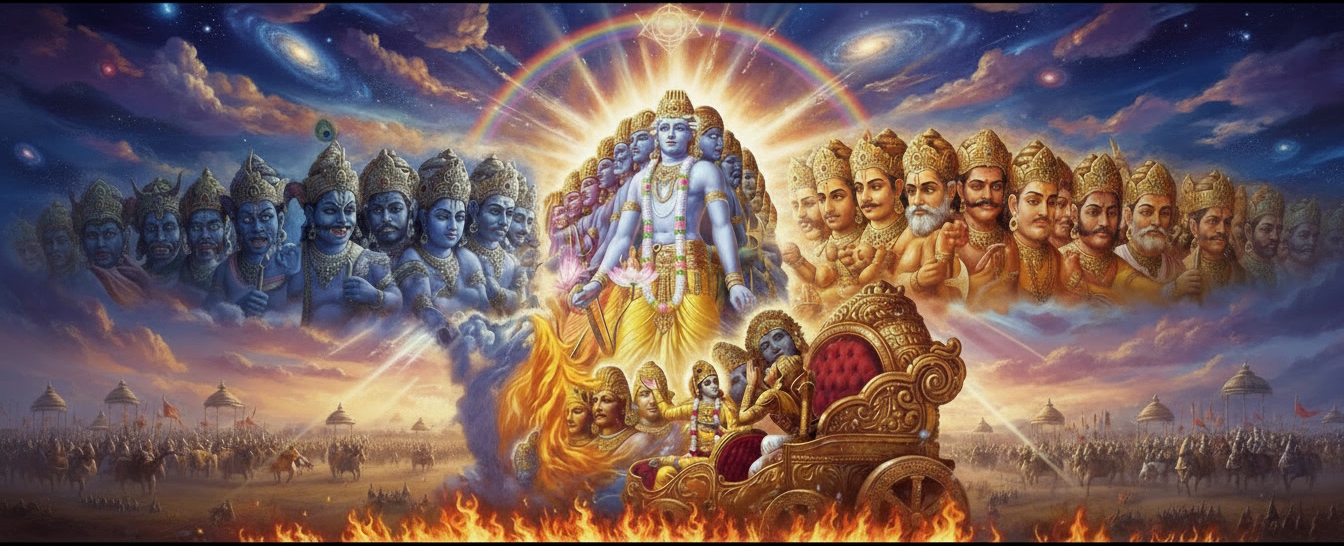
भोक्तारं यज्ञतपसां सर्वलोकमहेश्वरम्।
सुहृदं सर्वभूतानां ज्ञात्वा मां शान्तिमृच्छति।।5.29।।
bhoktāraṃ yajñatapasāṃ sarvalokamaheśvaram|
suhṛdaṃ sarvabhūtānāṃ jñātvā māṃ śāntimṛcchati||5.29||
Translation
He who knows Me as the enjoyer of sacrifices and austerities, the great Lord of all the worlds and the friend of all beings, attains to peace.
हिंदी अनुवाद
भक्त मुझे सब यज्ञों और तपोंका भोक्ता, सम्पूर्ण लोकोंका महान् ईश्वर तथा सम्पूर्ण प्राणियोंका सुहृद् (स्वार्थरहित दयालु और प्रेमी) जानकर शान्तिको प्राप्त हो जाता है।
Commentaries & Translations
Swami Ramsukhdas
व्याख्या--'भोक्तारं यज्ञतपसाम्'--जब मनुष्य कोई शुभ कर्म करता है, तब वह जिनसे शुभ कर्म करता है, उन शरीर, इन्द्रियाँ, मन, बुद्धि, पदार्थ आदिको अपना मानता है और जिसके लिये शुभ कर्म करता है, उसे उस कर्मका भोक्ता मानता है; जैसे--किसी देवताकी पूजा की तो उस देवताको पूजारूप कर्मका भोक्ता मानता है; किसीकी सेवा की तो उसे सेवारूप कर्मका भोक्ता मानता है; किसी भूखे व्यक्तिको अन्न दिया तो उसे अन्नका भोक्ता मानता है, आदि। इस मान्यताको दूर करनेके लिये भगवान् उपर्युक्त पदोंमें कहते हैं कि वास्तवमें सम्पूर्ण शुभ कर्मोंका भोक्ता मैं ही हूँ। कारण कि प्राणिमात्रके हृदयमें भगवान् ही विद्यमान हैं (टिप्पणी प0 321)। इसलिये किसीका पूजन करना, किसीको अन्न-जल देना, किसीको मार्ग बताना आदि जितने भी शुभ कर्म हैं, उन सबका भोक्ता भगवान्को ही मानना चाहिये। लक्ष्य भगवान्पर ही रहना चाहिये प्राणीपर नहीं।नवें अध्यायके चौबीसवें श्लोकमें भी भगवान्ने अपनेको सम्पूर्ण यज्ञोंका भोक्ता बताया है--'अहं हि सर्वयज्ञानां भोक्ता।'
Sri Harikrishnadas Goenka
इस प्रकार समाहितचित्त हुए पुरुषद्वारा जाननेयोग्य क्या है इसपर कहते हैं ( मनुष्य ) मुझ नारायणको कर्तारूपसे और देवरूपसे समस्त यज्ञों और तपोंका भोक्ता सर्वलोकमहेश्वर अर्थात् सब लोकोंका महान् ईश्वर समस्त प्राणियोंका सुहृद् प्रत्युपकार न चाहकर उनका उपकार करनेवाला सब भूतोंके हृदयमें स्थित सब कर्मोंके फलोंका स्वामी और सब संकल्पोंका साक्षी जानकर शान्तिको अर्थात् सब संसारसे उपरामताको प्राप्त हो जाता है।
Sri Anandgiri
[Objection:] "For the qualified aspirant as described, since there is an absence of duty to be performed, there is nothing to be known either"—raising this doubt, he refutes it with "evam" (thus), etc.
He distinguishes [the Lord] from the well-known enjoyer (the individual soul) with "sarvaloka" (all worlds), etc. Following the logic, "From Him indeed come bondage and its opposite (liberation) for this [soul]," he shows His nature as the giver of all fruits with the word "suhridam" (friend/benefactor).
He states the fruit regarding the described knowledge of Ishvara with "jnatva" (having known). He reveals the enjoyership in sacrifices and austerities in two ways: "as the agent" (kartru-rupena) [and as the deity].
To distinguish Him from Hiranyagarbha and others, he qualifies Him as "mahantam" (the Great Lord). He excludes a king who benefits [only] his own retinue with "pratyupakara" (implying help without expectation of return). He dispels the idea of Ishvara's aloofness (neutrality) with "sarvabhutanam" (of all beings).
[Doubt:] "Then, there might be association with the specific actions established here and there and their fruits?" Anticipating this, he implies [His role as supervisor/witness] with "sarvakarma" etc. And stating that objectively He does not even have a connection with the intellect and its modifications, he says "sarvapratyaya" (witness of all cognitions).
He states the fruit of the complete knowledge of Ishvara as described with "mam narayanam" (Me, Narayana). Thus, although Karma Yoga is praiseworthy compared to secondary renunciation, primary renunciation is superior to that; therefore, it is established that liberation is for one endowed with that [renunciation], possessed of purification of the intellect, capable of enduring the impulse born of desire and anger right here, qualified for Yoga, knowledgeable of the meaning of the word "Tvam" (Thou), and knowing the Supreme Self as the Innermost Self.
।। End of the Fifth Chapter in the commentary composed by Anandagiri. ।।
Sri Dhanpati
Thus, having aphorized Dhyana Yoga through two verses, and stating at the end "he is liberated indeed"—to remove the doubt "Is it a means to liberation without direct knowledge, or through knowledge?"—he establishes the conclusion of the second view (that it is through knowledge), in accordance with Shrutis like "Knowing Him alone one goes beyond death, there is no other path for going [to liberation]," "From knowledge alone is Kaivalya," and "Without knowledge there is no liberation."
By the third (verse 29)—knowing Me, Narayana, as the Self; who is the "enjoyer" of sacrifices and austerities in the form of the agent and the deity; who is the "Great Lord" of all from Brahma down to immobile objects; who is the "friend of all beings," meaning a benefactor without expectation of return help; who resides in the heart of all beings—one "richhati," meaning attains, "shanti" (peace), which is named liberation, the cessation of all Samsara.
Regarding the view that describes: "After the explanation of verse 24, 'thus the liberated one is spoken of.' Seekers are of three kinds: devoted to hearing (shravana), reflection (manana), and meditation (nididhyasana). Among them, the one devoted to hearing is spoken of by the second verse (25) 'labhante'; then the one devoted to reflection is spoken of by the third verse (26) 'kama', etc.; and by the remaining two verses (27-28), the one devoted to meditation is spoken of with 'sparshan', etc."—that view is questionable. Because the attainment of liberation stated in "labhante brahmanirvanam" cannot be established by hearing alone; and assuming it as a medium (dvara) or assuming a secondary meaning (gauna) is unjustifiable when the [literal] possibility exists. Also, because it would contradict "viditatmanam" (those who know the Self) and the Dhyana Yoga which is clearly apparent in "prana," etc., which serves as the aphorism for the Sixth Chapter—this is the indication.
Thus, by this Fifth Chapter—having stated the superiority of Karma Yoga, which produces purification of the mind, over renunciation performed by one of impure mind and devoid of establishment in knowledge; it is stated that liberation belongs to the Sannyasi of pure mind, endowed with control of the mind and senses (shama-dama), capable of enduring the impulse of desire etc. right here, qualified for Yoga, knowing the meaning of the term "Tvam" (Thou), and knowing the Supreme Self as the Innermost Self.
।। End of the Fifth Chapter in the Shri Gita Bhashya Utkarsha Dipika composed by the learned Dhanpati. ।।
Sri Madhavacharya
He states the object of meditation with "bhoktaram" (the enjoyer), etc.
Sri Neelkanth
Thus, what is to be known by one of concentrated mind is stated with "bhoktaram," etc. The "enjoyer" (bhoktaram) in the conditioned form (sopadhika) as the agent and deity of sacrifices and austerities. And the "Great" (mahantam), meaning all-pervading, "Lord" (Ishvara), meaning the Ruler and Inner Controller of all beings, even of Hiranyagarbha, etc. "Suhridam," meaning the benefactor of all beings (pranis) without expectation of return help. Knowing Me, Narayana, the "witness of all cognitions," as non-different from the Innermost Self (pratyag-abheda)—meaning realizing directly and attaining that state—he "richhati," meaning attains, "shantim" (peace), which is the unconditioned state, indefinable (nirupakhya), termed Kaivalya.
And thus, it is understood that the attainment of the Unconditioned (Nirupadhi) follows precisely the attainment of the Conditioned (Sopadhi) state of Brahman.
As stated in the Vartikasara: "Brahman is spoken of in two ways by the knower of Brahman: Conditioned (Sopadhi) and Unconditioned (Nirupadhi). The Universal Self (Sarvatma) would be 'Conditioned,' and the Unconditioned is 'Indefinable' (Nirupakhya). 'Eating, playing, enjoying'—this describes the Conditioned; in the Chandogya, the attainment of all desires is clearly stated due to the state of being the Self of all. 'I am food, I am the eater of food... I am the maker of verses'—thus Universal Selfhood is heard in the Sama-chant of the knower of Truth. Here too, through the example of the wheel [of Karma/World], the knower of Truth is heard of as Conditioned. Through reasoning like 'without prior, without posterior' (apurva-anapara), he will be heard of as Unconditioned.
Sri Ramanuja
Knowing Me as the "enjoyer of sacrifices and austerities," the "Great Lord of all worlds," and the "friend of all beings," he attains "peace"—meaning he attains happiness at the very moment of performing Karma Yoga.
"Sarvalokamaheshvaram" means the Ruler even of all the rulers of the worlds.
Indeed, it is heard [in scripture]: "Him, the Supreme Great Lord of lords" (Shvetashvatara Upanishad 6.7).
Knowing Me as the Great Lord of all worlds and the friend of all, and understanding that "Karma Yoga is a form of worshiping Me," he engages in it with happiness; this is the meaning. Everyone engages in the worship of their friends.
Sri Sridhara Swami
[Objection:] "In this way, how can liberation occur merely by the control of senses, etc.?" [Reply:] Not merely by that, but through knowledge; He states this with "bhoktaram" (the enjoyer), etc.
Knowing Me as the enjoyer—or the protector—of the sacrifices and austerities offered by My devotees out of their own free will; as the Great Lord of all worlds; as the "friend" of all beings, meaning the benefactor without expectation of return and the Inner Controller; by My grace, he "richhati," meaning attains, "shanti," meaning liberation.
Sri Vedantadeshikacharya Venkatanatha
At the beginning of the chapter, when asked about the distinction with "Renunciation of actions, O Krishna" (5.1), the difficulty of Jnana Yoga etc., and the ease and quickness of Karma Yoga were stated. Subsequently, Karma Yoga along with its procedure (itikartavyata) and head/culmination was clarified. Now, even here in the conclusion, the very ease etc. [of Karma Yoga] that was introduced as the answer to the previous question is being stabilized (confirmed) in another way; with this intention, he speaks with "uktasya" (of the described), etc.
Here, by the word "Karma Yoga," the specific principal parts mentioned in "Daivam eva" (4.25), etc., are grasped. By "having obligatory and occasional duties as its procedure," the unavoidable common element for those established in all varieties of Karma Yoga, and for those established in Jnana Yoga and Bhakti Yoga, [is indicated].
"Ease of performance" means being an object of engagement without despondency (anirveda). The word "Shanti" (peace) here does not refer to liberation in the form of attaining Bhagavan (since the context is the meditation on the individual soul/Jiva), nor to the result achievable by Karma Yoga [later]. Therefore, implying the "happiness" in the form of the cessation of mental afflictions etc., stated in "happily he is freed from bondage" (5.3), he says—"he attains happiness at the very moment of performing Karma Yoga."
Due to the grammatical coordination (samanadhikaranya) with Bhagavan and the correlation with "all worlds," the word "Maheshvara" here does not function in a specific conventional sense [i.e., referring only to Shiva], he says—"of all lords of the worlds also." The meaning of the compound is simply "The Great Lord of all worlds." He cites authority for that—"tam ishvaranam" (Him, [the Lord] of lords), etc. Even in the Shruti, the word "Maheshvara" is not conventional (rudha) because it is correlative and has the adjective "Supreme"; similarly here too.
Due to the non-restriction of the word "sarva" (all) and the adjective "mahattva" (greatness), the exclusion of other lords of worlds like Rudra, etc., is stated. It is indeed recalled in Smriti: "Krishna is the Lord of all lords" (Vishnu Dharma 74.44).
He dispels the doubt "How can there be happiness during the very stage of performance of Karma Yoga which is [inherently] troublesome?" with the three adjectives—"mam" (Me), etc. The idea is that one engages in Karma Yoga with a sense of happiness, just as in the service of a simpler, extremely generous emperor and a dear friend.
By "Karma Yoga is a form of My worship," the meaning of "the enjoyer of sacrifices and austerities" is expounded. The idea is that sacrifices and austerities are implications (upalakshana) for the class of Karma Yoga actions.
He gives a worldly example for "friendliness" (sauharda) being the cause of worship/service irrespective of other motives—"suhrida" (friend). "Sarve" (all) means not only those established in scripture, but even commoners and some animals/birds; recognizing a person possessing friendliness towards them through gestures and appearance, and being pleased merely by that, they follow/serve him with great effort; this is the meaning.
Unlike another person [of power], the avoidance of "wry-facedness" (arrogance/unpleasantness) rooted in the intoxication and pride of sovereignty is obtained by His being a "friend."
Swami Chinmayananda
हमको सदैव इस बात का ध्यान रखना चाहिए कि भगवान् श्रीकृष्ण जब कभी स्वयं के लिए मैं शब्द का प्रयोग करते हैं तब उनका अभिप्राय भूतमात्र के हृदय में वास करने वाली आत्मा से होता है और न कि देवकी पुत्र शरीरधारी श्रीकृष्ण से। अहंकार का मूलस्वरूप शुद्ध चैतन्य स्वरूप आत्मा है जो देहादि उपाधियों के साथ तादात्म्य के कारण कर्ता और भोक्ता के रूप में प्रतीत होता है। यज्ञ शब्द का अर्थ पहले भी बताया जा चुका है। गीता के अनुसार किसी भी कार्यक्षेत्र में निस्वार्थ भाव से विश्व कल्याण के लिए अर्पित किया गया कर्म यज्ञ कहलाता है। जिन शक्तियों का हम व्यर्थ में अपव्यय करते हैं उनका आत्मसंयम के द्वारा संचय करना तप है। फिर इस तप का उपयोग आत्म प्राप्ति के लिए किया जाना चाहिए।यह आत्मा वास्तव में सब देवों का देवमहेश्वर है। ज्ञान और कर्म के सम्पूर्ण व्यापारों के नियन्ता के अर्थ में यहाँ ईश्वर शब्द का प्रयोग किया गया है। शास्त्रों के अनुसार प्रत्येक कर्मेन्द्रिय तथा ज्ञानेन्द्रिय का एकएक अधिष्ठाता देवता है। नेत्र से रूपवर्ण श्रोत्र से शब्द और इसी प्रकार अन्य इन्द्रियों के द्वारा भिन्नभिन्न विषयों का ज्ञान होता है। इन दस इन्द्रियों का शासक और नियन्ता हैचैतन्य आत्मा। अत श्रीकृष्ण यहाँ आत्मा को महेश्वर विशेषण देते हैं।इस श्लोक में हमारा अनुभव यह है कि किसी बड़े पद के शासकीय अधिकारी के पास पहुँचने में अत्यन्त कठिनाई का सामना करना पड़ता है और उसमें भी राजनीति सत्ता के सर्वोच्च पद पर आसीन व्यक्ति की ओर तो सामान्य जन भयमिश्रित आदर के साथ देखते हैं। सामान्य मनुष्य में तो उसके समीप जाने का साहस ही नहीं होता। परन्तु सर्वलोक महेश्वर आत्मा के साथ यह बात नहीं है। भगवान् कहते हैं आत्मा सर्व प्राणियों का सुहृद (मित्र) है।मुझे (इस प्रकार) जानकर वह पुरुष शान्ति को प्राप्त होता है। यहाँ जानकर शब्द का अर्थ यह नहीं कि जैसे हम किसी फूल या फल को विषय रूप में उससे भिन्न रहकर जानते हैं वैसे ही श्रीकृष्ण को जानना है। ज्ञात्वा शब्द से तात्पर्य है श्रीकृष्ण को आत्मरूप से अनुभव करना। यज्ञ और तपों के भोक्ता महेश्वर और सुहृद भगवान् श्रीकृष्ण को आत्मरूप से साक्षात् अनुभव करके साधक परम शान्ति को प्राप्त होता है।Conclusionँ़ तत्सदिति श्रीमद्भगवद्गीतासूपनिषस्तु ब्रह्मविद्यायां योगशास्त्रेश्रीकृष्णार्जुनसंवादे कर्मसंन्यासयोगो नाम पंचमोऽध्याय।।
Sri Abhinavgupta
"Bhoktaram" (The Enjoyer)—He is the enjoyer regarding the fruits of sacrifices, because of the renunciation of fruits [by the practitioner].
Similarly regarding austerities.
Knowing the Divine Principle as such, even though situated "yatha tatha" (in whatever manner/state), he is liberated.
Sri Jayatritha
Why is the knowledge of the Lord as the means to peace stated again? To this, he says "dhyeyam" (the object of meditation). And therefore, the meaning of "jnatva" (having known) is "dhyatva" (having meditated upon).
The idea is that "being the knowledge which is the means to peace" is also merely an attribute of the object of meditation, just like "being the enjoyer," etc.
Sri Madhusudan Saraswati
Thus engaged in Yoga, knowing what does one become liberated? To this, He says: The "Enjoyer" of all sacrifices and austerities in the form of the agent and in the form of the deity—meaning the agent of enjoyment, or the protector. The root "bhuj" is used in the sense of protection and consuming/eating. The "Great Lord" of all worlds—the Controller even of Hiranyagarbha, etc.; the "Friend" of all living beings—the benefactor without expectation of return help; the Inner Controller of all, the Illuminator of all, the one essence of complete Existence-Consciousness-Bliss, the Absolute Truth, the Self of all—knowing Me, Narayana, [as such]—meaning realizing directly as the Self; he "richhati," meaning attains, "shanti," meaning the cessation of all Samsara, i.e., liberation; this is the meaning.
"Even though seeing You, why am I not liberated?"—to refute this doubt, the adjectives are provided. The idea is that the knowledge of Me in the stated form alone is the cause of liberation.
Sri Purushottamji
[Objection:] "How can there be liberation from 'contacts' (objects) etc. by merely this much?" Anticipating this doubt, He says "bhoktaram," etc. "Of sacrifices and austerities"—meaning of the hardships (tapa) earned through merit; "bhoktaram"—meaning the enjoyer of the Rasa (essence/joy) born of that hardship. "Sarvalokamaheshvaram"—the Creator of the world for the sake of His own play (Lila). "Suhridam of all beings"—by the giving of devotion, liberation, and the Rasa of His own nature, etc.
Knowing Me as such, he "richhati," meaning attains, "shanti" (peace) from the worldly [existence].
।। He who destroyed the mental delusional error through the description of the nature of Sannyasa, using the pretext of the Son of Kunti's (Arjuna's) question—to Him I bow. ।। 5 ।।
Sri Shankaracharya
Thus, what is to be known by one with such a concentrated mind is stated:
"Bhoktaram yajnatapasam"—the enjoyer of sacrifices and austerities in the form of the agent and in the form of the deity; "sarvalokamaheshvaram"—the Great Lord of all worlds; "suhridam sarvabhutanam"—the benefactor of all beings without expectation of return help; "sarvabhutanam hridayeshayam"—resting in the hearts of all beings; "sarvakarmaphaladhyaksham"—the presider over all fruits of actions; "sarvapratyayasakshinam"—the witness of all cognitions; knowing Me, Narayana, he "richhati," meaning attains, "shanti," meaning the cessation of all Samsara (transmigratory existence).
।। Here ends the Fifth Chapter in the Shrimad Bhagavad Gita Bhashya composed by Shrimad Shankara Bhagavat, the disciple of Shrimad Paramahamsaparivrajakacharya Shri Govinda Bhagavatpujyapada. 。
Sri Vallabhacharya
[Objection:] "In this way, how can one become liberated merely by the control of senses, etc.?" Anticipating this doubt, [He says] not merely by that alone, but through the knowledge of the Lord's majesty—He states "bhoktaram," etc.
Known as the enjoyer of sacrifices and austerities, He is the purport of the Karma Kanda (section on Rituals); as "the Great Lord of all worlds," He is the purport of Upasana (section on Worship); and as "the Self of all beings," He is the purport of the Jnana Kanda (section on Knowledge); knowing Me as such, he attains "peace" (shanti)—which is described as concerning what is to be heard and what has been heard, and is of the nature of indifference (nirveda) towards the fruits of actions.
।। He by whom, having abandoned the construction of alternatives [distinctions], the one single meaning of both Sankhya and Yoga was thus stated to Partha—to that Omniscient Hari, we bow. ।।
Swami Sivananda
भोक्तारम् the enjoyer? यज्ञतपसाम् of sacrifices and austerities? सर्वलोकमहेश्वरम् the great Lord of all worlds? सुहृदम् friend? सर्वभूतानाम् of all beings? ज्ञात्वा having known? माम् Me? शान्तिम् peace? ऋच्छति attains.Commentary I am the Lord of all sacrifices and austerities. I am their author? goal and their God. I am the friend of all beings? the doer of good to them without expecting any return for it. I am the dispenser of the fruits of all actions and the silent witness of their minds? thoughts and actions as I dwell in their hearts. On knowing Me? they attain peace and liberation or Moksha (deliverance from the round of birth and death and all worldly miseries and sorrows). (Cf.V.15IX.24)Thus in the Upanishads of the glorious Bhagavad Gita? the science of the Eternal? the scripture of Yoga? the dialogue between Sri Krishna and Arjuna? ends the fifth discourse entitledThe Yoga of Renunciation of Action.
Swami Gambirananda
Rcchati, one attains; santim, Peace, complete cessation of transmigration; jnatva, by knowing; mam, Me who am Narayana; who, as the sarva-loka-mahesvaram, great Lord of all the worlds; am the bhoktaram, enjoyer (of the fruits); yajna-tapasam, of sacrifices and austerities, as the performer and the Deity of the sacrifices and austerities (respectively); (and) who am the suhrdam, friend; sarva-bhutanam, of all creatures-who am the Benefactor of all without consideration of return, who exist in the heart of all beings, who am the dispenser of the results of all works, who am the Witness of all perceptions.
Swami Adidevananda
Knowing Me as the enjoyer of all sacrifices and austerities, as the Supreme Lord of all the worlds, and as the Friend of every being, he attains peace, i.e., wins happiness even while performing Karma Yoga. 'Him who is the Supreme Lord of all worlds' means 'Him who is the Lord of all the lords of the worlds.' For the Sruti says: 'Him who is the supreme mighty Lord of lords' (Sve. U., 6.7). The meaning is that knowing Me as the Supreme Lord of all the worlds and the 'friend' of all and considering Karma Yoga to be My worship, he becomes gladly engaged in it. All beings endeavour to please a 'friend'.