Bhagavad Gita - Chapter 6 - Shloka (Verse) 38
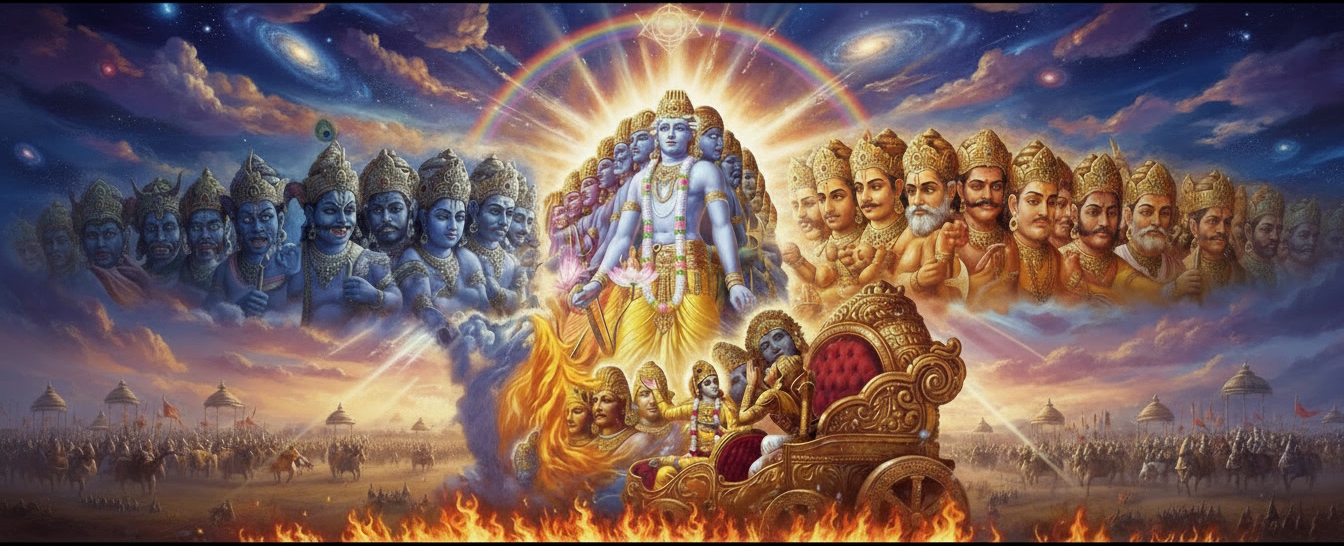
कच्चिन्नोभयविभ्रष्टश्छिन्नाभ्रमिव नश्यति।
अप्रतिष्ठो महाबाहो विमूढो ब्रह्मणः पथि।।6.38।।
kaccinnobhayavibhraṣṭaśchinnābhramiva naśyati|
apratiṣṭho mahābāho vimūḍho brahmaṇaḥ pathi||6.38||
Translation
Fallen from both, does he not perish like a rent cloud, supportless, O mighty-armed (Krishna), deluded on the path of Brahman?
हिंदी अनुवाद
हे महाबाहो ! संसारके आश्रयसे रहित और परमात्मप्राप्तिके मार्गमें मोहित अर्थात् विचलित -- इस तरह दोनों ओरसे भ्रष्ट हुआ साधक क्या छिन्न-भिन्न बादलकी तरह नष्ट तो नहीं हो जाता ?
Commentaries & Translations
Swami Ramsukhdas
व्याख्या--[अर्जुनने पूर्वोक्त श्लोकमें कां गतिं कृष्ण गच्छति कहकर जो बात पूछी थी, उसीका इस श्लोकमें खुलासा पूछते हैं।]
Sri Harikrishnadas Goenka
हे महाबाहो वह आश्रयरहित और ब्रह्मप्राप्तिके मार्गमें मोहित हुआ पुरुष कर्ममार्ग और ज्ञानमार्ग दोनों ओरसे भ्रष्ट होकर क्या छिन्नभिन्न हुए बादलकी भाँति नष्ट हो जाता है अथवा नष्ट नहीं होता।
Sri Anandgiri
He elaborates on the very question—with 'Kacchit' (6.38) etc. Accepting that 'Kacchit' implies a praiseworthy question, he explains it as 'Kim' (Is it that...) etc.
He clarifies the state of being 'fallen from both'—with 'Karma' etc. Just as a cloud ('Abhram') torn—scattered—by the wind perishes, like that—he states with 'Chhinna' etc. He states the cause for the fear of ruin—with 'Nirashrayah' (supportless) etc.
Anticipating that even in the absence of the support of the path of Action, he might have the support of the path of Knowledge, he says—'Vimudhah san' (being deluded) etc.
Indeed, this apprehension is not appropriate regarding a Karmi (performer of action); for one performing action after abandoning desire and offering it to the Lord, or even not offering it, the statement of 'fall' is not possible in a literal sense. But for the renouncer of all actions (Sarva-karma-sannyasi), because of the abandonment of prescribed duties and the fall from the means of Knowledge (Yoga), the fear of attaining evil is appropriate—this is the idea.
Sri Dhanpati
He clarifies his own intent in the question 'Kacchit' (Is it that?). "Ubhaya-vibhrashtah" (Fallen from both)—fallen from the path of action due to the renunciation of all actions, and from Yoga due to non-attainment of Right Vision (Samyag-darshana)—does he perish or does he not perish?
Now, he shows the state of being fallen from both by two adjectives. "Apratishthah" (Supportless)—meaning shelterless, devoid of the shelter in the form of the path of action. "Brahmanah pathi" (On the path of Brahman)—meaning on the path of attaining Brahman; "Vimudhah" (Deluded)—devoid of the support of the path of knowledge.
He states an example for the destruction of one fallen from both. "Chinnabhram iva" (Like a rent cloud)—just as a piece of cloud separated from a previous cloud, not reaching another cloud, perishes right in the middle, like that.
Addressing as "Mahabaho" (O Mighty-armed), he indicates that while You exist, endowed with extremely powerful arms capable of delivering devotees, his destruction is not proper.
And regarding that (interpretation of others) which explains the question thus: "'Kacchit' is in the sense of 'Kim' (What/Is it?). 'Nashyati' (Perishes) means attains hell. Or is there another destination for him?—thus the expected alternative side should be supplied.
(Objection) Now, what is his crime that his end is falling into hell? Anticipating this, he says 'Deluded on the path of Brahman.'
(Objection) Now, he will obtain the fruit of desire-prompted actions performed, and of obligatory actions performed for purification of mind; so from where is his attainment of hell? Anticipating this, he says 'Fallen from both.' Even when purification of mind is produced by performed obligatory actions, one completely fallen from the liberating knowledge which is the goal of that (purification)—would he obtain the fruit of those other obligatory actions? And having determined his own self as devoid of doership etc. and unqualified for action, due to performing action for purification by the path stated as 'Brahman is the offering...' etc., how would he be qualified for action?—this is the meaning of the term 'Fallen from both.'
(Objection) Now, why is there his delusion on the path of Brahman in this way? To this it is said 'Apratishthah' (Supportless). 'Pratishtha' (Support) is characterized by the power for the Supreme Goal through the abandonment of petty human goals; devoid of that (is Apratishtha)—this meaning"—which has been imagined by others, is false. (Refutation): Because of the absence of "being fallen from both" due to the inevitable nature of the fruit of desire-prompted actions; and because (the interpretation regarding) "his own self" etc. contradicts one's own previous text (reasoning) like "What use have I of liberation? I will do desire-prompted actions only for attaining those respective worlds." For it is not possible to suspect that one engaged in the path of desire-prompted action is "fallen from that"; therefore, "It refers to a Sannyasi"—because this has been stated in the Bhashya-Tika (Gloss on the Commentary).
By this, the meaning of the word "Apratishtha" (as imagined by others) is also refuted. Because the inability regarding the Supreme Goal is stated by "Deluded on the path of Brahman" itself.
Sri Madhavacharya
Ayati means 'effortless' (one without effort).
Sri Neelkanth
Regarding 'Kacchit'. Is he not 'fallen from both'—fallen from the path of Action (Karma) and the path of Yoga—like a 'severed cloud' (chinnabhra)? Just as (a torn cloud), not reaching the former or the latter mass of clouds, perishes right in the middle, like that.
'Apratisthah' means 'supportless' (nirashrayah).
'O Mahabaho' (Mighty-armed one), 'vimudho brahmanah pathi'—meaning (deluded) on the path of attaining Brahman.
Sri Ramanuja
Does this one, 'fallen from both', not perish like a 'severed cloud' (chinnabhra)? Just as a piece of cloud, severed from a previous large cloud and not reaching another large cloud, gets destroyed in the middle, exactly in that manner, does he not perish?
How is the state of being 'fallen from both'? (To this he says)—'Apratistho vimudho brahmanah pathi' etc. The action which is the means to heaven etc. as ordained, does not become a 'Pratistha' (support/foundation) as a means to its own fruit for this person who is devoid of attachment to fruits; therefore he is 'Apratisthah' (supportless). And he is 'Vimudhah' (deluded) on the 'Brahmanah pathi' (path of Brahman) which was commenced, meaning he has fallen from that path.
Therefore, being fallen from both, does he indeed perish or does he not perish?
Sri Sridhara Swami
He elaborates on the intention of the question—with 'Kacchit' etc. Because actions are offered to the Lord and because of the non-performance (of desire-prompted actions), he does not attain the fruit of actions like Heaven etc.; and due to the non-completion of Yoga, he does not attain Liberation. Thus fallen from both, 'Apratisthah'—meaning supportless—and therefore indeed being 'Vimudhah' (deluded) on the 'Pathi'—the path which is the means of attaining Brahman; 'Kacchit'—does he not perish, or does he perish? This is the meaning.
The example regarding destruction is: 'Yatha chinnamabhram'—just as a torn cloud, separated from the previous cloud and not having reached another cloud, dissolves right in the middle, like that (does he perish?); this is the meaning.
Sri Vedantadeshikacharya Venkatanatha
Thus, the previously stated 'means of Yoga' has been heard properly; now, (Arjuna) asks to hear in detail, endowed with all aspects, the very 'glory of Yoga' mentioned earlier—this is stated (by the commentator) with 'Atha'. By the word 'Yogamahatmyam' (glory of Yoga), the word 'Yogasiddhi' found in the summary verse is explained. For 'glory' is indeed the cause of 'perfection' (siddhi). And 'Siddhi' here is of this form: for even a slack Yoga, the attainment of many meritorious worlds for a long time, rebirth in a family of Yogis fit for Yoga again, through that again the fullness of Yoga, and from that Liberation. And this 'Siddhi' is due to a glory uncommon to anything else.
(Objection): In verses like "Nehabhikramanasho'sti" (2.40), the glory of Karma Yoga was stated; but here (the question is about) Yoga which is of the nature of Self-realization, which is the fruit of that (Karma Yoga); so how is it said "it has been heard"? To this he says—'Antargata' etc. "What of that?"—to this he says 'Taccha' etc. The glory of Karma Yoga was spoken there (in 2.40) because it contains the sprout of Self-knowledge within it and because it is the means to the nature of full Yoga. Therefore, when the glory of Karma Yoga—which is a limb (anga) and has Yoga as its attribute/qualifier—is stated, the glory of Yoga, which is the principal (angi), is indeed stated—this is the idea.
The connection of words like 'Ayatih' is shown with a different order due to the propriety of meaning. For, swerving from it can be predicated only of one who has engaged in it, not of one merely endowed with faith; therefore, with the intention that the effect (action) is indicated by faith, it is said 'Yoge pravrittah' (engaged in Yoga). Or the idea is that the word 'Upeta' (endowed/approached) itself here refers to the undertaking of Yoga caused by faith. 'Yogasamsiddhim aprapya'—meaning before the perfection of Yoga itself. 'Yogacchalitamanasah'—meaning one whose mind is not favorable to perform full Yoga. Which (destination) among enjoyment of desires, liberation, or hell does he go to?—this is the meaning. 'Kam gatim gacchati'—this general indication is elaborated by 'Kacchit' (6.38) etc.
In the example (Simile in 6.38) also, he shows the manner of being 'fallen from both'—with 'Yatha' etc. Since it is an elaboration of being fallen from both, and because only one phrase 'deluded in the path of Brahman' is mentioned, by elimination (parishesha), the term 'Apratistha' (supportless) refers to the fall from Karma which is the means to worldly fruits—this he states with 'Yathavasthitam' etc. In the effort of the performance of the nature of Karma etc., there is nothing lacking, but due to the difference (inequality/desirelessness) of intention, it has become fruitless (in a worldly sense)—this is the intention.
'Vimudho Brahmanah pathi'—here 'ignorance' regarding the path of Brahman is not intended, because the question is asked regarding one who, having known and started, has turned back. Therefore, the 'cessation of Yoga', which is the effect of delusion, is indicated here by the word 'Vimudha'—with this intention, it is stated from 'Prakranta' (started) up to '...prachyuta' (fallen). 'Brahmanah pathi'—meaning in Yoga, which is the means to attain Brahman.
'Etam me samshayam' (6.39)—he states the other side (consequence) established by implication of the doubt being pointed out—with 'Kimayam nashyatyeva' (Does he certainly perish?). 'Arhasi'—meaning You are fit (to answer) being endowed with omniscience, compassion, and being a dear friend. The meaning intended by the word 'Krishna' and 'Tvat' (You) is stated—with 'Svatah' etc. The knowledge of others (other than You) is dependent on instruments, mostly vague like inference, sequential, covering few objects, and occasional—this is the sentiment. By this, the statement of Bhagavan Nathamuni Mishra is recalled: "He who knows everything, simultaneously, by direct perception, always, by Himself—bowing to that Hari, we expound the scripture Nyaya Tattva." 'Na hyupapadyate' (For it is not appropriate)—by this, contradiction to reason is intended.
Swami Chinmayananda
सम्भव है कि ब्रह्म प्राप्ति के मार्ग पर चलता हुआ कोई श्रद्धावान् साधक मृत्यु का ग्रास बन जाए अथवा पर्याप्त संयम के अभाव में योग से पतित हो जाए। उसके पतन को दर्शाने के लिए जो अत्यन्त उपयुक्त और प्रभावोत्पादक दृष्टान्त अर्जुन के मुख से महर्षि व्यासजी ने दिया है उसे प्राय साहित्यिक क्षेत्र में उद्धृत किया जाता है।कभीकभी ग्रीष्म ऋतु में पर्वतों के पार्श्व भाग से कोई छत्रवत् मेघमालिका ऊर्ध्वदिशा में उठती हुई दृष्टिगोचर होती है। परन्तु तीव्र वेग से प्रवाहित वायु के स्पर्श से वह मेघ खण्ड अनेक छोटेछोटे मेघखण्डों में विभक्त हो जाता है। ये मेघखण्ड पूर्णतया प्रबल वायु की दया पर आश्रित इतस्तत लक्ष्यहीन भ्रमण करते रहते हैं। ग्रीष्म ऋतु के ये मेघ न कृषकों की अपेक्षाएं पूर्ण कर सकते हैं और न तृषितों की पिपासा को ही शान्त कर सकते हैं। किसी सुरक्षित स्थान को न प्राप्त कर अन्त में वे स्वयं भी नष्ट हो जाते है। अर्जुन का प्रश्न है कि क्या योगभ्रष्ट पुरुष की गति भी उस मेघ के समान ही नहीं होगीअर्जुन यह प्रश्न क्यों पूछता है वह स्वयं ही इसका कारण बताता है
Sri Abhinavgupta
'Ayatah' (variant for Ayatih) etc. up to 'na hyupapadyate'. If the mind swerves from the Yoga that has been attained (started), (but) faith is not lost.
For one whose faith is destroyed renders everything fruitless even if he is a 'Siddhayoga' (perfected in Yoga). It is indeed said: "When, even after attaining Vijnana (knowledge), it is defiled by mental confusion, then immediately it is destroyed like a heap of cotton by fire."
The question is: When the perfect success of Yoga has not arisen, having exited from the worlds (worldly paths), and not being properly merged in Brahman, would he perish? Or does he perish because of being unestablished in Brahman, leading to the obstruction of the higher worlds?
Sri Jayatritha
To refute the understanding that he is a 'non-fourth-ashrami' (not a Sannyasi), he says—'Ayatih' (meaning this term does not negate his status as a Sannyasi).
Sri Madhusudan Saraswati
He elaborates on this very seed of doubt with 'Kacchit'—a question implying expectation/hope. 'He Mahabaho' (O Mighty-armed one)—He who has four arms capable of removing all calamities of all devotees or capable of bestowing the four goals of human life (Purusharthas); by this (address), the absence of anger due to the question and the patience to grant its answer are suggested.
'Brahmanah pathi'—on the path of attaining Brahman, i.e., in Knowledge—he is 'Vimudhah'—distracted/confused. This means one in whom the direct realization of the unity of Brahman and Atman has not arisen.
'Apratisthah'—devoid of the 'Pratistha' (foundations) or means, namely Meditation (Upasana) and Action (Karma), which are the causes for traveling on the paths of Devayana (Path of Gods) and Pitriyana (Path of Fathers); because he has renounced all actions along with meditations.
Such a one, 'Ubhayavibhrashtah'—fallen from the path of Action and from the path of Knowledge—is like a 'Chinnabhra' (severed cloud). Just as a cloud torn and scattered by the wind, fallen from the previous cloud mass and not having reached the subsequent cloud, being unfit for rain, perishes right in the interval; similarly, the one fallen from Yoga, being severed from the previous path of Action and (not attaining) the subsequent Knowledge derived from scripture, perishes right in the interval—meaning, is he not unfit to attain both the fruit of Action and the fruit of Knowledge?—this is the meaning of the question.
By this, the doctrine of 'Combination of Knowledge and Action' (Jnana-Karma-Samucchaya) is refuted. For, in that view, even if the fruit of Knowledge were not attained, since the attainment of the fruit of Action would still be possible, the state of being 'fallen from both' would be impossible.
And it should not be argued that "even if action is possible, due to the abandonment of desire for fruit, the statement regarding the loss of its fruit can be assumed"; because the existence of fruit even for desireless actions has been repeatedly established by citing statements of Apastamba etc.
Therefore, this question is applicable only to the Renouncer of all actions (Sarva-karma-tyagi). The fear of attaining evil (total loss) is possible only in that case.
Sri Purushottamji
To remove the doubt imagined by his own intellect, he expands upon that very doubt of his intellect—with 'Kacchit' etc.
Due to the renunciation of actions etc. previously engaged in, he is 'apratishtha'—supportless—in the path of Yoga. Due to the absence of practice resulting in ignorance of the essential nature (Swarupa), and due to the absence of dispassion, he is 'vimudha'—deluded—on the 'path of Brahman', which is the path of exclusive effort for attaining the Lord.
'O Mighty-armed one'—capable of bestowing grace on all! Thus being 'fallen from both'—'like a severed cloud'—just as a severed cloud, separated from the previous cloud and not merged into another cloud, perishes right in the middle; similarly, being devoid of the fruit of Moksha earned by one's own Dharma due to the renunciation of previous Dharma, and being devoid of union with the Essence (Swarupa) due to ignorance of the nature of the Lord's path, and devoid of the state of attaining the Jiva's essential nature, does he not perish?
Sri Shankaracharya
'Kacchit'—Does he not, being 'fallen from both'—fallen from the path of Action and from the path of Yoga—
perish like a 'severed cloud'? Or does he not perish? 'Apratisthah'—supportless.
'O Mighty-armed one', 'vimudhah san'—being deluded. 'Brahmanah pathi'—on the path of attaining Brahman.
Sri Vallabhacharya
He conveys his own intention—with 'Kacchit' etc.
Is it that he does not become fallen from both—from the enjoyment of happiness of this world and of the next world? This is the question.
Because he is 'apratistha' (unestablished) in Yoga, which is the path to Brahman.
Swami Sivananda
कच्चित् is it that न not? उभयविभ्रष्टः fallen from both? छिन्नाभ्रम् rent cloud? इव like? नश्यति perishes? अप्रतिष्ठः supportless? महाबाहो O mightyarmed? विमूढः deluded? ब्रह्मणः of Brahman? पथि in the path.Commentary Both the path of Karma or the path of ritualistic activity in accordance with the Karma Kanda of the Vedas on the one hand and the path of Yoga on the other.Path of Brahman the path by which Brahman can be reached or the way that leads to Brahman.The Yoga taught by the Lord here demands onepointed devotion to its practice. The aspirant turns away from the world and spurns heaven? too. Some people held that if he failed to attain the goal? he would have lost everything for nothing. Hence the estion.
Swami Gambirananda
Mahabaho, O Mighty-armed one; ubhaya-vibhrastah, fallen from both, having fallen from the Path of Action and the Path of Yoga; apratisthah, without support; vimudhah, deluded-having become deluded; brahmanah pathi, on the path of Brahman, on the path leading to Brahman; kaccit na, does he not; nasyati, get ruined; iva, like; a chinna-abhram, scattered cloud? Or is it that he does not?
Swami Adidevananda
Arjuna said What way does he go, who has embarked on Yoga endowed with faith, but who by inadeacy of exertion in practice, does not gain success in Yoga and has his mind wandering from Yoga? Does he not perish like a small piece of cloud torn from a large mass of cloud - perish without reaching another large mass of cloud?
Now does he not fall away from both (sides)? He has no support and is confused on the path leading to the Brahman. He is without any support in the sense that Karma or rituals which constitutes the means of heaven etc., does not give support for a person who is devoid of attachment to fruits; for Karma is the means for generating its own fruits. He is also confused in the path leading to the Brahman on which he has just begun to traverse; He has lost his way. Does he then get lost by falling down from both sides, these being attainment of heaven on the one hand and liberation on the other. Does he not thus perish? You should remove this doubt altogether from my mind; for there is no other remover of this doubt than You, who always perceive directly all matters simultaneously.