Bhagavad Gita - Chapter 6 - Shloka (Verse) 47
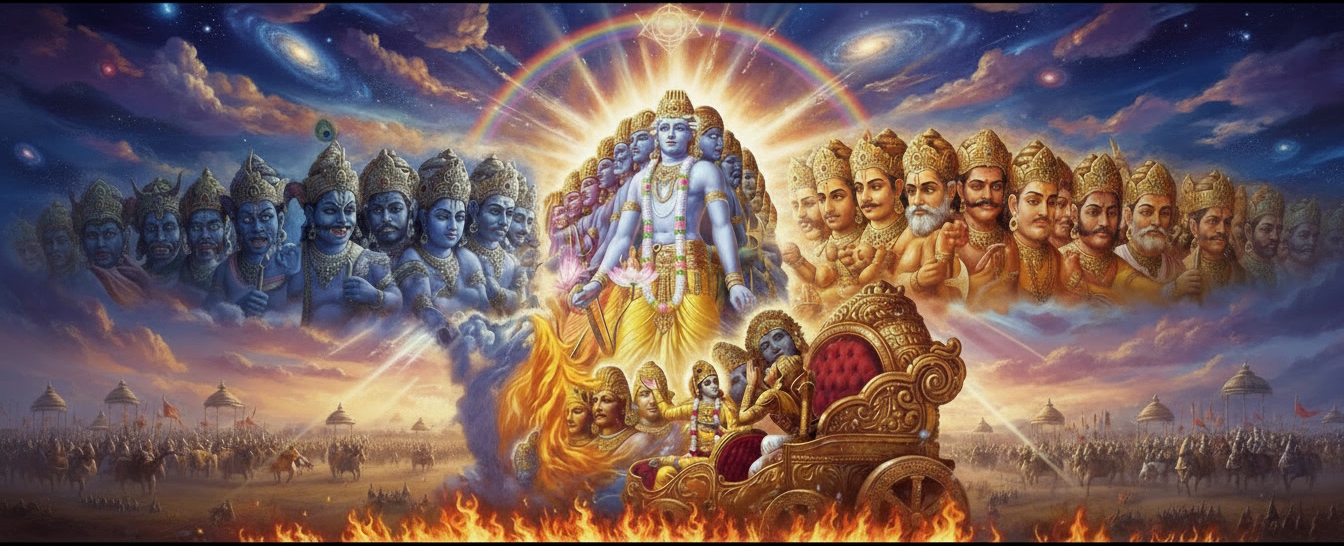
योगिनामपि सर्वेषां मद्गतेनान्तरात्मना।
श्रद्धावान्भजते यो मां स मे युक्ततमो मतः।।6.47।।
yogināmapi sarveṣāṃ madgatenāntarātmanā|
śraddhāvānbhajate yo māṃ sa me yuktatamo mataḥ||6.47||
Translation
And among all the Yogis he who, full of faith and with his inner self merged in Me, worships Me is deemed by Me to be the most devout.
हिंदी अनुवाद
सम्पूर्ण योगियोंमें भी जो श्रद्धावान् भक्त मुझमें तल्लीन हुए मनसे मेरा भजन करता है, वह मेरे मतमें सर्वश्रेष्ठ योगी है।
Commentaries & Translations
Swami Ramsukhdas
व्याख्या--'योगिनामपि सर्वेषाम्'--जिनमें जडतासे सम्बन्ध-विच्छेद करनेकी मुख्यता है, जो कर्मयोग, सांख्ययोग, हठयोग, मन्त्रयोग, लययोग आदि साधनोंके द्वारा अपने स्वरूपकी प्राप्ति-(अनुभव-) में ही लगे हुए हैं, वे योगी सकाम तपस्वियों, ज्ञानियों और कर्मियोंसे श्रेष्ठ हैं। परन्तु उन सम्पूर्ण योगियोंमें भी केवल मेरे साथ सम्बन्ध जोड़नेवाला भक्तियोगी सर्वश्रेष्ठ है।
Sri Harikrishnadas Goenka
रुद्र आदित्य आदि देवोंके ध्यानमें लगे हुए समस्त योगियोंसे भी जो योगी श्रद्धायुक्त हुआ मुझ वासुदेवमें अच्छी प्रकार स्थित किये हुए अन्तःकरणसे मुझे ही भजता है उसे मैं युक्ततम अर्थात् अतिशय श्रेष्ठ योगी मानता हूँ।
Sri Anandgiri
Objection: Many Yogis are found who are worshippers of the Sun (Aditya), the Cosmic Self (Virata-atma), the Sutra, the Cause (Karana), and the Imperishable (Akshara); among them, which one is desired as the most excellent? On this point, He says 'Of the Yogis' (yoginam), etc.
He who, with faith and with a mind as described, incessantly contemplates upon the Lord—whether Saguna (with attributes) or Nirguna (without attributes)—he is the most exceedingly integrated among the integrated ones (yuktas), he is the most excellent; such is intended by the Lord. The meaning is that His intention cannot be otherwise.
Thus, by this chapter—demonstrating the boundary of Karma-yoga which is the cause of renunciation, expounding Yoga along with its limbs, and loosening (removing) the scope for the doubt regarding the absolute destruction of one fallen from Yoga through the instruction on the means of mind-control—it has been established that for one who knows the meaning of the word 'Thou' (tvam-pada), through the statement of steadfastness in knowledge, 'liberation arises from the knowledge of the sentence meaning (vakyartha)'.
-- Here ends the Sixth Chapter in the commentary on the Gita Bhashya composed by Anandagiri.
Sri Dhanpati
Of the Yogis (yoginam)—meaning among all of them, even those engaged in meditation on other deities—he who worships Me (bhajate), i.e., serves Me, with his "inner self" (antaratmana)—i.e., the internal organ—"absorbed in Me" (madgatena)—i.e., concentrated in Me, Vasudeva—being "endowed with faith" (shraddhavan)—believing that there is nothing higher than Vasudeva; he is "considered" (matah)—i.e., intended/approved—by Me as the most exceedingly integrated (yuktatamah), the best of all Dhyana-yogis.
Therefore, the intention is that you become such a Dhyana-yogi.
Thus, by this Sixth Chapter—demonstrating the boundary of Karma-yoga which is the cause of Renunciation, the Dhyana-yoga along with its limbs, the means of mind control, the attainment of liberation through a good path due to the absence of a bad state for one fallen from Yoga, and the superiority of the worship of Vasudeva—it has been established that for one who knows the pure meaning of the word 'Thou' (tvam-pada) through this means, liberation (arises) from the knowledge of the sentence meaning (vakyartha).
With a mind devoted to the worship of the Lord, performing actions etc., devoid of doership etc., having obtained pure selfhood through the Vedas; I bow to that Self which has attained supreme oneness and is a mass of bliss, eternal, the innermost Self, (which is) in reality the Supreme Truth but due to delusion has become the Jiva fallen from its true nature.
-- Thus ends the Sixth Chapter in the Sri Gita Bhashya Utkarsha Dipika composed by the learned Dhanpati, son of Ramkumar, the ornament of the Datta lineage and disciple of Sri Paramahansa Parivrajakacharya Sri Balaswami Sripada. ||6||
Sri Neelkanth
The discrimination of the meaning of the word 'Thou' (tvam-pada), in which action (karma) is predominant, is concluded.
Hereafter, desiring to describe the meaning of the word 'That' (tat-pada) with a predominance of worship (upasana), He praises that worship as having great fruit with the words "Of the Yogis" (yoginam), etc.
Among all the Yogis possessed of the twelve types of Yogas spoken of in the Fourth Chapter beginning with "Some offer sacrifice to the gods alone" (Gita 4.25), he who worships Me, being endowed with faith, with his "inner self" (antaratmana)—meaning the mind—"absorbed in Me" (madgatena)—meaning offered to Me, Vasudeva—he is "considered" (matah)—meaning intended/approved—by "Me" (me) as the "most integrated" (yuktatamah), i.e., exceedingly integrated and praiseworthy.
The idea is: therefore, become My devotee.
Sri Ramanuja
'Of the Yogis' (yoginam)—here the Genitive case is in the sense of the Ablative (panchami). Since the Yogi to be described is not included among the four types of Yogis expounded by verses like "Abiding in all beings" (sarvabhutastham), the Genitive case in the sense of 'specification' (nirdharana - singling out one from a group) is not possible here. "Even of all" (api sarvesham)—here the word 'all' refers to the ascetics and others (mentioned in the previous verse); there too, by the stated logic, the meaning of the Ablative should be understood. It means: compared even to all Yogis, the Yogi to be described is the most integrated (yuktatamah). The meaning is that in comparison to him, there is no difference (in inferiority) between the ascetics etc. and the (other) Yogis. Just as in comparison to Mount Meru, although there exists a relative difference of smaller and larger among mustard seeds, yet in comparison to Meru, their inferiority is equal.
"With the inner self absorbed in Me" (madgatena antaratmana)—with a mind rooted in Me due to a nature exclusive to Me alone caused by My being exceedingly dear; the 'inner self' is indeed the mind which is the substratum of all external and internal modifications. With a mind absorbed in Me because it cannot sustain itself without Me due to My being exceedingly dear. "Endowed with faith" (shraddhavan)—being hasty (tvaravan) in the effort to attain (Me) because of the inability to tolerate separation even for a moment due to My being exceedingly dear. Who "worships Me" (mam bhajate).
"Me" (mam)—meaning (Me) whose sport is the creation, sustenance, and dissolution of the entire universe filled with the variegated and infinite objects of enjoyment, the groups of enjoyers, the instruments of enjoyment, and the places of enjoyment; the repository of a multitude of countless auspicious qualities like boundless and unsurpassed knowledge, strength, lordship, vigor, power, and brilliance, untouched by any defects; possessing a divine form which is the repository of infinite qualities like unsurpassed radiance, beauty, fragrance, tenderness, charm, youthfulness etc., which is eternal, flawless, wonderful, divine, inconceivable, uniform, and in accordance with the desire of My devotees; whose nature and essence are immeasurable by speech and mind; the great ocean of boundless compassion, good disposition (saushilya), parental affection (vatsalya), generosity, and lordship; the refuge of all the worlds without considering distinctions; the remover of the distress of those who bow down; the sole ocean of affection for those who seek refuge; who has become the object of vision for all human beings; who has descended in the house of Vasudeva without abandoning His own nature; who illumines the whole world with boundless, unsurpassed radiance; and who nourishes the universe with His luster—"worships" (bhajate), meaning serves or meditates upon.
"He is considered by Me to be the most integrated" (sa me yuktatamo matah)—he is the most excellent of all; thus "I"—who spontaneously and directly perceive everything at all times exactly as it is—hold.
Sri Sridhara Swami
Even among Yogis devoted to Yama (restraints), Niyama (observances), etc., My devotee is superior; thus He says "Of the Yogis" (yoginam), etc.
With an "inner self" (antaratmana)—meaning a mind—"absorbed in Me" (madgatena)—meaning attached to Me; he who worships Me, the Supreme Lord Vasudeva, being endowed with faith; he is "considered by Me" (mama sammatah) to be the best among those integrated in Yoga.
Therefore, become My devotee; this is the idea.
Sri Vedantadeshikacharya Venkatanatha
Thus, when the superiority of the Jivatma-yogi over all (Karma-yogis and Jnana-yogis) is propounded, suspecting that the hearer might become contented thinking "There is no supreme goal beyond that"; like in the Bhuma-Vidya (Chandogya 7.23), He Himself introduces, in order to propound by the middle hexad (chapters 7-12) the "Bhakti Yoga having Himself as object" which accomplishes a goal even superior to that (Jivatma-yoga) and is the principal of that (subordinate Jivatma-yoga)—he says "Tadevam" (Thus). By the manner established by the stated proofs and logic; this is the meaning. For the sake of connection, he states that the first hexad is subsidiary to the middle hexad—with "Paravidyangabhutam" (Subsidiary to the Supreme Knowledge). There, the indication of proof is "Prajapativakyoditam" (Said in the statement of Prajapati). This has been expanded before itself. By this, the later Vedantins etc. who say that "mere realization of the pure Inner Self is the Supreme Yoga" are refuted. "Paravidyam"—meaning Supreme Knowledge. Like "Now the Supreme, by which that Imperishable is attained" (Mundaka 1.1.5) etc. Or, meaning the Knowledge of the Supreme Self. "Prastauti" (Introduces)—this is merely an introduction, the expansion will indeed happen subsequently; this is the purport.
Thinking that from the context "Superior to ascetics" (6.46) etc., here too the meaning "Than Yogis" is intended, he says "Yoginam" (Of Yogis). "Genitive in the sense of Ablative"—the meaning results in a specific relationship from the general genitive due to the force of intention; this is the purport. (Objection) "Now, why strain like this? Genitive in the sense of 'Determination' (selection) is possible here. Thus—among the four Yogas stated before, some Yogi was mentioned in 'Who sees Me situated in all beings... established in unity' (6.31); here too in 'Possessed of faith worships Me' (6.47), he alone is recognized; therefore, by selecting him, the praise 'Most United' (Yuktatamah) is done here. And the suffix (Tamap) in 'Yuktatamah' indicates the sense of selection; therefore this is not genitive in the sense of ablative." To this he says "Sarvabhutastham". By this, it is shown that even though there was singular indication "Yogi" in the previous verse, here by the plural, he is not even the subject of restatement. "So what?"—to this he says "Teshvu" (Among them).
This is the intention—The Yogi who is the worshipper of the Supreme Self will indeed be described by the middle hexad; and his introduction is being done here; he was not mentioned before. And it was already propounded that "Who sees Me situated in all beings" (6.31) etc. is about the contemplation of similarity; so there is no recognition of him here. Moreover, in the verse "By comparison with oneself" (6.32), a Yogi even superior to the Yogi mentioned in "Situated in all beings" etc. was mentioned before; and then, if the Yogi mentioned by "Situated in all beings" etc. is propounded here as superior to all, there would be contradiction with the previous. Therefore, since this (Bhakta) Yogi cannot be one among them (the previous ones), this is not genitive of determination. This is what is said by "Teshvanantargatatvat" (Because of not being included among them). (Objection) "Now, gathering the previously mentioned and the to-be-mentioned Yogis generally, why can't there be determination of the 'to-be-mentioned' one as one among them?" Not so; for only someone already known among those known can be determined (selected); otherwise, restatement for the sake of ordaining excellence would be impossible. And the 'to-be-mentioned' Yogi is not known to the hearer Arjuna before this. This too is indicated by the word "Vakshyamanasya" (Of the to-be-mentioned). Therefore, this must be an introduction of the 'to-be-mentioned' Yogi who is superior to the previously mentioned Yogis. And then, when the Ablative sense is to be intended, the Genitive of determination is not possible.
In the construction by co-referentiality "Even of all Yogis" (Yoginam api sarvesham), the word "Api" (even) would have weak purpose. For the praise of Yogis would then be indicated; and since that is already known, it does not need indication here. And there would be a contrary perception like in usages "This is vaster even than the ocean" (implying distinction). The sense of "Api" as conjunction (and/also)—like fame and excellence—is possible here and should not be abandoned. Since the meaning is obtained by "Yoginam api" itself, the word "Sarva" (all) is also not extremely required; if the conjunction sense of "Api" and the reference of the word "Sarva" to other things to be conjoined is possible, then that alone is proper to accept. And here, Ascetics etc. who are relevant are possible as the meaning of the word "Sarva"; and they are not included in the word "Yogi"; and when the primary meaning is possible, secondary implication (lakshana) by that is not proper. Taking them (ascetics etc.), even though inferior to Yogis, is extremely appropriate for the sake of example. The combination of Yogis and Ascetics etc. is extremely required because it is useful for propounding inferiority and equality (relative to the Bhakta). Intending all this, he says "Api sarvesham" (Even of all). "By the stated logic"—meaning due to context, because of not being included among them, and because of the impossibility of including them; this is the purport.
To state the intention of including ascetics etc., he states the resultant connection—"Yogibhyah" (Than Yogis). "Yuktatamah"—means Superior. Or, since Yogis and Ascetics etc. are united with their respective means, this one is united with a means surpassing all of them; this is the meaning. Or, meaning 'Most fit'. Intending all this, he will say "Shreshthatamah" (Best). "Why are Ascetics etc., who are inferior even to Yogis, included here?"—clarifying their role as examples, he says "Tadapekshaya" (In comparison to that). He strengthens it with a worldly example—"Mervapekshaya" (In comparison to Meru). (Objection) "Now, saying there is no distinction in inferiority is improper; if so, there would be the contingency of absolute equality between Ascetics etc. and Yogis. And there is a distinction of 'inferior' and 'more inferior' like mustard seeds in comparison to Meru by degree of less and more?" To this he says "Yadyapi" (Although). Mutual gradation is not denied now; but compared to the extremely superior, the mere 'inferiority' of even those having mutual gradation is common; and by that much, the usage of 'inferiority' also becomes common; this is the purport. "Matpriyatvatirekena" (By the excess of being dear to Me)—He to whom I am dear, the object of love, is "Matpriyah"; his state/nature; by the excess of devotion; this is the meaning. "Ananyasadharanasvabhavataya" (By the nature common to none else)—meaning that the desired object of enjoyment alone is the sustainer; this is the purport. Compared to external senses, body, etc., the mind here is denoted by the word "Antaratma" (Inner Self). In the culminating state of devotion, the word "Shraddha" (Faith) being merely about desire etc. is inappropriate; therefore, he shows the object-hood of 'haste' which is the effect of desire, and the attainment of 'intense state' which is the cause of haste of desire—with "Atyartha" (Excessive) etc. He shows the forms intended by "Mam" (Me)—which are useful for meditation, stated by hundreds of Shrutis and Smritis and by the two hexads to be spoken of, regarding the One designated as worshipable—with "Vichitra" etc. up to "Apyayayantam" (Gladdening). Even there, the adjectives up to "Nature and essence not limited by speech and mind" are conducive to Supremacy (Paratva). The ones after that are conducive to Accessibility (Saulabhya); this is the distinction. And the mention of both is because the extremely easy like grass etc. and the extremely difficult like Meru etc. are not acceptable due to the lack of one or the other. Intending the culmination of general words like Sat, Brahman, Atman found in causal sentences into the meaning of "Narayana" which establishes the specific not established otherwise; by the meaning ascertained by the Sutra "From whom is the birth etc. of this" (Brahma Sutra 1.1.2); showing the definition of Brahman, the object of inquiry, propounded by the sentence "From whom indeed these..." (Taittiriya 3.1); in the Charioteer of Dhananjaya possessing the glory of being the cause of the world, universal form etc. which will be described—he shows with "Vichitra". Connection with Lilavibhuti (Sportive Glory/World) was propounded through Causality; now to remove the doubt of 'possession of defects' and 'lack of auspicious qualities' suspected in Causality, he shows the 'Dual Characteristics' (Ubhayalinga - faultlessness and auspiciousness) established by purifying sentences etc.—with "Asprishta". In "Asprishtasheshadosha" (Untouched by all defects), if it qualifies the qualities, then absence of co-existence with defects is intended; if it qualifies the Possessor of qualities, then absolute absence of defects. Now, through the propounding of being qualified by the Auspicious Support (Shubhashraya) Non-material Body—implying connection with divine ornaments, weapons, consorts, attendants, abode, etc.—he indicates connection with Nityavibhuti (Eternal Glory); with "Svabhimata". Thus, resultant from connection with both Vibhutis and from Dual Characteristics—to indicate the fitness for worship even in mere Supremacy due to being unlimited by speech and mind, he states the excess of Supremacy—with "Vangmanasa". "Svarupa" (Essence) is Lordship etc., or Bliss etc. "Svabhava" (Nature) are the attributes distinguishing the defined Essence. Some say the stated Supremacy is Essence, and the to-be-stated Accessibility is Nature. He states the causes of Accessibility in Incarnation—with "Apara" etc. That He is the Great Ocean of each of these—established by "Women, Vaishyas, and Shudras" (9.32), "To one surrendered even once... I give fearlessness from all beings, this is my vow" (Valmiki Ramayana 6.18.33), "For the Refuge of all worlds" (6.17.17), "Or even if Ravana himself" (6.18.34) etc.—he shows with "Analochita" (Without considering). "Vishesha"—forms like caste, quality, conduct, learning, etc. The stated qualities like Compassion etc. are causes for such Refugability. By the word "Sharanya" (Refuge), accessibility (approachability) was stated; he states the nature of destroying enemies which is the fruit of that—with "Pranatartiharam" (Remover of the distress of the bowed). Although the quality of "Vatsalya" (Parental affection) was mentioned along with other qualities as common to all, he contemplates it separately again—for the sake of contemplating the specific relationship, to make known its effectiveness especially in incarnations, for the fearlessness of offenders, to demonstrate that He Himself is the protector even in the state devoid of knowledge etc., and for the removal of aversion to the Supreme Lord which is an obstacle to that (protection)—with "Ashritavatsalyaikajaladhim" (The sole ocean of affection for dependants). Resulting from the stated group of qualities like Compassion etc., he states the distinction of the present Incarnation from other incarnations—with "Akhila". He reminds of what was stated before in "Though Unborn, Imperishable Self" (4.6) etc.—with "Ajahat" (Without abandoning). With the intention that "He who has taken shelter of a specific incarnation indeed worships Me," he says—"Vasudeva". Intending the attraction of the worshipper's mind by the specific qualities of the Incarnation-Body in the form of Tejas (Splendor) and Kanti (Beauty)—which manifest Supremacy and Accessibility even in the state of incarnation—he says "Anavadhika" (Unlimited). Here too, Tejas is luminosity; by that itself, invincibility is also established. Kanti is beauty (Ramaniyak), synonym of Lavanya, or radiance like moonlight. That is why indeed "Apyayayantam" (Gladdening/Nourishing) is stated. By this, "Gladdening the universe with beauty" (Satvata Samhita 2.70) is recalled. To state the intended meaning of "Bhajate" (Worships), he first shows the meaning read in the Dhatupatha—"Sevate" (Serves). Relying on the lexicographical fame "Seva is Bhakti, is Upasti," he establishes it in the intended scriptural meaning—"Upaste ityarthah" (Meditates, is the meaning). Combining the two groups mentioned as "Even of all Yogis," "Than all" is said. In "Me matah" (Considered by Me), he states what is intended by the word 'Asmad' (Me)—with "Sarvam" etc. Here too, "Who knows simultaneously" (Nyaya Tattva) etc. is contemplated. ||Thus ends the Sixth Chapter in the Tatparya Chandrika...||
Swami Chinmayananda
पूर्व श्लोक में आध्यात्मिक साधनाओं का तुलनात्मक मूल्यांकन करके ध्यानयोग को सर्वश्रेष्ठ सिद्ध किया गया है। अब इस श्लोक में समस्त योगियों में भी सर्वश्रेष्ठ योगी कौन है इसे स्पष्ट किया गया है। ध्यानाभ्यास की प्रारम्भिक अवस्था में साधक को प्रयत्नपूर्वक ध्येय विषयक वृत्ति बनाये रखनी पड़ती है और मन को बारम्बार विजातीय वृत्ति से परावृत्त करना पड़ता है। स्वाभाविक ही है कि प्रारम्भ में ध्यान प्रयत्नपूर्वक ही होगा सहज नहीं। ध्येय (ध्यान का विषय) के स्वरूप तथा मन को स्थिर करने की विधि के आधार पर ध्यान साधना का विभिन्न प्रकार से वर्गीकरण किया जा सकता है।इस दृष्टि से हमारी परम्परा में प्रतीकोपासना ईश्वर के सगुण साकार रूप का ध्यान गुरु की उपासना कुण्डलिनी पर ध्यान अथवा मन्त्र के जपरूप ध्यान आदि का उपदेश दिया गया है। इसी आधार पर कहा जाता है कि योगी भी अनेक प्रकार के होते हैं। यहाँ भगवान् स्पष्ट करते हैं कि उपर्युक्त योगियों में श्रेष्ठ और सफल योगी कौन है।जो श्रद्धावान् योगी मुझ से एकरूप हो गया है तथा मुझे भजता है वह युक्ततम है। यह श्लोक सम्पूर्ण योगशास्त्र का सार है और इस कारण इसके गूढ़ अभिप्राय को स्पष्ट करने के लिए अनेक ग्रंथों की रचना की जा सकती है। यही कारण है कि भगवान् आगामी सम्पूर्ण अध्याय में इस मन्त्र रूप श्लोक की व्याख्या करते हैं।इस अध्याय को समझने की दृष्टि से इस स्थान पर इतना ही जानना पर्याप्त होगा कि ध्यानाभ्यास का प्रयोजन मन को संगठित करने में उतना नहीं है जितना कि अन्तकरण को आत्मस्वरूप में लीन करके शुद्ध स्वरूप की अनुभूति करने में है। यह कार्य वही पुरुष सफलतापूर्वक कर सकता है जो श्रद्धायुक्त होकर मेरा अर्थात् आत्मस्वरूप का ही भजन करता है।भजन शब्द के साथ अनेक अनावश्यक अर्थ जुड़ गये हैं और आजकल इसका अर्थ होता है कर्मकाण्ड अथवा पौराणिक पूजा का विशाल आडम्बर। ऐसी पूजा का न पुजारी के लिए विशेष अर्थ होता है और न उन भक्तों को जो पूजा कर्म को देखते हुए खड़े रहते हैं। कभीकभी भजन का अर्थ होता है वाद्यों के साथ उच्च स्वर में कीर्तन करना जिसमें भावुक प्रवृति के लोगों को बड़ा रस आता है और वे भावावेश में उत्तेजित होकर अन्त में थक जाते हैं। यदा कदा ही उन्हें आत्मानन्द का अस्पष्टसा भान होता होगा। वेदान्त शास्त्र में भजन का अर्थ है जीव का समर्पण भाव से किया गया सेवा कर्म। भक्तिपूर्ण समर्पण से उस साधक को मन से परे आत्मतत्त्व का साक्षात् अनुभव होता है। इस प्रकार जो योगी आत्मानुसंधान रूप भजन करता है वह परमात्मस्वरूप में एक हो जाता है। ऐसे ही योगी को यहां सर्वश्रेष्ठ कहा गया है।वेदान्त की भाषा में कहा जायेगा कि जिस योगी ने अनात्म जड़उपाधियों से तादात्म्य दूर करके आत्मस्वरूप को पहचान लिया है वह श्रेष्ठतम योगी है।Conclusionँ़ तत्सदिति श्रीमद्भगवद्गीतासूपनिषस्तु ब्रह्मविद्यायां योगशास्त्रेश्रीकृष्णार्जुनसंवादे ध्यानयोगो नाम षष्ठोऽध्याय।।इस प्रकार श्रीकृष्णार्जुनसंवाद के रूप में ब्रह्मविद्या और योगशास्त्र स्वरूप श्रीमद्भगवद्गीतोपनिषद् का ध्यानयोग नामक छठवां अध्याय समाप्त होता है।
Sri Abhinavgupta
Nor is it said that mere painful Yoga devoid of God bestows perfection – this is stated by "Of the Yogis also" (yoginam api).
Among all Yogis, he who, thus having placed Me in his inner instrument (mind/heart), being devoted to Bhakti and faith, worships—reflects upon—Me alone and no other, through the sequence of tradition obtained by service to the Guru's feet; he is considered by Me the most integrated (yuktatamah), fully absorbed in the Supreme Lord.
Thus, the supreme predominance of Knowledge accompanied by God (Seshvara-jnana) has been stated.
Sri Madhusudan Saraswati
Now, describing the Yogi who is best among all Yogis, He concludes the chapter. "Of the Yogis" (yoginam)—meaning among all the devotees of minor deities like Vasus, Rudras, Adityas, etc.—he who, due to the special maturity of merits, with an "inner self" (antaratmana)—meaning the internal organ—"absorbed in Me" (madgatena)—meaning entered into Me through love; due to the strength of impressions from previous births and the company of sages, being "endowed with faith" specifically in My worship; "worships" (bhajate)—serves, constantly thinks of—"Me" (mam), Narayana, the Lord of Lords, whether Saguna (with attributes) or Nirguna (without attributes), abandoning errors like "this is a human," "this is common like other lords," etc.; that very devotee of Mine is the Yogi "most integrated" (yuktatamah)—superior to all integrated ones with concentrated minds—this is "considered" (matah), i.e., decided, by "Me" (me), the omniscient Supreme Lord.
The idea is: Although the trouble of practicing Yoga is equal and the exertion of worship is equal, since My devotee is superior to those devoid of devotion to Me, you will be able to become My devotee, the supreme most integrated one, without difficulty.
Thus, by this chapter—showing the boundary of Karma-yoga which is the cause of purification of the intellect, and then expounding Yoga with its limbs for one who has renounced all actions, teaching the means of mind-control along with refuting objections, and loosening the doubt regarding the lack of human goal for one fallen from Yoga—the section on Action (Karma-kanda) and the exposition of the meaning of the word 'Thou' (tvam-pada) have been concluded.
Hereafter, to describe the Yoga of Devotion (Bhakti-yoga) indicated by "he who worships Me with faith" and the worshipable Lord Vasudeva who is the meaning of the word 'That' (tat-pada), the next set of six chapters is begun. May there be auspiciousness (Shivam).
Sri Purushottamji
Yogis are also of many kinds; therefore, among them, the one possessing worship through the dharma of servitude (dasya) is the best; thus He says "Of the Yogis also" (yoginam api). Among all Yogis—Yogis are of three kinds: those devoted to meditation on the Lord through the practice of Yoga, those intent on practice and service through Bhakti-yoga, and those devoted to the sentiment of their own union (with the Lord) which is of the nature of Rasa (rasatmaka).
Among them, he who worships Me with an "inner self" (antaratmana) "absorbed in Me" (madgatena)—meaning through the emotional/sentimental nature (bhavatmaka-svarupa), through the Yoga in the form of the desire for the union of his own energy (with Me)—for My sake, being "endowed with faith" (filled with love); he is "considered" (matah)—accepted—by "Me" (me) as the "most integrated" (yuktatamah), i.e., extremely integrated and dear. Therefore, become a Yogi with that sentiment; this is the idea.
He who destroyed Partha's delusion regarding the path of Devotion through His own Yoga of servitude, may that Krishna be pleased with me. ||1||
Sri Shankaracharya
"Of the Yogis also" (yoginam api)—among all those devoted to meditation on Rudra, Aditya, etc.—he who worships, i.e., serves "Me" (mam), with his "inner self" (antaratmana)—i.e., the internal organ—"absorbed in Me" (madgatena)—i.e., concentrated on Me, Vasudeva—being "endowed with faith" (shraddhavan); he is "considered" (matah)—intended—by "Me" (me) to be the "most integrated" (yuktatamah), i.e., exceedingly integrated.
|| Thus ends the Sixth Chapter in the Srimad Bhagavad Gita Bhashya, the work of Srimat Shankara Bhagavat, the disciple of Srimat Paramahamsa Parivrajakacharya Sri Govinda Bhagavatpujyapada. ||
Sri Vallabhacharya
Among all Yogis also, the one devoted to My Pushti-Bhakti (Grace-filled Devotion) is the best. The mind which is restrained in Me alone, and is equal (indifferent) regarding fruits etc.—which is expected in Yoga and is (considered) integrated (yukta)—with an inner self possessed of such (a mind), being endowed with faith (shraddhavan)—meaning having a believing intellect in the instructional words of the excellent Acharyas—he who worships, i.e., serves, Me, Vasudeva, is considered by Me to be the most integrated (yuktatamah). Therefore, "become one possessing Surrender-Devotion (Sharana-Bhakti) which is the fruit of Yoga"—this is the hidden intention.
Therefore, it has been stated by the Jewels among Acharyas: "Having first expounded Sankhya and Yoga, and having driven away the delusion in Phalguna (Arjuna), He made him a drinker of the nectar of Devotion (Bhakti)"—this is the summary.
In the (first) hexad of chapters (Adhyaya-shatka) also, the performance of one's own duty is considered (accepted). "By discrimination and patience in Sankhya, and by Devotion in Yoga"—this has been stated like an aphorism (sutra).
Swami Sivananda
योगिनाम् of Yogis? अपि even? सर्वेषाम् of all? मद्गतेन merged in Me? अन्तरात्मना with inner Self? श्रद्धावान् endowed with faith? भजते worships? यः who? माम् Me? सः he? मे to Me? युक्ततमः most devout? मतः is deemed.Commentary Among all Yogis He who worships Me? the Absolute? is superior to those who worship the lesser gods such as the Vasus? Rudra? Aditya? etc.The inner self merged in Me The mind absorbed in Me? (Cf.VI.32)?(This chapter is known by the names Atmasamyama Yoga and Adhyatma Yoga also.)Thus in the Upanishads of the glorious Bhagavad Gita? the science of the Eternal? the scripture of Yoga? the dialogue between Sri Krishna and Arjuna? ends the sixth discourse entitledThe Yoga of Meditation.
Swami Gambirananda
Api, even; sarvesam yoginam, among all the yogis, among those who are immersed in meditation on Rudra, Aditya, and others; yah, he who; bhajate, adores; mam, Me; antaratmana,with his mind; madgatena, fixed on Me, concentrated on Me who am Vasudeva; and sraddhavan, with faith, becoming filled with faith; sah, he; is matah, considered; me, by Me; to be yukta-tamah, the best of the yogis, engaged in Yoga most intensely. [It has been shown thus far that Karma-yoga has monasticism as its ultimate culmination. And in the course of expounding Dhyana-yoga together with its ausxiliaries, and instructing about the means to control the mind, the Lord rules out the possibility of absolute ruin for a person fallen from Yoga. He has also stated that steadfastness in Knowledge is for a man who knows the meaning of the word tvam (thou) (in 'Thou are That'). All these instructions amount to declaring that Liberation comes from the knowledge of the great Upanisadic saying, 'Thou art That.']
Swami Adidevananda
'Yoginam', which is the genitive case, has to be taken in the sense of the ablative. In the verses beginning with, 'He sees the self as abiding in all beings' (6.29), Yogins at four degrees of attainment have been mentioned. Since the Yogin who is now mentioned in this passage cannot be included in the four types mentioned earlier, the genitive case specifying one out of many will be inappropriate here.
In 'api sarvesam,' those who practise austerities etc., are referred to by the word 'sarva' (all). According to the principle set forth, here also the case ending has to be taken as ablative. The meaning therefore is that the Yogin who is now referred to, is the most integrated compared with those mentioned earlier and all other types. Compared to this Yogin, the differences in point of superiority and inferiority among the other Yogins such as the performers of austerities etc., are of no significance like mustard-seeds compared to Mount Meru. Even though there exists smallness and bigness in relation to one another among mustard-seeds, still when compared to Meru, such distinctions among them have no significance, as they are all small compared to Meru.
I consider him the most integrated who, with his innermost self, has his mind fixed on Me, on account of My being the only object of his overflowing love and also on account of his having a nature which cannot be supported by anything other than Myself; who has 'faith,' i.e., who strives rapidly to attain Me because of his being unable to bear a moment's separation from Me on account of My being very dear to him; and who 'worships Me,' i.e., serves Me with devotion and meditates on Me - Me whose sportive delight brings about the origination, sustentation and dissolution of the entire cosmos filled with multifarious and innumerable objects of enjoyment, enjoyers, means and places of enjoyment; who is untouched by any evil without exception; whose divine figure is the treasue-house of innumerable multitudes of auspicious, unlimited and unsurpassed attributes such as knowledge, power, lordship, energy, potency and splendour; whose divine figure is the treasure-house of infinite, unsurpassed attributes agreeable and highly worthy, such as radiance, beauty, fragrance, tenderness, pervading sweetness and youthfulness which are uniform, inconceivable and divine, wondrous, eternal and flawless; whose essential nature and alities transcend all thought and words; who is the great ocean of compassion, condescension, paternal love and beauty; who is the impartial refuge of all beings without exception and without considerations of any difference; who is the reliever of the distress of supplicants; who is the great, unfathomable ocean of affection for supplicants; who has become visible to the eyes of all men without abandoning His essential nature; who has incarnated in the house of Vasudeva; who has made the entire would illumined with His limitless and excellent glory; and who has satisfied the entire universe with the impeccable glory of beauty.
The idea is that I, who by Myself alone see all things directly as they are, look upon him, the last mentioned type of Yogi here, as superior to all other types mentioned earlier.