Bhagavad Gita - Chapter 7 - Shloka (Verse) 23
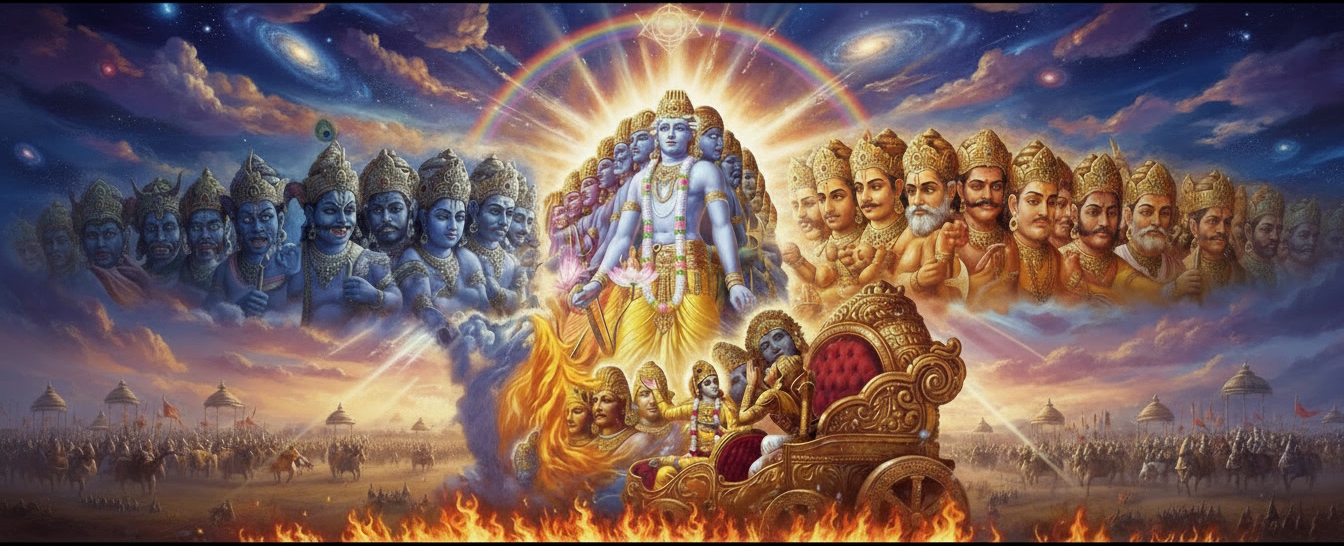
अन्तवत्तु फलं तेषां तद्भवत्यल्पमेधसाम्।
देवान्देवयजो यान्ति मद्भक्ता यान्ति मामपि।।7.23।।
antavattu phalaṃ teṣāṃ tadbhavatyalpamedhasām|
devāndevayajo yānti madbhaktā yānti māmapi||7.23||
Translation
Verily the reward (fruit) that accrues to those men of small intelligence is finite. The worshippers of the gods go to them, but My devotees come to Me.
हिंदी अनुवाद
परन्तु उन अल्पबुद्धिवाले मनुष्योंको उन देवताओंकी आराधनाका फल अन्तवाला (नाशवान्) ही मिलता है। देवताओंका पूजन करनेवाले देवताओंको प्राप्त होते हैं और मेरे भक्त मेरे ही प्राप्त होते हैं।
Commentaries & Translations
Swami Ramsukhdas
व्याख्या--'अन्तवत्तु फलं तेषां तद्भवत्यल्पमेधसाम्'--देवताओंकी उपासना करनेवाले अल्पबुद्धि-युक्त मनुष्योंको अन्तवाला अर्थात् सीमित और नाशवान् फल मिलता है। यहाँ शङ्का होती है कि भगवान्के द्वारा विधान किया हुआ फल तो नित्य ही होना चाहिये, फिर उनको अनित्य फल क्यों मिलता है? इसका समाधान यह है कि एक तो उनमें नाशवान् पदार्थोंकी कामना है और दूसरी बात, वे देवताओंको भगवान्से अलग मानते हैं। इसलिये उनको नाशवान् फल मिलता है। परन्तु उनको दो उपायोंसे अविनाशी फल मिल सकता है--एक तो वे कामना न रखकर (निष्कामभावसे) देवताओंकी उपासना करें तो उनको अविनाशी फल मिल जायगा और दूसरा, वे देवताओंको भगवान्से भिन्न न समझकर, अर्थात् भगवत्स्वरूप ही समझकर उनकी उपासना करें तो यदि कामना रह भी जायगी, तो भी समय पाकर उनको अविनाशी फल मिल सकता है अर्थात् भगवत्प्राप्ति हो सकती है।यहाँ 'तत्' कहनेका तात्पर्य है कि फल तो मेरा विधान किया हुआ ही मिलता है, पर कामना होनेसे वह नाशवान् हो जाता है।यहाँ 'अल्पमेधसाम्' कहनेका तात्पर्य है कि उनको नियम तो अधिक धारण करने पड़ते हैं तथा विधियाँ भी अधिक करनी पड़ती हैं, पर फल मिलता है सीमित और अन्तवाला। परन्तु मेरी आराधना करनेमें इतने नियमोंकी जरूरत नहीं है तथा उतनी विधियोंकी भी आवश्यकता नहीं है, पर फल मिलता है असीम और अनन्त। इस तरह देवताओंकी उपासनामें नियम हों अधिक, फल हो थोड़ा और हो जाय जन्म-मरणरूप बन्धन और मेरी आराधनामें नियम हों कम, फल हो अधिक और हो जाय कल्याण--ऐसा होनेपर भी वे उन देवताओंकी उपासनामें लगते हैं और मेरी उपासनामें नहीं लगते। इसलिये उनकी बुद्धि अल्प है, तुच्छ है।
Sri Harikrishnadas Goenka
क्योंकि वे कामी और अविवेकी पुरुष विनाशशील साधनकी चेष्टा करनेवाले होते हैं इसलिये उन अल्पबुद्धिवालोंका वह फल नाशवान् विनाशशील होता है। देवयाजी अर्थात् जो देवोंका पूजन करनेवाले हैं वे देवोंको पाते हैं और मेरे भक्त मुझको ही पाते हैं। अहो बड़े दुःखकी बात है कि इस प्रकार समानपरिश्रम होनेपर भी लोग अनन्त फलकी प्राप्ति के लिये केवल मुझ परमेश्वरकी ही शरणमें नहीं आते। इस प्रकार भगवान् करुणा प्रकट करते हैं।
Sri Anandgiri
He states the reason for the lack of beneficial nature of desires for one who acts with foresight with "Since" (yasmāt), etc. Moreover, those who are desirous are not discriminating; and therefore, since [desires] are preceded by non-discrimination, whence can there be any doubt of desires being beneficial?—He states this with "Indiscriminating" (avivekinaḥ). Anticipating the doubt that desires might be beneficial by yielding infinite results, he says "Therefore" (ataḥ). The meaning of the word "therefore" (ataḥ) is: because of their [efforts] being preceded by non-discrimination. The word "Tu" (indeed/but) is for emphasis.
If the fruit of desire is perishable, why are living beings devoted to desire? Anticipating this doubt, he says "because of dullness of intellect" with "Little" (alpa [referring to alpamedhasām]). What then is the means for the infinite fruit? Anticipating this, he says "Devotion to Me" with "My devotees" (madbhaktāḥ).
Having stated the literal meaning of the verse, he states the purport with "Thus" (evam). "And in the attainment of deities" is the remainder [to be supplied]. Regarding "Me alone" (māmeva), etc.—it should be stated that "they surrender to a specific deity for a finite fruit." Intending that there is no cause other than non-discrimination for acting contrary to what has been said, he says "Alas, indeed" (aho khalu).
Sri Dhanpati
Even though the effort is equal, they engage in the worship of those respective deities which accomplishes finite fruits, but do not surrender to Me, the Lord, the Self of all, the Bestower of fruits of respective actions, Vāsudeva, for the infinite fruit; "Alas, the smallness of their intellect!"—showing such compassion, He says "Finite" (antavat), etc.
"Of them"—of those intent on the worship of those respective deities, "of small intellect" (alpamedhasām): Based on the Śruti "Now, where one sees another, hears another, knows another, that is small (alpam)" (Chandogya 7.24.1), those whose medhā—intellect—is in the "small," i.e., in duality (dvaita); meaning those of divisive intellect. Or, those whose intellect is on the "small," i.e., the finite fruit. Or, those whose intellect is on the "small," i.e., the limited other deity. Or, those whose intellect is "very small" because of being unable to discriminate that "Vāsudeva alone is to be worshipped for the not-small, infinite fruit, and not another deity for a finite fruit."
That fruit is indeed "finite"—perishable—even though given by Me. He states that very thing: Because "the worshippers of gods" (devayajaḥ)—worshippers of Indra etc.—"go to the gods"—who are finite. But "My devotees" (madbhaktāḥ)—even the three types beginning with the distressed—having obtained their respective desired objects, gradually "go to"—attain—Me, Vāsudeva, the Mass of Existence-Knowledge-Bliss, the Infinite, denoted by the name Liberation (Mokṣa).
Sri Neelkanth
Of small intellect" (alpamedhasām)—According to the Śruti "Now, where one sees another, hears another, thinks of another, knows another, that is small (alpam)," duality is "small"; those whose intellect (medhā) is in that very thing [duality] are [of small intellect]. The meaning is: those who desire external objects.
That fruit of theirs is "finite" (antavat), because all external objects are indeed finite.
The word "Tu" (But) is to differentiate [them] from the devotees of the Lord [who see non-difference].
Since "worshippers of gods" (devayajaḥ)—those who sacrifice to gods—go to the gods, who are indeed possessed of an end (finite). Similarly, it should be observed that devotees of Yakshas and Rakshasas go to Yakshas etc., and devotees of ghosts and spirits go to ghosts etc.
But My devotees go to Me alone, the Infinite. Therefore, they are partakers of infinite fruit; this is the meaning.
Sri Ramanuja
For those of "small intellect" (alpamedhasām)—of little understanding—who sacrifice only to Indra and others, the fruit of that worship is very small and "finite" (antavat). Why? "The worshippers of gods go to the gods"—because those who sacrifice to them go to gods like Indra and others. Indeed, Indra and others possess limited enjoyments and exist for a limited time. Therefore, having attained union (sāyujya) with them, they fall [return to mortality] along with them.
But My devotees, knowing those very actions to be forms of worship of Me, renouncing attachment to limited fruits, and having My propitiation as their sole purpose, attain Me alone and do not return again. As will be stated: "But having attained Me, O Kaunteya, there is no rebirth" (Gita 8.16).
Others, however, render even My incarnation among men etc.—undertaken so that I may be accessible to all—ineffective; this He states [next].
Sri Sridhara Swami
Therefore, even though all deities are My forms alone, and thus worship of them is in reality worship of Me alone, and I am also the giver of those respective fruits; nevertheless, there is a difference in the fruit between those who are directly My devotees and them [devotees of other gods]; this He states with "But finite" (antavat tu).
For those of "small intellect"—of limited vision—that fruit, even though given by Me, is "finite"—perishable.
He states that very thing: "They sacrifice to gods," so they are "worshippers of gods" (devayajaḥ); they "go to the gods"—who are finite. But My devotees attain Me, the beginningless and endless Supreme Bliss.
Sri Vedantadeshikacharya Venkatanatha
"If by Your grace their fruit is also accomplished, then what is the distinction of Your worshippers from them?"—here the answer is "Antavattu" (But finite...) etc. Although forming one sentence was possible in the first half, to remove the delusion of sentence-split, the co-referentiality of "Tesham alpamedhasam" (Of those of small intelligence) is shown. "Tesham" (Of them)—this refers to the cause of the littleness of fruit; he says "Of those sacrificing to Indra etc. only." The cause there is small intelligence. Those whose "Medha"—intelligence—is in small Indra etc. and fruits dependent on them, they are "Alpamedhasah". Or, whose intelligence is small because of having small objects. Because of being 'Alpamedhas', the littleness of their fruit is also established—considering this, "Little and finite becomes" is said.
In "Devan devayajo" (Worshippers of gods to gods), the word 'Deva', by the logic of 'Go-balivarda' (Cattle and Bull - general and specific), refers to gods distinct from the Lord spoken of by the word 'Mam' (Me). Or, intending a specific class of gods subject to karma read along with humans etc., he says "Indra etc. gods, their sacrificers."
How is the attainment of Indra etc. the cause of the fruit being small and unstable? To this he says "Indradayo'pi hi" (For Indra etc. also). "Let them be of small enjoyment and unstable; what is that to their worshipper whose attainment of fruit depends on the Lord's grace?"—to this he says "Tatah" (Therefore). For to the sacrificers of mere Indra etc., the Lord grants that respective desired Sayujya (union/residence) etc. alone; and Sayujya means 'equal enjoyment'; therefore, since the enjoyment of Indra etc. is of limited nature and existing for limited time, the enjoyment of their worshipper, being equal to that, would also be of that kind; this is the purport.
Since the nature of the Lord designated by "Mam" (Me) is consisting of unsurpassable bliss, for one who has attained similarity with Him, 'unsurpassable enjoyment' is also established. And the Sutra is "And because of indications of equality in enjoyment only" (Brahma Sutra 4.4.21). And due to His eternality, he shows the eternality of His worshipper's enjoyment also—with "Na cha punarnivartante" (And they do not return again). He clarifies what is intended here by the statement to be spoken later—"Mamupetya" (Having attained Me). Here too the Sutra is "Non-return, because of scriptural word..." (Brahma Sutra 4.4.22).
In "My devotees come to Me also," the resting in Liberation even for those desiring other fruits from the Lord has been stated by Narayanarya: "Just as for devotees of other deities, the attainment of the desired object alone is the fruit; for devotees of the Lord, the fruit is not that much alone; but due to the destruction of sins which happens naturally and is unintended, by the opening up of excess of Sattva, by the production of faith in pure Dharmas, gradually through the attainment of Knowledge and Dispassion etc., due to the attainment of the previously mentioned specific Bhakti, even after a very long time, attainment of the Lord will happen—thus is the 'eternal-fruit-ness'; this is the intention."
And this is stated in Shandilya Samhita also in the section on offences against devotees: "Men who, aiming at the Lord, have Him as sole refuge; they never perish, even if engaged in desire-prompted actions."
Swami Chinmayananda
नाशवान् भोगों की इच्छा को पूर्ण करने के लिए मनुष्य जो कर्म करता है वह अनित्य होने से उसका फल भी क्षणभंगुर ही होता है। स्वर्ण से बने आभूषण स्वर्ण ही होंगे। कार्य का गुणधर्म पूर्णतया कारण पर निर्भर करता है।देशकाल से परिच्छिन्न कर्मों से प्राप्त फल अनित्य ही होगा चाहे वह सुख हो या दुख। सुख का अन्त दुख का प्रारम्भ है। अत जब कोई इच्छा पूर्ण हो जाती है तब यद्यपि क्षणमात्र के लिए सुख का आभास भी होता है परन्तु शीघ्र ही उसके समाप्त होने पर दुख का कटु अनुभव मनुष्य को होता है।भगवान् श्रीकृष्ण सामान्य नियम बताते हैं कि देवपूजक देवताओं को प्राप्त होते हैं। जिस नियम का जो अधिष्ठाता देवता है या जिस क्षेत्र में जो उत्पादन क्षमता है उसका आह्वान करने पर मनुष्य केवल उसी फल को प्राप्त कर सकता है।इसी प्रकार मेरे भक्त मुझे ही प्राप्त होते हैं। परिच्छिन्न भोगों के लिए मनुष्य इतना अधिक प्रयत्न करके अन्त में क्षणिक फल को ही प्राप्त करता है। यदि वही प्रयत्न वह दैवी जीवन जीने में करे तो उसे नित्य आनन्दस्वरूप की उपलब्धि हो सकती है। किन्तु मन की बहिर्मुखी प्रवृत्तियों के कारण वह अनात्म उपाधियों से तादात्म्य करके बाह्य वैषयिक जगत् में ही रमता है।विवेकी पुरुष विषयोपभोग की तुच्छता और व्यर्थता को पहचान कर उनसे विरक्त हो जाते हैं। विवेक और वैराग्य से सम्पन्न होकर जब वे आत्मस्वरूप का ध्यान करते हैं तब उन्हें परम आनन्दस्वरूप की वह अनुभूति होती है जो शरीर मन और बुद्धि तीनों के परे है नित्य है।गीता में भगवान् श्रीकृष्ण ने जो मैं शब्द का प्रयोग किया है वह उस अनन्त तत्त्व को सूचित करता है जो व्यष्टि और समष्टि का अधिष्ठान है। अत वे कहते हैं कि मेरे भक्त मुझे ही प्राप्त होते हैं तब उनका तात्पर्य ऐतिहासिक पुरुष देवकी पुत्र कृष्ण से नहीं वरन् चैतन्यस्वरूप पुरुष से होता है। इस दृष्टि से आत्मवित् आत्मस्वरूप ही बन जाता है। यही भगवान् श्रीकृष्ण के कथन का वास्तविक अभिप्राय है।तब क्या कारण है कि सामान्य जन आपको प्राप्त करने का प्रयत्न नहीं करता उत्तर है
Sri Abhinavgupta
[Commentary covering verses] from "By desires" (kāmaiḥ) up to "Me also" (māmapi).
Those, however, who possess minds limited by their own respective natures of desires—whether high or low—which are diverse; they, whose consciousness has been stolen by desires, worship a specific deity who is merely an "intermediate manifestation" (avāntara-tanu) of My very self, appropriate to that [desire]. Therefore, they receive the fruit of their desire from Me alone.
However, that [fruit] has an end, because it has been rendered limited by their own latent tendency (vāsanā). For this very reason, those performing sacrifices etc., with the intention of conceptualizing Indra and others, receive a fruit of that very [limited] kind.
But those intent on attaining Me, [attain] Me alone.
Sri Madhusudan Saraswati
Although all deities are indeed My forms—Me being the Self of all—and worship of them is in reality worship of Me alone, and I alone am the Inner Controller and the Bestower of fruits everywhere; nevertheless, there is a disparity in the fruit between My direct devotees and them, caused by discrimination and non-discrimination of the Reality. He states this:
"Of small intellect" (alpamedhasām)—meaning those who are incapable of discriminating the Reality due to dull understanding; for those devotees of respective deities, that fruit born of the worship of those respective deities, even though ordained by Me, is "finite" (antavat) indeed, meaning perishable indeed; their fruit is not infinite like that of My discriminating devotees; this is the meaning.
Why is this so? Because "worshippers of gods" (devayajaḥ)—those intent on worshipping deities other than Me—"go to the gods" (devān yānti)—like Indra and others, who are indeed finite.
However, My devotees—the three desirous types—first obtain their desired wishes through My grace. Due to the use of the word "also" (api), thereafter, through the maturation of worship of Me, they "attain" (yānti) Me "also" (api)—the Infinite, the Mass of Bliss, the Lord.
Therefore, even though being desirous is common to both, there is a great difference between My devotees and the devotees of other deities; hence, "All these are indeed noble" (7.18) was rightly stated.
Sri Purushottamji
Then, by the attainment of fruit created by You, there should indeed be excellence; how is that fruit not [excellent]? To this, He says "But finite" (antavat tu). "Tu" (But/Again)—the fruit for those of small intellect, even though created by Me, becomes "finite"—subject to destruction—because they are intent on desire, abandoning devotion; this is the meaning. By the word "that" (tat - implied contextually), it is suggested that the fruit is ordained by Me according to their intellect.
(Objection): The gods are also Your parts; why is there no excellent fruit in their worship? To this, He says "To the gods" (devān), etc. "God-worshippers" (devayajaḥ)... those who perform worship of gods for the sake of attaining their desired fruits in the manner described earlier. Or, those who worship them as gods, and not manifesting as My parts... Therefore, they "go to the gods"—in the absence of desire for union with Me, they attain them. And in the case of desire, they obtain only that [finite fruit]; this is the meaning. Those who worship other gods as gods attain union with them only. But in the case of [material] desire, they do not attain even that [union]. Therefore, worship of Me is excellent even with desire; this He states with "My devotees" (madbhaktāḥ).
My devotees—performers of My worship—go to "Me also" (mām api). Even if engaged with desire, in the manner described earlier, they attain Me also. That is why "All these are indeed noble" (7.18) was stated earlier. Therefore, later on, their liberation occurs. They attain union with the Imperishable (Akṣara) as well. Hence, in the Harivaṃśa [it is said]: "Progeny, wealth, wife, necklaces, palaces, horses, elephants, pleasures, as well as heaven and liberation are not far from devotion to Hari." This very thing is suggested by the word "also" (api).
Sri Shankaracharya
But that fruit of theirs, of those of "small intellect"—of little wisdom—is "finite," i.e., perishable.
"The worshippers of gods go to the gods"—meaning those who sacrifice to gods go to the gods. "My devotees go to Me also."
Thus, even though the effort is equal, they do not surrender to Me alone for the infinite fruit; "Alas! Indeed, they exist in misery"—thus the Lord shows compassion.
For what reason do they not surrender to Me alone? This is stated [next].
Sri Vallabhacharya
Therefore, due to the difference in attitude (bhāva), there is a difference in the fruit; this He states with "Finite" (antavat), etc. The word "Tu" (But) indicates the difference.
Because for those of "small intellect"—who sacrifice only to the parts (limbs) like Indra etc., like those who water only one among the branches, fruits, or leaves—their fruit is small and "finite" (perishable). And He says "The worshippers of gods go to the gods," etc.; [meaning] the attainment of union (sāyujya) with those respective deities is indeed what is to be obtained.
Regarding the Vedic sacrifice (Yāga), since the worship is performed with the knowledge that the gods are parts of the Lord, there is no contradiction.
But in Devotion (Bhakti), the worship of all occurs in the worship of the Whole (Aṅgī) alone; in this sense [Bhakti is superior], because He is the Root-form; this should be known. What need is there to say more? With the intention that "whoever worships whom with faith, [goes] to him alone," it is stated "My devotees go to Me also."
Swami Sivananda
अन्तवत् finite? तु verily? फलम् the fruit? तेषाम् of them? तत् that? भवति is? अल्पमेधसाम् those of small intelligence? देवान् to the gods? देवयजः the worshippers of the gods? यान्ति go to? मद्भक्ताः My devotees? यान्ति go to? माम् Me? अपि also.Commentary The exertion in the two kinds is the same and yet people do not attempt to worship the Supreme Being in order to attain the maximum benefits or the infinite reward (liberation or Moksha). The reward obtained by men of small understandng and petty intellect who worship the minor deities is small? perishable and temporary.Yajnas (Vedic rituals)? Homas (rituals in which oblations are offered into the sacred fire) and Tapas (penance) of various sorts can bestow only temporary rewards on the performer. Liberation from the wheel of transmigration alone will give everlasting bliss and eternal peace.Those who worship Indra and others are Sattvic devotees those who worship Yakshas and Rakshasas (demoniacal beings) are Rajasic devotees and those who worship the Bhutas and Pretas (discarnate spirits) are Tamasic devotees.The knowledge of those who worship the small deities is partial and incomplete. It cannot lead to liberation. (Cf.IX.25)
Swami Gambirananda
Since those non-discriminating men with desires are engaged in disciplines for limited results, therefore, tat phalam, that result; tesam, of theirs; alpamedhasam, who are of poor intellect, of poor wisdom; antavat tu bhavati, is limited, ephemeral, indeed. Deva-yajah, the worshippers of gods; yanti, go; devan, to the gods. Madbhaktah, My devotees; yanti, to; mam api, to Me alone.
'Thus, though the effort needed is the same, they do not resort to me alone for the unlimited result. Alas! they are surely in a pitiable condition.' In this manner the Lord expresses his compassion.
'Why do they not take refuge in Me alone?'
The answer is:
Swami Adidevananda
The men of 'small understanding' means those whose understanding is poor, who worship only Indra and other divinities. The fruit of their worship is small and finite. Why? The worshippers of divinities like Indra go to the divinities. And Indra and other divinities possess limited joy and live only for a limited time. So if they attain eality of enjoyment with them, they also fall down along with them in due course; but My devotees, knowing that their acts are of the nature of My worship, renouncing attachment for finite, fruits, reach Me, having for their purpose the pleasing of Me alone. That is, they never more return to Samsara. For Sri Krsna teaches later on: 'But on reaching Me there is no rirth, O Arjuna' (8.16).
Now Sri Krsna declares: 'But these others (i.e., who worship Indra etc.) regard as insignificant even My incarnations among men and other beings in order to make Myself easy for all to resort to.'