Bhagavad Gita - Chapter 8 - Shloka (Verse) 22
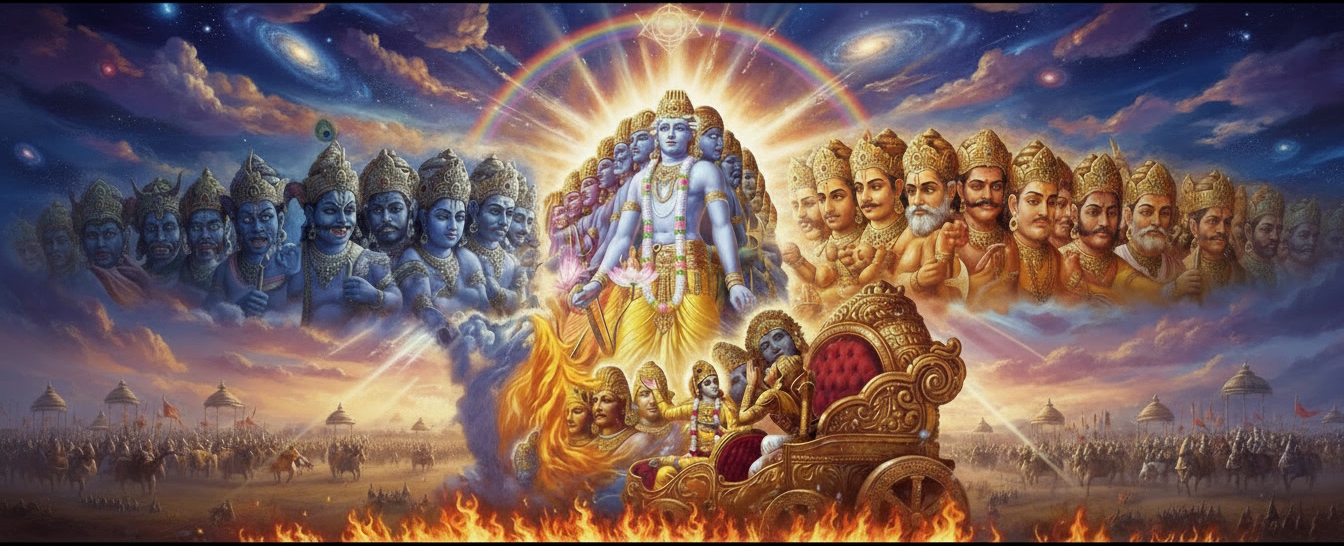
पुरुषः स परः पार्थ भक्त्या लभ्यस्त्वनन्यया।
यस्यान्तःस्थानि भूतानि येन सर्वमिदं ततम्।।8.22।।
puruṣaḥ sa paraḥ pārtha bhaktyā labhyastvananyayā|
yasyāntaḥsthāni bhūtāni yena sarvamidaṃ tatam||8.22||
Translation
That highest Purusha, O Arjuna, is attainable by unswerving devotion to Him alone within Whom all beings dwell and by Whom all this is pervaded.
हिंदी अनुवाद
हे पृथानन्दन अर्जुन ! सम्पूर्ण प्राणी जिसके अन्तर्गत हैं और जिससे यह सम्पूर्ण संसार व्याप्त है, वह परम पुरुष परमात्मा तो अनन्यभक्तिसे प्राप्त होनेयोग्य है।
Commentaries & Translations
Swami Ramsukhdas
व्याख्या--'यस्यान्तःस्थानि भूतानि येन सर्वमिदं ततम्'--सातवें अध्यायके बारहवें श्लोकमें भगवान्ने निषेधरूपसे कहा कि सात्त्विक, राजस और तामस भाव मेरेसे ही होते हैं, पर मैं उनमें और वे मेरेमें नहीं हैं। यहाँ भगवान् विधिरूपसे कहते हैं कि परमात्माके अन्तर्गत सम्पूर्ण प्राणी हैं और परमात्मा सम्पूर्ण संसारमें परिपूर्ण हैं। इसीको भगवान्ने नवें अध्यायके चौथे, पाँचवें और छठे श्लोकमें विधि और निषेध--दोनों रूपोंसे कहा है। तात्पर्य यह हुआ कि मेरे सिवाय किसीकी भी स्वतन्त्र सत्ता नहीं है। सब मेरेसे ही उत्पन्न होते हैं; मेरेमें ही स्थित रहते हैं और मेरेमें ही लीन होते हैं, अतः सब कुछ मैं ही हुआ।वे परमात्मा सर्वोपरि होनेपर भी सबमें व्याप्त हैं अर्थात् वे परमात्मा सब जगह हैं; सब समयमें हैं; सम्पूर्ण वस्तुओंमें हैं, सम्पूर्ण क्रियाओंमें हैं और सम्पूर्ण प्राणियोंमें हैं। जैसे सोनेसे बने हुए गहनोंमें पहले भी सोना ही था, गहनारूप बननेपर भी सोना ही रहा और गहनोंके नष्ट होनेपर भी सोना ही रहेगा। परन्तु सोनेसे बने गहनोंके नाम, रूप, आकृति, उपयोग, तौल मूल्य आदिपर दृष्टि रहनेसे सोनेकी तरफ दृष्टि नहीं जाती। ऐसे ही संसारके पहले भी परमात्मा थे, संसाररूपसे भी परमात्मा ही हैं और संसारका अन्त होनेपर भी परमात्मा ही रहेंगे। परन्तु संसारको पाञ्चभौतिक, ऊँच-नीच, बड़ा-छोटा, अनुकूल-प्रतिकूल आदि मान लेनेसे परमात्माकी तरफ दृष्टि नहीं जाती।
Sri Harikrishnadas Goenka
उस परमधामकी प्राप्तिका उपाय बतलाया जाता है --, शरीररूप पुरमें शयन करनेसे या सर्वत्र परिपूर्ण होनेसे परमात्माका नाम पुरुष है। हे पार्थ वह निरतिशय परमपुरुष जिससे पर ( सूक्ष्मश्रेष्ठ ) अन्य कुछ भी नहीं है जिस पुरुषके अन्तर्गत समस्त कार्यरूप भूत स्थित हैं -- क्योंकि कार्य कारणके अन्तर्वर्ती हुआ करता है -- और जिस पुरुषसे यह सारा संसार आकाशसे घट आदिकी भाँति व्याप्त है। ऐसा परमात्मा अनन्य भक्ितसे अर्थात् आत्मविषयक ज्ञानरूप भक्ितसे प्राप्त होने योग्य है।,
Sri Anandgiri
(Doubt:) "In the attainment of the Supreme Person, who is distinct from and superior to the Unmanifest, some extraordinary means must be sought, relying on which a thoughtful person engages and finds bliss." To this He says — "Of His attainment..." [referring to Shankara's intro].
He illustrates the two attributes of the Supreme Person — being the cause of all and being all-pervasive — with "Yasya" (In whom). He clarifies His unsurpassed nature with "Yasmāt" (Than whom...).
The word 'Tu' is for emphasis. 'Bhakti' means worship or service characterized by circumambulation, prostration, etc.; He excludes that [ritualistic bhakti here] — with "Knowledge..." [interpreting it as Knowledge-based devotion]. He states the distinctiveness of the said devotion regarding its object — with "Ananyayā" (exclusive/unswerving).
Who is that Person, devotion to whom is sufficient for His attainment? Raising this doubt, He explains the second half [of the verse] — with "Yasya" etc. In what manner do they stand within Him? To this He says — "For the effect..." [resides in the cause]. Relying on the Shruti text "He pervaded" (sa paryagāt), He explains — "Yena" (By whom).
Sri Dhanpati
He states the unfailing means for His attainment. "He, the Supreme Person" (Sa Paraḥ Puruṣaḥ) means the Highest of all; He is called Puruṣa because He rests in the city (puri) [of the body] or because He is Full (pūrṇa).
"By exclusive" (ananyayā) — meaning, that in which there is no other object; implying devotion directed towards the Self. "By devotion" (bhaktyā) means by the highest devotion characterized as Knowledge (jñāna-lakṣaṇā).
As it has been said: "He who sees the presence of the Lord in all beings [and the beings in the Self]... he is the highest among devotees." [And] "He who shows love, friendship, compassion, and indifference towards the Lord, His dependents, the ignorant, and the enemies [respectively], he is intermediate." [And] "He who engages in worship of Hari with faith only in the idol, and not in His devotees or others, he is considered a material (prākrita) devotee."
[Also] "Vasudeva is all — such a great soul is very rare." "He who worships another deity thinking 'He is other, I am other,' he does not know." Therefore, "That Supreme Person is I myself; there is nothing separate from the Self which is non-different from Him" — by such exclusive devotion He is "attainable" (labhyaḥ), i.e., can be realized.
(Objection:) "But He is always attained?" Raising this doubt, [the answer is:] Attainment is indeed of two kinds: attaining the unattained and attaining the attained. Among them, the attainment of the unattained is like gaining a village etc. through service to the king — this is the first. The attainment of the already attained — like finding a necklace (graiveyaka) [around one's own neck which was forgotten] through the words of a trustworthy person — is the second.
The latter attainment is intended here; with this intention, He accepts the premise [of the means].
"Of whom" (yasya) — of which Supreme Person; "inside" (antaḥ) — in the middle; "stand" (sthāni) — are situated; "beings" (bhūtāni) — meaning all beings which are products/effects; the meaning is that in which substratum they are superimposed (kalpita). For the superimposed object exists inside the substratum, not apart from it. "By whom" (yena) — by which Person; "all this world is pervaded" (tatam) — permeated by Existence and Consciousness/Illumination. "You too should strive to acquire Bhakti, which is the unfailing means of attaining Me; do not take shelter in confidence thinking 'I am the son of Pritha [Krishna's aunt], so I will attain the Lord even without Bhakti'" — implying this, He addresses him as "O Partha." Or, the address is to indicate: "Exclusive devotion towards Me is easily attainable for you."
Sri Madhavacharya
He states the supreme means — "Purusha," etc.
Sri Neelkanth
Thus having spoken of the Knowable Brahman non-different from the Inner Self; He says that the Cause of the World is to be worshipped, and is other than this (Imperishable)—with "Purushah" (The Person). The word "Tu" (Indeed/But) is to indicate distinction from the previous one.
O Partha, this one who by "Bhaktya"—by propitiation; meaning by worship. Of what kind? "Ananyaya" (Unswerving/Sole)—in which there is no other (object); meaning by (devotion) in the form of 'Grasping as I' (Aham-graha) without the distinction of worshipped and worshipper. He who is attainable by that devotion is "Parah" (Supreme/Higher)—other than the previously mentioned Akshara which is unseparated (?) and non-pervading (?); meaning the Causal Self.
Due to being 'attainable' itself, His being 'other' is also (established). For it is not logical to be the Self and also the Attainable (since Self is ever-attained).
He states His causality indeed—with "Yasya" (Of whom). In which Purusha all beings—Ether etc. and moving and unmoving—stand inside like a tree in a seed; and by whom all this is pervaded due to being the material cause; He is attainable by devotion—this is the construction.
Sri Ramanuja
"There is nothing else higher than Me... In Me all this is strung like clusters of gems on a string" (7.7); "Me, higher than these and imperishable" (7.13)—the One designated by such statements; inside Whom all beings stand; and by which Supreme Person all this is pervaded; that Supreme Person is attainable by unswerving devotion as stated in "With mind on nothing else, constantly" (8.14).
Now He states the 'Archiradi' path (path of light) common to the knower of the reality of the Self and the one devoted to the Supreme Person. For both, the Archiradi path is heard in the Shruti; and that is characterized by non-return.
As in the Panchagni-Vidya (Knowledge of Five Fires)—"Those who know thus, and those who in the forest worship faith and austerity; they go to the light (archis), from light to day" (Chandogya 5.10.1)—in such texts, for one gone by the Archiradi path, attainment of Supreme Brahman and non-return is stated: "He leads them to Brahman" (4.15.5), "Going by this, they do not return to this human cycle" (4.15.5)—thus.
And this गति-shruti (scripture on the path) "Those who know thus" is not regarding the attainment of the Self which is subsidiary to the Supreme Knowledge (Para-vidya) heard in the Prajapati-vakya etc.; because of the futility of the separate Shruti for Supreme Knowledge "And those who in the forest worship faith and austerity" (Chandogya 5.10.1).
And in the Panchagni-Vidya indeed—"In the fifth oblation waters come to be called Man" (Chandogya 5.9.1); "Those of good conduct, those of bad conduct" (5.10.7)—thus having stated the discrimination between Chit (Sentient) and Achit (Insentient) that the state of human etc. caused by merit and sin belongs to Waters alone mixed with other elements, and for the Self there is only contact/embrace; "Those who know thus," "They go to light," "They do not return to this human cycle"—thus regarding the Chit and Achit objects distinguished as 'to be abandoned' and 'to be attained', "Those who know thus go by Archiradi and do not return"—this is stated, so it is understood.
For the knower of the reality of the Self and the one devoted to the Supreme Person—due to the statement of attaining Brahman in "He leads them to Brahman" (Chandogya 4.15.5)—the Self-entity separated from Achit should be contemplated as having the sole essence of being subsidiary (Shesha) to Brahman, due to being of the nature of Brahman. And by the Tat-kratu logic, the state of having the sole essence of being subsidiary to the Supreme is also established by Shrutis like "Who standing in the Self... whose body is the Self" (Shatapatha Brahmana 14.6.5.5.30 / Brihadaranyaka 3.7.22).
Sri Sridhara Swami
And regarding His attainment, devotion is the proximate (internal) means; He states exactly what was said before — with "Purusha," etc.
And I, that Supreme Person, am attainable only by exclusive devotion — "unswerving" (ananyayā) meaning that for which there exists no other as a refuge — and not otherwise.
He explains His supremacy (paratvam) — Within whom, the Causal Being, the beings are situated. And by whom, the Causal Being, all this world is pervaded (tatam).
Sri Vedantadeshikacharya Venkatanatha
In the verse "Purushaḥ saḥ," because the word 'tu' (however/indeed) indicates a different meaning/result; because of the force of the phrase "by unswerving devotion"; because the word 'Purusha' is used for the Supreme Self based on reasons like "resting in the city" (puri-shayatva), "fullness" (purnatva), "prior existence" (purva-sadbhava), and "abundant giving" (puru-dana), and due to the abundance of scriptural usages like "The Thousand-headed Purusha"; and because of the qualification by the word 'Para' (Supreme) — this verse is intended to teach a fruit superior to the previously mentioned fruit [of Kaivalya]. With this intention, he says "Of the Knower" (jñāninaḥ).
"Distinct" (vibhaktam) — "by the discriminating ones" is to be supplied. Or, the meaning is "different/extraordinary."
Although things exist inside space (gagana) etc., space lacks [absolute] supremacy; to establish That [Supremacy of the Lord], the reference "Yasya" (in whom), made as if it were well-known, refers to the Supremacy mentioned before; he shows this with "Mattaḥ" (From Me/Than Me). The idea is that the restatement and the original statement have the same meaning.
To recall the Shruti text starting from "Beyond whom there is nothing..." up to "...by that Person all this is filled," it is said "And by whom" (yena cha) [the Supreme Person].
What is the nature of the exclusiveness of devotion? To this he says — "With a mind focused on no other" (ananyacetāḥ).
Swami Chinmayananda
हिन्दुओं के उपदेष्टा भगवान् श्रीकृष्ण यहाँ उस साधन मार्ग को बताते हैं जिसके द्वारा उस परम पुरुष को प्राप्त किया जा सकता है जिसे अव्यक्त अक्षर कहा गया था। वह साधन मार्ग है अनन्य भक्ति। परम पुरुष से भक्ति (निष्काम परम प्रेम) तभी वास्तविक और पूर्ण हो सकती है जब साधक भक्त स्वयं को शरीर मन और बुद्धि द्वारा अनुभूयमान जगत् से विरत और वियुक्त करना सीख लेता है। नित्य पारमार्थिक सत्य से प्रेम ही वह साधन है जिसके द्वारा मिथ्या वस्तु से वैराग्य होता है। प्रखर जिज्ञासा से अनुप्राणित हुई आत्मतत्त्व की खोज और फिर उसके साथ एकत्त्व की यह अनुभूति कि यह आत्मा मैं हूँ अनन्य भक्ति है जिसके विषय में यहाँ बताया गया है।ध्यानावस्थित मन के द्वारा जिस आत्मा की अनुभूति स्वस्वरूप के रूप में होती है उसे कोई परिच्छिन्न चेतन तत्त्व नहीं समझना चाहिए जो केवल एक व्यष्टि उपाधि में ही स्थित उसे चेतनता प्रदान कर रहा हो। यद्यपि आत्मा की खोज और अनुभव साधक अपने हृदय में करता है तथापि उसका ज्ञान यह होता है कि यह चैतन्य आत्मा सम्पूर्ण विश्व का अधिष्ठान है। इस हृदयस्थ आत्मा का जगदधिष्ठान सत्य ब्रह्म के साथ एकता का निर्देश भगवान् श्रीकृष्ण इस वाक्य में देते हैं कि जिसमें भूतमात्र स्थित है और जिससे यह सम्पूर्ण जगत् व्याप्त है वह पुरुष है।मिट्टी के बने सभी घट मिट्टी में ही स्थित होते हैं और उनके नाम रूपरंग और आकार विविध होते हुए भी एक ही मिट्टी उन सबमें व्याप्त होती है। सभी लहरें तरंगें फेन आदि समुद्र में ही स्थित होते हैं और समुद्र उन्हें व्याप्त किये रहता है। घटों के अन्तर्बाह्य उनका उपादान कारण (मूल स्वरूप) मिट्टी और लहरों में समुद्र होता है।शुद्ध चैतन्य स्वरूप ही वह सनातन सत्य है जिसमें अव्यक्त सृष्टि व्यक्त होती है। किसी वस्त्र पर धागे से बनाये गये चित्र का अधिष्ठान कपास है जिसके बिना वह चित्र नहीं बन सकता था। शुद्ध चैतन्य तत्त्व वासनाओं के विविध सांचों में ढलकर अविद्या से स्थूल रूप को प्राप्त होकर असंख्य नामरूपमय जगत् के रूप में प्रतीत होता है। तत्पश्चात् सर्वत्र सब लोग विषयों को देखकर आकर्षित होते हैं उनकी कामना करते हैं उन्हें प्राप्त करने के लिए संघर्ष करते हैं। जो पुरुष आत्मस्वरूप का साक्षात् अनुभव कर लेता है वह यह समझ लेता है कि इस नानाविध सृष्टि का एक ही अधिष्ठान है जिसके अज्ञान से ही इस जगत् का प्रत्यक्ष हो रहा है। जीव अज्ञान के वश इसे ही सत्य समझ कर संसार के मिथ्या दुःखों से पीड़ित रहता है व्यक्त से अव्यक्त को लौटने के दो विभिन्न मार्गों को बताने के पश्चात् अब भगवान् अगले प्रकरण में साधकों द्वारा प्राप्त किये जा सकने वाले दो विभिन्न लक्ष्यों के भिन्नभिन्न मार्गों का वर्णन करते हैं। कोई साधक उस लक्ष्य को प्राप्त होते हैं जहाँ से संसार का पुनरावर्तन होता है तथा अन्य लक्ष्य वह है जिसे प्राप्त कर पुनः संसार को नहीं लौटना पड़ता।वे दो मार्ग कौन से हैं भगवान् कहते हैं --
Sri Abhinavgupta
From all worlds there is return, but not having attained Me, the Supreme Lord—He clarifies this—from "Para" etc. up to "Pratishthitam".
The Vasudeva-principle is devoid of the calculation of Time of the stated kind. "Vyaktam" (Manifest)—pervading all; even being the Reality, it is "Avyaktam" (Unmanifest) due to being difficult to attain. And that it is attainable by devotion was stated before.
And this universe situated in That; which indeed is of imperishable nature, always being thus.
There, what is the meaning of the word "Punah" (Again) and the word "Avritti" (Return)? For that (return) depends on the interruption of that nature in between. And for Sri Parameshwara—who is Eternal, Transcendent to the Universe, Non-different from the Universe, the Foundation of the Universe, and whose nature is Supreme Consciousness and Independence—the attainment of that state (of return) [is not possible]; by which any interruption of nature at any time [could be imagined].
Therefore, it was rightly said "But having attained Me" (8.16).
Sri Jayatritha
Since the instrumentality of Bhakti for attaining the Lord was already stated with "Endowed with devotion" [Gita 8.10], is the subsequent statement [this verse] repetitive? To this he says — "Supreme" (parama).
Since it was mentioned there along with other means [like Yoga strength], giving rise to a doubt regarding its equality with them, He states the supremacy of Bhakti among means through this [verse].
And that [supremacy] is to be illuminated precisely by the repetition; this is the purport.
Sri Madhusudan Saraswati
Now, He states that Bhakti-yoga (the path of devotion) alone—which was previously mentioned in "He who remembers Me constantly with an exclusive mind... to him I am easily accessible"—is the means for attaining That; He says "He, the Supreme" (sa paraḥ), meaning the unsurpassed Person, the Supreme Self, is I Myself. He is attainable only by "exclusive" (ananyayā) devotion—meaning that in which there is no other object, which is characterized by love—and not otherwise.
In response to the expectation "Who is He?", He says — Inside which Person "stand" (antaḥsthāni) all beings, i.e., all effects/products. Because the effect resides within the cause. Therefore, by which Person all this aggregate of effects is "pervaded" (tatam).
[This is supported] by Shruti texts such as: "Beyond whom there is nothing else, smaller than whom or greater than whom there is nothing; who stands alone in the heaven, fixed like a tree; by that Person all this is filled" [Svetasvatara Up. 3.9]; "And whatever this entire world is seen or heard, pervading all that inside and outside, Narayana is established" [Mahanarayana Up.]; and "He pervaded, He is radiant..." [Isha Up. 8].
Sri Purushottamji
(Objection:) "How are You to be attained, attaining whose abode they do not return?" In response to this expectation, He says — "Purusha" etc. O Partha, My devotee! I, that Supreme Purushottama, am "attainable" (labhyaḥ) by "exclusive" (ananyayā) "devotion" (bhaktyā) — meaning devotion that takes sole refuge in Me regarding matters of this world and the next, and is devoid of knowledge other than Me — i.e., by affection (sneha).
What is He like? To this He says — "In whom" (yasya), etc. Inside whom "stand" (antassthāni) the beings — moving and non-moving, which are of the nature of instruments for [My] sport (ramana) — i.e., they stand within His essential nature. By whom all this visible world is "pervaded" (tatam).
Here the purport is: All worldly beings are not suitable for My sport because they are established in [ritualistic/worldly] conduct; therefore, having attained My Abode through knowledge etc., they merge right there and become liberated. The meaning is that by Him — who has manifested for the sake of sport — being the substratum of it, this world situated in Me appears pervaded and expanded.
Sri Shankaracharya
"Purusha" — because He rests in the city (puri) [of the body] or because of His fullness (pūrṇatva). That "Supreme" (paraḥ) one, O Partha, is unsurpassed; beyond which Person there is nothing. He is attainable indeed by devotion (bhakti) — which is characterized by knowledge, is exclusive (ananyayā), and is directed towards the Self.
Within which Person "stand" (antaḥsthāni) — i.e., stand in the middle — the "beings" (bhūtāni), i.e., effects/products; for the effect indeed resides within the cause. By which Person all this world is "pervaded" (tatam), just as pot-etc. are by space.
For the yogis currently under discussion — who have fixed their minds on Brahman through Om (Pranava) and are destined for liberation in due course of time (kālāntara-mukti) — the 'Northern Path' needs to be described for their attainment of Brahman. Therefore, "at which time" (yatra kāle), etc., is spoken to present the intended meaning. The mention of the 'Path of Return' is for the purpose of praising the other path [the Northern Path].
Sri Vallabhacharya
"Purushah sa parah" (He is the Supreme Person)—thus. By this, His own—the Perfect Bliss's—attainability by causeless devotion, being beyond the Imperishable (Akshara), is stated. By this, it is established that the followers of the path of Knowledge do not attain the Supreme Person (Purushottama).
He states the definition of the Supreme—"In whom beings stand inside"—meaning along with the Akshara (Imperishable). And this is clear in the episode of eating mud in Sri Gokuleshvara (Krishna). "By whom all this is pervaded" (18.46/8.22)—thus the Glory is limited yet all-pervading—in the Damodara Lila, "All this". Expanded in the Sutra Bhashya "But the inclusion of Akshara-ideas is due to commonality and nature of That, like in Aupasada, that is said" (Brahma Sutra 3.3.33).
And what was said by some (Ramanuja Acharyas) that "Earth etc. Prakriti and Jiva-bhuta (Prakriti) are the Abode/Body of the Lord"—that is stated incorrectly. Therefore, for the Jiva-bhuta, being His Abode/Body is indeed heard—"Whose body is Earth" (Brihadaranyaka 3.7.3), "Whose body is Atma" (Shatapatha 14.6.5.5)—thus. But 'Imperishability' (Aksharatva) is not possible for the Jiva-bhuta then (always?); because the Reality is established after Knowledge.
Therefore, we said that the 'Akshara'—which is beyond Jiva and is the cause of all causes—is also distinct. Since it is said in the Third (Canto) of Bhagavatam (11.40-41): "This Egg-sheath outside is fifty crore (yojanas) extensive; where (the earth) entered along with ten-times greater (layers) looks like an atom; and inside which other heaps of Eggs in crores are seen; That they call the Imperishable Brahman (Akshara Brahma), the cause of all causes. The Abode of Vishnu, Supreme, Direct, of the Great-souled Purusha"—thus.
The 'Purusha' who is a part of that Akshara is the Vairaja (Cosmic Person) identifying with the collective and individual; he is designated as "Become the Jiva in the world of Jivas" (15.7).
But Purushottama is other than these three, He Himself will say. And He—the Self of fruit of all means, beyond the world of Jivas, of the nature of Bliss—"This Self is not attainable by instruction, nor by intelligence, nor by much hearing" (Katha 1.2.23); but "Whom alone He chooses, by him He is attainable"—from this Shruti, He appears as attainable by Devotion graced by Himself. We shall demonstrate exactly that later.
Swami Sivananda
पुरुषः Purusha? सः that? परः highest? पार्थ O Partha? भक्त्या by devotion? लभ्यः is attainable? तु verily? अनन्यया without another object (unswerving)? यस्य of whom? अन्तःस्थानि dwelling within? भूतानि beings? येन by whom? सर्वम् all? इदम् this? ततम् pervaded.Commentary All the beings (effects) dwell within the Purusha (the Supreme Person? the cause) because every effect rests within its cause. Just as the effect? pot? rests within its cause? the clay? so also all beings and the worlds rest within their cause? the Purusha. Therefore the whole world is pervaded by the Purusha.Sri Sankara explains exclusive devotion as Jnana or knowledge of the Self.Purusha is so called because everything is filled by It (derived from the Sanskrit root pur which means to fill) or because It rests in the body of all (derived from the Sanskrit root pur). None is higher than It and so It is the Supreme Person. (Cf.IX.4XI.38XV.6and7)
Swami Gambirananda
O son of Prtha, sah, that; parah purusah, supreme, unsurpassable Person-(the word purusa) derived in the sense of 'residing in the heart' or 'all-pervasiveness'; that Person, compared to whom there is nothing superior-; yasya, in whom, in which Person; antahsthani, are included; bhutani, (all) the beings which are Its products-for a product remains inherent in its cause; and yena, by whom, by which Person; tatam, is pervaded; sarvam, all; idam, this, the Universe, as pot etc. are by space; is tu, indeed; labhyah, reached; through ananyaya, one-pointed; bhaktya, through devotion, characterized as Knowledge; ananyaya, which is one pointed, which relates to the Self.
The Northern Path meant for the attainment of Braman by the yogis under discussion, who have superimposed the idea of Brahman on the syllable Om and who are destined to get Liberation in due course, has to be stated. Hence, in order to present the intended idea the verse, '(O best of the Bharata dynasty) of that time৷৷.at which,' etc. is being recited. The description of the Path of Return (in verse 25) is by way of praising the other Path (of Departure, in verse 24):
Swami Adidevananda
That Supreme Person has been declared in such texts as 'There is nothing higher than Myself, O Arjuna. All this is strung on Me, as rows of gems are on a thread' (7.7), and 'Who am beyond them and immutable' (7.13) - He is the Supreme Person in whom all beings abide and by whom all this is pervaded. He is to be attained by undivided devotion as described in 'Whose mind is not in anything else' (8.14).
Now, Sri Krsna teaches the 'path of light,' described in the Srutis which is common to the knowers of the true nature of the self and to the persons who are devoted to the Supreme Person. The nature of this path is alified as one of 'non-return to Samsara.' In the case of a person journeying through the 'path of light,' as described in the text of the worship of Five Fires is as follows: 'So those who know It (i.e., the eternal nature of the individual self) thus, as taught in the Vidya of the Five Fires, and those too who worhip in the forest with faith and Tapas go to the deity ruling over the rays of light, and from there to the deity of the day' (Cha. U., 5.10.1). The attainment of the Supreme Brahman and the non-return to birth are declared with reference to those who go by the path of light, etc., by the teaching that 'He the Supreme Being leads them to Brahman ৷৷. Those who reach by this path do not return to the (wordly) life of man' (Cha. U., 4.15.5). This declaration of the goal in the text, 'Those who know it thus etc.,' is not with reference to the attainment of the Atman which constitutes ony the limb of the science of Brahman as taught in the beginning of Prajapati's teaching. For there will then arise purposelessness for the separate teaching of the same in regard to the principal science of the Supreme in the text. 'Those who are in the forest worship by means of faith and austerity etc.,' (Cha. U., 5.10.1).
It is taught in the Vidya (meditation) of Five Fires: 'Thus, indeed, in the fifth oblation the waters become Purusa' (Cha. U., 5.9.1) and 'Those with a balance of good Karmas ৷৷. and those with a balance of bad Karmas' (Ibid., 5.10.7). What is to be understood here is that the state of existence as men and other beings, which has its origin in good and evil Karmas, refer to the 'waters' which alone are mixed with other elements (i.e., to the body-mind); as for the self, there is only contact with them and not identification. Thus, is declared the difference between intelligent self and inanimate matter. Then, by the texts, 'Those who know this' (Ibid., 5.10.1), 'Those who go to the rays of light' (Ibid.), and 'They who proceed by it return not to the human condition here,' it is instructed that those who know this concerning the sentient and inanimate entities - the one to be attained and the other to be rejected , they jourey along the path described by the terms 'beginning with light and do not return to Samsara'. On account of the passage, 'He leads them to the Brahman' (Ibid., 4.15.5), which holds that the Brahman is attained by both the knower of real nature of the self and the devotees of the Supreme Person and also because of the axiom of 'results according to efforts' (Tat-kratu-nyaya), the entity self, separated from the inanimate matter, should be constantly meditated upon as having its sole joy in absolute subservience to the Supreme Brahman who is Its self. The self's nature of finding only joy consists in absolute subservience to the Surpeme Person. This is proved from the Srutis like 'He who dwells within the self ৷৷. whose body is the self' (Sa. Bra., 14.6.5.5.30).