Bhagavad Gita - Chapter 8 - Shloka (Verse) 8
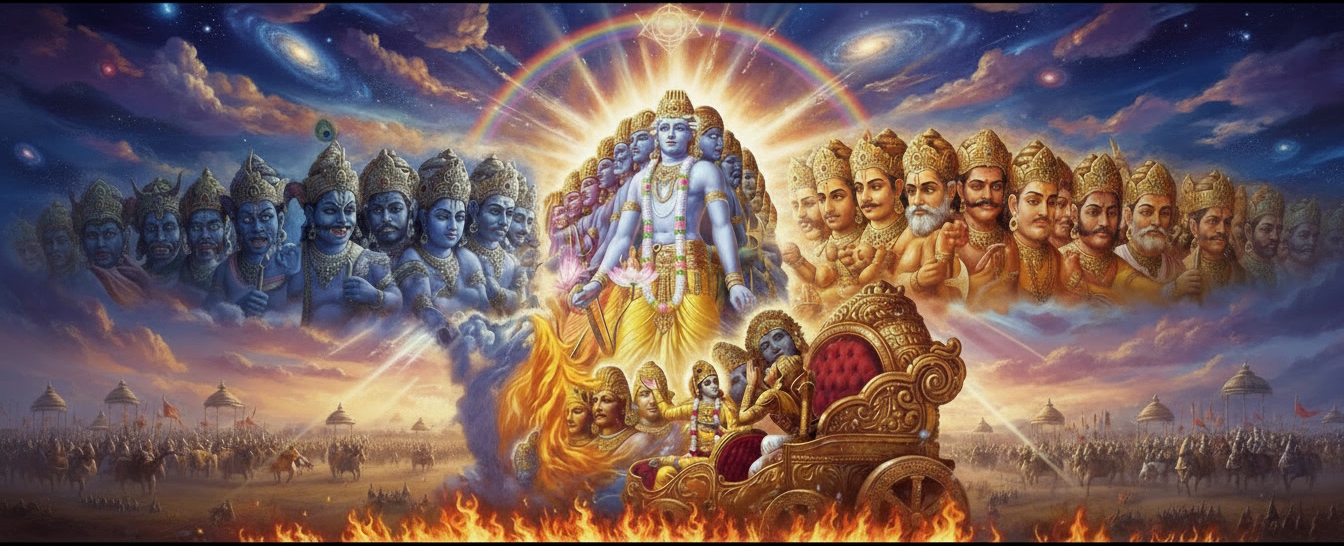
अभ्यासयोगयुक्तेन चेतसा नान्यगामिना।
परमं पुरुषं दिव्यं याति पार्थानुचिन्तयन्।।8.8।।
abhyāsayogayuktena cetasā nānyagāminā|
paramaṃ puruṣaṃ divyaṃ yāti pārthānucintayan||8.8||
Translation
With the mind not moving towards any other thing, made steadfast by the method of habitual meditation, and constantly meditating, one goes to the Supreme Person, the Resplendent, O Arjuna.
हिंदी अनुवाद
हे पृथानन्दन ! अभ्यासयोगसे युक्त और अन्यका चिन्तन न करनेवाले चित्तसे परम दिव्य पुरुषका चिन्तन करता हुआ (शरीर छोड़नेवाला मनुष्य) उसीको प्राप्त हो जाता है।
Commentaries & Translations
Swami Ramsukhdas
व्याख्या --[सातवें अध्यायके अट्ठाईसवें श्लोकमें जो सगुणनिराकार परमात्माका वर्णन हुआ था उसीको यहाँ आठवें नवें और दसवें श्लोकमें विस्तारसे कहा गया है।]
'अभ्यासयोगयुक्तेन'-- इस पदमें अभ्यास और योग -- ये दो शब्द आये हैं। संसारसे मन हटाकर परमात्मामें बारबार मन लगानेका नाम अभ्यास है और समताका नाम योग है-- 'समत्वं योग उच्यते' (गीता 2। 48)। अभ्यासमें मन लगनेसे प्रसन्नता होती है और मन न लगनेसे खिन्नता होती है। यह अभ्यास तो है पर अभ्यासयोग नहीं है। अभ्यासयोग तभी होगा जब प्रसन्नता और खिन्नता -- दोनों ही न हों। अगर चित्तमें प्रसन्नता और खिन्नता हो भी जायँ तो भी उनको महत्त्व न दे केवल अपने लक्ष्यको ही महत्त्व दे। अपने लक्ष्यपर दृढ़ रहना भी योग है। ऐसे योगसे युक्त चित्त हो।
Sri Harikrishnadas Goenka
तथा --, हे पार्थ अभ्यासयोगयुक्त अनन्यगामी चित्तद्वारा अर्थात् चित्तसमर्पणके आश्रयभूत मुझ एक परमात्मामें ही विजातीय प्रतीतियोंके व्यवधानसे रहित तुल्य प्रतीतिकी आवृत्तिका नाम अभ्यास है वह अभ्यास ही योग है ऐसे अभ्यासरूप योगसे युक्त उस एक ही आलम्बनमें लगा हुआ विषयान्तरमें न जानेवाला जो योगीका चित्त है उस चित्तद्वारा शास्त्र और आचार्यके उपदेशानुसार चिन्तन करता हुआ योगी परम निरतिशय -- दिव्य पुरुषको -- जो आकाशस्थ सूर्यमण्डलमें परम पुरुष है -- उसको प्राप्त होता है।
Sri Anandgiri
"For this reason also," one who practices the meaning stated in the previous verse attains the Lord at the time of the end—He states this with "Kincha" (Moreover). He analyzes "Abhyasa" (practice)—with "Mayi" (In Me) etc. (in the Bhashya).
Not considering that there exists any "real" object distinct from the Lord that could be the object of mental offering, he qualifies it—with "Chitta" etc.
[Objection:] "Even for a non-yogi, there may be a repetition of similar thoughts in the interval, even while dissimilar thoughts arise intermittently?" Anticipating this doubt, he says—"Vilakshana" (Extraordinary/Distinct).
He explains the state of the mind being engaged in the Yoga named "Abhyasa"—with "Tatraiva" (There alone). The Abhyasa-Yoga referred to by the instrumental case is also referred to by the locative. [Objection:] "But is not the mind of ordinary people like that?" Anticipating this, he qualifies it—with "Yoginaha" (Of the Yogi). "If that mind touches another object, then it would not be the cause of attaining the Supreme Goal?" Anticipating this, he says—"Nanyagamina" (Not going elsewhere).
To allow for accidental/inadvertent subjection to other objects, the suffix denoting "habit/nature" (tacchilya) is used; the meaning is: by that (mind) which does not intentionally touch other objects and is intent on the Supreme Person.
That very "unsurpassability" of the Purusha is His being untouched by all evils and being of unsurpassed bliss; and that has been explained earlier, it does not require explanation here.
Following the Shruti "He who is in the sun...", he says—"Divi" (In the divine realm/sun). Existence there means "special manifestation."
Contemplating on the described Person with the aforementioned mind, he "goes" (Yati) to Him alone—this is the connection. Regarding "Anuchintayan" (Contemplating/Thinking of), he explains the meaning of the word 'Anu' as—"Shastra" (following scripture). He explains 'Chintayan' as—"Dhyayan" (Meditating).
Sri Dhanpati
Moreover—In Me, Vasudeva, who am the sole object of the offering of the mind etc.; "Abhyasa" (Practice) is defined as the repetition of similar thoughts uninterrupted by dissimilar thoughts; and that itself is "Yoga," i.e., Samadhi; "Yuktam" (Endowed/Engaged) with that—meaning occupied in that alone. The meaning is: fully possessed by the activity of the repetition of thoughts.
With that "Cheta" (Mind)—of the Yogi. "Ananyagamina"—with that whose nature is not to go to another object; the purport is: with (the mind) that has attained "one-pointedness" (the state of not going elsewhere), which is the fruit of the Yoga of practice. "Paramam"—The Supreme (unsurpassed); "Purusham"—The Full/Perfect; "Divyam"—existing in the shining Sun. "Anudhyayan"—meditating in accordance with the instruction of the scripture and the teacher; he "Yati"—goes (attains).
"For the sake of attaining Me, with a mind engaged in the Yoga of practice regarding Me and not wandering to others, contemplate Me, the Supreme Divine Person, Vasudeva; for contemplation of Me is easy for you"—implying this, He says "He Partha" (O Partha).
Sri Madhavacharya
He clarifies the state of "being always habituated to that sentiment" (mentioned in the previous verse)—with "Abhyasa" etc.
"Abhyasa" (practice) itself is "Yoga"; hence "Abhyasa-yoga" (Yoga of practice).
"Divyam Purusham" (Divine Person) means "Puri-shayam" (resting in the city/body) and "Purnam" (Full/Complete). Based on the Shruti: "Verily, this Purusha is he who dwells in all bodies (cities); nothing is uncovered by him, nothing is enveloped by him" [Brihadaranyaka Up. 2.5.18].
"Divyam" means endowed with the sport (krida) of creation etc. From the root "Divu krida..." [Dhatupatha 4.1] (meaning 'div' is used in the sense of play).
Sri Neelkanth
He explains this very thing through three verses (starting 8.8)—'Abhyasa' etc. "Abhyasayogayuktena" (Endowed with the yoga of practice)—'Practice is the effort for stability there' (Yoga Sutra 1.13)—the practice thus aphorized; 'there' means the effort for the purpose of stabilizing the mind in the object of meditation. And that (practice) is of the nature of creating a flow of similar cognitions uninterrupted by dissimilar cognitions; that is 'Abhyasa' here.
There, the object to be meditated upon is 'Siddha' (accomplished/concrete), like the image of Vishnu etc. or the Virat etc. But 'Asiddha' (unaccomplished/abstract) is the mental image etc. There, regarding the 'Asiddha', a double effort has to be made due to the difference in the object: accomplishing the mind's taking the form of the image, and accomplishing stability there. But regarding the 'Siddha', there is only one effort for the sake of stabilizing the mind.
There, just as a naturally clear crystal becomes "Red Crystal" due to the coloring/proximity of a hibiscus flower—thus there is superimposition of redness there; due to the strength of that, when the cognition of crystal is lost there itself, there is superimposition of being a Ruby (Padmaraga); even in the Ruby, due to moonlight, there is superimposition of being a Sapphire (Indranila); there itself, at that very time, being situated at some distance, there is superimposition of being a worthless stone; thus by the sequence of successive superimpositions, the pure one crystal alone becomes fivefold. Similarly, the naturally pure Consciousness, due to the coloring of Maya, that itself becomes Ishvara; when Maya is strong, upon the loss of that very Ishvara-hood aspect, there itself is the superimposition of Sutratma; even in the Sutra, due to the firmness of ignorance, there is superimposition of Virat; from that itself, there is the delusion of Self-hood in the parts of Virat, i.e., bodies etc.
There, just as a lamp situated inside a pot illuminates only the pot; coming out through a hole in the pot, it illuminates some object like form etc. touched by its own light; but coming out of the pot completely, it illuminates the entire group of objects existing within the belly of the house. Similarly, the Consciousness situated inside the body illuminates only the body; being capable of going out through the holes of the body like eyes etc., it illuminates some object like form etc. near it; but when the pride of limitation caused by the body is abandoned completely by the method spoken by the Guru, becoming unlimited, it illuminates the entire Virat-Self. As stated in external texts (non-Vedic/Yogic texts) also—"Gem, fire, star, moon, sun etc. illuminate here only the little external object on earth. The Light within, risen from the dissolution of the innate, would illuminate even the three worlds by the sequence of subtle and gross distinctions." "Sahaja-laya-samuttham" (Risen from the dissolution of the innate)—'Sahaja' means natural pride of limitation caused by the body; risen merely from the dissolution of that. 'Gradually'—by the sequence of resolve (Sankalpa). Because everything is accomplished merely by the 'Seeing' (Ikshana/Will) of the Sat (Existence), and because before the Resolve, it was non-existent. And thus the Shruti (Chandogya 8.2.1): "If he becomes desirous of the world of fathers, by his mere resolve fathers arise." And from the Akshapada Sutra (Nyaya Sutra 4.2.2?): "Objects like form etc. are caused by defects, created by resolve." Defects are attachment etc.
So thus, when the Virat is shining, based on the authority of the scripture "He thinks 'I alone am all this', that is his supreme world" (Brihadaranyaka 4.3.20), the grasp of 'I' (Aham-graha) taken by the worshipper—although it is of the form of delusion relative to the absolute reality of the object—still, relative to the natural grasp of 'I' in the body, it is of the form of truth; just as in a crystal, the grasp of 'Sapphire-ness' relative to the grasp of 'worthless stone-ness', like that.
And just as the eye being focused on the crystal, with increasing sharpness successively, negating Sapphire-ness understands Ruby-ness, by negating that understands Red-Crystal-ness, and by negating that understands Pure-ness; similarly, the mind being focused on the Inner Self by the method spoken by the Guru, removing the outer and outer form of this, stays in the inner and inner (form). But having attained the final pure form, it dissolves by itself. As stated: "Abandon that by which you abandon." By which mind you abandon the Virat-state etc., abandon even that mind; this is the meaning.
So thus, regarding Virat, Sutra, and Antaryami which are 'accomplished' relative to worldly dealing, the effort for stabilizing the mind is 'Abhyasa'; the fruit of that is 'Yoga' i.e., Samadhi, the steadiness of the mind in the object of meditation alone; by the mind endowed with that quality. "Nanyagamina" (Not going elsewhere)—means Ananyagamin (going nowhere else). The compound is like "Naikadha" (Not one way/manifold). By that mind, the "Paramam"—Supreme/All-excellent—"Purusham"—from whom all defects are cast away. Because of the derivation: "Because He burnt (aushat) all sins 'Purva' (before) of all, therefore He is Purusha" (Brihadaranyaka 1.4.1). "Divyam"—shining; "Anuchintayan"—thinking continuously "I alone am the Lord, the Self of all, Vasudeva"—constantly meditating on the teacher's instruction; he goes to Him alone by the logic of river and ocean, O Partha. And thus the Shruti (Mundaka 3.2.8): "Just as flowing rivers go to rest in the ocean, abandoning name and form; so the wise one, shaking off merit and sin, attains the Divine Purusha higher than the high." "Parat"—than the Sutra; "Param"—the Antaryamin (Inner Controller).
Sri Ramanuja
Day after day, with a mind not going elsewhere due to being engaged in "Abhyasa" and "Yoga," thinking at the time of the end of Me, the Supreme Divine Person—in the manner to be described—he attains Me alone. Like the ancient Bharata attaining deer-hood (due to thinking of it at death), he becomes of a form similar to Me, characterized by opulence (Aishwarya).
"Abhyasa" (Practice) is the mental cultivation (samshilana) of the object of worship at all times that are not in conflict with obligatory (nitya) and occasional (naimittika) duties. "Yoga" is the worship (upasana) possessing the described characteristics, performed day after day at the specific time of Yoga.
Sri Sridhara Swami
Showing that "Abhyasa" (practice) is the internal (antaranga) means for continuous remembrance, He says—"Abhyasa" etc. "Abhyasa" is the continuous flow of similar thoughts (sajatiya-pratyaya-pravaha); that itself is "Yoga," the means.
Endowed with that—i.e., one-pointed—and therefore with a mind whose nature is not to go to another object; contemplating the "Divyam"—effulgent/illuminating—Supreme Person, the Supreme Lord; O Partha, he goes to Him alone.
Sri Vedantadeshikacharya Venkatanatha
Since "Worship" (Upasana) was introduced with "Anusmara" (Remember) [8.7] as the cause of the "final thought"—which arose in the context of the final thought—he says "Evam" (Thus), implying that the differentiation of the mode (of worship) is the meaning of the subsequent section. The "difference in path" (gati-bheda) to be described later should also be implied by this.
He states the meaning of the three verses beginning with "Abhyasa"—with "Tatra" (There/Among them). If the word "Yoga" meant mere connection, it would be purposeless (redundant); therefore, it is proper to interpret it here as "Meditation" (Dhyana). And since the Dvandva compound is acceptable because both terms retain their importance (unlike Tatpurusha), he says—"Abhyasayogabhyam" (By Abhyasa and Yoga).
"Nanyagamina" (Not going elsewhere)—this, like words such as "Naika" (not one), means "Ananyagamina" (going nowhere else). He whose nature is not to go elsewhere to another object is "Nanyagami."
Since "prior contemplation" has been stated by the words "Abhyasa-Yoga," to demonstrate that "Anuchintayan" (contemplating) refers to the "memory at the end," he says "Antakale" (At the time of the end).
The object (karma) of the thinking and meditation here is the Purusha alone, and since He is qualified by the word "Paramam" (Supreme), He is God (Ishvara) alone—with this intention, the two words beginning with "Mam" (Me...) are used.
Regarding "Divyam"—Shankara's statement that it means "situated in the solar orb" is baseless and contrary to what will be said later as "Sun-colored, beyond darkness" [8.9]; with this intention, he says—"Vakshyamanaprakaram" (Of the nature to be described). "By the subsequent two verses"—this is the remainder to be supplied.
[Question:] How is the "attainment of the Supreme Person"—which is not desired/sought after by the seeker of opulence (Aishvaryarthi)—stated as the fruit? To this, he says—"Adibharata..." (Ancient Bharata...) etc. Here, "attainment of the Supreme Person" means the attainment of opulence (Aishwarya) "similar" to the Supreme Person who is qualified by the form suitable for granting the enjoyment remembered at the time of the end. For the attainment of "similarity to that" was indeed cited as "attaining that" in the verse "Yam Yam" [8.6]; this is the purport.
"Repeated cultivation (samshilana) of the support (arambhana) is Abhyasa"—following this statement of the Vakyakara, he states the meaning of the word Abhyasa—with "Abhyasah" etc. By the phrase "repeatedly" (punah punah), interruption by some inevitable activities in between is indicated; with this intention, it is said—"Nityanaimittikaviruddheshu" (In times not opposed/contradictory to obligatory and occasional duties). "Sarveshu kaleshu" (At all times)—meaning not only at the time of Yoga, because the cultivation at that specific time is grasped by the word "Yoga"; this is the idea.
"Arambhanam" means Alambanam (Support), and that is explained here by the word "Upasya" (Object of worship). With the intention that the "essential nature of the primary limb" (angi-svarupa) is expressed by the word "Yoga," he says—"Yogastviti" (But Yoga is...). "Yathoktam" (As described - in Ramanuja's commentary) means attained to a state of being exceedingly dear and most vivid perception (vishadatama-pratyakshata).
Swami Chinmayananda
इस श्लोक में प्रयुक्त याति क्रियापद का अर्थ है जाता है। परन्तु यह परम पुरुष को जाना या प्राप्त होना मृत्यु के पश्चात् ही नहीं समझना चाहिए। मृत्यु से तात्पर्य अहंकार के नाश से है जिसका उपाय है ध्यानाभ्यास। इस श्लोक का प्रयोजन यह दर्शाना है कि परिच्छिन्न अहंकार के लुप्त होने पर कोई भी साधक मुक्त पुरुष के रूप में इसी जीवन में सदा स्वस्वरूप में स्थित रहकर जी सकता है।जो व्यक्ति जगत् में अस्थायी यात्री के रूप में और न कि स्थायी निवासी बनकर उपर्युक्त जीवन पद्धति के अनुसार जीता है और नित्यनिरन्तर आत्मचिन्तन का अभ्यास करता है वह निश्चय ही ध्यान में एकाग्र हो जाता है। वास्तव में यह वेदोपदिष्ट प्रार्थना और उपासना का तथा पुराणों में वर्णित भक्ति और प्रपत्ति (शरणागति) की साधनाओं का ही स्पष्टीकरण है जबकि पूर्व श्लोक में जो उपदेश है वह धर्म के व्यावहारिक स्वरूप का है अर्थात् अपने कार्यक्षेत्र में ही संन्यास के स्वरूप का है।इस अभ्यासयोग के फलस्वरूप भक्त को चित्त की एकाग्रता प्राप्त होती है जो बुद्धि को सुगठित करने में उपयोगी होती है। ऐसे अन्तःकरण के आत्म साक्षात्कार के योग्य हो जाने पर आत्मा की अनुभूति सहज सिद्ध हो जाती है। निरन्तर चिन्तन से हे पार्थ साधक परम दिव्य पुरुष को प्राप्त होता है। यह नियम न केवल परम पुरुष की प्राप्ति के विषय में सत्य प्रमाणित है वरन् किसी भी वस्तु के लिए यह समान रूप से लागू होता है। इससे इस श्लोक का गूढ़ार्थ स्पष्ट हो जाता है। यदि साधक सर्वसाधन सम्पन्न हो तो आत्मा का अनुभव तथा उसमें दृढ़ निष्ठा इसी वर्तमान जीवन में ही प्राप्त की जा सकती है।यहाँ प्रयुक्त अनुचिन्तयन् शब्द साभिप्राय है। ध्येयविषयक सजातीय वृत्ति प्रवाह को चिन्तन या ध्यान कहते हैं। अनु उपसर्ग का अर्थ है निरन्तर। अत यहाँ दिव्य पुरुष को निरन्तर चिन्तन करने का उपदेश दिया गया है।वह ध्येय पुरुष किन गुणों से विशिष्ट है भगवान् कहते हैं --
Sri Abhinavgupta
"Abhyasa" etc. "Anuchintayan" (Thinking/Contemplating) — meaning, after the breaking of the body (death), when the pain caused by the body has ceased, thinking of the Lord afterwards.
Sri Jayatritha
From where is this meaning derived? To this, implying that it is explained in this very way later, he says—"Sada" (Always...). To dispel the doubt of a Dvandva compound etc., he says—"Abhyasa eva" (Practice itself is Yoga). The purport is that there is no Yoga useful in the present context other than Practice.
To refute the perception that the Hiranyagarbha mentioned in the context of "Purushashchadhidaivatam" [8.4] is being spoken of here, he says "Divyam" (Divine). Due to the qualification "Divine," it means this is the Lord alone.
From the root 'pr' (to protect/fill) [Dhatupatha 3.4], by the injunction of the suffix 'kushan' via the rule "vidipuroshcha," the meaning "Full" (purnam) is also established. "Existing in all cities (bodies)"—restating this nature, the term "Purusha" is predicated. Its explanation is "Puri-shaya" (resting in the city) etc. "Avarana" (Covering) means internal pervasion. "Samvarana" means external covering.
[Objection:] "Divya" means "born in Div" (heaven/sky); and since he resides in the solar orb, he could be Hiranyagarbha? — thus says someone (Shankara). Therefore, he says—"Divyam." Here the suffix is 'yak' from the Unadi aphorisms. The purport is: because of the adjective "Paramam" (Supreme) [it cannot be Hiranyagarbha].
Sri Madhusudan Saraswati
Having thus answered all seven questions, He begins to explain the fruit characterized as "attainment of the Lord" resulting from the remembrance of the Lord at the time of departure — "Abhyasa" is the flow of similar thoughts uninterrupted by dissimilar thoughts, explained previously in the Sixth Chapter; that itself is "Yoga," i.e., Samadhi; "Yuktam" with that, meaning engaged in that alone, the mind which is devoid of mental modifications other than the form of the Self; with that "Chetas" (mind), which due to skill in practice is "Nanyagamina"—meaning whose nature is not to go elsewhere to other objects even without the effort of restraint—he
"Yati" (goes/attains) the "Paramam" (Supreme/Unsurpassed), "Purusham" (Full/Perfect), "Divyam" (Divine)—existing in "Divi," the illuminating Sun—according to the Shruti "He who is in the Sun."
O Partha, "Anuchintayan"—meditating in accordance with (anu) the instruction of scripture and the teacher.
Sri Purushottamji
Now, your attainment of Me is undoubted because you have been instructed directly by Me; but He states that even those who remember Me with exclusive feeling, even without My direct command (?), attain Me—with "Abhyasa" etc.
O Partha, My devotee! "Abhyasa" is the constant cultivation of attachment to the Lord; that itself is "Yoga," the means; with a mind endowed with that and "Nanyagamina"—meaning free from the fault of fickleness born of the knowledge of excellence elsewhere; "Anuchintayan"—contemplating the "Divyam" i.e., playful (kridatmakam), "Paramam Purusham" i.e., the state of Purushottama—thinking/remembering after (anu) the remembrance created (initiated) by the Lord; O Partha, he attains Him alone; this is the meaning.
By the address "Partha," due to the relationship with Pritha (Kunti), it is indicated: "Just as you attain Me through remembrance following the remembrance created by Me."
Sri Shankaracharya
Abhyasayogayuktena—"Abhyasa" (Practice) is characterized by the repetition of similar thoughts regarding Me, the single object to whom the mind is offered, uninterrupted by dissimilar thoughts. And that practice itself is "Yoga." "Yuktam" with that—meaning the Yogi's mind engaged in that alone. With that "Chetas" (mind) which is "Nanyagami"—meaning whose nature is not to go elsewhere to another object; hence "Nanyagami" (not wandering). With that one-pointed mind, "Anuchintayan"—contemplating in accordance with the instruction of the scripture and the teacher—he "Yati" (goes/attains) the "Paramam" (Supreme/Unsurpassed) "Purusham" (Person), the "Divyam" (Divine)—existing in "Divi," the Solar Orb; O Partha.
What specific Person does he attain? This is stated—
Sri Vallabhacharya
Having thus determined the answers to the seven questions, He states the fruit consisting of the attainment of the respective forms for Yogis, Jnanis, and Bhaktas at the time of departure—with "Abhyasayoga..." etc.
"Anuchintayan" (Contemplating) with a "Nanyagami" mind—one not going to sense-objects etc. (or Akshara etc.)—he attains the "Paramam Purusham"—Narayana—who is "Divyam," i.e., situated in the Sun. He qualifies Him further—with "Kavim" (The Seer) etc.
The Yogi who fully remembers the Supreme Self, the presiding deity of the boundaries of creation (Sarga-maryada), who is "Subtler than the subtle." "Anoh"—subtler even than the Jiva, based on the sentence "One should meditate on the atomic particle of life (Jiva-kala)." "Adityavarnam" means of the nature of self-luminosity; or the form residing within that (Sun); or the form of Vayu; or the nature propounded by the Purusha Sukta. Who is "Parastat" (beyond/superior) to "Tamas," i.e., Prakriti.
Swami Sivananda
अभ्यासयोगयुक्तेन (with the mind made) steadfast by the method of habitual meditation? चेतसा with the mind? न not? अन्यगामिना moving towards any other thing? परमम् Supreme? पुरुषम् Purusha? दिव्यम् the resplendent? याति goes? पार्थ O Partha? अनुचिन्तयन् meditating.Commentary Abhyasa means practice. Practice is the constant repetition of one idea of God. In the practice of meditation Vijatiya Vrittis (worldly thoughts or thoughts of a type different from the object of meditation) are shut out and there is Sajatiya Vrittipravaha (continous flow of thoughts of the Self or the Absolute alone). This is Abhyasa. Abhyasa is Yoga. This will terminate in Nirvikalpa Samadhi. The Yogi with Samahita Chitta (eanimity of mind) attains Paramatman or the Supreme Soul. Just as the rivers abandoning their names and forms because one with the ocean? so also the sage or the Vidvan? being liberated from names and forms? and virtue and vice? becomes identical with the Supreme Self.The most vital factor in this practice is regularity. Be regular in your meditation. You will soon reach the goal.Purusham Divyam The resplendent? transcendental Being or the Inner Ruler (Antaryamin) in the solar orb.He who meditates constantly without allowing the mind to wander among the sensual objects? in accordance with the instructions of the scriptures and the perceptor reaches the Supreme Purusha.
Swami Gambirananda
Partha, O son of Prtha; anu-cintayan, by meditating, i.e. contemplating in accordance with (anu) the instruction of teachers and scriptures; cestasa, with a mind; abhyasa-yogayuktena, engaged in the yoga of practice-abhyasa, practice, consists in the repetition of the same kind of thought, uninterupted by any contrary idea, with regard to Me who am the object of concentration of the mind; that practice itself is yoga; the mind of a yogi is engrossed (yuktam) in that itself; with a mind that is such, and na anya-gamina, which does not stray away to anything else which is not inclined to go away to any other object; yati, one reaches; the paramam, supreme, unsurpassed; purusam, Person; divyam, existing in the effulgent region (divi), in the Solar Orb.
And, to what kind of a Person does he go? This is being stated:
Swami Adidevananda
Contemplating on Me, the Supreme Divine Person, in the way to be specified further, at the last moment, with a mind trained by constant practice and Yoga, and not moving towards anything else, one reaches Me alone, i.e., attains a form similar to that of Mine, by virtue of the attributes of enjoyment and the prosperity contemplated upon, like the royal sage Bharata who acired the form of a deer on account of contemplating on it at the last moment. Abhyasa is the training of the mind to be often in touch with the object of meditation at all times without obstruction to the performance of the prescribed periodical and occasional rituals. Yoga is the meditation practised day by day at the time of Yoga practice in the manner prescribed.