Bhagavad Gita - Chapter 9 - Shloka (Verse) 1
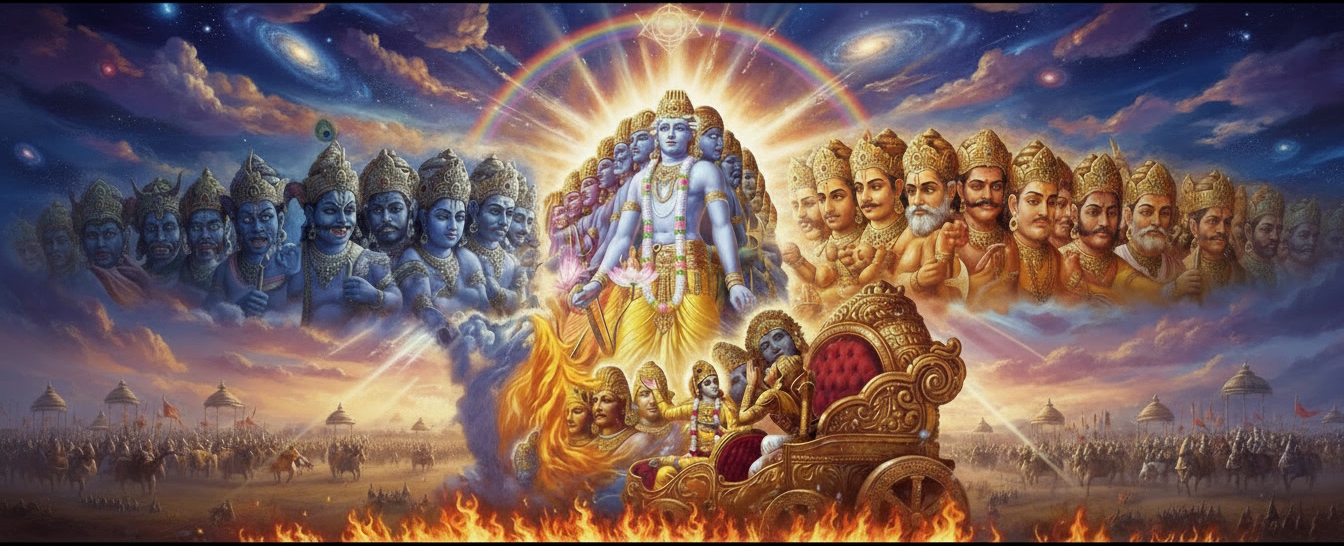
श्री भगवानुवाच इदं तु ते गुह्यतमं प्रवक्ष्याम्यनसूयवे।
ज्ञानं विज्ञानसहितं यज्ज्ञात्वा मोक्ष्यसेऽशुभात्।।9.1।।
śrī bhagavānuvāca
idaṃ tu te guhyatamaṃ pravakṣyāmyanasūyave|
jñānaṃ vijñānasahitaṃ yajjñātvā mokṣyase'śubhāt||9.1||
Translation
The Blessed Lord said I shall now declare to thee who does not cavil, the greatest secret, the knowledge combined with experience (Self-realisation). Having known this thou shalt be free evil.
हिंदी अनुवाद
श्रीभगवान् बोले -- यह अत्यन्त गोपनीय विज्ञानसहित ज्ञान दोषदृष्टिरहित तेरे लिये तो मैं फिर अच्छी तरहसे कहूँगा, जिसको जानकर तू अशुभसे अर्थात् जन्म-मरणरूप संसारसे मुक्त हो जायगा।
Commentaries & Translations
Swami Ramsukhdas
व्याख्या--इदं तु ते गुह्यतमं प्रवक्ष्याम्यनसूयवे--भगवान्के मनमें जिस तत्त्वको, विषयको कहनेकी इच्छा है, उसकी तरफ लक्ष्य करानेके लिये ही यहाँ भगवान् सबसे पहले 'इदम्' (यह) शब्दका प्रयोग करते हैं। उस (भगवान्के मन-बुद्धिमें स्थित) तत्त्वकी महिमा कहनेके लिये ही उसको 'गुह्यतमम्' कहा है अर्थात् वह तत्त्व अत्यन्त गोपनीय है। इसीको आगेके श्लोकमें 'राजगुह्यम्' और अठारहवें अध्यायके चौंसठवें श्लोकमें 'सर्वगुह्यतमम्' कहा है।
यहाँ पहले 'गुह्यतमम्'कहकर पीछे (गीता 9। 34 में) 'मन्मना भव' ৷৷. कहा है और अठारहवें अध्यायमें पहले 'सर्वगुह्यतमम्' कहकर पीछे (गीता 18। 65 में) 'मन्मना भव' ৷৷. कहा है। तात्पर्य है कि यहाँका और वहाँका विषय एक ही है, दो नहीं।
Sri Harikrishnadas Goenka
वहाँ (यह शङ्का होती है कि ) क्या इस प्रकार साधन करनेसे ही मोक्षप्राप्तिरूप फल मिलता है अन्य किसी प्रकारसे नहीं मिलता इस शङ्काको निवृत्त करनेकी इच्छासे श्रीभगवान् बोले --, जो ब्रह्मज्ञान आगे कहा जायगा और जो कि पूर्वके अध्यायोंमें भी कहा जा चुका है? उसको बुद्धिके सामने रखकर यहाँ इदम् शब्दका प्रयोग किया है। तु शब्द अन्यान्य ज्ञानोंसे इसे अलग करके विशेषतासे लक्ष्य करानेके लिये है। यही यथार्थ ज्ञान साक्षात् मोक्षप्राप्तिका साधन है। जो कि सब कुछ वासुदेव ही है आत्मा ही यह समस्त जगत् है ब्रह्म अद्वितीय एक ही है इत्यादि श्रुतिस्मृतियोंसे दिखलाया गया है? ( इसके अतिरिक्त ) और कोई ( मोक्षका साधन ) नहीं है। जो इससे विपरीत जानते हैं वे अपनेसे भिन्न अपना स्वामी माननेवाले मनुष्य विनाशशील लोकोंको प्राप्त होते हैं इत्यादि श्रुतियोंसे भी यही सिद्ध होता है। तुझ असूयारहित भक्तसे मैं यह अति गोपनीय विषय कहूँगा। वह क्या है ज्ञान। कैसा ज्ञान विज्ञानसहित अर्थात् अनुभवसहित ज्ञान। जिस ज्ञानको जानकर अर्थात् पाकर तू संसाररूप बन्धनसे मुक्त हो जायगा।
Sri Anandgiri
To state that the coming chapter is not a repetition of the past one (agatarthata), he restates what has passed—'Ashtama' etc. 'Nadi' implies the Sushumna Nadi. 'Dharanayoga' is Yoga endowed with the limb called Dharana (concentration). 'Saguna' means endowed with qualities like the restraint of all gates (senses); this is the meaning.
Anticipating that the commencement of the subsequent chapter is to state the fruit of that (Yoga), he says 'Tasya cha' etc. Through the path of Devayana characterized by the sequence implied by 'fire, light', etc.—this is the view. Anticipating the objection that since the stated fruit is obtained immediately after knowledge, what is the need for this path? he says 'Kalantare' etc. (meaning liberation is in another time via the path).
If attainment of Brahman is through the path of light (Archiradi), liberation would become dependent on the path, and there would be a contradiction with Shruti texts like 'His pranas do not depart' (Brihadaranyaka 4.4.6); with this intention, a doubt is raised—'Tatra' etc. 'Vrittorthah' refers to the meaning of the Seventh Chapter. To remove the stated doubt, he introduces the subsequent chapter—'Tadashanka' etc.
Even though it is not immediate (aparoksha) due to not being physically present, Brahma-jnana (knowledge of Brahman) is grasped by the word 'Idam' (this) because it is present in the intellect due to the consideration of the preceding and succeeding texts; thus he says 'Tadbuddhau' etc. The word 'Tu' indicates the distinctiveness of this knowledge from the ignorance under discussion; thus he says 'Tushabda' etc. He clarifies the meaning of the particle itself—'Idameva' etc.
He shows Shruti and Smriti texts as corroborative evidence for that meaning—'Vasudeva' etc.
Anticipating that just like non-dual knowledge, dualistic knowledge might also be a cause for liberation for some, he says 'Nanyat' etc. He cites Shruti to show that dualistic knowledge is not capable of leading to liberation—'Atha' etc.
The word 'Atha' is for the commencement of the section on ignorance (Avidya). 'Atah' means otherwise than non-duality. Meaning, as distinct/different. 'Viduh' (they know)—here 'tattvam' (reality) is implied/remaining. Since duality is inexplicable and thus imagined, knowledge of it is equal to the knowledge of a snake in a rope and thus is not a cause for attaining welfare (liberation); this is the meaning of the particle 'cha'.
'Asuya' is the invention/discovery of faults in qualities; to one who is free from that. Meaning, to one qualified for knowledge.
'Jnana' is Brahman-Consciousness or valid knowledge regarding It; anticipating the impropriety of it being qualified by itself, he explains—'Anubhava' etc. 'Vijnana' means experience, i.e., direct realization; combined with that, is the meaning.
Anticipating what will happen to one who attains the said knowledge, he says 'Yajjnanam' etc.
Sri Dhanpati
In the eighth chapter, it was said that they attain liberation characterized by non-return through the path of Devayana. Dispelling the doubt that liberation is attained only in that manner and not otherwise, the Lord said—'Idam' etc. Having brought into presence in the intellect the Brahma-jnana (knowledge of Brahman) spoken of in the previous chapters and to be spoken of, 'Idam' (This) is uttered. The word 'Tu' is to indicate the distinction of Knowledge (Jnana) from Meditation (Dhyana). Because Knowledge accompanied by realization (Vijnana) is the direct means to liberation. The connection is: 'I shall speak this knowledge to you'.
And that is the knowledge of the Supreme Self as non-different from the inner Self, as stated in Shruti and Smriti texts like 'Vasudeva is all', 'The Self alone is all this', 'I am Brahman', 'All this is indeed Brahman', 'One only without a second', 'There is no diversity here', 'He goes from death to death who sees diversity here'. It is accompanied by, i.e., united with, Vijnana (experience/realization) and is 'Guhyatamam' (most secret). The meaning is this: Knowledge of Dharma is 'Guhya' (secret); knowledge of the object of worship (Upasya) is 'Guhyatara' (more secret); knowledge of the Indivisible Reality is 'Guhyatama' (most secret/highly confidential).
Objection: Why do you speak the most secret thing? Answer: Being won over by your quality of non-envy (Anasuya), I shall speak; thus He says 'Anasuyave'. Asuya is the invention of faults in virtues. Since the knowledge of the Supreme Self, which is the direct means to liberation, is opposed to the enjoyment of objects in various worlds, seeing faults in that Tattva-jnana (knowledge of Reality) which is the means to the supreme goal of human life—to one free from that. Or, 'He always praises Himself before me by proclaiming His own opulence'—envy of this form; as per the Bhashya: 'Abhyasuyati' means imputing faults like self-praise and not tolerating it due to not knowing His Lordship.
Knowing—meaning attaining—which knowledge distinguished by the stated attributes, you will be liberated from 'ashubhat'—from the bondage of Samsara. You will be free; this is the meaning.
As for what some say—'This "Idam" refers to the knowable (Jneya) knowledge to be spoken of, distinct from the object of meditation (Dhyeya) of the previous (chapter) by the word "tu"; Brahman which is of the nature of pure Consciousness accompanied by Vijnana i.e., experience, and not merely by indirect knowledge; knowing which knowledge and realizing it...' etc.—that is to be disregarded. Because the contradiction is clear with the root text 'accompanied by Vijnana', 'King of sciences, King of secrets', 'Men without faith in this Dharma, O Scorcher of foes', and with the Bhashya 'This Brahma-jnana is the King of sciences because of excessive brilliance; indeed this Brahma-vidya shines excessively', 'of Self-knowledge', 'of this Dharma'. This is the direction.
Sri Madhavacharya
Salutations to Sri Ranganatha.
He clarifies in this chapter what was stated in the seventh chapter.
Sri Neelkanth
In the previous chapter, regarding the seven questions beginning with 'What is that Brahman?', brief explanations were given starting with 'The Imperishable is the Supreme Brahman'. When the need for a distinct purpose for that knowledge arose, the division of goal (prapya) and means (prapaka) was shown by determining that the place for the knower of Karma is Adhibhautika and attainable by the path of smoke etc. By that, 'Karma' and 'Adhibhuta' were explained. Similarly, it was stated that the worshipper of the Sutra and Antaryamin attains the place of gradual liberation (Krama-mukti) through the path of light (Archiradi); by that, 'Adhidaiva' and 'Adhiyajna' were explained. With 'Om ity ekaksharam' etc., the answer to 'How are You to be known at the time of death?' was explained. Thus, the Dhyeya-Brahmavidya (knowledge of Brahman as object of meditation) along with its limbs was described.
The remaining first two questions regarding the Jneya-Brahma (Brahman as object of knowledge)—'What is that Brahman?' and 'What is Adhyatma?'—to explain them, the ninth chapter is commenced.
To state the distinction that liberation is not only in another time attainable by the path of Archiradi, but that there is Sadyomukti (immediate liberation) right here, the Lord said—'Idam tu te' etc. 'Idam'—this knowable (Jneya) which is to be spoken of, distinct from the object of meditation (Dhyeya) of the previous chapter by 'tu'—I shall speak to 'te' (you), which is 'guhyatamam' (most secret). 'Anasuyave'—to one free from asuya, which is finding faults in virtues.
'Jnanam'—Brahman which is of the nature of pure Consciousness. 'Vijnanena'—accompanied by experience (realization), and not merely by indirect knowledge. Knowing which knowledge—realizing it—you will be liberated from 'ashubhat', i.e., Samsara.
Here, the promise made at the beginning of the seventh chapter 'I shall declare to you this knowledge along with realization in full'; and for the realization of which the Brahman as the cause of the world was described there itself as an indicator (upalakshana) using the logic of the bough and the moon (shakha-chandra-nyaya); and for obtaining eligibility for the realization of which the worship of the same Saguna (Qualified Brahman) was stated (in Ch 8)—that very Brahman which is the ultimate remainder/essence (Sarva-sheshi-bhuta) is to be spoken of here; thus He makes the same promise that direct knowledge arises here merely by the words. And that has been established there itself; it should not be forgotten.
Sri Ramanuja
The Lord said — This most secret knowledge, which is of the nature of Bhakti (devotion) and is called meditation (Upasana), accompanied by Vijnana—meaning accompanied by the specific knowledge of the procedure/mode of meditation—I shall declare to you who are free from envy (Anasuya).
Meaning: I shall speak to you who, upon hearing My greatness which is distinct from all else and of unlimited modes, believe 'It is indeed possible like this'.
Knowing which knowledge up to the point of practice, you will be liberated from all 'evil' (ashubha) that is opposed to the attainment of Me.
Sri Sridhara Swami
In the eighth chapter, it was established that the Supreme Lord is attained by pure devotion. In the ninth, His most wonderful opulence is expanded upon. (1)
Thus, having stated in the seventh and eighth chapters that His own Supreme Truth is easily attainable only through devotion and not otherwise, now wishing to expound on His own inconceivable opulence and the extraordinary power of devotion, the Lord said—'Idam tu' etc.
'That by which it is known specifically' is Vijnana, i.e., Upasana (worship); accompanied by that, this knowledge regarding the Lord, I shall speak to you, 'Anasuyave'—to you who are free from fault-finding in Me, the supremely compassionate one, such as thinking 'He teaches His own greatness again and again'.
The word 'Tu' is for distinction/excellence. He states that very thing with 'Guhyatamam' etc. Knowledge of Dharma is 'Guhya' (secret); knowledge of the Self as distinct from the body etc. is 'Guhyatara' (more secret) than that; and knowledge of the Supreme Self is 'Guhyatama' (most secret) because it is the greatest mystery. Knowing which, you will be liberated from 'Ashubha', i.e., Samsara—you will become free immediately.
Sri Vedantadeshikacharya Venkatanatha
स्वमाहात्म्यं मनुष्यत्वे परत्वं च महात्मनाम्। विशेषो नवमे योगो भक्तिरूपः प्रकीर्तितः [गी.सं.13] इति सङ्ग्रहश्लोकमपि व्याकुर्वंस्तदनुसारेणाष्टमनवमयोः सङ्गतिं च दर्शयति -- उपासकेत्यादिना।
विशेषाः ज्ञातव्योपादेयभेदाः। परमपुरुषमाहात्म्यस्य ज्ञानिनां विशेषस्य च प्रागेव प्रकृतत्वात्तत्प्रभावविशोधनमत्रोपासनतत्फलानुप्रविष्टतया क्रियते अध्यायप्रधानार्थस्तूपासनस्वरूपनिष्कर्षप्रधानार्थत्वेन इत्यभिप्रायेणविशोध्येति विच्छिद्य?भक्तिरूपस्येत्यादि पृथगुक्तम्। भजनोपासनशब्दयोरस्मिन्नेवाध्याये प्रकरणान्तरेषु च समानविषयतयैव प्रयोगवशाच्छ्रुतिसिद्धोपासनस्यैवात्र भक्तिशब्देन विशेषणं कृतमित्यभिप्रायेणभक्तिरूपस्योपासनस्येत्युक्तम्।
अत्रइदं तु ते गुह्यतमम् इति ज्ञानस्योपक्रान्तत्वात्?मन्मना भव [9।34] इति चोपसंह्रियमाणत्वात्? मध्ये च बहुशो भजनस्यैवाभ्यस्यमानत्वात्? प्रत्यक्षरूपत्वनिरतिशयप्रियत्वकीर्तनीययतननमस्काररूपत्वादीनां चापूर्वाणां भक्तिस्वरूपानुप्रवेशिनां प्रकाराणां प्रतिपाद्यमानत्वात्? स्वरूपतः साध्यतया निरतिशयफलप्रतिपादनात्?राजविद्या इत्यादिना प्रशंसारूपार्थवाददर्शनाच्चात्रोपक्रमोपसंहारादितात्पर्यलिङ्गैः भक्तिस्वरूपनिष्कर्षेऽध्यायस्य तात्पर्यम् तदन्विततयाऽन्यदत्रोच्यत इत्यभिप्रायः।
इदं तु ते इत्यत्र वक्ष्यमाणमेव बुद्धिस्थतयाइदम् इति निर्दिष्टम्। एष तु वा अतिवदति [छां.उ.7।16।1] इति प्राणविदपेक्षया सत्यविदोऽधिकत्ववत्? तुशब्देन कर्मयोगज्ञानयोगाभ्यामप्यस्याधिक्यं विवक्षितम्। तयोर्हि गुह्यत्वं? गुह्यतरत्वं च। इदं तु गुह्यतमम्। इदं च शूश्रूषातिशयोत्थापनार्थं? गोपनाधिक्यशिक्षणार्थं चोक्तम्।
उपबृंहणीयवेदान्तवाक्येष्विवात्रापि ज्ञानशब्दस्य वक्ष्यमाणविशेषपर्यवसानप्रदर्शनायभक्तिरूपमुपासनाख्यमित्युक्तम्।उपासनगतविशेषज्ञानसहितमिति पूर्वोक्तविज्ञानादत्रत्यविज्ञानस्य भेदः तद्ध्युपास्यादिविशेषज्ञानम्? उपासनगतविशेषः? उपासनप्रकारः।
प्रस्तुतौपयिकमनसूयुत्वप्रकारं दर्शयतिमद्विषयमिति। गुणेषु दोषाविष्करणचित्तवृत्तिविशेषो ह्यसूया तद्विपर्ययश्च गुणेषु गुणाध्यवसाय एव हीति भावः। एतेनोपदेशयोग्यायोग्यविभागेन शिष्यशिक्षणं कृतम्। स्मरन्ति च विद्याया वचनम्असूयकाय मां मादाः [मनुः2।114] इत्यादि। वक्ष्यति चइदं ते नातपस्काय इत्यारभ्यन च मां योऽभ्यसूयति [18।67] इति।
प्रवक्ष्यामि कृत्स्नं लघु व्यक्तं च वक्ष्यामीत्यर्थः।यज्ज्ज्ञानमनुष्ठानपर्यन्तं ज्ञात्वेति नह्यनुष्ठेयज्ञानमात्रादनुष्ठानफलम् अत उपासनस्वरूपं ज्ञात्वा तदनुष्ठानद्वारा मोक्ष्यस इत्युच्यत इति भावः।
कर्मादिभिर्हि भक्त्युत्पत्त्यादिविरोधिपापनिरसनम् भक्त्या तु भगवत्प्राप्तिविरोधिसमस्तपापनिरसनं हि प्रमाणसिद्धमित्यभिप्रायेण -- मत्प्राप्तिविरोधिनः सर्वस्मादशुभादित्युक्तम्। अशुभशब्दस्यात्र स्वर्गाद्यपरपर्यायव्यामोहननिरयहेतुभूतपुण्यशब्दाभिलप्यपापविषयत्वमपिसर्वस्मादित्यनेन विवक्षितम्।
Swami Chinmayananda
भगवान् श्रीकृष्ण अर्जुन में एक मुमुक्षु के लक्षण पाते हैं? जो वास्तव में आत्मोन्नति के द्वारा संसार के समस्त बंधनों का विच्छेदन करना चाहता है। उसे केवल किसी ऐसी सहायता की आवश्यकता है? जिससे कि उसे अपने साधन मार्ग की प्रामाणिकता का दृढ़ निश्चय हो सके। भगवान् कहते हैं कि वे अनसूयु अर्जुन को विज्ञान के सहित ज्ञान का अर्थात् सैद्धान्तिक ज्ञान तथा उसके अनुभव का उपदेश देंगे। असूया का अर्थ है गुणों में भी दोष देखना। अत अनसूयु का अर्थ है वह पुरुष जो असूया रहित है अथवा दोष दृष्टि रहित है। इस ज्ञान का प्रयोजन है? जिसे जानकर तुम अशुभ अर्थात् संसार बंधनों से मुक्त हो जाओगे।जीवन की चुनौतियों का सामना करने में मनुष्य की अक्षमता का कारण यह है कि वह वस्तु और व्यक्ति अर्थात् जगत् का त्रुटिपूर्ण मूल्यांकन करता है। फलत जीवनसंगीत के सुर और लय को वह खो देता है। अपने तथा बाह्य जगत् के वास्तविक स्वरूप को समझने का अर्थ है जगत् के साथ स्वस्थ एवं सुखवर्धक संबंध रखने के रहस्य को जानना। जो पुरुष इस प्रकार समष्टि के साथ एकरूपता पाने में सक्षम है? वही जीवन में निश्चित सफलता और पूर्ण विजय का भागीदार होता है।आन्तरिक विघटन के कारण अपने समय का वीर योद्धा अर्जुन एक विक्षिप्त पुरुष के समान व्यवहार करने लगा था। ऐसे पुरुष को जीवन की समस्यायें अत्यन्त गम्भीर? कर्तव्य महत् कष्टप्रद और स्वयं जीवन एक बहुत बड़ा भार प्रतीत होने लगता है। वे सभी लोग संसारी कहलाते हैं? जो जीवनइंजिन को अपने ऊपर से चलने देकर छिन्नभिन्न हो जाते हैं। इनके विपरीत? जो पुरुष इस जीवनइंजिन में चालक के स्थान पर बैठकर मार्ग के सभी गन्तव्यों को पार करके अपने गन्तव्य तक सुरक्षित पहुँचते हैं? वे आत्मज्ञानी? और सन्त ऋषि कहलाते हैं। यद्यपि आत्मज्ञानी का यह पद मनुष्य का जन्मसिद्ध अधिकार है? तथापि इस धरोहर का लाभ केवल वह विवेकी प्ाुरुष पाता है? जिसमें अपने जीवन पर विजय पाने का उत्साह और साहस होता है और जो इस पृथ्वी पर ईश्वर के समान रहता है सभी परिस्थितियों का शासक बनकर और जीवन की दुर्भाग्यपूर्ण स्थितियों में हँसता हुआ।जीवन जीने की इस कला के प्रति साधक के मन में रुचि और उत्साह उत्पन्न करने के लिए इस ज्ञान की स्तुति करते हुए भगवान् कहते हैं --
Sri Abhinavgupta
'Idam', etc. Freedom from envy (Anasuyatva) is the principal cause for the transmission of knowledge.
'Jnana' and 'Vijnana' are as explained before.
Sri Jayatritha
He states the purport of the chapter showing its connection with the preceding one—'Saptama' etc.
'Bhagavan-mahatmyam' (The greatness of the Lord) is implied/to be supplied.
'Knowledge of the sentence-meaning is preceded by the knowledge of the word-meanings'—following this principle, having explained in the eighth chapter the word-meanings stated in the seventh, He clarifies that sentence-meaning in the ninth chapter; this is the meaning.
Sri Madhusudan Saraswati
I praise that King of Gurus, Kashiraja, who by supreme instruction through the imperishable Consciousness, made me the Supreme Imperishable, dispelling delusion through knowledge.
In the previous chapter, gradual liberation (Krama-mukti) was explained—characterized by the attainment of Supreme Brahman at the end of the Kalpa due to the dawn of perfect knowledge there (in Brahmaloka), for one who has departed by his own will through the path of light (Archiradi) via the crown-nadi (Sushumna), practicing Yoga with qualities like restraint of all sensory gates and concentration on the heart, throat, eyebrow-center, etc.
Anticipating the doubt that liberation is attained only in this manner and not otherwise, direct attainment of liberation through the realization of the Divine Truth was stated by 'He who remembers Me constantly with undivided mind... I am easily attainable to him' (8.14) etc. And there, exclusive devotion was stated to be the extraordinary cause—'That Supreme Person, O Partha, is attainable by exclusive devotion' (8.22).
Now, the ninth chapter is commenced to explain in detail the Divine Truth and devotion to It, for the sake of direct attainment of liberation without the trouble of the aforementioned Yoga-concentration, departure of Pranas, travel via Archiradi path, delay in time, etc.
Briefly: In the eighth, by describing the Brahman as the object of meditation (Dhyeya), the path of one devoted to meditation was stated; in the ninth, by describing the Brahman as the object of knowledge (Jneya), the path of one devoted to knowledge is stated.
To praise the knowledge to be spoken of, the Lord spoke three verses—'Idam tu' etc.
'Idam'—this knowledge which has been spoken of in many ways before, will be spoken of later, and is being spoken of now; which has sound (Shabda) as its proof and has the Reality of Brahman as its subject; I shall speak to you. The word 'Tu' states the distinction of Knowledge (Jnana) from Meditation (Dhyana) spoken of in the previous chapter. This perfect knowledge alone is the means to direct attainment of liberation, not meditation, because that (meditation) does not remove ignorance. That (meditation) leads to liberation gradually by generating this very knowledge through the purification of the internal organ (mind); so it has been said.
What kind of knowledge? 'Guhyatamam'—most confidential, because it is a great secret. Since it is accompanied by 'Vijnana'—meaning leading up to the experience of Brahman. Even though it is such a great secret, I shall speak it to you because of the excess of disciple-qualities in you—'Anasuyave'. Asuya is seeing faults in virtues, resulting in proclaiming them—of the form 'He always praises Himself before me by declaring His own opulence'; to one free from that. By this, straightforwardness and self-control are also explained as qualities of the disciple.
Again, what kind of knowledge? Knowing which—attaining which—you will be immediately liberated from 'Ashubha', i.e., the bondage of Samsara which is the cause of all sorrow.
Sri Purushottamji
Krishna, out of compassion, spoke to the son of Pandu in the ninth chapter the Raja-vidya, Raja-guhya, and the Yoga indicating His own opulence. (1) Thus, having stated in the previous chapter that His own nature is attainable only through devotion, Krishna now compassionately speaks of the knowledge which is the nature of devotion—'Idam tu' etc.
'Idam'—this 'Guhyatamam', i.e., extremely secret knowledge consisting of devotion to the Lord; 'Vijnana-sahitam', i.e., accompanied by experience, which is the reflection/result of devotion; 'Anasuyave'—to you whose mind is intent solely on listening without finding faults even when the nature attainable only by devotion becomes harder and harder to understand at every moment; to you 'Pravakshyami'—I shall speak effectively along with the knowledge of My nature.
Knowing which—knowing which nature—you will be liberated from 'Ashubha', i.e., from Samsara consisting of ignorance of the Self, or from delusion.
By the word 'Tu', it is indicated that this is not to be spoken to everyone. By saying 'Te' (to you), it is implied that 'I shall speak out of compassion'.
Sri Shankaracharya
This Brahma-jnana (knowledge of Brahman) which is going to be spoken of and was spoken of in previous chapters—having brought that into presence in the intellect, He says 'Idam' (this).
The word 'Tu' is for specific determination. This perfect knowledge ALONE is the direct means to the attainment of liberation, based on Shruti and Smriti texts like 'Vasudeva is all', 'The Self alone is all this', 'One only without a second'; and not any other. And also from Shruti texts like 'But those who know otherwise than this, they have others as their kings and their worlds are perishable'.
To 'te' (you)—'anasuyave' (who are free from envy/fault-finding)—I shall 'pravakshyami' (declare) the 'guhyatamam' (most secret/confidential). What is that knowledge? Distinguished by what? 'Vijnana-sahitam'—accompanied by experience/realization. Knowing which—attaining which—you will be liberated from 'ashubhat'—from the bondage of Samsara.
And that—
Sri Vallabhacharya
In the ninth chapter, the Great Purifier of the fallen speaks of the knowledge of His Imperishable Opulence accompanied by realization, which is pregnant with true devotion. (1)
Thus, having stated His own Supreme Divine Truth as the best in the seventh and eighth chapters, and having indicated that He is attainable only by the devotion of the Knower (Jnani) perfected in Yoga; now wishing to display the extraordinary greatness of His devotion and His nature as the Great Purifier of the fallen through the knowledge of the glory of His Imperishable Opulence, the Lord said—'Idam tu' etc. 'Tu' is to distinguish from the previous. That (previous knowledge) was 'Guhya' (secret)—characterized by distinctions based on four types of worshippers. But this is 'Guhyatamam' (most secret)—characterized by the greatness of devotion to the Object of Worship.
To 'te' (you)—'anasuyave', i.e., to one who, hearing again and again about My unlimited greatness of qualities which is distinct from all else, believes 'It is indeed possible like this'. 'Jnanam'—knowledge regarding My greatness; 'Vijnana'—accompanied by specific knowledge regarding devotion; I shall speak effectively. Knowing which, you will be liberated from 'Ashubha'—from delusion.
Swami Sivananda
इदम् this? तु indeed? ते to thee? गुह्यतमम् greatest secret? प्रवक्ष्यामि (I) shall declare? अनसूयवे to one who does not cavil? ज्ञानम् knowledge? विज्ञानसहितम् combined with experience? यत् which? ज्ञात्वा having known? मोक्ष्यसे thou shalt be free? अशुभात् from evil.Commentary Idam (this) alludes to knowledge of the Self.Jnana Theoretical knowledge of Brahman through the study of the Upanishads? also known as Paroksha Brahma Jnana.Vijnana Direct intuitive perception of Brahman or AtmaSakshatkara? also known as Aparoksha Brahma Jnana.This alone forms the direct means of attaining to liberation from evil or the bondage of Samsara? freedom from birth and death.The knowledge of the Self is the most profound secret. It can hardly be described in words. It can be realised only through direct experience or spiritual intuition. Atman or Brahman or the selfluminous? eternal? Supreme Purusha is ever shining in the chambers of the hearts of men. Throughout the ages there have always been a few who have trodden the spiritual path and found out this secret or the spiritual treasure of the precious pearl of the Self. Knowledge of the Self is the only direct means for attaining liberation? Karma Yoga purifies the heart and leads to the dawn of the knowledge of the Self.Lord Krishna says? O Arjuna? I shall teach you this profoundest secret knowledge combined with realisation as you are free from jealousy. From this we can clearly understand that freedom from jealousy is an important alification for an aspirant. Knowledge can only dawn in a mind which is free from all forms of jealousy which causes great distraction of the mind and produces intense heartburning. Matsarya (malicious envy)? Irshya (jealous of others prosperity or happiness) and Asuya (envious or indignant over the merits of another) are all varieties of jealousy. If you superimpose evil alities on a virtuous man who really does not possess these alities on a virtuous man who really does not possess these alities and speak ill of him? this is jealousy (Asuya). To behold evil or to look at a person with the faultfinding evil eye? and to see evil in him who is free from any kind of fault and who is virtuous is Asyua. Jealousy is only pettymindedness. This is a modification of ignorance. It can be eradicated by eniry of the nature of the Self and cultivating its opposite alities? viz.? nobility? broad and universal tolerance? magnanimity and largeheartedness.To thee who does not carp or cavil This implies that Arjuna was endowed with all the virtues of a disciple such as straightforwardness? selfcontrol? restraint of the senses? serenity of mind? discrmination? dispassion? etc. This is the Upalakshana (the truth alluded to where only a part is stated) and Asuya is the Upalakshaka (the hint which alludes to the Upalakshana).
Swami Gambirananda
Te, to you; anasuyave, who are not given to cavilling, who are free from carping; pravaksyami, I shall speak of; idam, this.
The Lord uttered the word 'this' by bearing in mind as an immediately present fact the knowledge of Brahman that will be and was spoken of in the earlier chapters. The word tu (however) is used for pointing out a distinction [The distinction of Knowledge from meditation that was being discussed.].
(I shall speak) of this itself-what is that?-(it is) guhyatamam, the highest secret; and is jnanam, Knowledge, complete Knowledge-nothing else-, the direct means to Liberation, as stated in the Upanisads and the Smrtis, 'Vasudeva is all' (7.19), 'the Self verily is all this' (Ch. 7.25.2), 'One only, without a second' (op. cit. 6.2.1), etc., and also as stated in such Upanisadic texts as, 'On the other hand, those who understand otherwise than this come under a different ruler, and belong to the worlds that are subject to decay' (op. cit. 7.25.2). (Knowledge) of what kind? It is vijnana-sahitam, combined with experience; jnatva, by realizing, by attaining; yat, which Knowledge; moksyase, you shall be free; asubhat, from evil, from worldly bondage.
Swami Adidevananda
The Lord said I will declare to you, who does not cavil, this most mysterious knowledge called Upasana, which is of the nature of Bhakti, together with special knowledge, namely, the distinguishing knowledge of how it differs from other meditations. The import is this: You have heard of My eminence, which is distinct in kind from all other forms of greatness and is unlimited in its modes. You must have been convinced that it can be so only and not otherwise. To you whose mind is thus prepared, I shall declare that knowledge by aciring which, and making which your way of life, you will be emancipated from all evil that hinders you from attaining Me.