Bhagavad Gita - Chapter 9 - Shloka (Verse) 11
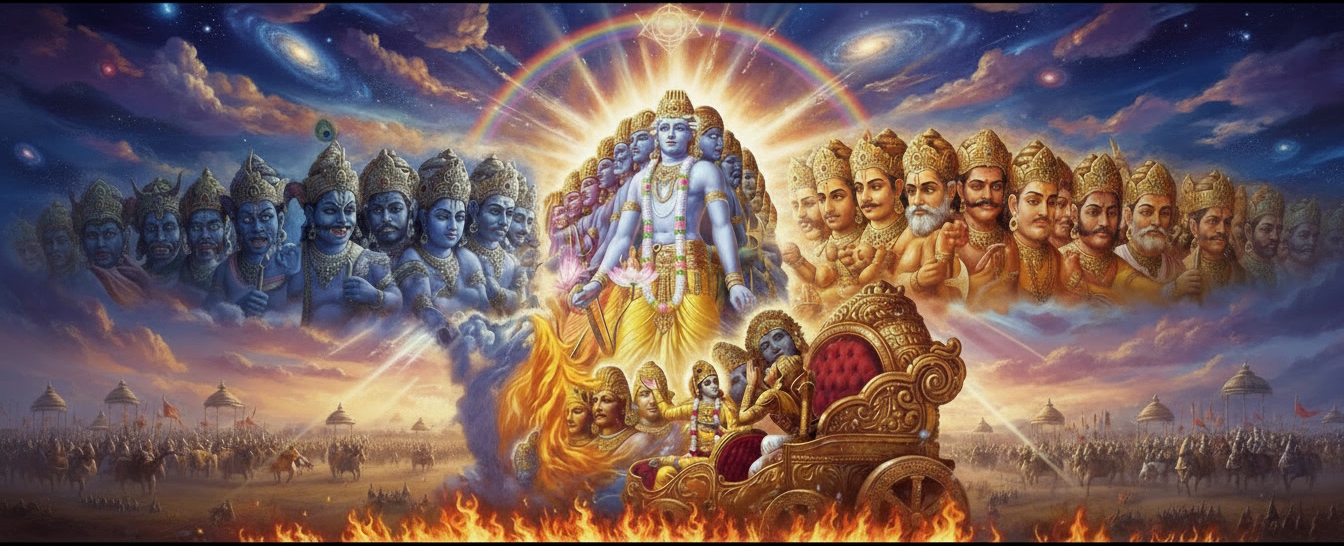
अवजानन्ति मां मूढा मानुषीं तनुमाश्रितम्।
परं भावमजानन्तो मम भूतमहेश्वरम्।।9.11।।
avajānanti māṃ mūḍhā mānuṣīṃ tanumāśritam|
paraṃ bhāvamajānanto mama bhūtamaheśvaram||9.11||
Translation
Fools disregard Me, clad in human form, not knowing My higher Being as the great Lord of (all) beings.
हिंदी अनुवाद
मूर्खलोग मेरे सम्पूर्ण प्राणियोंके महान् ईश्वररूप परमभावको न जानते हुए मुझे मनुष्यशरीरके आश्रित मानकर अर्थात् साधारण मनुष्य मानकर मेरी अवज्ञा करते हैं।
Commentaries & Translations
Swami Ramsukhdas
व्याख्या--परं भावमजानन्तो मम भूतमहेश्वरम्--जिसकी सत्ता-स्फूर्ति पाकर प्रकृति अनन्त ब्रह्माण्डोंकी रचना करती है, चरअचर, स्थावर-जङ्गम प्राणियोंको पैदा करती है; जो प्रकृति और उसके कार्यमात्रका संचालक, प्रवर्तक, शासक और संरक्षक है जिसकी इच्छाके बिना वृक्षका पत्ता भी नहीं हिलता प्राणी अपने कर्मोंके अनुसार जिनजिन लोकोंमें जाते हैं, उन-उन लोकोंमें प्राणियोंपर शासन करने-वाले जितने देवता हैं, उनका भी जो ईश्वर (मालिक) है और जो सबको जाननेवाला है-- ऐसा वह मेरा भूतमहेश्वररूप सर्वोत्कृष्ट भाव (स्वरूप) है।
'परं भावम्' कहनेका तात्पर्य है कि मेरे सर्वोत्कृष्ट प्रभावको अर्थात् करनेमें, न करनेमें और उलट-फेर करनेमें जो सर्वथा स्वतन्त्र है; जो कर्म, क्लेश, विपाक आदि किसी भी विकारसे कभी आबद्ध नहीं है; जो क्षरसे अतीत और अक्षरसे भी उत्तम है तथा वेदों और शास्त्रोंमें पुरुषोत्तम नामसे प्रसिद्ध है (गीता 15। 18) -- ऐसे मेरे परमभावको मूढ़लोग नहीं जानते, इसीसे वे मेरेको मनुष्य-जैसा मानकर मेरी अविज्ञा करते हैं।'मानुषी तनुमाश्रितम्'-- भगवान्को मनुष्य मानना क्या है? जैसे साधारण मनुष्य अपनेको शरीर, कुटुम्ब-परिवार, धन-सम्पत्ति, पद-अधिकार आदिके आश्रित मानते हैं अर्थात् शरीर, कुटुम्ब आदिकी इज्जत-प्रतिष्ठाको अपनी इज्जतप्रतिष्ठा मानते हैं; उन पदार्थोंके मिलनेसे अपनेको बड़ा मानते हैं; और उनके न मिलनेसे अपनेको छोटा मानते हैं और जैसे साधारण प्राणी पहले प्रकट नहीं थे, बीचमें प्रकट हो जाते हैं तथा अन्तमें पुनः अप्रकट हो जाते हैं (गीता 2। 28), ऐसे ही वे मेरेको साधारण मनुष्य मानते हैं। वे मेरेको मनुष्यशरीरके परवश मानते हैं अर्थात् जैसे साधारण मनुष्य होते हैं? ऐसे ही साधारण मनुष्य कृष्ण हैं --ऐसा मानते हैं।
Sri Harikrishnadas Goenka
इस प्रकार मैं यद्यपि नित्यशुद्धबुद्धमुक्तस्वभाव तथा सभी प्राणियोंका आत्मा हूँ तो भी --, मूढ़ -- अविवेकी लोग मेरे सर्व लोकोंके महान् ईश्वररूप परमभावको अर्थात् सबका अपना आत्मारूप मैं परमात्मा सब प्राणियोंका महान् ईश्वर हूँ एवं आकाशकी भाँति बल्कि आकाशकी अपेक्षा भी सूक्ष्मतर भावसे व्यापक हूँ -- इस परम परमात्मतत्त्वको न जाननेके कारण मुझ मनुष्यदेहधारी परमात्माको तुच्छ समझते हैं अर्थात् मनुष्यरूपसे लीला करते हुए मुझ परमात्माकी अवज्ञा -- अनादर करते हैं। इसलिये मुझ परमात्माके निरादरकी भावनासे वे पामर जीव ( व्यर्थ ) मारे हुए पड़े हैं।
Sri Anandgiri
(Objection:) 'If You are the Overseer of all, the Abode of all beings, and Eternally Free, then why do not all people worship You alone, either as the Self or as distinct (through Bhakti)?'—To this He says (referring to the verse context).
He states that 'perverted intelligence' is the cause for disregarding the Lord, with the word 'Mudhah' (Fools). He explains that misconception regarding Him is possible due to the Lord's connection with a human body, with 'Manushim' (Human body). (However,) He distinguishes the Lord from the identification with the body (Deha-tadatmya) that exists in people like us. He states that ignorance rooted in non-discrimination is the cause for those disregarding the Lord, with 'Param' (Supreme State).
Regarding 'What happens from disregarding the Lord?', He says that those whose intellect is obstructed by such disregard become pitiable—'Tatashcha' (And thereby...). The connection is: Because of the very cause of disregarding the Lord, those disregarding creatures become 'Varakah' (wretched/pitiable) and deplorable, and are excluded from all human goals (Purusharthas).
He indicates the cause for that with 'Tasya' etc. Disregard of the Lord under discussion—meaning disrespect or censure—its 'Bhavana' means doing it repeatedly; 'Ahata' (struck/ruined) by that means their intellect is obstructed by the power of the sin generated from that disregard.
Sri Dhanpati
(Objection:) 'Nanu'—If You are of such a nature—eternally Pure, Conscious, Free, and the Self of all beings—then why do not all accept You either as the Self or as distinct (Lord)? On the contrary, they disregard You? If so, He answers—'Avajananti' (They disregard). Even though I am such, they 'disregard' Me—meaning they treat Me with disrespect, direct insult, and censure. He states the cause for disregarding the Lord with 'Mudhah'—meaning those of perverted knowledge.
He states the occasion/reason for that perverted knowledge with 'Manushim tanum ashritam'—meaning relying on a human-related body, or acting through a human body. The idea is: Although I am devoid of body-identification like ordinary humans and have assumed a Maya-constituted playful form (Lila-vigraha) for the grace of seekers, the 'perception of connection with a body' in Me, the Supreme Brahman, is the cause of their perverted intelligence.
Regarding why they see connection with a body in the Supreme Self who is devoid of body-connection, He says—'Param' (Supreme State). 'Mama'—of Me, the Great Lord of all beings from Brahma down to a blade of grass; 'Param'—the most excellent; 'Bhavam'—the Reality of the Supreme Self, which like space is devoid of all attachment and is the root cause even of space—not knowing this Self-nature of Mine. Thus, the ignorance of My real nature is indeed the cause therein; this is the intention.
Sri Madhavacharya
(Doubt:) 'Then why do some disregard You, and what is their fate?' To this He says—'Avajananti' etc. 'Manushim tanum'—(means) the body appearing like a human to the fools, but not (actually) of human nature (material).
It is stated in Mokshadharma: "O King, whatever is bound by a body in this world is permeated by the five elements born of Ishvara's intelligence. But Ishvara is indeed the Creator of the world, the Lord Narayana, the Virat; He is the Inner Self of beings, the Giver of boons, possessor of Gunas (Saguna) and also Attributeless (Nirguna)..."
This is said in the very context of Incarnation. Therefore, Incarnations should not be doubted as being separate (i.e., material like others). "He created many forms for the sake of manifestation—Varaha, Narasimha, Vamana, and likewise Human" (Mahabharata 12.349.37). In that very text, the classification of Incarnation-forms is stated at the very time of the First Creation (implying their eternality). Therefore, their 'human-ness' etc. does not exist without delusion (on the part of the observer).
'Bhuta-Maheshvaram'—Bhuta (Eternal/Existing), Mahat (Great/Full), and Ishvara (Lord)—thus Bhuta-Maheshvara. As per the Babhravya Shakha (of Samaveda): "Beginningless and endless, of Perfect Form, the Ruler even of the 'Varas' (Best Deities), the Power of Gods..." And (Brihadaranyaka Up. 2.4.10): "Of this 'Mahato Bhutasya' (Great Being) is the breath..." And in Mokshadharma: "Brahma-purohita..." etc.
Sri Neelkanth
Even though I am such, fools 'avajananti' (disregard/misunderstand) Me.
Because I am 'manushim tanum ashritam'—acting through a human body. Not knowing My 'Param'—excellent/supreme—'Bhavam'—i.e., Reality/Truth—they disregard Me, the 'Maheshvara' (Great Lord) of beings—this is the syntactic connection.
Sri Ramanuja
Thus, regarding Me, the 'Bhuta-Maheshvara'—who am Omniscient, of True Resolve, the sole cause of the entire universe—who have taken recourse to a 'human body' out of supreme compassion so as to be accessible to all; fools, due to their own sinful deeds, 'disregard' Me—meaning they consider Me equal to an ordinary material human.
Not knowing this 'Param Bhavam' (Supreme Nature) of Mine, the Great Lord of beings—which is characterized by taking on the human form due to boundless compassion, generosity, good disposition (Saushilya), and parental love (Vatsalya)—they despise Me, thinking Me to be of the same class as others merely because I have taken recourse to a human form.
Sri Sridhara Swami
(Objection:) 'Nanu'—Why do some not respect You, the Supreme Lord of such nature? To this He answers in two verses (starting with) 'Avajananti'.
Not knowing My 'Param Bhavam' (Supreme State/Truth) as the Great Lord of all beings, fools (the ignorant) 'disregard' Me (treat Me with contempt).
The cause for this disregard is: that I have taken recourse to a 'human form' out of submission to the devotees' desire, even though My body is made of Pure Sattva.
Sri Vedantadeshikacharya Venkatanatha
To state the distinction of the Great Souls (Mahatmas), the nature of the fools is described in two verses beginning with 'Avajananti'. The word 'Evam' (Thus - implied context) is for consistency with the topic under discussion.
'Bhuta-Maheshvaram'—since this cannot qualify 'Bhavam' (state), it connects with 'Mam' (Me) even though separated by other words. What is intended by words like 'Bhuta-Maheshvara' is shown (in Ramanuja Bhashya) as 'Omniscient' etc.
'Manushim'—meaning related to humans, or possessing a structure of the same class as humans. Just as between a gold pot and a clay pot, there is similarity in 'structure' (Samsthana) even though there is difference in 'substance' (Dravya), so it is here (God's body is not material, though looking human). And this is also an 'Upalakshana' (indicator) for the assumption of bodies like Fish (Matsya), etc.
Since delusion is also dependent on God, to remove that fault (of God being blamed), it is said 'due to their own sinful deeds'. The cause of disregard is shown by 'Prakrita...' (in Bhashya).
By 'Param bhavam ajanantah', the non-grasping of difference (Bhedagraha)—which is a cause of illusion—is stated. By 'Manushim tanum ashritam', the similarity (Sadrishya) is stated. From these two arises the illusion that He belongs to the same class as ordinary humans. And then, by denying whatever excellence is somehow perceived, attributing inferiority constitutes 'Disregard' (Avajna). All this is clarified by 'Bhuta-Maheshvarasya...' (in Bhashya). 'Manushyatva-samashrayana-lakshanam'—The idea is: For One who does not abandon His own nature, such an assumption of human form—which is extraordinary/unique—is actually included within His 'Supremacy' (Paratva) itself.
Swami Chinmayananda
सातवें अध्याय में ब्रह्म की परा और अपरा प्रकृति का वर्णन करते हुए भगवान् श्रीकृष्ण ने यह घोषित किया था कि मूढ़ लोग? मेरे अव्यय और परम भाव को नहीं जानते हैं और परमार्थत अव्यक्तस्वरूप मुझको व्यक्त मानते हैं।इस अध्याय में स्वयं को सबकी आत्मा बताते हुए श्रीकृष्ण पुन उसी कठोर शब्द मूढ़ का प्रयोग उन लोगों की निन्दा के लिए करते हैं? जो तत्त्व को छोड़कर केवल रूप को ही पकड़े रहते हैं। मेरे परम स्वरूप को नहीं जानते हुए मूढ़ लोग मुझे किसी देह विशेष में ही स्थित मानते हैं प्रतिमा को ही भगवान् मानना या गुरु के शरीर को ही अनन्त परमात्मा समझना उसी प्रकार की त्रुटि या विपरीत ज्ञान है? जैसे घट को ही उसमें निहित वस्तु मान लेना है। मूर्ति तो उस इन्द्रिय अगोचर सूक्ष्म सत्य का मात्र प्रतीक है। भूखे या प्यासे होने पर केवल दूध की बोतल से खेलने से ही ताजगी अनुभव नहीं होती वास्तव में भूखे होने पर थाली पर चम्मच बजाने से कोई सन्तोष नहीं मिलता। प्रतीक को ही ध्येय समझने का अर्थ है साधन को ही साध्य मानने की गलती करना। ऐसी विपरीत धारणायें धार्मिक कट्टरता एवं असहिष्णुता को जन्म देती हैं जो लोगों में शत्रुता और ईर्ष्या के बीज बोती हैं। इन बीजों से? समय आने पर? केवल विपत्ति और नाश की फसल ही प्राप्त होती है यह सब कुछ विभिन्न धर्मावलम्बियों के अपनेअपने पाषाण के देवता? काष्ठ के बने प्रतीक और पीपल के बने भगवान् के नाम पर होता है खादी का तिरंगा कपड़ा राष्ट्रध्वज हो सकता है? परन्तु वह स्वयं मेरी मातृभूमि नहीं है परन्तु जब ध्वजारोहण के समय मैं अपना शीश झुकाता हूँ तो राष्ट्र के प्रति अपना सम्मान व्यक्त करता हूँ वह ध्वज मेरे राष्ट्र की संस्कृति एवं महत्वाकांक्षाओं का पवित्र प्रतीक है।इस सिद्धांत को ध्यान में रखकर इस श्लोक का अध्ययन करने पर वह अत्यन्त स्पष्ट हो जाता है। भगवान् कहते हैं कि साधारण भक्तजन मुझे भूतमात्र के महेश्वर के रूप में नहीं जानते हैं और मनुष्य शरीर धारण करने पर मेरा अनादर करते हैं।क्यों ये मूढ़ लोग आत्मा का सम्यक् परिचय प्राप्त करने में असमर्थ होते हैं उत्तर में कहते हैं --
Sri Abhinavgupta
'Avajananti' etc.
'So'ham'—That I am the One lying within all people (Antaryamin). (Yet,) due to being the Self of all (and thus appearing common), I become an object of 'disregard'.
(People think:) 'Since no Ishvara is perceived distinct from the fourteen kinds of creation beginning with humans, how does He exist?' (Thinking thus, they disregard Me).
Sri Jayatritha
Since the connection of the subsequent sentence is not apparent, he explains it with 'Tarhi' (Then...). (The intention of the doubt is:) 'If You alone are the Creator, Sustainer, and Destroyer, then since some people disregard You and yet seem to suffer no evil consequences, Your statement appears false?' (This verse answers this).
He explains 'Manushim tanum ashritam' to refute any incorrect understanding—interpreting it as 'appearing human'. The idea is that this is merely a restatement of the delusion (of the ignorant). Why is it not (actually human)? He answers 'Uktam cha' (And it is said). 'Cha' implies reason. Bodies are indeed material (bhautika). And the elements (bhutas) are born of Ishvara's intelligence; so how can they bind Him? That is the meaning.
Right there, by 'Ishvaro hi' etc., other reasons are stated. 'Virat'—of eternally manifest form. 'Varada'—giver of liberation. 'Saguna'—possessing attributes like independence. 'Avyakta' is that into which beings merge; its presiding deity is His 'Shushrushu' (attendant). The gender change (in shushrushu) is a Vedic irregularity.
(Objection:) 'Let this apply to the Original Form (Vishnu), but for the Incarnation Krishna, let there be human-ness (material body)?' To this he says—'Avatara...' (This is said in the context of Incarnation). 'The form with a horse-head that Brahma saw...'—this is in the context of Hayagriva incarnation. (Objection:) 'Let it be so for Hayagriva, but why can't Krishna be of human body?' (Reply:) No, due to the similarity of logic and specific evidence—he quotes 'Rupani...' (He created many forms). 'Asrijat' means divided/manifested. 'Pradurbhava-bhavaya'—for the sake of manifestation. He is Narayana. 'Manusham' means forms like Krishna. In that very Mokshadharma, 'at the time of the first creation itself'—meaning even before the origin of the human species (the forms were established). He concludes—'Atah' (Therefore, of those incarnations...).
Otherwise, there would be a contradiction with the subsequent term—with this idea, he explains 'Bhutam'. 'Bhutam'—always existing—indicates infinity in Time. 'Mahat'—infinity in Space. 'Ishvaram'—infinity in Attributes. 'Bhavam' is interpreted as 'Yatharthya' (Reality), hence the neuter gender. Here he quotes Shruti—'Tatha hi'. 'Isham varanam'—Ruler of the best (gods)—means Ishvara. 'Deva viryam'—He whose sons/power are the gods. 'Mahato bhutasya'—indicates infinity in space and time. Regarding His lordship over the 'Vara' (best) gods, the Mokshadharma text 'Brahma...' is the proof; meaning the hosts of gods like the Purohita are subservient to You. The repetition of 'Brahma' is for respect.
Sri Madhusudan Saraswati
Thus, even though I am of the nature of eternally Pure, Conscious, Free, the Self of all creatures, a Mass of Bliss, and Infinite; they 'avajananti'—meaning they do not respect Me thinking 'This is directly the Lord,' or they censure Me. Who? 'Mudhah'—undiscriminating people. He indicates the delusion that is the cause of their disregard—'Manushim tanum ashritam'.
(Meaning) Me, who have assumed a form appearing as human, by My own will, for the sake of gracing the devotees. The meaning is: Me, acting through a body that appears to be human.
And consequently, having their inner faculties covered by the delusion 'This is a human,' and 'ajanantah' (not knowing) My 'Param Bhavam'—the excellent Absolute Reality, the Great Lord of all beings—that they do not respect or that they censure Me, is indeed befitting that 'foolishness'.
Sri Purushottamji
(Objection:) 'Nanu'—Why do not all people know this Form which is the Controller of all? To this He answers in two verses 'Avajananti' etc.
'Mudhah'—the Asuras (demoniac natures), created merely by desire/lust; 'ajanantah' (not knowing) My 'Bhuta-Maheshvara' form—the Controller of all, the Supreme Divine Form—My 'Param Bhavam' which is of the nature of Purushottama; knowing Me through their own ignorance as merely 'Manushim tanum' (having a human body) and 'Mayinam' (a magician/wielder of Maya), they 'avajananti' (disregard/insult) Me.
Here the idea is: The very Form with which this Purushottama speaks is the Form of Brahman, full of Bliss; but due to ignorance, they know Him only as 'resorting to a human body'.
Sri Shankaracharya
'Avajananti'—They disregard, treat with contempt; Me; 'Mudhah'—the undiscriminating ones. (Whom?) Me, who have 'ashritam' (taken recourse to) a 'Manushim'—human-related—'tanum' (body); meaning Me acting through a human body.
(Why?) 'Ajanantah'—Not knowing My 'Param'—excellent—'Bhavam'—the Reality of the Supreme Self, which is like space (all-pervading) and subtler/innermost than even space. (What kind of nature?) 'Mama Bhuta-Maheshvaram'—My nature as the Great Lord of all beings and their own Self.
And consequently, 'Ahatah' (ruined/struck down) by the feeling of disregard for Me, they are 'Varakah' (pitiable/wretched).
...How so? (He explains in next verse)...
Sri Vallabhacharya
(Objection:) 'Nanu'—Why do some not respect You who possess such glory? To this He answers in two verses—'Avajananti' etc. Me, the Controller of all beings, Omniscient, of True Resolve, of Inconceivable Glory, the Lord of Yogeshvaras, the sole Cause of the entire universe—who, out of supreme compassion, have 'resorted to a human body' to be accessible to all; considering Me to be of the same class as others because of My resorting to humanness, 'Mudhah'—the demoniac people etc.—despise Me; this is the meaning.
The cause for that is: 'Ajanantah' (not knowing) My 'Param Bhavam'—the Reality whose nature is inconceivable majesty and characterized by 'Pure Bliss' (Ananda-matra).
Here, 'Tanum' (body) must be interpreted as being 'Svarupatmika' (identical with His essence), consisting of hands, feet, face, belly etc. made of 'Pure Bliss' alone, and having a human shape; otherwise, there would be a difference (between God and His body, which is not true in Pushtimarga). In reality, there is no division of Body and Embodied in Him; He is One alone—consisting of hands, feet, face, belly etc. made of Pure Bliss, and everywhere the Self devoid of internal difference (Svagata-bheda).
It is remembered in Smriti: "Of faultless perfect Form, Independent, devoid of the qualities of an insentient body..." That such a Form alone is devoid of material shape is also the experience of Shruti—"With averted eyes... beheld the Self" (Katha Up 4.1), "Bliss is the form of Brahman." All this has been expounded by the author of Shrimad Vidvan-Mandana (Sri Vitthalnathji); everything should be ascertained from there.
Swami Sivananda
अवजानन्ति disregard? माम् Me? मूढाः fools? मानुषीम् human? तनुम् form? आश्रितम् assumed? परम् higher? भावम् state or nature? अजानन्तः not knowing? मम My? भूतमहेश्वरम् the Great Lord of beings.Commentary Fools only find fault with My pure nature? just as a man with jaundiced eyes finds all objects to be yellow. The man who is suffering from fever finds even milk as bitter as the essence of neem. Those who wish to behold Me by means of the physical eyes cannot know Me. If anyone takes the mirage for the Ganga? can he find any water thereFools who do not have discrimination and right understanding despise Me? dwelling in the human form. I have taken this body to bless My devotees. These fools have no knowledge of My higher Being. They do not know that I am the great Lord? the Supreme SElf? the luminous? omniscient? pure? ever free? immortal? wise? the Self of all. These fools take Me for an ordinary mortal and despise Me always. The wise know both My transcendental nature and the glory of My manifestation.I pervade? permeate and interpenetrate the universe. I am the support of this world? body? mind? lifeforce and the senses and yet there are some miserable fools? who say that I do not exist. There is thus not a place anywhere where I am not? and yet these people are not able to see Me. Look at the misfortune of these people. Pitiable is their lot (Cf.IV.6VII.24)
Swami Gambirananda
Ajanatah, not knowing; mama, My; param, supreme; bhavam, nature-My supreme Reality, which is like space, nay, which is subtler and more pervasive than space; as bhuta-maheswaram, the Lord of all beings, the great Lord of all beings who is their Self; mudhah, foolish people, the non-discriminating ones; avajananti, disregard, belittle; mam, Me, although I am by nature thus eternal, pure, intelligent, free and the Self of all beings; and asritam, who have taken; manusim tanum, a human body common to men, i.e৷৷. when I act with the help of a human body. As a result of that, as a result of continously disrespecting Me, those wretches get ruined.
How?
Swami Adidevananda
Because of their evil actions (Karmas), fools disregard Me - the great Lord of all beings, the Omniscient, whose resolves are true, who is the sole cause of the entire universe, and who has taken the human body out of great compassion so that I might become the refuge of all. They consider Me to be a man like themselves. The meaning is that they disregard Me, not knowing My higher nature which is an abode of compassion, generosity, condescension and parental solicitude. This nature of mine is the cause of My resorting to the human shape. But without understanding this, the ignorant consider Me as of the same nature as others, because I have assumed the human form.