Bhagavad Gita - Chapter 11 - Shloka (Verse) 16
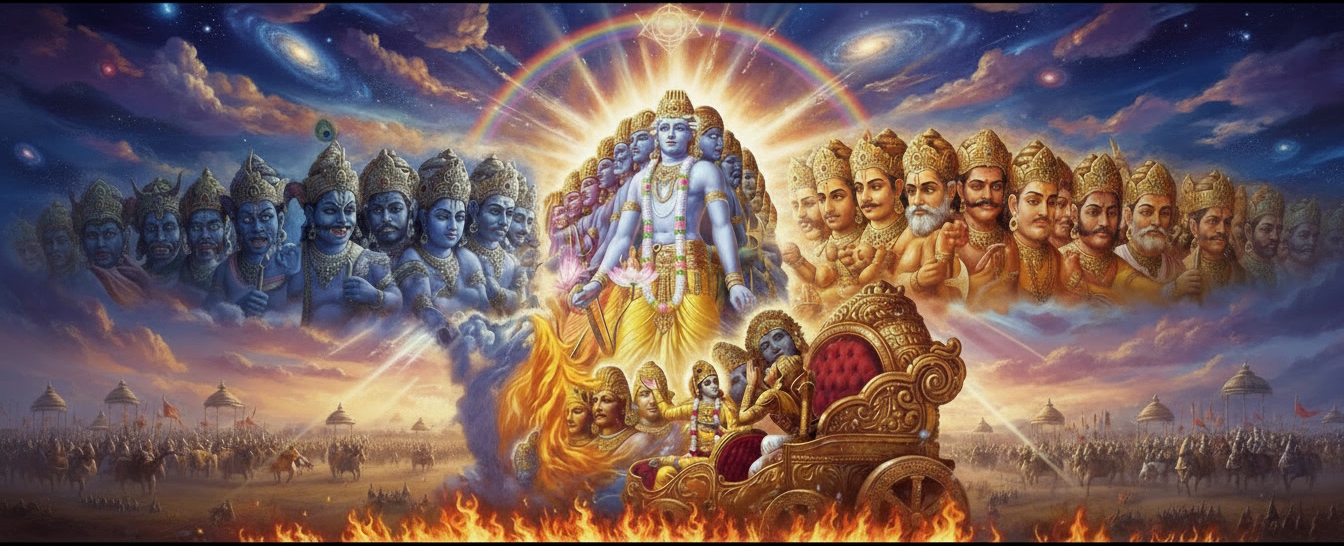
अनेकबाहूदरवक्त्रनेत्रं पश्यामि त्वां सर्वतोऽनन्तरूपम्।
नान्तं न मध्यं न पुनस्तवादिं पश्यामि विश्वेश्वर विश्वरूप।।11.16।।
anekabāhūdaravaktranetraṃ
paśyāmi tvāṃ sarvato'nantarūpam|
nāntaṃ na madhyaṃ na punastavādiṃ
paśyāmi viśveśvara viśvarūpa||11.16||
Translation
I see Thee of boundless form on every side with many arms, stomachs, mouths and eyes: neither the end nor the middle nor also the beginning do I see, O Lord of the universe, O Cosmic Form.
हिंदी अनुवाद
हे विश्वरूप ! हे विश्वेश्वरव ! आपको मैं अनेक हाथों, पेटों, मुखों और नेत्रोंवाला तथा सब ओरसे अनन्त रूपोंवाला देख रहा हूँ। मैं आपके न आदिको, न मध्यको और न अन्तको ही देख रहा हूँ।
Commentaries & Translations
Swami Ramsukhdas
व्याख्या--'विश्वरूप',विश्वेश्वर'--इन दो सम्बोधनोंका तात्पर्य है कि मेरेको जो कुछ भी दीख रहा है, वह सब आप ही हैं और इस विश्वके मालिक भी आप ही हैं। सांसारिक मनुष्योंके शरीर तो जड होते हैं और उनमें शरीरी चेतन होता है; परन्तु आपके विराट्रूपमें शरीर और शरीरी-- ये दो विभाग नहीं हैं। विराट्रूपमें शरीर और शरीरीरूपसे एक आप ही हैं। इसलिये विराट्रूपमें सब कुछ चिन्मय-ही-चिन्मय है। तात्पर्य यह हुआ कि अर्जुन विश्वरूप सम्बोधन देकर यह कह रहे हैं कि आप ही शरीर हैं और 'विश्वेश्वर' सम्बोधन देकर यह कह रहे हैं कि आप ही शरीरी (शरीरके मालिक) हैं।
Sri Harikrishnadas Goenka
मैं आपको अनेकों भुजा? उदर? मुख और नेत्रोंवाला अर्थात् आपके जिस स्वरूपमें अनेकों भुजा? उदर? मुख और नेत्र हैं ऐसे रूपवाला तथा सब ओरसे अनन्त रूपवाला अर्थात् जिसके सर्वत्र अनन्त रूप हैं ऐसा? देख रहा हूँ। हे विश्वेश्वर हे विश्वरूप मैं आपका न तो अन्त अर्थात् समाप्ति? न मध्य अर्थात् आदि और अन्तके बीचकी अवस्था और न आदि ही देखता हूँ? अभिप्राय यह कि मुझे आप परमात्मदेवका न अन्त दिखलायी देता है? न मध्य दीखता है और न आपका आदि ही दिखलायी देता है।
Sri Anandgiri
He qualifies the very form of the Lord in whose body all this was seen—with 'Aneka' etc.
By the word 'Adi', the root (origin) is expressed.
In 'Neither end nor middle', he indicates the connection of 'Pashyami' (I see) with each term—(meaning) 'I do not see the end', etc.
Sri Dhanpati
He qualifies the embodied One in whose body everything was seen.
You, who have many arms etc.; I see You, who have infinite forms everywhere. Again, I do not see Your beginning, end, or middle. To indicate that seeing the universe in Your body is appropriate because You are the 'Universal Form' (Vishvarupa), the address is 'O Vishvarupa'.
To indicate that although the universe has a beginning, end, and middle, You do not possess them—because even while being the Universal Form, You are the 'Lord of the Universe' (Vishweshvara)—the address is 'O Vishweshvara'.
Sri Madhavacharya
The word 'Aneka' (many) denotes 'Infinite'; for He Himself will say later 'Infinite arms' [11.19], and also 'Hands and feet everywhere' etc. In the Khila Suktas of the Rigveda: 'The one God has eyes everywhere, faces everywhere, arms everywhere, and feet everywhere. He fans/blows with His arms and wings, creating heaven and earth.' And similarly in the Yajurveda.
The word 'Vishva' also denotes 'Infinite', as stated: 'Sarva, Samasta, Vishva, Ananta, and Purna (are synonyms).' And in the Babhravya branch (of Samaveda): 'Infinite arms, infinite feet, infinite forms, many faces, the One.'
Statements of greatness etc. are also due to being of that nature (Brahman). Otherwise, 'Beginningless Supreme Brahman' [13.12] etc. would be inappropriate. In one place He is called 'Anantarupa' because His forms are infinite; elsewhere 'Aparimana' (measureless). Indeed, both are stated in the Yajurveda: 'That which is higher than the high, greater than the great, the One, Unmanifest, and of Infinite Forms.' The immeasurability in the greatness of the Mahat is established only due to the infinity of the Unmanifest. In the Aditya Purana: 'And He stands encompassing the Great Pradhana (Matter); of that Infinite One, there is no end nor any calculation.' And that 'each single form is infinite' occurs in one place. In the Rigveda Khilas: 'His bodies are innumerable and consisting of knowledge, and all are devoid of measurement.' And [Chandogya Up. 8.1.3]: 'As vast as this space is, so vast is this space within the heart; in it both heaven and earth are contained...'
And in Bhagavatam [10.16.31]: 'Crushed by the heavy weight of Krishna, in whose womb lies the universe...'
And this is not unreasonable, because the Lord possesses inconceivable power. In Vishnu Purana: 'Indeed, those entities which are inconceivable should not be subjected to logic.' And Shruti [Katha 2.9]: 'This wisdom is not to be attained by logic.' Overextension (logical fallacy) should be removed by the force of the Great Purport (Maha-tatparya) and the strength of the scriptural statement. A certified entity (like God) is not refuted merely because some object like a pot is not seen [to have such qualities]. In some entities, the arrangement of statements is accepted due to the existence of inconceivable power.
As stated in Jabali-Khila Shruti: 'In the Lord, there are heard and unheard qualities, even highly contradictory ones; there is no doubt here. Thinkable and unthinkable aspects, and faults too, which are heard or perceived by the ignorant [are arranged thus]. Thus, in the Supreme and elsewhere, there is an orderly arrangement of heard/unheard qualities and non-qualities.'
'Na madhyam' (No middle) is stated to avoid metaphorical interpretation; otherwise, it would have been established by the very absence of beginning and end. In the Shandilya branch: 'He is Vishvarupa, Purnarupa (Full Form); He is Vishvarupa, Anunarupa (Flawless Form); therefore He is Anantarupa, there is indeed no destruction of Him.'
Sri Neelkanth
'Aneka' means infinite; He in whom there are infinite arms, bellies, mouths, and eyes is 'Anekabahudaravaktranetram'.
'Sarvatah' means in all four directions and above and below; He whose form is 'Ananta' i.e., unlimited; Him (I see).
He explains the infinity itself—with 'Na antam' etc.
It means that You do not have spatial beginning and end like a long rope.
Sri Ramanuja
I see You everywhere as 'Anekabahudaravaktranetram'—having many arms, bellies, mouths, and eyes, and as 'Anantarupam'—of infinite forms.
O 'Vishweshvara'—Ruler of the universe! O 'Vishvarupa'—having the universe as Your body! Since You are 'Ananta' (Infinite),
therefore I see neither Your end, nor middle, nor again Your beginning.
Sri Sridhara Swami
Moreover—'Aneka' etc. I see You as one who has many arms etc.
I see You, who have infinite forms, everywhere.
But I do not see Your end, middle, or beginning, because You are all-pervading.
Sri Vedantadeshikacharya Venkatanatha
If the construction were 'Infinite forms on all sides' (sarvatah anantarupam), the word 'sarvatah' would be superfluous; however, the construction 'I see everywhere' (sarvatah pashyami) is appropriate as it accords with the acquisition of the divine eye.
The word 'Vishweshvara' implies the cause for being 'Vishvarupa'; with this intent, [the Bhashya] says—'O Ruler of the Universe.' For, the Controller who pervades is indeed the Embodied One (Shariri).
In 'Neither end nor middle', the non-perception of something that exists is not intended, because that would be inconsistent with Arjuna having obtained the divine eye; rather, due to the adjective 'Anantarupam' elsewhere which contains the reason, the non-perception is stated due to the very absence of the object (end etc.)—like a hare's horn; with this intent, [the Bhashya] says—'Yatah' (Since).
And this is also intended by 'Vishvarupa'. Here, the negation of beginning, middle, and end should be understood in terms of space and time. Due to the absence of the limitations of beginning and end, the absence of the 'middle', which is defined by those two, is also established.
Swami Chinmayananda
विश्वरूप के अनन्त वैभव को एक ही दृष्टिक्षेप में देख पाने के लिए मानव की परिच्छिन्न बुद्धि उपयुक्त साधन नहीं है। इस रूप के परिमाण की विशालता और उसके गूढ़ अभिप्राय से ही मनुष्य की? बुद्धि निश्चय ही? लड़खड़ाकर रह जाती है। भगवान् ही वह एकमेव सत्य तत्त्व हैं जो सभी प्राणियों की कर्मेन्द्रियों के पीछे चैतन्य रूप से विद्यमान हैं। अर्जुन इसे इन शब्दों में सूचित करता है कि मैं आपको अनेक बाहु? उदर? मुख और नेत्रों से युक्त सर्वत्र अनन्तरूप में देखता हूँ। इसे सत्य का व्यंग्यचित्र नहीं समझ लेना चाहिये। सावधानी की सूचना उन शीघ्रता में काम आने वाले चित्रकारों के लिए आवश्यक है? जो इस विषयवस्तु से स्फूर्ति और प्रेरणा पाकर इस विराट् रूप को अपने रंगों और तूलिका के द्वारा चित्रित करना चाहते हैं और अपने प्रयत्न में अत्यन्त दयनीय रूप से असफल होते हैं।विश्व की एकता कोई दृष्टिगोचर वस्तु नहीं है यह साक्षात्कार के योग्य एक सत्य तथ्य है। इस तथ्य की पुष्टि अर्जुन के इन शब्दों से होती है कि मैं न आपके अन्त को देखता हूँ? और न मध्य को और न आदि को। विराट् पुरुष का वर्णन इससे और अधिक अच्छे प्रकार से नहीं किया जा सकता था।उपर्युक्त ये श्लोक सभी परिच्छिन्न वस्तुओं के और मरणशील प्राणियों में सूत्र रूप से व्याप्त उस एकत्व का दर्शन कराते हैं? जिसने उन्हें इस विश्वरूपी माला के रूप मे धारण किया हुआ हैअर्जुन आगे कहता है
Sri Jayatritha
अनेकबाहूदरवक्त्रनेत्रं इत्यत्रानेकशब्दस्य द्व्यादौ पर्यवसानात् विवक्षितमर्थमाह -- अनेकेति। अनेनानेकवक्त्रनयनमित्यपि व्याख्यातम्। कुत एतत् इत्यत आह -- अनन्तेति।सर्वत इत्यस्यार्थस्तात्पर्यनिर्णयेऽवगन्तव्यः इत्यादि च वक्ष्यति। बाहुभ्यां प्रधानाभ्यां? पतत्त्रैः पतत्त्रसदृशैरितरबाहुभिः? सन्धमति अग्न्यादिभूतानि संयोजयतीति प्रत्येकमन्वयः। सन्नमतीत्यस्याप्ययमेवार्थः।
एतयोर्मन्त्रयोः प्रकृतानुपयोगादयुक्तमुदाहरणमित्यत आह -- विश्वशब्दश्चेति। तथा च प्रथमार्थे तसिरित्युक्तं भवति। स्पष्टार्थो चात्र श्रुतिमाह -- अनन्तबाहुमिति।
यदि भगवाननन्तबाह्वादिस्तद्य परममहत्परिमाणः स्यात्। अन्यथा तदयोगात्। न च तद्युक्तम्।रूपं महत्ते [11।23] इति महत्त्वमात्रोक्तेः। तथाबहुवक्त्रनेत्र [11।23] इति बहुत्वमात्रोक्तेरनन्तबाह्वादित्वोक्तिश्चानुपपन्नेत्यत आह -- महत्त्वादिति। स्यादयं विरोधो यदि भगवद्रूपस्य महत्त्वमात्रं तदवयवानां च बहुत्वमात्रमुच्येत्। न चैवम्? अवच्छेदकाश्रवणात्। महत्त्वबहुत्वोक्तिस्तु परममहत्त्वात्मकत्वेनानन्तावयत्वेन च सह सम्भवति। परममहति महत्त्वस्यानन्ते बहुत्वस्यान्तर्भावादित्यर्थः।
अवच्छेदकानुक्तावप्यवान्तरमहत्त्वादिग्रहणे को दोषः इत्यत आह -- अन्यथेति। तत्र परममहत्त्वस्यानन्तावयवत्वस्य चोक्तेरिति भावः।
पश्यामि त्वां सर्वतोऽनन्तरूपंत्वया ततं विश्वमनन्तरूप [11।38] इत्यनन्तशब्दद्वयस्य माहात्म्यातिशयसूचनायार्थभेदमाह -- एकत्र त्विति। अपरिमाणोऽपरिच्छिन्न इत्यनन्तरूप इति सम्बन्धः। स्यादिदं व्याख्यानं यदीदं द्वयं प्रामाणिकं स्यादित्यत आह -- उक्तं हीति। महान्तं महत्।महतो महान्तं इत्यनन्तमपरिच्छिन्नपरिमाणं रूपमस्येत्युक्तार्थे प्रमाणम्। एकं भिन्नमपि अनन्तरूपमित्यनन्तसङ्ख्यान्यस्य रूपाणीत्यत्र।
ननुमहतो महान्तं इति महत्तत्त्वान्महत्त्वमेवोच्यते? न त्वन्तत्वम्। ततश्चयदेकमव्यक्तं इत्यव्यक्तव्यापित्ववचनात्तत्साम्यमेव सिध्यतीत्यत आह -- अव्यक्तस्येति। महतो महत्त्वेऽव्यक्तव्यापित्वे चेत्यपि ग्राह्यम्। अव्यक्तस्यानन्तत्वं कुतः इत्यत आह -- महान्तं चेति। अनन्तस्य विष्णोः प्रतिमाभूतस्य तस्यान्तः परिमाणं परिच्छेदः? कार्यतः सङ्ख्यानं सङ्ख्यापरिच्छेदोऽपि न विद्यते।
प्रकारान्तरेणानन्तरूपशब्दद्वयस्यार्थभेदमाह -- तानि चेति। एकस्यानन्तरूपशब्दस्यानन्तसङ्ख्यारूपार्थत्वे स्थिते सत्येकत्रानन्तरूपशब्दे तानि चानन्तसङ्ख्यानि रूपाणि प्रत्येकमपरिच्छिन्नपरिमाणानीत्यर्थो भवतीत्यर्थः। अत्र प्रमाणमाह -- असङ्ख्याता इति। ज्ञानकाः ज्ञानानन्दात्मकाः। अयं बहिर्व्याप्त आकाशः परमात्मा यावान् यावत्परिमाणस्तावानेवैषोऽन्तर्हृदये स्थितः परमात्मेत्यर्थः। गर्भे जठरे जगद्यस्यासौ तथोक्तः। अवसन्नोऽवनतः। गर्भजगत्त्वेनापरिच्छिन्नपरिमाणत्वं लभ्यते।
कृष्णादीनामप्यपरिच्छिन्नपरिमाणत्वं वदन्तो वक्तव्याः। तत्राल्पपरिमाणप्रतीतिर्या सा किं भ्रान्तिरुत प्रमितिः इति। आद्ये क्रियादेर्द्विभुजचतुर्भुजादेश्च मिथ्यात्वं स्यात्। न द्वितीयः? युगपदेकत्राल्पानल्पपरिमाणसमावेशस्यायुक्तत्वात्। अतोऽपरिच्छिन्नपरिमाणोक्तिरुपचारमात्रमिति चेत्? किमिदमनेकपरिमाणत्वस्यायुक्तत्वं किमन्यत्रादर्शनेनासम्भावितत्वम् उत नायमल्पानल्पपरिमाणोपेतो द्रव्यत्वात्। नायं परममहत्परिमाणः? अल्पपरिमाणत्वात् पटवदित्यादियुक्तिविरुद्धत्वम्।अथातिप्रसङ्गदुष्टत्वं किंवाऽप्रामाणिकत्वम् नाद्य इत्याह -- न चेति। अघटितघटनाशक्त्युपेते किं नामासम्भावितमिति भावः। न द्वितीयः? ईश्वरस्य युक्त्यगोचरत्वेन तदनवकाशादिति भावेनाह -- अचिन्त्या इति।
एषा ब्रह्मविषया। अपनेया निराकार्या। अतिप्रसङ्गोऽपि किं यदीश्वरो विरुद्धपरिमाणद्वयोपेतः स्यात् तदा निर्दुःखो दुःखी स्यातीश्वरमधिकृत्य स्यात् उत प्राणादयोऽपि तथा स्युः तथा चाणुश्चेत्यादिका तद्विषयवाक्यव्यवस्था नाङ्गीक्रियेतेत्यन्यदधिकृत्य स्यात्। आद्यं दूषयति -- अतिप्रसङ्गस्त्विति। अविशेषमाश्रित्य ह्ययमतिप्रसङ्गः? नचासावस्ति निर्दोषानन्तगुणत्वे हरेः श्रुतीनां महातात्पर्येण दुःखादेस्तद्विरोधात्? परिमाणद्वयस्य तु तदविरोधात्? दुःखादेरप्रामाणिकत्वात्? परिमाणद्वयस्य तूक्तवक्ष्यमाणवाक्यसिद्धत्वादिति भावः। विपर्ययापर्यवसायी चायं प्रसङ्ग इति भावेनाह -- न हीति। यदि घटः पृथुबुध्नोदराकारः स्यात्तर्हि पदार्थो न स्यात् तथाविधस्य पदार्थस्य कस्याप्यदृष्टत्वादिति प्रसङ्गो यथा न युक्तः? भवति च पदार्थस्तस्मात्पृथुबुध्नोदराकारः? न भवतीति विपर्ययस्य प्रमाणबाधितत्वेनापर्यवसानात्? तथात्वेन तस्य धर्मिग्राहकप्रमाणदृष्टत्वात्। तथा प्रकृतेऽपीति। एतेनानुमानानां कालात्ययापदिष्टत्वं चोक्तं भवति। प्राणादिकमधिकृत्यातिप्रसङ्ग इति द्वितीयं निराकरोति -- केषुचिदिति। अत्रापि सम्भावनाहेतुभावाभावाभ्यां विशेषादविशेषोऽसिद्ध इति भावः।
चतुर्थं निरस्यति -- गुणा इति। श्रुता अश्रुता अपि सुविरुद्धा अन्यत्र सहादृष्टा अविरुद्धाश्च। तथा गुणा इव दोषाः श्रुता अश्रुताश्च नैव सन्ति? किन्त्वज्ञैर्मिथ्यादृष्टिभिर्हि तथा सन्तीति प्रतीताः। एवं परे ईश्वरे स्थितिः? ततोऽन्यत्र तु श्रुतानां प्रमाणान्तरसिद्धानां च गुणदोषाणां व्यवस्थावस्थानम्। तच्च क्रमादुत्तमेषु गुणबाहुल्यं दोषाल्पत्वं? मध्यमेषूभयसाम्यम्? अवरेषु दोषबाहुल्यं गुणाल्पत्वमिति।
तदेवमसम्भावनाद्यभावान्न भगवति अपरिच्छिन्नपरिमाणत्वोक्तेरुपचरितत्वं कल्प्यम्। अर्जुनेनापि तन्निराकृतमिति भावेनाह -- उपचारत्वेति।नान्तं न पुनस्तवादिं पश्यामि इत्याद्यन्ताभावोक्तेरुपचरितत्वपरिहाराय न मध्यमित्युक्तम्। मध्यनिराकरणार्थमेव तत्किं न स्यात् इत्यत आह -- अन्यथेति। उपचारत्वपरिहारार्थत्वाभावे तद्वैयर्थ्यं स्यादिति शेषः। कुतः आद्यन्तसापेक्षत्वात् मध्यस्य तदभावोक्त्यैव तदभावसिद्धेः।
विश्वं महदादिकं रूपं स्वरूपमस्येति प्रतीतिं सप्रमाणकं निवायरति -- विश्वरूप इति। एतच्चाभ्यासरूपमिति मन्तव्यम्।
Sri Madhusudan Saraswati
He qualifies that very Lord in whose body he saw all this—with 'Aneka' etc. I see You everywhere ('sarvatah') as 'Anekabahudaravaktranetram'—He who has many arms, bellies, mouths, and eyes.
'Anantarupam'—Him who has infinite forms. But I see neither Your 'antam'—end/termination, nor middle, nor beginning, because You are all-pervading.
'O Vishweshvara', 'O Vishvarupa'—the two addresses are due to extreme awe/excitement.
Sri Purushottamji
I see You too, in whose body I see these things"—he says this to indicate absence of delusion—with 'Aneka' etc.
You, who have many arms etc.; whose forms are infinite everywhere—I see You as such.
Even though You have such manifold forms, I do not see Your 'end'—limit/completion, 'middle'—place of stay, or 'beginning'—place of origin.
'Vishweshvara'—O Protector of the Universe! What more need I say? I see You as 'Vishvarupa'.
Sri Shankaracharya
'Anekabahudaravaktranetram'—You who have many arms, bellies, mouths, and eyes; Him. 'Pashyami tva'—I see You 'sarvatah'—everywhere. 'Anantarupam'—He who has infinite forms; Him.
'Na antam'—End means termination; 'Na madhyam'—Middle means the interval between two ends; 'Na punah tava adim'—I do not see the end of the God, nor the middle, nor again the beginning; O 'Vishweshvara', O 'Vishvarupa'.
Moreover—
Sri Vallabhacharya
'Aneka' etc. Because He is immutable (Kutastha) [hence without beginning, middle, or end].
Swami Sivananda
अनेकबाहूदरवक्त्रनेत्रम् with manifold arms? stomachs? mouths and eyes? पश्यामि (I) see? त्वाम् Thee? सर्वतः on every side? अनन्तरूपम् of boundless form? न not? अनत्म् end? न not? मध्यम् middle? न not? पुनः,again? तव Thy? आदिम् origin? पश्यामि (I) see? विश्वेश्वर O Lord of the universe? विश्वरूप O Cosmic Form.Commentary A thing that is limited by space and time has a begining? a middle and an end? but the Lord is omnipresent and eternal. He exists in the three periods of time -- past? present and future? but is not limited by time and space. Therefore He has neither a beginning nor middle nor end.Arjuna could have this divine vision only with the help of the divine eye bestowed upon him by the Lord. He who has supreme devotion to the Lord and on whom the Lord showers His grace can enjoy this wondrous vision.
Swami Gambirananda
Pasyami, I see; tvam, You; aneka-bahu-udara-vaktra-netram, as possessed of numerous arms, bellies, mouths and eyes; ananta-rupam, having infinite forms; sarvatah, all around. Visveswara, O Lord of the Universe; visva-rupa, O Cosmic Person; na pasyami, I see not; ['I do not see-because of Your all-pervasiveness.'] tava, Your; antam, end; na madhyam, nor the middle-what lies between two extremities; na punah, nor again; the adim, beginning-I see not the limit (end) nor the middle, nor again the beginning, of You who are God!
Furthermore,
Swami Adidevananda
I behold Your infinite form on all sides with many arms, stomachs, mouths and eyes. O Lord of the universe, namely, the controller of the universe, O Universal Form having the universe as Your body! As You are infinite, therefore, I see no end, no middle and no beginning for You.