Bhagavad Gita - Chapter 11 - Shloka (Verse) 17
किरीटिनं गदिनं चक्रिणं च तेजोराशिं सर्वतोदीप्तिमन्तम्।
पश्यामि त्वां दुर्निरीक्ष्यं समन्ताद् दीप्तानलार्कद्युतिमप्रमेयम्।।11.17।।
kirīṭinaṃ gadinaṃ cakriṇaṃ ca
tejorāśiṃ sarvatodīptimantam|
paśyāmi tvāṃ durnirīkṣyaṃ samantād
dīptānalārkadyutimaprameyam||11.17||
Translation
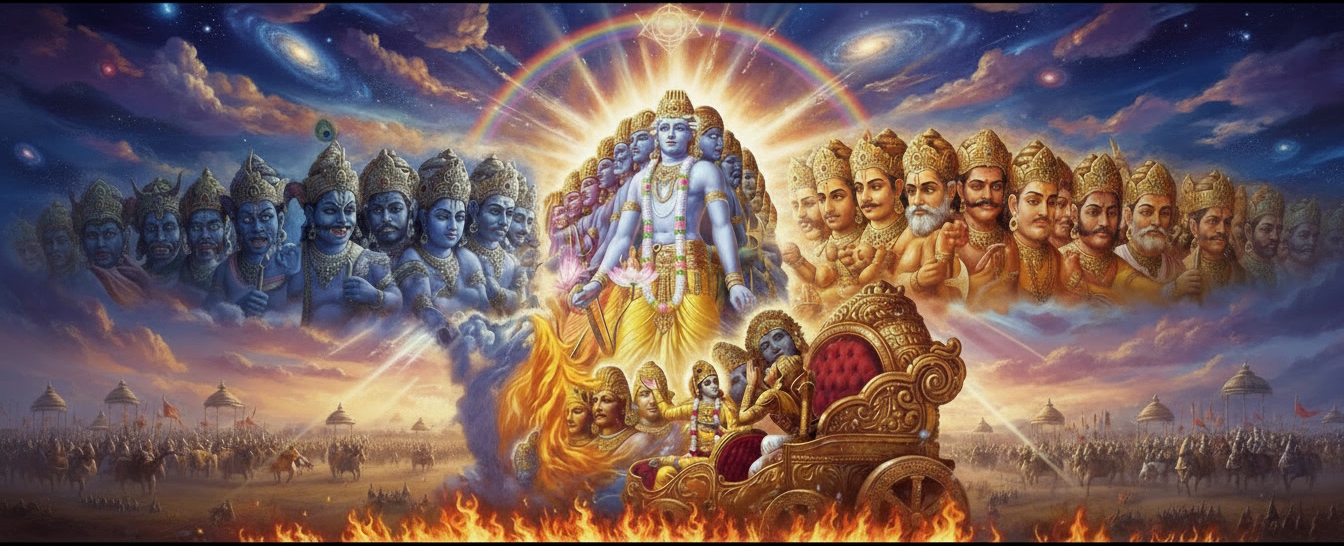
I see Thee with the diadem, the club and the discus, a mass of radiance shining
everywhere, very hard to look at, blazing all round like burning fire and the sun, and immeasurable.
हिंदी अनुवाद
मैं आपको किरीट, गदा, चक्र (तथा शङ्ख और पद्म) धारण किये हुए देख रहा हूँ। आपको तेजकी राशि, सब ओर प्रकाश करनेवाले, देदीप्यमान अग्नि तथा सूर्यके समान कान्तिवाले, नेत्रोंके द्वारा कठिनतासे देखे जानेयोग्य और सब तरफसे अप्रमेयस्वरूप देख रहा हूँ।
Commentaries & Translations
Swami Ramsukhdas
व्याख्या--'किरीटिनं गदिनं चक्रिणं च'--आपको मैं किरीट, गदा और चक्र धारण किये हुए देख रहा हूँ। यहाँ 'च' पदसे शङ्क और पद्मको भी ले लेना चाहिये। इसका तात्पर्य ऐसा मालूम देता है कि अर्जुनको विश्वरूपमें भगवान् विष्णुका चतुर्भुजरूप भी दीख रहा है।
'तेजोराशिम्'--आप तेजकी राशि हैं, मानो तेजका समूह-का-समूह (अनन्त तेज) इकट्ठा हो गया हो। इसका पहले सञ्जयने वर्णन किया है कि आकाशमें हजारों सूर्य एक साद उदित होनेपर भी भगवान्के तेजकी बराबरी नहीं कर सकते (11। 12)। ऐसे आप प्रकाशस्वरूप हैं।
Sri Harikrishnadas Goenka
तथा --, शिरके भूषणविशेषका नाम किरीट है? वह जिसके शिरपर हो उसे किरीटी कहते हैं। जिसके पास गदा हो वह गदी है। जिसके हाथमें चक्र हो वह चक्री है। इस प्रकार? मैं आपको किरीटी -- किरीटयुक्त? गदीगदायुक्त? चक्रीचक्रयुक्त? तेजोराशि -- तेजका समूह और सर्वतोदीप्तिमान् -- सब ओरसे दीप्तिशाली देख रहा हूँ। तथा आपको दुर्निरीक्ष्य -- जो कठिनतासे देखा जा सके ऐसा? एवं सब ओरसे प्रज्वलित अग्नि और सूर्यके समान प्रकाशमय और बुद्धि आदिसे जिसका ग्रहण न हो सके? ऐसा अप्रमेयस्वरूप देखता हूं? प्रदीप्त यानी प्रकाशित अग्नि और अर्क यानी सूर्य इन दोनोंके समान जिसका प्रकाश -- तेज हो उसका नाम दीप्तानलार्कद्युति है।,
Sri Anandgiri
He expounds on the Lord possessing the Universal Form in another way—with 'Kincha' etc.
He excludes limitation—with 'Sarvatah' etc. 'I see Him who is difficult to gaze at'—this is not contradictory due to the difference in qualification (Arjuna having the divine eye). His vision is not just in front, or behind, or on the side, but everywhere; thus he says—'Samantatah'.
He clarifies the quality of radiance with an example—'Dipta' etc.
Sri Dhanpati
Moreover, 'Kiritinam'—having a specific head-ornament; 'Gadi'—He who has a mace, Him; 'Chakri'—He who has a discus, Him.
Therefore, 'Samantatah'—everywhere; He whose radiance is like the radiance of blazing fire and sun.
Therefore, 'Durnirikshyam'—difficult to be gazed at; even though possessing a crown etc., 'Aprameyam'—impossible to define/limit; I see You.
Sri Madhavacharya
Having said 'radiance of fire and sun', he removes the doubt of limitedness—with 'Aprameyam' (Immeasurable).
Sri Neelkanth
The wearer of crown, mace, and discus.
'Durnirikshyam'—impossible to look at precisely because of being radiant.
Whose radiance is like that of blazing fires and suns everywhere; 'Samantad-diptanalarkadyutim' is one compound word.
Therefore 'Aprameyam'—whose limits are impossible to see.
Sri Ramanuja
I see You—a mass of splendor, glowing on all sides, difficult to gaze at everywhere, having the radiance of blazing fire and sun, immeasurable—wearing a crown, bearing a mace and a discus.
Sri Sridhara Swami
Moreover—'Kiritinam' etc. 'Kiritinam'—having a crown; 'Gadinum'—having a mace; 'Chakrinam'—having a discus; 'Sarvato diptimantam'—of the form of a mass of light;
and 'Durnirikshyam'—impossible to look at. The reason for that: He whose radiance/splendor is like the radiance of blazing fire and sun.
Therefore 'Aprameyam'—impossible to determine as 'He is like this'—I see You everywhere.
Sri Vedantadeshikacharya Venkatanatha
'Kiritinam' etc. Disregarding the textual order of 'Kiritinam' etc., the connection is stated [in Ramanuja's Bhashya] following the order of perception/meaning—with 'Tejorashim' etc. 'Tejorashim' (Mass of splendor)—this indicates the essential nature of the Subject (Dharmi). 'Sarvato diptimantam'—endowed with all-pervading radiance, like 'By His light all this shines' [Katha 1.5.15]. 'Samantat' (Everywhere)—this is stated intending the entire region of the body.
'Diptanalarkadyutim' (Radiance of blazing fire and sun)—this is the cause for being 'difficult to gaze at'. Here, by the word 'Dyuti', the light in the form of rays is intended, so there is no repetition with 'Diptimantam'. Or, in the former, the purport is on all-pervasiveness, while here it is on the extreme intensity which causes it to be difficult to look at. 'Aprameyam'—impossible to limit by 'such-ness' (nature) or 'this-much-ness' (extent). Up to this point, the general perception is stated; with this intent, [the Bhashya] separates and states 'Aprameyam tvam' (You, the Immeasurable).
Even in seeing a form never seen before, I recognize You by Your unique signs; with this intent, [the Bhashya] says—'I see You with crown, mace, and discus.' 'Kiritinam'—this is an indicator (upalakshana) for the class of ornaments. Even there, the specific mention of the crown (Kirita) is because it manifests His Supreme Lordship. For the category of headgear (mukuta) is twofold: Kirita and Karandika; therein, Kirita is worn by the highest.
'Gadinum Chakrinam'—this is an indicator for the class of weapons. Even there, the mention of discus etc. is because they are famous as being unique to the Lord.
Swami Chinmayananda
विश्वरूप का और अधिक वर्णन करते हुये अर्जुन बताता है कि उस अचिन्त्य अग्राह्य दिव्य रूप में उसने क्या देखा। उसने वहाँ मुकुट धारण किए शंखचक्रगदाधारी भगवान् विष्णु को देखा। पुराणों में किये गये वर्णनों के अनुसार शंख? चक्र आदि भगवान् विष्णु के पदक या प्रतीत हैं।हिन्दू शास्त्रों में देवताओं को कूछ विशेष शस्त्रास्त्रयुक्त या चिह्नयुक्त बताया गया है जिनका विशेष अर्थ भी है। ये विशेष पदक जगत् पर उनके शासकत्व एवं प्रभुत्व को दर्शाने वाले हैं। जो व्यक्ति बाह्य परिस्थितियों का स्वामी तथा मन की स्वाभाविक प्रवृत्तियों का शासक है? वही वास्तव में? प्रभु या ईश्वर कहलाने योग्य होता है। जो व्यक्ति अपने मन का और बाह्य आकर्षणों का दास बना होता है? वह दुर्बल है यदि वह राजमुकुट भी धारण किये हुये है तब भी उसका राजत्व भी उतना ही अनित्य है जितना कि रंगमंच पर बनावटी मुकुट धारण कर राजा की भूमिका कर रहे अभिनेता का होता है। सत्तारूढ़ पुरुष को इन्द्रिय संयम और मनसंयम के बिना व्ाास्तविक अधिकार या प्रभावशीलता प्राप्त नहीं हो सकती। निम्न स्तर की कामुक प्रवृत्तियों पर विजय प्राप्त कर अपने मन रूपी राज्य पर स्वयं ही स्वयं का राजतिलक किये बिना कोई भी व्यक्ति सुखी और शक्तिशाली जीवन नहीं जी सकता। संयमी पुरुष ही विष्णु है और वही राजमुकुट का अधिकारी है।चतुर्भुज विष्णु अपने हाथों में शंख? चक्र? गदा और पद्म (कमल) धारण किये रहते हैं। यह एक सांकेतिक रूपक है। भारत में कमल पुष्प शान्ति? आनन्द? शुभ और सुख का प्रतीक है। शंखनाद मनुष्य को अपने कर्तव्य के लिये आह्वान करता है। यदि मनुष्यों की कोई पीढ़ी अपने हृदय के इस उच्च आह्वान को नहीं सुनती है? तब सर्वत्र अशान्ति? युद्ध? महामारी? अकाल? तूफान और साम्प्रादायिक विद्वेष तथा सामाजिक दुर्व्यवस्था फैल जाती है। यही उस पीढ़ी पर गदा का आघात है जो उसे सुव्यवस्थित और अनुशासित करने के लिए उस पर किया जाता है। यदि कोई ऐसी पीढ़ी हो? जो इतना दण्ड पाकर भी उससे कोई पाठ नहीं सीखती है? तो फिर उसके लिए आता है चक्र कालचक्र जो सुधार के अयोग्य उस पीढ़ी को नष्ट कर देता है।अर्जुन द्वारा किये गये वर्णन से ज्ञात होता है कि एक ही परम सत्य ब्रह्मादि से पिपीलिका तक के लिए अधिष्ठान है। वह सत्य सदा? सर्वत्र एक ही है केवल उसकी अभिव्यक्ति ही विविध प्रकार की है। उसकी दिव्यता की अभिव्यक्ति में तारतम्य का कारण विभिन्न स्थूल और सूक्ष्म उपाधियां हैं जिनके माध्यम से वह सत्य व्यक्त होता है।यह विश्वरूप सब ओर से प्रकाशमान तेज का पुञ्ज? प्रदीप्त अग्नि और सूर्य के समान ज्योतिर्मय और देखने में अति कठिन है। इस श्लोक में किये गये वर्णन में यह पंक्ति सर्वाधिक अभिव्यंजक है जो हमें शुद्ध चैतन्यस्वरूप पुरुष का स्पष्ट बोध कराती है। इसे भौतिक प्रकाश नहीं समझना चाहिये। यद्यपि लौकिक भाषा से यह शब्द लिया गया है? तथापि उसका प्रयोग साभिप्राय है। चैतन्य ही वह प्रकाश है? जिसमें हम अपने मन की भावनाओं और बुद्धि के विचारों को स्पष्ट देखते हैं। यही चैतन्य? चक्षु और श्रोत्र के द्वारा क्रमश रूप वर्ण और शब्द को प्रकाशित करता है। इसलिए स्वाभाविक ही है कि अनन्त चैतन्यस्वरूप भगवान् श्रीकृष्ण के विश्वरूप का वर्णन? अर्जुन को लड़खड़ाती भाषा में इसी प्रकार करना पड़ा कि वह विश्वरूप तेजपुञ्ज है? जो इन्द्रिय? मन और बुद्धि को अन्ध बना दे रहा है? अर्थात् ये उपाधियां उसका ग्रहण नहीं कर पा रहीं हैं।अप्रमेय (अज्ञेय) यद्यपि अब तक अर्जुन ने अपनी ओर से सर्वसंभव प्रयत्न करके विराट्स्वरूप का तथा उसके दर्शन से उत्पन्न हुई मन की भावनाओं का वर्णन किया है? परन्तु इन समस्त श्लोकों में निराशा की एक क्षीण धारा प्रवाहित हो रही प्रतीत होती है। अर्जुन यह अनुभव करता है कि वह विषयवस्तु की पूर्णता को भाषा की मर्यादा में व्यक्त नहीं कर पाया है। भाषा केवल उस वस्तु का वर्णन कर सकती है? जो इन्द्रियों द्वारा देखी गयी हो? या मन के द्वारा अनुभूत हो अथवा बुद्धि से समझी गयी हो। यहाँ अर्जुन के समक्ष ऐसा दृश्य उपस्थित है? जिसे वह अनुभव कर रहा है? देख रहा है और स्वयं बुद्धि से समझ पा रहा है और फिर भी? कैसा विचित्र अनुभव है कि जब वह उसे भाषा की बोतल में बन्द करने का प्रयत्न करता है? तो वह मानो वाष्परूप में उड़ जाता है अर्जुन? इन्द्रियगोचर वस्तुओं के अनुभव की तथा भावनाओं की भाषा में वर्णन करने का प्रयत्न करता है? किन्तु उस वर्णन से स्वयं ही सन्तुष्ट नहीं होता है।आश्चर्यचकित मानव उस वैभव का गान अपनी बुद्धि की भाषा में करने का प्रयत्न कर रहा है। परन्तु यहाँ भी केवल निराश होकर यही कह सकता है कि? हे प्रभो आप सर्वदा अप्रमेय हैं अज्ञेय है। यद्यपि कवि ने विराट् स्वरूप का चित्रण दृश्यरूप में किया है? तथापि वे हमें समझाना चाहते हैं कि सत्स्वरूप आत्मा? वास्तव में? द्रष्टा है? और वह बुद्धि का भी ज्ञेय विषय नहीं बन सकता है। आत्मा द्रष्टा और प्रमाता है? और न कि दृश्य और प्रमेय वस्तु।आपके इस ईश्वरीय योग के दर्शन से मैं अनुमान करता हूँ कि
Sri Jayatritha
[Objection:] Since it is said 'Radiance of fire and sun', the statement [in verse 12] that 'thousand' means 'infinite' is incorrect?
[Reply:] No; anticipating this very doubt, and implying that this is stated merely for the sake of conveying an idea, while in reality the Lord has unlimited radiance—He Himself says 'Anala' etc.
The doubt regarding the limitedness of radiance that arises upon saying this [is removed by 'Aprameyam']. And this [word 'Aprameyam'], being a qualification with a qualifier, is connected with 'Dyuti' (radiance).
Sri Madhusudan Saraswati
He qualifies that very Lord of Universal Form in another way—'Kiritinam' etc. Wearing a crown, mace, and discus; and 'Sarvato diptimantam'—a mass of splendor; therefore 'Durnirikshyam'—impossible to gaze at without a divine eye.
In the reading with 'ya' (Durnirikshyam vs Durniriksham), the prefix 'Dus' implies negation; meaning 'Anirikshyam' (invisible/unguardable).
He whose radiance is like the radiance of blazing fire and sun; 'Aprameyam'—impossible to limit as 'He is like this'; I see You 'Samantat'—everywhere—with the divine eye. Therefore, due to the difference in qualification, there is no contradiction in saying 'I see the unseeable/hard-to-see'.
Sri Purushottamji
Moreover, 'Kiritinam'—endowed with the ornament of a crown, consisting of Rasa. 'Gadinum'—holding the presiding divine dharma of all vital forces (pranas). 'Chakrinam'—holding the Sudarshana (discus) which is of the nature of light.
By the particle 'Cha' (and), holding the discus for the purpose of granting liberation is also indicated.
'Tejorashim'—consisting of a mass of splendor. 'Sarvato diptimantam'—endowed with illuminating rays all around.
He gives an example for being endowed with splendor and radiance—'Diptanalarkadyutim'—like the radiance of blazing fire and sun. 'Aprameyam'—unfit to be measured/comprehended; I see You everywhere, difficult to gaze at.
Sri Shankaracharya
'Kiritinam'—Kirita is a specific head-ornament; he who has it is Kiriti; him 'Kiritinam'. And 'Gadinum'—He has a Gada (mace), so Gadi; him 'Gadinum'. And 'Chakrinam'—He has a Chakra (discus), so Chakri; him 'Chakrinam'.
'Tejorashim'—a heap of light; 'Sarvatodiptimantam'—he has radiance on all sides, so Sarvatodiptiman; him 'Sarvatodiptimantam' I see—You. 'Durnirikshyam'—he who is looked at with difficulty is Durnirikshya; him 'Durnirikshyam'.
'Samantat'—everywhere. 'Diptanalarkadyutim'—Anala (fire) and Arka (sun) make Analarkau; blazing Analarkau; whose Dyuti (radiance/light) is like the Dyuti of those blazing fire and sun, he is Diptanalarkadyuti; You are he; Him 'Diptanalarkadyutim'. 'Aprameyam'—not an object of knowledge (measure), impossible to limit—this is the meaning.
From this very fact, from seeing Your Yoga-power, I infer—
Sri Vallabhacharya
'Kiritinam' etc.
Here, one should understand many crowns etc. which are symbols of supreme sovereignty; because He has multiple limbs.
Swami Sivananda
किरीटिनम् one with diadem? गदिनम् with club? चक्रिणम् with discus? च and? तेजोराशिम् a mass of radiance? सर्वतः everywhere? दीप्तिमन्तम् shining? पश्यामि (I) see? त्वाम् Thee? दुर्निरीक्ष्यम् very hard to look at? समन्तात् all round? दीप्तानलार्कद्युतिम् blazing like burning fire and sun? अप्रमेयम् immeasurable.Commentary Kiritam is a special ornament for the head? the crown.Arjuna had worshipped the Lord as having a crown? club and discus and the Lord showed him the same form now. He is in all forms and He is beyond all forms as the transcendental Reality. Who can comprehend His GloryTejorasim A mass of splendour that cannot be perceived without the inner divine eye of intuition.Aprameyam Immeasurable? whose limits cannot be fixed.I infer from this vision of Thy power of Yoga that Thu art the Imperishable? etc.
Swami Gambirananda
Pasyami, I see; tvam, You; as kiritinam, wearing a diadem-kirita is a kind of decoration for the head; one having it is kiriti; gadinam, wielding a mace; and also cakrinam, holding a disc; tejorasim, a mass of brilliance; sarvatah diptimantam, glowing all around; durniriksyam, difficult to look at; samantat, from all sides, at every point; as though dipta-analarka-dyutim, possessed of the radiance (dyuti) of the blazing (dipta) fire (anala) and sun (arka); and aprameyam, immeasurable, i.e. beyond limitation.
'For this reason also, i.e., by seeing Your power of Yoga, I infer' that-
Swami Adidevananda
I behold you a mass of light shining everywhere, hard to look at, blazing like a burning fire and the sun. You, who are identifiable with Your divine diadem, mace and discus, are indefinable and immeasurable.