Bhagavad Gita - Chapter 11 - Shloka (Verse) 50
सञ्जय उवाच इत्यर्जुनं वासुदेवस्तथोक्त्वा स्वकं रूपं दर्शयामास भूयः।
आश्वासयामास च भीतमेनं भूत्वा पुनः सौम्यवपुर्महात्मा।।11.50।।
sañjaya uvāca
ityarjunaṃ vāsudevastathoktvā
svakaṃ rūpaṃ darśayāmāsa bhūyaḥ|
āśvāsayāmāsa ca bhītamenaṃ
bhūtvā punaḥ saumyavapurmahātmā||11.50||
Translation
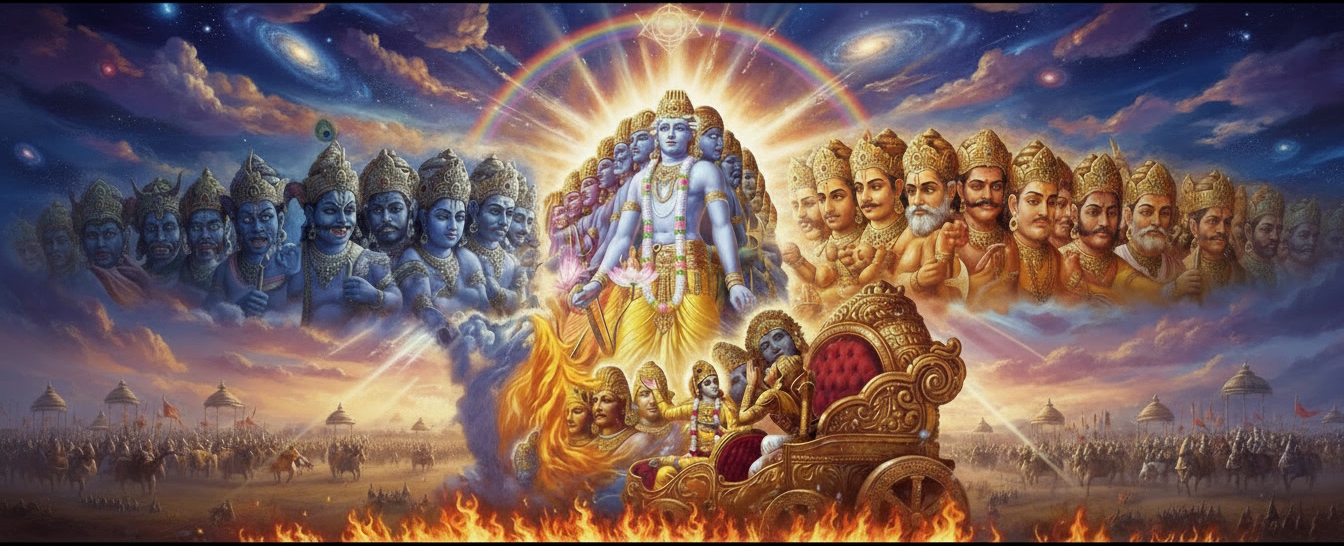
Sanjaya said Having thus spoken to Arjuna, Krishna again showed His own form and the great Soul (Krishna), assuming His gentle form, consoled him (Arjuna) who was terrified.
हिंदी अनुवाद
सञ्जय बोले -- वासुदेवभगवान् ने अर्जुनसे ऐसा कहकर फिर उसी प्रकारसे अपना रूप (देवरूप) दिखाया और महात्मा श्रीकृष्णने पुनः सौम्यवपु (द्विभुजरूप) होकर इस भयभीत अर्जुनको आश्वासन दिया।
Commentaries & Translations
Swami Ramsukhdas
व्याख्या--'इत्यर्जुनं वासुदेवस्तथोक्त्वा स्वकं रूपं दर्शयामास भूयः'--अर्जुनने जब भगवान्से चतुर्भुजरूप होनेके लिये प्रार्थना की, तब भगवान्ने कहा कि मेरे इस विश्वरूपको देखकर तू व्यथित और भयभीत मत हो। तू प्रसन्न मनवाला होकर मेरे इस रूपको देख (11। 49)। भगवान्के इसी कथनको सञ्जयने यहाँ 'इत्यर्जुनं वासुदेवस्तथोक्त्वा' पदोंसे कहा है।
Sri Harikrishnadas Goenka
संजय बोला -- इस प्रकार भगवान् वासुदेवने पूर्वोक्त वचन कहकर अर्जुनको अपनावसुदेवके घरमें प्रकट हुआ रूप दिखलाया। फिर सौम्यमूर्ति होकर अर्थात् प्रसन्न देहसे युक्त होकर महात्मा कृष्णने इस भयभीत अर्जुनको पुनःपुनः धैर्य दिया।,
Sri Anandgiri
(The commentator) says that Sanjaya (the Sūta's son) reported this event to the King (Dhṛtarāṣṭra).
'Tathābhūtaṃ vacanam' (the word of that kind) means 'Mayā prasannena' (by me being pleased) etc. (And He showed) the four-armed form.
Why is it proper for the Lord to comfort Arjuna by showing that form, which was previously familiar, and by being of a pleasing body? On this, he states the reason (hetu) - 'Mahātmā' (He is the Great-Souled One).
Sri Dhanpati
The commentator says that Sanjaya reported this event to Dhṛtarāṣṭra. 'Sanjaya uvāca' (Sanjaya said). Vāsudeva, having spoken the word of that kind to Arjuna 'iti' in this way.
By the word 'Vāsudevaḥ' it is suggested that the meaning of 'svakam' (one's own) is 'His own form born in the house of Vasudeva'.
He showed, i.e., exhibited, and comforted him again and again. And again, becoming of a gentle body, i.e., a pleasing body.
If it is asked, why did He not cause agitation in Arjuna, whose mind was fickle in this way? - (the commentator) states this to remove that doubt. 'Mahātmā' (The Great Soul) – The Lord is the mine of groups of qualities like compassion etc., hence comforting Arjuna by showing the previously familiar gentle body is proper indeed, this is the sense.
Sri Madhavacharya
'Svakaṃ rūpaṃ' (His own form) is (said) by the perception (knowledge) of delusion (on Arjuna's part). Otherwise, that (Universal Form) is also His own.
Proofs have already been stated before.
Sri Neelkanth
Sanjaya uvāca -- 'Iti' (Thus). Vāsudeva, having spoken to Arjuna 'iti' in the previously mentioned manner, showed again His own human form just as it was before.
The meaning is that that four-armed form, which was the subject of meditation and was requested by Arjuna, also vanished.
And thus, the Mahātmā (Great Soul), though all-pervading, becoming of a gentle body, i.e., a gracious body, comforted this frightened (Arjuna).
Sri Ramanuja
Sanjaya uvāca -- In this manner, the Lord, the son of Vasudeva, having spoken to the son of Pāṇḍu (Arjuna), showed again His own four-armed form. He comforted this (Arjuna), who was frightened by the vision of the unfamiliar form (the Universal Form), by again becoming the familiar gentle body. The Mahātmā has true resolve (Satyasaṅkalpa).
This All-Lord, the Supreme Person, the Supreme Brahman, and the son of Vasudeva who assumed human form for the benefit of the world, has the four-armed form as His own form. Due to the prayer of Vasudeva, who was fearful of Kaṃsa, two arms were withdrawn before the slaying of Kaṃsa and manifested afterwards.
For thus was the prayer: 'You are born, O Lord of the Gods, holder of the conch, discus, and mace. O God, withdraw this divine form out of grace.' (Viṣṇu Purāṇa 5.3.10) and 'O Soul of the Universe, withdraw this four-armed form.' (Viṣṇu Purāṇa 5.3.13).
Even for Śiśupāla, who was a hater, the form of the son of Vasudeva that was the constant object of meditation was the four-armed one: 'He had noble, massive, four arms, holding the conch, discus, and mace.' (Viṣṇu Purāṇa 4.15.10). Therefore, Pārtha (Arjuna) here says 'tenaiva rūpeṇa caturbhujena' (with that very four-armed form) (Gītā 11.46).
Sri Sridhara Swami
Having spoken thus, He showed the form that existed before – thus Sanjaya uvāca (Sanjaya said) states with 'iti' (thus) (in the verse).
Śrī Vāsudeva, having spoken thus to Arjuna, showed again His own four-armed form, which was endowed with a crown etc., just as it was before.
He comforted this frightened Arjuna again, by becoming of a pleasing body. 'Mahātmā' means either the Universal Form or the Compassionate One.
Sri Vedantadeshikacharya Venkatanatha
To indicate natural affection (Sanjaya) says – 'Evaṃ Pāṇḍutanayaṃ Vasudevasūnuḥ' (Thus the son of Vasudeva to the son of Pāṇḍu).
Since the word 'sva' in 'svakam' (His own) is intended to refer to the Kṛṣṇa Avatāra, (Ramanuja) said 'svakīyam eva caturbhujaṃ rūpam' (His own four-armed form). In 'bhītam enam' (this frightened one), to eliminate the confusion of being frightened by the vision of the four-armed form which was just shown, (Ramanuja) says – 'aparicitasvarūpadarśanena' (by the vision of the unfamiliar form).
How can He (the Lord) assume various forms etc. merely by His will? – On this point, the word 'Mahātmā', which was stated as the justifier of that, is interpreted in terms of its relevance to the context as – 'Satyasaṅkalpaḥ' (One whose resolve is true). The sense is that since His resolve is unobstructed, everything is established.
Since Krishna's stay in Nanda's village is proven to be with a two-armed form, how can the four-armed form be His own? – On this, (Ramanuja) establishes that with evidence – beginning with 'asya sarveśvarasya' (of this All-Lord) etc. The epithets beginning with 'asya sarveśvarasya' are given to express the supreme nature and accessibility suitable for taking refuge in the assembly (battlefield). 'Svakiyaṃ rūpam' (His own form) means the natural form of the Kṛṣṇa Avatāra.
Swami Chinmayananda
यहाँ संजय अन्ध वृद्ध राजा से इस बात की पुष्टि करता है कि भगवान् ने अपने दिये हुए वचन के अनुसार पुन सौम्य रूप को धारण किया। वासुदेव शब्द से यह स्पष्ट करते हैं कि पूर्व का रूप कौन सा था वह रूप जिसमें श्रीकृष्ण ने वसुदेव के घर जन्म लिया था। भगवान् ने पुन? अर्जुन के परिचित मित्र और गोपियों के घनश्याम कृष्ण का सौम्य और प्रिय रूप धारण किया। भयभीत अर्जुन को वे मधुर वचनों से आश्वस्त करते हैं।यहाँ फिर एक बार हम संजय के शब्दों में उसकी व्याकुलता देखते हैं। वह चाहता है कि धृतराष्ट्र यह देखें कि श्रीकृष्ण ही विश्वेश्वर हैं और वे पाण्डवों के साथ हैं। किन्तु कैसे क्या कभी एक अन्धा व्यक्ति देख सकता हैफिर रणभूमि का दृश्य है। संजय अर्जुन के शब्दों में सूचित करता है कि
Sri Jayatritha
'Svakaṃ rūpaṃ darśayāmāsa' (He showed His own form) – Here, due to the qualification of Kṛṣṇa's form being 'svakam' (His own), there might be the understanding that the Universal Form is not His own, therefore (the commentator) says – 'svakam iti'. That is, it is said as a reiteration of the deluded perception that Kṛṣṇa's form is His own, and the Universal Form is not.
How is this (established)? On this, (the commentator) says – 'anyathā' (otherwise). That is, by the perception (understanding) of proofs (scriptures).
What are those proofs? On this, (the commentator) says – 'pramāṇāni' (the proofs). (The word 'pramāṇāni' here is) in the second case ending (accusative plural).
Sri Madhusudan Saraswati
'Iti' (Thus). Vāsudeva, having spoken the previously mentioned (words) to Arjuna, showed again (bhūyaḥ) His own form, just as it was before – which was endowed with a crown, makara-earrings, mace, discus, etc., four-armed, adorned with Śrīvatsa, Kaustubha, Vanamālā, yellow garments, etc.
He comforted this frightened Arjuna again. And again, becoming of a gentle body like before, i.e., a gracious body, the Mahātmā (Great Soul) – who is the supremely compassionate, All-Lord, All-Knower, etc., mine of auspicious qualities.
Sri Purushottamji
Having spoken thus, He showed His own form – thus Sanjaya says 'iti' (in this manner). In this manner, Vāsudeva, the bestower of liberation and supremely compassionate, having spoken to Arjuna in the former way, showed again (bhūyaḥ) His own Puruṣottama form.
Having shown thus, and again becoming of a gentle body, He comforted this Arjuna, who was frightened by the vision of the former form (Universal Form), again.
If it is asked, why did He do this repeatedly? On this, (the commentator) says – 'Mahātmā' (Great Soul). The sense is that He is the Great one and the Self, and therefore did so out of compassion.
Alternatively, He is the Self of great devotees, hence did so because of His devotion (to His devotees), this is the meaning.
Sri Shankaracharya
'Iti evam' – Thus Vāsudeva, having spoken the word of that kind to Arjuna, showed His own form which was born in Vasudeva's house, bhūyaḥ (punaḥ) again.
And He comforted this frightened (Arjuna), i.e., reassured him. Again becoming of a gentle body, i.e., a pleasing body, the Mahātmā (Great Soul).
Arjuna said --
Sri Vallabhacharya
Thus Sanjaya uvāca (Sanjaya said) – 'iti' (in this manner). He showed His own four-armed form which was previously exhibited. Nevertheless, perceiving Pārtha (Arjuna) who, considering friendship and charioteership etc. to be improper, had alighted from the chariot and was desirous of praising Him, Puruṣottama, the inconceivable Master of Yoga, the All-Pervading (Vibhu), the Mahātmā, becoming again of a gentle body, i.e., the two-armed form which is the accepted form in the world (possibly), assumed by the prayer of the devotee, comforted this frightened (Arjuna).
Here, the word 'saumya' (gentle) itself proves the two-armed form as it indicates the absence of fear more than anything else. Otherwise, there would be redundancy in 'bhūyaḥ' (again) and 'punaḥ' (again). And (Arjuna) also says later: 'dṛṣṭvedaṃ mānuṣaṃ rūpaṃ' (Seeing this human form) [11.51].
Swami Sivananda
इति thus? अर्जुनम् to Arjuna? वासुदेवः Vaasudeva? तथा so? उक्त्वा having spoken? स्वकम् His own? रूपम् form? दर्शयामास showed? भूयः again? आश्वासयामास consoled? च and? भीतम् who was terrified? एनम् him? भूत्वा having become? पुनः again? सौम्यवपुः of gentle form? महात्मा the greatsouled One.Commentary His own form His form as the son of Vasudeva.
Swami Gambirananda
Iti, thus; uktva, having spoken; arjunam, to Arjuna; tatha, in that manner, the words as stated above; Vasudeva darsayamasa, showed; svakam, His own; rupam, form, as was born in the house of Vasudeva; bhuyah, again. And the mahatma, exalted One; asvasayamasa, reassured; enam, this; bhitam, terrified one; bhutva, by becoming; punah, again; saumya-vapuh, serene in form, graceful in body.
Swami Adidevananda
Sanjaya said Having spoken thus to Arjuna, the Lord, the son of Vasudeva, revealed His own four-armed form. And the Mahatman, i.e., one whose resolves are always treu, reassured him who was terror-stricken on seeing ann unfamiliar form, by resuming the familiar pleasant form. Possession of His own four-armed form alone is proper to this Lord of all, the Supreme Person, the Supreme Brahman, when he has assumed the human form for blessing this world as the son of Vasudeva. But in answer to the prayer of Vasudeva, who was terrified by Kamsa, the two extra arms were withdrawn till the destruction of Kamsa. These became manifest again. For He was prayed to thus: 'You are born, O Lord, O Lord of gods, withdraw this form bearing conch, discus and mace out of grace ৷৷. withdraw this form of four arms, O Self of all' (V. P., 5.3.10 and 13). Even to Sisupala, who hated Him, this form of four arms of Sri Krsna was the object of constant thought, as described in: 'Him who is of four long and robust arms, bearing the conch, discus and the mace' (V. P., 4.15.10). Hence Arjuna also exclaimed here; 'Assume again that four-armed shape' (11.46).