Bhagavad Gita - Chapter 11 - Shloka (Verse) 52
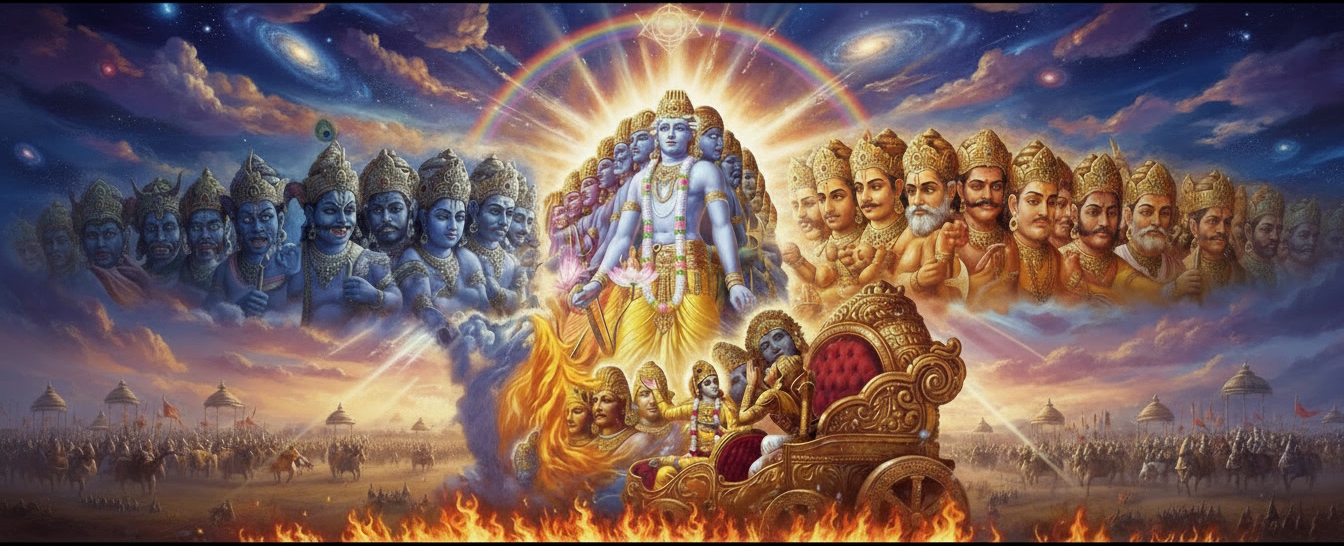
श्री भगवानुवाच सुदुर्दर्शमिदं रूपं दृष्टवानसि यन्मम।
देवा अप्यस्य रूपस्य नित्यं दर्शनकाङ्क्षिणः।।11.52।।
śrī bhagavānuvāca
sudurdarśamidaṃ rūpaṃ dṛṣṭavānasi yanmama|
devā apyasya rūpasya nityaṃ darśanakāṅkṣiṇaḥ||11.52||
Translation
The Blessed Lord said Very hard indeed it is to see this form of Mine which thou hast seen. Even the gods are ever longing to behold it.
हिंदी अनुवाद
श्रीभगवान् बोले -- मेरा यह जो रूप तुमने देखा है, इसके दर्शन अत्यन्त ही दुर्लभ हैं। इस रूपको देखनेके लिये देवता भी नित्य लालायित रहते हैं।
Commentaries & Translations
Swami Ramsukhdas
व्याख्या--'सुदुर्दर्शमिदं रूपं दृष्टवानसि यन्मम'--यहाँ 'सुदुर्दर्शम्' पद चतुर्भुजरूपके लिये ही आया है, विराट्रूप या द्विभुजरूपके लिये नहीं। कारण कि विराट्रूपकी तो देवता भी कल्पना क्यों करने लगे ! और मनुष्यरूप जब मनुष्योंके लिये सुलभ था, तब देवताओंके ल,ये वह दुर्लभ कैसे होता ! इसलिये 'सुदुर्दर्शम्' पदसे भगवान् विष्णुका चतुर्भुजरूप ही लेना चाहिये, जिसके लिये 'देवरूपम्' (11। 45) और स्वकं रूपम् (11। 50) पद आये हैं।
Sri Harikrishnadas Goenka
श्रीभगवान् बोले -- मेरे जिस रूपको तूने देखा है? वह बड़ा दुर्दर्श है अर्थात् जिसका दर्शन बड़ी कठिनतासे हो? ऐसा है। देवता लोग भी मेरे इस रूपका दर्शन करनेकी सदा इच्छा करते हैं। अभिप्राय यह है कि दर्शनकी इच्छा करते हुए भी उन्होंने तेरी भाँति ( मेरा रूप ) देखा नहीं है और देखेंगे भी नहीं।,
Sri Anandgiri
To praise the Universal Form for the sake of its worshippability, (the commentator) introduces the statement of the Lord -- 'Bhagavān iti' (The Lord said).
He clarifies the fact that this form is impossible to be seen by those other than you (tvad-vyatiriktānām) by the statement -- 'Devādayaḥ iti' (Gods, etc. said).
Sri Dhanpati
Having heard this, the Blessed Lord spoke to avoid the futility of the extremely rare grace done by Him.
That form of mine which you have seen by My grace, that is 'sudurdarśam' (very difficult to see) for others, meaning whose vision occurs with great (suṣṭhu) difficulty, with extreme hardship. Because even the most excellent, Sāttvika (pure), and seekers of that vision (tad-darśanārthinaḥ) Devas (Gods), like Indra etc., have not seen it like you, nor will they see it – with this intention (the Lord) says 'Devā iti' (Gods, etc.).
Sri Neelkanth
Showing the rarity of this vision of the Universal Form, the Blessed Lord spoke -- 'Sudurdarśam' (Very difficult to see).
'Darśanakāṅkṣiṇaḥ' (Those desirous of the vision) only desire the vision, but do not attain it.
Sri Ramanuja
The Blessed Lord spoke -- This form of mine, which is situated in the governance of all, is the support of all, is the cause of all, which you have seen
that is 'sudurdarśam' (very difficult to see); it cannot be seen by anyone.
Even the Devas (Gods) are eternally desirous of the vision of this form, but they have not seen it.
Why? - on this, (the Lord) speaks (in the subsequent verse) --
Sri Sridhara Swami
Showing the extreme rarity of the grace done by Himself, the Blessed Lord spoke -- 'Sudurdarśam' (Very difficult to see) etc.
That Universal Form of mine which you have seen, this is 'sudurdarśam', meaning extremely impossible to see.
Therefore, even the Devas (Gods) desire the vision of this form always, (but) not only do they not see it again (not even once in reality is the implied meaning in context).
Sri Vedantadeshikacharya Venkatanatha
Since the word 'yat' (which) refers to the well-known (famous), (Ramanuja) states the well-known features (ākārān) beginning with 'sarvasya praśāsane'vastitam' (situated in the governance of all) etc.
Assuming that the reliance on the untenable connection (agati) of the word 'nityam' (eternally) with the vision of a part of the substance is improper, (Ramanuja) says 'na tu dṛṣṭavantaḥ' (but they have not seen) with the intention that the eternality of the desire implies the absence of the vision.
Swami Chinmayananda
See Commentary under 11.53.
Sri Madhusudan Saraswati
Showing the extreme rarity of the grace done by Himself, the Blessed Lord spoke with four (verses) -- 'Sudurdarśam' (Very difficult to see) etc.
That form of mine which you have seen now, this Universal Form is 'sudurdarśam', meaning extremely impossible to see.
Because even the Devas (Gods) are eternally (nityam) desirous of the vision of this form, but the intention is that they have not seen it before like you, nor will they see it later. The eternality is stated due to the desire for the vision.
Sri Purushottamji
The Blessed Lord states the extreme rarity of His form, due to its being achievable only by His grace, with 'Sudurdarśam' (Very difficult to see) etc. This visible form of mine is 'sudurdarśam', meaning it is impossible to see even with great difficulty, which you have seen. The Devas (Gods) too, who are fit for My sport, who are even My parts, remain perpetually (nityam), daily, desirous of the vision of this (form), meaning they are desirous of seeing it.
Here is the sense -- The Devas like Brahmā etc. went away after praising (the Lord) in Śrī Devakī's house; then the manifestation (prākaṭya) occurred only in the womb, not outside. After the external manifestation, however, due to the mother's prayer, (the form) was withdrawn (tirohita) and established as the object of meditation. For the Devas etc., due to ignorance of that account, and worship according to the method stated in the Vedas, only the vision of a form of that kind occurs. And this form is bhāvātmakam (of the nature of feeling/realization), unobtainable by the Vedas etc., and also because it is heard from the mouth of a devotee, (the Devas) remain desirous, thus (it is said).
Sri Shankaracharya
'Sudurdarśam' – That whose vision is with great (suṣṭhu) difficulty is 'sudurdarśam' (very difficult to see). This form of mine which you have seen?
Even the Devas (Gods), though eternally (nityam), always desirous of the vision of this form of mine, i.e., wishing to see it, have not seen it like you, and nor will they see it -- this is the intention.
Why? (kasmāt) -- (He says in the next verse) --
Sri Vallabhacharya
Then, describing the extreme difficulty of vision (sudurdarśatvam) of the Form in such a state, and in context, He concludes (nigamayati) His own attainability as being only through the grace of devotion with three (verses) -- 'Sudurdarśam' (Very difficult to see) etc.
This form related to Me, the imperishable (akṣara), the Universal Form, which you have seen? Since I (Myself) am sudurdarśam (having a very difficult vision), what need to be said about this form related to Me? That very thing He states -- 'Devā api' (Even the Gods).
Even though they are sāttvika (pure), they (the Gods) are eternally desirous of the vision? But they have not seen it, due to the absence of the element of the seed of grace.
Swami Sivananda
सुदुर्दर्शम् very hard to see? इदम् this? रूपम् form? दृष्टवानसि thou hast seen? यत् which? मम My? देवाः gods? अपि also? अस्य (of) this? रूपस्य of form? नित्यम् ever? दर्शनकाङ्क्षिणः (are) desrious to behold.Commentary Lord Krishna says to Arjuna Though the gods long to behold the Cosmic Form yet they have not seen it as you have done. THey can never behold it.Just as the Chataka (a bird) longs for a drop of rain? eagerly turning its eyes towards the clouds? so also do gods yearn to behold the Cosmic Form but their wishes have not been gratified even in their dreams. Such is that marvellous vision which thou hast easily seen.
Swami Gambirananda
Idam, this; rupam, form; mama, of Mine; yat, which; drstavan, asi, you have seen is; sudur-darsam, very difficult to see. Api, even; the devah, gods; are nityam, ever; darsana-kanksinah, desirous of a vision; asya, of this; rupasya, form of Mine. The idea is that though they want to see, they have not seen in the way you have, nor will they see!
Why so?
Swami Adidevananda
The Lord said This form of Mine which you have seen, and which has the whole universe under control, which is the foundation of all and which forms the origin of all - this cannot be beheld by any one. Even the gods ever long to see this form; but they have not seen it.
Why? Sri Krsna says: