Bhagavad Gita - Chapter 14 - Shloka (Verse) 21
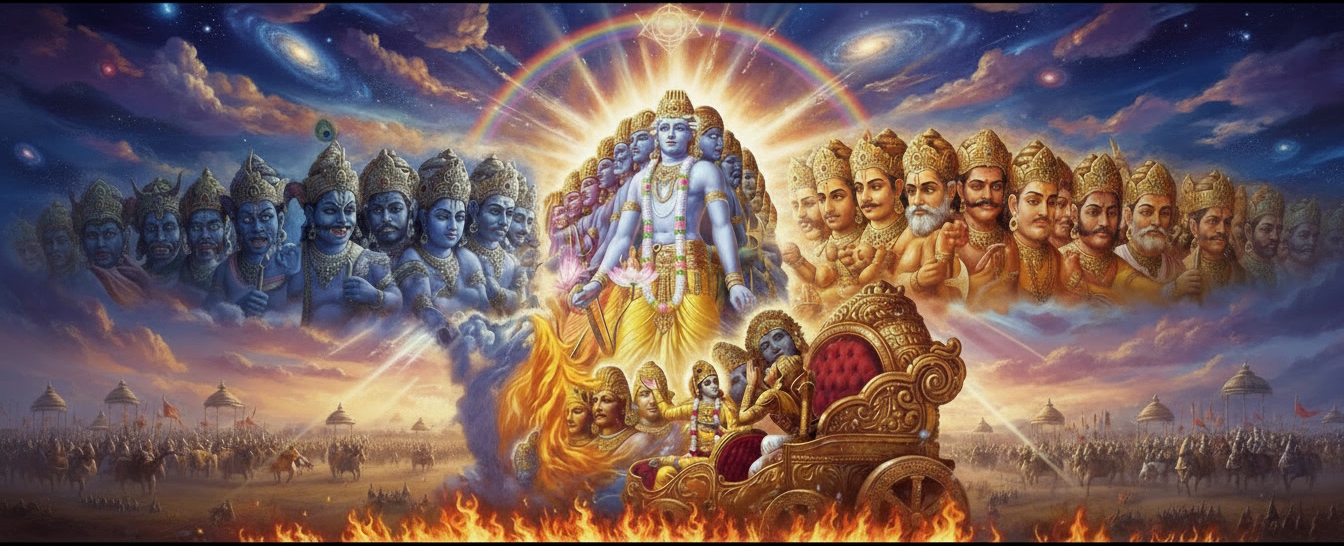
अर्जुन उवाचकैर्लिंगैस्त्रीन्गुणानेतानतीतो भवति प्रभो।
किमाचारः कथं चैतांस्त्रीन्गुणानतिवर्तते।।14.21।।
arjuna uvācakairliṃgaistrīnguṇānetānatīto bhavati prabho|
kimācāraḥ kathaṃ caitāṃstrīnguṇānativartate||14.21||
Translation
Arjuna said What are the marks of him who has transcended the three alities, O Lord? What is his conduct and how does he go beyond these three alities?
हिंदी अनुवाद
अर्जुन बोले -- हे प्रभो ! इन तीनों गुणोंसे अतीत हुआ मनुष्य किन लक्षणोंसे युक्त होता है? उसके आचरण कैसे होते हैं? और इन तीनों गुणोंका अतिक्रमण कैसे किया जा सकता है?
Commentaries & Translations
Swami Ramsukhdas
व्याख्या -- कैर्लिङ्गैस्त्रीन्गुणानेतानतीतो भवति प्रभो -- हे प्रभो मैं यह जानना चाहता हूँ कि जो गुणोंका अतिक्रमण कर चुका है? ऐसे मनुष्यके क्या लक्षण होते हैं तात्पर्य है कि संसारी मनुष्यकी अपेक्षा गुणातीत मनुष्यमें ऐसी कौनसी विलक्षणता आ जाती है? जिससे साधारण व्यक्ति समझ ले कि यह गुणातीत पुरुष हैकिमाचारः -- उस गुणातीत मनुष्यके आचरण कैसे होते हैं अर्थात् साधारण आदमीकी जैसी दिनचर्या और रात्रिचर्या होती है? गुणातीत मनुष्यकी वैसी ही दिनचर्यारात्रिचर्या होती है या उससे विलक्षण होती है साधारण आदमीके जैसे आचरण होते हैं जैसा खानपान? रहनसहन? सोनाजागना होता है? गुणातीत मनुष्यके आचरण? खानपान आदि भी वैसे ही होते हैं या कुछ विलक्षण होते हैंकथं चैतांस्त्रीन्गुणानतिवर्तते -- इन तीनों गुणोंका अतिक्रमण करनेका क्या उपाय है अर्थात् कौनसा साधन करनेसे मनुष्य गुणातीत हो सकता है सम्बन्ध -- अर्जुनके प्रश्नोंसे पहले प्रश्नके उत्तरमें भगवान् आगेके दो श्लोकोंमें गुणातीत मनुष्यके लक्षणोंका वर्णन करते हैं।
Sri Harikrishnadas Goenka
शरीरधारी जीव ) जीता हुआ ही गुणोंको अतिक्रम करके अमृतका अनुभव करता है इस प्रश्नबीजको पाकर अर्जुन बोला --, हे प्रभो इन पूर्ववर्णित तीनों गुणोंसे अतीत -- पार हुआ पुरुष किनकिन लक्षणोंसे युक्त होता है और वह कैसे आचरणवाला होता है अर्थात् उसके आचरण कैसे होते हैं तथा किस प्रकारसे ( किस उपायसे ) मनुष्य इन तीनों गुणोंसे अतीत हो सकता है।
Sri Anandgiri
Having heard that immortality preceded by transcending Gunas is said to be the fruit of right knowledge, intending that the characteristics of the liberated one should be stated as the topic, he raises the question -- 'Jivanneva' (Indeed while living) etc.
The explained qualities Sattva etc., having transcended the superimpositions which are their modifications, by what signs is he known? Those should be stated, which are to be practiced before for attainment and are effortless signs afterwards? What are they, he asks -- 'Kaih' (By what).
To exclude arbitrary behavior, another question -- 'Kimacharah' (What is his conduct).
Since knowledge, the means to transcend Gunas, has been stated, another question due to desire to know the mode of the means -- 'Katham' (How).
Sri Dhanpati
Having heard the fruit of right knowledge stated by the Lord as the attainment of immortality preceded by the cessation of all evils through transcending Gunas, obtaining the seed of the question, desiring to know well the characteristics, conduct, and means of transcending Gunas of one beyond Gunas, Arjuna said -- 'Kaih' etc.
By what signs, marks, is one 'Atitah', transcended, these mentioned three Gunas? By what signs does one become 'Prabhuh', capable, in transcending Gunas? Indicating this he addresses as 'Prabho' (O Lord). Or the intention of the address is 'You are extremely capable in solving this and other questions'.
'What is his conduct', thus 'Kimacharah'; and 'Katham', in what manner does he cross beyond these three Gunas? Tell the definition of one beyond Gunas through signs and conduct, and the means of transcending Gunas; this is the meaning.
Sri Neelkanth
The mode of liberation from Prakriti having been stated, now asking the characteristics of the liberated one, Arjuna said -- 'Kaih' etc.
By what signs, marks, does a man become 'Atitah' (transcended) these explained three Gunas, O Lord? And 'Kimacharah', what is his conduct? 'Katham', and in what manner, does he exist having transcended these three Gunas?
Sri Ramanuja
Arjuna said -- One who has transcended these three Gunas Sattva etc., 'Kairlingaih', by what characteristics is he distinguished? 'Kimacharah', with what conduct is he endowed? What is the conduct which serves as a sign for understanding his nature? This is the meaning.
'Katham cha' (And how), by what means does he cross beyond these three Gunas Sattva etc.?
Sri Sridhara Swami
Having heard 'Having transcended these Gunas he enjoys immortality', desiring to know well the characteristics, conduct, and means of transcending Gunas of one beyond Gunas, Arjuna said -- 'Kairlingaih' etc.
O Lord? 'Kairlingaih', by what kind of signs produced in the self does the embodied one become beyond Gunas? This is a question about definition.
'Whose conduct is it', thus 'Kimacharah'. How does he behave, this is the meaning.
And 'Katham', by what means does he exist having transcended these three Gunas also? Tell that.
Sri Vedantadeshikacharya Venkatanatha
To describe one's own state etc., [he] introduces Arjuna's question — "Atha" etc. "By what marks" and "what conduct" — because these two refer to internal and external indicators respectively, they form one group, and "how" is a separate question regarding the means — intending this, [he] states: indication of nature, mode of conduct, and the cause of transcending the Gunas.
Since the word "linga" is used even for dress etc., and that is not a sign (linga) regarding the cause of dharma, and thus unfit to characterize one who has transcended Gunas, intending the specific internal attributes like tranquility (Shama) etc., [he] says — "by what characteristics". Regarding "kimācāraḥ", intending the Bahuvrihi compound "kaḥ asya ācāraḥ" (what is his conduct), [he] says — "endowed with what conduct is he". Here, [he] states that the word "achara" refers to invariable external signs — "becoming a sign for the understanding of his nature". Although transcendence of Gunas might be perceived in oneself by internal [signs] knowable only to oneself, yet in others, it is inferred by external conduct; therefore, this is a separate question — this is the idea.
Since the word "katham" (how) is understood to refer to the method acting as the means from the manner of the reply, [he] rejects meanings referring to objection or the mode of the fruit-stage external to practice — [saying] "by what means".
Swami Chinmayananda
दर्शनशास्त्र के प्रारम्भिक अध्ययन के समय की अपरिहार्य कठिनाई और थकान दूर करने तथा अध्ययन को और अधिक मनोरंजन बनाने के लिये गीता की रचना संवाद शैली में की गई है। यह स्पष्ट है कि पूर्ण ज्ञानी भगवान् श्रीकृष्ण और मोहित पुरुष अर्जुन के इस संवाद में? कवि व्यास जी को तात्त्विक विवेचन के समय भी मानव स्वभाव का विस्मरण नहीं हुआ है। ज्ञानियों की किसी भी सभा में अर्जुन के प्रश्न बालसुलभ कौतूहल अथवा केवल बुद्धिचातुर्य के समान प्रतीत होंगे। तथापि जिस धैर्य के साथ भगवान् श्रीकृष्ण मध्यम बुद्धि के शिष्य के प्रश्नों का उत्तर देते हैं उससे ज्ञात होता है कि एक ब्रह्मनिष्ठ ज्ञानी पुरुष का यह कर्तव्य है कि उसको संयमी अथवा नास्तिक लोगों के द्वारा पूछे गये प्रश्नों के उत्तर भी विस्तारपूर्वक देने चाहिये।यदि ज्ञानदान की ऐसी स्वस्थ परंपरा को प्राप्त करने का सौभाग्य हमें मिला है? तथापि किसी कारण से? इसे रहस्य बनाये रखने की एक दुष्टभावना हमारी गौरवमयी संस्कृति की एक स्वस्थ परम्परा को लूटे लिये जा रही है। तत्त्वज्ञान के सिद्धान्तों को विचार मन्थन के द्वारा जब प्रकाश में नहीं लाया जाता? तब वे नष्टप्राय होने लगते हैं। प्रत्येक जिज्ञासु शिष्य को यह स्वतंत्रता है कि सर्वप्रथम तत्त्वज्ञान के सिद्धान्तों को भलीभाँति समझने के लिये प्रश्न पूछ सके। उन्हें समझने पर ही उनके महत्त्व को पहचाना जा सकता है। जब तक इस प्रकार की समझ और पहचान नहीं होती तब तक हम उन सिद्धान्तों को अपने दैनिक जीवन में नहीं जी सकते। हिन्दू दर्शन एक जीवनपद्धति है? न कि जीवन की ओर देखने का केवल एक दृष्टिकोण। इसलिए आवश्यक है कि इस ज्ञान को हम अपने जीवन में जियें।यहाँ अर्जुन ने तीन प्रश्न पूछे हैं (1) तीनों गुणों से अतीत हुये पुरुष के लक्षण क्या हैं जिनसे उसकी पहचान हो सकती है (2) उसका आचरण किस प्रकार का होगा और (3) किस प्रकार वह ज्ञानी पुरुष त्रिगुणों से अतीत होकर अपने आत्मवैभव को प्राप्त होता है इनके उत्तर में भगवान् श्रीकृष्ण सर्वप्रथम त्रिगुणातीत पुरुष के लक्षण बताते है
Sri Abhinavgupta
'Kaih' (By what marks...), etc.
Objection: If this is an embodied being; then how does he become one who has transcended the Gunas (Gunatita)? For in every way, he exists through some mental modification (chitta-vritti); and that (modification) is necessarily one among the three Gunas.
With this intention, Arjuna asks.
Sri Madhusudan Saraswati
Having heard 'Having transcended these Gunas, he enjoys immortality even while living', desiring to know well the characteristics and conduct of one beyond Gunas and the means to be beyond Gunas, Arjuna said --
He who has transcended these Gunas, 'Kairlingaih', by what signs is he distinguished? Tell me those signs by which he can be known; this is one question. Indicating that due to lordship, the servant's pain is to be removed by the Lord alone, he addresses as 'Prabho' (O Lord).
'Kah acharah asya' (What is his conduct), thus 'Kimacharah'; does he act as he pleases or is he restrained? This is the second question.
'Katham cha', and in what manner, does he 'Ativartate', cross beyond, these three Gunas? What is the means to be beyond Gunas? This is the third question.
Sri Purushottamji
"Thus these three Gunas" was said by the Lord? Therefore, thinking "There are other Gunas also by which the transcending of these happens", Arjuna submits exactly that -- "Kairlingaih" etc.
O Lord, capable of doing everything, "Kairlingaih", by what signs does one become "Atita" (transcended) these three binding Gunas? Meaning, having transcended, he becomes possessed of a supernatural body.
"Tatah" (Then), after attaining the body, "Kimacharah", possessed of what kind of conduct (is he)? And again, having transcended these three Gunas, "Katham", by what means does he exist? Tell that, this is the meaning.
Sri Shankaracharya
"Kairlingaih", by what signs, marks, does one become "Atitah", transcended, these three explained Gunas, O Lord? "Kimacharah", what is his conduct, thus "Kimacharah"? "Katham", and in what manner, does he "Ativartate", exist having transcended, these three Gunas?
Asked by Arjuna about the definition of one beyond Gunas and the means to be beyond Gunas, Sri Bhagavan spoke the reply in this verse for the purpose of the two questions.
First, regarding "endowed with what signs does one become beyond Gunas?", listen to that --
Sri Bhagavan said --
Sri Vallabhacharya
Now, desiring to know the definition, conduct, and cause of transcending Gunas of one beyond Gunas, Arjuna said -- "Kairlingaih" etc.
By what characteristics is one distinguished as having transcended the three Gunas; "Kimacharah" (what is his conduct); "Katham", by what means or in the form of cause does he cross beyond the three Gunas?
Swami Sivananda
कैः by what? लिंगैः by marks? त्रीन् three? गुणान् Gunas? एतान् these? अतीतः crossed? भवति becomes? प्रभो O Lord? किमाचारः what (is his) conduct? कथम् how? च and? एतान् these? त्रीन् three? गुणान् Gunas? अतिवर्तते goes beyond.Commentary Arjuna said O Lord? by what characteristics may a man be recognised as having gone beyond the three alities What is the behaviour of that Trigunatita sage (one who has gone beyond the three alities) and how does he go beyond the world and is above the Gunas Tell me that.These are the characteristics of the sage who has gone beyond the Gunas others should cultivate them.Just as a king is able to remove the grievances and sorrows of his servants? so also the Lord is able to remove the sorrows of His devotees. That is the reason why Arjuna addresses Sri Krishna as Lord and uses the term Prabhu. By using this word? Arjuna hinted to the Lord that He alone was capable of relieving his sorrows and pains. (Cf.II.54)
Swami Gambirananda
Prabho, O Lord; kaih, by what; lingaih, signs; bhavati, is one (known); atitah, who has gone beyond; etan, these; trin, three; gunan, alities that have been explained? Kim, what; is his acarah, behaviour; ca, and; katham, how, in what way; ativartate, does he transcend; [Ast. adds here, 'atitya vartate, (in what way) does he exist after transcending (the three alities)?'-Tr.] etan, these; trin, three; gunan, alities?
In this verse the signs of one who has gone beyond the alities, and the means of transcending them have been asked by Arjuna. By way of replying to the two estions, the Lord said: 'As for the estion, 'With what sings does one who has gone beyond the alities become endowed with?", listen to them:'
Swami Adidevananda
Arjuna said By what signs, namely, distinguishing features, is a man who has crossed beyond these three Gunas, Sattva and the rest, characterised? What is his behaviour? With what kind of behaviour is he associated and how does it serve as a sign for knowing his state? Such is the meaning. How does he, i.e., by what means does he cross beyond the three Gunas, the Sattva and the rest?