Bhagavad Gita - Chapter 18 - Shloka (Verse) 66
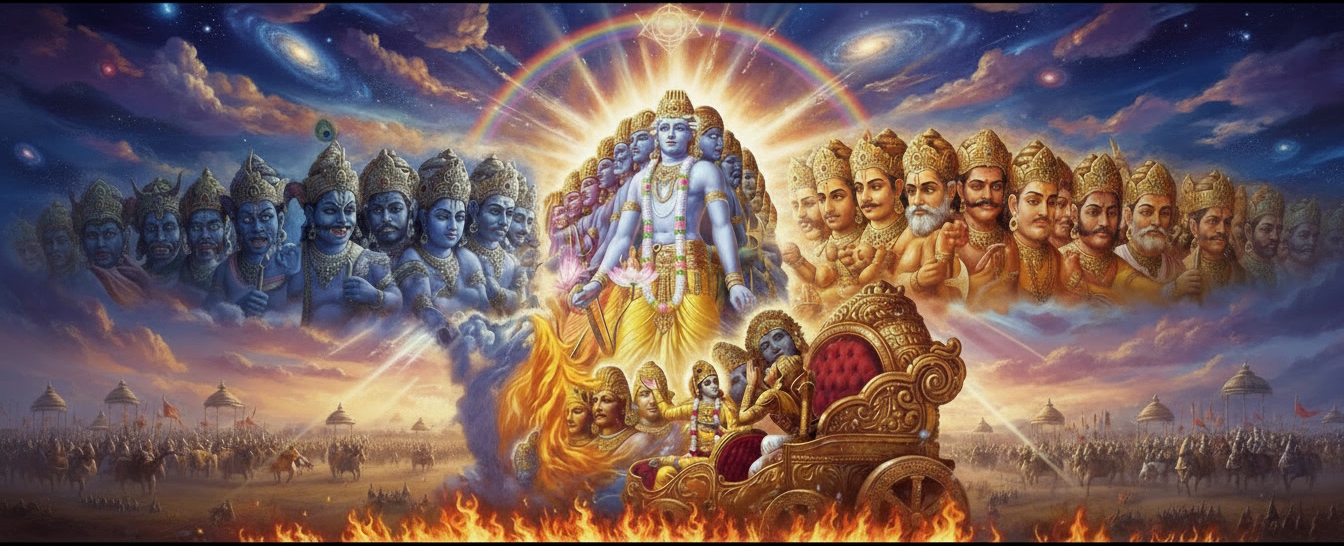
सर्वधर्मान्परित्यज्य मामेकं शरणं व्रज।
अहं त्वा सर्वपापेभ्यो मोक्षयिष्यामि मा शुचः।।18.66।।
sarvadharmānparityajya māmekaṃ śaraṇaṃ vraja|
ahaṃ tvā sarvapāpebhyo mokṣayiṣyāmi mā śucaḥ||18.66||
Translation
Abandoning all duties, take refuge in Me alone: I will liberate thee from all sins; grieve not.
हिंदी अनुवाद
सम्पूर्ण धर्मोंका आश्रय छोड़कर तू केवल मेरी शरणमें आ जा। मैं तुझे सम्पूर्ण पापोंसे मुक्त कर दूँगा, चिन्ता मत कर।
Commentaries & Translations
Swami Ramsukhdas
सर्वधर्मान्परित्यज्य मामेकं शरणं व्रज -- भगवान् कहते हैं कि सम्पूर्ण धर्मोंका आश्रय? धर्मके निर्णयका विचार छोड़कर अर्थात् क्या करना है और क्या नहीं करना है -- इसको छोड़कर केवल एक मेरी ही शरणमें आ जा।स्वयं भगवान्के शरणागत हो जाना -- यह सम्पूर्ण साधनोंका सार है। इसमें शरणागत भक्तको अपने लिये कुछ भी करना शेष नहीं रहता जैसे -- पतिव्रताका अपना कोई काम नहीं रहता। वह अपने शरीरकी सारसँभाल भी पतिके नाते? पतिके लिये ही करती है। वह घर? कुटुम्ब? वस्तु? पुत्रपुत्री और अपने कहलानेवाले शरीरको भी अपना नहीं मानती? प्रत्युत पतिदेवका ही मानती है। तात्पर्य यह हुआ कि जिस प्रकार पतिव्रता पतिके परायण होकर पतिके गोत्रमें ही अपना गोत्र मिला देती है और पतिके ही घरपर रहती है? उसी प्रकार शरणागत भक्त भी शरीरको लेकर माने जानेवाले गोत्र? जाति? नाम आदिको भगवान्के चरणोंमें अर्पण करके निर्भय? निःशोक? निश्चिन्त और निःशङ्क हो जाता है।गीताके अनुसार यहाँ धर्म शब्द कर्तव्यकर्मका वाचक है। कारण कि इसी अध्यायके इकतालीसवेंसे चौवालीसवें श्लोकतक स्वभावज कर्म शब्द आये हैं? फिर सैंतीलीसवें श्लोकके पूर्वार्धमें स्वधर्म शब्द आया है। उसके बाद? सैंतालीसवें श्लोकके ही उत्तरार्धमें तथा (प्रकरणके अन्तमें) अड़तालीसवें श्लोकमें कर्म शब्द आया है। तात्पर्य यह हुआ कि आदि और अन्तमें कर्म शब्द आया है और बीचमें स्वधर्म शब्द आया है तो इससे स्वतः ही धर्म शब्द कर्तव्यकर्मका वाचक सिद्ध हो जाता है।अब यहाँ प्रश्न यह होता है कि सर्वधर्मान्परित्यज्य पदसे क्या धर्म अर्थात् कर्तव्यकर्मका स्वरूपसे त्याग माना जाय इसका उत्तर यह है कि धर्मका स्वरूपसे त्याग करना न तो गीताके अनुसार ठीक है और न यहाँके प्रसङ्गके अनुसार ही ठीक है क्योंकि भगवान्की यह बात सुनकर अर्जुनने कर्तव्यकर्मका त्याग नहीं किया है? प्रत्युत करिष्ये वचनं तव (18। 73) कहकर भगवान्की आज्ञाके अनुसार कर्तव्यकर्मका पालन करना स्वीकार किया है। केवल स्वीकार ही नहीं किया है? प्रत्युत अपने क्षात्रधर्मके अनुसार युद्धि भी किया है। अतः उपर्युक्त पदमें धर्म अर्थात् कर्तव्यका त्याग करनेकी बात नहीं है। भगवान् भी कर्तव्यके त्यागकी बात कैसे कह सकते हैं भगवान्ने इसी अध्यायके छठे श्लोकमें कहा है कि यज्ञ? दान? तप और अपनेअपने वर्णआश्रमोंके जो कर्तव्य हैं? उनका कभी त्याग नहीं करना चाहिये? प्रत्युत उनको जरूर करना चाहिये (टिप्पणी प0 970.1)।गीताका पूरा अध्ययन करनेसे यह मालूम होता है कि मनुष्यको किसी भी हालतमें कर्तव्यकर्मका त्याग नहीं करना चाहिये। अर्जुन तो युद्धरूप कर्तव्यकर्म छोड़कर भिक्षा माँगना श्रेष्ठ समझते थे (2। 5) परन्तु भगवान्ने इसका निषेध किया (2। 3138)। इससे भी यही सिद्ध होता है कि यहाँ स्वरूपसे धर्मोंका त्याग नहीं है।अब विचार यह करना है कि यहाँ सम्पूर्ण धर्मोंके त्यागसे क्या लेना चाहिये गीताके अनुसार सम्पूर्ण धर्मों अर्थात् कर्मोंको भगवान्के अर्पण करना ही सर्वश्रेष्ठ धर्म है। इसमें सम्पूर्ण धर्मोंके आश्रयका त्याग करना और केवल भगवान्का आश्रय लेना -- दोनों बातें सिद्ध हो जाती हैं। धर्मका आश्रय लेनेवाले बारबार जन्ममरणको प्राप्त होते हैं -- एवं त्रयीधर्ममनुप्रपन्ना गतागतं कामकामा लभन्ते (गीता 9। 21)। इसलिये धर्मका आश्रय छोड़कर भगवान्का ही आश्रय लेनेपर फिर अपने धर्मका निर्णय करनेकी जरूरत नहीं रहती। आगे अर्जुनके जीवनमें ऐसा हुआ भी है।अर्जुनका कर्णके साथ युद्ध हो रहा था। इस बीच कर्णके रथका चक्का पृथ्वीमें धँस गया। कर्ण रथसे नीचे उतरकर रथके चक्केको निकालनेका उद्योग करने लगा और अर्जुनसे बोला कि जबतक मैं यह चक्का निकाल न लूँ? तबतक तुम ठहर जाओ क्योंकि तुम रथपर हो और मैं रथसे रहित हूँ और दूसरे कार्यमें लगा हूआ हूँ। ऐसे समय रथीको उचित है कि उसपर बाण न छोड़े। तुम सहस्रार्जुनके समान शस्त्र और शास्त्रके ज्ञाता हो और धर्मको जाननेवाले हो? इसलिये मेरे ऊपर प्रहार करना उचित नहीं है। कर्णकी बात सुनकर अर्जुनने बाण नहीं चलाया। तब भगवान्ने कर्णसे कहा कितुम्हारेजैसे आततायीको किसी तरहसे मार देना धर्म ही है पाप नहीं (टिप्पणी प0 970.2) और अभीअभी तुम छः महारथियोंने मिलकर अकेले अभिमन्युको घेरकर उसे मार डाला। अतः धर्मकी दुहाई देनेसे कोई लाभ नहीं है। हाँ? यह सौभाग्यकी बात है कि इस समय तुम्हें धर्मकी बात याद आ रही है? पर जो स्वयं धर्मका पालन नहीं करता? उसे धर्मकी दुहाई देनेका कोई अधिकार नहीं है। ऐसा कहकर भगवान्ने अर्जुनको बाण चलानेकी आज्ञा दी तो अर्जुनने बाण चलाना आरम्भ कर दिया।इस प्रकार यदि अर्जुन अपनी बुद्धिसे धर्मका निर्णय करते तो भूल कर बैठते अतः उन्होंने धर्मका निर्णय भगवान्पर ही रखा और भगवान्ने धर्मका निर्णय किया भी।अर्जुनके मनमें सन्देह था कि हमलोगोंके लिये युद्ध करना श्रेष्ठ है अथवा युद्ध न करना श्रेष्ठ है (2। 6)। यदि हम युद्ध करते हैं तो अपने कुटुम्बका नाश होता है और अपने कुटुम्बका नाश करना बड़ा भारी पाप है। इससे तो अनर्थपरम्परा ही बढ़ेगी (2। 40 -- 44)। दूसरी तरफ हमलोग देखते हैं तो क्षत्रियके लिये युद्धसे बढ़कर श्रेयका कोई साधन नहीं है। अतः भगवान् कहते हैं कि क्या करना है और क्या नहीं करना है? क्या धर्म है और क्या अधर्म है? इस पचड़ेमें तू क्यों पड़ता है तू धर्मके निर्णयका भार मेरेपर छोड़ दे। यही सर्वधर्मान्परित्यज्य का तात्पर्य है।मामेकं शरणं व्रज -- इन पदोंमें एकम् पद माम् का विशेषण नहीं हो सकता माम् (भगवान्) एक ही हैं? अनेक नहीं। इसलिये एकम् पदका अर्थ अनन्य लेना ही ठीक बैठता है। दूसरी बात? अर्जुनने तदेकं वद निश्चित्य (3। 2) और यच्छ्रेय एतयोरेकम् (5। 1) पदोंमें भी एकम् पदसे सांख्य और कर्मयोगके विषयमें एक निश्चित श्रेयका साधन पूछा है। उसी एकम् पदको लेकर भगवान् यहाँ यह बताना चाहते हैं कि सांख्ययोग? कर्मयोग आदि जितने भी भगवत्प्राप्तिके साधन हैं? उन सम्पूर्ण साधनोंमें मुख्य साधन एक अनन्य शरणागति ही है।गीतामें अर्जुनने अपने कल्याणके साधनके विषयमें कई तरहके प्रश्न किये और भगवान्ने उनके उत्तर भी दिये। वे सब साधन होते हुए भी गीताके पूर्वापरको देखनेसे यह बात स्पष्ट दीखती है कि सम्पूर्ण साधनोंका सार और शिरोमणि साधन भगवान्के अनन्यशरण होना ही है।भगवान्ने गीतामें जगहजगह अनन्यभक्तिकी बहुत महिमा गायी है। जैसे? दुस्तर मायाको सुगमतासे तरनेका उपाय अनन्य शरणागति ही है (टिप्पणी प0 971.1) (7। 14) अनन्यचेताके लिये मैं सुलभ हूँ (टिप्पणी प0 971.2) (8। 14) परम पुरुषकी प्राप्ति अनन्य भक्तिसे ही होती है (8। 22) अनन्य भक्तोंका योगक्षेम मैं वहन करता हूँ (9। 22) अनन्य भक्तिसे ही भगवान्को जाना? देखा तथा प्राप्त किया जा सकता है (11। 54) अनन्य भक्तोंका मैं बहुत जल्दी उद्धार करता हूँ (12। 37) गुणातीत होनेका उपाय अनन्यभक्ति ही है (14। 26)। इस प्रकार अनन्य भक्तिकी महिमा गाकर भगवान् यहाँ पूरी गीताका सार बताते हैं -- मामेकं शरणं व्रज। तात्पर्य है कि उपाय और उपेय? साधन और साध्य मैं ही हूँ।मामेकं शरणं व्रज का तात्पर्य मनबुद्धिके द्वारा शरणागतिको स्वीकार करना नहीं है? प्रत्युत स्वयंको भगवान्की शरणमें जाना है। कारण कि स्वयंके शरण होनेपर मन? बुद्धि? इन्द्रियाँ? शरीर आदि भी उसीमें आ जाते हैं? अलग नहीं रहते।अहं त्वा सर्वपापेभ्यो मोक्षयिष्यामि मा शुचः -- यहाँ कोई ऐसा मान सकता है कि पहले अध्यायमें अर्जुनने जो युद्धसे पाप होनेकी बातें कही थीं? उन पापोंसे छुटकारा दिलानेका प्रलोभन भगवान्ने दिया है। परन्तु यह मान्यता यक्तिसंगत नहीं है क्योंकि जब अर्जुन सर्वथा भगवान्के शरण हो गये हैं? तब उनके पाप कैसे रह सकते हैं (टिप्पणी प0 971.3) और उनके लिये प्रलोभन कैसे दिया जा सकता है अर्थात् उनके लिये,प्रलोभन देना बनता ही नहीं। हाँ? पापोंसे मुक्त करनेका प्रलोभन देना हो तो वह शरणागत होनेके पहले ही दिया जा सकता है? शरणागत होनेके बाद नहीं। मैं तुझे सम्पूर्ण पापोंसे मुक्त कर दूँगा -- इसका भाव यह है कि जब तू सम्पूर्ण धर्मोंका आश्रय छोड़कर मेरी शरणमें आ गया और शरण होनेके बाद भी तुम्हारे भावों? वृत्तियों? आचरणों आदिमें फरक नहीं पड़ा अर्थात् उनमें सुधार नहीं हुआ भगवत्प्रेम? भगवद्दर्शन आदि नहीं हुए और अपनेमें अयोग्यता? अनधिकारिता? निर्बलता आदि मालूम होती है? तो भी उनको लेकर तुम चिन्ता या भय मत करो। कारण कि जब तुम मेरी अनन्यशरण हो गये तो वह कमी तुम्हारी कमी कैसे रही उसका सुधार करना तुम्हारा काम कैसे रहा वह कमी मेरी कमी है। अब उस कमीको दूर करना? उसका सुधार करना मेरा काम रहा। तुम्हारा तो बस? एक ही काम है वह काम है -- निर्भय? निःशोक? निश्चिन्त और निःशङ्क होकर मेरे चरणोंमें पड़े रहना (टिप्पणी प0 972.1) परन्तु अगर तेरेमें भय? चिन्ता? वहम आदि दोष आ जायँगे तो वे शरणागतिमें बाधक हो जायँगे और सब भार तेरेपर आ जायगा। शरण होकर अपनेपर भार लेना शरणागतिमें कलङ्क है।जैसे? विभीषण भगवान् रामके चरणोंकी शरण हो जाते हैं? तो फिर विभीषणके दोषको भगवान् अपना ही दोष मानते हैं। एक समय विभीषणजी समुद्रके इस पार आये। वहाँ विप्रघोष नामक गाँवमें उनसे एक अज्ञात ब्रह्महत्या हो गयी। इसपर वहाँके ब्राह्मणोंने इकट्ठे होकर विभीषणको खूब मारापीटा? पर वे मरे नहीं। फिर ब्राह्मणोंने उन्हें जंजीरोंसे बाँधकर जमीनके भीतर एक गुफामें ले जाकर बंद कर दिया। रामजीको विभीषणके कैद होनेका पता लगा तो वे पुष्पकविमानके द्वारा तत्काल विप्रघोष नामक गाँवमें पहुँच गये और वहाँ विभीषणका पता लगाकर उनके पास गये। ब्राह्मणोंने रामजीका बहुत आदरसत्कार किया और कहा कि महाराज इसने ब्रह्महत्या कर दी है। इसको हमने बहुत मारा? पर यह मरा नहीं। भगवान् रामने कहा कि हे ब्राह्मणों विभीषणको मैंने कल्पतककी आयु और राज्य दे रखा है? वह कैसे मारा जा सकता है और उसको मारनेकी जरूरत ही क्या है वह तो मेरा भक्त है। भक्तके लिये मैं स्वयं मरनेको तैयार हूँ। दासके अपराधकी जिम्मेवारी वास्तवमें उसके मालिकपर ही होती है अर्थात् मालिक ही उसके दण्डका पात्र होता है। अतः विभीषणके बदलेमें आपलोग मेरेको ही दण्ड दें (टिप्पणी प0 972.2)। भगवान्की यह शरणागतवत्सलता देखकर सब ब्राह्मण आश्यर्य करने लगे और उन सबने भगवान्की शरण ले ली।तात्पर्य यह हुआ कि मैं भगवान्का हूँ और भगवान् मेरे हैं -- इस अपनेपनके समान योग्यता? पात्रता?,अधिकारिता आदि कुछ भी नहीं है। यह सम्पूर्ण साधनोंका सार है। छोटासा बच्चा भी अपनेपनके बलपर ही आधी रातमें सारे घरको नचाता है अर्थात् जब वह रातमें रोता है तो सारे घरवाले उठ जाते हैं और उसे राजी करते हैं। इसलिये शरणागत भक्तको अपनी योग्यता आदिकी तरफ न देखकर भगवान्के साथ अपनेपनकी तरफ ही देखते रहना चाहिये।, मा शुचः का तात्पर्य है -- (1) मेरे शरण होकर तू चिन्ता करता है? यह मेरे प्रति अपराध है? तेरा अभिमान है और शरणागतिमें कलङ्क है।मेरे शरण होकर भी मेरा पूरा विश्वास? भरोसा न रखना ही मेरे प्रति अपराध है। अपने दोषोंको लेकर चिन्ता करना वास्तवमें अपने बलका अभिमान है क्योंकि दोषोंको मिटानेमें अपनी सामर्थ्य मालूम देनेसे ही उनको मिटानेकी चिन्ता होती है। हाँ? अगर दोषोंको मिटानेमें चिन्ता न होकर दुःख होता है तो दुःख होना इतना दोषी नहीं है। जैसे? छोटे बालकके पास कुत्ता आता है तो वह कुत्तेको देखकर रोता है? चिन्ता नहीं करता। ऐसे ही दोषोंका न सुहाना दोष नहीं है? प्रत्युत चिन्ता करना दोष है। चिन्ता करनेका अर्थ यही होता है कि भीतरमें अपने छिपे हुए बलका आश्रय है (टिप्पणी प0 972.3) और यही तेरा अभिमान है। मेरा भक्त होकर भी तू चिन्ता करता है तो तेरी चिन्ता दूर कहाँ होगी लोग भी देखेंगे तो यही कहेंगे कि यह भगवान्का भक्त,है और चिन्ता करता है भगवान् इसकी चिन्ता नहीं मिटाते तू मेरा विश्वास न करके चिन्ता करता है तो विश्वासकी कमी तो है तेरी और कलङ्क आता है मेरेपर? मेरी शरणागतिपर। इसको तू छोड़ दे।(2) तेरे भाव? वृत्तियाँ? आचरण शुद्ध नहीं हुए हैं तो भी तू इनकी चिन्ता मत कर। इनकी चिन्ता मैं करूँगा।(3) दूसरे अध्यायके सातवें श्लोकमें अर्जुन भगवान्के शरण हो जाते हैं और फिर आठवें श्लोकमें कहते हैं कि इस भूमण्डलका धनधान्यसे सम्पन्न निष्कण्टक राज्य मिलनेपर अथवा देवताओंका आधिपत्य मिलनेपर भी इन्द्रियोंको सुखानेवाला मेरा शोक दूर नहीं हो सकता। भगवान् मानो कह रहे हैं कि तेरा कहना ठीक ही है क्योंकि भौतिक नाशवान् पदार्थोंके सम्बन्धसे किसीका शोक कभी दूर हुआ नहीं? हो सकता नहीं और होनेकी सम्भावना भी नहीं। परन्तु मेरे शरण होकर जो तू शोक करता है? यह तेरी बड़ी भारी गलती है। तू मेरे शरण होकर भी भार अपने सिरपर ले रहा है(4) शरणागत होनेके बाद भक्तको लोकपरलोक? सद्गतिदुर्गति आदि किसी भी बातकी चिन्ता नहीं करनी चाहिये। इस विषयमें किसी भक्तने कहा है --, दिवि वा भुवि वा ममास्तु वासो नरके वा नरकान्तक प्रकामम्। अवधीरितशारदारविन्दौ चरणौ ते मरणेऽपि चिन्तयामि।। हे नरकासुरका अन्त करनेवाले प्रभो आप मेरेको चाहे स्वर्गमें रखें? चाहे भूमण्डलपर रखें और चाहे यथेच्छ नरकमें रखें अर्थात् आप जहाँ रखना चाहें? वहाँ रखें। जो कुछ करना चाहें? वह करें। इस विषयमें मेरा कुछ भी कहना नहीं है। मेरी तो एक यही माँग है कि शरद् ऋतुके कमलकी शोभाको तिरस्कृत करनेवाले आपके अति सुन्दर चरणोंका मृत्युजैसी भयंकर अवस्थामें भी चिन्तन करता रहूँ आपके चरणोंको भूलूँ नहीं।,शरणागतिसम्बन्धी विशेष बातशरणागत भक्त मैं भगवान्का हूँ और भगवान् मेरे हैं इस भावको दृढ़तासे पकड़ लेता है? स्वीकार कर,लेता है तो उसके भय? शोक? चिन्ता? शङ्का आदि दोषोंकी जड़ कट जाती अर्थात् दोषोंका आधार मिट जाता है। कारण कि भक्तिकी दृष्टिसे सभी दोष भगवान्की विमुखतापर ही टिके रहते हैं।भगवान्के सम्मुख होनेपर भी संसार और शरीरके आश्रयके संस्कार रहते हैं? जो भगवान्के सम्बन्धकी दृढ़ता होनेपर मिट जाते हैं (टिप्पणी 973.1)। उनके मिटनेपर सब दोष भी मिट जाते हैं।सम्बन्धका दृढ़ होना क्या है भय? शोक? चिन्ता? शङ्का? परीक्षा ओर विपरीत भावनाका न होना ही सम्बन्धका दृढ़ होना है। अब इनपर विचार करें।(1) निर्भय होना -- आचरणोंकी कमी होनेसे भीतरसे भय पैदा होता है और साँप? बिच्छू? बाघ आदिसे बाहरसे भय पैदा होता है। शरणागत भक्तके ये दोनों ही प्रकारके भय मिट जाते हैं। इतना ही नहीं? पतञ्जलि महाराजने जिस मृत्युके भयको पाँचवाँ क्लेश माना है (टिप्पणी प0 973.2) और जो बड़ेबड़े विद्वानोंको भी होता है (टिप्पणी प0 973.3) वह भय भी सर्वथा मिट जाता है (टिप्पणी प0 973.4)।अब मेरी वृत्तियाँ खराब हो जायँगी -- ऐसा भयका भाव भी साधकको भीतरसे ही निकाल देना चाहिये क्योंकि मैं भगवान्की कृपामें तरान्तर हो गया हूँ? अब मेरेको किसी बातका भय नहीं है। इन वृत्तियोंको मेरी माननेसे ही मैं इनको शुद्ध नहीं कर सका क्योंकि इनको मेरी मानना ही मलिनता है -- ममता मल जरि जाइ (मानस 7। 117क)। अतः अब मैं कभी भी इनको मेरी नहीं मानूँगा। जब वृत्तियाँ मेरी हैं ही नहीं तो मेरेको भय किस बातका अब तो केवल भगवान्की कृपाहीकृपा है भगवान्की कृपा ही सर्वत्र परिपूर्ण हो रही है यह बड़ी खुशीकी? बड़ी प्रसन्नताकी बात है,कई ऐसी शङ्का करते हैं कि भगवान्के शरण होकर उनका भजन करनेसे तो द्वैत हो जायगा अर्थात् भगवान् और भक्त -- ये दो हो जायँगे और दूसरेसे भय होता है -- द्वितीयाद्वै भयं भवति (बृहदारण्यक0 1। 4। 2)। पर यह शङ्का निराधार है। भय द्वितीयसे तो होता है? पर आत्मीय से भय नहीं होता अर्थात भय दूसरेसे होता है? अपनेसे नहीं। प्रकृति और प्रकृतिका कार्य शरीरसंसार द्वितीय है? इसलिये इनसे सम्बन्ध रखनेपर ही भय होता है क्योंकि इनके साथ सदा सम्बन्ध रह ही नहीं सकता। कारण यह है कि प्रकृति और पुरुषका स्वभाव सर्वथा भिन्नभिन्न है जैसे एक जड है और एक चेतन? एक विकारी है और एक निर्विकारी? एक परिवर्तनशील है और एक अपरिवर्तनशील? एक प्रकाश्य है और एक प्रकाशक? इत्यादि।भगवान् द्वितीय नहीं हैं। वे तो आत्मीय हैं क्योंकि जीव उनका सनातन अंश है? उनका स्वरूप है। अतः भगवान्के शरण होनेपर उनसे भय कैसे हो सकता है प्रत्युत उनके शरण होनेपर मनुष्य सदाके लिये अभय हो जाता है। स्थूल दृष्टिसे देखा जाय तो बच्चेको माँसे दूर रहनेपर भय होता है? पर माँकी गोदमें चले जानेपर उसका भय मिट जाता है क्योंकि माँ उसकी अपनी है। भगवान्का भक्त इससे विलक्षण होता है। कारण कि बच्चे और माँमें तो भेदभाव दीखता है? पर भक्त और भगवान्में भेदभाव सम्भव ही नहीं।(2) निःशोक होना -- जो बात बीत चुकी है? उसको लेकर शोक होता है। बीती हुई बातको लेकर शोक करना बड़ी भारी भूल है क्योंकि जो हुआ है? वह अवश्यम्भावी था और जो नहीं होनेवाला है? वह कभी हो ही नहीं सकता तथा अभी जो हो रहा है? वह ठीकठीक (वास्तविक) होनेवाला ही हो रहा है? फिर उसमें शोक करनेकी कोई बात ही नहीं है (टिप्पणी प0 974.1)। प्रभुके इस मङ्गलमय विधानको जानकर शरणागत भक्त सदा निःशोक रहता है शोक उसके पास कभी आता ही नहीं।(3) निश्चिन्त होना -- जब भक्त अपनी मानी हुई वस्तुओंसहित अपनेआपको भगवान्के समर्पित कर देता है? तब उसको लौकिकपारलौकिक किञ्चिन्मात्र भी चिन्ता नहीं होती अर्थात् अभी जीवननिर्वाह कैसे होगा कहाँ रहना होगा मेरी क्या दशा होगी क्या गति होगी आदि चिन्ताएँ बिलकुल नहीं रहतीं (टिप्पणी प0 974.2)। भगवान्के शरण होनेपर शरणागत भक्तमें यह एक बात आती है कि अगर मेरा जीवन प्रभुके लायक सुन्दर और शुद्ध नहीं बना तो भक्तोंकी बात मेरे आचरणमें कहाँ आयी अर्थात् नहीं आयी क्योंकि मेरी वृत्तियाँ ठीक नहीं रहतीं। वास्तवमें मेरी वृत्तियाँ है ऐसा मानना ही दोष है? वृत्तियाँ उतनी दोषी नहीं हैं। मन? बुद्धि? इन्द्रियाँ? शरीर आदिमें जो मेरापन है -- यही गलती है क्योंकि जब मैं भगवान्के शरण हो गया और जब सब कुछ उनके अर्पण कर दिया? तो फिर मन? बुद्धि आदिकी अशुद्धिकी चिन्ता कभी नहीं करनी चाहिये अर्थात् मेरी वृत्तियाँ ठीक नहीं हैं -- ऐसा भाव कभी नहीं लाना चाहिये। किसी कारणवश अचानक ऐसी वृत्तियाँ आ भी जायँ तो आर्तभावसेहे मेरे नाथ हे मेरे प्रभो बचाओ बचाओ बचाओ ऐसे प्रभुको पुकारना चाहिये क्योंकि वे मेरे स्वामी हैं? मेरे सर्वप्रथम प्रभु हैं तो अब मैं चिन्ता क्यों करूँ और भगवान्ने भी कह दिया है कितू चिन्ता मत कर (मा शुचः)। अतः निश्चिन्त होकर मनसे भगवान्के चरणोंमें गिर जाय और भगवान्से कह दे -- हे नाथ यह सब आपके हाथकी बात है? आप जानें।सर्वप्रथम प्रभुके शरण भी हो गये और चिन्ता भी करें -- ये दोनों बातें बड़ी विरोधी हैं क्योंकि शरण हो गये तो चिन्ता कैसी और चिन्ता होती है तो शरणागति कैसी इसलिये शरणागतको ऐसा सोचना चाहिये कि जब,भगवान् यह कहते हैं किमैं सम्पूर्ण पापोंसे छुड़ा दूँगा? तो क्या ऐसी वृत्तियोंसे छूटनेके लिये मेरेको कुछ करना पड़ेगा मैं तो बस? आपका हूँ। हे भगवन् मेरेमें वृत्तियोंको अपना माननेका भाव कभी आये ही नहीं। हे नाथ शरीर? इन्द्रियाँ? प्राण? मन? बुद्धि -- ये कभी मेरे दीखें ही नहीं परन्तु हे नाथ सब कुछ आपको देनेपर भी ये शरीर आदि कभीकभी मेरे दीख जाते हैं अब इस अपराधसे मेरेको आप ही छुड़ाइये -- ऐसा कहकर निश्चिन्त हो जाय।(4) निःशङ्क होना -- भगवान्के सम्बन्धमें कभी यह सन्देह न करे कि मैं भगवान्का हुआ या नहीं भगवान्ने मुझे स्वीकार किया या नहीं प्रत्युत इस बातको देखे किमैं तो अनादिकालसे भगवान्का ही रहूँगा। मैंने ही अपनी मूर्खतासे अपनेको भगवान्से अलग -- विमुख मान लिया था। परन्तु मैं अपनेको भगवान्से कितना ही अलग मान लूँ तो भी उनसे अलग हो सकता ही नहीं और होना सम्भव भी नहीं। अगर मैं भगवान्से अलग होना भी चाहूँ? तो भी अलग कैसे हो सकता हूँ क्योंकि भगवान्ने कहा है कि यह जीव मेरा ही अंश है -- मम एव अंशः (गीता 15। 7)। इस प्रकारमैं भगवान्का हूँ और भगवान् मेरे हैं -- इस वास्तविकताकी स्मृति आते ही शङ्काएँ -- सन्देह मिट जाते हैं? शङ्काओं -- सन्देहोंके लिये किञ्चिन्मात्र भी गुंजाइश नहीं रहती।(5) परीक्षा न करना -- भगवान्के शरण होकर ऐसी परीक्षा न करे किजब मैं भगवान्के शरण हो गया हूँ तो मेरेमें ऐसेऐसे लक्षण घटने चाहिये। यदि ऐसेऐसे लक्षण मेरेमें नहीं हैं तो मैं भगवान्के शरण कहाँ हुआ प्रत्युतअद्वेष्टा आदि (गीता 12। 13 -- 19) गुणोंकी अपनेमें कमी दीखे तो आश्चर्य करे कि मेरेमें यह कमी कैसे रह गयी। (टिप्पणी प0 975) ऐसा भाव आते ही यह कमी नहीं रहेगी? मिट जायगी। कारण कि यह उसका प्रत्यक्ष अनुभव है कि पहले अद्वेष्टा आदि गुण जितने कम थे? उतने कम अब नहीं हैं। शरणागत होनेपर भक्तोंके जितने भी लक्षण हैं? वे सब बिना प्रयत्न किये जाते हैं।(6) विपरीत धारणा न करना -- भगवान्के शरणागत भक्तमें यह विपरीत धारणा भी कैसे हो सकती है किमैं भगवान्का नहीं हूँ क्योंकि यह मेरे मानने अथवा न माननेपर निर्भर नहीं है। भगवान्का और मेरा परस्पर जो सम्बन्ध है? वह अटूट है? अखण्ड है? नित्य है। मैंने इस सम्बन्धकी तरफ खयाल नहीं किया? यह मेरी गलती थी। अब वह गलती मिट गयी? तो फिर विपरीत धारणा हो ही कैसे सकती हैजो मनुष्य सच्चे हृदयसे प्रभुकी शरणागतिको स्वीकार कर लेता है? उसमें भय? शोक? चिन्ता आदि दोष नहीं रहते। उसका शरणभाव स्वतः ही दृढ़ होता चला जाता है जैसेविवाह होनेके बाद कन्याका अपने पिताके घरसे सम्बन्धविच्छेद और पतिके घरसे सम्बन्ध स्वतः ही दृढ़ होता चला जाता है। वह सम्बन्ध यहाँतक दृढ़ हो जाता है कि जब वह कन्या दादीपरदादी बन जाती है? तब उसको स्वप्नमें भी यह भाव नहीं आता कि मैं यहाँकी नहीं हूँ। उसके मनमें यह भाव दृढ़ हो जाता है कि मैं तो यहाँकी ही हूँ और ये सब मेरे ही हैं। जब उसके पौत्रकी स्त्री आती है और घरमें उद्दण्डता करती है? खटपट मचाती है तो वह (दादी) कहती है कि इस परायी जायी छोकरीने मेरा घर बिगाड़ दिया पर उस बूढ़ी दादीको यह बात याद ही नहीं आती कि मैं भी तो परायी जायी (पराये घरमें जन्मी) हूँ। तात्पर्य यह हुआ कि जब बनावटी सम्बन्धमें भी इतनी दृढ़ता हो सकती है? तब भगवान्के ही अंश इस प्राणीका भगवान्के साथ जो नित्य सम्बन्ध है? वह दृढ़ हो जाय -- इसमें आश्चर्य ही क्या है वास्तवमें भगवान्के सम्बन्धकी दृढ़ताके लिये केवल संसारके माने हुए सम्बन्धों का त्याग करनेकी ही आवश्यकता है।सच्चे हृदयसे प्रभुके चरणोंकी शरण होनेपर उस शरणागत भक्तमें यदि किसी भाव? आचरण आदिकी किञ्चित कमी रह जाय? कभी विपरीत वृत्ति पैदा हो जाय अथवा किसी परिस्थितिमें पड़कर (परवशतासे) कभी किञ्चित् कोई दुष्कर्म हो जाय? तो उसके हृदयमें जलन पैदा हो जायगी। इसलिये उसके लिये अन्य कोई प्रायश्चित्त करनेकी आवश्यकता नहीं है। भगवान् कृपा करके उसके उस पापको सर्वथा नष्ट कर देते हैं (टिप्पणी प0 976.1)।भगवान् भक्तके अपनेपनको ही देखते हैं? गुणों और अवगुणोंको नहीं (टिप्पणी प0 976.2) अर्थात् भगवान्को भक्तके दोष दीखते ही नहीं? उनको तो केवल भक्तके साथ जो अपनापन है? वही दीखता है। कारण कि स्वरूपसे भक्त सदासे ही भगवान्का है। दोष आगन्तुक होनेसे आतेजाते रहते हैं और वह नित्य निरन्तर ज्योंकात्यों ही रहता है। इसलिये भगवान्की दृष्टि सदा इस वास्तविकतापर ही जमी रहती है। जैसे? कीचड़ आदिसे सना हुआ बच्चा जब माँके सामने आता है? तब माँकी दृष्टि केवल अपने बच्चेकी तरफ जाती है बच्चेकी मैलेकी तरफ नहीं जाती। बच्चेकी दृष्टि भी मैलेकी तरफ नहीं जाती। माँ साफ करे या न करे? पर बच्चेकी दृष्टिमें तो मैला है ही नहीं? उसकी दृष्टिमें तो केवल माँ ही है। द्रौपदीके मनमें कितना द्वेष और क्रोध भरा हुआ था कि जब दुःशासनके खूनसे अपने केश धोऊँगी? तभी केशोंको बाँधूँगी परन्तु द्रौपदी जब भी भगवान्को पुकारती है? भगवान् चट आ चाते हैं क्योंकि भगवान्के साथ द्रौपदीका गाढ़ अपनापन था।भगवान्के साथ अपनापन होनेमें दो भाव रहते हैं -- (1) भगवान् मेरे हैं और (2) मैं भगवान् का हूँ। इन दोनोंमें भगवान्का सम्बन्ध समान रीतिसे रहते हुए भीभगवान् मेरे हैं -- इस भावमें भगवान्से अपनी अनुकूलताकी इच्छा है किभगवान् मेरे हैं तो मेरी इच्छाकी पूर्ति क्यों नहीं करते परन्तुमैं भगवान्का हूँ इस भावमें भगवान्से अपनी अनुकूलता की इच्छा नहीं हो सकती क्योंकिमैं भगवान्का हूँ तो भगवान् मेरे लिये जैसा ठीक समझें? वैसा ही निःसंकोच होकर करें। इसलिये साधकको चाहिये कि वह भगवान्की ही मरजीमें सर्वथा अपनी मरजी मिला दे? भगवान्पर अपना किञ्चित भी आधिपत्य न माने? प्रत्युत अपनेपर उनका पूरा आधिपत्य माने। कहीँ भी भगवान् हमारे मनकी करें तो उसमें संकोच हो कि मेरे लिये भगवान्को ऐसा करना पड़ा यदि अपने मनकी बात पूरी होनेसे संकोच नहीं होता? प्रत्युत संतोष होता है तो यह शरणागति नहीं है। शरणागत भक्त शरीर? इन्द्रियाँ? मन? बुद्धिके प्रतिकूल परिस्थितिमें भी भगवान्की मरजी समझकर प्रसन्न रहता है।शरणागत भक्तको अपने लिये कभी किञ्चिन्मात्र भी कुछ करना शेष नहीं रहता क्योंकि उसने सम्पूर्ण ममतावाली वस्तुओंसहित अपनेआपको भगवान्के समर्पित कर दिया जो वास्तवमें प्रभुका ही था। अब करने? कराने आदिका सब काम भगवान्का ही रह गया। ऐसी अवस्थामें वह कठिनसेकठिन और भयंकरसेभंयकर घटना? परिस्थितिमें भी अपनेपर प्रभुकी महान् कृपा देखकर सदा प्रसन्न रहता है मस्त रहता है। जैसे? गरुडजीके पूछनेपर काकभुशुण्डिजीने अपने पूर्वजन्मके ब्राह्मणशरीरकी कथा सुनायी? जिसमें लोमश ऋषिने शाप देकर उन्हें (ब्राह्मणको) पक्षियोंमें नीच चाण्डाल पक्षी (कौआ) बना दिया परन्तु काकभुशुण्डिजीके मनमें न कुछ भय हुआ और न कुछ दीनता ही आयी। उन्होंने उसमें भगवान्का शुद्ध विधान ही समझा। केवल समझा ही नहीं? प्रत्युत मनहीमन बोल उठे -- उर प्रेरक रघुबंस बिभूषन (मानस 7। 113। 1)। ऐसा भयंकर शाप मिलनेपर भी जब काकभुशुण्डिजीकी प्रसन्नतामें कोई कमी नहीं आयी? तब लोमश ऋषिने उनको भगवान्का प्यारा भक्त समझकर अपने पास बुलाया और बालक रामजीका ध्यान बताया। फिर भगवान्की कथा सुनायी और अत्यन्त प्रसन्न होकर काकभुशुण्डिजीके सिरपर हाथ रखकर आशीर्वाद दिया -- मेरी कृपासे तुम्हारे हृदयमें अबाध? अखण्ड रामभक्ति रहेगी। तुम रामजीके प्यारे हो जाओगे। तुम सम्पूर्ण गुणोंकी खान बन जाओगे। जिस रूपकी इच्छा करोगे? वह रूप धारण कर लोगे। जिस स्थानपर तुम रहोगे? उसमें एक योजनापर्यन्त मायाका कण्टक किञ्चिन्मात्र भी नहीं आयेगा आदिआदि। इस प्रकार बहुतसे आशीर्वाद देते ही आकाशवाणी हुई किहे ऋषे तुमने जो कुछ कहा? वह सब सच्चा होगा? यह मन? वाणी? कर्मसे मेरा भक्त है। इन्हीं बातोंको लेकर भगवान्के विधानमें सदा प्रसन्न रहनेवाले काकभुशुण्डिजीने कहा है --, भगति पच्छ हठ करि रहेउँ दीन्हि महा रिषि साप। मुनि दुर्लभ बर पायउँ देखहु भजन प्रताप।। (मानस 7। 114 ख)यहाँभजन प्रताप शब्दोंका अर्थ है -- भगवान्के विधानमें हर समय प्रसन्न रहना। विपरीतसेविपरीत अवस्थामें भी प्रेमी भक्तकी प्रसन्नता अधिकसेअधिक बढ़ती रहती है क्योंकि प्रेमका स्वरूप ही प्रतिक्षण वर्धमान है।यह नियम है कि जो चीज अपनी होती है? सदा ही अपनेको प्यारी लगती है। भगवान् सम्पूर्ण जीवोंको अपना प्रिय मानते हैं -- सब मम प्रिय सब मम उपजाए (मानस 7। 86। 2) और इस जीवको भी प्रभु स्वतः ही प्रिय लगते हैं। हाँ? यह बात दूसरी है कि यह जीव परिवर्तनशील संसार और शरीरको भूलसे अपना मानकर अपने प्यारे प्रभुसे विमुख हो जाता है। इसके विमुख होनेपर भी भगवान्ने अपनी तरफसे किसी भी जीवका त्याग नहीं किया है और न कभी त्याग कर ही सकते हैं। कारण कि जीव सदासे साक्षात् भगवान्का ही अंश है। इसलिये सम्पूर्ण जीवोंके साथ भगवान्की आत्मीयता अक्षुण्ण? अखणडितरूपसे स्वाभाविक ही बनी हुई है। इसीसे वे मात्र जीवोंपर कृपा करनेके लिये अर्थात् भक्तोंकी रक्षा? दुष्टोंका विनाश और धर्मकी स्थापना -- इन तीन बातोंके लिये समयसमयपर अवतार लेते हैं (गीता 4। 8)। इन तीनों बातोंमें केवल भगवान्की आत्मीयता ही टपक रही है? नहीं तो भक्तोंकी रक्षा? दुष्टोंका विनाश और धर्मकी स्थापनासे भगवान्का क्या प्रयोजन सिद्ध होता है अर्थात् कुछ भी प्रयोजन सिद्ध नहीं होता। भगवान् तो ये तीनों ही काम केवल प्राणिमात्रके कल्याणके लिये ही करते हैं। इससे भी प्राणिमात्रके साथ भगवान्की स्वाभाविक आत्मीयता? कृपालुता? प्रियता? हितैषिता? सुहृत्ता और निरपेक्ष उदारता ही सिद्ध होती है? और यहाँ भी इसी दृष्टिसे अर्जुनसे कहते हैं -- मद्भक्तो भव? मन्मना भव? मद्याजी भव? मां नमस्कुरु। इन चारों बातोंमें भगवान्का तात्पर्य केवल जीवको अपने सम्मुख करानेमें ही है? जिससे सम्पूर्ण जीव असत् पदार्थोंसे विमुख हो जायँ क्योंकि दुःख? संताप? बारबार जन्मनामरना? मात्र विपत्ति आदिमें मुख्य हेतु भगवान्से विमुख होना ही है।भगवान् जो कुछ भी विधान करते हैं? वह संसारमात्रके सम्पूर्ण जीवोंके कल्याणके लिये ही करते हैं -- बस? भगवान्की इस कृपाकी तरफ जीवकी दृष्टि हो जाय? तो फिर उसके लिये क्या करना बाकी रहा जीवोंके हितके लिये भगवान्के हृदयमें एक तड़पन है? इसीलिये भगवान् सर्वधर्मान्परित्यज्य मामेकं शरणं व्रज वाली अत्यन्त गोपनीय बात कह देते हैं। कारण कि भगवान् जीवमात्रको अपना मित्र मानते हैं -- सुहृदं सर्वभूतानाम् (5। 29) और उन्हें यह स्वतन्त्रता देते हैं कि वे कर्मयोग? ज्ञानयोग? भक्तियोग आदि जितने भी साधन हैं? उनमेंसे किसी भी साधनके द्वारा सुगमतापूर्वक मेरी प्राप्ति कर सकते हैं और दुःख? संताप,आदिको सदाके लिये समूल नष्ट कर सकते हैं।वास्तवमें जीवका उद्धार केवल भगवत्कृपासे ही होता है। कर्मयोग? ज्ञानयोग? भक्तियोग? अष्टाङ्गयोग? लययोग? हठयोग? राजयोग? मन्त्रयोग आदि जितने भी साधन हैं? वे सबकेसब भगवान्के द्वारा और भगवत्तत्त्वको जाननेवाले महापुरुषोंके द्वारा ही प्रकट किये गये हैं (टिप्पणी प0 977.1)। अतः इन सब साधनोंमें भगवत्कृपा ही ओतप्रोत है। साधन करनेमें तो साधक निमित्तमात्र होता है? पर साधनकी सिद्धिमें भगवत्कृपा ही मुख्य है।शरणागत भक्तको तो ऐसी चिन्ता भी कभी नहीं करनी चाहिये कि अभी भगवान्के दर्शन नहीं हुए? भगवान्के चरणोंमें प्रेम नहीं हुआ? अभी वृत्तियाँ शुद्ध नहीं हुईँ? आदि। इस प्रकारकी चिन्ताएँ करना मानो बँदरीका बच्चा बनना है। बँदरीका बच्चा स्वयं ही बँदरीको पकड़े रहता है। बँदरी कूदेफाँदे? किधर भी जाय? बच्चा स्वयं बँदरीसे चिपका रहता है।भक्तको तो अपनी सब चिन्ताएँ भगवान्पर ही छोड़ देनी चाहिये अर्थात् भगवान् दर्शन दें या न दें? प्रेम दें या न दें? वृत्तियोंको ठीक करें या न करें? हमें शुद्ध बनायें या न बनायें -- यह सब भगवान्की मरजीपर छोड़ देना चाहिये। उसे तो बिल्लीका बच्चा बनना चाहिये। बिल्लीका बच्चा अपनी माँपर निर्भर रहता है। बिल्ली चाहे जहाँ रखे? चाहे जहाँ ले जाय। बिल्ली अपनी मरजीसे बच्चेको उठाकर ले जाती है तो वह पैर समेट लेता है। ऐसे ही शरणागत भक्त संसारकी तरफसे अपने हाथपैर समेटकर (टिप्पणी प0 977.2) केवल भगवान्का चिन्तन? नामजप आदि करते हुए भगवान्की तरफ ही देखता रहता है। भगवान्का जो विधान है? उसमें परम प्रसन्न रहता है? अपने मनकी कुछ भी नहीं लगाता।जैसे? कुम्हार पहले मिट्टीको सिरपर उठाकर लाता है तो कुम्हारकी मरजी? फिर उस मिट्टीको गीला करके उसे रौंदता है तो कुम्हारकी मरजी? फिर चक्केपर चढ़ाकर घुमाता है तो कुम्हारकी मरजी। मिट्टी कभी कुछ नहीं कहती कि तुम घड़ा बनाओ? सकोरा? मटकी बनाओ। कुम्हार चाहे जो बनाये? उसकी मरजी है। ऐसे ही शरणागत भक्त अपनी कुछ भी मरजी? मनकी बात नहीं रखता। वह जितना अधिक निश्चिन्त और निर्भय होता है? भगवत्कृपा उसको अपनेआप उतना ही अधिक अपने अनुकूल बना लेती है और जितनी वह चिन्ता करता है? अपना बल मानता है? उतना ही वह आती हुई भगवत्कृपामें बाधा लगाता है अर्थात् शरणागत होनेपर भगवान्की ओरसे जो विलक्षण? विचित्र? अखण्ड? अटूट कृपा आती है? अपनी चिन्ता करनेसे उस कृपामें बाधा लग जाती है।जैसे धीवर (मछुआ) मछलियोंको पकड़नेके लिये नदीमें जाल डालता है तो जालके भीतर आनेवाली सब मछलियाँ पकड़ी जाती हैं परन्तु जो मछली जाल डालनेवाले मछुएके चरणोंके पास आ जाती है? वह नहीं पकड़ी जाती। ऐसे ही भगवान्की माया(संसार) में ममता करके जीव फँस जाते हैं और जन्मतेमरते रहते हैं परन्तु जो जीव मायापति भगवान्के चरणोंकी शरण हो जाते हैं? वे मायाको तर जाते हैं -- मामेव ये प्रपद्यन्ते मायामेतां तरन्ति ते (गीता 7। 14)। इस दृष्टान्तका एक ही अंश ग्रहण करना चाहिये क्योंकि धीवरका तो मछलियोंको जालमें फँसानेका भाव होता है परन्तु भगवान्का जीवोंको मायामें फँसानेका किञ्चिन्मात्र भी भाव नहीं होता। भगवान्का भाव तो जीवोंको मायाजालसे मुक्त करके अपने शरण लेनेका होता है? तभी तो वे कहते हैं -- मामेकं शरणं व्रज। जीव संयोगजन्य सुखकी लोलुपतासे खुद ही मायासे फँस जाते हैं।जैसे चलती हुई चक्कीके भीतर आनेवाले सभी दाने पिस जाते हैं (टिप्पणी प0 978) परन्तु जिसके आधारपर चक्की चलती है? उस कीलके आसपास रहनेवाले दाने ज्योंकेत्यों साबूत रह जाते हैं। ऐसे ही जन्ममरणरूप संसारकी चलती हुई चक्कीमें पड़े हुए सबकेसब जीव पिस जाते हैं अर्थात् दुःख पाते हैं,परन्तु जिसके आधारपर संसारचक्र चलता है? उन भगवान्के चरणोंका सहारा लेनेवाला जीव पिसनेसे बच जाता है -- कोई हरिजन ऊबरे? कील माकड़ी पास। परन्तु यह दृष्टान्त भी पूरा नहीं घटता क्योंकि दाने तो स्वाभाविक ही कीलके पास रह जाते हैं। वे बचनेका कोई उपाय नहीं करते। परन्तु भगवान्के भक्त संसारसे विमुख होकर प्रभुके चरणोंका आश्रय लेते हैं। तात्पर्य यह है कि जो भगवान्का अंश होकर भी संसारको अपना मानता है अथवा संसारसे कुछ चाहता है? वही जन्ममरणरूप चक्रमें पड़कर दुःख भोगता है।संसार और भगवान् -- इन दोनोंका सम्बन्ध दो तरहका होता है। संसारका सम्बन्ध केवल माना हुआ है और भगवान्का सम्बन्ध वास्तविक है। संसारका सम्बन्ध तो मनुष्यको पराधीन बनाता है? गुलाम बनाता है? पर भगवान्का सम्बन्ध मनुष्यको स्वाधीन बनाता है? चिन्मय बनाता है और बनाता है भगवान्का भी मालिककिसी बातको लेकर अपनेमें कुछ भी विशेषता दीखती है? यही वास्तवमें पराधीनता है। यदि मनुष्य विद्या? बुद्धि? धनसम्पत्ति? त्याग? वैराग्य आदि किसी बातको लेकर अपनी विशेषता मानता है तो यह उस विद्या आदिकी पराधीनता? दासता ही है। जैसे? कोई धनको लेकर अपनेमें विशेषता मानता है तो यह विशेषता वास्तवमें धनकी ही हुई? खुदकी नहीं। वह अपनेको धनका मालिक मानता है? पर वास्तवमें वह धनका गुलाम है।संसारका यह कायदा है कि सांसारिक पदार्थोंको लेकर जो अपनेमें कुछ विशेषता मानता है? उसको ये सांसारिक पदार्थ तुच्छ बना देते हैं? पददलित कर देते हैं। परन्तु जो भगवान्के आश्रित होकर सदा भगवान्पर ही निर्भर रहता है? उसको अपनी कुछ विशेषता दीखती ही नहीं? प्रत्युत भगवान्की ही अलौकिकता? विलक्षणता? विचित्रता दीखती है। भगवान् चाहे उसको अपना मुकुटमणि बना लें और चाहे अपना मालिक बना लें? तो भी उसको अपनेमें कुछ भी विशेषता नहीं दीखती। प्रभुका यह कायदा है कि जिस भक्तको अपनेमें कुछ भी विशेषता नहीं दीखती? अपनेमें किसी बातका अभिमान नहीं होता? उस भक्तमें भगवान्की विलक्षणता उतर आती है। किसीकिसीमें यहाँ तक विलक्षणता उतर आती है कि उसके शरीर? इन्द्रियाँ? मन? बुद्धि आदि प्राकृत पदार्थ भी चिन्मय बन जाते हैं। उनमें जडताका अत्यन्त अभाव हो जाता है। ऐसे भगवान्के कई प्रेमी भक्त भगवान्में ही समा गये? अन्तमें उनके शरीर नहीं मिले। जैसे मीराबाई शरीरसहित भगवान्के श्रीविग्रहमें लीन हो गयीं। केवल पहचानके लिये उनकी साड़ीका छोटासा छोर श्रीविग्रहके मुखमें रह गया और कुछ नहीं बचा। ऐसे ही सन्त श्रीतुकारामजी शरीरसहित वैकुण्ठ चले गये।ज्ञानमार्गमें शरीर चिन्मय नहीं होता क्योंकि ज्ञानी असत्से सम्बन्धविच्छेद करके? असत्से अलग होकर स्वयं चिन्मय तत्त्वमें स्थित हो जाता है। परन्तु जब भक्त भगवान्के सम्मुख होता है? तब उसके शरीर? इन्द्रियाँ? मन? प्राण आदि सभी भगवान्के सम्मुख हो जाते हैं। तात्पर्य यह हुआ कि जिनकी दृष्टि केवल चिन्मय तत्त्वपर ही है अर्थात् जिनकी दृष्टिमें चिन्मय तत्त्वसे भिन्न जडताकी स्वतन्त्र सत्ता ही नहीं होती? तो वह चिन्मयता उनके शरीर आदिमें भी उतर आती है और वे शरीर आदि चिन्मय हो जाते हैं। हाँ? लोगोंकी दृष्टिमें तो उनके शरीरमें जडता दीखती है? पर वास्तवमें उनके शरीर चिन्मय ही होते हैं।भगवान्के सर्वथा शरण हो जानेपर शरणागतके लिये भगवान्की कृपा तो विशेषतासे प्रकट होती ही है? पर मात्र संसारका स्नेहपूर्वक पालन करनेवाली और भगवान्से अभिन्न रहनेवाली वात्सल्यमयी माता लक्ष्मीका प्रभुशरणागतपर कितना अधिक स्नेह होता है वे कितना अधिक प्यार करती हैं? इसका कोई भी वर्णन नहीं कर सकता। लौकिक व्यवहारमें भी देखनेमें आता है कि पतिव्रता स्त्रीको पितृभक्त पुत्र बहुत प्यारा लगता है।दूसरी बात? प्रेमभावसे परिपूरित प्रभु जब अपने भक्तको देखनेके लिये गरुडपर बैठकर पधारते हैं? तब माता लक्ष्मी भी प्रभुके साथ गरुडपर बैठकर आती हैं? जिस गरुडकी पाँखोंसे सामवेदके मन्त्रोंका गान होता रहता,है परन्तु कोई भगवान्को न चाहकर केवल माता लक्ष्मीको ही चाहता है? तो उसके स्नेहके कारण माता लक्ष्मी आ तो जाती हैं? पर उनका वाहन दिवान्ध उल्लू होता है। ऐसे वाहनवाली लक्ष्मीको प्राप्त करके मनुष्य भी मदान्ध हो जाता है। अगर उस माँको कोई भोग्या समझ लेता है तो उनका बड़ा भारी पतन हो जाता है क्योंकि वह तो अपनी माँको ही कुदृष्टिसे देखता है? इसलिये वह महान् अधम है।तीसरी बात? जहाँ केवल भगवान्का प्रेम होता है? वहाँ तो भगवान्से अभिन्न रहनेवाली लक्ष्मी भगवान्के साथ आ ही जाती हैं? पर जहाँ केवल लक्ष्मीकी चाहना है? वहाँ लक्ष्मीके साथ भगवान् भी आ जायँ -- यह नियम नहीं है।शरणागतिके विषयमें एक कथा आती है। सीताजी? रामजी और हनुमान्जी जंगलमें एक वृक्षके नीचे बैठे थे। उस वृक्षकी शाखाओं और टहनियोंपर एक लता छायी हुई थी। लताके कोमलकोमल तन्तु फैल रहे थे। उन तन्तुओंमें कहींपर नयीनयी कोपलें निकल रही थीं और कहींपर ताम्रवर्णके पत्ते निकल रहे थे। पुष्प और पत्तोंसे लता छायी हुई थी। उससे वृक्षकी सुन्दर शोभा हो रही थी। वृक्ष बहुत ही सुहावना लग रहा था। उस वृक्षकी शोभाको देखकर भगवान् श्रीराम हनुमान्जीसे बोले -- देखो हनुमान् यह लता कितनी सुन्दर है वृक्षके चारों ओर कैसी छायी हुई है यह लता अपने सुन्दरसुन्दर फल? सुगन्धित फूल और हरीभरी पत्तियोंसे इस वृक्षकी कैसी शोभा बढ़ा रही है इससे जंगलके अन्य सब वृक्षोंसे यह वृक्ष कितना सुन्दर दीख,रहा है इतना ही नहीं? इस वृक्षके कारण ही सारे जंगलकी शोभा हो रही है। इस लताके कारण ही पशुपक्षी इस वृक्षका आश्रय लेते हैं। धन्य है यह लताभगवान् श्रीरामके मुखसे लताकी प्रसंशा सुनकर सीताजी हनुमान्जीसे बोलीं -- देखो बेटा हनुमान् तुमने खयाल किया कि नहीं देखो? इस लताका ऊपर चढ़ जाना? फूलपत्तोंसे छा जाना? तन्तुओंका फैल जाना -- ये सब वृक्षके आश्रित हैं? वृक्षके कारण ही हैं। इस लताकी शोभा भी वृक्षके ही कारण हैं। इसलिये मूलमें महिमा तो वृक्षकी ही है। आधार तो वृक्ष ही है। वृक्षके सहारे बिना लता स्वयं क्या कर सकती है कैसे छा सकती है अब बोलो हनुमान् तुम्हीं बातओ? महिमा वृक्षकी ही हुई न रामजीने कहा -- क्यों हनुमान् यह महिमा तो लताकी ही हुई न, हनुमान्जी बोले -- हमें तीसरी ही बात सूझती है। सीताजीने पूछा -- वह क्या है बेटा हनुमान्जीने कहा -- माँ वृक्ष और लताकी छाया बड़ी सुन्दर है। इसलिये हमें तो इन दोनोंकी छायामें रहना ही अच्छा लगता है अर्थात् हमें तो आप दोनोंकी छाया(चरणोंके आश्रय) में रहना ही अच्छा लगता हैसेवक सुत पति मातु भरोसें। रहइ असोच बनइ प्रभु पोसें।। (मानस 4। 3। 2)ऐसे ही भगवान् और उनकी दिव्य आह्लादिनी शक्ति -- दोनों ही एकदूसरेकी शोभा बढ़ाते हैं। परन्तु कोई तो उन दोनोंको श्रेष्ठ बताता है? कोई केवल भगवान्को श्रेष्ठ बताता है और कोई केवल उनकी आह्लादिनी शक्तिको श्रेष्ठ बताता है। शरणागत भक्तके लिये तो प्रभु और उनकी आह्लादिनी शक्ति -- दोनोंका आश्रय ही श्रेष्ठ है।एक बार एक प्रज्ञाचक्षु (नेत्रहीन) संत हाथमें लाठी पकड़े हुए यमुनाके किनारेकिनारे चले जा रहे थे। नदीमें बाढ़ आयी हुई थी। उससे एक जगह यमुनाका किनारा पानीमें गिर पड़ा तो बाबाजी भी पानीमे गिर पड़े।,हाथसे लाठी छूट गयी थी। दीखता तो था ही नहीं? अब तैरें तो किधर तैरें भगवान्की शरणागतिकी बात याद आते ही प्रयासरहित होकर शरीरको ढीला छोड़ दिया तो उनको ऐसा लगा कि किसीने हाथ पकड़कर किनारेपर डाल दिया। वहाँ दूसरी कोई लाठी हाथमें आ गयी और उसके सहारे वे चले पड़े। तात्पर्य यह है कि जो भगवान्के शरण होकर भगवान्पर निर्भर रहता है? उसको अपने लिये करना कुछ नहीं रहता। भगवान्के विधानसे जो हो जाय? उसीमें वह प्रसन्न रहता है।बहुतसी भेड़बकरियाँ जंगलमें चरने गयीं। उनमेंसे एक बकरी चरतेचरते एक लतामें उलझ गयी। उसको उस लतामें निकलनेमें बहुत देर लगी? तबतक अन्य सब भेड़बकरियाँ अपने घर पहुँच गयीं। अँधेरा भी हो रहा था। वह बकरी घूमतेघूमते एक सरोवरके किनारे पहुँची। वहाँ किनारेकी गीली जमीनपर सिंहका एक चरणचिन्ह अङ्कित था। वह उस चरणचिन्हके शरण होकर उसके पास बैठ गयी। रातमें जंगली सियार? भेड़िया? बाघ आदि प्राणी बकरीको खानेके लिये पासमें आये तो उस बकरीने बता दिया किपहले देख लेना कि मैं किसके शरणमें हूँ? तब मुझे खाना वे चिन्हको देखकर कहने लगे -- अरे? यह तो सिंहके चरणचिन्हके शरण है? जल्दी भागो यहाँसे सिंह आ जायगा तो हमको मार डालेगा। इस प्रकार सभी प्राणी भयभीत होकर भाग गये। अन्तमें जिसका चरणचिन्ह था? वह सिंह स्वयं आया और बकरीसे बोला -- तू जंगलमें अकेली कैसे बैठी है बकरीने कहा -- यह चरणचिन्ह देख लेना? फिर बात करना। जिसका यह चरणचिन्ह है? उसीके मैं शरण हुए बैठी हूँ। सिंहने देखा किओह यह तो मेरा ही चरण चिन्ह है? यह,बकरी तो मेरे ही शरण हुई सिंहने बकरीको आश्वासन दिया कि अब तुम डरो मत? निर्भय होकर रहो।रातमें जब जल पीनेके लिये हाथी आया तो सिंहने हाथीसे कहा -- तू इस बकरीको पीठपर चढ़ा ले इसको जंगलमें चराकर लाया कर और हरदम अपनी पीठपर ही रखा कर? नहीं तो तू जानता नहीं कि मैं कौन हूँ मार डालूँगा सिंहकी बात सुनकर हाथी थरथर काँपने लगा उसने अपनी सूँडसे झट बकरीको पीठपर चढ़ा लिया। अब वह बकरी निर्भय होकर हाथीकी पीठपर बैठेबैठे ही वृक्षोंकी ऊपरकी कोंपलें खाया करती और मस्त रहती। खोज पकड़ सैंठे रहो? धणी मिलेंगे आय। अजया गज मस्तक चढ़े? निर्भय कोंपल खाय।।ऐसे ही जब मनुष्य भगवान्के शरण हो जाता है? उनके चरणोंका सहारा ले लेता है? तब वह सम्पूर्ण प्राणियोंसे? विघ्नबाधाओंसे निर्भय हो जाता है। उसको कोई भी भयभीत नहीं कर सकता? उसका कोई भी कुछ बिगाड़ नहीं सकता। जो जाको शरणो गहै? ताकहँ ताकी लाज। उलटे जल मछली चले? बह्यो जात गजराज।।भगवान्के साथ काम? भय? द्वेष? क्रोध? स्नेह आदिसे भी सम्बन्ध क्यों न जोड़ा जाय? वह भी जीवका कल्याण करनेवाला ही होता है (टिप्पणी प0 980)। तात्पर्य यह हुआ कि काम? भय? द्वेष आदि किसी तरहसे भी जिनका भगवान्के साथ सम्बन्ध जुड़ गया? उनका तो उद्धार हो ही गया? पर जिन्होंने किसी तरहसे भी भगवान्के साथ सम्बन्ध नहीं जोड़ा? उदासीन ही रहे? वे भगवत्प्राप्तिसे वञ्चित रह गये भगवान्के अनन्य भक्तोंके लिये नारदजीने कहा --, नास्ति तेषु जातिविद्यारूपकुलधनक्रियादिभेदः। (नारदभक्तिसूत्र 72)उन भक्तोंमें जाति? विद्या? रूप? कुल? धन? क्रिया आदिका भेद नहीं है।तात्पर्य यह है कि स्थूल? सूक्ष्म और कारणशरीरको लेकर सांसारिक जितने भी जाति? विद्या आदि भेद हो सकते हैं? वे सब उनपर लागू नहीं होते जो सर्वथा भगवान्के अर्पित हो गये हैं (टिप्पणी प0 981.1)। कारण कि वे अच्युत भगवान्के ही हैं -- यतस्तदीयाः (नारदभक्तिसूत्र 73)? संसारके नहीं। अच्युत भगवान्के होनेसे वेअच्युत गोत्र के ही कहलाते हैं (टिप्पणी प0 981.2)।शरणागतिका रहस्यशरणागतिका रहस्य क्या है -- इसको वास्तवमें भगवान् ही जानते हैं। फिर भी अपनी समझमें आयी बात कहनेकी चेष्टा की जाती है क्योंकि हरेक आदमी जो बात कहता है? उससे वह अपनी बुद्धिका ही परिचय देता है। पाठकोंसे प्रार्थना है कि वे यहाँ आयी बातोंका उलटा अर्थ न निकालें क्योंकि प्रायः लोग किसी तात्त्विक रहस्यवाली बातको गहराईसे समझे बिना उसका उलटा अर्थ जल्दी निकाल लेते हैं? इसलिये ऐसी बातको कहनेसुननेके पात्र बहुत कम होते हैं।भगवान्ने गीतामें शरणागतिके विषयमें दो बातें बतायी हैं --, (1) मामेकं शरणं व्रज (18। 66)अनन्यभावसे केवल मेरी शरणमें आ जा। (2) स सर्वविद्भजति मां सर्वभावेन भारत (15। 19)वह सर्वज्ञ पुरुष सर्वभावसे मेरा भजन करता है? तमेव शरणं गच्छ सर्वभावेन भारत (18। 62)तू सर्वभावसे उस परमात्माकी शरणमें जा।हम भगवान्के शरण कैसे हो जायँ केवल एक भगवान्के शरण हो जायँ अर्थात् भगवान्के गुण? ऐश्वर्य आदिकी तरफ दृष्टि न रखें और सर्वभावसे भगवान्के शरण हो जायँ अर्थात् साथमें अपनी कोई सांसारिक कामना न रखें।केवल एक भगवान्के शरण होनेका रहस्य यह है कि भगवान्के अनन्त गुण हैं? प्रभाव हैं? तत्त्व हैं? रहस्य हैं? महिमा है? लीलाएँ हैं? नाम हैं? धाम हैं भगवान्का अनन्त ऐश्वर्य है? माधुर्य है? सौन्दर्य है -- इन विभूतियोंकी तरफ शरणागत भक्त देखता ही नहीं। उसका यही एक भाव रहता है किमैं केवल भगवान्का हूँ और केवल भगवान् ही मेरे हैं। अगर वह गुण? प्रभाव आदिकी तरफ देखकर भगवान्की शरण लेता है? तो वास्तवमें वह गुण? प्रभाव आदिके ही शरण हुआ? भगवान्के शरण नहीं हुआ। परन्तु इन बातोंका उलटा अर्थ न लगा लें।उलटा अर्थ लगाना क्या है भगवान्के गुण? प्रभाव? नाम? धाम? ऐश्वर्य? माधुर्य? सौन्दर्य आदिको मानना ही नहीं है? इनकी तरफ जाना ही नहीं है। अब कुछ करना है ही नहीं? न भजन करना है? न भगवान्के गुण? प्रभाव? लीला आदि सुननी है? न भगवान्के धाममें जाना है -- यह उलटा अर्थ लगाना है। इनका ऐसा अर्थ लगाना महान् अनर्थ करना है।केवल एक भगवान्के शरण होनेका तात्पर्य है -- केवल भगवान् मेरे हैं। अब वे ऐश्वर्यसम्पन्न हैं तो बड़ी अच्छी बात और उनमें कुछ भी ऐश्वर्य नहीं है तो बड़ी अच्छी बात। वे बड़े दयालु हैं तो बड़ी अच्छी बात और इतने निष्ठुर? कठोर हैं कि उनके समान दुनियामें कोई कठोर है ही नहीं? तो बड़ी अच्छी बात। उनका बड़ा भारी प्रभाव है तो बड़ी अच्छी बात और उनमें कोई प्रभाव नहीं है तो बड़ी अच्छी बात। शरणागतमें इन बातोंकी कोई परवाह नहीं होती। उसका तो एक ही भाव रहता है कि भगवान् जैसे भी हैं? मेरे हैं (टिप्पणी प0 982.1)। भगवान् की इन बातोंकी परवाह न होनेसे भगवान्का ऐश्वर्य? माधुर्य? सौन्दर्य? गुण? प्रभाव आदि चले जायँगे? ऐसी बात नहीं है। पर हम उनकी परवाह नहीं करेंगे? तो हमारी असली शरणागति होगी।जहाँ गुण? प्रभाव आदिको लेकर भगवान्के शरण होते हैं? वहाँ केवल भगवान्के शरण नहीं होते? प्रत्युत गुण? प्रभाव आदिके ही शरण होते हैं जैसे -- कोई रुपयोंवाले आदमीका आदर करे तो वास्तवमें वह आदर उस आदमीका नहीं? रुपयोंका है। किसी मिनिस्टरका कितना ही आदर किया जाय तो वह आदर उसका नहीं? मिनिस्टरी(पद) का है। किसी बलवान् व्यक्तिका आदर किया जाय तो वह उसके बलका आदर है? उसका खुदका आदर नहीं है। परन्तु अगर कोई केवल व्यक्ति(धनी आदि) का आदर करे तो इससे धनीका धन या मिनिस्टरकी मिनिस्टरी चली जायगी -- यह बात नहीं है। वह तो रहेगी ही। ऐसे ही केवल भगवान्के शरण होनेसे भगवान्के गुण? प्रभाव आदि चले जायँगे -- ऐसी बात नहीं है। परन्तु हमारी दृष्टि तो केवल भगवान्पर ही रहनी चाहिये? उनके गुणों आदिपर नहीं।सप्तर्षियोंने जब पार्वतीजीके सामने शिवजीके अनेक अवगुणोंका और विष्णुके अनेक सद्गुणोंका वर्णन करते हुए उनको शिवजीका त्याग करनेके लिये कहा? तब पार्वतीजीने उनको यही उत्तर दिया -- महादेव अवगुन भवन विष्नु सकल गुन धाम। जेहि कर मनु रम जाहि सन तेहि तेही सन काम।। (मानस 1। 80)ऐसी ही बात गोपियोंने भी उद्धवजीसे कही थी --, ऊधौ मन माने की बात। दाख छोहारा छाड़ि अमृतफल? बिषकीरा बिष खात।। जो चकोर को दै कपूर कोउ?, तजि अंगार अघात। मधुप करत घर कोरे काठमें?, बँधत कमल के पात।। ज्यों पतंग हित जान आपनो?, दीपक सों लपटात। सूरदास जाको मन जासों? ताको सोइ सुहात।।भगवान्के प्रभाव आदिकी तरफ देखनेवालेको? उससे प्रेम करनेवालेको मुक्ति? ऐश्वर्य आदि तो मिल सकता है? पर भगवान् नहीं मिल सकते। भगवान्के प्रभावकी तरफ न देखनेवाला भगवत्प्रेमी भक्त ही भगवान्को पा सकता है। इतना ही नहीं? वह प्रेमीभक्त भगवान्को बाँध भी सकता है? उनकी बिक्री भी कर सकता है भगवान् देखते हैं कि वह मेरेसे प्रेम करता है? मेरे प्रभावकी तरफ देखतातक नहीं? तो भगवान्के मनमें उसका बड़ा आदर होता है।प्रभावकी तरफ देखना यह सिद्ध करता है कि हमारेमें कुछ पानेकी कामना है। हमारे मनमें उन कामनावाले पदार्थका आदर है। जबतक हमारे मनमें उस कामनावाले पदार्थका आदर है। जबतक हमारे मनमें कामना है? तबतक हम प्रभावको देखते हैं। अगर हमारे मनमें कोई कामना न रहे तो भगवान्के प्रभाव? ऐश्वर्यकी तरफ हमारी दृष्टि नहीं जायगी। केवल भगवान्की तरफ दृष्टि होगी तो हम भगवान्के शरण हो जायँगे? भगवान्के अपने हो जायँगे।पूतना राक्षसीने जहर लगाकर स्तन मुखमें दिया तो उसको भगवान्ने माताकी गति दे दी (टिप्पणी प0 982.2) अर्थात् जो मुक्ति यशोदा मैयाको मिले? वह मुक्ति पूतनाको मिल गयी। जो मुखमें जहर देती है? उसे,तो भगवान्ने मुक्ति दे दी। अब जो रोजाना दूध पिलाती है? उस मैयाको भगवान् क्या दें तो अनन्त जीवोंको मुक्ति देनेवाले भगवान् मैयाके अधीन हो गये? उन्हें अपनेआपको ही दे दिया मैयाके इतने वशीभूत हो गये कि मैया छड़ी दिखाती है तो वे डरकर रोने रग जाते हैं कारण कि मैयाकी भगवान्के प्रभाव? ऐश्वर्यकी तरफ दृष्टि ही नहीं है। इस प्रकार जो भगवान्से मुक्ति चाहता है? उसे भगवान् मुक्ति दे देते हैं? पर जो कुछ भी नहीं चाहता? उसे भगवान् अपनेआपको ही दे देते हैं।सर्वभावसे भगवान्के शरण होनेका रहस्य यह है कि हमारा शरीर अच्छा है? इन्द्रियाँ वशमें हैं? मन शुद्धनिर्मल है? बुद्धिसे हम ठीक जानते हैं? हम पढ़ेलिखे हैं? हम यशस्वी हैं? हमारा संसारमें मान है -- इस प्रकारहम भी कुछ हैं ऐसा मानकर भगवान्के शरण होना शरणागति नहीं है। भगवान्के शरण होनेके बाद शरणागतको ऐसा विचार भी नहीं करना चाहिये कि हमारा शरीर ऐसा होना चाहिये हमारी बुद्धि ऐसी होनी चाहिये हमारा मन ऐसा होना चाहिये हमारा ऐसा ध्यान लगना चाहिये हमारी ऐसी भावना होनी चाहिये हमारे जीवनमें ऐसे लक्षण आने चाहिये हमारे ऐसे आचरण होने चाहिये हमारेमें ऐसा प्रेम होना चाहिये कि कथाकीर्तन सुननेपर आँसू बहने लगें? कण्ठ गद्गद हो जाय पर ऐसा हमारे जीवनमें हुआ ही नहीं तो हम भगवान्के शरण कैसे हुए आदिआदि। ये बातें अनन्य शरणागतिकी कसौटी नहीं हैं। जो अनन्य शरण हो जाता है? वह यह देखता ही नहीं कि शरीर बीमार है कि स्वस्थ है मन चञ्चल है कि स्थिर है बुद्धिमें जानकारी है कि अनजानपना है अपनेमें मूर्खता है कि विद्वत्ता है योग्यता है कि अयोग्यता है आदि। इन सबकी तरफ वह स्वप्नमें भी नहीं देखता क्योंकि उसकी दृष्टिमें ये सब चीजें कूड़ाकरकट हैं? जिन्हें अपने साथ नहीं लेना है। यदि इन चीजोंकी तरफ देखेगा तो अभिमान ही बढ़ेगा कि मैं भगवान्का शरणागत भक्त हूँ अथवा निराश होना पड़ेगा कि मैं भगवान्के शरण तो हो गया? पर भक्तोंके गुण (गीता 12। 13 -- 19) तो मेरेमें आये ही नहीं। तात्पर्य यह हुआ कि अगर अपनेमें भक्तोंके गुण दिखायी देंगे तो उनका अभिमान हो जायगा और अगर नहीं दिखायी देंगे तो निराशा हो जायगी। इसलिये यही अच्छा है कि भगवान्के शरण होनेके बाद इन गुणोंकी तरफ भूलकर भी नहीं देखें। इसका यह उलटा अर्थ न लगा लें कि हम चाहे वैरविरोध करें? चाहे द्वेष करें? चाहे ममता करें? चाहे जो कुछ करें यह अर्थ बिलकुल नहीं है। तात्पर्य है कि इन गुणोंकी तरफ खयाल ही नहीं होना चाहिये। भगवान्के शरण होनेवाले भक्तमें ये सबकेसब गुण अपनेआप ही आयेंगे? पर इनके आने या न आनेसे उसको कोई मतलब नहीं रखना चाहिये। अपनेमें ऐसी कसौटी नहीं लगानी चाहिये कि अपनेमें ये गुण या लक्षण हैं या नहीं।सच्चा शरणागत भक्त तो भगवान्के गुणोंकी तरफ भी नहीं देखता और अपने गुणोंकी तरफ भी नहीं देखता। वह भगवान्के ऊँचेऊँचे प्रेमियोंकी तरफ भी नहीं देखता कि ऊँचे प्रेमी ऐसेऐसे होते हैं? तत्त्वको जाननेवाले जीवन्मुक्त ऐसेऐसे होते हैं।प्रायः लोग ऐसी कसौटी लगाते हैं कि यह भगवान्का भजन करता है तो बीमार कैसे हो गया भगवान्का भक्त हो गया तो उसको बुखार क्यों आ गया उसपर दुःख क्यों आ गया उसका बेटा क्यों मर गया उसका धन क्यों चला गया उसका संसारमें अपयश क्यों हो गया उसका निरादर क्यों हो गया आदिआदि। ऐसी कसौटी लगाना बिलकुल फालतू बात है? बड़े नीचे दर्जेकी बात है। ऐसे लोगोंको क्या समझायें वे सत्सङ्गके नजदीक ही नहीं आये? इसीलिये उनको इस बातका पता ही नहीं है कि भक्ति क्या होती है शरणागति क्या होती है वे इन बातोंको समझ ही नहीं सकते। परन्तु इसका अर्थ यह भी नहीं है कि भगवान्का भक्त दरिद्र होता ही है? उसका संसारमें अपमान होती ही है? उसकी निन्दा होती ही है। शरणागत भक्तको तो निन्दाप्रशंसा? रोगनिरोगअवस्था आदिसे कोई मतलब ही नहीं होता। इनकी तरफ वह देखता ही नहीं। वह यही देखता है कि मैं हूँ और भगवान् हैं? बस। अब संसारमें क्या है? क्या नहीं है? त्रिलोकीमें क्या है? क्या नहीं है? प्रभु ऐसे हैं? वे उत्पत्ति? स्थिति और प्रलय करनेवाले हैं -- इन बातोंकी तरफ उसकी दृष्टि जाती ही नहीं।किसीने एक सन्त से पूछा -- आप किस भगवान्के भक्त हैं जो उत्पत्ति? स्थिति? प्रलय करते हैं? उनके भक्त हैं क्या तो उस सन्तने उत्तर दिया -- हमारे भगवान्का तो उत्पत्ति? स्थिति? प्रलयके साथ कोई सम्बन्ध है ही नहीं। यह तो हमारे प्रभुका ऐश्वर्य है। यह कोई विशेष बात नहीं है। शरणागत भक्तको ऐसा होना चाहिये। ऐश्वर्य आदिकी तरफ उसकी दृष्टि ही नहीं होनी चाहिये।ऋषिकेशमें गङ्गाजीके किनारे शामको सत्सङ्ग हो रहा था। गरमी पड़ रही थी। उधरसे गङ्गाजीकी ठण्डी हवाकी लहर आयी तो एक सज्जनने कहा -- कैसी ठण्डी हवाकी लहर आ रही है पास बैठे दूसरे सज्जनने उनसे कहा -- हवाको देखनेके लिये तुम्हें समय कैसे मिल गया यह ठण्डी हवा आयी? यह गरम हवा आयी -- इस तरफ तुम्हारा खयाल कैसे चला गया भगवान्के भजनमें लगे हो तो हवा ठण्डा आयी या गरम आयी? सुख आया या दुःख आया -- इस तरफ जब तक खयाल है? तबतक भगवान्की तरफ खयाल कहाँ इसी विषयमें हमने एक कहानी सुनी है। कहानी तो नीचे दर्जेकी है पर उसका निष्कर्ष बड़ा अच्छा है।एक कुलटा स्त्री थी। उसको किसी पुरुषसे संकेत मिला कि इस समय अमुक स्थानपर तुम आ जाना। अतः वह समयपर अपने प्रेमीके पास जा रही थी। रास्तेमें एक मस्जिद पड़ती थी। मस्जिदकी दीवारें छोटीछोटी थीं। दीवारके पास ही वहाँका मौलवी झुककर नमाज पढ़ रहा था। वह कुलटा अनजानेमें उसके ऊपर पैर,रखकर निकल गयी। मौलवीको बड़ा गुस्सा आया कि कैसी औरत है यह इसने मेरेपर जूतीसहित पैर रखकर मेरेको नापाक (अशुद्ध) बना दिया वह वहीं बैठकर उसको देखता रहा कि कब आयेगी। जब वह कुलटा पीछे लौटकर आयी? तब मौलवीने उसको धमकाया किकैसी बेअक्ल हो तुम हम परवरदिगारकी बंदगीमें बैठे थे? नमाज पढ़ रहे थे और तुम हमारेपर पैर रखकर चली गयी तब वह बोली -- मैं नरराची ना लखी? तुम कस लख्यो सुजान। पढ़ि कुरान बौरा भया? राच्यो नहिं रहमान।।अर्थात् एक पुरुषके ध्यानमें रहनेके कारण मेरेको इसका पता ही नहीं लगा कि सामने दीवार है या कोई मनुष्य है? पर तू तो भगवान्के ध्यानमें था? फिर तूने मेरेको कैसे पहचान लिया कि वह यही थी तू केवल कुरान पढ़पढ़कर बावला हो गया है। अगर तू भगवान्के ध्यानमें रचा हुआ होता तो क्या मुझे पहचान लेता कौन आया? कैसे आया? मनुष्य था कि पशुपक्षी था? क्या था? क्या नहीं था? कौन ऊपर आया? कौन नीचे आया? किसने पैर रखा -- इधर तेरा खयाल ही क्यों जाता तात्पर्य है कि एक भगवान्को छोड़कर किसीकी तरफ ध्यान ही कैसे जाय दूसरी बातोंका पता ही कैसे लगे जबतक दूसरी बातोंका पता लगता है? तबतक वह शरण कहाँ हुआकौरवपाण्डव जब बालक थे? तब वे अस्त्रशस्त्र सीख रहे थे। सीखकर जब तैयार हो गये? तब उनकी परीक्षा ली गयी। एक वृक्षपर एक बनावटी चिड़िया बैठा दी गयी और सबसे कहा गया कि उस चिड़ियाके कण्ठपर तीर मारकर दिखाओ। एकएक करके सभी आने लगे। गुरुजी पहले सबसे अलगअलग पूछते कि बताओ? तुम्हें वहाँ क्या दीख रहा है कोई कहता कि हमें तो वृक्ष दीखता है? कोई कहता कि हमें तो टहनी दीखती है? कोई कहता है हमें तो चिड़िया दीखती है? चोंच भी दीखती है? पंख भी दीखते हैं। ऐसा कहनेवालोंको वहाँसे हटा दिया गया। जब अर्जुनकी बारी आयी? तब उनसे पूछा गया कि तुमको क्या दीखता है? तो अर्जुनने कहा कि मेरेको तो केवल कण्ठ ही दीखता है और कुछ भी नहीं दीखता। तब अर्जुनसे बाण मारनेके लिये कहा गया। अर्जुनने अपने बाणसे उस चिड़ियाका कण्ठ वेध दिया क्योंकि उनकी लक्ष्यपर दृष्टि ठीक थी। अगर चिड़िया दीखती है? वृक्ष? टहनी आदि दीखते हैं तो लक्ष्य कहाँ सधा है अभी तो दृष्टि फैली हुई है। लक्ष्य होनेपर तो वही दीखेगा? जो लक्ष्य होगा। लक्ष्यके सिवाय दूसरा कुछ दीखेगा ही नहीं। इसी प्रकार जबतक मनुष्यका लक्ष्य एक नहीं हुआ है? तबतक वह अनन्य कैसे हुआ अव्यभीचारीअनन्ययोग होना चाहिये -- मयि चानन्ययोगेन भक्तिरव्यभिचारिणी (गीता 13। 10)।अन्ययोग,नहीं होना चाहिये अर्थात् शरीर? मन? बुद्धि? अहम् आदिकी सहायता नहीं होनी चाहिये। वहाँ तो केवल एक भगवान् ही होने चाहिये।गोस्वामी तुलसीदासजी महाराजसे किसीने कहा -- आप जिन रामललाकी भक्ति करते हैं? वे तो बारह कलाके अवतार हैं? पर सूरदासजी जिन भगवान् कृष्णकी भक्ति करते हैं? सोलह कलाके अवतार हैं। यह सुनते ही गोस्वामीजी महाराज उसके चरणोंमें गिर पड़े और बोले -- ओह आपने बड़ी भारी कृपा कर दी मैं तो रामको दशरथजीके लाड़ले कुँवर समझकर ही भक्ति करता था। अब पता लगा कि वे बारह कलाके अवतार हैं इतने बड़े हैं वे आपने आज नयी बात बताकर बड़ा उपकार किया। अब कृष्ण सोलह कलाके अवतार हैं -- यह बात उन्होंने सुनी ही नहीं? इस तरफ उनका ध्यान ही नहीं गया।भगवान्के प्रति भक्तोंके अलगअलग भाव होते हैं। कोई कहता है कि दशरथजीकी गोदमें खेलनेवाले जो रामलला हैं? वे ही हमारे इष्ट हैं -- इष्टदेव मम बालक रामा (मानस 7। 75। 3) राजाधिराज रामचन्द्रजी नहीं? छोटासा रामलला। कोई भक्त कहता है कि हमारे इष्ट तो लड्डूगोपाल हैं? नन्दके लाला हैं। वे भक्त अपने रामललाको? नन्दललाको सन्तोंसे आशीर्वाद दिलाते हैं? तो भगवान्को वह बहुत प्यारा लगता है।,तात्पर्य है कि भक्तोंकी दृष्टि भगवान्के ऐश्वर्यकी तरफ जाती ही नहीं। या ब्रजरज की परस से? मुकति मिलत है चार। वा रज को नित गोपिका? डारत डगर बुहार।।आँगनकी जिस रजमें कन्हैया खेलते हैं? वह रज कोई ले ले तो उसको चारों प्रकारकी मुक्ति मिल जाय। पर यशोदा मैया उसी रजको बुहारकर बाहर फेंक देती हैं। मैयाके लिये तो वह कूड़ाकरकट है। अब मुक्ति किसको चाहिये मैयाकी केवल कन्हैयाकी तरफ ही दृष्टि है। न तो कन्हैयाके ऐश्वर्यकी तरफ दृष्टि है और न योग्यताकी तरफ ही दृष्टि है।सन्तोंने कहा है कि अगर भगवान्से मिलना हो तो साथमें साथी भी नहीं होना चाहिये और सामान भी नहीं होना चाहिये अर्थात् साथी और सामानके बिना उनसे मिलो। जब साथी? सहारा साथमें है? तो तुम क्या मिले भगवान्से और मन? बुद्धि? विद्या? धन आदि सामान साथमें बँधा रहेगा तो उसका परदा (व्यवधान) रहेगा। परदेमें मिलन थोड़े ही होता है वहाँ तो कपड़ेका भी व्यवधान होता है। कपड़ा ही नहीं? माला भी आड़में आ जाय तो मिलन क्या हुआ इसलिये साथमें कोई साथी और सामान न हो फिर भगवान्से जो मिलन होगा? वह बड़ा विलक्षण और दिव्य होगा।एक महात्माजीको खेतमें काम करनेवाला एक व्रजवासी ग्वाला मिल गया। वह भगवान्का भक्त था। महात्माजीने उससे पूछा -- तुम क्या करते हो उसने कहा -- हम तो अपने लाला कन्हैयाका काम करते हैं। महात्माजीने कहा -- हम भगवान्के अनन्य भक्त हैं? तुम क्या हो उसने कहा -- हम फनन्य भक्त हैं। महात्माजीने पूछा -- फनन्य भक्त क्या होता है तो उसने भी पूछा -- अनन्य भक्त क्या होता है महात्माजीने कहा -- अनन्य भक्त वह होता है जो सूर्य? शक्ति? गणेश? ब्रह्मा आदि किसीको भी न माने? केवल हमारे कन्हैयाको ही माने। उसने कहा -- बाबाजी? हम तो इन ससुरोंका नाम भी नहीं जानते कि ये क्या होते हैं? क्या नहीं होते हमें इनका पता ही नहीं है तो हम फनन्य हो गये कि नहीं इस प्रकार ब्रह्म क्या होता है आत्मा क्या होती है सगुण और निर्गुण क्या होता है साकार और निराकार क्या होता है आदि बातोंकी तरफ शरणागत भक्तकी दृष्टि ही नहीं जानी चाहिये।व्रजकी एक बात है। एक सन्त कुएँपर किसीसे बात कर रहे थे कि ब्रह्म है? परमात्मा है? जीवात्मा है आदि। वहाँ एक गोपी जल भरने आयी। उसने कान लगाया कि बाबाजी क्या बात कर रहे हैं। जब वह गोपी दूसरी,गोपीसे मिली तो उससे पूछा -- अरी सखी यह ब्रह्म क्या होता है उसने कहा -- हमारे लालाका ही कोई अड़ोसीपड़ोसी? सगासम्बन्धी होगा हमलोग तो जानती नहीं सखी ये लोग उसीकी धुनमें लगे हैं न इसलिये सब जानते हैं। हमारे तो एक नन्दके लाला ही हैं। कोई काम हो तो नन्दबाबासे कह देंगी? गिरिराजसे कह देंगी कि महाराज आप कृपा करो। कन्हैया तो भोलाभाला है? वह क्या समझेगा और क्या करेगा कन्हैयासे क्या मिलेगा अरी सखी वह कन्हैया हमारा है? और क्या मिलेगा हम भी अकेली हैं और वह कन्हैया भी अकेला है। हमारे पास भी कुछ समान नहीं? और उसके पास भी कुछ सामान नहीं? बिलकुल नंगधड़ंग बाबा -- नगन मूरतिबाल गुपालकी? कतरनी बरनी जगजालकी। अब ऐसे कन्हैयासे क्या मिलेगायशोदा मैया दाऊजीसे कहती हैं -- देख दाऊ यह कन्हैया बहुत भोलाभाला है? तू इसका खयाल रखा कर कि कहीं यह जंगलमें दूर न चला जाय। जंगलमें मेले साथ चलतेचलते कोई साँपका बिन देखता है तो उसमें हाथ डाल देता है? अब इसे कोई साँप काट ले तो मैया कहती है -- बेटा अभी वह छोटासा अबोध बालक है? तू बड़ा है? इसलिये इसकी निगाह रखा कर। ग्वालबालोंसे कोई कहे कि कन्हैया तो सब दुनियाका पालन करता है? तो वे यही कहेंगे कि तुम्हारा ऐसा भगवान् होगा? जो सब दुनियाका पालन करता होगा। हमारा तो ऐसा नहीं है। हमारा छोटासा कन्हैया दुनियाका क्या पालन करेगाएक बाबाजीकी गोपियोंसे बातचीत चली। वे बाबाजी बात करतेकरते कहने लगे कि कृष्ण इतने ऐश्वर्यशाली हैं? उनका इतना माधुर्य है? उनके पास ऐश्वर्यका इतना खजाना है? आदि। तो गोपियाँ कहने लगीं -- महाराज उस खजानेकी चाबी तो हमारे पास है कन्हैयाके पास क्या है उसके पास तो कुछ भी नहीं है। कोई उससे माँगेगा तो वह कहाँसे देगा इसलिये किसीको कुछ चाहिये तो वह कन्हैया पास न जाये। कन्हैयाके पास? उसकी शरणमें तो वही जाये? जिसको कभी कुछ नहीं चाहिये। किसी भी अवस्थामें कुछ भी चाहनेका भाव न हो अर्थात् विपत्ति? मौत आदिकी अवस्थामें भीमेरी थोड़ी सहायता कर दो? रक्षा कर दोऐसा भाव भी नहीं होभगवान् श्रीरामसे वाल्मीकिजी कहते हैं --, जाहि न चाहिअ कबहुँ कछु तुम्ह सन सहज सनेहु। बसहु निरंतर तासु मन सो राउर निज गेहु।। (मानस 2। 131)कुछ भी चाहनेका भाव न होनेसे भगवान् स्वाभाविक ही प्यारे लगते हैं? मीठे लगते हैं -- तुम्ह सन सहज सनेहु। जिसमें चाह नहीं है? वह भगवान्का खास घर है -- सो राउर निज गेहु। यदि चाहना भी साथमें रखें और भगवान्को भी साथमें रखें तो वह भगवान्का खास घर नहीं है। भगवान्के साथसहज स्नेह हो? स्नेहमें कोई मिलावट न हो अर्थात् कुछ भी चाहना न हो। वहाँ तो आसक्ति? वासना? मोह? ममता ही होते हैं। इसलिये गोपियाँ सावधान करती हुई कहती हैं --, मा यात पान्थाः पथिभीमरथ्यां दिगम्बरः कोऽपि तमालनीलः। विन्यस्तहस्तोऽपि नितम्बबिम्बे धूतः समाकर्षति चित्तवित्तम्।।अरे पथिको उस गलीसे मत जाना? वह बड़ी भयावनी है। वहाँ अपने नितम्बविम्बपर दोनों हाथ रखे जो तमालके समान नीले रंग का एक नंगधड़ंग बालक खड़ा है? वह केवल देखनेमात्रका अवधूत है। वास्तवमें तो वह अपने पासमें होकर निकलनेवाले किसी भी पथिकके चित्तरूपी धनको लूटे बिना नहीं रहता।वह जो कालाकाला नंगधड़ंग बालक खड़ा है न उससे तुम लुट जाओगे? रीते रह जाओगे वह ऐसा चोर है कि सब खत्म कर देगा। उधर जाना ही मत? पहले ही खयाल रखना। अगर चले गये तो फिर सदाके,लिये ही चले गये इसलिये कोई अच्छी तरहसे जीना चाहे तो उधर मत जाय। उसका नाम कृष्ण है न कृष्ण कहते हैं खींचनेवालेको। एक बार खींच ले तो फिर छोड़े ही नहीं। उससे पहचान न हो? तबतक तो ठीक है। अगर उससे पहचान हो गयी तो फिर मामला खत्म। फिर किसी कामको नहीं रहोगे? त्रिलोकीभरमें निकम्मे हो जाओगे नारायन बौरी भई डोलै? रही न काहू काम की।। जाहि लगन लगी घनस्याम की।हाँ? जो किसी कामका नहीं होता? वह सबके लिये सब कामका होता है। परन्तु उनको उसी कामसे कोई मतलब नहीं होता।शरणागत भक्तको भजन भी करना नहीं पड़ता। उसके द्वारा स्वतःस्वाभाविक भजन होता है। भगवान्का नाम उसे स्वाभाविक ही बड़ा मीठा? प्यारा लगता है। अगर कोई पूछे कि तुम श्वास क्यों लेते हो यह हवाको भीतरबाहर करनेका क्या धंधा शुरू कर रखा है तो यही कहेंगे कि भाई यह धंधा नहीं है? इसके बिना हम जी ही नहीं सकते। ऐसे ही शरणागत भक्त भजनके बिना रह ही नहीं सकता। जिसको सब कुछ अर्पण कर दिया? उसके विस्मरणमें परम व्याकुलता? महान् छटपटाहट होने लगती है -- तद्विस्मरणे परमव्याकुलतेति (नारदभक्तिसूत्र 19)। ऐसे भक्तसे अगर कोई कहे कि आधे क्षणके लिये भगवान्को भूल जानेसे त्रिलोकीका राज्य मिलेगा? तो वह इसे भी ठुकरा देगा। भागवतमें आया है -- त्रिभुवनविभवहेतवेऽप्यकुण्ठ स्मृतिरजितात्मसुरादिभिर्विमृग्यात्। न चलति भगवत्पदारविन्दा ल्लवनिमिषार्धमपि यः स वैष्णवाग्र्यः।। (श्रीमद्भा0 11। 2। 53)तीनों लोकोंके समस्त ऐश्वर्यके लिये भी उन देवदुर्लभ भगवच्चारणकमलोंका जो आधे निमेषके लिये भी त्याग नहीं कर सकते? वे ही श्रेष्ठ भगवद्भक्त हैं। न पारमेष्ठ्यं न महेन्द्रधिष्ण्यं न सार्वभौमं न रसाधिपत्यम्। न योगसिद्धीरपुनर्भवं वा मय्यार्पितात्मेच्छति मद् विनान्यत्।। (श्रीमद्भा0 11। 14। 14)भगवान् कहते हैं किस्वयंको मेरे अर्पित करनेवाला भक्त मुझे छोड़कर ब्रह्माका पद? इन्द्रका पद? सम्पूर्ण पृथ्वीका राज्य? पातालादि लोकोंका राज्य? योगकी समस्त सिद्धियाँ और मोक्षको भी नहीं चाहता।भरतजी कहते हैं -- अरथ न धरम न काम रुचि गति न चहउँ निरबान। जनम जनम रति राम पद यह बरदानु न आन।। (मानस 2। 204) सम्बन्ध -- अब पूर्वश्लोकमें कहे अत्यन्त गोपनीय वचनको अनाधिकारियोंके सामने कहनेका निषेध करत हैं।
Sri Harikrishnadas Goenka
कर्मयोगनिष्ठाके परम रहस्य ईश्वरशरणागतिका उपसंहार करके? उसके पश्चात् अब कर्मयोगनिष्ठाका फलस्वरूप? समस्त वेदान्तोंमें कहा हुआ यथार्थ ज्ञान कहना है? इसलिये ( भगवान् ) बोले --, समस्त धर्मोंको? अर्थात् जितने भी धर्म हैं उन सबको? यहाँ नैष्कर्म्य ( कर्माभाव ) का प्रतिपादन करना है? इसलिये धर्म शब्दसे अधर्मका भी ग्रहण किया जाता है। जो बुरे चरित्रोंसे विरक्त नहीं हुआ धर्म और अधर्म दोनोंको छोड़ इत्यादि श्रुतिस्मृतियोंसे भी यही सिद्ध होता है। सब धर्मोंको छोड़कर -- सर्व कर्मोंका संन्यास करके? मुझ एककी शरणमें आ? अर्थात् मैं जो कि सबका आत्मा? समभावसे सर्व भूतोंमें स्थित? ईश्वर? अच्युत तथा गर्भ? जन्म? जरा और मरणसे रहित हूँ? उस एकके इस प्रकार शरण हो। अभिप्राय यह कि मुझ परमेश्वरसे अन्य कुछ है ही नहीं ऐसा निश्चय कर। तुझ इस प्रकार निश्चयवालेको मैं अपना स्वरूप प्रत्यक्ष कराके? समस्त धर्माधर्मबन्धनरूप पापोंसे मुक्त कर दूँगा। पहले कहा भी है कि -- मैं हृदयमें स्थित हुआ प्रकाशमय ज्ञानदीपकसे (अज्ञानजनित अन्धकारका) नाश करता हूँ इसलिये तू शोक न कर अर्थात् चिन्ता मत कर।( शास्त्रके उपसंहारका प्रकरण ), यह विचार करना चाहिये कि इस गीताशास्त्रमें निश्चय किया हुआ? परम कल्याण ( मोक्ष ) का साधन ज्ञान है या कर्म? अथवा दोनों पू0 -- यह सन्देह क्यों होता है उ0 -- जिसको जानकर अमरता प्राप्त कर लेता है तदनन्तर मुझे तत्त्वसे जानकर मुझमें ही प्रविष्ट हो जाता है इत्यादि वाक्य तो केवल ज्ञानसे मोक्षकी प्राप्ति दिखला रहे हैं तथा तेरा कर्ममें ही अधिकार है तू कर्म ही कर इत्यादि वाक्य कर्मोंकी अवश्यकर्तव्यता दिखला रहे हैं। इस प्रकार ज्ञान और कर्म दोनोंकी कर्तव्यताका उपदेश होनेसे ऐसा संशय भी हो सकता है कि सम्भवतः दोनों समुच्चित ( मिलकर ) ही मोक्षके साधन होंगे। पू0 -- परंतु इस मीमांसाका फल क्या होगा उ0 -- यही कि इन तीनोंमेंसे किसी एकको ही परम कल्याणका साधन निश्चय करना। अतः इसकी विस्तारपूर्वक मीमांसा कर लेनी चाहिये।( सिद्धान्तका प्रतिपादन ), केवल आत्मज्ञान ही परम कल्याण ( मोक्ष ) का हेतु ( साधन ) है क्योंकि भेदप्रतीतिका निवर्तक होनेके कारण? कैवल्य ( मोक्ष ) की प्राप्ति ही उसकी अवधि है। आत्मामें क्रिया? कारक और फलविषयक भेदबुद्धि अविद्याके कारण सदासे प्रवृत्त हो रही है। कर्म मेरे हैं? मैं उनका कर्त्ता हूँ? मैं अमुक फलके लिये यह कर्म करता हूँ यह अविद्या अनादिकालसे प्रवृत्त हो रही है। यह केवल? ( एकमात्र ) अकर्ता? क्रियारहित और फलसे रहित आत्मा मैं हूँ? मुझसे भिन्न और कोई भी नहीं है ऐसा आत्मविषयक ज्ञान इस अविद्याका नाशक है क्योंकि यह उत्पन्न होते ही? कर्मप्रवृत्तिकी हेतुरूप भेदबुद्धिका नाश करनेवाला है। उपर्युक्त वाक्यमें तु शब्द दोनों पक्षोंकी निवृत्तिके लिये है अर्थात् मोक्ष न तो केवल कर्मसे मिलता है और न ज्ञानकर्मके समुच्चयसे ही। इस प्रकार तु शब्द दोनों पक्षोंका खण्डन करता है। मोक्ष अकार्य अर्थात् स्वतःसिद्ध है? इसलिये कर्मोंको उसका साधन मानना नहीं बन सकता क्योंकि कोई भी नित्य ( स्वतःसिद्ध ) वस्तु कर्म या ज्ञानसे उत्पन्न नहीं की जाती।, पू0 -- तब तो केवल ज्ञान भी व्यर्थ ही है उ0 -- यह बात नहीं है क्योंकि अविद्याका नाशक होनेके कारण उसकी मोक्षप्राप्तिरूप फलपर्यन्तता प्रत्यक्ष है। अर्थात् जैसे दीपकके प्रकाशका? रज्जु आदि वस्तुओंमें होनेवाली सर्पादिकी भ्रान्तिको और अन्धकारको? नष्ट कर देना ही फल है और जैसे उस प्रकाशका फल सर्पविषयक विकल्पको हटाकर? केवल रज्जुको प्रत्यक्ष कराके? समाप्त हो जाता है? वैसे ही अविद्यारूप अन्धकारके नाशक आत्मज्ञानका भी फल? केवल,आत्मस्वरूपको प्रत्यक्ष कराके ही समाप्त होता देखा गया है। जिनका फल प्रत्यक्ष है? ऐसी जो लकड़ीको चीरना अथवा अरणीमन्थनद्वारा अग्नि उत्पन्न करना आदि क्रियाएँ हैं? उनमें लगे हुए कर्ता आदि कारकोंकी? जैसे अलगअलग टुकड़े हो जाना? अथवा अग्नि प्रज्वलित हो जाना आदि फलसे अतिरिक्त किसी अन्य फल देनेवाले कर्ममें प्रवृत्ति नहीं हो सकती? वैसे ही जिसका फल प्रत्यक्ष है? ऐसी ज्ञाननिष्ठारूप क्रियामें लगे हुए ज्ञाता आदि कारकोंकी भी आत्मकैवल्यरूप फलसे अतिरिक्त फलवाले किसी अन्य कर्ममें प्रवृत्ति नहीं हो सकती। अतः ज्ञाननिष्ठा कर्मसहित नहीं हो सकती। यदि कहो कि भोजन और अग्निहोत्र आदि क्रियाओंके समान ( इसमें भी समुच्चय ) हो सकता है तो ऐसा कहना ठीक नहीं क्योंकि जिसका फल कैवल्य ( मोक्ष ) है? उस ज्ञानके प्राप्त होनेके पश्चात् कर्मफलकी इच्छा नहीं रह सकती? जैसे सब ओरसे परिपूर्ण जलाशयके प्राप्त हो जानेपर कूपतालाब आदिकी जलके लिये चाह नहीं रहता? उसी प्रकार मोक्ष जिसका फल है? ऐसे ज्ञानकी प्राप्ति होनेके बाद क्षणिक सुखरूप फलान्तरकी या उसकी साधनभूत क्रियाकी इच्छुकता नहीं रह सकती। क्योंकि जो मनुष्य राज्य प्राप्त करा देनेवाले कर्ममें लगा हुआ है उसकी प्रवृत्ति? क्षेत्रप्राप्ति ही जिसका फल है ऐसे कर्ममें नहीं होती और उस कर्मके फलकी इच्छा भी नहीं होता। सुतरां यह सिद्ध हुआ कि परम कल्याणका साधन न तो कर्म है और न ज्ञानकर्मका समुच्चय ही है तथा कैवल्य ( मोक्ष ) ही जिसका फल है? ऐसे ज्ञानको कर्मोंकी सहायता भी अपेक्षित नहीं है क्योंकि ज्ञान अविद्याका नाशक है इसलिये उसका कर्मोंसे विरोध है। यह प्रसिद्ध ही है कि अन्धकारका नाशक अन्धकार नहीं हो सकता। इसलिये केवल ज्ञान ही परम कल्याणका साधन है। पू0 -- यह सिद्धान्त ठीक नहीं क्योंकि नित्यकर्मोंके न करनेसे प्रत्यवाय होता है और मोक्ष नित्य है। भाव यह कि -- पहले जो यह कहा गया कि केवल ज्ञानसे ही मोक्ष मिलता है? ठीक नहीं क्योंकि वेदशास्त्रमें कहे हुए नित्यकर्मोंके न करनेसे नरकादिकी प्राप्तिरूप प्रत्यवाय होगा। यदि कहो कि ऐसा होनेसे तो कर्मोंसे छुटकारा ही न होगा? अतः मोक्षके अभावका प्रसङ्ग आ जायगा? तो ऐसा दोष नहीं है क्योंकि मोक्ष नित्यसिद्ध है। नित्यकर्मोंका आचरण करनेसे तो प्रत्यवाय न होगा? निषिद्ध कर्मोंका सर्वथा त्याग कर देनेसे अनिष्ट ( बुरे ) शरीरोंकी प्राप्ति न होगी? काम्यकर्मोंका त्याग कर देनेके कारण इष्ट ( अच्छे ) शरीरोंकी प्राप्ति न होगी तथा वर्तमान शरीरको उत्पन्न करनेवाले कर्मोंका? फलके उपभोगसे क्षय हो जानेपर? इस शरीरका नाश हो जानेके पश्चात्? दूसरे शरीरकी उत्पत्तिका कोई कारण नहीं रहनेसे तथा शरीरसम्बन्धी आसक्ति आदिके न करनेसे? जो स्वरूपमें स्थित हो जाना है वही कैवल्य है? अतः बिना प्रयत्नके ही कैवल्य सिद्ध हो जायगा। उ0 -- किंतु भूतपूर्व अनेक जन्मोंके किये हुए जो स्वर्गनरक आदिकी प्राप्तिरूप फल देनेवाले अनेक अनारब्धफल -- सञ्चित कर्म हैं? उनके फलका उपभोग न होनेके कारण? उनका तो नाश नहीं होगा -- ऐसा कहें तो पू0 -- यह बात नहीं है क्योंकि नित्यकर्मके अनुष्ठानमें होनेवाले परिश्रमरूप दुःखभोगको? उस कर्मोंके फलका उपभोग माना जा सकता है। अथवा प्रायश्चित्तकी भाँति नित्य कर्म भी पूर्वकृत पापका नाश करनेवाले मान लिये जायँगे तथा प्रारब्धकर्मका फलभोगसे नाश हो जायगा? फिर नये कर्मोंका आरम्भ न करनेसे कैवल्य,बिना यज्ञके सिद्ध हो जायगा। उ0 -- यह सिद्धान्त ठीक नहीं है क्योंकि उस ( परमात्मा ) को जानकर ही मनुष्य मृत्युसे तरता है मोक्षप्राप्तिके लिये दूसरा मार्ग नहीं है इस प्रकार मोक्षके लिये विद्याके अतिरिक्त अन्य मार्गका अभाव बतलानेवाली श्रुति है तथा जैसे चमड़ेकी भाँति आकाशको लपेटना असम्भव है? उसी प्रकार अज्ञानीकी मुक्ति असम्भव बतलानेवाली भी श्रुति है? एवं पुराण और स्मृतियोंमें भी यही कहा गया है कि ज्ञानसे ही कैवल्यकी प्राप्ति होती है। इसके सिवा ( उस सिद्धान्तमें ) जिनका फल मिलना आरम्भ नहीं हुआ ऐसे पूर्वकृत पुण्योंके नाशकी उत्पत्ति न होनेसे भी? यह पक्ष ठीक नहीं है। अर्थात् जिस प्रकार पूर्वकृत सञ्चित पुण्योंका होना सम्भव है? उसी प्रकार सञ्चित पापोंका होना भी सम्भव है ही अतः देहान्तरको उत्पन्न किये बिना उनका क्षय सम्भव न होनेसे ( इस पक्षके अनुसार ) मोक्ष सिद्ध नहीं हो सकेगा। इसके सिवा? पुण्यपापके कारणरूप राग? द्वेष और मोह आदि दोषोंका? बिना आत्मज्ञानके मूलोच्छेद होना सम्भव न होनेके कारण भी? पुण्यपापका उच्छेद होना सम्भव नहीं। तथा श्रुतिमें नित्यकर्मोंका पुण्यलोककी प्राप्तिरूप फल बतलाया जानेके कारण और अपने कर्मोंमें स्थित वर्णाश्रमावलम्बी इत्यादि स्मृतिवाक्योंद्वारा भी यही बात कही जानेके कारण भी कर्मोंका क्षय ( मानना ) सिद्ध नहीं होता। तथा जो यह कहते हैं कि नित्यकर्म दुःखरूप होनेके कारण पूर्वकृत पापोंका फल ही है? उनका अपने स्वरूपसे अतिरिक्त और कोई फल नहीं है क्योंकि श्रुतिमें उनका कोई फल नहीं बतलाया गया तथा उनका,विधान जीवननिर्वाह आदिके लिये किया गया है। उनका कहना ठीक नहीं है क्योंकि जो कर्म फल देनेके लिये प्रवृत्त नहीं हुए? उनका फल होना असम्भव है और नित्यकर्मके अनुष्ठानका परिश्रम? अन्य कर्मका फलविशेष है यह बात भी सिद्ध नहीं की जा सकेगी। तुमने जो यह कहा? कि पूर्वजन्मकृत पापकर्मोंका फल? नित्यकर्मोंके अनुष्ठानमें होनेवाले परिश्रमरूप दुःखके द्वारा भोगा जाता है? सो ठीक नहीं क्योंकि मरनेके समय जो कर्म भविष्यमें फल देनेके लिये अङ्कुरित नहीं हुए उनका फल दूसरे कर्मोंद्वारा उत्पन्न हुए शरीरमें भोगा जाता है? यह कहना युक्तियुक्त नहीं है। यदि ऐसा न हो तो स्वर्गरूप फलका भोग करनेके लिये अग्निहोत्रादि कर्मोंसे उत्पन्न हुए जन्ममें? नरकके कारणभूत कर्मोंका फल भोगा जाना भी? युक्तिविरुद्ध नहीं होगा। इसके सिवा यह ( नित्यकर्मके अनुष्ठानमें होनेवाला परिश्रमरूप दुःख ) पापोंकी फलरूप दुःखविशेष सिद्ध न हो सकनेके कारण भी तुम्हारा कहना ठीक नहीं है क्योंकि भिन्नभिन्न प्रकारके दुःखसाधनरूप फल देनेवाले? अनेक ( सञ्चित) पापोंके होनेकी सम्भावना होते हुए भी? नित्यकर्म अनुष्ठानके परिश्रममात्रको ही उन सबका फल मान लेनेपर? शीतोष्णादि द्वन्द्वोंकी अथवा रोगादिकी पीड़ासे होनेवाले दुःखोंको पापोंका फल नहीं माना जा सकेगा तथा यह हो भी कैसे सकता है कि नित्यकर्मके अनुष्ठानका परिश्रम ही पूर्वकृत पापोंका फल है? सिरपर पत्थर आदि ढोनेका दुःख उसका फल नहीं इसके सिवा? नित्यकर्मोंके अनुष्ठानसे होनेवाला परिश्रमरूप दुःख पूर्वकृत पापोंका फल है? यह कहना प्रकरणविरुद्ध भी है। पू0 -- कैसे उ0 -- जो पूर्वकृत पाप? फल देनेके लिये अङ्कुरित नहीं हुए हैं? उनका क्षय नहीं हो सकता ऐसा प्रकरण है? उसमें तुमने? फल देनेके लिये प्रस्तुत हुए पूर्वकृत पापोंका ही फल? नित्यकर्मोंके अनुष्ठानसे होनेवाला परिश्रमरूप दुःख बतलाया है? जो कर्म फल देनेके लिये प्रस्तुत नहीं हुए हैं उनका फल नहीं बतलाया। यदि तुम यह मानते हो? कि पूर्वकृत सभी पाप कर्म? फल देनेके लिये प्रवृत्त हो चुके हैं? तो फिर नित्यकर्मोंके अनुष्ठानका परिश्रमरूप दुःख ही उनका फल है? यह विशेषण देना अयुक्त ठहरता है। और नित्यकर्मविधायक शास्त्रको भी व्यर्थ माननेका प्रसङ्ग आ जाता है। क्योंकि फल देनेके लिये अङ्कुरित हुए पापोंका तो उपभोगसे ही क्षय हो जायगा ( उनके लिये नित्यकर्मोंकी क्या आवश्यकता है )। इसके सिवा ( वास्तवमें ) वेदविहित नित्यकर्मोंसे होनेवाला परिश्रमरूप दुःख यदि कर्मका फल हो तो वह उन ( विहित नित्यकर्मों ) का ही फल होना चाहिये क्योंकि वह व्यायाम आदिकी भाँति? उनके ही अनुष्ठानसे होता हुआ दिखलायी देता है? अतः यह कल्पना करना कि वह किसी अन्य कर्मका फल है युक्तियुक्त नहीं है। नित्यकर्मोंका विधान जीवनादिके लिये किया गया है इसलिये भी नित्यकर्मोंको प्रायश्चित्तकी भाँति पूर्वकृत पापोंका फल मानना युक्तियुक्त नहीं है। जिस पापकर्मके लिये जो प्रायश्चित विहित है? वह उस पापका फल नहीं है। तथापि यदि ऐसा मानें? कि प्रायश्चित्तरूप दुःख ( जिसके लिये प्रायश्चित्त किया जाय ) उस पापरूप निमित्तका ही फल होता है? तो जीवनादिके लिये किये जानेवाले नित्यकर्मोंका परिश्रमरूप दुःख भी? जीवन आदि हेतुओंका ही फल सिद्ध होगा क्योंकि नित्य और प्रायश्चित्त ये दोनों ही किसीनकिसी निमित्तसे किये जानेवाले हैं? इनमें कोई भेद नहीं है। इसके सिवा दूसरा दोष यह भी है कि नित्यकर्मके परिश्रमकी और काम्यअग्निहोत्रादि कर्मके परिश्रमकी समानता होनेके कारण? नित्यकर्मका परिश्रम ही पूर्वकृत पापका फल है? काम्यकर्मानुष्ठानका परिश्रमरूप दुःख उसका फल नहीं है? ऐसा माननेके लिये कोई विशेष कारण नहीं है? अतः वह काम्यकर्मका परिश्रमरूप दुःख भी? पूर्वकृत पापका ही फल माना जायगा। ऐसा होनेसे नित्यकर्मोंका फल नहीं बतलाया गया है और उनके अनुष्ठानका विधान किया गया है? उस विधानकी अन्य प्रकारसे उपपत्ति न होनेके कारण? नित्यकर्मोंके अनुष्ठानसे होनेवाला दुःख? पूर्वकृत पापोंका ही फल है? इस प्रकारकी जो अर्थापत्तिकी कल्पना की गयी थी? उसका खण्डन हो गया। इस तरह प्रकारान्तरसे नित्यकर्मोंके विधानकी अनुपपत्ति होनेसे और नित्यकर्मोंका अनुष्ठानसम्बन्धी परिश्रमरूप दुःखके सिवा दूसरा फल होता है? ऐसा अनुमान होनेसे भी ( यह पक्ष खण्डित हो जाता है )। इसके सिवा ऐसा माननेमें विरोध होनेके कारण भी ( यह पक्ष कट जाता है )। नित्यकर्मोंका अनुष्ठान करते हुए दूसरे कर्मोंका फल भोगा जाता है? ऐसा मान लेनेसे यह कहना होता है कि वह उपभोग ही नित्यकर्मका फल है। और साथ ही यह भी प्रतिपादन करते जाते हो कि नित्यकर्मका फल नहीं है अतः यह कथन परस्पर विरुद्ध होता है। इसके अतिरिक्त ( तुम्हारे मतानुसार ) काम्यअग्निहोत्रादिका अनुष्ठान करते हुए तन्त्रसे नित्यअग्निहोत्रादि भी उन्हींके साथ अनुष्ठित हो जाते हैं। अतः उस परिश्रमरूप दुःखभोगसे ही काम्यअग्निहोत्रादिका फल भी क्षीण हो जायगा क्योंकि वह उसके अधीन है। यदि ऐसा मानें कि काम्यअग्निहोत्रादिका स्वर्गादि प्राप्तिरूप दूसरा ही फल होता है तो उनके अनुष्ठानमें होनेवाले परिश्रमरूप दुःखको भी नित्यकर्मके परिश्रमसे भिन्न मानना आवश्यक होगा। परंतु प्रत्यक्ष प्रमाणसे विरुद्ध होनेके कारण यह नहीं हो सकता। क्योंकि काम्यकर्मोंके अनुष्ठानसे होनेवाले परिश्रमरूप दुःखसे? केवल नित्यकर्मअनुष्ठानमें होनेवाले परिश्रमरूप दुःखका भेद नहीं है। इसके सिवा दूसरी बात यह भी है कि जो कर्म न विहित हो और न प्रतिषिद्ध हो? वही तत्काल फल देनेवाला होता है? शास्त्रविहित या प्रतिषिद्ध कर्म तत्काल फल देनेवाला नहीं होता। यदि ऐसा होता तो स्वर्ग आदि लोकोंका प्रतिपादन करनेमें और अदृष्ट फलोंके बतलानेमें शास्त्रकी प्रवृत्ति नहीं होती। कर्मत्वमें किसी प्रकारका भेद न होनेपर तथा अंग और इतिकर्तव्यता आदिकी कोई विशेषता न होनेपर भी? केवल नित्यअग्निहोत्रादिका फल तो अनुष्ठानजनित परिश्रमरूप दुःखके उपभोगसे क्षय हो जाता है और फलेच्छुकतामात्रकी अधिकतासे काम्यअग्निहोत्रादिका स्वर्गादि महाफल होता है? ऐसी कल्पना नहीं की जा सकती। सुतरां नित्यकर्मोंका अदृष्ट फल नहीं होता यह बात कभी भी सिद्ध नहीं हो सकती। इसलिये यह सिद्ध हुआ कि अविद्यापूर्वक होनेवाले सभी शुभाशुभ कर्मोंका? अशेषतः नाश करनेवाला हेतु? विद्या ( ज्ञान ) ही है? नित्यकर्मका अनुष्ठान नहीं। क्योंकि सभी कर्म अविद्या और कामनामूलक हैं। ऐसा ही हमने सिद्ध किया है? कि अज्ञानीका विषय कर्म है और ज्ञानीका विषय सर्वकर्मसंन्यासपूर्वक ज्ञाननिष्ठा है। उभौ तौ न विजानीतः वेदाविनाशिनं नित्यम् ज्ञानयोगेन सांख्यानां कर्मयोगेन योगिनाम् अज्ञानां कर्मसङ्गिनाम् तत्त्ववित्तु गुणा गुणेषु वर्तन्त इति मत्वा न सज्जते सर्वकर्माणि मनसा संन्यस्यास्ते, नैव किंचित् करोमीति युक्तो मन्येत तत्त्ववित् इत्यादि वाक्योंके अर्थसे यही सिद्ध होता है? कि अज्ञानी ही,मैं कर्म करता हूँ ऐसा मानता है ( ज्ञानी नहीं )। आरुरुक्षुके लिये कर्म कर्तव्य बतलाये हैं और आरूढके लिये अर्थात् योगस्थ पुरुषके लिये उपशम कर्तव्य बतलाया है। तथा ( ऐसा भी कहा है कि ) तीनों प्रकारके अज्ञानी भक्त भी उदार हैं? पर ज्ञानी तो मेरा स्वरूप ही है? ऐसा मैं मानता हूँ। कर्म करनेवाले सकाम अज्ञानी लोग आवागमनको प्राप्त होते हैं और अनन्य भक्त नित्ययुक्त होकर चिन्तन करते हुए आत्मस्वरूप? आकाशके सदृश? मुझ निष्पाप परमात्माकी उपासना किया करते हैं। उनको मैं वह बुद्धियोग देता हैं जिससे वे मुझे प्राप्त हो जाते हैं इससे यह सिद्ध होता है कि कर्म करनेवाले अज्ञानी भगवान्को प्राप्त नहीं होते। भगवदर्थ कर्म करनेवाले जो युक्ततम होनेपर भी कर्मी होनेके नाते अज्ञानी हैं? वे चित्तसमाधानसे लेकर कर्मफलत्यागपर्यन्त उत्तरोत्तर हीन बतलाये हुए साधनोंसे युक्त होते हैं। तथा जो अनिर्देश्य अक्षरके उपासक हैं वे अद्वेष्टा सर्वभूतानाम् आदिसे लेकर? बारहवें अध्यायकी समाप्तिपर्यन्त बतलाये हुए साधनोंसे सम्पन्न और तेरहवें अध्यायसे लेकर तीन अध्यायोंमें बतलाये हुए ज्ञानसाधनोंसे भी युक्त होते हैं। अधिष्ठानादि पाँच जिसके कारण हैं? ऐसे समस्त कर्मोंका जो संन्यास करनेवाले हैं? जो आत्माके एकत्व और अकर्तृत्वको जाननेवाले हैं? जो ज्ञानकी परानिष्ठामें स्थित हो गये हैं? जो भगवत्स्वरूप और आत्माके एकत्वज्ञानकी शरण हो चुके हैं ऐसे भगवान्के तत्त्वको जाननेवाले परमहंस परिव्राजकोंको इष्टअनिष्ट और मिश्र -- ऐसा त्रिविध कर्मफल नहीं मिलता। इनसे अन्य जो संन्यास न करनेवाले कर्म परायण अज्ञानी हैं उनको कर्मका फल अवश्य भोगना पड़ता है यही गीताशास्त्रमें कहे हुए कर्तव्य और अकर्तव्यका विभाग है। पू0 -- सभी कर्मोंको अविद्यामूलक मानना युक्तिसङ्गत नहीं है। उ0 -- नहीं? ब्रह्महत्यादि निषिद्ध कर्मोंकी भाँति ( सभी कर्म अविद्यामलूक हैं ) नित्यकर्म यद्यपि शास्त्रप्रतिपादित हैं तो भी वे अविद्यायुक्त पुरुषके ही कर्म हैं। जैसे प्रतिषेधशास्त्रसे कहे हुए भी अनर्थके कारणरूप ब्रह्महत्यादि निषिद्ध कर्म अविद्या और कामनादि दोषोंसे युक्त पुरुषके द्वारा ही हो सकते हैं क्योंकि दूसरी तरह उनमें प्रवृत्ति नहीं हो सकती। उसी प्रकार नित्यनैमित्तिक और काम्य आदि कर्म भी? अविद्या और कामनासे युक्त मनुष्यसे ही हो सकते हैं। पू0 -- परंतु आत्माको शरीरसे पृथक् समझे बिना नित्यनैमित्तिक आदि कर्मोंमें प्रवृत्तिका होना असम्भव है। उ0 -- यह कहना ठीक नहीं? क्योंकि आत्मा जिसका कर्ता नहीं है ऐसे चलनरूप कर्ममें ( अज्ञानियोंकी ) मैं करता हूँ ऐसी प्रवृत्ति देखी जाती है। यदि कहो कि शरीर आदिमें जो अहंभाव है वह गौण है? मिथ्या नहीं है। तो ऐसा कहना ठीक नहीं? क्योंकि ऐसा माननेसे उनके कार्यमें भी गौणता सिद्ध होगी। पू0 -- जैसे हे पुत्र तू मेरा आत्मा ही है इस श्रुतिवाक्यके अनुसार? अपने पुत्रमें अहंभाव होता है तथा संसारमें भी जैसे यह गौ मेरा प्राण ही है इस प्रकार प्रिय वस्तुमें अहंभाव होता देखा जाता है? उसी प्रकार अपने शरीरादि संघातमें भी अहंभाव गौण ही है। यह प्रतीति मिथ्या नहीं है। मिथ्या प्रतीति तो वह है कि जो स्थाणु और पुरुषके भेदको न जानकर स्थाणुमें पुरुषकी प्रतीति होती है। उ0 -- ( यह कहना ठीक नहीं? क्योंकि ) गौण प्रयोग लुप्तोपमा शब्दद्वारा अधिकरणकी स्तुति करनेके लिये होता है? इसलिये गौण प्रतीतिसे मुख्यके कार्यकी सिद्धि नहीं होती। जैसे कोई कहे कि देवदत्त सिंह है? या बालक अग्नि है? तो उसका यह कहना? देवदत्त सिंहके सदृश क्रूर और बालक अग्निके समान पिङ्गल ( गौर ) वर्ण? इस प्रकारकी समानताके कारण देवदत्त और बालकरूप अधिष्ठानकी स्तुतिके लिये ही है। क्योंकि गौण शब्द या गौण ज्ञानसे कोई सिंहका कार्य ( किसीको भक्षण कर जाना ) या अग्निका कार्य ( किसीको जला डालना ) सिद्ध नहीं किया जा सकता। परंतु मिथ्या प्रत्ययका कार्य ( जन्ममरणरूप ) अनर्थ? ( मनुष्य ) अनुभव कर रहा है। इसके सिवा गौण प्रतीतिके विषयको मनुष्य ऐसा जानता भी है कि वास्तवमें यह देवदत्त सिंह नहीं है और यह बालक अग्नि नहीं है। ( यदि उपर्युक्त प्रकारसे शरीरादि संघातमें भी आत्मभाव गौण होता तो ) शरीरादिके संघातरूप गौण आत्माद्वारा किये हुए कर्म? अहंभावके मुख्य विषय आत्माके किये हुए नहीं माने जाते। क्योंकि गौण सिंह,( देवदत्त ) और गौण अग्नि ( बालक ) द्वारा किये हुए कर्म मुख्य सिंह और अग्निके नहीं माने जाते। तथा उस क्रूरता और पिङ्गलताद्वारा कोई मुख्य सिंह और मुख्य अग्निका कार्य नहीं किया जा सकता? क्योंकि वे केवल स्तुतिके लिये कहे हुए होनेसे हीनशक्ति हैं। जिनकी स्तुति की जाती है वे ( देवदत्त और बालक ) भी यह जानते हैं कि मैं सिंह नहीं हूँ? मैं अग्नि नहीं हूँ तथा सिंहका कर्म मेरा नहीं है? अग्निका कर्म मेरा नहीं है। इसी प्रकार ( यदि शरीर आदिमें गौण भावना होती तो ) संघातके कर्म मुझ मुख्य आत्माके नहीं हैं -- ऐसी ही प्रतीति होनी चाहिये थी? ऐसी नहीं कि मैं कर्ता हूँ? मेरे कर्म हैं ( सुतरां यह सिद्ध हुआ कि शरीरमें आत्मभाव गौण नहीं? मिथ्या है )। जो ऐसा कहते हैं कि अपने स्मृति? इच्छा और प्रयत्न इन कर्महेतुओंके द्वारा आत्मा कर्म किया करता है? उनका कथन ठीक नहीं क्योंकि ये सब मिथ्या प्रतीतिपूर्वक ही होनेवाले हैं। अर्थात् स्मृति? इच्छा और प्रयत्न आदि सब मिथ्या प्रतीतिसे होनेवाले? इष्टअनिष्टरूप अनुभूत कर्मफलजनित संस्कारोंको? लेकर ही होते हैं। जिस प्रकार इस वर्तमान जन्ममें धर्म? अधर्म और उनके फलोंका अनुभव ( सुखदुःख ) शरीरादि संघातमें आत्मबुद्धि और रागद्वेषादिद्वारा किये हुए होते हैं? वैसे ही भूतपूर्व जन्ममें और उससे पहलेके जन्मोंमें भी थे।इस न्यायसे यह अनुमान करना चाहिये कि यह बीता हुआ और आगे होनेवाला ( जन्ममरणरूप ) संसार अनादि एवं अविद्याकर्तृक ही है। इससे यह सिद्ध होता है? कि ज्ञाननिष्ठामें सर्वकर्मोंके संन्याससे संसारकी आत्यन्तिक निवृत्ति हो जाती है क्योंकि देहाभिमान अविद्यारूप है अतः उसकी निवृत्ति हो जानेपर शरीरान्तरकी प्राप्ति न होनेके कारण,( जन्ममरणरूप ) संसारकी प्राप्ति नहीं हो सकती। शरीरादि संघातमें जो आत्माभिमान है वह अविद्यारूप है क्योंकि संसारमें भी मैं गौ आदिसे अन्य हूँ और गौ आदि वस्तुएँ मुझसे अन्य हैं ऐसा जाननेवाला कोई भी मनुष्य उनमें ऐसी बुद्धि नहीं करता कि यह मैं हूँ। न जाननेवाला ही स्थाणुमें पुरुषकी भ्रान्तिके समान अविवेकके कारण? शरीरादि संघातमें मैं हूँ ऐसा आत्मभाव कर सकता है पर विवेकपूर्वक जाननेवाला नहीं कर सकता। तथा पुत्रमें जो हे पुत्र तू मेरा आत्मा ही है ऐसी आत्मबुद्धि है? वह जन्यजनकसम्बन्धके कारण होनेवाली गौण बुद्धि है? उस गौण आत्मा ( पुत्र ) से भोजन आदिकी भाँति कोई मुख्य कार्य नहीं किया जा सकता। जैसे कि गौण सिंह और गौण अग्निरूप देवदत्त और बालकद्वारा? मुख्य सिंह और मुख्य अग्निका कार्य नहीं किया जा सकता। पू0 -- स्वर्गादि अदृष्ट पदार्थोंके लिये कर्मोंका विधान करनेवाली श्रुतिका प्रमाणत्व होनेसे? यह सिद्ध होता है कि शरीरइन्द्रिय आदि गौण आत्माओंके द्वारा मुख्य आत्माके कार्य किये जाते हैं। उ0 -- ऐसा कहना ठीक नहीं? क्योंकि उनका आत्मत्व अविद्याकर्तृक है। अर्थात् शरीर? इन्द्रिय आदि गौण आत्मा नहीं हैं ( किंतु मिथ्या हैं )। पू0 -- तो फिर ( इनमें आत्मभाव ) कैसे होता है उ0 -- मिथ्या प्रतीतिसे ही सङ्गरहित आत्माकी सङ्गति मानकर? इनसे आत्मभाव किया जाता है क्योंकि उस मिथ्याप्रतीतिके रहते हुए ही उनमें आत्मभावकी सत्ता है? उसके अभावसे आत्मभावनाका भी अभाव हो जाता है। अभिप्राय यह कि मूर्ख अज्ञानियोंका ही अज्ञानकालमें मैं बड़ा हूँ ? मैं गौर हूँ इस प्रकार शरीरइन्द्रिय आदिके संघातमें आत्माभिमान देखा जाता है। परंतु मैं शरीरादि संघातसे अलग हूँ ऐसा समझनेवाले विवेकशीलोंकी? उस समय शरीरादि संघातमें अहंबुद्धि नहीं होती। सुतरां? मिथ्याप्रतीतिके अभावसे देहात्मबुद्धिका अभाव हो जानेके कारण? यह सिद्ध होता है कि शरीरादिमें आत्मबुद्धि अविद्याकृत ही है? गौण नहीं। जिनकी समानता और विशेषता अलगअलग समझ ली गयी है? ऐसे सिंह और देवदत्तमें या अग्नि और बालक आदिमें ही गौण प्रतीति या गौण शब्दका प्रयोग हो सकता है जिनकी समानता और विशेषता नहीं समझी गयी उनमें नहीं। तुमने जो कहा कि श्रुतिको प्रमाणरूप माननेसे यह पक्ष सिद्ध होता है कि वह भी ठीक नहीं क्योंकि उसकी प्रमाणता अदृष्टविषयक है। अर्थात् प्रत्यक्षादि प्रमाणोंसे उपलब्ध न होनेवाले अग्निहोत्रादिके? साध्य? साधन और सम्बन्धके विषयमें ही श्रुतिकी प्रमाणता है प्रत्यक्षादि प्रमाणोंसे उपलब्ध हो जानेवालेविषयोंमें नहीं। क्योंकि श्रुतिकी प्रमाणता अदृष्ट विषयको दिखलानेके लिये ही है ( अर्थात् अप्रत्यक्ष विषयको बतलाना ही उसका काम है )। सुतरां देहादिसंघातमें? प्रत्यक्ष ही मिथ्या ज्ञानसे होनेवाली अहंप्रतीतिको? गौण मानना नहीं बन सकता। क्योंकि अग्नि ठण्डा है या अप्रकाशक है ऐसा कहनेवाली सैकड़ों श्रुतियाँ भी प्रमाणरूप नहीं मानी जा सकतीं। यदि श्रुति ऐसा कहे कि अग्नि ठण्डा है अथवा अप्रकाशक है तो ऐसा मान लेना चाहिये कि श्रुतिको कोई और ही अर्थ अभीष्ट है। क्योंकि अन्य प्रकारसे उसकी प्रामाणिकता सिद्ध नहीं हो सकती। परंतु प्रत्यक्षादि अन्य प्रमाणोंके विरुद्ध या श्रुतिके अपने वचनोंके विरुद्ध श्रुतिके अर्थकी कल्पना करना उचित नहीं। पू0 -- कर्म मिथ्या ज्ञानयुक्त पुरुषद्वारा ही किये जानेवाले हैं? ऐसा माननेसे वास्तवमें कर्ताका अभाव हो जानेके कारण श्रुतिकी अप्रमाणता ( अनर्थकता ) ही सिद्ध होती है ऐसा कहें तो उ0 -- नहीं? क्योंकि ब्रह्मविद्यामें उसकी सार्थकता सिद्ध होती है। पू0 -- कर्मविधायक श्रुतिकी भाँति ब्रह्मविद्याविधायक श्रुतिकी अप्रमाणताका प्रसङ्ग आ जायगा? ऐसा माने तो उ0 -- यह ठीक नहीं? क्योंकि उसका कोई बाधक प्रत्यय नहीं हो सकता। अर्थात् जैसे ब्रह्मविद्याविधायक श्रुतिद्वारा आत्मसाक्षात्कार हो जानेपर? देहादि संघातमें आत्मबुद्धि बाधित हो जाती है? वैसे आत्मामें ही होनेवाला आत्मभावका बोध किसीके द्वारा किसी भी कालमें किसी प्रकार भी बाधित नहीं किया जा सकता। क्योंकि वह आत्मज्ञान स्वयं ही फल है? उससे भिन्न किसी अन्यफलकी प्राप्ति नहीं है? जैसे अग्नि उष्ण और प्रकाशस्वरूप है। इसके सिवा ( वास्तवमें ) कर्मविधायक श्रुति भी अप्रामाणिक नहीं है? क्योंकि वह पूर्वपूर्व ( स्वाभाविक ) प्रवृत्तियोंको रोकरोककर उत्तरोत्तर नयीनयी ( शास्त्रीय ) प्रवृत्तिको उत्पन्न करती हुई ( अन्तमें अन्तःकरणकी शुद्धिद्वारा साधकको ) अन्तरात्माके सम्मुख करनेवाली प्रवृत्ति उत्पन्न करती है। अतः उपाय मिथ्या होते हुए भी? उपेयकी सत्यतासे? उसकी सत्यता ही है जैसे कि विधिवाक्यके अन्तमें कहे जानेवाले अर्थवादवाक्योंकी सत्यता मानी जाती है। लोकव्यवहारमें भी ( देखा जाता है कि ) उन्मत्त और बालक आदिको दूध आदि पिलानेके लिये चोटी बढ़ने आदिकी बात कही जाती है। तथा आत्मज्ञान होनेसे पहले? देहाभिमाननिमित्तक प्रत्यक्षादि प्रमाणोंके प्रमाणत्वकी भाँति प्रकारान्तरमें स्थित,( कर्मविधायक ) श्रुतियोंकी साक्षात् प्रमाणता भी सिद्ध होती है। तुम जो यह मानते हो? कि आत्मा स्वयं क्रिया न करता हुआ भी सन्निधिमात्रसे कर्म करता है? यही आत्माका मुख्य कर्तापन है। जैसे राजा स्वयं युद्ध न करते हुए भी सन्निधिमात्रसे ही अन्य योद्धाओंके युद्ध करनेसे राजा युद्ध करता है ऐसे कहा जाता है तथा वह जीत गया? हार गया ऐसे भी कहा जाता है। इसी प्रकार सेनापति भी केवल वाणीसे ही आज्ञा करता है। फिर भी राजा और सेनापतिका उस क्रियाके फलसे सम्बन्ध होता देखा जाता है। तथा जैसे ऋत्विक्के कर्म यजमानके माने जाते हैं? वैसे ही देहादि संघातके कर्म आत्मकृत हो सकते हैं? क्योंकि उनका फल आत्माको ही मिलता है। तथा जैसे भ्रामक ( भ्रमण करानेवाला चुम्बक ) स्वयं क्रिया नहीं करता? तो भी वह लोहेका चलानेवाला है? इसलिये उसीका मुख्य कर्तापन है? वैसे ही आत्माका मुख्य कर्तापन है। ऐसा मानना ठीक नहीं? क्योंकि ऐसा माननेसे न करनेवालेको कारक माननेका प्रसङ्ग आ जायगा। यदि कहो कि कारक तो अनेक प्रकारके होते हैं? तो भी तुम्हारा कहना ठीक नहीं क्योंकि राजा आदिका मुख्य कर्तापन भी देखा जाता है। अर्थात् राजा अपने निजी व्यापारद्वारा भी युद्ध करता है। तथा योद्धाओंसे युद्ध कराने और उन्हें धन देनेसे भी निःसन्देह उसका मुख्य कर्तापन है? उसी प्रकार जयपराजय आदि फलभोगोंमें भी उसकी मुख्यता है। वैसे ही यजमानका भी प्रधान आहुति स्वयं देनेके कारण और दक्षिणा देनेके कारण निःसन्देह मुख्य कर्तृत्व है। इससे यह निश्चित होता है कि क्रियारहित वस्तुमें जो कर्तापनका उपचार है वह गौण है। यदि राजा और यजमान आदिमें स्वव्यापाररूप मुख्य कर्तापन न पाया जाता तो उनका सन्निधिमात्रसे भी मुख्य कर्तापन माना जा सकता था? जैसे कि लोहेको चलानेमें चुम्बकका सन्निधिमात्रसे मुख्य कर्तापन माना जाता है? परंतु चुम्बककी भाँति राजा और यजमानका स्वव्यापार उपलब्ध न होता होऐसी बात नहीं है। सुतरां सन्निधिमात्रसे जो कर्तापन है वह भी गौण ही है। ऐसा होनेसे उसके फलका सम्बन्ध भी गौण ही होगा? क्योंकि गौण कर्ताद्वारा मुख्य कार्य नहीं किया जा सकता। अतः यह मिथ्या ही कहा जाता है कि निष्क्रिय आत्मा देहादिकी क्रियासे कर्ताभोक्ता हो जाता है। परंतु भ्रान्तिके कारण सब कुछ हो सकता है। जैसे कि स्वप्न और मायामें होता है। परंतु शरीरादिमें,आत्मबुद्धिरूप अज्ञानसन्ततिका विच्छेद हो जानेपर? सुषुप्ति और समाधि आदि अवस्थाओंमें कर्तृत्व? भोक्तृत्व आदि अनर्थ उपलब्ध नहीं होता। इससे यह सिद्ध हुआ? कि यह संसारभ्रम मिथ्या ज्ञाननिमित्तक ही है? वास्तविक नहीं? अतः पूर्ण तत्त्वज्ञानसे उसकी आत्यन्तिक निवृत्ति हो जाती है।
Sri Anandgiri
In expectation of 'What is that', He says — 'Manmanā' — in Me, Vasudeva, is whose mind, be such Maccitta, always think of Me alone. 'Madbhaktaḥ' — be one whose worship is of Me — hearing, chanting etc. of Me. 'Madyājī' — be habituated to sacrificing to Me. 'Māṃ namaskuru' — do obeisance to Me alone.
'Tatraiva' — existing right there, in Me Vasudeva alone having dedicated means, ends and purpose, you will come to Me alone — will come, will obtain knowledge of non-difference from Me.
In this matter 'satyam' — to you — 'pratijāne' — I promise truly. Since 'priyo'si me'.
And thus knowing My — the Lord's — nature of true promise, ascertaining that attainment of Me is the inevitable fruit of My devotion, be solely devoted to taking refuge in Me — this is the meaning of the sentence.
Sri Dhanpati
Having concluded the Karma Yoga which consists of the worship of the Supreme Lord, and the Bhakti Yoga characterized by surrender to the Lord which is the supreme secret of that steadfastness; now, at this time, he concludes the Right Knowledge (Samyag-darshana) -- which is the fruit of both, which is established in all Vedanta, and which has been expounded in detail in various places -- with 'Sarva-dharman' (All dharmas).
'Sarve ca te dharmash ca' (All and those dharmas) means 'Sarva-dharman' (all dharmas); them. By the word 'dharma' here, 'adharma' is also comprehended. Because 'Naishkarmya' (actionlessness) is intended. As per the Shruti and Smriti texts like: 'One who has not desisted from bad conduct, who is not peaceful, who is not concentrated, or whose mind is not tranquil cannot attain this (Self) by knowledge', and 'Abandon dharma and adharma', etc. 'Sarva-dharman' means having abandoned, i.e., renounced, all actions; 'Mam ekam' (Me alone) -- the Self of all, the equal, situated in all beings, the Ruler, the Imperishable, devoid of birth, birth and old age -- 'I am verily such a Supreme Self'; in this way 'Sharanam vraja' (take refuge) in One. Meaning: Determine that 'There is nothing other than Me'.
'Aham tvam' (I, you) -- who have such a determined intellect; 'Sarva-papebhyah' (from all sins) -- which are of the nature of bonds of dharma and adharma; 'Mokshayishyami' (I will liberate) by the instrument of the illumination of My own nature. And it is said in the 10th chapter: 'Situated in their Self-state, I destroy... with the shining lamp of knowledge'. Therefore, 'Ma shuchah' (Do not grieve), meaning do not make sorrow.
However, as for what someone prattled -- that in 'By worshipping Him with one's own duty, a man attains perfection' Karma-nishtha was concluded ending in Karma-sannyasa; and in 'Then having known Me in reality, he enters immediately after' Jnana-nishtha accompanied by the maturity of hearing (shravana) etc., preceded by Sannyasa, was concluded; but now, expanding on what was said 'The Lord resides in the heart region of all beings... Go to Him alone for refuge with all your being', he concludes the steadfastness in devotion to God (Bhagavad-bhakti-nishtha) at the end, because it is the means to both and the fruit of both -- (saying) 'Sarvadharman' etc.
'Abandoning, i.e., disregarding as a refuge, all dharmas of Varna and Ashrama, whether non-existent or existent, take refuge in Me alone, the Ruler, the One without a second, the controller of all dharmas and the giver of fruits. Let dharmas exist or not exist, what is the use of them which depend on others? With the determination 'By the Lord's grace alone, independent of others, I shall be fulfilled', worship Sri Vasudeva alone, the Lord, the embodiment of supreme bliss, the Infinite, by constant contemplation at every moment. Thinking 'This alone is the supreme truth, there is nothing greater than this', with an excess of love preceded by inquiry, with a mental modification devoid of thoughts of non-Self, uninterrupted like a stream of oil, constantly think (of Me), this is the meaning.
Here (in this view), since abandoning all other refuges is obtained by 'Go to Me alone for refuge', the command 'Abandoning all dharmas' is a reiteration of a prohibition (nishedha-anuvada) to establish that effectiveness. Just as in the Yajna-yajniya Saman, regarding 'Having made it aira (related to water/speech), it is to be sung', the statement 'One should not say gira gira' is used. And thus, the meaning is: 'Since I alone am the doer of all dharmas, for one who has Me alone as refuge, there is no need for dharmas'.
By this, the following is (also) refuted: (The argument that) since the abandonment of 'adharmas' is not obtained by the statement 'Abandoning all dharmas', therefore the word dharma refers to karma (rites).
For here, the abandonment of action is not enjoined, but rather, even while action exists, mere sole surrender to God with disregard for that (action) is enjoined commonly for Brahmacharis, Grihasthas, Vanaprasthas, and Bhikshus. There, regarding 'Abandoning all dharmas' -- since for them (Brahmacharis etc.) respect for their own duties is possible, the statement of abandonment is to remove that; but regarding adharma which results in evil, since no one has respect for it, the command to abandon it would be meaningless, and also because it is established by other scriptures. Therefore, 'Abandoning all dharmas' is merely a reiteration. The supreme secret of all those scriptures is sole surrender to God, and the Lord has concluded with that alone. Without that (surrender), even Sannyasa does not culminate in its fruit. And regarding Arjuna, a Kshatriya, who is not qualified for Sannyasa, it is not proper to instruct Sannyasa. If the instruction is for another using Arjuna as a pretext, then the commencement 'I will speak what is good for you' and conclusion 'I will liberate you... you do not grieve' would not be appropriate. Therefore, the Lord's purport is only in sole surrender to God with disregard even for the duties of Sannyasa.
'Because you are one whose sole refuge is Me, disregarding all dharmas, therefore, since I am the doer of all actions, I will liberate you from all sins, caused by killing kinsmen etc., which are the cause of Samsara, without even expiation; because as per the Shruti 'He destroys sin by Dharma', I take the place of Dharma. Therefore do not grieve... do not sorrow thinking 'How will I be delivered from the sin caused by killing kinsmen while engaged in war?' etc.' (Dhanpati's Answer:) That (interpretation) should not be respected. Because the illustrious, all-knowing Commentator (Shankara), who is the Self of the Lord, knows the intention of the Lord; and this (opposing view) is a display of ignorance of his intention. To explain: In this chapter, which is the conclusion of the meaning of the Gita scripture ending at the 17th chapter, a conclusion of the entire scripture ending in this chapter by means of Karma etc. (as described by the opponent) is not appropriate. For, the conclusion of the description of Karma-nishtha is seen in 'By worshipping Him with one's own duty, a man attains perfection', and because it was said 'Even performing all actions always... renouncing all actions in Me mentally...'. Therefore, it is appropriate that having expounded Karma Yoga, Bhakti Yoga, and Jnana which were taught in various places, in summary in this chapter, He concludes at the end of the entire scripture.
Otherwise, why could it not be that Bhakti Yoga was concluded in 'Resorting to Buddhi Yoga... Be constantly minded of Me... Minded of Me, you will cross all difficulties by My grace'? Therefore, it is proper to describe the conclusion as applicable only after the completion of the exposition of Karma Yoga etc., not just anywhere. Since the conclusion of Jnana-nishtha (Steadfastness in Knowledge) -- which is preceded by Sannyasa, which is the fruit of Karma Yoga and Bhakti Yoga, which is the purport of all Vedanta, and which was propounded by 'To them who are constantly steadfast... I give that Buddhi Yoga by which they come to Me', 'Indeed there is nothing here as purifying as knowledge', 'But this most secret to you...', 'The supreme perfection of actionlessness... attains Sannyasa', etc. -- is necessary to be done at the end of the scripture; and since the renunciation of all actions is clearly perceived by 'Abandoning all dharmas'; intending the appropriateness of the conclusion of such Jnana-nishtha, the Acharya (Shankara) has concluded that very thing in this verse. The intention of the Lord is known only by the Lord, not by wretched ones like us.
The oneness of Vishnu and Shiva and their nature as the Supreme Self is established in Shruti, Smriti, Itihasa, Purana, etc. And it is not that the explanation of 'Go to Him alone for refuge' is done by this (verse). Because it is not proper to explain a clear meaning with an ambiguous meaning. But as for 'Abandoning all dharmas' -- just as in various places, making Arjuna the instrument, the exposition of Jnana-nishtha preceded by Sannyasa (was done); although Arjuna, being a Kshatriya, was not qualified for Jnana-nishtha through the said Sannyasa, it is not contradictory that having placed him in front, He desired to teach it to the (qualified) aspirants. It is accepted that the Lord's activity is for the benefit of the world, making Arjuna the instrument. Otherwise, if only what the listener, the Kshatriya Arjuna, was qualified for was to be spoken, the description of Jnana-nishtha preceded by Sannyasa would be meaningless. In reality, since Arjuna is His own form, the instruction would be meaningless due to his omniscience.
Moreover, stating the abandonment of all dharmas to him is contradictory to what came before and after. 'Your right is only to action...', 'Do not be the cause of the fruit of action...', 'By action alone Janaka etc. attained perfection', 'Man does not attain actionlessness by non-commencement of actions', 'Devoted to his own duty...', 'Hear how he attains perfection...', 'Worshipping Him by his own duty...', 'Better is one's own duty...', 'One should not abandon the duty born of nature...', 'Performing all actions always...', 'Born of one's own nature...', etc. -- in these places, non-abandonment of action is propounded with great insistence; thus, stating this (abandonment of action for Arjuna personally) would be a clear mutual contradiction. By this, the description 'Abandoning all dharmas means disregarding them as a refuge, let dharmas exist or not, what is the use of them', etc., is refuted.
Because the contradiction with statements like 'Acts of sacrifice, charity and penance are not to be abandoned, they must be performed', 'Sacrifice, charity and penance are purifiers', 'Doing My work, supreme in Me', 'Worshipping Him by his own duty', etc., remains equal even in this unheard-of imagination. And because it is inappropriate to describe such a conclusion, since it is nowhere said in the Gita scripture that 'An ignorant person qualified for action should disregard the dharma enjoined by the Vedas and perform worship of My form'. And because Shruti and Smriti teach the superiority of worship combined with action (for the ignorant), such as 'They enter blind darkness who worship Avidya; into greater darkness, as it were, they who delight in Vidya', 'Remember Me and fight', 'Shruti and Smriti are My command, he who violates them...', 'Ignorance is violation of command, it is treachery against Me, even if My devotee, he is not a Vaishnava', 'By a person following Varna and Ashrama conduct, the Supreme Person Vishnu is worshipped; there is no other path to His satisfaction', 'Therefore, Janardana is worshipped by a person of good conduct performing duties prescribed for his own Varna'. Where censure of action is heard in Puranas etc., that is not of desireless action enjoined by Vedas which is of the nature of worship of God, but of desire-driven action performed with face turned away from God. Therefore, it is not the Lord's intention that Arjuna should perform the renunciation of all actions. But rather, 'Having renounced action itself by those qualified for renunciation, the steadfastness in knowledge that 'I am verily the Lord Vasudeva, there is nothing other than Me' is to be perfectly accomplished' -- that 'I will speak what is good for you', 'I will liberate you from all sins', 'Do not grieve' -- is the commencement and conclusion. Just as in 'Know that by prostration... the wise seers of truth will instruct you in knowledge', it is not contradictory to instruct another using Arjuna as a pretext.
And as for the interpretation 'from all sins caused by killing kinsmen etc.', that is mere rashness. Because in 'There is no greater good for a Kshatriya than a righteous war', He has established with great insistence that the prescribed violence such as killing enemies in war, like the violence to the animal in the Agni-shomiya sacrifice, does not generate sin. And as for 'Here...' etc., that is merely deluding children. Because in 'Go to Me alone for refuge' via the reasoning mentioned, the meaning stated by the Acharya (Shankara) alone is intended. And because the meaning 'Worship Me alone by the practice of your own duty, not other deities' is also possible, so obtaining 'abandonment of all dharmas' is not possible (in the opponent's view).
And as for 'By this, this is refuted' etc., that too is trivial. Because it is a display of not having looked at the Shruti and Smriti cited in the Bhashya like 'Not one who has not desisted from bad conduct', 'Abandon dharma and adharma'. And thus, for every ignorant person desiring fruit, the practice of adharma is seen due to the force of attachment to objects; since that practice is possible even for one qualified for Sannyasa (due to past habits), the instruction to abandon it is meaningful in accordance with Shruti and Smriti. It is impossible to say that 'No one has respect for adharma which results in evil', because respect for it is found in the world; otherwise, prohibitory sentences like 'One should not drink wine', 'One should not eat poisoned meat' would be meaningless. Therefore, having expounded the renunciation of actions enjoined by Vedas for the qualified aspirants in the Gita scripture using Arjuna as a pretext, it is concluded at the end. Because sole surrender to God has (already) been stated by 'Go to Him alone for refuge'.
Because Bhakti Yoga and Karma Yoga have been concluded by 'Be minded of Me, My devotee, sacrifice to Me'. As for the argument that 'Since it is obtained by the scripture of Sannyasa and the scripture of prohibition, the abandonment of all dharmas is not enjoined here' -- since it is obtained by the Veda in the form of injunctions and prohibitions, the Smritis, Itihasas, and Puranas expounding that meaning would become meaningless -- let that be. Thus, the bad imaginations of others which are opposed to the Bhashya should be rejected after proper inquiry.
I bow to that Krishna, the Teacher of teachers, the supreme nectar, Shiva, who carried the burden of the cows/earth, who well-destroyed those intent on destroying the meaning of Vedas, who is the beginningless cause of the worlds, the pure source of scripture, the All-pervading, by whose glance of compassion my desired object is fulfilled and wonderful.
Sri Madhavacharya
Abandonment of Dharma [means] abandonment of fruit. Otherwise how [is there] injunction for war.
'But he who is abandoner of fruit of action, he is called Tyagi' [18.11] — thus it is said also.
Sri Neelkanth
Thus, by the sequence of bowing, sacrificing, worshipping, and reflecting, the 'Sankhya-nishtha' (Steadfastness in Knowledge) has been stated, which was previously shown by the verse 'By meditation they see the Self' (Gita 13.24).
Now, regarding the 'Kevala-upasti-nishtha' (Steadfastness in mere worship) called 'Yoga' which was stated in 'Others, however, not knowing thus, worship having heard from others; they too indeed cross over death, devoted to what they have heard' (Gita 13.25) -- He speaks of that with 'Sarva' (All) etc.
Having abandoned the Dharmas (duties/characteristics) of all Varnas and Ashramas, and of the body, senses, and intellect—such as Agnihotra etc. (rituals) and pleasure and pain etc.; 'Mam ekam' (in Me alone) -- the Lord of all, the Omnipotent, whether with adjuncts (Saguna) or without adjuncts (Nirguna), the indivisible homogeneous essence, the mass of bliss, the Supreme Self. 'Sharanam' (Refuge) -- that which 'shrinati' (destroys), i.e., kills afflictions like ignorance etc.; to that Shelter, the supreme goal; 'Gaccha' (Go) -- attain. Meaning: Be one whose sole refuge is Me.
Here, the meaning of the 'Ktva' suffix (in 'Tyaktva' - having abandoned) is causality, just as in 'Having eaten food only one is satisfied, not merely having drunk water'. Meaning: Take refuge in Me through the abandonment of all Dharmas.
As it is stated: 'We worship the Supreme Self solely by the non-perception of the non-Self'.
He states the fruit of this act of taking refuge in the Lord -- 'Aham tva' (I, you). 'I' -- the Inner Self, the Inner Controller of the Sun etc., Narayana, completely free from all sins, being perfectly known; 'Mokshayishyami' (will liberate) 'Tva' (you) -- meaning you -- 'Sarvapapebhyah' (from all sins) -- accumulated and currently being performed, born of killing kinsmen etc. 'Ma shuchah' -- Do not make sorrow.
For indeed, the fruit of Knowledge of Reality being non-contact with sin and crossing over sorrow is well-known in all Shruti and Smriti. Referring to Narayana residing within the Sun, it is heard in the Chandogya: 'He has risen above all sins... verily he rises above all sins who knows thus'; 'The knower of Self crosses sorrow'; 'There what delusion, what sorrow is there for one seeing oneness?', etc.
'Uditah' (Risen) means gone upwards from here, gone having transcended sins, meaning 'sinless'; this is the meaning of the word in the Shruti. The meaning is: For one realizing the Nirvikalpa (changeless) Self, having abandoned the Dharmas of the body etc. by the Yoga described in the Sixth Chapter, preceded by the renunciation of Varna and Ashrama Dharmas, there is no taint of action.
Sri Ramanuja
While performing all Dharmas (duties) which are of the nature of Karma Yoga, Jnana Yoga, and Bhakti Yoga, which are the means to the supreme beatitude, as worship of Me, with excessive love, according to your eligibility—abandoning them in the manner described [previously], by renouncing the fruit, the [possessiveness regarding] action, and doership, etc.—contemplate Me alone as the Agent, the Object of worship, the Goal, and the Means.
"This alone is the scriptural renunciation of all Dharmas"—this has been firmly established in the beginning of the chapter, starting from "Hear My conclusion regarding renunciation, O best of the Bharatas; for renunciation is declared to be threefold, O tiger among men" (Gita 18.4), [and continuing with] "abandoning attachment and fruit, that renunciation is considered Sattvic" (Gita 18.9), [and] "It is indeed not possible for an embodied being to abandon actions entirely; but he who renounces the fruit of action is called a renouncer" (Gita 18.11).
"I will release you from all sins"—I will release you, who are acting in this way, from all sins which are obstacles to attaining Me, which have been accumulated over beginningless time, and which consist of infinite acts of performing what should not be done and not performing what should be done. "Do not grieve"—do not sorrow.
OR [Alternative interpretation]: Since Bhakti Yoga is to be accomplished only by a person who is completely free from all sins and is extremely dear to the Lord; and because the sins opposing the commencement of that [Bhakti] are infinite; and because it is difficult to cross over those [sins] through Dharmas (rites) in the form of expiations for them which would take unlimited time to perform—seeing his own unfitness for commencing Bhakti Yoga, the Lord, dispelling the grief of Arjuna who was grieving, said: "Abandoning all Dharmas, take refuge in Me alone."
Abandoning all Dharmas—which correspond to the various infinite sins accumulated over beginningless time that oppose the commencement of Bhakti Yoga; which are in the form of expiations for them; which consist of various and infinite [rites] like Krichhra, Chandrayana, Kushmanda, Vaishvanara, Prajapatya, Vratapati, Pavitreshti, Trivrit, Agnishtoma, etc.; [and] which are difficult to be performed by you who exist for a limited time—for the sake of the success of the commencement of Bhakti Yoga, take refuge in Me alone, who am supremely compassionate, the refuge of all the worlds without considering specific differences, and the ocean of affection for those who seek refuge. "I will release you from all sins"—from all sins which are obstacles to the commencement of Bhakti of the nature described. "Do not grieve."
Sri Sridhara Swami
He states that which is more secret than that — 'Sarva'. With the firm faith that everything will happen by My devotion alone, abandoning servitude to injunctions, be one whose sole refuge is Me.
Being thus, 'there might be sin caused by abandonment of action' — do not grieve thus. Since 'tvā' — you — whose sole refuge is Me, I shall release from all sins.
Sri Vedantadeshikacharya Venkatanatha
Thus, having extracted the specific 'most essential contemplation' common to the three paths of Karma Yoga etc., which were described in detail and in summary; and then, having stated the attainment of the desired goal with 'You shall come to Me alone' (18.65), the removal of the undesirable obstacles to that attainment is now stated by the verse 'Sarvadharman'.
He [Ramanuja] states this with [the explanation starting with] 'Karma Yoga' etc. By the word 'Sarva' (all), the triad under discussion [Karma, Jnana, Bhakti] is grasped without distinction. He explains that Karma Yoga etc. are denoted by the word 'Dharma' because they are characterized as means of support (Dhriti) -- saying 'which are the means to the supreme good'. 'According to their suitability, indirectly or directly' is the implied completion. He states the determinant of their instrumentality -- 'as being My worship'. He states the cause for turning away from the three goals (Dharma, Artha, Kama) -- 'due to excessive love'.
Relying on the previously stated 'Do as you wish' (18.63), he says -- 'performing according to qualification'. The idea is that all of this should indeed be practiced by him in sequence. By 'performing only' (Kurvana eva), it is reminded that views advocating the abandonment of the form of action etc. are condemned as Tamasic etc. He states what is intended by the word 'Parityaga' (renunciation) -- 'in the manner stated'. Meaning, in the manner clarified at the beginning of the chapter [as Sattvic Tyaga]. 'By the renunciation of fruit, action, and agency' -- this means the renunciation of the act implies the renunciation of the notion of 'mine-ness' (ownership). Even in Bhakti Yoga, other fruits like sovereignty etc. must certainly be abandoned; indeed, even regarding the fruit called Moksha, the idea of it being for oneself (Sva-sheshata) must be avoided by the understanding that one is subservient (Shesha) to the Lord who is the Master of all (Sarva-sheshi). By the word 'Adi' (etc.), the pride of Indra and others—who are like mere armors (instruments)—being the objects of worship is included. Regarding action, the sense of agency and the idea of ownership are included by the word 'Adi'.
By using 'Parityaga' (in the commentary) for 'Parityajya' (in the verse), the general is limited by the specific. 'Elsewhere, those [who have not studied Vedanta] engage in action believing agency in themselves, worship-worthiness in others like Indra, goal-worthiness in Swarga etc. which is different from both, and means-worthiness in the action distinct from them; this is not how it should be contemplated by you; contemplate all this in Me alone' -- this is the purport of 'Mam ekam sharanam vraja' (Go to Me alone for refuge); he states this with 'Mam ekam eva' etc. Here, since regarding the four factors like agency etc., individually or collectively, it is impossible for them to be denoted by the word 'Sharanam' (refuge) under a single attribute, the agency etc. intended by 'Mam ekam' is restated. 'Upayam' (The Means) is the statement of the meaning of the word 'Sharanam'.
'Kartaram' (Doer) means situated as the instigator of the doer, as the Inner Controller, and as the Permitter. By contemplating that, the abandonment of the pride of one's own agency [occurs]. To abandon the idea that actions are for the sake of other deities or for one's own sake, he says -- 'Aradhyam' (To be worshipped). For it has been said 'I am indeed the enjoyer of all sacrifices' (9.24) and 'Worshipping Him by one's own duty' (18.46). 'Prapyam' (The Goal) -- directly and indirectly, is implied. By that, the fruit of Swarga etc. is abandoned. Having stated the three aspects restated for the purpose of the threefold renunciation, he now states what is intended to be enjoined by the word 'Sharanam' here -- 'Upayam' (The Means). For it has already been determined that in all scriptures, He, being pleased, bestows the fruit.
'Abandoning the idea of instrumentality for future results in the meanings of roots (actions) like sacrifice and worship which are accomplished by personal effort and are perishable, contemplate the agency of bestowing fruit in Me, who is the Siddha (Ever-accomplished), Permanent, Omniscient, endowed with qualities like true resolve and great generosity, and who is propitiated by the purport of all scriptures' -- saying this, he points out the contradiction to the context in the view of renunciation of the form of action etc. -- with 'Esha eva' (This alone). 'Firmly established' -- The intention is this: It has been explained in such a way that the view of abandoning the essential nature of Varna and Ashrama duties does not arise due to the superficial appearance of this verse or through fallacious reasoning.
'I' -- worshipped in the said manner, am qualified by a host of attributes like omniscience, omnipotence, and supreme compassion which are useful for bestowing the fruit; this is the idea. He says that the reference 'Tva' (You) here is regarding the specific state of having practiced the means -- with 'Evam vartamanam' (Existing thus). Since the direct means is also included by the word 'Sarvadharma', and because 'You shall come to Me alone' (18.65) was stated immediately before, it is said 'from those opposed to attaining Me'. Here the idea is that only the removal of obstacles is achievable by the means; whereas the attainment of the Lord, characterized by the manifestation of one's own nature, happens automatically.
Here he states what is intended by the word 'Sarva' (all) -- with 'Anadikala' (beginningless time) etc. Objection: When the three Yogas have been stated, and the 'most secret of all' essential meaning of the scripture has been again displayed with distinction, what is the purpose of propounding again here the contemplation common to the three, which was already expounded in detail before? Nor is this verse intending a different meaning/means, because it is not perceived, and not stated so in the Summary (Gitartha Samgraha). It was stated at the beginning of the scripture too. And in the Bhashya too -- in the verse 'Tam uvacha' (Spoke to him 2.10), the speech concerning the true nature of the Supreme Self and the Karma, Jnana, and Bhakti Yogas which are the means to attaining Him -- starting from 'Na tvevaham' (2.12) up to 'Aham tva sarvapapebhyo mokshayishyami ma shuchah' (18.66) was spoken -- this is the meaning.
Moreover, 'Ma shuchah' (Do not grieve) here is not to refute the grief rooted in misplaced affection etc. which arose first, because that was completely washed away earlier itself. Therefore, just as in 'Ma shuchah sampadam daivim...' (16.5), it is for removing the grief caused by the immediately present occasion, so it is appropriate here too. And this grief is not due to ignorance, or unworthiness, or uncertainty about the principal part regarding the means shown by the Omniscient One to Arjuna, who has a subtle intellect and is the foremost of the righteous Kshatriyas. Doubt regarding the fruit has also been completely uprooted by 'You shall come to Me alone' (18.65). Therefore, by elimination -- this grief could be due to the difficulty of the means which is to be served with respect continuously for a long time, or due to the delay in the fruit; so this verse should be for alleviating such grief -- due to dissatisfaction with the stated 'other meaning' (Sattvic Tyaga view), he states another meaning appropriate to the natural sense of the word 'Tyaga' (abandonment) -- with 'Athava' (Or).
Here 'Sarvapapa-vinirmukta' -- refers to all objects (sins) opposed to the means. Being exceedingly dear to the Lord due to liberation from sins is implied. For it is said 'In men whose sins are destroyed, devotion to Krishna is born'. By contemplating 'Devotion of men to Govinda is obstructed by ten thousand obstacles', he says -- 'due to the infinity of sins opposing its commencement'. In the reading 'Parimita-kala-kritaih' (done in limited time) following 'In thousands of other births', intolerance of delay is indicated. In the reading 'Aparimita-kala-kritaih' (done in unlimited time), the word 'Api' (even) should be supplied. By that, the difficulty of accomplishing the means is suggested. 'Shokam apanudan' -- means for the removal of grief.
Since Bhakti Yoga was the subject in the previous verse 'Manmana bhava madbhaktah' (18.65), the word 'Sarvapapa' (all sins) here refers to the sins that are the cause of grief because they obstruct the commencement of that (Bhakti Yoga). And the word 'Sarvadharma' refers to the group of Dharmas (expiations) mentioned for the removal of those specific sins; of which this is the summary command 'One destroys sin by Dharma' (Mahanarayana Up. 17.6). Diversity and infinity in sins and Dharmas are implied by the plural number and the word 'Sarva'. He states this with 'Bhakti-yoga-arambha-virodhi' etc.
Examples of expiating known sins are given like Kricchra, Chandrayana, etc. It was stated earlier that Agnishtoma etc. also accomplish various results due to difference in application. By the word 'Adi', Karma Yoga which was elaborated before as an internal division by 'Some offer sacrifice to the gods alone' (4.25) and those not mentioned are included. Similarly, Jnana Yoga is also included by the word 'Adi', because it was also elaborated earlier as a destroyer of sins opposing the commencement of Bhakti Yoga.
'Parimita-kala-vartina' (Living for a limited time) -- implies one body (lifetime). His grief is indeed due to the certainty that it (expiation) is achievable only by perfection over many births rooted in extremely difficult practices. In this interpretation, 'Sarvadharman parityajya' implies the abandonment of the form (of expiations). And by that much, there is no contingency of the omission of Nitya and Naimittika duties; because it is stated regarding 'difficult-to-perform' expiations etc. By equal logic, even among Nitya and Naimittika duties, those which are 'difficult to perform', there it could be so; because the scripture proceeds only authorizing the 'capable'; there is no fault in the 'incapable' not doing it; and when capable of the substitute (Anukalpa), that alone should be performed; and here, since for one incapable of the primary means, the single 'Bhagavat-prapadana' (Surrender to God) is enjoined as the primary substitute for all modes, and due to the difference of capable and incapable aspirants, the non-difference of fruit between the primary and substitute is established everywhere. Therefore, there is no occasion for the inconsistency of heavy and light alternatives; like 'One should repeat the Pranava three times or remember the Imperishable Vishnu'.
And just as 'Bathing is known to be of seven kinds -- Mantra, Bhauma, Agneya, Vayavya, Divya, Varuna, and Manasa', where 'Vishnu-chintana' (Manasa bath) is enjoined as accomplishing the fruit for one unable to dip in water etc.; so it is here too, thus there is no fault. Here, due to difficulty, being achievable in long time, and the agent having little power and living for limited time, the abandonment of duties which are difficult to perform is 'artha-siddha' (established by implication); it is reiterated in the shadow of an injunction as being helpful to the injunction of choosing God as the sole means. Just as hearing and reflecting, which are naturally obtained as helpful to Nididhyasana, are reiterated in 'Should be heard, should be reflected on'.
And that injunction of choosing Him as the sole means has for its subject the specific abandonment of means other than Him; by that, the abandonment of duties regarding other deities enjoined as means to that fruit, and of other Dharmas regarding the Lord, is included. And since the prohibition of Dharmas of other deities is established by implication, one should not resort to a 'Vyadhikarana Samasa' (compound of different case-endings) here to establish it; with this intention, 'Sarvan Dharman' (All Dharmas) is shown. Objection: If the prohibition is authorizing the capable, the scripture is futile? If for the incapable, there is no need for an injunction? Answer: Not so; it is required for the incapable themselves -- like in the binding of Brahmastra etc. -- to make known that the acceptance of another means is contradictory to it. Or, for whatever purpose the 'Surrender' is performed, even if the capacity for another means for that purpose becomes possible later due to some cause, it is meaningful to make known the duty not to undertake that (other means) for that purpose.
Here, in 'I will liberate you from all sins, do not grieve', since the fruit depends solely on the Lord, 'Surrender to Him alone' is the only thing to be performed as the means (Phalataya - as the method for the fruit); and the 'abandonment of all Dharmas' is established as subsidiary to it from the sentence; and in the vicinity of a fruitful injunction, the fruitless one is its limb. There, in referring to a pre-established form, it enters the category of qualification; otherwise, by the sign (Linga), it rests in a form useful to the Surrender to Him alone. For the determination of Him as the sole means is contradictory to the acceptance of means other than Him. Therefore, just as the 'Avahanan' (threshing) culminates in the form useful for the rice required by the principal (sacrifice), so the abandonment culminates in the abandonment of Dharmas opposed to Surrender to Him alone; thus, the abandonment of Nitya etc. duties which are not for that fruit (of expiation) and are not opposed (to Surrender) is not required by this. Thus, those (duties) obtained by independent injunctions connected to Varna and Ashrama remain exactly as they are. Nor are they limbs of Prapadana (Surrender) or the Principal of it; because there is no such command; and because it is impossible to enjoin Surrender with difficult actions as limbs for the incapable. And the performance of sacrifices etc., which are not limbs of this, is appropriate for other purposes and for the purpose of Ashrama etc.
The word 'Ekam' (Alone/One) is due to being the opposite of what is indicated by the word 'Sarva', or 'Mam ekam' (Me alone). And from that, it is said that 'Surrender to God' alone will be the 'Universal Expiation'. And the abandonment of means other than that would be established by the very nature of Sharangati (Surrender). As they define -- 'The solicitation of Him as the sole means, preceded by great faith, regarding one's desire not achievable by others, is Prapatti or Sharanagati'. The word 'Sharanam' here is a synonym for 'Upaya' (Means). As stated in the section on Prapatti -- 'This word Sharanam exists in the meanings of house and protector; but currently here it is the sole denoter of the meaning Means' (Ahirbudhnya Samhita 36.33). And they read -- 'Sharanam is said in the meanings of house, protector, and means'.
And His being the Means is due to performing its function while standing in the place of the means, qualified by attributes like compassion; with this intention, the qualities like 'Supreme Compassion' etc. are mentioned. 'Ekam' (Alone) implies independence. Or, to establish that, 'Mam' (Me) implies the inclusion of Compassion etc. 'Paramakarunikam' -- 'Kakutstha (Rama) protected even the one deserving death out of compassion' etc. establishes the supremacy of Compassion, and from that, His nature as the Refuge. He states the unshrinkability (universality) of that -- 'The Refuge of the entire world without considering distinctions'. The Shruti says 'The Lord of all, the Ruler, the Refuge of all, the Friend' (Shvetashvatara 3.17). 'For the Refuge of all worlds' (Valmiki Ramayana 6.17.15) is the statement of Ravana's younger brother. And His own statement -- 'Whether Vibhishana, or Sugriva, or if Ravana himself' (VR 6.18.34). The word 'Vishesha' here refers to caste, color, knowledge, conduct, quality, impression, past and future help, etc.
He mentions another attribute inseparable from the said attributes -- 'The Ocean of affection for the refugees'. For it is said 'He is known as the Knower of Dharma and affectionate to the refugee' (VR 5.21.19). 'Even if he has a fault' (VR 6.18.3) -- by such process, 'Vatsalya' (affection) is mentioned to show disregard for faults. Since roots implying motion are used in the sense of knowledge, the root 'Vraj' (Go) was explained in the previous plan (Bhakti Yoga interpretation) as 'contemplation only'. But here (in Prapatti interpretation), he explains it with the word 'Prapadyasva' (Surrender), rooted in a specific intellect characterized by determined faith that 'He will protect'.
'Aham tva' -- I, the Omniscient and Omnipotent -- you, the little-knowing and little-powerful; this is the meaning. 'Ma shuchah' -- Since the cessation of all sins is accomplished by One, easy, and immediate means; do not grieve on account of the impossibility of acquiring the fitness for commencing Bhakti Yoga now by infinite, difficult, delayed, individual expiations for each sin; this is the meaning. Thus, 'Bhagavat-prapadana' (Surrender to God), which is famous in the Divine Scriptures etc. as the means for all desired ends, is demonstrated here in the specific example of destroying sins opposed to the commencement of the Bhakti Yoga under discussion. 'For whatever desired object one grieves due to it being very difficult, that-that I am for him' -- this is the summary of the Charama Shloka. Therefore, there is no contradiction between the Bhashya text here and the Gadya Stuti.
What was said here by Shankara -- 'Having concluded the supreme secret of steadfastness in all Karma Yoga, i.e., Surrender to the Lord, by the verse Manmana bhava; now, he says Sarvadharman to speak of the Right Vision (Samyag Darshana) which is the fruit of steadfastness in Karma Yoga and is the essence of all Vedanta' -- this too is a specific example of 'Understanding meanings wrongly' (Gita 18.32); because steadfastness in Bhakti Yoga has been shown as distinct from steadfastness in Karma Yoga, and seeing the explicit statement 'Sharanam Vraja' (Take Refuge) right here, the rhetoric of concluding it (Surrender) earlier is inconsistent. And what was said here -- 'Take refuge in Me alone, the Self of all... determine that there is nothing other than Me' -- first of all, the word does not have such power; nor do we see any reason to accept a metaphorical meaning under its pressure; on the contrary, from the natural flow of 'I will liberate you from all sins', the difference between the Protector and the Protected, characterized by protectorship and protectedness, is perceived like that between Raghava and Vibhishana. And other scriptures have been established earlier as not contradicting this.
And what is said here -- 'By Sarvadharman parityajya, the method of renunciation of the nature of all actions is enjoined' -- this is also an acceptance of the 'Tamasic Renunciation' stated at the beginning of the chapter. To refute this indeed, 'Sattvic Renunciation' has been shown here in the (Ramanuja) Bhashya. Objection: 'This option of Sattvic, Rajasic, and Tamasic renunciation is only for those qualified for action? For the knowers of Truth who are renouncers of all actions, since abandonment based on delusion or pain is impossible, Sattvic renunciation is also spoken only referring to those devoted to action; thus we have explained it there itself' -- if you say this? That is false; because the question and the answer appear to have a general subject since they concern the form of Tyaga and Sannyasa in general; and because the abandonment of the form of Nitya and Naimittika duties even for those steadfast in knowledge has been refuted earlier.
And what is said in Anugita -- 'Neither having dharma nor adharma...' etc.; and 'Knowledge is characterized by Sannyasa' etc.; and what is in Srimad Bhagavata Purana -- 'Therefore, Uddhava, abandoning injunction and prohibition... Go to Me alone for refuge...'; and what is elsewhere -- 'Abandon dharma and adharma...'; -- such statements must be led (interpreted) only by the stated process of Sattvic Tyaga. In statements intent on the state of Samadhi, there is no contradiction. In 'Abandon dharma by absence of desire...' etc., it is clearly expressed that only Sattvic abandonment of dharma is stated in those respective verses. And regarding 'Mam ekam' (Me alone), hearing the intention of 'Identity with attributeless pure consciousness' etc., even children would laugh. The meaning of the word 'Ekam' stated in the Bhashya is consistent with the natural flow of the statement and other preceding and succeeding scriptures. The word 'Eka' is seen even regarding totally distinct entities. As in 'Away... leaving her, I will take refuge in the Rama... unity with her is not...' etc. And in 'Where is your contact with Rama? How do you know Lakshmana?...' regarding this question, 'The unity (friendship) of Rama and Sugriva happened thus, O Devi' etc.
As for the interpretation of Yadavaprakasha and others regarding 'Sarvadharman parityajya' as the subject of abandoning only contradictory dharmas, there is no dispute on the meaning there. But the eulogistic interpretation 'Abandoning even dharmas that must be necessarily done', is improper due to supplying words like 'Api' (even) etc. In the explanation of Narayanarya that 'Abandoning indefinite dharmas is intended here', there is no contradiction in practice.
Moreover, we reflect from the beginning here -- In the first chapter, everyone agrees that the spiritual scripture was introduced by the second chapter to quell the intellect of the opponent (Arjuna) raised by the desire for the occasion of violating the scripture due to misplaced affection, compassion, etc. That the Lord alone is to be worshipped even by the Yoga etc. described in the second chapter -- there is no disagreement here either. For He alone is worshipped even by the meanings of scriptures like sprinkling and threshing regarding rice etc. But that He is not the direct object there is supported by the force of context etc., and because the one directly united with God will be propounded by introducing 'Of all yogis...' (6.47).
In the third, the discussion of Kriya Yoga and Buddhi Yoga as parts of the means called Yoga -- this too is refuted by the description of different qualifications in 'Knowledge Yoga for the Sankhyas, Karma Yoga for the Yogis' (3.3). And it should not be said that due to the statement 'Action is far inferior' (2.49), equal status is inappropriate; because that has been established as referring to desire-laden actions condemned in that context. What is said -- that in the two verses 'But who would be delighting in the Self alone' (3.17), for the person thirstless for seen and scriptural objects and delighting solely in the Supreme Self, the absence of purpose in performing duties and absence of sin in not doing duties is propounded -- that too is incorrect; because of the explanation of contradiction with 'Not one who has not desisted from bad conduct' (Katha Up 1.2.24); and because 'Even having killed these worlds' (18.17) which is to be stated later and cited here is established as having a different subject.
If the intention is that the absence of other duties is intended in these two verses during the state of Samadhi? Then indeed, we accept it as there is no contradiction, like in the liberated state. And the subject being the state of Samadhi was stated by them (Krishna) in the sixth. To explain -- in the verse 'Know that to be Yoga which they call Sannyasa' (6.2), it is said 'Only at the time of Samadhi, renunciation of action is to be done; not otherwise'. And in 'For the sage wishing to ascend to Yoga' (6.3), it is suggested thus -- 'For the self-controlled one whose entire time of action is pervaded by Yoga, the abandonment of action is proper; not for another'.
It should be contemplated that this very thing was propounded by the Lord in the third, fourth, and fifth also. In the third in 'But who would be delighting in the Self alone'; in the fourth in 'Having renounced actions by Yoga' (4.41); and in the fifth in 'Renouncing all actions mentally' (5.13); by that, it is concluded that the intention of the Lord is to be grasped that: for the self-controlled ones delighting in the Self, who are ascended to Yoga, only (then) is renunciation of action proper; (but) even for them, the wise ones who are famous in the world and are ideals for all people, even in the absence of benefit for themselves, Karma Yoga alone is proper for the benefit of the world. And as for 'Because of absence of sin in performing prohibited acts, there is no purpose in not doing them' -- this is a statement irrelevant to that state.
As for 'By action alone Janaka etc. attained perfection' (3.20) -- the mention of Kings is because their stories are well-known in the world. Here this alone is the proper idea. As for the alternative view stated immediately after -- 'Thus transmitted in succession the Royal Sages knew this' (4.2), by this sign, this instruction of non-abandonment of action is for Kings alone, not others -- that is weak; because the non-abandonment of the form of action for others also is very clear everywhere. Therefore indeed it was said by Himself in the fourth. Here some think that because of the statement 'Royal Sages knew', the mention of Janaka for illustration in the previous chapter, and 'Royal Knowledge, Royal Secret' (9.2) to be stated in the ninth chapter, only Kings have the qualification in this Yoga taught by the Lord, not others -- that is incorrect; because in the ninth chapter by 'Women, Vaisyas, as well as Sudras, they too go to the supreme goal' (9.32), the qualification of all will be stated. Therefore, it must be accepted that the mention of the special activity of Kings is for illustration, not otherwise.
And in the fifth, after 'Sannyasa and Karma Yoga both lead to the highest good' (5.2), the explanation that Sankhya and Yoga mentioned in 'Sankhya and Yoga are distinct, (so say) children' (5.4) are different meanings (than the former pair) -- that is also weak; because of the recognition of what was said before 'Knowledge Yoga for Sankhyas, Karma Yoga for Yogis' (3.3). And there is no contradiction with fame (usage), because in this scripture they are famous in this very way. And there is no repetition by 'Both lead to the highest good', because that is resolved by being in summary and detail forms; and because it is accepted so by everyone everywhere.
And as for 'The wise are equal-sighted' (5.18) -- that equal-vision is intended as the idea of non-violence everywhere, the idea of being favored, the idea of all beings being favored by the Lord, and the idea of being the manifestation (Vibhuti) of the Lord -- in that much there is no dispute. But what was said immediately there -- 'But not the idea of equality of fruit in violence and favor, or the rejection of distinctions like Brahminhood etc. Why? Because of accordance with other scriptures and other proofs' -- this is also a reproach of the view of those arguing for the falsity of everything other than the Self; but not of the view (Visishtadvaita) arguing for the conditional real difference of Selfs which are inherently equal to each other; because in seeing the equality of nature even in unequal bodies, there is no contradiction with other scriptures or proofs, but rather agreement with them.
The specific subject etc. of the Yoga stated in the sixth has been clearly explained there itself. And the diversity of Yogis is undeniable even by them. Therefore indeed in the verse 'Of all Yogis...' (6.47), they explained -- 'Yogis are of many kinds due to the variety of support for the mind; among them, he who worships Me alone with faith with mind fixed on Me, he is considered most united by Me'. And the Yoga propounded by us here through summary and detail -- that is considered the best of all Yogas.
'Transcends the Sabda Brahman' (6.44) -- this too must be accepted as referring to transcending the three goals (Dharma, Artha, Kama). Here, to assume the fruit of that (Veda) through the Veda involves great strain like 'Lakshita-lakshana' and contraction. But the method stated in the Bhashya (Ramanuja) has the distinction of speaking what is intended by directly grasping the horn (direct approach). In the verse 'The Yogi is greater than ascetics' (6.46), what was said -- 'Here by Tapas word Vanaprastha duties are grasped, by Jnana word Brahmachari duties, by Karma word Grihastha duties' -- this division is baseless; because in all Ashramas, Tapas, Jnana, and Karma not opposed to one's Ashrama are possible, so there is no contradiction in the literal sense, and no purpose for the metaphorical interpretation of Vanaprastha etc.
The absolute difference of the two Natures (Prakritis) -- sentient and insentient -- stated in the seventh from the nature of Brahman has been supported by us in various places. And the eightfold division of the lower nature is established as consistent literally. And regarding 'I am the taste in water' (7.8), what was said to explain the coordination -- 'I am the embodiment of the aggregate of all auspicious qualities, therefore My parts are all auspicious qualities everywhere' -- there, the aggregate of piled up auspicious qualities is not the nature of the Lord; nor is the non-material body constituted of material taste etc.; therefore, by elimination, taste etc. themselves would be said to be the body; there, the mention of partiality by aggregate and individual relation is fruitless. Therefore, the explanation of coordination only by His being the source and their dependence etc. is correct. In the intention of identity of auspicious qualities by the logic of difference-non-difference, since He, the Self of all, would have identity even with the inauspicious, the defect of being the abode of all rejectables would arise. Thus it should be understood in subsequent coordinations too.
In the eighth, that the questions 'What is that Brahman' (8.1) etc. are subjects knowable by a single qualified person has been refuted by us there itself. The mention of Brahma's life, calculation of days, and the process of Mahakalpa based on human day-night calculation -- since it is accepted by us too in accordance with other Smritis, this is a reproach of those arguing for the Great Dissolution at the end of Hiranyagarbha's day. Regarding 'Having gone to which they do not return' (15.6) -- although there is no contradiction with the doctrine in its referring to the Supreme Sky (Paramapad), the arguments for it referring to the pure Self here have been established there itself.
And regarding 'Fire, Light' (8.24) 'Smoke, Night' (8.25) -- that 'by the words Fire and Smoke, specific times forming parts of day and night are implied' is false; because the two paths named Devayana and Pitryana are recognized here by those respective words; and by the conclusion 'These two paths...' (8.27); and because the word 'Kala' (Time) in the commencement 'At which time' (8.23) has been established as intending the multitude of deities presiding over time and conductors (Ativahikas). Therefore, the rule 'Yogis, knowers of Brahman, should depart for non-return at the conjunction of Uttarayana, Shukla Paksha, Day, and Forenoon' is impossible. And that 'The return of Yogis departing in Dakshinayana, Krishna Paksha, Afternoon, and Night after attaining the lunar light is propounded by the subsequent verse' is also false; because by the two Adhikaranas (Brahma Sutras 4.2.19-20), the attainment of Supreme Brahman and non-return preceded by union with the Moon -- by the process stated in Taittiriya -- even for the Yogi dying in the night of Dakshinayana is supported; thus this verse is established as referring to the qualified person suitable for the path of smoke etc., distinct from the Yogi proper.
And regarding the objection raised -- 'How then is it understood that the words Fire, Light, Smoke refer to the said specific times?' -- and the answer given -- 'Because in all Shrutis and Smritis, Uttarayana, Shukla Paksha, Day, Forenoon are generally taught as subsidiary to divine rites, and remembering the time of death is also divine (religious), and in other scriptures these two are divine rites, there is an occasion for avoiding Dakshinayana etc.' -- (all that is refuted).
And again, what was explained at the beginning of the ninth -- 'The Lord spoke to tell the mode of Surrender to God which is easy even for those of uncontrolled minds, easily understood, and yielding quick fruit' -- that too is rejected because it appears to be an elaboration of the exclusive worship achievable only by the Knower described earlier. And regarding the verse 'And others by knowledge-sacrifice' (9.15), what was projected -- 'Worship by Sankhya and Yoga combined is worship as oneness; worship by them as alternatives is worship as distinctness; or Buddhi Yoga is intended by the word Jnana here' -- and there too this meaning -- 'Some worship by Karma Yoga and Buddhi Yoga combined, some by Karma Yoga alone, others by Buddhi Yoga alone, thus they worship in many ways' -- regarding this, nothing is seen here that introduces Sankhya Yoga etc. According to the subsequent explanatory text 'I am the Kratu...' (9.16), the subject of worship being oneness and distinctness is very clear.
In 'Thinking of Me as not other' (9.22) etc., we have accepted everything such as 'My exclusive devotees do not need other deities or other duties even for necessary welfare'. In the tenth, interpreting the word 'Yoga' in 'In detail Your Yoga and Vibhuti' (10.18) as referring to 'Karma Yoga of the Lord' is improper; because of contradiction with the recognition in 'Behold My Yoga of sovereignty' (11.8) 'This Vibhuti and Yoga' (10.7); and because its detail is not seen immediately in this chapter. The last verse of the eleventh chapter 'Doing My work' (11.55) being the answer (detail) to that is also refuted because of the distant separation and because the detail is not seen there either.
The description of coordination of specific Vibhutis and the entire world as 'parts' due to being a portion of His nature is also defeated by the previously stated process of defects like being faulty etc. Similarly, the description of the universe as a limb of the Cosmic Form body is also discarded by the division of Material and Non-material. The difference of the worship of the Imperishable stated in the twelfth from the worship of the Lord is proven by the natural flow of its own sentence, the (superiority of) the Supreme Person, and consistency with other contexts. And what was said again -- 'Statements of difference must somehow be interpreted resorting to difference of state; and the difference of state intended here is the nature of attributeless mere reality, and the nature of the aggregate of all manifested auspicious qualities' -- this is laughable even by children as it is loose due to contradiction with many subjects. Since defects have been elaborated elsewhere, we stop here.
In the thirteenth, everything to be said regarding the Knower of the Field has been said earlier. The reading 'Yatascha tat' (13.4) is unknown. Even with that reading, the reference to knowledge is not natural. If you say 'Because the Field is eternal, being causeless, the cause was not mentioned, so it is said' -- True, it was said (by you), but said wrongly; because there is agreement on the impermanence of the entire Field to be described by 'The great elements, egoism' (13.6) which is distinct from the Unmanifest; and because of the statement of the merger and separation of even the eternal Unmanifest in the Supreme Brahman by 'Therefore the Unmanifest is born...' etc.
And what was said regarding 'Brahma Sutra Padaih' (13.5) -- 'Words of aphorisms composed by Panchashikha etc. intent on establishing the categories of Field etc.' -- that is also foolish; because of the absence of the fame of 'Brahma Sutra' in the works of Panchashikha etc. And regarding 'My devotee knowing this becomes fit for My state' (13.19), that 'The Lord alone is spoken of as the Knowable in 'I will speak of that which is Knowable' (13.13)' -- that is not so; because of the restatement by the word 'Etat' (This) of the three concluded by 'Thus the Field, Knowledge, and the Knowable have been spoken briefly' (13.19); there, just like the knowledge of the Knower of the Field (Soul), the knowledge of the Knower of the Field subject to Karma is also proven to be useful for liberation; and because the meaning of the scripture in the form of knowledge of Field etc. is also of the nature of propitiation of the Lord, the Ruler of all, there is no contradiction with 'My devotee knowing this'.
And in the fourteenth, regarding 'My womb is the Great Brahman, in that I place the germ' (14.3), what was said -- 'The germ is the combination of the parts of the Higher and Lower Natures named Jiva and Avyakta' -- there, since the Unmanifest is indicated by the word Brahman, there is no purpose in speaking of placing its part in it; and because 'From the union of Field and Knower of Field' (13.27) is recognized here; the intention of the Sentient alone by the word 'Garbha' (Germ) is proper. In the verse 'In this body light is born in all gates... when knowledge' (14.11), it is impossible to establish the words Light and Knowledge as subjects of external and internal sense functions; because there is no contradiction even in the reverse, and because the use of the word 'Light' is appropriate to distinguish from the Rajasic and Tamasic knowledge to be described.
In the verse on the effect of Rajas, the explanation of 'Greed, activity...' as a compound 'Greed is the source of activity' is improper; because it is not read so; and in the verse on the effect of Tamas 'Darkness and inactivity' (14.13), just like the negation of 'Light' (Sattvic effect), the negation of 'Activity' (Rajasic effect) is also mentioned separately, so 'Activity' as its counter-positive is properly mentioned separately here; and 'Undertaking of actions' (14.12) is managed by the logic of 'Cattle and Bull' (General and Specific).
In the fifteenth also, the reading 'Prapadye yatah pravrittih' (15.4) is unknown. And regarding 'My own part in the world of Jivas becoming the eternal Jiva' (15.7), what was first explained as 'Some part of the Lord alone distinct from the transmigrator is the meaning of the word Jiva' -- although there is no contradiction of meaning there, still, due to being read in the middle of the Vibhuti section, and the Inner Controller being stated immediately after in 'And I am seated in the heart of all' (15.15); and due to the lack of high fame of the word Jiva for a specific part of the Supreme Self; and because it is proper to accept the fame in its own scripture 'Becoming the Jiva, O mighty armed' (7.5) as stronger than the fame in other scriptures like Manu; and in 'Enjoys the objects' (15.9), the contraction to unpleasant and indifferent experiences is difficult, and due to mention of departure etc.; and because terms like Lord presiding over senses etc. are appropriate even for the transmigrator who controls them, due to the natural sense of the Inner Controller pervading the heart; and in 'Situated in the self' (15.11) because it is possible to accept the meaning appropriate to the context for the polysemous word 'Atma'; we think that the second plan stated by you (Shankara) alone is intended by the Bhashyakara (Vyasa) and is correct.
In 'I am indeed to be known by all Vedas' (15.15), what is to be said regarding words Veda and Vedanta has been said earlier. 'Kutasthah Aksharah' (15.16) -- its application to the 'Liberated Soul' distinct from the Jiva-state and Higher Nature is more appropriate.
And what was said in the sixteenth -- 'To remove Arjuna's grief by another method, the nature of Divine Natures, and Arjuna having Divine Nature due to proximity to supreme good, and the nature of Demoniac Natures, and their being the cause of all evil is stated' -- that is incorrect; because at the beginning of the scripture there was no occasion for grief rooted in non-determination of Arjuna's own nature; and here in that context, its removal also being incidental is proper; therefore, following the conclusion 'Therefore let scripture be your authority...' (16.24), 'Subservience to Scripture' alone is the principal meaning of the chapter by the process stated by Bhagavad Yamunacharya.
In the seventeenth, that the 'Threefold Faith' is regarding subjects other than scriptural is incorrect; because immediately 'Performed without scripture' (17.5) is stated separately. Nor can the threefold faith be combined there, because it is not stated and its assumption is untenable. Regarding 'Om Tat Sat is the designation' (17.23), that 'Some limb in sacrifices etc. of seekers of liberation is taught for the excess of their potency' is incorrect; because it is not contradictory for non-seekers of liberation too, and there is no differentiator. Therefore, 'The mark of what is established by scripture is threefold' (Gitartha Samgraha 21) -- this meaning alone is proper.
In the eighteenth, in the distinction of the nature of Tyaga etc., there is not much contradiction; but regarding what is to be said in the Charama Shloka, everything has been attached (said) by us. Similarly, in other past and future commentaries on the Gita, the directional delusion should be quelled following the view of Bhagavad Yamunacharya and the Bhashyakara (Ramanuja). One should be indifferent to minor slips and differences of planning that are not far removed; so enough with excessive elaboration.
'Though there are hundreds of commentators like Pishacha, Rantideva, Gupta, Shankara, Yadavaprakasha, Bhaskara, Narayanarya, Yajnaswami, etc., established in their own respective views; this essential meaning here is accepted without dissent by the founders of our doctrine, Bhagavad Yamunacharya, the Bhashyakara (Ramanuja), etc. -- The Lord alone is the Supreme Reality; for those with no other refuge, resorting to Him alone according to qualification is the Supreme Dharma.'
Swami Chinmayananda
भगवद्गीता के समस्त श्लोकों में यह श्लोक सर्वश्रेष्ठ होते हुए भी अत्यधिक विवादास्पद बन गया है। इस श्लोक की व्याख्या करने में सभी अनुवादकों? भाष्यकारों समीक्षकों और टीकाकारों ने अपनी सम्पूर्ण क्षमता एवं मौलिकता की पूँजी लगा दी है। व्यापक आशय के इस महान् श्लोक के माध्यम से प्रत्येक दार्शनिक ने अपने दृष्टिकोण को स्पष्ट करने का प्रयत्न किया है। श्री रामानुजाचार्य के अनुसार सम्पूर्ण गीता का यह चरम श्लोक है।धर्म शब्द हिन्दू संस्कृति का हृदय है। विभिन्न सन्दर्भों में इस शब्द का प्रयोग किन्हीं विशेष अभिप्रायों से किया जाता है। यही कारण है कि भारतवर्ष के निवासियों ने इस पवित्र भूमि की आध्यात्मिक सम्पदा का आनन्द उपभोग किया और यहाँ के धर्म को सनातन धर्म की संज्ञा प्रदान की।हिन्दू धर्म शास्त्रों में प्रयुक्त धर्म शब्द की सरल और संक्षिप्त परिभाषा है अस्तित्व का नियम। किसी वस्तु का वह गुण जिसके कारण वस्तु का वस्तुत्व सिद्ध होता है? अन्यथा नहीं? वह गुण उस वस्तु का धर्म कहलाता है। उष्णता के कारण अग्नि का अग्नित्व सिद्ध होता है? उष्णता के अभाव में नहीं? इसलिए? अग्नि का धर्म उष्णता है। शीतल अग्नि से अभी हमारा परिचय होना शेष है मधुरता चीनी का धर्म है? कटु चीनी मिथ्या हैजगत् की प्रत्येक वस्तु के दो धर्म होते हैं (1) मुख्य धर्म (स्वाभाविक) और (2) गौण धर्म (कृत्रिम या नैमित्तिक) गौण धर्मों के परिवर्तन अथवा अभाव में भी पदार्थ यथावत् बना रह सकता है? परन्तु अपने मुख्य (स्वाभाविक) धर्म का परित्याग करके क्षणमात्र भी वह नहीं रह सकता। अग्नि की ज्वाला का वर्ण या आकार अग्नि का गौण धर्म है? जबकि उष्णता इसका मुख्य धर्म है। किसी पदार्थ का मुख्य धर्म ही उसका धर्म होता है।इस दृष्टि से मनुष्य का निश्चित रूप से क्या धर्म है उसकी त्वचा का वर्ण? असंख्य और विविध प्रकार की भावनाएं और विचार? उसका स्वभाव (संस्कार)? उसके शरीर? मन और बुद्धि की अवस्थाएं और क्षमताएं ये सब मनुष्य के गौण धर्म ही है जबकि उसका वास्तविक धर्म चैतन्य स्वरूप आत्मतत्त्व है। यही आत्मा समस्त उपाधियों को सत्ता और चेतनता प्रदान करता है। इस आत्मा के बिना मनुष्य का अस्तित्व सिद्ध नहीं होता। इसलिए? मनुष्य का वास्तविक धर्म सच्चिदानन्द स्वरूप आत्मा है।यद्यपि नैतिकता? सदाचार? जीवन के समस्त कर्तव्य? श्रद्धा? दान? विश्व कल्याण की इच्छा इन सब को सूचित करने के लिए भी धर्म शब्द का प्रयोग किया जाता है तथापि मुख्य धर्म की उपयुक्त परिभाषा को समझ लेने पर इन दोनों का भेद स्पष्ट हो जाता है। सदाचार आदि को भी धर्म कहने का अभिप्राय यह है कि उनका पालन हमें अपने शुद्ध धर्म का बोध कराने में सहायक होता है। उसी प्रकार? सदाचार के माध्यम से ही मनुष्य का शुद्ध स्वरूप अभिव्यक्त होता है। इसलिए? हमारे धर्मशास्त्रों में ऐसे सभी शारीरिक? मानसिक एवं बौद्धिक कर्मों को धर्म की संज्ञा दी गयी है? जो आत्मसाक्षात्कार में सहायक होते हैं।इसमें सन्देह नहीं है कि गीता के कतिपय श्लोकों में? भगवान् श्रीकृष्ण ने साधकों को किसी निश्चित जीवन पद्धति का अवलम्बन करने का आदेश दिया है और यह भी आश्वासन दिया है कि वे स्वयं उनका उद्धार करेंगे। उद्धार का अर्थ भगवत्स्वरूप की प्राप्ति है। परन्तु इस श्लोक के समान कहीं भी उन्होंने इतने सीधे और स्पष्ट रूप में? अपने भक्त के मोक्ष के उत्तरदायित्व को स्वीकार करने की अपनी तत्परता व्यक्त नहीं की हैं।ध्यानयोग के साधकों को तीन गुणों को सम्पादित करना चाहिए। वे हैं (1) ज्ञानपूर्वक ध्यान के द्वारा सब धर्मों का त्याग? (2) मेरी (ईश्वर की) ही शरण में आना? और? (3) चिन्ता व शोक का परित्याग करना। इस साधना का पुरस्कार मोक्ष है मैं तुम्हें समस्त पापों से मुक्त कर दूंगा। यह आश्वासन मानवमात्र के लिये दिया गया है। गीता एक सार्वभौमिक धर्मशास्त्र है यह मनुष्य की बाइबिल है? मानवता का कुरान और हिन्दुओं का शक्तिशाली धर्मग्रन्थ है।सर्वधर्मान् परित्यज्य (सब धर्मों का परित्याग करके) हम देख चुके हैं कि अस्तित्व का नियम धर्म है? और कोई भी वस्तु अपने धर्म का त्याग करके बनी नहीं रह सकती। और फिर भी? यहाँ भगवान् श्रीकृष्ण अर्जुन को समस्त धर्मों का परित्याग करने का उपदेश दे रहे हैं। क्या इसका अर्थ यह हुआ कि धर्म की हमारी परिभाषा त्रुटिपूर्ण हैं अथवा? क्या इस श्लोक में ही परस्पर विरोधी कथन है इस पर विचार करने की आवश्यकता है।आत्मस्वरूप के अज्ञान के कारण मनुष्य अपने शरीर? मन और बुद्धि से तादात्म्य करके एक परिच्छिन्न? र्मत्य जीव का जीवन जीता है। इन उपाधियों से तादात्म्य के फलस्वरूप उत्पन्न द्रष्टा? मन्ता? ज्ञाता? कर्ता? भोक्ता रूप जीव ही संसार के दुखों को भोगता है। वह शरीरादि उपाधियों के जन्ममरणादि धर्मों को अपने ही धर्म समझता है। परन्तु? वस्तुत? ये हमारे शुद्ध स्वरूप के धर्म नहीं हैं। वे गौण धर्म होने के कारण उनका परित्याग करने का यहाँ उपदेश दिया गया है। इनके परित्याग का अर्थ अहंकार का नाश ही है।इसलिए? समस्त धर्मों का त्याग करने का अर्थ हुआ कि शरीर? मन और बुद्धि की जड़ उपाधियों के साथ हमने जो आत्मभाव से तादात्म्य किया है अर्थात् उन्हें ही अपना स्वरूप समझा है? उस मिथ्या तादात्म्य का त्याग करना। आत्मनिरीक्षण और आत्मशोधन ही भगवान् श्रीकृष्ण के कथन का गूढ़ अभिप्राय हैं।मामेकं शरणं ब्रज (मेरी ही शरण में आओ) मन की बहिर्मुखी प्रवृत्ति की विरति तब तक संभव नहीं होती है? जब तक कि हम उसकी अन्तर्मुखी प्रवृत्ति को विकसित करने के लिए कोई श्रेष्ठ आलम्बन प्रदान नहीं करते हैं। अपने एकमेव अद्वितीय सच्चिदानन्द आत्मा के ध्यान के द्वारा हम अनात्म उपाधियों से अपना तादात्म्य त्याग सकते हैं।साधना के केवल निषेधात्मक पक्ष को ही बताने से भारतीय दार्शनिकों को सन्तोष नहीं होता है निषेधात्मक आदेशों की अपेक्षा विधेयात्मक उपदेशों में वे अधिक विश्वास रखते हैं। भारतीय दर्शन की स्वभावगत विशेषता है? उसकी व्यावहारिकता। और इस श्लोक में हमें यही विशेषता देखने को मिलती है। भगवान् श्रीकृष्ण स्पष्ट घोषणा करते हैं? तुम मेरी शरण में आओ? मैं तुम्हें मोक्ष प्रदान करूंगा।मा शुच (तुम शोक मत करो) उपर्युक्त दो गुणों को सम्पादित कर लेने पर साधक को ध्यानाभ्यास में एक अलौकिक शान्ति का अनुभव होता है। परन्तु यह शान्ति भी स्वरूपभूत शान्ति नहीं है। तथापि ऐसे शान्त मन का उपयोग आत्मस्वरूप में दृढ़ स्थिति पाने के लिए करना चाहिए। परन्तु दुर्भाग्य से? आत्मसाक्षात्कार की व्याकुलता या उत्कण्ठा ही इस शान्ति को भंग कर देती है। चिन्ता का स्पर्श पाकर एक स्वाप्निक सेतु के समान यह शान्ति लुप्त हो जाती है। बाह्य विषयों तथा शरीरादि उपाधियों से मन के ध्यान को निवृत्त करके उसे आत्मस्वरूप में समाहित कर लेने पर साधक को साक्षात्कार की उत्कण्ठा का भी त्याग कर देना चाहिए। ऐसी उत्कण्ठा भी चरम उपलब्धि में बाधक बन सकती है।अहं त्वा सर्वपापेभ्यो मोक्षयिष्यामि (मैं तुम्हें समस्त पापों से मुक्त कर दूंगा) जो हमारे मन में विक्षेप उत्पन्न करके हमारी शक्तियों को बिखेर देता है? वह पाप कहलाता है। हमारे कर्म ही हमारी शक्ति का ह्रास कर सकते हैं? क्योंकि मन और बुद्धि की सहायता के बिना कोई भी कर्म नहीं किया जा सकता। संक्षेप में? कर्म मनुष्य के अन्तकरण में वासनाओं को अंकित करते जाते हैं? जिन से प्रेरित होकर मनुष्य बारम्बार कर्म में प्रवृत्त होता है।शुभ वासनाएं शुभ विचारों को जन्म देती हैं? तो अशुभ वासनाओं से अशुभ विचार ही उत्पन्न होते हैं। वृत्ति रूप मन है? अत जब तक शुभ या अशुभ वृत्तियों का प्रवाह बना रहता है? तब तक मन का भी अस्तित्व यथावत् बना रहता है। इसलिए वासनाक्षय का अर्थ ही वृत्तिशून्यता है? और यही मनोनाश भी है। मन और बुद्धि के अतीत हो जाने का अर्थ ही शुद्ध चैतन्य स्वरूप कृष्णतत्व का साक्षात्कार करना है।जिस मात्रा में एक साधक अनात्मा से तादात्म्य का त्याग करने और आत्मानुसंधान करने में सफल होता है? उसी मात्रा में वह इस आत्मदर्शन को प्राप्त करता है। इस नवप्राप्त अनुभव में? वह अपनी सूक्ष्मतर वासनाओं के प्रति अधिकाधिक जागरूक होता जाता है। वासनाओं का यह भान अत्यन्त पीड़ादायक होता है। अत? भगवान् श्रीकृष्ण यहाँ आश्वासन देते हैं? तुम शोक मत करो। मैं तुम्हें समस्त पापों से मुक्त कर दूंगा। मन को विचलित करने वाली? कर्मों की प्रेरक? इच्छा और विक्षेपों को उत्पन्न करने वाली ये वासनाएं ही पाप हैं।यह श्लोक महत्वपूर्ण है। कारण यह है कि यहाँ स्वयं सर्वशक्तिमान् भगवान् ही ऐसे साधक की सहायता करने के लिए तत्परता दिखाते हैं? जो उत्साह के साथ सर्वसंभव प्रयत्नों के द्वारा अपना योगदान देने को उत्सुक है। साधनाकाल में? यदि साधक अपने मन में दुर्दम्य आशावाद का स्वस्थ वातावरण बनाये रख पाता है? तो अध्यात्म मार्ग में उसकी प्रगति निश्चित होती है।इसके विपरीत? जिस साधक का मन नैराश्य और रुदन? विषाद और अवसाद से भरा रहता है वह कभी पूर्ण हृदय से आवश्यक प्रयत्न कर ही नहीं कर सकता है और? स्वाभाविक ही है कि उसके आत्मविकास का लक्ष्य कहीं दूरदूर तक भी दृष्टिगोचर नहीं होता है। गूढ़ अभिप्रायों एवं व्यापक आशयों से पूर्ण यह एक श्लोक ही अपने आप में इस दार्शनिक काव्य गीता का उपसंहार है।इस अध्याय में सम्पूर्ण गीताशास्त्र के तत्त्वज्ञान का उपसंहार किया गया है। शास्त्रसिद्धांत पर विशेष बल देने के प्रयोजन से? इस श्लोक में पुन संक्षेप में उसका वर्णन करने के पश्चात्? अब शास्त्रसम्प्रदाय की विधि का वर्णन करते हैं।
Sri Abhinavgupta
And He said — 'Sarvadharmān'. Whatever this incidental killing of relatives etc. in doing war, abandoning the nature of self-dharma as 'I am the doer of all that'; and in the prohibition of the act of killing teachers etc. 'it will be my Dharma (Adharma?)' — abandoning this by mind; take refuge in Me alone, the All-Doer, Independent — by presiding over all natures.
Therefore I, the Omniscient, shall release you from all sins. 'Mā śucaḥ' — do not go to delusion regarding what is to be done.
Sri Jayatritha
'Sarvadharmān parityajya' — by this even abandonment of all Dharmas enjoined for Varna and Ashrama is enjoined — to refute this misunderstanding he says — 'Dharma'.
Why not the apparent meaning itself? To this he says — 'Katham'. Is done in this scripture — is the remainder.
This meaning is non-literal, if you say? No, because the word Dharma implies the fruit of its own effect.
Sri Madhusudan Saraswati
Now, however, He explains what was said [in verses 61-62] -- 'The Lord resides in the region of the heart of all beings', 'Go to Him alone for refuge with all your being' -- with 'Abandoning all duties' (Sarvadharman parityajya). Some are duties of Varna (caste), some are duties of Ashrama (stage of life), some are general duties; thus abandoning all duties even -- whether existent or non-existent -- meaning disregarding them as a refuge, go to Me alone for refuge, the Lord, the One without a second, the Controller of all duties and the Bestower of fruits.
Let duties exist or let them not exist, what is the use of them which depend on others? With the conviction that 'I shall be fulfilled solely by the grace of the Lord which is independent of others', worship the Lord Sri Vasudeva alone, the Embodiment of Supreme Bliss, the Infinite, through constant contemplation at every moment. Thinking 'This alone is the Supreme Reality, there is nothing greater than this', with an excess of love preceded by inquiry, with a mental modification devoid of thoughts of non-Self, constantly contemplate (Me) uninterruptedly like a continuous stream of oil; this is the meaning.
Here, since the abandonment of regarding all duties as refuge is obtained by the phrase 'Go to Me alone for refuge' itself, the statement 'Abandoning all duties' is a reiteration of the prohibition for the sake of establishing its effectiveness; just as in the Yajnayajniya Saman, regarding the rule 'Having made it aira (related to water/speech), it is to be sung', the statement 'One should not say gira gira' is used [as a reinforcement]. And thus, the meaning is: 'Since I alone accomplish the effects of all duties, for one who has Me alone as refuge, there is no need for duties'.
By this, the following view is refuted: 'By the statement "Abandoning all dharmas", the abandonment of "adharmas" (unrighteous acts) is not obtained, therefore the word dharma refers only to karma (ritual action)'. For indeed, the abandonment of action is not enjoined here, but rather, even while action exists, mere sole surrender to God with disregard for that (action) is enjoined commonly for Brahmacharis, Householders, Forest-dwellers, and Mendicants. There, regarding 'Abandoning all dharmas' -- since for them respect for their own duties is possible, it is for the removal of that. And regarding adharma which results in evil, since no one has respect for it, the instruction to abandon it would be meaningless indeed; and also because it is established (as to be abandoned) by other scriptures. Therefore, it is logical that this statement is solely for removing the doubt that 'Since Varna and Ashrama duties are famous as causes of prosperity, they might also be causes of liberation'.
Nor is the (literal) abandonment of all dharma and adharma enjoined here, simply because it is already obtained by the scripture of Renunciation and the scripture of Prohibition. Nor is this a 'scripture of Renunciation', because the intention is to enjoin 'Sole Surrender to God'. Therefore, 'Abandoning all dharmas' is merely a reiteration. The supreme secret of all scriptures is 'Surrender to God' alone, hence the Lord has concluded the scripture in that very thing. Because without that (surrender), even Renunciation does not culminate in its fruit.
And regarding Arjuna, a Kshatriya, who is not qualified for Renunciation, it is not proper to instruct Renunciation. If the instruction were for another using Arjuna as a pretext, then the commencement 'I will speak what is good for you' and conclusion 'I will liberate you from all sins... you do not grieve' would not be appropriate. Therefore, the Lord's purport is only in sole surrender to God with disregard even for the duties of Renunciation.
'Since you are one whose sole refuge is Me, disregarding all duties; therefore, since I am the doer of the effects of all duties, I will liberate you from all sins, caused by killing kinsmen etc. which are the cause of Samsara, without even any expiation. Because as per the Shruti "He destroys sin by Dharma", I take the place of Dharma. Therefore do not grieve... do not make sorrow thinking "How will I be delivered from the sin caused by killing kinsmen while engaged in war?"'
The Commentator (Shankara) has refuted erroneous views here in detail. Desiring only to explain the text, I do not strive for that (refutation).
'I am His alone', 'He is mine alone', 'He is I alone' -- thus in three ways, surrender to God occurs through the maturity of the practice of Sadhana.
All the specific details have been described by us in 'Bhaktirasayana'; for fear of expanding the book, only a mere indication is given here.
Among them, the first is 'Mild', as: 'Even when difference disappears, O Lord, I am Yours, You are not mine. For the wave belongs to the ocean, nowhere does the ocean belong to the wave.'
The second is 'Medium', as: 'Having shaken off my hand, You have gone by force, O Krishna, what is wonderful in that? If You go out from my heart, I shall count that as Your manliness.'
The third is the 'Limit' (Supreme), as: 'All this and I are Vasudeva; that Supreme Person, Supreme Lord is One; thus when the mind becomes unshakable regarding the Infinite seated in the heart; (O Messenger) leaving them, go far away.'
This is Yama's speech to his messenger. Ambarisha, Prahlada, the Gopis, etc., are to be cited as examples in this stage. Indeed, in this Gita scripture, three steadfastnesses (Nishthas) -- attaining the relationship of means and end -- are intended and spoken of in many ways.
Among them, 'Steadfastness in Action' (Karma-nishtha) has been concluded ending in the renunciation of all actions in 'By worshipping Him with one's own duty, a man attains perfection'.
'Steadfastness in Knowledge' (Jnana-nishtha), accompanied by the maturity of hearing (shravana) etc. preceded by renunciation, has been concluded in 'Then having known Me in reality, he enters immediately after'.
But 'Steadfastness in Devotion to God' (Bhagavad-bhakti-nishtha) -- which becomes the means to both and the fruit of both -- is concluded at the end in 'Abandoning all duties, go to Me alone for refuge'. The Commentator (Shankara), however, says that taking 'Abandoning all duties' as a reiteration of the renunciation of all actions, 'Steadfastness in Knowledge' is concluded by 'Go to Me alone for refuge'.
Who are we wretched ones to describe the intention of the Lord? 'Who is the one, not very skilled, that can expand upon the explanation of the speech called Gita, which is the secret of the Vedic words of the Supreme Person? However, this childishness that I have committed here somehow; that too is only for the amusement of the great ones who possess causeless affection.'
Sri Purushottamji
Objection: How will this be accomplished? Doubting thus He says — 'Sarvadharmān'. Abandoning all Dharmas — characterized by injunctions — abandoning them due to absence of knowledge characterized by excellence of duty — take refuge in Me alone, the main Purushottama, this is the meaning.
By the plural 'Dharmān' and singular 'Māmekam' — there (in Dharmas) accomplishment by effort and performance with accessories; here (in Me) ease of service and capacity to give all fruits — is indicated.
Sri Shankaracharya
"Sarva-dharman" (All Dharmas/Duties) and by the word 'cha' (and), all Adharmas (unrighteous deeds) as well. Are 'Adharmas' also comprehended here by the word 'Dharma'? Yes, because 'Naishkarmya' (the state of actionlessness) is what is intended to be taught. This is supported by scriptural texts such as: "One who has not desisted from bad conduct (cannot attain the Self)" (Katha Upanishad 1.2.24) and "Abandon both Dharma and Adharma" (Mahabharata, Shanti Parva 329.40). Therefore, the meaning is: "Abandoning all Dharmas (and Adharmas)—that is, having renounced all actions completely—seek refuge in 'Mam Ekam' (Me alone), the Self of all, the Same in all, existing in all beings, the Lord, the Imperishable, free from conception, birth, old age, and death." That is: "I am indeed That"—resolve thus. The meaning is: ascertain that there is nothing else except Me.
"Aham tva" (I will [liberate] you)—you who have such a resolute understanding—"Mokshayishyami" (I will liberate) "Sarva-papebhyah" (from all sins), meaning from all bonds in the form of Dharma and Adharma, by manifesting your true Self-nature. As it has been said: "Standing in their Self-nature, I destroy the darkness born of ignorance by the luminous lamp of Knowledge" (Gita 10.11). Therefore, "Ma shuchah" (do not grieve/do not sorrow).
Now, in this Scripture of the Gita, what is determined as the means to the Supreme Good (Moksha)? Is it Knowledge (Jnana)? Or Action (Karma)? Or is it both? Why this doubt? Because passages like "Having known which, one attains the Immortal" (Gita 13.12) and "Then, knowing Me in truth, he enters into Me immediately" (Gita 18.55) show that the attainment of the Supreme Good is through Knowledge alone. On the other hand, passages like "Your right is in action alone" (Gita 2.47) and "Perform action indeed" (Gita 4.15) show the obligatory nature of actions. Since both Knowledge and Action are thus enjoined as duties, a doubt may arise in someone's mind that perhaps the cause of the Supreme Good is the combination of both (Samuccaya). Then, what is the fruit of this inquiry (Mimamsa) here? Indeed, this: the determination of one of these as the means to the Supreme Good. Therefore, this requires a rather extensive consideration.
(Siddhanta - Shankara's Conclusion): Self-Knowledge alone is the cause of the Supreme Good. Because, by removing the notion of difference (duality), it culminates in the result of Kaivalya (absolute isolation/liberation). The notion of difference involving action, agent, and fruit is eternally active in the Self due to Avidya (Nescience/Ignorance)—"This is my work," "I am the doer," "I will do this work for such and such result." This Avidya has been active since beginningless time. What is the remover of this Avidya? It is the knowledge regarding the Self taking the form: "I am this One, Absolute, Non-agent, Actionless, Fruitless; there is no one else other than Me." When such knowledge arises, it removes Avidya, because it removes the notion of difference which is the cause of engagement in action.
The word 'Tu' (in the Sanskrit analysis, implying 'however' or exclusivity) is used to exclude other positions—it refutes the two views that liberation comes from actions alone or from the combination of Knowledge and Action. Furthermore, since Liberation (Moksha) is not a product (Akarya), the instrumentality of action is illogical. An eternal entity is not produced by either action or knowledge.
(Objection): Then, is mere Knowledge also useless? (Reply): No. Because, being the remover of Avidya, it is seen to culminate in the result of Kaivalya which is directly experienced. The knowledge that removes the darkness of Avidya culminates in the seen result of Kaivalya. Just as in the case of a rope, the light of a lamp, which removes the darkness of ignorance (that created the snake-illusion), has the result of the cessation of the snake-alternative and culminates in the 'Kaivalya' (aloneness/truth) of the rope alone; so too is Knowledge.
In the case of actions like cutting or churning fire, which have visible results, the agents (doer, instrument, etc.) engaged therein do not—after producing the result of severance or fire—engage in another fruit or another action. Similarly, the agent (knower) engaged in the 'action' of steadfastness in Knowledge (Jnana-Nishtha), which has a seen result, cannot logically engage in another action after the attainment of the fruit of Self-Kaivalya. Therefore, 'Steadfastness in Knowledge' combined with action is not possible.
(Objection): Can it be like the act of eating and the Agnihotra ritual (done together)? (Reply): No, because in Knowledge which has Kaivalya as its fruit, there is no possibility of desiring the fruit of actions. When Knowledge resulting in Kaivalya is attained—just as one has no desire for the fruits of actions like digging a well or a pond when a flood of water is available everywhere—there is no possibility of desire for any other result or for the action which is the means to it. A person engaged in an action for the fruit of attaining a kingdom does not engage in an action that yields only a field, nor does he have desire for it. Therefore, action is not a means to the Supreme Good. Nor is the combination of Knowledge and Action. Nor does Knowledge, which results in Kaivalya, depend on the assistance of action, because there is a contradiction (Virodha) as it is the remover of Avidya. Darkness cannot be the remover of darkness. Therefore, Knowledge alone is the means to the Supreme Good.
(Objection): But if Nitya (obligatory) actions are not performed, one incurs Pratyavaya (sin/harm), and Kaivalya is eternal? (Reply): The argument that Kaivalya is attained by Knowledge alone is false (according to you), because the non-performance of obligatory duties prescribed by Shruti would lead to Pratyavaya, characterized by attaining hell, etc. (Shankara's Refutation): If so, then there is no liberation from actions, so there would be 'Anirmoksha' (absence of liberation) entirely. (Counter-Refutation): This is not a defect, because Moksha is eternal. By performing Nitya Karmas, Pratyavaya is avoided; by not doing forbidden acts, an undesirable body is not obtained; by avoiding Kamya (desire-prompted) acts, a desirable body is not produced. And since the actions that caused the present body are exhausted by enjoyment, upon the fall of this body, there being no cause for the production of another body, and due to the absence of attachment (Raga) etc. in the Self, remaining in one's own nature is Kaivalya. Thus, Kaivalya is attained without effort (Ayatna-siddha).
(Shankara): If you say that the fruits of actions performed in many past lives—yielding heaven or hell—which have not yet begun to operate (Sanchita Karma), cannot be exhausted without enjoyment? (Opponent): The pain experienced in the exertion of performing Nitya Karmas can be considered the enjoyment of those fruits. Or, Nitya Karma is like a penance (Prayashchitta) for the destruction of previously accumulated sins. The started (Prarabdha) actions are destroyed by enjoyment alone, and since new actions are not begun, Kaivalya is established without effort.
(Shankara's Final Verdict): This is incorrect. Because the Shruti says: "Knowing Him alone one goes beyond death; there is no other path for going there" (Shvetashvatara Upanishad 3.8). This indicates there is no other path to Moksha but Knowledge. And there is the Shruti text about the impossibility of Moksha for the ignorant, comparable to "rolling up the sky like leather." The Puranas and Smritis also state, "One attains Kaivalya through Knowledge." Furthermore, the exhaustion of meritorious (Punya) deeds, whose fruits have not yet commenced, is not possible (without Knowledge). Just as there is the possibility of previously accumulated sins whose fruits have not begun, so too is there the possibility of merits. Without creating another body, their exhaustion is impossible, hence Moksha would be impossible. Also, since the causes of Dharma and Adharma—namely attachment, aversion, and delusion—cannot be eradicated without Self-Knowledge, the eradication of Dharma and Adharma is impossible. Moreover, Shruti speaks of Nitya Karmas having fruits (like Punya-loka), and Smriti says "Castes and Ashramas devoted to their duties (attain high worlds)," etc., so the exhaustion of action is not possible (through mere ritual performance).
(Opponent): Nitya Karmas are painful in nature, so they must be the fruit of past evil deeds only; they have no other fruit distinct from their own nature? (Reply): No, because actions that have not commenced (Aprasuta) cannot yield fruit. And there would be no explanation for specific painful fruits. Your statement that "the pain of performing Nitya Karma is the consumption of the fruit of past sins" is false. It is not logical that the fruit of an action which did not sprout at the time of death to yield a result, is experienced in a birth started by another action.
Moreover, it is irrelevant to say that the pain of performing Nitya Karma is the fruit of past sins. Why? The topic under discussion was: "The destruction of past sins whose fruits have not yet commenced is not possible." In that context, you spoke of the fruit of an action whose fruit has commenced (namely, the pain of the current duty). Further, if the fruit of Nitya Karma is pain, that pain is clearly seen as arising from the exertion of the performance itself (like exercise); imagining it to belong to something else (past sins) is illogical. And also, since fruits of Nitya Karmas are inferred in Shruti and Smriti (like Pitruloka), imagining the pain to be the only fruit is incorrect.
(Conclusion of Argument): Therefore, 'Vidya' (Knowledge) alone is the cause of the total destruction of Action—whether good or bad—which is preceded by Avidya; not the performance of Nitya Karma. Indeed, all action has Avidya and Kama (desire) as its seed. Thus, it has been established that Action is for the ignorant (Avidvan), and Steadfastness in Knowledge (Jnana-Nishtha), preceded by the renunciation of all actions, is for the Knower (Vidvan).
(Objection): Is it not unproven that all action is based on Avidya? (Reply): No, it is proven, just as in the case of Brahma-hatya (killing a Brahmin). Although Nitya Karma is known through Scripture, it still belongs only to one possessing Avidya. Just as the prohibition "Do not kill a Brahmin," though known from Scripture, is relevant only to one having defects like Avidya and Kama (desire/anger), so too are Nitya, Naimittika, and Kamya actions.
(Objection): But can one not engage in Nitya Karma knowing the Self distinct from the body? (Reply): No, because we see the engagement "I am doing" in actions involving motion, where the agent is the Not-Self (body/mind).
(Objection): The notion of "I" in the aggregate of the body, etc., is figurative (Gauna), not false (Mithya)? (Reply): No, because its effects would also be figurative. In the case "The Self is indeed the son," the notion of "I" in the son is figurative. This is not a false notion (illusion). But the false notion (Mithya) is like seeing a man in a tree-stump where the distinction is not perceived. A figurative notion does not accomplish the main function. But the ignorant man experiences the actual pain and evil of the body; hence the identification "I am the body" is a false error (Mithya), not a figurative usage (Gauna). Those who say the Self performs action through memory, desire, and effort which belong to it: No, because they (memory, etc.) are also preceded by false knowledge (Avidya). Therefore, it is established that absolute cessation of Samsara occurs only through Steadfastness in Knowledge accompanied by the renunciation of all actions. Since identification with the body is of the nature of Avidya, upon its cessation, the body ceases to exist, and thus Samsara becomes impossible.
(Final Closing): The argument that "The Self, though inactive, acts by mere proximity" is also false, because it would lead to the defect of an inactive thing becoming an agent. The example of the magnet moving iron does not apply here, because the King or sacrificer is seen to have personal agency, whereas the Self has none. Therefore, the idea that the Self, which is not an agent by the activity of the body, is an "agent and enjoyer" is all due to Delusion (Bhranti), just as in a dream or in magic. In deep sleep (Sushupti) or Samadhi, where the continuity of the delusion of body-identification is broken, the evil of agency and enjoyment is not perceived. Thus, this Samsara-delusion is caused solely by false knowledge, and is not real (Paramartha). By Right Knowledge (Samyag-darshana), there is absolute cessation of it. This is established.
Having concluded the meaning of the entire Gita-Shastra in this chapter, and specifically having made a brief summary at the end to strengthen the meaning of the scripture, the Lord now states the rule for the transmission (Sampradaya) of the Scripture.
Sri Vallabhacharya
Now, if you are unable to do even this main thing here, then teaching you the alternative to that, He says—(Therefore now, having renounced the burden of Dharma and action unto Me, the Prime Agent, the Supreme Deity, the Supreme Self, acting according to My words by taking sole refuge in Me is proper for you, and thus there is liberation also; He says)—"Abandoning all Dharmas" (sarvadharman parityajya), etc.
Here, having restated the abandonment of all Dharmas, taking refuge is enjoined. Therefore, by the word "all" (sarva), Dharmas opposed to the path of surrender are meant. Their abandonment, and the injunction of those not opposed to that, is suggested, because consistency with "Be My-minded" (manmana - 18.65) is possible. Or else, when I, the Possessor of Dharma (Dharmi), am grasped, Dharmas are not to be taken up again; according to the logic "Like a sovereign (or Indra/water) regarding a well-digger..." Or else, in "Fix your mind on Me alone," by the word "alone" (eva), worship of others is warded off. Therefore, here too, "abandoning all Dharmas" in the form of worship of others—thus, for the sake of entering Arjuna, who belongs to the path of Maryada (boundaries/scriptural law) and is engaged in the worship of others, into Pushti (Grace), the abandonment of Dharma in the form of worship of others is spoken by the Lord.
Therefore, for him being such, in abandoning that, there is even a possibility of sin. There, revealing the nature of the Supreme Person of Grace (Pushti-Purushottama), He says "I will release you from all sins, do not grieve," because His incarnation is for the sake of total restraint (Nirodha) [of the devotee in Him]; this is the intention.
All this has been described in the Vedantaacharya-padya as the teaching of renunciation in the verses of renunciation (nyasadesha) and the qualification of the destitute (akinchanadhikari), as stated in the eighteen chapters. For indeed, from the instruction of renunciation (nyasadesha) spoken by the Lord in the eighteenth chapter, "Abandoning all Dharmas," the qualification of the destitute (akinchanadhikari) is stated. From abandoning all Dharmas, there is nothing [else] for them except the Supreme Self; only Hari is the Supreme Self, for all of them the qualification is stated in the instructions of renunciation (nyasadesha); this is the meaning.
Or, helplessness (karpanva) is distress due to lack of strength in practice (sadhana), or lack of strength in the means. Many helpless beings here, wandering like birds, living on alms, devoid of the strength of practice like Dharma, like the Gopis, take sole refuge in God; thus, helplessness (karpanva) has been mentioned as a limb in the instructions of renunciation (nyasadesha). Or, it is the expectation of worship other than Me. Indeed, like Kakshivat and others, having rejected the expectation of Dharmas of worship other than Me, they act according to My commands. Or, those Dharmas which are difficult to accomplish, or the sins of killing like Drona and Bhishma, which require atonement—in those, the desire and the act are rejected, and their abandonment is spoken of. The specialty here is to be understood from the writings of Shri Vithalleswara Prabhu.
In the present context, instead of saying "I will cause to be released" (mocayisyami), it is said "I will release" (moksyami). By this, it is known that for Arjuna, whose mind is engrossed in all the boundaries of Dharma, the Lord, who nourishes His dependents, by effortless action, has granted release in the form of accepting him, which is unparalleled grace, from elsewhere. Indeed, this itself is the renunciation spoken of in Sankhya and Yoga, by devotion, by taking hold of Hari through action for the sake of God. (1) Thus, it is truly understood in the words of Sri Krishna, "May you who have come to Me as refuge sing My praise. May you perform your own duty, commanded by Me, with unmotivated [purpose]." (2) The Lord of Maryada and Pushti paths, that Purushottama. (3)
Swami Sivananda
सर्वधर्मान् all duties? परित्यज्य having abandoned? माम् to Me? एकम् alone? शरणम् refuge? व्रज take? अहम् I? त्वा thee? सर्वपापेभ्यः from all sins? मोक्षयिष्यामि will liberate? मा dont? शुचः grieve.Commentary This is the answer given by the Lord to the estion put by Arjuna in chapter II? verse 7 I ask Thee which may be the better tell me that decidedly. I am Thy disciple? suppliant to Thee teach me.All Dharmas Righteous deeds? including Adharma all actions? righteous or unrighteous? as absolute freedom from all actions is intended to be taught here.Taking refuge in Me alone implies the knowledge of unity without any thought of duality knowing that there is nothing else except Me? the Self of all? dwelling the same in all. If thou art established in this faith? I shall liberate thee from all sins? from all bonds of Dharma and Adharma by manifesting Myself as thy own Self.To behold forms is the Dharma of the eye. The support or substratum of all forms is Brahman. When you look at an object behold Brahman Which is the one essence and abandon the form as it is illusory and unreal. Have the same attitude towards the other objects which pertain to the other senses.Give up the JivaDharma (the notions I am the doer o actions? I enjoy. I am a Brahmana. I am a Brahmachari. I am endowed with a little knowledge and power? etc. and get yourself established in BrahmaBhavana (the understanding or knowledge I am Brahman). This is what is meant by taking refuge in Lord Krishna? according to the Vedantins.Work ceaselessly for the Lord but surrender the fruits of all actions to the Lord. Take the Lord as your sole refuge. Live for Him. Work for Him. Serve Him in all forms. Think of Him only. Meditate on Him alone. See Him in all forms. Think of Him only. Meditate on Him alone. See Him everywhere. Worship Him in your heart. Consecrate your life? all actions? feelings and thoughts to the Lord. You will rest in Him. You will attain union with Him. You will attain immortal supreme peace and eternal bliss. This is the view of another school of thought.Sri Sankara very strongly refutes the idea that knowledge in conjunction with Karma (action) produces or leads to liberation. He says that Karma and knowledge may not go together in the same man? that karma helps the man to get purification of the heart? and that right knowledge of the Self alone will give him absolute freedom from Samsara. He says that work and knowledge are like darkness and light? that action is possible only in this universe of illusory phenomena which is the projection of ignorance and knowledge dispels this ignorance. (Cf.III.30IX.22)
Swami Gambirananda
Sarva-dharman, all forms of rites and duties: Here the word dharma (righteousness) includes adharma (unrighteousness) as well; for, what is intended is total renunciation of all actions, as is enjoined in Vedic and Smrti texts like, 'One who has not desisted from bad actions' (Ka. 1.2.24), 'Give up religions and irreligion' (Mbh. Sa. 329.40), etc.
Parityajya, abandoning all rites and duties; [Being a Ksatriya, Arjuna is not alified for steadfastness in Knowledge through monasticism in the primary sense. Still, the Gita being meant for mankind as a whole, monasticism is spoken of here by accepting Arjuna as a representative man.] saranam vraja, take refuge; mam ekam, in Me alone, the Self of all, the same in all, existing in all beings, the Lord, the Imperishable, free from being in the womb, birth, old age and death-by knowing that I am verily so. That is, know it for certain that there is nothing besides Me. By revealing My real nature, aham, I; moksayisyami, shall free; tva, you, who have this certitude of understanding; sarva-paphyah, from all sins, from all bondages in the form of righteousness and unrighteousness. It has also been stated, 'I, residing in their hearts, destroy the dark-ness born of ignorance with the luminous lamp of Knowledge' (10.11). Therefore, ma, do not; sucah, grieve, i.e. do not sorrow.
In this scripture, the Gita, has knowledge been established as the supreme means to Liberation, or is it action, or both?
Why does the doubt arise?
(Because) the passages like, '৷৷.by realizing which one attains Immortality' (13.12), 'Then, having known Me in truth, he enters (into Me) immediately after that (Knowledge)' (55), etc. point to the attainment of Liberation through Knowledge alone. Texts like, 'Your right is for action alone' (2.47), '(you undertake) action itself (4.15), etc. show that actions have to be under-taken as a matter of compulsory duty. Since both Knowledge and action are thus enjoined as duties, therefore the doubt may arise that they, in combination as well, may become the cause of Liberation.
Objection: What, again, would be the result of this iniry?
Vedantin: Well, the resut will verily be this: The ascertainment of one of these as the cuase of the highest good. Hence this has to be investigated more extensively.
Knowledge of the Self, however, is exclusively the cause of the highest good; for, through the removal of the idea of differences, it culminates in the result that is Liberation. The idea of distinction among action, agent and result is ever active with regard to the Self because of ignorance. This ignorance in the form, 'My work; I am the agent; I shall do this work for that resut', has been at work from time without beginning. The dispeller of this ignorance is this Knowledge regarding the Self-in the form, 'I am the absolute, non agent, free from action and result; there is none else other than myself because, when it (Knowledge) arises it despels the idea of differences which is the cause of engagement in action.
The word 'however' above is used for ruling out the other two alternatives. This refutes the two other alternative views by showing that the highest good cannot be attained through mere actions, nor by a combination of Knowledge and action. Besides, since Liberation is not a product, therefore it is illogical that it should have action as its means. Indeed, an eternal entity cannot be produced by either action of Knowledge.
Objection: In that case, ever exclusive Knowledge is purposeless.
Vedantin: No, since Knowledge, being the destroyer of ignorance, culminates in Liberation which is directly experienced result. The fact that Knowledge, which removes the darkness of ignorance, culminates in Liberation as its result is directly perceived in the same way as is the result of the light of a lamp which removes ignorance the form of sanke etc. and darkness from objects such as rope etc. Indeed, the result of light amounts to the mere (awareness of the) rope, free from the wrong notions of snake etc. So is the case with Knowledge.
As in the case of the acts like 'cutting down', 'producing fire by friction' etc., in which accessories such as the agent and others operate, and which have perceivable results, there is no possiblity of (the agent etc.) engaging in any other activity giving some other result apart from 'splitting into two', 'seeing (or lighting of) fire' etc, similarly, in the case of the agent and the other factors engaged in the 'act' of steadfastness in Knowledge which has a tangible result, there is no possibility of (their) engagement in any other action which has a result different from that in the form of the sole existence of the Self. Hence, steadfastness in Knowledge combined with action is not logical.
Objection: May it not be argued that this is possible like the acts of eating and Agnihotra sacrifice etc.? [As such a common action as eating can go hand in hand with such Vedic rites as the Agnihotra-sacrifice, so, actions can be combined with Knowledge.]
Vedantin: No, since it is unreasonable that, when Knowledge which resutls in Liberation is attained, there can remain a hankering for results of actions. Just as there is no desire for an action or its result [Action, i.e. digging etc.; result, i.e. bathing etc.] in connection with a well, pond, etc. when there is a flood all around, similarly when Knowledge which has Liberation for its result is attained there can be no possibility of hankering for any other result or any action which leads to it. Indeed, when somody is engaged in actions aimed at winning a kingdom, there can be no possibility of his engaging in any activity for securing a piece of land, or having a longing for it!
Hence, action does not constitute the means to the highest good. Nor do Knowledge and action in combination. Further, Knowledge which has Liberation as its result can have no dependence on the assistance of action, because, being the remover of ignorance, it is opposed (to action). Verily, darkness cannot be the dispeller of darkness. Therefore Knowledge alone is the means to the highest good.
Objection: Not so, because from non-performance of nityakarmas one incurs sin. Besides, freedom (of the Self) is eternal. As for the view that Liberation is attainable through Knowledge alone, it is wrong. For, if nityakarmas [As also the occasional duties (naimittika-karmas).] which are prescribed by the Vedas are not performed, then one will incur evil in the form of going to hell etc.
Counter-objection: If this be so, then, since Liberation cannot come from action, will there not arise the contingency of there being no Liberation at all?
Pseudo-Vedantin: Not so, for Liberation is eternal. as a result of performing nityakarmas there will not be incurring of evil, and as a result of not doing any prohibited action (nisiddha-karma) there will not be any possibility of birth in an undesirable body; from relinishing actions meant for desired results (kamya-karmas) there will be no possibility of being born in some desirable body. Since there is no cause to produce another body when the present body falls after the results of actions that produced this body get exhausted by experiencing them, and since one does not have attachment etc., therefore Liberation consists in the mere continuance of the Self in Its own natural state. Thus, Liberation is attained without effort.
Objection: May it not be argued that, since in the case of actions done in many past lives-which are calculated to yield such results as attainment of heaven, hell, etc. but have not commenced bearing results-there is no possiblity of their being experienced, therefore they cannot be exhausted?
Pseudo-Vedantin: No, since the suffering of pain from the effort involved in the nityakarmas can reasonably be (considered to be) the experiencing of their [i.e. of actions done in past lives, which have not commenced bearing their fruits.-Tr.] results. Or, since the nityakarmas, like expiations, may be considered as being meant for eliminating the sins incurred earlier, and since actions that have begun bearing their fruits get exhausted merely through their being experienced, therefore Liberation is attained without effort-provided no fresh actions are performed.
Vedantin: No, since there is the Upanisadic text, 'Knowing Him alone, one goes beyond death; there is no other way to go by' (Sv. 3.8), which states that for Liberation there is no other path but enlightenment; also because there is the Upanisadic statement that Liberation for an unenlightened person is as impossible as the rolling up of the sky like leather (Sv. 6.20); and since it is mentioned in the Puranas and the Smrtis that Liberation follows only from Knowledge.
(From your view) it also follows that there is no possibility of the exhaustion of the results of virtuous deeds which have not as yet begun yielding their fruits. And, as there is the possibility of the persistence of sins which were incurred in the past but have not yet commenced yielding results, similarly there can be the possibility of the persistence of virtues which have not yet begun bearing fruits. And so, if there be no scope of their being exhausted without creating another body, then there is no possibility of Liberation. And since attachment, hatred and delusion, which are the causes of virtue and vice, cannot be eradicated through any means other than Knowledge, therefore the eradication of virtue and vice becomes impossible. Besides, since the Sruti [See Ch. .2.23.1 and Br. 1.5.16-Tr.] mentions that nityakarmas have heaven as their result, and there is the Smrti text, 'Persons belonging to castes and stages of life, and engaged in their own duties' ['৷৷.attain to a high, immeasurable happiness.'-Tr.] (Ap. Dh. Su. 2.2.2.3), etc., therefore the exhaustion of (the fruits of) actions (through nityakarmas) is not possible.
As for those who say, 'The nityakarmas, being painful in themselves, must surely be the result of evil deeds done in the past; but apart from being what they are, they have no other result because this is not mentioned in the Vedas and they are enjoined on the basis of the mere fact that one is alive'-(this is) not so, because actions which have not become operative cannot yield any result. Besides, there is no ground for experiencing a particular conseence in the form of pain [Pain involved in the performance of nityakarmas.] The statement, that the pain one suffers from the effort involved in performing the nityakarmas is the result of sinful acts done in past lives, is false. Indeed, it does not stand to reason that the result of any action which did not become operative at the time of death to yield its fruit is experienced in a life produced by some other actions. Otherwise, there will be no reason why the fruit of some action that is to lead to hell should not be experienced in a life that is produced by such actions as Agnihotra etc. and is meant for enjoying the result in the form of heaven! Besides, that (pain arising from the effort in performing nityakarmas) cannot be the same as the conseence in the form of the particular suffering arising from sin.
Since there can be numerous kinds of sins with results productive of various kinds of sorrows, therefore, if it be imagined that their (sins') result will be merely in the form of pain arising from the effort in undertaking the nityakarmas, then it will certainly not be possible to suppose that they (the sins incurred in the past) are the causes of such obstacles as the pairs of opposites (heat and cold, etc.), disease etc., and that the result of sins incurred in the past will be only the pain arising from the exertion in performing nityakarmas, but not the sufferings like carrying stones on the head etc. Further, it is out of context to say this, that the pain resulting from the effort in performing nityakarmas is the result of sinful acts done in the past.
Objection: How?
Vedantin: What is under discussion is that the sin committed in the past, which has not begun to bear fruit, cannot be dissipated. In that context you say that pain resulting from the effort in undertaking nityakarmas is the result of action which has begun bearing fruit, not of that which has not yet commenced yielding fruit!
On the other hand, if you think that all sins committed in the past have begun yielding their results, then it is unreasonable to specify that the pain resulting from the exertion in performing the nitya-karmas is their only result. And there arises the contingency of the injunction to perform nityakarmas becoming void, because the sinful deed which has begun bearing fruit can ligically be dissipated only be experiencing its result. Further, if pain be the result of nityakarmas enjoined by the Vedas, then it is seen to arise from the very effort in undertaking nityakarmas-as in the case of excercise etc. To imagine that it is the result of something else is illogical. [The pain arising from bodily excercise is the result of the excercise itself, and not the result of any past sin! Similarly, the pain resulting from undertaking nityakarmas is the conseence of that performance itself, and need not be imagined to be the result of any past sin.]
And if the nityakarmas have been enjoined simply on the basis of a person's being alive, it is unreasonable that it should be the result of sins committed in the past, any more than expiation is. An expiation that has been enjoined following a particular sinful act is not the result of that sin! On the other hand, if the suffering arising from expiation be the reslut of that very sin which is its cause, then the pain from the effort in performing nityakarmas, though prescribed merely on the fact of one's being alive, may become the fruit of that very fact of one's being alive-which was itself the occasion (for enjoining the nityakarmas)-, because both the nityakarmas and expiatory duties are indistinguishable so far as their being occasioned by something is concerned.
Moreover, there is the other fact: There can be no such distinction that only the pain resulting from the performance of nityakarmas is the result of past sinful deeds, but not so the pain from performing kamya-karmas (rites and duties undertaken for desired results), because the pain in performing Agnihotra-sacrifice etc. is the same when it is performed as a nityakarma or as a kamya-karma. Thus the latter also may be the result of past sinful acts.
This being the case, it is untenable to assume on the ground of circumstantial inference that, since no result is enjoined in the Vedas for nityakarmas and since its prescription cannot be justified on any other ground, therefore pain from the effort in performing nityakarmas is the result of sinful past deeds. Thus, the (Vedic) injunction being unjustifiable otherwise, it can be inferred that nityakarmas have got some result other than the pain arising from the effort in undertaking them. It also involves this contradiction: It is contradictory to say that through the performance of nityakarma a result of some other action is experienced. And when this is admitted, it is again a contradiction to say that that very experience is the result of the nityakarma, and yet that niyakarma has no result!
Moreover, when Agnihotra and other sacrifices are performed for desirable results (Kamya-Agnihotra), then the Agnihotra etc. which are performed as nityakarma (Nitya-Agnihotra) become accomplished simultaneously (on a account of its being a part ofthe former). Hence, since the Kamya-Agnihotra (as an act) is dependent on and not different from the Nitya-Agnihotra, therefore the result of the Agnihotra and other sacrifices performed with a desire for results will get exhausted through the suffering involved in the exertion in undertaking it (the Nitya-Agnihotra). On the other hand, if the result of Kamya-Agnihotra etc. be different, viz heaven etc., then even the suffering arising from the exertion in performing them ought to be necessarily different (from the suffering involved in the Nitya-Agnihotra). And that is not the fact, because it contradicts what is directly perceived; for the pain resulting from the effort in performing only the Nitya-(-Agnihotra) does not differ from the pain resulting from the exertion in undertaking the Kamya (-Agnihotra).
Besides, there is this other consideration: Actions which have not been enjoined or prohibited (by the scriptures) produce immediate results. But those enjoined or prohibited by the scriptures do not produce immediate results; were they to do so, then there would be no effort even with regard to heaven etc. and injunctions concerning unseen results.
And it cannot be imagined that only the fruit of (Nitya-) Agnihotra etc. gets exhausted through the suffering arising from the effort in performing them, but the Kamya (-Agnihotra) has exalted results like heaven etc. merely as a conseence of the fact of desire for results, though as acts there is no essential difference between them (the Nitya and the Kamya) and there is no additional subsidiary part, processes of performance, etc. (in the kamya-Agnihotra). Therefore, it can never be established that nitya-karmas have no unseen results. And hence, enlightenment alone, not the performance of nityakarmas, is the cuase of the total dissipation of actions done through ignorance, be they good or bad. For, all actions have for their origin ignorance and desire.
Thus has it been established (in the following passages) that action (rites and duties) is meant for the ignorant, and steadfastness in Knowledge-after renunciation of all actions-is meant for the enlightened: 'both of them do not know' (2.19); 'he who knows this One as indestructible, eternal' (2.21); 'through the Yoga of Knowledge for the men of realization; through the Yoga of Action for the yogis' (3.3); 'the ignorant, who are attached to work' (3.26); 'But৷৷.the one who is a knower৷৷.does not become attached, thinking thus: "The organs rest on the objects of the organs"' (3.28); 'The embodied man৷৷.having given up all actions mentally, continues' (5.13); 'Remaining absorbed in the Self, the knower of Reality should think, "I certainly do not do anything"' (5.8); i.e; the unenlightened person thinks, 'I do'; 'For (the sage) who wishes to ascend (to Dhyana-yoga), action is said to be the means৷৷.when he has ascended (when he is established in the Yoga of Meditation), inaction alone is said to be the means' (6.3); 'noble indeed' are all the three (classes of) unenlightened persons, 'but the man of Knowledge is the very Self. (This is) My opinion' (7.18); the unenlightened who perform their rites and duties, 'who are desirous of pleasures, attain the state of going and returning' (9.21); 'becoming non-different from Me and meditative' (9.22) and endowed with steadfast devotion, they worship (Me) the Self which has been described as comparable to space and taintless; and 'I grant that possession of wisdom by which they reach Me' (10.10); i.e., the unenlightened persons who perform rites and duties 'do not reach Me.'
Those who perform works for the Lord and who, though they be the most devout, are ignorant persons performing rites and duties,-they remain involved in practices which, in a descending order, culminate in giving up the fruit of actions (cf. 12.6-11). But those who meditate on the indefinable Immutable take recourse to the disciplines stated in the passages beginning with 'He who is not hateful towards any creature' (12.13) and ending with that Chapter, and also resort to the path of Knowledge presented in the three chapters beginning with the Chapter on the 'field'. The three results of actions, viz the undesirable etc. (cf. 12), do not accrue only to the mendicants belonging to the Order of Paramahamsas (the highest Order of monks)-who have renounced all actions that originate from the five causes beginning with the locus (cf. 14), who possess the knowledge of the oneness and non-agentship of the Self (17,20), who continue in the supreme steadfastness in Knowledge, who know the real nature of the Lord, and who have taken refuge in the unity of the real nature of the Lord with the Self. It does accrue to the others who are not monks, the ignorant persons who perform rites and duties. Such is this distinction made in the scripture Gita with regard to what is duty and what is not.
Objection: May it not be argued that it cannot be proved that all actions are due to ignorance?
Reply: No, (it can be proved,) as in the case of slaying a Brahmin. Although the nityakarmas are known from the scriptures, still they are meant only for the ignorant. As such an action as killing a Brahmin, even though known to be a source of evil from the scripture prohibiting it, is still perpetrated by one who has defects such as ignorance, passion, etc.-because impulsion to any action is otherwise not possible-, so also is it with regard to the nitya, naimittika and kamya actions.
Objection: May it not be held that impulsion to nityakarma etc. is not possible if the Self be not known as a distinct entity? [Unless one knows the Self to be distinct from the body etc. he will not perform the nityakarmas etc. meant for results in the other worlds, viz heaven etc.
(Tr.:) In place of vyatiriktatmani, Ast. reads 'deha-vyatiriktatmani, the Self which is distinct from the body'.]
Reply: No, since it is seen that with regard to actions which are of the nature of motion and are accomplished by the not-Self, one engages in them with the idea, 'I do.' [The actionless Self is not the agent of the movements of the body etc. Still agentship is superimposed on It through ignorance.]
Objection: Can it not be said that the notion of egoism with regard to the aggregate of body etc. occurs in a figurative sense; it is not false?
Reply: No, since its effects [i.e. the effects of the notion of egoism.] also will become figurative.
Objection: The notion of 'I' with regard to the aggregate of one's own body etc. occurs in a figurative sense. As with regard to one's own son it is said (in the Veda), 'It is you yourself who is called the son' (Sa. Br. 14.9.4.26), and in common parlance also it is said, 'This cow is my very life', so is the case here. [As the use of the word 'I' with regard to a son is figurative, so also with regard to the body.] This is certainly not a false notion. However, a false notion (of identity) occurs in the case of a stump and a man, when the distinction between them is not evident (due to darkness).
Reply: A figuratively expressed notion cannot lead to an effect in the real sense, because that (notion) is used for the eulogy of its basis with the help of a word of comparison which remains understood. As for instance, such sentences as, 'Devadatta is a lion', 'The boy is a fire'-implying 'like a lion', 'like a fire', on the basis of the similarity of cruelty, the tawny colour, etc.-are meant only for eulogizing Devadatta and the boy who are the basis (i.e. the subjects of the two sentences). But no action of a lion or a fire is accomplished because of the use of the figurative words or ideas. On the contrary, one experiences the evil effects of false notions. [Therefore the idea of 'I' with regard to one's body etc. does not occur in a secondary sense, but it does so falsely.] And with regard to the subjects of the figurative notions, one understands, 'This Devadatta cannot be a lion; this boy cannot be a fire.' Similarly, actions done by the aggregate of body etc., which is the 'Self' in a figurative sense, cannot be held to have been done by the Self which is the real subject of the notion of 'I'. For, actions done by the figurative lion or fire cannot be considered to have been accomplished by the real lion or fire. Nor is any action of the real lion and fire accomplished through the (figurative) cruelty or tawnyaness; for, their purpose is fully served by being used for eulogy. And those who are praised know, 'I am not a lion; I am not fire; and neither is the work of a lion or fire mine.' So the more ligical notion is, 'The action of the aggregate (of body etc.) do not belong to me who am the real Self', and not, 'I am the agent; it is my work.'
As for the assertion made by some that the Self acts through Its own memory, deisre and effort, which are the causes of activity-that is not so, for they are based on false knowledge. Memory, desire, effort, etc. indeed follow from the tendencies born from the experience of the desirable and the undesirable results of actions (-which actions themselves arise from the notions of the 'desirable' and the 'undesirable') caused by false knowledge. [False knowledge gives rise to the ideas of the desirable and the undesirable. From these arise desire and repulsion. Actions which follow give rise to the experience of their desirable and undesirable results. Such experiences create impressions in the mind, from which are born memory etc.] Just as in this life virtue, vice and the experience of their results are cuased by the identification (of the Self) with the aggregate of body etc. and attraction, repulsion, etc., so also was it in the previous birth, and even in the life preceding that. Thus it can be inferred that past and future mundane existence is without beginning and is a product of ignorance. And from this it becomes proved that the absolute cessation of mundane existence is caused by steadfastness in Knowledge, accompanied by renunciation of all rites and duties.
Besides, since self-identification with the body is nothing but ignorance, therefore, when the (ignorance) ceases, there remains so possibility of re-birth, and so, mundane existence becomes impossible. The identification of the Self with the aggregate of body etc. is nothing but ignorance, because in common life it is not seen that anybody who knows, 'I am different from cattle etc., and the cattle etc. are different from me', entertains the notion of 'I' with regard to them. However, mistaken perceiving a stump to be a man, one may out of indiscrimination entertain the idea of 'I' with regard to the aggregate of body etc.; not so when perceiving them as distinct. As for that notion of considering the son to be oneself-as mentioned in, 'It is you yourself who is called the son' (Sa. Br. 14.9.4.26)-, that is a metaphor based on the relationship between the begotten and the begetter. And no real action like eating etc.can be accomplished through something considered metaphorically as the Self, just as actions of the real lion or fire (cannot be accomplished) by someone metaphorically thought of to be a lion or fire.
Objection: Since an injunction relating to an unseen result is valid, therefore, may it not be said that the purposes of the Self are accomplished by the body and organs which are figuratively considered to be the Self?
Reply: No, since the thinking of them as the Self is the result of ignorance. The body, organs, etc. are not the Self in a figurative sense.
Objection: How then?
Reply: Although the Self is devoid of relationship, still, by an ascription of relationship (to the Self), they (body etc.) come to be regarded as the Self, verily through a false notion. For, this identification (of body etc.) with the Self exists so long as the false notion is there, and ceases to exist when it is not there. So long as ignorance lasts, identification of the Self with the aggregate of body and organs is seen only in the case of non-discriminating, immature, ignorant poeple who say, 'I am tall', 'I am fair'. But in the case of discriminating persons who possess the knowledge, 'I am different from the aggregate of body etc.', there does not arise the idea of egoism with regard to the body etc. at that time (i.e. simultaneously with that knowledge). Hence, since it (i.e. identification of the Self with the body etc.) ceases in the absence of the false notion, therefore it is a creation of that (false notion), and not a figurative notion.
It is only when the common and the uncommon features of the lion and Devadatta, or of fire and the boy, are known distinctly, that a figurative notion or verbal expression can occur; not when the common and the uncommon features are unknown.
As for the argument that (the figurative notion should be accepted) on the authority of the Vedas, we say, 'No', because their validity concerns unseen results. The validity of the Vedas holds good only with regard to matters concerning the relation between ends and means of Agnihotra etc., which are not known through such valid means of knowledge as direct perception; but not with regard to objects of direct perception etc., because the validity of the Vedas lies in revealing what is beyond direct perception. Therefore it is not possible to imagine that the idea of egism with regard to the aggregate of body etc., arising from an obviously of false knowledge, is a figurative notion. Surely, even a hundred Vedic texts cannot become valid if they assert that fire is cold or non-luminous! Should a Vedic text say that fire is cold or non-luminous, even then one has to assume that the intended meaning of the text is different, for otherwise (its) validity cannot be maintained; but one should not assume its meaning in a way that might contradict some other valid means of knowledge or contradict its own statement.
Objection: May it not be said that since actions are undertaken by one possessed of a false idea of agentship, therefore, when the agent ceases to be so ['According to you (the Vedantin), an ignorant man alone can be an agent. Therefore, when he becomes illumined, he will cease to be ignorant and conseently the Vedas will cease to be valid for him.'] the Vedas will become invalid?
Reply: No, since the Vedas become logically meaningful in respect of knowledge of Brahman. [Though the Vedic injunctions about rituals etc. be inapplicable in the case of an enlightened person, still they have empirical validity before enlightenment. Besides, the Vedas have real validity with regard to the knowledge of Brahman.]
Objection: May it not be said that there arises the contingency of the Vedic texts enjoining knowledge of Brahman becoming as invalid as those texts enjoining rites and duties?
Reply: No, since there cannot possibly be any notion which can remove (the knowledge of Brahman). Unlike the manner in which the idea of egoism with regard to the aggregate of body etc. is removed after the realization of the Self from hearing the Vedic injunctions regarding the knowledge of Brahman, the realization of the Self in the Self can never be removed in any way in that manner by anything whatsoever-just as the knowledge that fire is hot and luminous is irremovable-, since (Self-) realization is inseparable from its result (i.e. cessation of ignorance).
Besides, the Vedic texts enjoining rites (and duties) etc. are not invalid, because they, through the generation of successively newer tendencies by eliminating the successively preceding tendencies, are meant for creating the tendency to turn towards the indwelling Self. [The Vedic injunctions make people up rituals etc. by giving up their earlier worldly tendencies. Thery their minds become purified. The purified mind then aspires to know the indwelling Self. Thus, since the ritualistic injunctions are meant for making a person turn towards the knowledge ofthe indwelling Self, they are not invalid.] Although the means be unreal (in itself), still it may be meaningful in relation to the truth of the purpose it serves, as are the eulogistic sentences (arthavada) [See note on p. 40.-Tr.] occuring along with injunctions. Even in the world, when it becomes necessary to make to child or a lunatic drink milk etc. it is said that it will help growth of hair [Cuda, lit. hair on the top of the head; or single lock of hair left on the crown of the head after tonsure. See V.S.A.] etc.! Before the dawn of Knowledge, the (ritualistic) Vedic texts concerned with a different situation [The situation obtaining before the dawn of Self-knowledge.] are also as valid in themselves as are direct perception etc. occuring due to Self-identification with the body etc. On the other hand, as for your view 'The Self, though inactive by Itself, acts through Its mere proximity; and that itself constitutes agentship of the Self in the primary sense. Just as it is well known that a king, though not himself engaged in a battle, is, merely by virtue of his being in charge, said to be fighting when his soldiers are fighting, and that he is victorious or defeated; similarly, as the ?nder of an army acts through his mere orders, and it is seen that the results of the actions accrue to the king or to the ?nder; or, just as the actions of the priests are ascribed to the sacrificer,-in that very manner are the actions done by the body etc. ought to be of the Self because the result of those actions accrues to the Self. And, as the agentship of a magnet which, in fact, is not active, is attributed to it in the primary sense because it causes a piece of iron to move, similar is the agentship of the Self'-that is wrong, since it will amunt to an inactive entity becoming an agent.
Objection: May not agentship be of various kinds?
Reply: No, for in the case of the 'king' and others it is seen that they have agentship even in the primary sense. As for the king, he fights even through his personal engagement. And he has agentship in the primary sense by virtue of making (his) warriors fight, distributing wealth, and also reaping the fruits of victory or defeat. Similarly, the agentship of a sacrificer is primary by virtue of his offering the main oblation and giving gifts due to the priests. Therefore it is understood that the agentship which is attributed to an inactive entity is figurative.
If primary agentship consisting in their personal engagement is not perceived in the case of the king, a sacrificer and others, then it could be assumed that they have primary agentship owing to the mere fact of their presence, just as a magnet has by virtue of making the iron move. But in the case of the king and others it is not perceived that they have no personal engagement in that way. Therefore, even the agentship owing to mere presence is a figurative one. And if that be so, the connection with the result of such agentship will also be figurative. No action in the primary sense is performed by an agent figuratively thought to be so. Hence the assertion is certainly wrong that owing to the activities of the body etc. the actionless Self becomes an agent and experiencer. But everything becomes possible due to error. This is just as it happens in dream or in jugglery!
Besides, in deep sleep, absorption in Brahman, etc. where the current of the mistaken idea of Self-identity with the body etc. ceases, evils like agentship, enjoyership, etc. are not perceived. Therefore this delusion of mundane existence is surely due to false knowledge; but it is not reality. Conseently, it is established that it ceases absolutely as a result of full enlightenment.
Having summed up in this chapter the import of the whole of the scripture Gita, and having again summarized it specially here at the end (in verse 66) for the sake of emphasizing the purport of the Scripture, now after that, the Lord states the rules for handing down the Scripture:
Swami Adidevananda
'Relinishing all Dharmas means the complete relinishment of the sense of agency, possessiveness, fruits etc., in the practising of Karma, Jnana and Bhakti Yogas in the way instructed, and the realising of Me as the agent, object of worship, the means and the end. It means that relinishment is not of all devotional duties but only of the sense of agency and the fruits. This is the Sastraic relinishment of all Dharmas. It is firmly established in the beginning of this chapter commencing from, 'Listen regarding My decision, O Arjuna, about abandonment; for abandonment is declared to be of three kinds' (18.4), and 'Renouncing attachments and also the fruit, such abandonment is regarded as Sattvika ৷৷. for it is impossible for one who bears the body to abandon acts entirely. But he who gives up the fruits of works, is called the abandoner' (18.9-11).
If you practise such abandonment of the sense of agency and fruits, I will release you from all 'sins' - i.e., I will release you from all evil incompatible with the attainment of Myself, consisting of innumerable acts of the nature of doing what ought not to be done and not doing what ought to be done. These piled up from beginningless times from the obstruction in the way. Grieve not, you should not despair; for I shall release you from all these obstructions.
Another (alternative) explanation is this: Bhakti Yoga is possible only for those people to whom the Lord is exceedingly dear and who are free from all evils. Those evils are so huge in their case that the expiatory rites which could wash them off, could not be performed in the limited time of one's life span. Ajuna therefore thought that he was unfit for commencing Bhakti Yoga. To remove the grief of Arjuna the Lord said: 'Completely relinishing all Dharmas, seek Me alone for refuge.' Expiatory rites can be taken here as what is meant by Dharma, Completely forsake these rites (Dharmas) appropriate for the removal of numerous and varied sins piled up from beginningless time and obstructing the starting of Bhakti Yoga. The expiatory rites consist of practices like Krcchra, Candrayana, Kusmanda, Vaisvanara, Vratapati, Pavitresti, Trvrit, Agnistoma etc., which are of manifold varieties, and which are difficult to perform on account of the brevity of life. So in order to succeed in commencing Bhakti Yoga, seek Me alone for refuge. I am supremely compassionate, the refuge of all without considering the differences of character among them, and am an ocean of tenderness for those dependent on Me. I will release you from all evil, the nature of which has been explained as incompatible with the commencement of Bhakti Yoga. Grieve not. [Both these interpretations of this famous verse are said to teach only Bhakti Yoga and not Prapatti. But the estion will rise in one's mind - why should it not be so taken?]