Bhagavad Gita - Chapter 18 - Shloka (Verse) 75
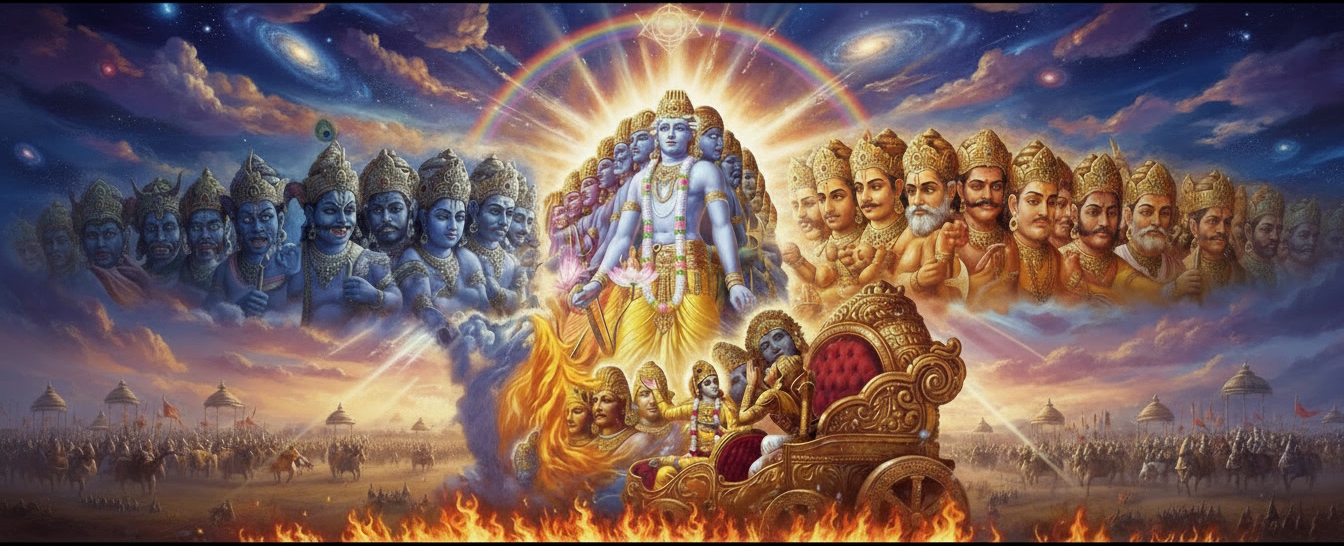
व्यासप्रसादाच्छ्रुतवानेतद्गुह्यमहं परम्।
योगं योगेश्वरात्कृष्णात्साक्षात्कथयतः स्वयम्।।18.75।।
vyāsaprasādācchrutavānetadguhyamahaṃ param|
yogaṃ yogeśvarātkṛṣṇātsākṣātkathayataḥ svayam||18.75||
Translation
Through the grace of Vyasa I have heard this supreme and most secret Yoga direct from Krishna, the Lord of Yoga, Himself declaring it.
हिंदी अनुवाद
व्यासजीकी कृपासे मैंने स्वयं इस परम गोपनीय योग (गीता-ग्रन्थ) को कहते हुए साक्षात् योगेश्वर भगवान् श्रीकृष्णसे सुना है।
Commentaries & Translations
Swami Ramsukhdas
व्यासप्रसादात् श्रुतवान् -- सञ्जयने जब भगवान् श्रीकृष्ण और महात्मा अर्जुनका पूरा संवाद सुना? तब वे बड़े प्रसन्न हुए। अब उसी प्रसन्नतामें वे कह रहे हैं कि ऐसा परम गोपनीय योग मैंने भगवान् व्यासजीकी कृपासे सुना व्यासजीकी कृपासे सुननेका तात्पर्य यह है कि भगवान्ने यत्तेऽहं प्रीयमाणाय वक्ष्यामि हितकाम्यया (10। 1)? इष्टोऽसि मे दृढमिति ततो वक्ष्यामि ते हितम् (18। 64)? मामेवैष्यसि सत्यं ते प्रतिजाने प्रियोऽसि मे (18। 65)? अहं त्वा सर्वपापेभ्यो मोक्षयिष्यामि मा शुचः (18। 66) आदिआदि प्यारे वचनोंसे अपना हृदय खोलकर अर्जुनसे जो बातें कही हैं? उन बातोंको सुननेमें केवल व्यासदेवजीकी कृपा ही है अर्थात् सब बातें मैंने व्यासजीकी कृपासे ही सुनी हैं।एतद् गुह्यं परं योगम् -- समस्त योगोंके महान् ईश्वरके द्वारा कहा जानेसे यह गीताशास्त्रयोग अर्थात् योगशास्त्र है। यह गीताशास्त्र अत्यन्त श्रेष्ठ और गोपनीय है। इसके समान श्रेष्ठ और गोपनीय दूसरा कोई संवाद देखनेसुननेमें नहीं आता।जीवका भगवान्के साथ जो नित्यसम्बन्ध है? उसका नामयोग है। उस नित्ययोगकी पहचान करानेके लिये कर्मयोग? ज्ञानयोग आदि योग कहे गये हैं। उन योगोंके समुदायका वर्णन गीतामें होनेसे गीता भीयोग,अर्थात् योगशास्त्र है।योगेश्वरात्कृष्णात्साक्षात्कथयतः स्वयम् -- सञ्जयके आनन्दकी कोई सीमा नहीं रही है। इसलिये वे हर्षोल्लासमें भरकर कह रहे हैं कि इस योगमें मैंने समस्त योगोंके महान् ईश्वर साक्षात् भगवान् श्रीकृष्णके मुखसे सुना है। सञ्जयको योगेश्वरात्? कृष्णात्? साक्षात्? कथयतः? स्वयम् -- ये पाँच शब्द कहनेकी क्या आवश्यकता थी सञ्जय इन शब्दोंका प्रयोग करके यह कहना चाहते हैं कि मैंने यह संवाद परम्परामें नहीं सुना है और किसीने मुझे सुनाया हैऐसी बात भी नहीं इसको तो मैंने खुद भगवान्के कहतेकहते सुना है
Sri Harikrishnadas Goenka
और इसे --, मैंने ( भगवान् ) व्यासजीकी कृपासे उनसे दिव्यचक्षु पाकर इस परम गुह्य संवादको और परम योगको,( सुना ) अथवा ( यों समझो कि ) योगविषयक होनेसे यह संवाद ही योग है? अतः इस संवादरूप योगको मैंने योगेश्वर भगवान् श्रीकृष्णसे? साक्षात् स्वयं कहते हुए सुना है? परम्परासे नहीं।
Sri Anandgiri
How did you hear the excellent dialogue, if you say? To that he says — 'Tam'. This word referring to the dialogue should be taken in masculine gender, he says — 'Etam'.
Supremacy is due to being useful for the supreme human goal; supreme secret — excessively hidden mystery, or.
Yoga [means] knowledge and action; since it is for that purpose this dialogue is called 'Yoga'? Or since it is a limb of Yoga which is restraint of mental modifications, this dialogue is Yoga, he says — 'Saṃvādam'.
Lord of Yogas is Yogeshvara; since His grace is the cause of Yoga and its fruit, from Him directly without intervention I heard, not through tradition, he says — 'Yogeśvarāt'.
'Svayam' — by Himself the Supreme Lord, in the form of unobstructed knowledge and lordship, 'kathayataḥ' — from the expounding one, this is the meaning.
Sri Dhanpati
Separated (by distance), how did you hear, in this expectation he says — 'Vyāsaprasādāt' — having obtained divine senses by Vyasa's grace, I heard this dialogue — secret, very hidden, supreme — being for the sake of Yoga, this dialogue is also Yoga, that; or being a limb of Yoga which is restraint of mental modifications, this is Yoga, heard that; from 'Yogeśvarāt Kṛṣṇāt' — directly Himself speaking; not through tradition.
By the statement 'from the Lord of Yogas', he indicates that the power of Yoga by which I, who was separated, heard, that power belongs to that Yogeshvara alone, not to me.
By 'Kṛṣṇāt', he implies that Krishna's grace alone is Krishna-Dvaipayana's (Vyasa's) grace, not another.
Sri Neelkanth
How was this dialogue of Vasudeva and Arjuna, though distant, heard by you, to he says — 'Vyāsaprasādāt'. By Lord Vyasa divine eye, ear etc. were given to me, by which I know everything covered or distant like a myrobalan fruit in hand.
Therefore by Vyasa's grace this scripture, supreme secret — hidden — I heard. And Yoga — displayed with the promise 'Behold My divine Yoga' [9.5/11.8], the Universal Form, that also I saw — is the remainder.
By saying 'svayaṃ kathayataḥ' — Himself speaking — from the Shruti 'Of this Great Being the breath is this Rig Veda' [Bri. Up. 2.4.10], it follows that He speaks His breath-Veda through the tradition of disciple and teacher; for that sake (distinct from that) 'sākṣāt kathayataḥ' — directly speaking. Like to Brahma at the beginning of creation, now to Arjuna directly speaking I heard, this is the meaning.
By that, equality of himself with Brahma due to being a recipient of God's grace is indicated. Here, in the construction 'etat yogam' as non-different, with respect to the word 'guhya', the apposition of masculine 'yogam' and neuter 'etat' is possible; and as in 'Yatkiñcid aśnatāpi kṣudupahantum' etc., due to the strength of the impression of the gender used before, even when a substantive of different gender is obtained later, the previous impression does not cease — thus apposition of different genders is also possible to say, this should be known.
Sri Ramanuja
'Vyāsaprasādāt' — by the grace of Vyasa through gaining divine eye and ear; 'etat paraṃ guhyam' — named Yoga; 'yogeśvarāt' — from the repository of knowledge, strength, lordship, vigor, power, splendor, Lord Krishna; 'svayameva kathayataḥ' — directly heard I.
Sri Sridhara Swami
He states the possibility in his hearing that — 'Vyāsaprasādāt'.
By Lord Vyasa divine eye-ear etc. was given to me; therefore by Vyasa's grace I have heard this.
What is that — in this expectation he says 'Paraṃ yogam'.
He reveals the supremacy. From Yogeshvara Sri Krishna Himself directly speaking I heard.
Sri Vedantadeshikacharya Venkatanatha
Due to absence here of grace characterized by removal of delusion and impurity of the dull-witted, 'Vyāsānugraheṇa' (by Vyasa's grace) is said.
For the vision of Sri Vishvarupa invisible even to gods and for hearing words from a distance, he states the intermediate operation of grace — 'Divyacakṣuḥśrotralābhāt'. Here divineness is merely by capacity to grasp supersensuous etc.
To justify the neuter gender of 'Etat', he makes the word Yoga an adjective — 'Yogākhyam'. In 'Supreme Brahman', the intention is fitness in non-action? Even such was heard by me — this is indication of Vyasa's greatness.
In 'Yogeśvarāt', the word Yoga refers to connection with auspicious qualities, like previously said 'This Vibhuti and Yoga' [10.7], he says — 'Jñāna'. Of Himself speaking, not making others speak, this is the meaning. By this the distinctiveness of the speaker is stated. Like 'Of the entire Pancharatra, the speaker is Narayana Himself' [M.Bh. 12.348.68].
'Sākṣācchrutavānaham' — not through Vivasvan, Arjuna etc. His disciples, this is the meaning. Or even being distant, heard directly.
Swami Chinmayananda
महाभारत युद्ध के प्रारम्भ होने के पूर्व? महर्षि व्यास जी ने धृतराष्ट्र को दिव्य दृष्टि का वरदान देने की अपनी इच्छा प्रकट की थी। परन्तु धृतराष्ट्र में उस वरदान को स्वीकार करने का साहस नहीं था। अत धृतराष्ट्र के अनुरोधानुसार युद्ध का सम्पूर्ण वृतान्त जानने के लिए संजय को दिव्य दृष्टि प्रदान की गयी। इस प्रकार? संजय सम्पूर्ण युद्धभूमि को देख सकने तथा वहाँ के संवादों को सुनने में भी समर्थ हुआ था। वैभवशाली राज प्रासाद में बैठकर वही अन्ध धृतराष्ट्र को युद्ध का वृतान्त सुनाता था। श्रीकृष्णार्जुन के संवाद के द्वारा परम् गुह्य ज्ञान के श्रवण का सुअवसर पाकर संजय कृतार्थ हो गया था। स्वाभाविक है कि वह सिद्ध कवि महर्षि व्यास जी के प्रति अपनी कृतज्ञता प्रकट करता है और वह मन ही मन महाभारत के रचयिता? अतुलनीय सिद्ध कवि वेदव्यासजी को प्रणाम करता है।साक्षात् योगेश्वर श्रीकृष्ण से सुना ऐसी बात नहीं है कि संजय ने इसके पूर्व कभी औपनिषदिक ज्ञान को सुना ही नहीं था? जिससे वह इस अवसर पर विस्मयविमुग्ध हो जाय। उसके आनन्द का कारण यह था कि उसे इस ज्ञान का श्रवण करने का ऐसा अवसर मिला? जब साक्षात् योगेश्वर भगवान् श्रीकृष्ण स्वयं ही इस ज्ञान का उपदेश अपने मुखारविन्द से दे रहे थे।यहाँ? पुन? संजय का प्रयत्न धृतराष्ट्र को यह सूचित करना है कि गीताचार्य श्रीकृष्ण कोई देवकीपुत्र गोपबाल ही नहीं थे? वरन् वे सर्वशक्तिमान् परमात्मा ही थे। स्वयं उन्होंने ने ही अर्जुन को मोहनिद्रा से जगाया था और वे अपने भक्त के रथ के सारथी के रूप में कार्य भी कर रहे थे। वह अन्ध राजा को स्मरण कराता है कि यद्यपि धृतराष्ट्र पुत्रों की सेना पाण्डवों की सेना से अधिक विशाल और शास्त्रास्त्रों से सुसज्जित थी? तथापि उसका विनाश अवश्यंभावी था? क्योंकि उन्हें अपने शत्रुपक्ष में स्वयं अनन्त परमात्मा का ही सामना करना था।संजय आगे कहता है
Sri Abhinavgupta
From 'Ityaham' etc. up to 'Matirmama'. Concluding the dialogue with Sanjaya's words — by the sequence of deep arrangement of this meaning, by the continuity assisted by the stream of constant contemplation, and at the end attaining the form of very clear indeterminate experience, mere remembrance itself is bestower of Supreme Brahman, thus it is said.
Thus by mere remembrance of the dialogue of the Lord and Arjuna, by attainment of Truth (by pervasion of Truth?), fortune, victory and prosperities [occur]. || Auspiciousness || Here is the summary verse — Breaking the intellect made slow by ignorance and delusion and distinct by Sattva etc., obtaining the Vishnu beyond alternatives by the beauty of Self-knowledge (by glory of Self?); whatever he does playfully situated merely in the trade of senses rising by their own juice (will/bliss), all that of his becomes auspicious (Shankara). || Thus ends the eighteenth chapter in Srimad Bhagavad Gitartha Sangraha composed by Sri Mahamaheshvaracharya-varya Rajanaka Abhinavaguptapada. ||
[Praise of Teacher] Sriman Katyayana was there like Vararuchi satisfied with flashing knowledge, ornament of his lineage who was steady-minded was Saushuka named very learned. Brahmin Sribhutiraja was born after him his son the great soul, by whom all these worlds fallen in darkness were lifted up like by the sun. || 1 ||
Bee at his lotus feet, Abhinavagupta composed Bhagavadgitarthasangraha controlled by the urging of the good Brahmin Lotaka. || 2 ||
Therefore this whether incorrect or correct is not so at all by all means. This work not to be envied by the learned is for a kinsman indeed. || 3 ||
Power of ever-new form (Abhinava), concealed (Gupta) by that is the Great Lord God. I bow to Abhinavagupta Shiva who is the form of both abodes (pairs?). || 4 ||
Complete is this Srimad Bhagavadgitarthasangraha, a good work. Of Abhinavagupta famous by obtaining thought of feet of the Three-eyed One. || 5 || || Thus Auspiciousness ||
Sri Madhusudan Saraswati
He states his own fitness for hearing the dialogue of the Lord and Arjuna even though separated — 'Vyāsaprasādāt'.
From 'Vyāsa-prasāda' which is in the form of gaining divine eye, ear etc. given by Vyasa, this supreme secret Yoga — the unfailing cause of Yoga — the dialogue from 'Yogeśvarāt' — from Krishna Himself speaking in His supreme divine form, I have heard directly indeed, not through tradition — thus he praises his own fortune.
Here the masculine reading 'Imam' is explained by commentators; but the neuter reading 'Etat' alone is this explanation by apposition with 'Yoga' — thus its expounders [say].
Sri Purushottamji
Objection: With relation of hatred existing, how did he hear, to this he says — 'Vyāsaprasādāt'.
By the grace of Vyasa — the incarnation of God's knowledge — eye, ear etc. supernatural divine were given by Vyasa, by that I heard.
What did he hear, to this he says. 'Etat' — the visible secret hidden supreme most excellent 'Yogam' — from Yogeshvara Krishna directly Himself speaking — 'I have heard'.
Sri Shankaracharya
Through the grace of Vyasa, and consequently by the attainment of the divine eye (supernatural vision), I heard this dialogue, which is the supreme secret and supreme Yoga.
The text itself is called 'Yoga' because its purpose is Yoga.
Or [I heard] this dialogue which is Yoga itself—directly from Krishna, the Lord of Yoga, while He was speaking it Himself.
Not through a lineage or succession (hearsay).
Sri Vallabhacharya
If it be asked, "How did you hear this dialogue in this way?" the answer is—"Through the grace of Vyasa."
Divine vision and hearing, etc., were granted to me, just as they were granted to Arjuna by Vasudeva. I heard this supreme secret Yoga directly from Krishna, the Lord of Yoga, while He was speaking it Himself. The use of the word param (supreme) indicates its transcendence due to its connection with Krishna, establishing that this is indeed the direct speech of the Lord Himself; as stated in the Gita Mahatmya: "Which has emerged directly from the lotus-mouth of Lord Padmanabha," and as the glorious Acharyas have stated, "The Vedas are the words of Sri Krishna."
The meaning is that this became the source of awakening for Arjuna. Nor should it be said that only the instruction of the Ishvara-gita is the awakener of Arjuna, for this (dialogue) is integral (subsidiary) to that. Understand this.
Swami Sivananda
व्यासप्रसादात् through the grace of Vyasa? श्रुतवान् have heard? एतत् this? गुह्यम् secret? अहम् I? परम् supreme? योगम् Yoga? योगेश्वरात् from the Lord of Yoga? कृष्णात् from Krishna? साक्षात् directly? कथयतः declaring? स्वयम् Himself.Commentary Through the grace of Vyasa By obtaining the divine eye from him.Yoga This dialogue between Krishna and Arjuna? I have heard it direct from Him. This dialogue is called Yoga because it treats of Yoga and it leads to the attainment of union with the Lord.
Swami Gambirananda
And vyasa-prasadat, through the favour of Vyasa, by having received divine vision from him; aham, I; srutvan, heard; etat [The Commentator uses etam in the masculine gender, in place of etat in the text, because it refers to the masculine word samvada.] (should rather be etam), this; guhyam, secret dialogue, such as it is; concerning the param, supreme; Yogam, Yoga-or, this dialogue itself is the Yoga because it is meant for it-; krsnat, from Krsna; yogeswarat, from the Lord of yogas; kathayatah, while He was speaking; svayam, Himself; saksat, actually; not indirectly through others.
Swami Adidevananda
By the grace of Vyasa i.e., by the benefit of the divine sense of perception, granted by him, I have heard this supreme mystery called Yoga from Sri Krsna himself - Sri Krsna who is the treasure-house of knowledge, strength, sovereignty, valour, power and brilliance.