Bhagavad Gita - Chapter 18 - Shloka (Verse) 77
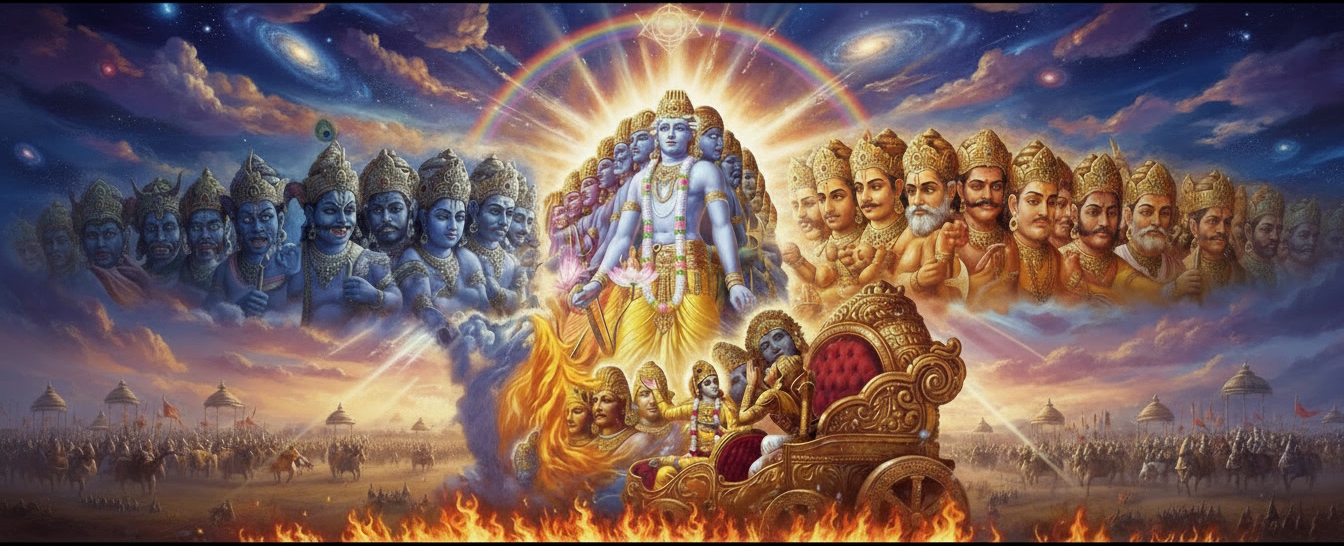
तच्च संस्मृत्य संस्मृत्य रूपमत्यद्भुतं हरेः।
विस्मयो मे महान् राजन् हृष्यामि च पुनः पुनः।।18.77।।
tacca saṃsmṛtya saṃsmṛtya rūpamatyadbhutaṃ hareḥ|
vismayo me mahān rājan hṛṣyāmi ca punaḥ punaḥ||18.77||
Translation
And, remembering again and again, also that most wonderful form of Hari, great is my wonder, O King; and I rejoice again and again.
हिंदी अनुवाद
हे राजन् ! भगवान् श्रीकृष्णके उस अत्यन्त अद्भुत विराट्रूपको याद कर-करके मेरेको बड़ा भारी आश्चर्य हो रहा है और मैं बार-बार हर्षित हो रहा हूँ।
Commentaries & Translations
Swami Ramsukhdas
व्याख्या-- तच्च संस्मृत्य ৷৷. पुनः पुनः-- सञ्जयने पीछेके श्लोकमें भगवान् श्रीकृष्ण और अर्जुनके संवादको तोअद्भुत बताया? पर यहाँ भगवान्के विराट्रूपकोअत्यन्त अद्भुत बताते हैं। इसका तात्पर्य है कि संवादको तो अब भी पढ़ सकते हैं? उसपर विचार कर सकते हैं? पर उस विराट्रूपके दर्शन अब नहीं हो सकते। अतः वह रूप अत्यन्त अद्भुत है।ग्यारहवें अध्यायके नवें श्लोकमें सञ्जयने भगवान्को महायोगेश्वरः कहा था। यहाँ विस्मयो मे महान् पदोंसे कहते हैं कि ऐसे महायोगेश्वर भगवान्के रूपको याद करनेसे महान् विस्मय होगा ही। दूसरी बात? अर्जुनको,तो भगवान्ने कृपासे द्रवित होकर विश्वरूप दिखाया? पर मेरेको तो व्यासजीकी कृपासे देखनेको मिल गयायद्यपि भगवान्ने रामावतारमें कौसल्या अम्बाको विराट्रूप दिखाया और कृष्णावतारमें यशोदा मैयाको तथा कौरवसभामें दुर्योधन आदिको विराट्रूप दिखाया तथापि वह रूप ऐसा अद्भुत नहीं था कि जिसकी दाढ़ोंमें बड़ेबड़े योद्धालोग फँसे हुए हैं और दोनों सेनाओँका महान् संहार हो रहा है। इस प्रकारके अत्यन्त अद्भुत रूपको याद करके सञ्जय कहते हैं कि राजन् यह सब जो व्यासजी महाराजकी कृपासे ही मेरेको देखनेको मिला है।
नहीं तो ऐसा रूप मेरेजैसेको कहाँ देखनेको मिलता
सम्बन्ध-- गीताके आरम्भमें धृतराष्ट्रका गूढ़ाभिसन्धिरूप प्रश्न था कि युद्धका परिणआम क्या होगा अर्थात् मेरे पुत्रोंकी विजय होगी या पाण्डुपुत्रोंकी आगेके श्लोकमें सञ्जय धृतराष्ट्रके उसी प्रश्नका उत्तर देते हैं।
Sri Harikrishnadas Goenka
तथा हे राजन् हरिके उस अति अद्भुत विश्वरूपको भी बारम्बार याद करके? मुझे बड़ा आश्चर्य हो रहा है और मैं बारम्बार हर्षित हो रहा हूँ।
Sri Anandgiri
Now he praises that form known as the "Universal Form" (Vishvarupa), endowed with attributes (svagunam), which the Lord showed to Arjuna for the purpose of meditation, with the verse beginning "And that" (taccha).
Sri Dhanpati
Remembering that extremely wonderful Universal Form (Vishvarupa) endowed with attributes, which the Lord showed to Arjuna for the purpose of meditation, I experience great amazement (vismaya) and rejoice again and again.
Or, the implied meaning addressing Dhritarashtra is: The Lord displayed the Universal Form to remove Arjuna's doubt—"Whether we should conquer them or they should conquer us"—by showing the withdrawal (total destruction) of everything. By addressing him as "O King," Sanjaya hints at the wonder: "Even after hearing about this Universal Form (and the inevitable destruction it portended), you still do not abandon your enmity, nor do you prepare for peace, but remain attached to war—this is surprising."
Sri Neelkanth
"And that" (taccha) etc. "Form" refers to the Universal Form. Upon seeing this, Arjuna saw entities distant in space, like the Lord Brahma, and events distant in time, like the destruction of Bhishma and others—described as "They are hurriedly entering Your mouths"—as clearly as a myrobalan fruit in the palm of one's hand.
This (vision of future and distant things) is not possible without accepting the falsity (mithyatva) of the world, as established in the Vedanta-kataka:
"A Yogi observes past and future objects like a Bilva fruit in the hand; the scriptures proclaim like a drumbeat that the world arises merely from will/imagination (sankalpa)."
"This universe exists always, everywhere, and in all states within Maya; due to that limiting adjunct (upadhi), Consciousness, being the Self of all, perceives everything."
"How can a Yogi see a future or past object which, by its own nature through origination and transformation, is not yet 'Sat' (existent/real)?"
"If past and future objects are considered to appear merely through imagination (like a hallucination of a lost wife), then the Yogi's knowledge would be invalid (aprama)."
"If it is accepted that the object arises merely by the Yogi's will, then let it be accepted that the origin of everything is merely through the Lord's will (Ishvara-sankalpa)."
"In (physical) origination or transformation, the transcendence of space and time is never seen; but this is clearly seen in dreams and illusion (Maya)."
"A single pot is perceived simultaneously by Yogis situated in different places; clearly, it is projected like the sun reflected in water."
"If you argue that because it is perceived by Yogis, the pot (world) exists everywhere and always as Real (Sat), then how can an 'effect' (which by definition changes) be of such a nature?"
"An effect is accepted as being distinct/delimited; if you accept simultaneous existence in different places without (the theory of) mental projection (kalpana), you have no example to support it."
"Therefore, the world is not created by atoms like a wall, nor is it a transformation of Nature (Prakriti) like milk turning to curd, but it is like a magic show (Indrajala)."
"This universe, which is a magic show, appears real to those with bound vision (extroverted gaze); but for those of pure vision, it simply does not exist apart from its Substratum (Brahman)." The meaning of the root verse is clear.
Sri Ramanuja
And having remembered again and again that extremely wonderful, sovereign Form (aishvaram rupam) of Hari which was revealed to Arjuna—and which I visualized directly (sakshat-kritam)—great amazement arises in me as I rejoice, and I rejoice again and again.
What is the need of saying much more here?
Sri Sridhara Swami
Moreover—"And that," etc. The word "That" (tat) indicates the Universal Form (Vishvarupa).
The rest is clear.
Sri Vedantadeshikacharya Venkatanatha
"And that form"—this phrase is used to distinguish it from the form of the son of Vasudeva (the human form of Krishna) which is visible to all people; hence it is explained as "the Sovereign Form revealed to Arjuna."
To maintain the same agent for the action "having remembered" (samsmritya) as for the verb "I rejoice" (hrishyami) found in the verse, the term "of me rejoicing" (hrishyatah) is adopted in the commentary context.
The purport of this verse is that the result seen is of even greater magnitude.
Swami Chinmayananda
भगवान् श्रीकृष्ण ने अर्जुन को अपना विश्वरूप दर्शाया था जिसका यहाँ संजय स्मरण कर रहा है। सहृदय व्यक्ति के लिए यह विश्वरूप इतना ही प्रभावकारी है? जितना कि गीता का ज्ञान एक बुद्धिमान व्यक्ति के लिए अविस्मरणीय है। वेदों में वर्णित विराट् पुरुष का दर्शन चौंका देने वाला है और गीता में? निसन्देह वह अति प्रभावशाली है। परन्तु कोई आवश्यक नहीं है कि यह महर्षि व्यास जी की केवल काव्यात्मक कल्पना ही हो दूसरे भी अनेक लोग हैं? जिनके अनुभव भी प्राय इसी के समान ही हैं।यदि गीता का तत्त्वज्ञान? मानव जीवन के गौरवशाली प्रयोजन को उद्घाटित करते हुए मनुष्य के बौद्धिक पक्ष को अनुप्राणित और हर्षित करता है? तो प्रत्येक नामरूप? अनुभव और परिस्थिति में मन्दस्मित वृन्दावनबिहारी भगवान् श्रीकृष्ण का दर्शन प्रेमरस से मदोन्मत्त भक्तों के हृदयों को जीवन प्रदायक हर्ष से आह्लादित कर देता है।मेरा ऐसा विचार है कि यदि संजय को स्वतन्त्रता दी जाती? तो उसने श्रीमद्भगवद्गीता पर एक सम्पूर्ण संजय गीता की रचना कर दी होती जब ज्ञान के मौन से बुद्धि हर्षित होती है? और प्रेम के आलिंगन में हृदय उन्मत्त होता है? तब मनुष्य अनुप्राणित कृतकृत्यता के भाव में आप्लावित हो जाता है।कृतकृत्यता के सन्तोष का वर्णन करने में भाषा एक दुर्बल माध्यम है इसलिए? अपनी मन की प्रबलतम भावना का और अधिक विस्तार किये बिना? संजय अपने दृढ़विश्वास को? गीता के इस अन्तिम एक श्लोक में? सारांशत घोषित करता है
Sri Abhinavgupta
From "Thus I" (ityaham) up to "is my opinion" (matirmama). Concluding the dialogue through the words of Sanjaya, it is stated that due to the continuity created by a constant stream of deep contemplation on the meaning of this text, the mere remembrance of it—which in the end assumes the form of a very clear, non-conceptual (nirvikalpa) experience—bestows the Supreme Brahman.
Thus, merely by remembering the dialogue between the Lord and Arjuna, through the attainment (or pervasion) of the Truth, "fortune, victory, and prosperity" are achieved. May there be Auspiciousness (Shivam).
Here is the summary verse: Having shattered the intellect which is sluggish due to ignorance and delusion and differentiated by qualities like Sattva; and having attained Vishnu, who is beyond mental constructs (vikalpa), through the beauty of one's own Self-awakening; whatever is done effortlessly (helatah) while remaining merely in the natural rising functions of the senses—all that becomes auspicious (Shankaram) for him.
[Praise of the Teacher]: There was Katyayana, equal to Vararuchi, satisfied with blossoming knowledge. Adorning his lineage was the extremely learned Sauchuka of steady intellect. After him came the Brahmin Shri Bhutiraja. His son was the Mahatma (Abhinavgupta), by whom all these people fallen into darkness were uplifted like the sun.
The bee at his lotus feet, Abhinavgupta, composed this Bhagavadgitarthasangraha at the request of the good Brahmin Lotaka. Whether this is incorrect or correct, it should not be envied by the learned, for this work is done for the sake of kinsmen (devotees).
I bow to the immaculate Abhinavgupta (who is Shiva), who represents the union of both: the ever-new (Abhinava) Shakti and the Hidden (Gupta) Maheshwara (Lord Shiva).
This Srimad Bhagavadgitarthasangraha is the complete and good work of Abhinavgupta, who attained fame through meditation on the feet of the Three-eyed Lord (Shiva). May there be Auspiciousness.
Sri Madhusudan Saraswati
Now, contemplating that form endowed with attributes (saguna) known as the Universal Form (Vishvarupa), which the Lord showed to Arjuna for the purpose of meditation, he says "And that" (taccha).
"That" refers to the Universal Form. "O King, I have great amazement (vismaya), and therefore I rejoice." The rest is clear.
Sri Purushottamji
Moreover, "And that," etc. Having remembered that extremely wonderful, supernatural form, and again having remembered the form belonging to Hari, the Supreme Person (Purushottama) who removes all sorrows, great amazement has arisen in me; (thinking) how will your sons win?
Or (thinking that) by seeing the primordial form, all will attain liberation, I rejoice again and again with respect.
Or alternatively—having remembered that extremely wonderful form of Hari which is knowable only through experience as the Supreme Person, and having remembered it again—meaning having meditated upon it—I have great amazement; for where am I, an insignificant living being, and where is that vision? This vision occurred due to my connection with you, hence he addresses him as "O King" (Rajan).
Moreover, I rejoice again, I attain bliss. That joy is inherent in the vision of the Lord is established by your experience as well; addressing him as one who knows that, he addresses him with dignity as "O King."
Sri Shankaracharya
And remembering again and again that form—the extremely wonderful Universal Form (Vishvarupa) of Hari—O King, great is my amazement (vismaya), and I rejoice again and again.
What is the need to say more—
Sri Vallabhacharya
Moreover, "And that," etc. O King! Remembering that Universal Form of Hari—who is the shelter of all attributes (dharmas), the All-pervading (Vibhu), of incomparable glory, the Supreme Person (Purushottama) Krishna, the remover of all sorrows and destroyer of the wicked—
which is described as supremely wonderful, the shelter of manifold attributes, imperishable (akshara), beyond Time and Maya, sovereign, and the abode of incomparable glory—I experience amazement, because I have visualized it directly;
and remembering it again and again, I rejoice. By this, it is indicated that such joy belongs to one of divine nature (daiva), not to another.
Swami Sivananda
तत् that? च and? संस्मृत्य having remembered? संस्मृत्य having remembered? रूपम् the form? अत्यद्भुतम् the most wonderful? हरेः of Hari? विस्मयः wonder? मे my? महान् great? राजन् O King? हृष्यामि (I) rejoice? च and? पुनः again? पुनः again.Commentary Form The Cosmic Form. (Cf.XI)
Swami Gambirananda
And, rajan, O King; samsmrtya samsmrtya, repeatedly recollecting; tat, that; ati-adbhutam, greatly extraordinary; rupam, form, the Cosmic form; hareh, of Hari; mahan vismayah me, I am struck with great wonder. And hrsyami, I rejoice; punah punah, again and again.
Swami Adidevananda
Great amazement is caused in me, stirred by joy born of the repeated remembrance of that most marvellous and sovereign form of the Lord revealed to Arjuna and directly witnessed by me. I rejoice again and again.
Why say more?