Bhagavad Gita - Chapter 2 - Shloka (Verse) 10
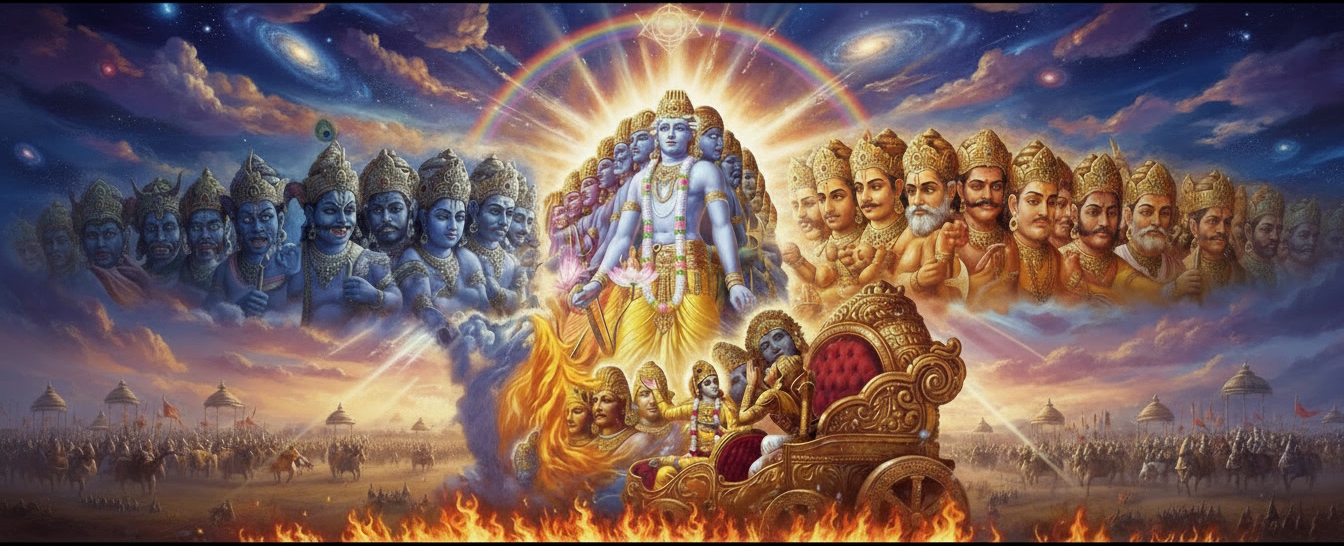
तमुवाच हृषीकेशः प्रहसन्निव भारत।
सेनयोरुभयोर्मध्ये विषीदन्तमिदं वचः।।2.10।।
tamuvāca hṛṣīkeśaḥ prahasanniva bhārata|
senayorubhayormadhye viṣīdantamidaṃ vacaḥ||2.10||
Translation
To him who was despondent in the midst of the two armies, Krishna, as if smiling, O Bharata, spoke these words.
हिंदी अनुवाद
हे भरतवंशोद्भव धृतराष्ट्र! दोनों सेनाओंके मध्यभागमें विषाद करते हुए उस अर्जुनके प्रति हँसते हुए-से भगवान् हृषीकेश यह (आगे कहे जानेवाले) वचन बोले।
Commentaries & Translations
Swami Adidevananda
Sanjaya said Thus, the Lord, the Supreme Person, introduced the Sastra regarding the self for the sake of Arjuna - whose natural courage was lost due to love and compassion in a misplaced situation, who thought war to be unrighteous even though it was the highest duty for warriors (Ksatriyas), and who took refuge in Sri Krsna to know what his right duty was -, thinking that Arjuna's delusion would not come to an end except by the knowledge of the real nature of the self, and that war was an ordained duty here which, when freed from attachment to fruits, is a means for self-knowledge. Thus, has it been said by Sri Yamunacarya: 'The introduction to the Sastra was begun for the sake of Arjuna, whose mind was agitated by misplaced love and compassion and by the delusion that righteousness was unrighteousness, and who took refuge in Sri Krsna.'
The Supreme Person spoke these words as if smiling, and looking at Arjuna, who was thus overcome by grief resulting from ignorance about the real nature of the body and the self, but was nevertheless speaking about duty as if he had an understanding that the self is distinct from the body, and while he (Arjuna), torn between contradictory ideas, had suddenly become inactive standing between the two armies that were getting ready to fight. Sri Krsna said, as if in ridicule, to Arjuna the words beginning with, 'There never was a time when I did not exist' (II. 12), and ending with 'I will release you from all sins; grieve not!' (XVIII. 66) - which have for their contents the real nature of the self, of the Supreme Self, and of the paths of work (Karma), knowledge (Jnana) and devotion (Bhakti) which constitute the means for attaining the highest spiritual fulfilment.
Swami Gambirananda
And here, the text commencing from 'But seeing the army of the Pandavas' (1.2) and ending with '(he) verily became silent, telling Him (Govinda), "I shall not fight"' is to be explained as revealing the cause of the origin of the defect in the from of sorrow, delusion, etc. [Delusion means want of discrimination. Etc. stands for the secondary manifestations of sorrow and delusion, as also ignorance which is the root cause of all these.] which are the sources of the cycles of births and deaths of creatures.
Thus indeed, Ajuna's own sorrow and delusion, cuased by the ideas of affection, parting, etc., originating from the erroneous belief, 'I belong to these; they belong to me', with regard to kingdom [See note under verse 8.-Tr.], elders, sons, comrades, well-wishers (1.26), kinsmen (1.37), relatives (1.34) and friends, have been shown by him with the words, 'How can I (fight)৷৷.in battle (against) Bhisma' (4), etc. It is verily because his discriminating insight was overwhelmed by sorrow and delusion that, even though he had become engaged in battle out of his own accord as a duty of the Ksatriyas, he desisted from that war and chose to undertake other's duties like living on alms etc. It is thus that in the case of all creatures whose minds come under the sway of the defects of sorrow, delusion, etc. there verily follows, as a matter of course, abandoning their own duties and resorting to prohibited ones. Even when they engage in their own duties their actions with speech, mind, body, etc., are certainly motivated by hankering for rewards, and are accompanied by egoism. [Egoism consists in thinking that one is the agent of some work and the enjoyer of its reward.]
Such being the case, the cycle of births and deaths characterized by passing through desireable and undesirable births, and meeting with happiness, sorrow, etc. [From virtuous deeds follow attainment of heaven and happiness. From unvirtuous, sinful deeds follow births as beasts and other lowly beings, and sorrow. From the performance of both virtuous and sinful deeds follows birth as a human being, with a mixture of happiness and sorrow.] from the accumulation of virtue and vice, continues unendingly. Thus, sorrow and delusion are therefore the sources of the cycles of births and deaths. And their cessation comes from nothing other than the knowledge of the Self which is preceded by the renunciation of all duties. Hence, wishing to impart that (knowledge of the Self) for favouring the whole world, Lord Vasudeva, making Arjuna the medium, said, 'You grieve for those who are not to be grieved for,' etc.
As to that some (opponents) [According to A.G. the opponent is the Vrttikara who, in the opinion of A. Mahadeva Sastri, is none other than Bodhayana referred to in Sankaracarya's commentary on B.S. 1.1.11-19.-Tr.] say: Certainly, Liberation cannot be attained merely from continuance in the knowledge of the Self which is preceded by renunciation of all duties and is independent of any other factor. What then? The well-ascertained conclusion of the whole of the Gita is that Liberation is attained through Knowledge associated with rites and duties like Agnihotra etc. prescribed in the Vedas and the Smrtis. And as an indication of this point of view they ote (the verses): 'On the other hand, if you will not fight this righteous (battle)' (33); 'Your right is for action (rites and duties) alone' (47); 'Therefore you undertake action (rites and duties) itself' (4.15), etc. Even this objection should not be raised that Vedic rites and duties lead to sin since they involve injury etc.'.
Objection: How?
Opponent: The duties of the Ksatriyas, charaterized by war, do not lead to sin when undertaken as one's duty, even though they are extremely cruel since they involve violence against elders, brothers, sons and others. And from the Lord's declaration that when they are not performed, 'then, forsaking your own duty and fame, you will incur sin' (33), it stands out as (His) clearly stated foregone conclusion that one's own duties prescribed in such texts as, '(One shall perform Agnihotra) as long as one lives' etc., and actions which involve crutely to animals etc. are not sinful.
Vedantin: That is wrong because of the assertion of the distinction between firm adherence (nistha) to Knowledge and to action, which are based on two (different) convictions (buddhi).
The nature of the Self, the supreme Reality, determined by the Lord in the text beginning with 'Those who are not to be grieved for' (11) and running to the end of the verse, 'Even considering your own duty' (31), is called Sankhya. Sankhya-buddhi [Sankhya is that correct (samyak) knowledge of the Vedas which reveals (khyayate) the reality of the Self, the supreme Goal. The Reality under discussion, which is related to this sankhya by way of having been revealed by it, is Sankhya.] (Conviction about the Reality) is the conviction with regard to That (supreme Reality) arising from the ascertainment of the meaning of the context [Ascertainment৷৷.of the context, i.e., of the meaning of the verses starting from, 'Never is this One born, and never does It die,' etc. (20).] that the Self is not an agent because of the absence in It of the six kinds of changes, viz birth etc. [Birth, continuance, growth, transformation, decay and death.] Sankhyas are those men of Knowledge to whom that (conviction) becomes natural. Prior to the rise of this Conviction (Sankhya-buddhi), the ascertained [Ast. and A.G. omit this word 'ascertainment, nirupana'-Tr.] of the performance of the disciplines leading to Liberation which is based on a discrimination between virtue and vice, [And adoration of God]. and which presupposes the Self's difference from the body etc. and Its agentship and enjoyership is called Yoga. The conviction with regard to that (Yoga) is Yoga-buddhi. The performers of rites and duties, for whom this (conviction) is appropriate, are called yogis.
Accordingly, the two distinct Convictions have been pointed out by the Lord in the verse, 'This wisdom (buddhi) has been imparted to you from the standpoint of Self-realization (Sankhya). But listen to this (wisdom) from the standpoint of (Karma-) yoga' (39). And of these two, the Lord will separately speak, with reference to the Sankhyas, of the firm adherence to the Yoga of Knowledge. [Here Yoga and Knowledge are identical. Yoga is that through which one gets connected, identified. with Brahman.] which is based on Sankya-buddhi, in, 'Two kinds of adherences were spoken of by Me in the form of the Vedas, in the days of yore.' [This portion is ascending to G1.Pr. and A.A.; Ast. omits this and otes exactly the first line of 3.3. By saying, 'in the form of the Vedas', the Lord indicates that the Vedas, which are really the knowledge inherent in God and issue out of Him, are identical with Himself.-Tr.] similarly, in, 'through the Yoga of Action for the yogis' (3.3), He will separately speak of the firm adherence to the Yoga [Here also Karma and Yoga are identical, and lead to Liberation by bringing about purity of heart which is followed by steadfastness in Knowledge.] of Karma which is based on Yoga-buddhi (Conviction about Yoga). Thus, the two kinds of steadfastness that based on the conviction about the nature of the Self, and that based on the conviction about rites and duties have been distinctly spoken of by the Lord Himself, who saw that the coexistence of Knowledge and rites and duties is not possible in the same person, they being based on the convictions of non-agentship and agentship, unity and diversity (respectively).
As is this teaching about the distinction (of the two adherences), just so has it been revealed in the Satapatha Brahmana: 'Desiring this world (the Self) alone monks and Brahmanas renounce their homes' (cf. Br. 4.4.22). After thus enjoining renunciation of all rites and duties, it is said in continuation, 'What shall we acheive through childeren, we who have attained this Self, this world (result).' [The earlier otation implies an injuction (vidhi) for renunciation, and the second is an arthavada, or an emphasis on that injunction. Arthavada: A sentence which usually recommends a vidhi, or precept, by stating the good arising from its proper observance, and the evils arising from its omission; and also by adducing historical instances in its support.-V.S.A] Again, there itself it is said that, before accepting a wife a man is in his natural state [The state of ignorance owing to non-realization of Reality. Such a person is a Brahmacarin, who goes to a teacher for studying the Vedas]. And (then) after his eniries into rites and duties, [The Brahmacarin first studies the Vedas and then enires into their meaning. Leaving his teacher's house after completing his course, he becomes a house holder.] 'he' for the attainment of the three worlds [This world, the world of manes and heaven.-Tr.] 'desired' (see Br. 1.4.17) as their means a son and the two kinds of wealth consists of rites and duties that lead to the world of manes, and the divine wealth of acisition of vidya (meditation) which leads to heaven. In this way it is shown that rites and duties enjoined by the Vedas etc. are meant only for one who is unenlightened and is passessed of desire. And in the text, 'After renouncing they take to mendicancy' (see Br. 4.4.22), the injunction to renounce is only for one who desires the world that is the Self, and who is devoid of hankering (for anything else).
Now, if the intention of the Lord were the combination of Knowledge with Vedic rites and duties, then this utterance (of the Lord) (3.3) about the distinction would have been illogical. Nor would Arjuna's estion, 'If it be Your opinion that wisdom (Knowledge) is superior to action (rites and duties)৷৷.,' etc. (3.1) be proper. If the Lord had not spoken earlier of the impossibility of the pursuit of Knowledge and rites and duties by the same person (at the same time), then how could Arjuna falsely impute to the Lord by saying, 'If it be your opinion that wisdom is superior to action৷৷৷৷' (of having spoken) what was not heard by him, viz the higher status of Knolwedge over rites and duties? Morevoer, if it be that the combination of Knowledge with rites and duties was spoken of for all, then it stands enjoined, ipso facto, on Arjuna as well. Therefore, if instruction had been given for practising both, then how could the estion about 'either of the two' arise as in, 'Tell me for certain one of these (action and renunciation) by which I may attain the highest Good' (3.2)? Indeed, when a physician tells a patient who has come for a cure of his biliousness that he should take things which are sweet and soothing, there can arise no such reest as, 'Tell me which one of these two is to be taken as a means to cure biliousness'! Again, if it be imagined that Arjuna put the estion because of his noncomprehension of the distinct meaning of what the Lord had said, even then the Lord ought to have answered in accordance with the estion: 'The combination of Knowledge with rites and duties was spoken of by Me. Why are you confused thus?' On the other hand, it was not proper to have answered, 'Two kinds of steadfastness were spoken of by Me it the days of yore,' in a way that was inconsistent and at variance with the estion.
Nor even do all the statements about distinction etc. become logical if it were intended that Knowledge was to be combined with rites and duties enjoined by the Smrtis only. Besides, the accusation in the sentence, 'Why then do you urge me to horrible action' (3.1) becomes illogical on the part of Arjuna who knew that fighting was a Ksatriya's natural duty enjoined by the Smrtis. Therefore, it is not possible for anyone to show that in the scripture called the Gita there is any combination, even in the least, of Knowledge of the Self with rites and duties enjoined by the Srutis or the Smrtis. But in the case of a man who had engaged himself in rites and duties because of ignorance and defects like the attachment, and then got his mind purified through sacrifices, charities or austerities (see Br. 4.4.22), there arises the knowledge about the supreme Reality that all this is but One, and Brahman is not an agent (of any action). With regard to him, although there is a cessation of rites and duties as also of the need for them, yet, what may, appear as his diligent continuance, just as before, in those rites and duties for setting an example before people that is no action in which case it could have stood combined with Knowledge. Just as the actions of Lord Vasudeva, in the form of performance of the duty of a Ksatriya, do not get combined with Knowledge for the sake of achieving the human goal (Liberation), similar is the case with the man of Knowledge because of the absence of hankering for results and agentship. Indeed, a man who has realized the Truth does not thingk 'I am doing (this)' nor does he hanker after its result.
Again, as for instance, person hankering after such desirable things as heaven etc. may light up a fire for performing such rites as Agnihotra etc. which are the mans to attain desirable things; [The Ast. reading is: Agnihotradi-karma-laksana-dharma-anusthanaya, for the performance of duties in the form of acts like Agnihotra etc.-Tr.] then, while he is still engaged in the performance of Agnihotra etc. as the means for the desirable things, the desire may get destroyed when the rite is half-done. He may nevertheless continue the performance of those very Agnihotra etc.; but those performance of those very Agnihotra etc.; but those Agnihotra etc. cannot be held to be for this personal gain.
Accordingly does the Lord also show in various places that, 'even while perfroming actions,' he does not act, 'he does not become tainted' (5.7). As for the texts, '৷৷.as was performed earlier by the ancient ones' (4.15), 'For Janaka and others strove to attain Liberation through action itself' (3.20), they are to be understood analytically.
Objection: How so?
Vedantin: As to that, if Janaka and others of old remained engaged in activity even though they were knowers of Reality, they did so for preventing people from going astray, while remaining established in realization verily through the knowledge that 'the organs rest (act) on the objects of the organs' (3.28). The idea is this that, though the occasion for renunciation of activity did arise, they remained established in realization along with actions; they did not give up their rites and duties.
On the other hand, if they were not knowers of Reality, then the explanation should be this; Through the discipline of dedicating rites and duties to God, Janaka and others remained established in perfection (samsiddhi) either in the form of purification of mind or rise of Knowledge. This very idea [The idea that rites and duties become the cause of Knowledge through the purification of the mind.] will be expressed by the Lord in, '(the yogis) undertake action for the purification of oneself (i.e. of the heart, or the mind)' (5.11). After having said, 'A human being achieves success by adoring Him through his own duties' [By performing one's own duty as enjoined by scriptures and dedicating their results to God, one's mind becomes purified. Then, through Gods grace one becomes fit for steadfastness in Knowledge. From that steadfatness follows Liberation. Therefore rites and duites do not directly lead to Liberation. (See Common. under 5.12) (18.46), He will again speak of the steadfastness in Knowledge of a person who has attained success, in the text, '(Understand৷৷.from Me৷৷.that process by which) one who has achieved success attains Brahman' (18.50).
So, the definite conclusion in the Gita is that Liberation is attained only from the knowledge of Reality, and not from its combination with action. And by pointing out in the relevant contexts the (aforesaid) distinction, we shall show how this conclusion stands.
That being so, Lord Vasudeva found that for Arjuna, whose mind was thus confused about what ought to be done [The ast. and A.A., have an additional word mithyajnanavatah, meaning 'who had false ignorance'.-Tr.] and who was sunk in a great ocean of sorrow, there could be no rescue other than through the knowledge of the Self. And desiring to rescue Arjuna from that, He said, '(You grieve for) those who are not to be grieved for,' etc. by way of introducing the knowledge of the Self. [In this Gita there are three distinct parts, each part consisting of six chapters. These three parts deal with the three words of the great Upanisadic saying, 'Tattvamasi, thou art That', with a view to finding out their real meanings. The first six chapters are concerned with the word tvam (thou); the following six chapters determine the meaning of the word tat (that); and the last six reveal the essential identity of tvam and tat. The disciplines necessary for realization this identity are stated in the relevant places.]
Swami Ramsukhdas
व्याख्या-- तमुवाच हृषीकेषशः ৷৷. विषीदन्तमिदं वचः-- अर्जुनने बड़ी शूरवीरता और उत्साहपूर्वक योद्धाओंको देखनेके लिये भगवान्से दोनों सेनाओंके बीचमें रथ खड़ा करनेके लिये कहा था। अब वहींपर अर्थात् दोनों सेनाओंके बीचमें अर्जुन विषादमग्न हो गये! वास्तवमें होना यह चाहिये था कि वे जिस उद्देश्यसे आये थे, उस उद्देश्यके अनुसार युद्धके लिये खड़े हो जाते। परन्तु उस उद्देश्यको छोड़कर अर्जुन चिन्ता-शोकमें फँस गये। अतः अब दोनों सेनाओंके बीचमें ही भगवान् शोकमग्न अर्जुनको उपदेश देना आरम्भ करते हैं।
'प्रहसन्निव'-- (विशेषतासे हँसते हुएकी तरह-) का तात्पर्य है कि अर्जुनके भाव बदलनेको देखकर अर्थात् पहले जो युद्ध करनेका भाव था, वह अब विषादमें बदल गया--इसको देखकर भगवान्को हँसी आ गयी। दूसरी बात, अर्जुनने पहले (2। 7 में) कहा था कि मैं आपके शरण हूँ, मेरेको शिक्षा दीजिये अर्थात् मैं युद्ध करूँ या न करूँ, मेरेको क्या करना चाहिये-- इसकी शिक्षा दीजिये; परन्तु यहाँ मेरे कुछ बोले बिना अपनी तरफसे ही निश्चय कर लिया कि 'मैं युद्ध नहीं करूँगा'--यह देखकर भगवान्को हँसी आ गयी। कारण कि शरणागत होनेपर 'मैं क्या करूँ और क्या नहीं करूँ' आदि कुछ भी सोचनेका अधिकार नहीं रहता। उसको तो इतना ही अधिकार रहता है कि शरण्य जो काम कहता है, वही काम करे। अर्जुन भगवान्के शरण होनेके बाद 'मैं युद्ध नहीं करूँगा' ऐसा कहकर एक तरहसे शरणागत होनेसे हट गये। इस बातको लेकर भगवान्को हँसी आ गयी। 'इव' का तात्पर्य है कि जोरसे हँसी आनेपर भी भगवान् मुस्कराते हुए ही बोले।
जब अर्जुनने यह कह दिया कि 'मैं युद्ध नहीं करूँगा' तब भगवान्को यहीं कह देना चाहिये था कि जैसी तेरी मर्जी आये, वैसा कर--'यथेच्छसि तथा कुरु'(18। 63)। परन्तु भगवान्ने यही समझा कि मनुष्य जब चिन्ता-शोकसे विकल हो जाता है, तब वह अपने कर्तव्यका निर्णय न कर सकनेके कारण कभी कुछ, तो कभी कुछ बोल उठता है। यही दशा अर्जुनकी हो रही है। अतः भगवान्के हृदयमें अर्जुनके प्रति अत्यधिक स्नेह होनेके कारण कृपालुता उमड़ पड़ी। कारण कि भगवान् साधकके वचनोंकी तरफ ध्यान न देकर उसके भावकी तरफ ही देखते हैं। इसलिये भगवान् अर्जुनके 'मैं युद्ध नहीं करूँगा' इस वचनकी तरफ ध्यान न देकर (आगेके श्लोकसे) उपदेश आरम्भ कर देते हैं।
जो वचनमात्रसे भी भगवान्के शरण हो जाता है भगवान् उसको स्वीकार कर लेते हैं। भगवान्के हृदयमें प्राणियोंके प्रति कितनी दयालुता है!
'हृषीकेश' कहनेका तात्पर्य है कि भगवान् अन्तर्यामी हैं अर्थात् प्राणियोंके भीतरी भावोंको जाननेवाले हैं। भगवान् अर्जुनके भीतरी भावोंको जानते हैं कि अभी तो कौटुम्बिक मोहके वेगके कारण और राज्य मिलनेसे अपना शोक मिटता न दीखनेके कारण यह कह रहा है कि 'मैं युद्ध नहीं करूँगा'; परन्तु जब इसको स्वयं चेत होगा ,तब यह बात ठहरेगी नहीं और मैं जैसा कहूँगा, वैसा ही यह करेगा।
'इदं वचः उवाच' पदोंमें केवल 'उवाच' कहनेसे ही काम चल सकता था; क्योंकि 'उवाच' के अन्तर्गत ही 'वचः' पदका अर्थ आ जाता है। अतः 'वचः' पद देना पुनरूक्तिदोष दीखता है। परन्तु वास्तवमें यह पुनरुक्तिदोष नहीं है, प्रत्युत इसमें एक विशेष भाव भरा हुआ है। अभी आगेके श्लोकसे भगवान् जिस रहस्यमय ज्ञानको प्रकट करके उसे सरलतासे, सुबोध भाषामें समझाते हुए बोलेंगे, उसकी तरफ लक्ष्य करनेके लिये यहाँ 'वचः' दिया गया है।
सम्बन्ध -- शोकाविष्ट अर्जुनको शोकनिवृत्तिका उपदेश देनेके लिये भगवान् आगेका प्रकरण कहते हैं।
Sri Harikrishnadas Goenka
यहाँ दृष्ट्वा तु पाण्डवानीकम् इस श्लोकसे लेकर न योत्स्य इति गोविन्दमुक्त्वा तूष्णीं बभूव ह इस श्लोकतकके ग्रन्थकी व्याख्या यों कर लेनी चाहिये कि यह प्रकरण प्राणियोंके शोक मोह आदि जो संसारके बीजभूत दोष है उनकी उत्पत्तिका कारण दिखलानेके लिये है। क्योंकि कथं भीष्ममहं संख्ये इत्यादि श्लोकोंद्वारा अर्जुनने इसी तरह राज्य गुरु पुत्र मित्र सुहृद स्वजन सम्बन्धी और बान्धवोंके विषयमें यह मेरे हैं मैं इनका हूँ इस प्रकार अज्ञानजनित स्नेहविच्छेद आदि कारणोंसे होनेवाले अपने शोक और मोह दिखाये हैं। यद्यपि ( वह अर्जुन ) स्वयं ही पहले क्षात्रधर्मरूप युद्धमें प्रवृत्त हुआ था तो भी शोकमोहके द्वारा विवेकविज्ञानके दब जानेपर ( वह ) उस युद्धसे रुक गया और भिक्षाद्वारा जीवननिर्वाह करना आदि दूसरोंके धर्मका आचरण करनेके लिये प्रवृत्त हो गया। इसी तरह शोकमोह आदि दोषोंसे जिनका चित्त घिरा हुआ हो ऐसे सभी प्राणियोंसे स्वधर्मका त्याग और निषिद्ध धर्मका सेवन स्वाभाविक ही होता है। यदि वे स्वधर्मपालनमें लगे हुए हों तो भी उनके मन वाणी और शरीरादिकी प्रवृत्ति फलाकांक्षापूर्वक और अहंकारसहित ही होती है। ऐसा होनेसे पुण्यपाप दोनों बढ़ते रहनेके कारण अच्छेबुरे जन्म और सुखदुःखोंकी प्राप्तिरूप संसार निवृत्त नहीं हो पाता अतः शोक और मोह यह दोनों संसारके बीजरूप हैं। इन दोनोंकी निवृत्ति सर्वकर्मसंन्यासपूर्वक आत्मज्ञानके अतिरिक्त अन्य उपायसे नहीं हो सकती। अतः उसका ( आत्मज्ञानका ) उपदेश करने की इच्छावाले भगवान् वासुदेव सब लोगोंपर अनुग्रह करने के लिये अर्जुनको निमित्त बनाकर कहने लगे अशोच्यान् इत्यादि। इसपर कितने ही टीकाकार कहते हैं कि केवल सर्वकर्मसंन्यासपूर्वक आत्मज्ञाननिष्ठामात्रसे ही कैवल्यकी ( मोक्षकी ) प्राप्ति नहीं हो सकती किंतु अग्निहोत्रादि श्रौतस्मार्तकर्मोंसहित ज्ञानसे मोक्षकी प्राप्ति होती है यही सारी गीताका निश्चित अभिप्राय है। इस अर्थमें वे प्रमाण भी बतलाते हैं जैसे अथ चेत्त्वमिमं धम्यं सङ्ग्रामं न करिष्यसि कर्मण्येवाधिकारस्ते कुरु कर्मैव तस्मात्त्वम् इत्यादि। ( वे यह भी कहते हैं कि ) हिंसा आदिसे युक्त होनेके कारण वैदिक कर्म अधर्मका कारण है ऐसी शंका भी नहीं करनी चाहिये क्योंकि गुरु भ्राता और पुत्रादिकी हिंसा ही जिसका स्वरूप है ऐसा अत्यन्त क्रूर युद्धरूप क्षात्रकर्म भी स्वधर्म माना जानेके कारण अधर्मका हेतु नहीं है ऐसा कहनेवाले तथा उसके न करनेमें ततः स्वधर्म कीर्तिं च हित्वा पापमवाप्स्यसि इस प्रकार दोष बतलानेवाले भगवान्का यह कथन तो पहले ही सुनिश्चित हो जाता है कि जीवनपर्यन्त कर्म करें इत्यादि श्रुतिवाक्योंद्वारा वर्णित पशु आदिकी हिंसारूप कर्मोंको करना अधर्म नहीं है। परंतु वह ( उन लोगोंका कहना ) ठीक नहीं है क्योंकि भिन्नभिन्न दो बुद्धियोंके आश्रित रहनेवाली ज्ञाननिष्ठा और कर्मनिष्ठाका अलगअलग वर्णन है। अशोच्यान् इस श्लोकसे लेकर स्वधर्ममपि चावेक्ष्य इस श्लोकके पहलेके प्रकरणसे भगवान्ने जिस परमार्थआत्मतत्त्वका निरूपण किया है वह सांख्य है तद्विषयक जो बुद्धि है अर्थात् आत्मामें जन्मादि छहों विकारोंका अभाव होनेके कारण आत्मा अकर्ता है इस प्रकारका जो निश्चय उक्त प्रकरणके अर्थका विवेचन करनेसे उत्पन्न होता है वह सांख्यबुद्धि है वह जिन ज्ञानियोंके लिये उचित होती है ( जो उसके अधिकारी हैं ) वे सांख्ययोगी हैं। इस ( उपर्युक्त ) बुद्धिके उत्पन्न होनेसे पहलेपहले आत्माका देहादिसे पृथक्पन कर्तापन और भोक्तापन माननेकी अपेक्षा रखनेवाला जो धर्मअधर्मके विवेकसे युक्त मार्ग है मोक्षसाधनोंका अनुष्ठान करनेके लिये चेष्टा करना ही जिसका स्वरूप है उसका नाम योग है और तद्विषयक जो बुद्धि है वह योगबुद्धि है वह जिन कर्मियोंके लिये उचित होती है ( जो उसके अधिकारी हैं ) वे योगी हैं। इसी प्रकार भगवान्ने एषा तेऽभिहिता सांख्ये बुद्धिर्योगे त्विमां श्रृणु इस श्लोकसे अलगअलग दो बुद्धियाँ दिखलायी हैं। उन दोनों बुद्धियोंमेंसे सांख्यबुद्धिके आश्रित रहनेवाली सांख्ययोगियोंकी ज्ञानयोगसे ( होनेवाली ) निष्ठाको पुरा वेदात्मना मया प्रोक्ता इत्यादि वचनोंसे अलग कहेंगे। तथा योगबुद्धिके आश्रित रहनेवाली कर्मयोगसे ( होनेवाली ) निष्ठाको कर्मयोगेन योगिनाम् इत्यादि वचनोंसे अलग कहेंगे। कर्तापनअकर्तापन और एकताअनेकताजैसी भिन्नभिन्न बुद्धिके आश्रित रहनेवाले जो ज्ञान और कर्म हैं उन दोनोंका एक पुरुषमें होना असम्भव माननेवाले भगवान्ने ही स्वयं उपर्युक्त प्रकारसे सांख्यबुद्धि और योगबुद्धिका आश्रय लेकर अलगअलग दो निष्टाएँ कही हैं। जिस प्रकार ( गीताशास्त्रमें ) इन दोनों निष्ठाओंका अलगअलग वर्णन है वैसे ही शतपथ ब्राह्मणमें भी दिखलाया गया है। ( वहाँ ) इस आत्मलोकको ही चाहनेवाले वैराग्यशील ब्राह्मण संन्यास लेते हैं इस प्रकार सर्वकर्मसंन्यासका विधान करके उसी वाक्यके शेष वाक्यसे कहा है कि जिन हमलोगोंका यह आत्मा ही लोक है ( वे हम ) सन्ततिसे क्या ( सिद्ध ) करेंगे। वहीं यह भी कहा है कि प्राकृत आत्मा अर्थात् अज्ञानी मनुष्य धर्मजिज्ञासाके बाद और विवाहसे पहले तीनों लोकोंकी प्राप्तिके साधनरूप पुत्रकी तथा दैव और मानुष ऐसे दो प्रकारके धनकी इच्छा करने लगा। इनमें पितृलोककी प्राप्तिका साधनरूप कर्म तो मानुष धन है और देवलोककी प्राप्तिका साधनरूप विद्या देवधन है। इस तरह ( उपर्युक्त श्रुतिमें ) अविद्या और कामनावाले पुरुषके लिये ही श्रौतादि सम्पूर्ण कर्म बताये गये हैं।उन सब ( कर्मों ) से निवृत्त होकर संन्यास ग्रहण करते हैं इस कथनसे केवल आत्मलोकको चाहनेवाले निष्कामी पुरुषके लिये संन्यासका ही विधान किया है। यदि ( इसपर भी यह बात मानी जायगी कि ) भगवान्को श्रौतकर्म और ज्ञानका समुच्चय इष्ट है तो यह उपर्युक्त विभक्त विवेचन अयोग्य ठहरेगा। तथा ( ऐसा मान लेनेसे ) ज्यायसी चेत्कर्मणस्ते इत्यादि जो अर्जुन का प्रश्न है वह भी नहीं बन सकता। यदि ज्ञान और कर्मका एक पुरुषद्वारा एक साथ किया जाना असम्भव और कर्मकी अपेक्षा ज्ञानका श्रेष्ठत्व भगवान्ने पहले न कहा होता तो इस तरह अर्जुन बिना सुनी हुई बातका झूठे ही भगवान्में अध्यारोप कैसे करता कि ज्यायसी चेत्कर्मणस्ते मता बुद्धिः। यदि सभीके लिये ज्ञान और कर्मका समुच्चय कहा होता तो अर्जुनके लिये भी वह कहा ही गया था फिर दोनोंका समुचित उपदेश होते हुए यच्छ्रेय एतयोरेकं तन्मे ब्रूहि सुनिश्चितम् इस प्रकार दोनोंमेंसे एकके ही सम्बन्धमें प्रश्न कैसे होता क्योंकि पित्तकी शान्ति चाहनेवालेको वैद्यके द्वारा यह उपदेश दिया जानेपर कि मधुर और शीत पदार्थ सेवन करना चाहिये रोगोका यह प्रश्न नहीं बन सकता कि उन दोनोंमेंसे किसी एकको ही पित्तकी शान्तिका उपाय बतलाइये। यदि ऐसी कल्पना की जाय कि भगवान्द्वारा कहे हुए वचन न समझनेके कारण अर्जुनने प्रश्न किया है तो फिर भगवान्को प्रश्नके अनुरूप ही यह उत्तर देना चाहिये था कि मैंने तो ज्ञान और कर्मका समुच्चय बतलाया है तू ऐसा भ्रान्त क्यों हो रहा है परंतु प्रश्नसे विपरीत दूसरा ही उत्तर देना कि मैंने दो निष्ठाएँ पहले कही हैं ( उपर्युक्त कल्पनाके ) उपयुक्त नहीं है। इसके सिवा यदि केवल स्मार्तकर्मके साथ ही ज्ञानका समुच्चय माना जाय तो भी विभक्त वर्णन आदि सब उपयुक्त नहीं ठहरते। तथा ऐसा माननेसे युद्धरूप स्मार्तकर्म क्षत्रियका स्वधर्म है यह जाननेवाले अर्जुनका इस प्रकार उलाहना देना भी नहीं बन सकता कि तत् किं कर्मणि घोरे मां नियोजयसि। सुतरां यह सिद्ध हुआ कि गीताशास्त्रमें किञ्चिन्मात्र भी श्रौत या स्मार्त किसी भी कर्मके साथ आत्मज्ञानका समुच्चय कोई भी नहीं दिखा सकता। अज्ञानसे या आसक्ित आदि दोषोंसे कर्ममें लगे हुए जिस पुरुषको यज्ञसे दानसे या तपसे अन्तःकरण शुद्ध होकर परमार्थतत्त्वविषयक ऐसा ज्ञान प्राप्त हो जाता है कि यह सब एक ब्रह्म ही है और वह अकर्ता है। उसके कर्ममें कर्म और फल दोनों ही यद्यपि निवृत्त हो चुकते हैं तो भी लोकसंग्रहके लिये पहलेकी भाँति यत्नपूर्वक कर्मोंमें लगे रहनेवाले पुरुषका जो प्रवृत्तिरूप कर्म दिखलायी देता है वह वास्तवमें कर्म नहीं है जिससे कि ज्ञानके साथ उसका समुच्चय हो सके। जैसे भगवान् वासुदेवद्वारा किये हुए क्षात्रकर्मोंका मोक्षकी सिद्धिके लिये ज्ञानके साथ समुच्चय नहीं होता वैसे ही फलेच्छा और अहंकारके अभावकी समानता होनेके कारण ज्ञानीके कर्मोंका भी ( ज्ञानके साथ समुच्चय नहीं होता )। क्योंकि आत्मज्ञानी न तो ऐसा ही मानता है कि मैं करता हूँ और न उन कर्मोंका फल ही चाहता है। इसके सिवा जैसे कामसाधनरूप अग्निहोत्रादि कर्मोंका अनुष्ठान करने के लिये सकाम अग्निहोत्रादिमें लगे हुए स्वर्गादिकी कामनावाले अग्निहोत्रीकी कामना यदि आधा कर्म कर चुकनेपर नष्ट हो जाय और फिर भी उसके द्वारा वही अग्निहोत्रादि कर्म होता रहे तो भी वह काम्यकर्म नहीं होता ( वैसे ही ज्ञानीके कर्म भी कर्म नहीं हैं )। कुर्वन्नपि न लिप्यते न करोति न लिप्यते इत्यादि वचनोंसे भगवान् भी जगहजगह यही बात दिखलाते हैं। इसके सिवा जो पूर्वैः पूर्वतरं कृतम् कर्मणैव हि संसिद्धिमास्थिता जनकादयः इत्यादि वचन हैं उनको विभागपूर्वक समझना चाहिये। पू0 वह किस प्रकार समझें उ0 यदि वे पूर्वमें होनेवाले जनकादि तत्त्ववेत्ता होकर भी लोकसंग्रहके लिये कर्मोंमें प्रवृत्त थे तब तो यह अर्थ समझना चाहिये कि गुण ही गुणोंमें बरत रहे हैं इस ज्ञानसे ही वे परम सिद्धिको प्राप्त हुए अर्थात् कर्मसंन्यासकी योग्यता प्राप्त होनेपर भी कर्मोंका त्याग नहीं किया कर्म करतेकरते ही परम सिद्धिको प्राप्त हो गये। यदि वे जनकादि तत्त्वज्ञानी नहीं थे तो ऐसी व्याख्या करनी चाहिये कि वे ईश्वरके समर्पण किये हुए साधनरूप कर्मोंद्वारा चित्तशुद्धिरूप सिद्धिको अथवा ज्ञानोत्पत्तिरूप सिद्धिको प्राप्त हुए। यही बात भगवान् कहेंगे कि ( योगी ) अन्तःकरणकी शुद्धिके लिये कर्म करते हैं। तथा स्वकर्मणा तमभ्यर्च्य सिद्धिं विन्दति मानवः ऐसा कहकर फिर उस सिद्धिप्राप्त पुरुषके लिये सिद्धिं प्राप्तो यथा ब्रह्म इत्यादि वचनोंसे ज्ञाननिष्ठा कहेंगे। सुतरां गीताशास्त्रमें निश्चय किया हुआ अर्थ यही है कि केवल तत्त्वज्ञानसे ही मुक्ित होती है कर्मसहित ज्ञानसे नहीं। जैसा यह भगवान्का अभिप्राय है वैसा ही प्रकरणके अनुसार विभागपूर्वक उनउन स्थानोंपर हम आगे दिखलायेंगे।
Sri Anandgiri
Understanding that Arjuna was despairing ("Vishidantam") in the middle of both armies ("Senayoh/Vahinyoh"), extremely sorrowful, overwhelmed by grief and delusion, and practically fallen from his own duty; the Lord, "as if smiling" ("Prahasanniva")—meaning, as if teasing/mocking slightly—and addressing him as "O Bharata" (Descendant of Bharata) to reassure him, spoke these words which constitute the answer to his question and the means for attaining the Highest Good (Nihshreyasa). This is stated in "Tam uvacha" (Spoke to him).
Sri Dhanpati
"What did the Lord do after this?"—To this, the verse says "Tam" (To him).
To that Arjuna, who was despairing—accepting grief and delusion—in the middle of both armies, Hrishikesha, Lord Vasudeva, "as if smiling"—as if revealing "I am pleased with you who are obedient to My command"—spoke these words that follow.
Some interpret it as: "As if drowning him in an ocean of shame by exposing his improper conduct."
Others say: "As if smiling thinking 'Though foolish, he speaks like a wise man'."
Sanjaya addresses the blind (Prajnachakshu) Dhritarashtra as "Bharata" to indicate: "You too, being born in the lineage of Bharata, deserve to listen to the Lord's words with attention." Some others say that the Lord addressed him (Arjuna) as "Bharata" to reassure him, and spoke to him.
Sri Neelkanth
"Tam" etc.
"As if smiling" (Prahasanniva)—thinking "Though this one is deluded (mudha), he speaks like one who is not deluded."
"Idam" (This) refers to what will be spoken next.
Sri Ramanuja
Sanjaya said. Thus, addressing Partha—who had reached an unnatural state due to affection and compassion arising at an improper place; who was considering war, the supreme duty of Kshatriyas, to be Adharma (unrighteousness); and who had surrendered out of a desire to know Dharma—the Supreme Person, the Lord, thought: "Without the knowledge of the true nature of the Self, and without the knowledge that war—which is one's own duty (Svadharma)—performed without attachment to fruits is the means to attain the reality of the Self, his delusion will not cease." Thinking thus, He initiated the teaching of the spiritual scripture (Adhyatma-shastra).
As it is said: "Addressing Partha, who was agitated by affection, compassion, and thoughts of Dharma and Adharma at an improper place and who had surrendered, the scripture was introduced." (Gitartha Sangraha 5).
Seeing Partha thus—who was possessed by grief caused by the (misconceived) knowledge of the nature of the body and the Self, and yet was speaking of Dharma based on the knowledge of the Self as distinct from the body; thus endowed with mutually contradictory qualities; and who had suddenly become inactive in the middle of the two armies ready for war—the Supreme Person spoke this, as if smiling.
Speaking as if in jest (parihasa), He recited the teachings ranging from "Never was I not there" (Gita 2.12) to "I will liberate you from all sins, do not grieve" (Gita 18.66), the subject of which is the true nature of the individual Self and the Supreme Self, and the Karma Yoga, Jnana Yoga, and Bhakti Yoga which are the means to attain That. This is the meaning.
Sri Sridhara Swami
In response to the expectation "What happened next?", the verse says "Tam uvacha" (He spoke to him).
"Prahasanniva" (as if smiling) means having a pleasant face.
Sri Vedantadeshikacharya Venkatanatha
To show he was worthy of ridicule, the one referred to by "Tam" (Him) is described by "Evam" etc.
What is indicated by "Ubhayoh" (of both) is explained as "ready for war." By this, the attainment of the opportunity for instruction is suggested.
By "Sidamanam" (despairing), "inactivity" (nirudyogatva) is implied. Explaining the intent of the word "Madhye" (in the middle)—which indicates a state unfit for withdrawing from war—he says "Akasmat" (Suddenly). The sentiment is: there is no valid cause here for withdrawing from war, such as unrighteousness or defeat; and abandoning an undertaken task without cause is indeed a matter for ridicule.
Here, the "distinctiveness of the speaker from all others"—implied by the term "Hrishikesha" and useful for the authority of the scripture to be spoken—is shown as "Parama Purusha" (Supreme Person). Although, being Hrishikesha, He is capable of controlling all of Partha's senses by mere will and impelling him to relieve the earth's burden, He performs the benefit to the world in a human form through the instruction of the scripture, which is the means to the human goal common to Partha and others—this is the idea.
Alternatively, having Himself agitated the courageous Arjuna in His capacity as Hrishikesha, He spoke the scripture for the world's benefit "as if smiling"; due to this special relationship and considering the immediate context where a joking tone is appropriate, the object of the "laughter" is stated to be Partha. Alternatively, considering that ridicule is impossible towards one who has surrendered due to looking at his faults, and that in spiritual instruction to a disciple there is only a "gentle smile" (prahasa-matra), and that a simile (of laughing) is useless (if not real), the word "Partha" is used (in the previous commentary context).
Thus, by "Prahasanniva" (as if smiling), He shows the sweetness, easy graspability, and the effortless articulation of the great collection of meanings hidden in the caves of all the Upanishads. The scope of the word "Idam" (This) covers all the Lord's words to be spoken, and shows the indication of the intended meaning even by gesture—this is shown by "Parihasa" etc.
Even the verse "Ashochyan" (2.11) is merely the introduction to the scripture, having the "shadow of ridicule" to draw attention to the teaching; since it is not the scripture directly, it is stated that the scripture begins with "Na tvevaham" (2.12). Alternatively, the verse "Ashochyan" (2.11) is the object of "Prahasanniva," and the text starting with "Na tvevaham" (2.12) is the meaning of the word "Idam."
Here, the instruction extends up to "Ma shuchah" (18.66) and is designated as the "subject of Bhakti Yoga," because the "Surrender" (Prapadana) mentioned in the final verse (Charama Shloka)—which achieves everything—will be cited as the remover of obstacles to Bhakti by connecting it to the present context.
Swami Chinmayananda
इस प्रकार धर्म और अधर्म शुभ और अशुभ इन दो सेनाओं के संव्यूहन के मध्य अर्जुन (जीव) पूर्ण रूप से अपने सारथी भगवान् श्रीकृष्ण (सूक्ष्म विवेकवती बुद्धि) की शरण में आत्मसमर्पण करता है जो पाँच अश्वों (पंच ज्ञानेन्द्रियों) द्वारा चालित रथ (देह) अपने पूर्ण नियन्त्रण में रखते हैं।ऐसे दुखी और भ्रमित व्यक्ति जीव अर्जुन को श्रीकृष्ण सहास्य उसकी अन्तिम विजय का आश्वासन देने के साथ ही गीता के आत्ममुक्ति का आध्यात्मिक उपदेश भी करते हैं जिसके ज्ञान से सदैव के लिये मनुष्य के शोक मोह की निवृत्ति हो जाती है।उपनिषद् के रूपक को ध्यान में रखकर यदि हम संजय द्वारा चित्रित दृश्य का वर्णन उपर्युक्त प्रकार से करें तो इसमें हमें सनातन पारमार्थिक सत्य के दर्शन होंगे। जब जीव (अर्जुन) विषादयुक्त होकर शरीर में (देह) स्थित हो जाता है और सभी स्वार्थ पूर्ण कर्मों के साधनों (गाण्डीव) को त्यागकर इन्द्रियों को (श्वेत अश्व) मन की लगाम के द्वारा संयमित करता है तब सारथि (शुद्ध बुद्धि) जीव को धर्म शक्ति की सहायता से वह दैवी सार्मथ्य और मार्गदर्शन प्रदान करता है जिससे अधर्म की बलवान सेना को भी परास्त कर जीव सम्पूर्ण विजय को प्राप्त करता है।
Sri Abhinavgupta
"Karpanya" etc.
With the phrase "Between the two armies" etc., this is indicated: Arjuna, possessed by doubt, has not desisted from war based on a single [decided] view (but is rather confused). For he says thus: "Instruct me who have surrendered to You."
Therefore, standing in the middle of both Knowledge and Ignorance, he is instructed by the Supreme Lord.
Sri Madhusudan Saraswati
To dispel the false hope of Dhritarashtra—thinking that "Even though Arjuna ignored the war, the Lord might also ignore him"—Sanjaya speaks the verse "Senayoh" (Of the armies) etc. To that Arjuna, who had come to the middle of both armies with the effort for war but was now experiencing despondency (delusion) contrary to that; "as if smiling"—meaning, as if drowning him in an ocean of shame by exposing his improper conduct; Hrishikesha, the indwelling Lord of all, spoke these words ("Ashochyan" etc.) which are of extremely profound meaning and reveal his improper conduct; He did not ignore him.
"Prahasa" (laughter/mockery) is the generation of shame by exposing improper conduct. And since shame is painful, it is primary only regarding an object of hatred. But since Arjuna is an object of the Lord's grace, and the exposure of improper conduct here is the cause for the arising of discrimination (viveka), this laughter is only "secondary" (figurative) due to the absence of the one component (hatred)—to indicate this, the word "Iva" (as if) is used.
The Lord exposes Arjuna's improper conduct "as if" to generate shame—meaning, actually to generate discrimination; the arising of shame is merely incidental (nantariyaka)—whether it happens or not is not the intention.
If he had ignored the war while staying at home before the commencement of war, he would not have done anything improper; but having come to the battlefield with great preparation/fury, ignoring it then is extremely improper—to convey this, the adjective "Senayoh" (in the middle of armies) etc. is used. This will become clear in "Ashochyan" (2.11) etc.
Sri Purushottamji
In response to the expectation "What did the Lord answer then?", he says "Tam uvacha" etc.
Hrishikesha, "as if smiling," spoke "Idam vachah" (these words)—which will be stated ahead—to the despairing Arjuna in the middle of both armies.
Even to His own people ("Sviyeshu") who may not be acting according to His words ("Svoktakarishu api"), the Lord speaks again to create confidence—hence the address "Bharata" (O descendant of Bharata).
Sri Shankaracharya
Here, the text beginning from 'dṛṣṭvā tu pāṇḍavānīkam' (Gita 1.2) up to 'na yotsya iti govindam uktvā tūṣṇīṃ babhūva ha' (Gita 2.9) is to be explained as intending to show the cause of the origin of defects like grief and delusion, which are the seeds of transmigratory existence (samsara) for living beings. Thus indeed, by Arjuna, grief and delusion of the self—caused by the fear of separation from affection born of the notion 'I am theirs, they are mine' with regard to kingdom, teachers, sons, friends, well-wishers, kinsmen, and relatives—were displayed through 'kathaṃ bhīṣmam ahaṃ saṃkhye' (Gita 2.4), etc. For, one whose discriminating knowledge is overpowered by grief and delusion, even though naturally engaged in war which is the duty of a Kshatriya, desisted from that war and proceeded to perform the duty of others, such as living on alms. And similarly, for all living beings whose minds are possessed by defects like grief and delusion, there is naturally an abandonment of one's own duty and resorting to prohibited actions. Even for those engaged in their own duty, the activity of speech, mind, body, etc., occurs only with desire for results and with egoism. This being so, due to the accumulation of dharma and adharma, samsara characterized by the attainment of desired and undesired births, happiness, misery, etc., becomes unceasing. Therefore, grief and delusion are the seeds of samsara. And since their cessation does not occur through anything other than Self-knowledge preceded by the renunciation of all actions, desiring to teach that, for the benefit of all worlds, making Arjuna the occasion, Lord Vasudeva said 'aśocyān' (Gita 2.11), etc.
Sri Vallabhacharya
"What happened next?"—To this, it says "Tam uvacha" (He spoke to him).
"Alas, what kind of cowardice (klaibya) is this due to ignorance of the reality of the Self!"—laughing (prahasan) at this; and yet with the sentiment that "Because he is extremely righteous (dharmishtha), this (compassion/grief) is also fitting for him"—thus it is stated.