Bhagavad Gita - Chapter 2 - Shloka (Verse) 9
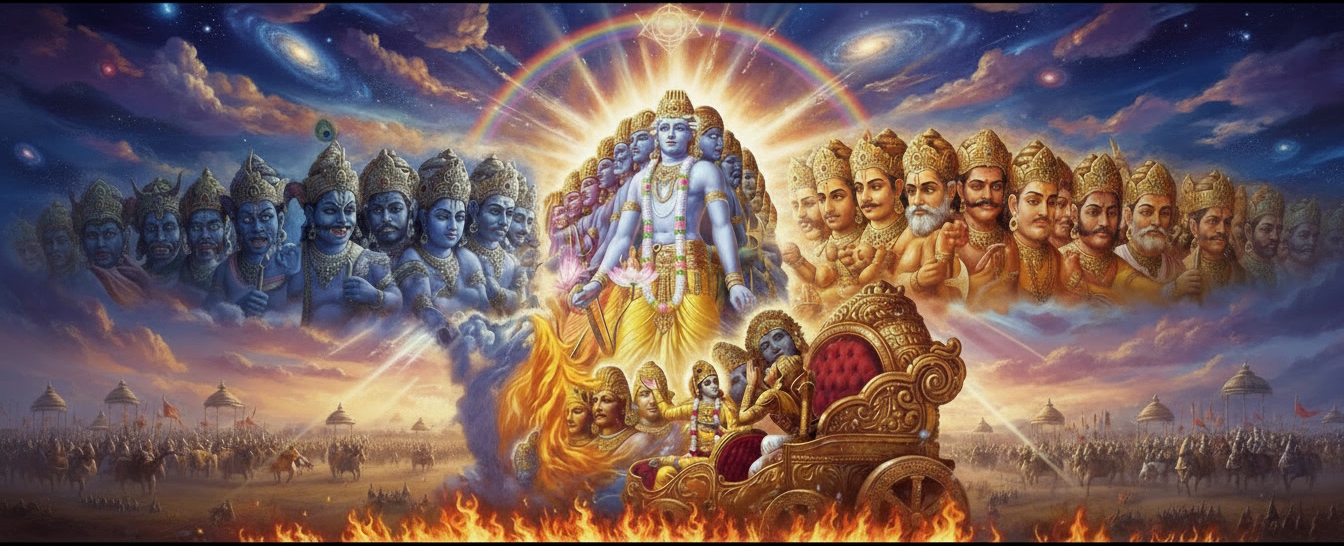
सञ्जय उवाच एवमुक्त्वा हृषीकेशं गुडाकेशः परन्तप।
न योत्स्य इति गोविन्दमुक्त्वा तूष्णीं बभूव ह।।2.9।।
sañjaya uvāca
evamuktvā hṛṣīkeśaṃ guḍākeśaḥ parantapa|
na yotsya iti govindamuktvā tūṣṇīṃ babhūva ha||2.9||
Translation
Sanjaya said Having spoken thus to Hrishikesha (the Lord of the senses), Arjuna (the coneror of sleep), the destroyer of foes, said to Krishna, "I will not fight" and became silent.
हिंदी अनुवाद
संजय बोले - हे शत्रुतापन धृतराष्ट्र! ऐसा कहकर निद्राको जीतनेवाले अर्जुन अन्तर्यामी भगवान् गोविन्दसे 'मैं युद्ध नहीं करूँगा' ऐसा साफ-साफ कहकर चुप हो गये।
Commentaries & Translations
Swami Ramsukhdas
व्याख्या--'एवमुक्त्वा हृषीकेषम् ৷৷. बभूव ह'-- अर्जुनने अपना और भगवान् का--दोनोंका पक्ष सामने रखकर उनपर विचार किया, तो अन्तमें वे इसी निर्णयपर पहुँचे कि युद्ध करनेसे तो अधिक-से-अधिक राज्य प्राप्त हो जायगा, मान हो जायगा, संसारमें यश हो जायगा, परन्तु मेरे हृदयमें जो शोक है, चिन्ता है, दुःख है, वे दूर नहीं होंगे। अतः अर्जुनको युद्ध न करना ही ठीक मालूम दिया।
यद्यपि अर्जुन भगवान्की बातका आदर करते हैं और उसको मानना भी चाहते हैं; परंतु उनके भीतर युद्ध करनेकी बात ठीक-ठीक जँच नहीं रही है। इसलिये अर्जुन अपने भीतर जँची हुई बातको ही यहाँ स्पष्टरूपसे, साफ-साफ कह देते हैं कि 'मैं युद्ध नहीं करूँगा'। इस प्रकार जब अपनी बात, अपना निर्णय भगवान्से साफ-साफ कह दिया, तब भगवान्से कहनेके लिये और कोई बात बाकी नहीं रही; अतः वे चुप हो जाते हैं।
सम्बन्ध-- जब अर्जुनने युद्ध करनेके लिये साफ मना कर दिया तब उसके बाद क्या हुआ--इसको सञ्जय आगेके श्लोकमें बताते हैं।
Sri Anandgiri
Thus, when Arjuna had revealed his intent to the Lord, Sanjaya reported it to the King—this is stated in 'Sanjaya Uvacha.'
'Evam'—Having replied to the Lord in the manner previously described, Parantapa Arjuna, having told Govinda 'Na yotsye' (I will not fight, i.e., I will not strike)—because of the context of extremely unbearable grief—became silent ('Tushnim babhuva'); this is the meaning.
Sri Dhanpati
Although he is the conqueror of ignorance/sleep (Gudakesha) and the scorcher of enemies (Parantapa), having accepted ignorance and the cessation of war, and having spoken thus to Govinda—the Knower of the Vedas and the Supreme Self—for the purpose of revealing the meaning of the Vedas for the world's upliftment, he became silent; indicating this, Sanjaya says "Evam" (Thus).
"Evam"—meaning, having spoken in the manner previously described to Hrishikesha (the Controller of all senses), Gudakesha (Arjuna), the Parantapa (Scorcher of enemies), told Govinda "Na yotsye" ("I will not fight") and became "Tushnim"—silent, i.e., free from the activity of speech.
The word "Ha" is used as an ornament of speech. The particle "Ha" is used to illuminate the fact that in him (Arjuna), who is by nature a conqueror of laziness and a scorcher of all enemies, this adventitious (temporary) laziness and failure to scorch enemies will not find a permanent seat (will not last).
By the words "Govinda" and "Hrishikesha"—which indicate His omniscience and omnipotence respectively—it is suggested by some that the removal of his delusion is easily achievable by the Lord.
Sri Neelkanth
Objection: "Since it has already been stated that war alone is 'Shreyas' (good) with the words 'Abandoning this petty weakness of heart, stand up, O Parantapa,' why do you ask again?" To this, he says "Na hi."
The grief caused by the destruction of kinsmen will not be removed by gaining a kingdom or by gaining lordship over heaven; therefore, tell me some means of "Shama" (peace/control) that is distinct from war and is of the nature of "Nivritti" (withdrawal/renunciation)—this is the intent.
Here, under the pretext of Arjuna's despondency, the qualifications of an aspirant eligible for Brahma-vidya (Knowledge of Brahman)—namely, the practice of mendicancy (begging) and dispassion towards the enjoyment of wealth and fruits in this world and the next—are demonstrated.
Sri Ramanuja
Sanjaya said. Thus, addressing Partha—who had reached an unnatural state due to affection and compassion arising at an improper place; who was considering war, the supreme duty of Kshatriyas, to be Adharma (unrighteousness); and who had surrendered out of a desire to know Dharma—the Supreme Person, the Lord, thought: "Without the knowledge of the true nature of the Self, and without the knowledge that war—which is one's own duty (Svadharma)—performed without attachment to fruits is the means to attain the reality of the Self, his delusion will not cease." Thinking thus, He initiated the teaching of the spiritual scripture (Adhyatma-shastra).
As it is said: "Addressing Partha, who was agitated by affection, compassion, and thoughts of Dharma and Adharma at an improper place and who had surrendered, the scripture was introduced." (Gitartha Sangraha 5).
Seeing Partha thus—who was possessed by grief caused by the knowledge of the true nature of the body and the Self (as he perceived it), and yet was speaking of Dharma based on the knowledge of the Self as distinct from the body; thus endowed with mutually contradictory qualities; and who had suddenly become inactive in the middle of the two armies ready for war—the Supreme Person spoke this, as if smiling.
Speaking as if in jest, He recited the teachings ranging from "Never was I not there" (Gita 2.12) to "I will liberate you from all sins, do not grieve" (Gita 18.66), the subject of which is the true nature of the individual Self and the Supreme Self, and the Karma Yoga, Jnana Yoga, and Bhakti Yoga which are the means to attain That. This is the meaning.
Sri Sridhara Swami
In response to the expectation "Having spoken thus, what did Arjuna do?", Sanjaya said.
"Evam" (Thus) etc. The meaning is clear.
Sri Vedantadeshikacharya Venkatanatha
In the verse 'evam uktvā' (having spoken thus), by the word 'Hṛṣīkeśa,' the Lord's agency in impelling Arjuna's senses to hear the true meaning, and His capacity to pacify the agitation of the senses mentioned in 'yacchokam ucchoṣaṇam indriyāṇām' (that grief which dries up the senses), etc., is implied. 'Hṛṣīkāṇi' (senses) are so called because they rejoice (hṛṣyanti) or cause rejoicing (harṣayanti). 'Evam uktvā' means having made known his own state. 'Guḍākā' refers to sleep, as per 'nidrālasye guḍākā syāt' (guḍākā is in sleep and laziness); the lord of that is 'Guḍākeśa,' meaning one whose nature is awakened. Or, it means 'one with thick/curly hair' (piṇḍitakeśa). By the word 'Govinda,' the possession of speech capable of dispelling grief, and engagement in removing the burden of the earth indicated by the word 'go,' are intended. Thus, by this introduction, stating the connection for the commencement of the scripture to be spoken at the appropriate opportunity, he explains the summary verse of the introduction beginning with 'evam' by implication. Suggesting that the word 'asthāna' relates to 'viṣame samupasthitam' (2.2), he mentioned them (love and compassion) separately to establish the connection specifically through love and compassion. The meaning of the word 'ākula' is stated as 'aprakṛtiṅgatam' (gone out of normal state). By this, natural courage is implied. Indeed, he (Arjuna) himself said 'upahatasvabhāvaḥ' (nature struck down - 2.7). By this, it is also shown that having one's nature struck by the fault of faintheartedness is stated as the cause for the mind being confused about dharma. The meaning of 'dharmādharmadhiyā' (by the thought of dharma and adharma), which is an explanation of 'dharmasammūḍhacetāḥ' (2.7), is stated by 'kṣatriyāṇām,' etc. The idea of adharma in dharma is 'dharmādharmadhīḥ,' like the idea of silver in a shell; here, in the view of Yathārthakhyāti (theory of real perception), the non-grasping of the difference is intended. And this intellect is Tamasic, which 'considers adharma to be dharma' (18.32), as will be stated. Here, the analysis (vigraha) should be seen as: the idea of dharma and adharma born from misplaced love and compassion. This is in accordance with ancient commentaries like 'snehakāruṇyadharmādharmabhayākula.' However, in the reading 'dharmādharmabhayākulam,' it is a Dvandva compound of three. The meaning of the word 'prapanna' (surrendered), uttered together with 'pṛcchāmi tvām' (2.7), is stated as 'surrendered with a desire to know dharma.' Thus, activity directed toward a worthy object is proper; so he says 'pārtham uddiśya.' The idea is that the scripture was introduced merely using this as a pretext/occasion. The purport of 'ākulam pārtham uddiśya' (Gita Samgraha 5) is stated from 'ātma' up to 'matvā.' The true nature of the self (eternality, dependence on God, etc.) is the only means to remove grief for him who says 'na hi prapaśyāmi' (2.8); this is the idea. Regarding 'kṛtam' (done)—to the expectation 'by whom?', and to dispel the doubt of it being the author Vyasa etc., it is said 'by the Bhagavan, the Supreme Person.' By these two words, possessing both characteristics (ubhayaliṅga - freedom from defects and possession of auspicious qualities) useful for scriptural authority is intended. To exclude other scriptures devoted to other topics, it is qualified as 'adhyātma.' To show this meaning is traditional, he says 'tad uktam.' Although distinct meanings are stated in each chapter by summary verses, to distinguish that the portion preceding this (even part of Ch 2) is the introduction to the scripture, and what follows is the commencement of the scripture, this much is summarized by the summary verse 'asthāna,' etc., which does not explicitly mention the first chapter. The Great Sage, however, included 'taṃ tathā' (2.1) etc. in the second chapter due to the internal connection of the story of grief and its removal; this is also indicated by those summarizing the fruit of the second chapter as 'tanmohaśāntaye' (Gita Samgraha 6). And thus, the meaning of the first chapter is the agitation caused by misplaced love etc., with specifics; that very thing is restated here for connection; this is also shown. Objection: How is the scripture regarding Karma Yoga, Jnana Yoga, Bhakti Yoga, etc., taught to one such as this without being asked? For they recall 'One should not speak to anyone unasked' (Manu 2.110). Especially since this meaning is of the nature of secret, more secret, and most secret, it is improper to teach it suddenly. And in 'Therefore fight, O Bharata' (2.18) and 'resolved for war' (2.37), etc., only the intent of encouragement for the contextual war is perceived. Therefore, this scripture is not devoted to Adhyatma. Answer: Here it is said—In the question 'yacchreyaḥ syāt' (2.7), 'yacchreyaḥ' (what may be beneficial) is seen without a determined specific. And there is no rule that Arjuna must inquire only about war as the beneficial path. For him, a supreme believer, with the Lord present, inquiry extending up to the supreme beatitude through the context at hand is reasonable. Or let his inquiry be about war only; even so, it is proper for the supremely compassionate Lord, relying on the general statement 'yacchreyaḥ,' to give the supreme instruction. 'Fight,' etc., is also meant as a means to supreme beatitude; this is clear in various places. Therefore, this introduction of the Adhyatma scripture is appropriate.
Swami Chinmayananda
संजय आगे वर्णन करते हुये कहता है कि भगवान् की शरण में जाकर गुडाकेशनिद्राजित एवं शत्रु प्रपीड़क अर्जुन ने यह कहा कि वह युद्ध नहीं करेगा और फिर वह मौन हो गया।केवल एक अंध धृतराष्ट्र को छोड़कर किसी भी व्यक्ति को यह अधिकार या सार्मथ्य नहीं थी कि वह युद्ध को इन क्षणों में भी रोक सके। अवश्यंभावी और अपरिहार्य युद्ध को धृतराष्ट्र द्वारा रोकने की क्षीण आशा संजय के हृदय में थी। शत्रुपीड़क अर्जुन अब तीनों जगत् को जीतने वाले (गोविन्द) भगवान् श्रीकृष्ण की शरण में पहुँच गया था इसलिये उसकी विजय अब निश्चित थी परन्तु जन्मान्ध धृतराष्ट्र ने किसी की भी श्रेष्ठ सलाह को अत्यधिक पुत्र प्रेम के कारण नहीं सुना।
Sri Abhinavgupta
"Karpanya" etc.
By the phrase "Between the two armies" etc., this is indicated: Arjuna, possessed by doubt, has not desisted from war based on a single [decided] view (but is rather confused). For he says thus: "Instruct me who have surrendered to You."
Therefore, standing in the middle of both Knowledge and Ignorance, he is instructed by the Supreme Lord.
Sri Madhusudan Saraswati
In response to Dhritarashtra's curiosity "What did Arjuna do next?", (Sanjay describes): "Gudakesha"—the conqueror of laziness; "Parantapa"—the scorcher of enemies, Arjuna; to "Hrishikesha"—the Inner Controller by virtue of being the impeller of all senses; to "Govinda"—who is Omniscient because He is the source/knower of all Vedas, derived from the etymology "He knows 'Gam', i.e., the speech characterized as Veda."
Having initially stated the unsuitability of the nature of the war with "How shall I fight Bhishma..." etc., and subsequently stating the absence of any fruit of war with "I will not fight" (Na yotsye), he "Tushnim babhuva"—became silent.
The meaning is that due to the cessation of the activity of the external senses which were previously engaged for war, he became inactive.
The word "Ha" is used to illuminate the fact that in him, who is naturally a conqueror of laziness and a scorcher of all enemies, this adventitious (temporary) laziness and failure to scorch enemies will not establish a foothold.
By the words "Govinda" and "Hrishikesha"—which indicate His omniscience and omnipotence respectively—it is suggested that the removal of his delusion is easily achievable by the Lord.
Sri Purushottamji
Having spoken thus, what did Arjuna do?"—To this, the verse says "Evam uktva" etc.
Gudakesha (Arjuna) having spoken "Evam" (thus)—in the manner previously described—to Hrishikesha, the impeller of the senses; and having told Govinda, the protector of devotees, "Na yotsye" (I will not fight), he became silent.
"Ha" implies wonder. (The wonder is that) even though spoken to by the Lord, he did not become desirous of the kingdom.
"Parantapa"—"One whose penance (tapa) is excellent"—this is a form of address (likely to Dhritarashtra). The implication is: "Your people (sons), having given up their lives in the presence of Sri Krishna, will become fulfilled (attain liberation)."
That is why the verse is sung in the Bhagavatam (3.2.20): "Purified by Partha's weapons, they attained His abode."
Sri Vallabhacharya
In response to the expectation "Having spoken thus, what did Arjuna do?", Sanjaya said "Evam" etc.
"Gudaka" means sleep; he is the "Isha" (Lord) of that; meaning, even though he is free from lethargy (he became silent). Or, "Guda" refers to "Alaka" (curly hair) [so Gudakesha means one with curly hair].
He surrendered to "Govinda"—the presiding Lord of all senses, the Lord of Vraja (Vrajendra).
Having said "I will not fight," he became silent ("Ha" - indeed/alas).
Swami Adidevananda
Sanjaya said Thus, the Lord, the Supreme Person, introduced the Sastra regarding the self for the sake of Arjuna - whose natural courage was lost due to love and compassion in a misplaced situation, who thought war to be unrighteous even though it was the highest duty for warriors (Ksatriyas), and who took refuge in Sri Krsna to know what his right duty was -, thinking that Arjuna's delusion would not come to an end except by the knowledge of the real nature of the self, and that war was an ordained duty here which, when freed from attachment to fruits, is a means for self-knowledge. Thus, has it been said by Sri Yamunacarya: 'The introduction to the Sastra was begun for the sake of Arjuna, whose mind was agitated by misplaced love and compassion and by the delusion that righteousness was unrighteousness, and who took refuge in Sri Krsna.'
The Supreme Person spoke these words as if smiling, and looking at Arjuna, who was thus overcome by grief resulting from ignorance about the real nature of the body and the self, but was nevertheless speaking about duty as if he had an understanding that the self is distinct from the body, and while he (Arjuna), torn between contradictory ideas, had suddenly become inactive standing between the two armies that were getting ready to fight. Sri Krsna said, as if in ridicule, to Arjuna the words beginning with, 'There never was a time when I did not exist' (II. 12), and ending with 'I will release you from all sins; grieve not!' (XVIII. 66) - which have for their contents the real nature of the self, of the Supreme Self, and of the paths of work (Karma), knowledge (Jnana) and devotion (Bhakti) which constitute the means for attaining the highest spiritual fulfilment.