Bhagavad Gita - Chapter 4 - Shloka (Verse) 11
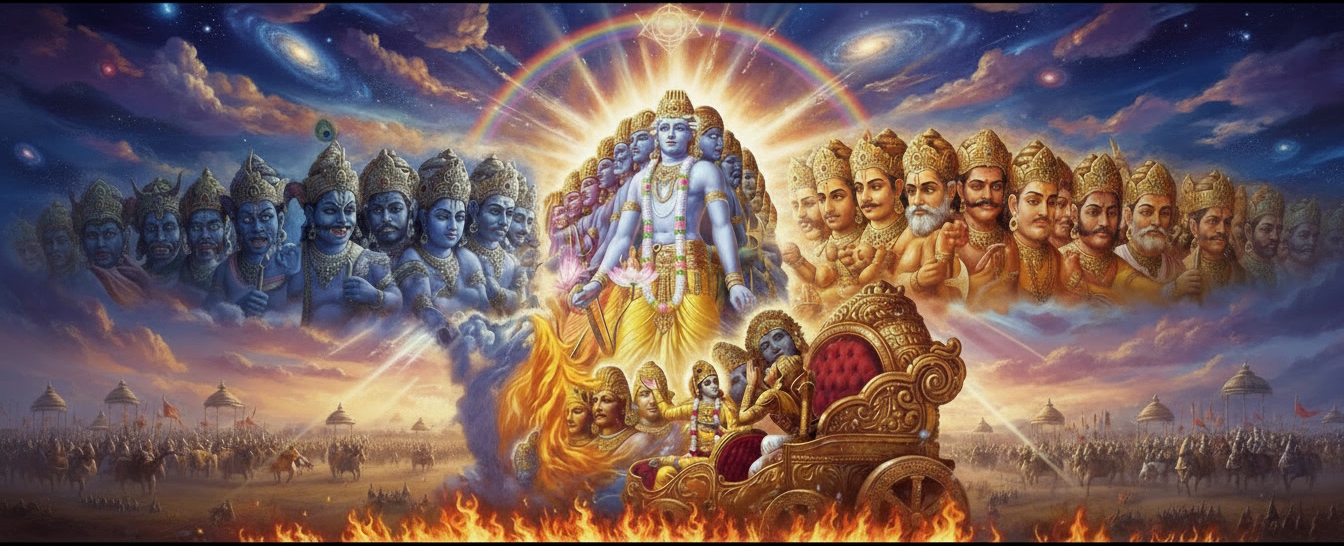
ये यथा मां प्रपद्यन्ते तांस्तथैव भजाम्यहम्।
मम वर्त्मानुवर्तन्ते मनुष्याः पार्थ सर्वशः।।4.11।।
ye yathā māṃ prapadyante tāṃstathaiva bhajāmyaham|
mama vartmānuvartante manuṣyāḥ pārtha sarvaśaḥ||4.11||
Translation
In whatever way men approach Me even so do I reward them; My path do men tread in all ways, O Arjuna.
हिंदी अनुवाद
हे पृथानन्दन ! जो भक्त जिस प्रकार मेरी शरण लेते हैं, मैं उन्हें उसी प्रकार आश्रय देता हूँ; क्योंकि सभी मनुष्य सब प्रकारसे मेरे मार्गका अनुकरण करते हैं।
Commentaries & Translations
Swami Ramsukhdas
व्याख्या--'ये यथा मां प्रपद्यन्ते तांस्तथैव भजाम्यहम्'--भक्त भगवान्की जिस भावसे, जिस सम्बन्धसे, जिस प्रकारसे शरण लेता है, भगवान् भी उसे उसी भावसे, उसी सम्बन्धसे, उसी प्रकारसे आश्रय देते हैं। जैसे, भक्त भगवान्को अपना गुरु मानता है तो वे श्रेष्ठ गुरु बन जाते हैं, शिष्य मानता है तो वे श्रेष्ठ शिष्य बन जाते हैं, माता-पिता मानता है तो वे श्रेष्ठ माता-पिता बन जाते हैं, पुत्र मानता है तो वे श्रेष्ठ पुत्र बन जाते हैं, भाई मानता है तो वे श्रेष्ठ भाई बन जाते हैं, सखा मानता है तो वे श्रेष्ठ सखा बन जाते हैं, नौकर मानता है तो वे श्रेष्ठ नौकर बन जाते हैं। भक्त भगवान्के बिना व्याकुल हो जाता है तो भगवान् भी भक्तके बिना व्याकुल हो जाते हैं।अर्जुनका भगवान् श्रीकृष्णके प्रति सखाभाव था तथा वे उन्हें अपना सारथि बनाना चाहते थे; अतः भगवान् सखाभावसे उनके सारथि बन गये। विश्वामित्र ऋषिने भगवान् श्रीरामको अपना शिष्य मान लिया तो भगवान् उनके शिष्य बन गये। इस प्रकार भक्तोंके श्रद्धाभावके अनुसार भगवान्का वैसा ही बननेका स्वभाव है।अनन्त ब्रह्माण्डोंके स्वामी भगवान् भी अपने ही बनाये हुए साधारण मनुष्योंके भावोंके अनुसार बर्ताव करते हैं, यह उनकी कितनी विलक्षण उदारता, दयालुता और अपनापन है? भगवान् विशेषरूपसे भक्तोंके लिये ही अवतार लेते हैं--ऐसा प्रस्तुत प्रकरणसे सिद्ध होता है। भक्तलोग जिस भावसे, जिस रूपमें भगवान्की सेवा करना चाहते हैं ,भगवान्को उनके लिये उसी रूपमें आना पड़ता है। जैसे, उपनिषद्में आया है--'एकाकी न रमते' (बृहदारण्यक0 1। 4। 3)--अकेले भगवान्का मन नहीं लगा, तो वे ही भगवान् अनेक रूपोंमें प्रकट होकर खेल खेलने लगे। ऐसे ही जब भक्तोंके मनमें भगवान्के साथ खेल खेलनेकी इच्छा हो जाती है, तब भगवान् उनके साथ खेल खेलने-(लीला करने-) के लिये प्रकट हो जाते हैं। भक्त भगवान्के बिना नहीं रह सकता तो भगवान् भी भक्तके बिना नहीं रह सकते।
यहाँ आये ''यथा' और 'तथा'--इन प्रकारवाचक पदोंका अभिप्राय 'सम्बन्ध', 'भाव' और 'लगन' से है। भक्त और भगवान्का प्रकार एक-सा होनेपर भी इनमें एक बहुत बड़ा अन्तर यह है कि भगवान् भक्तकी चालसे नहीं चलते, प्रत्युत अपनी चाल-(शक्ति-) से चलते हैं (टिप्पणी प0 232.1)। भगवान् सर्वत्र विद्यमान, सर्वसमर्थ, सर्वज्ञ, परम सुहृद् और सत्यसंकल्प हैं। भक्तको केवल अपनी पूरी शक्ति लगा देनी है, फिर भगवान् भी अपनी पूरी शक्तिसे उसे प्राप्त हो जाते हैं।भगवत्प्राप्तिमें बाधा साधक स्वयं लगाता है क्योंकि भगवत्प्राप्तिके लिये वह समझ, सामग्री, समय और सामर्थ्यको अपनी मानकर उन्हें पूरा नहीं लगाता, प्रत्युत अपने पास बचाकर रख लेता है। यदि वह उन्हें अपना न मानकर उन्हें पूरा लगा दे तो उसे शीघ्र ही भगवत्प्राप्ति हो जाती है। कारण कि यह समझ, सामग्री आदि उसकी अपनी नहीं हैं; प्रत्युत भगवान्से मिली हैं; भगवान्की हैं। अतः इन्हें अपनी मानना ही बाधा है। साधक स्वयं भी भगवान्का ही अंश है। उसने खुद अपनेको भगवान्से अलग माना है, भगवान्ने नहीं। भक्ति (प्रेम) कर्मजन्य अर्थात् किसी साधन-विशेषका फल नहीं है। भगवान्के सर्वथा शरण होनेवालेको भक्ति स्वतः प्राप्त होती है। दास्य, सख्य, वात्सल्य, माधुर्य आदि भावोंमें सबसे श्रेष्ठ शरणागतिका भाव है। यहाँ भगवान् मानो इस बातको कह रहे हैं कि तुम अपना सब कुछ मुझे दे दोगे तो मैं भी अपना सब कुछ तुम्हें दे दूँगा और तुम अपने-आपको मुझे दे दोगे तो मैं भी अपने-आपको तुम्हें दे दूँगा। भगवत्प्राप्तिका कितना सरल और सस्ता सौदा हैअपने-आपको भगवच्चरणोंमें समर्पित करनेके बाद भगवान् भक्तकी पुरानी त्रुटियोंको यादतक नहीं करते। वे तो वर्तमानमें साधकके हृदयका दृढ़ भाव देखते हैं--रहति न प्रभु चित चूक किए की।
करत सुरति सय बार हिए की।।(मानस 1। 29। 3)इस (ग्यारहवें) श्लोकमें द्वैत-अद्वैत, सगुण-निर्गुण, सायुज्य-सामीप्य आदि शास्त्रीय विषयका वर्णन नहीं है, प्रत्युत भगवान्से अपनेपनका ही वर्णन है। जैसे, नवें श्लोकमें भगवान्के जन्म-कर्मकी दिव्यताको जाननेसे भगवत्प्राप्ति होनेका वर्णन है। 'केवल भगवान् ही मेरे हैं और मैं भगवान्का ही हूँ; दूसरा कोई भी मेरा नहीं है और मैं किसीका भी नहीं हूँ'-- इस प्रकार भगवान्में अपनापन करनेसे उनकी प्राप्ति शीघ्र एवं सुगमतासेहो जाती है। अतः साधकको केवल भगवान्में ही अपनापन मान लेना चाहिये (जो वास्तवमें है), चाहे समझमें आये अथवा न आये। मान लेनेपर जब संसारके झूठे सम्बन्ध भी सच्चे प्रतीत होने लगते हैं, फिर जो भगवान्का सदासे ही सच्चा सम्बन्ध है, वह अनुभवमें क्यों नहीं आयेगा? अर्थात् अवश्य आयेगा।
शङ्का--जो भगवान्को जिस भावसे स्वीकार करते हैं, भगवान् भी उनसे उसी भावसे बर्ताव करते हैं, तो फिर यदि कोई भगवान्को द्वैष, वैर आदिके भावसे स्वीकार करेगा तो क्या भगवान् भी उससे उसी (द्वेष आदिके) भावसे बर्ताव करेंगे?
Sri Harikrishnadas Goenka
तब क्या आपमें रागद्वेष हैं जिससे कि आप किसीकिसीको ही आत्मभाव प्रदान करते हैं सबको नहीं करते इसपर कहते हैं जो भक्त जिस प्रकारसे जिस प्रयोजनसे जिस फलप्राप्तिकी इच्छासे मुझे भजते हैं उनको मैं उसी प्रकार भजता हूँ अर्थात् उनकी कामनाके अनुसार ही फल देकर मैं उनपर अनुग्रह करता हूँ क्योंकि उन्हेंमोक्षकी इच्छा नहीं होती। एक ही पुरुषमें मुमुक्षुत्व और फलार्थित्व ( फलकी इच्छा करना ) यह दोनों एक साथ नहीं हो सकते। इसलिये जो फलकी इच्छावाले हैं उन्हें फल देकर जो फलको न चाहते हुए शास्त्रोक्त प्रकारसे कर्म करनेवाले और मुमुक्षु हैं उनको ज्ञान देकर जो ज्ञानी संन्यासी और मुमुक्षु हैं उन्हें मोक्ष देकर तथा आर्तोंका दुःख दूर करके इस प्रकार जो जिस तरहसे मुझे भजते हैं उनको मैं भी वैसे ही भजता हूँ। रागद्वेषके कारण यह मोहके कारण तो मैं किसीको भी नहीं भजता। हे पार्थ मनुष्य सब तरहसे बर्तते हुए भी सर्वत्र स्थित मुझ ईश्वरके ही मार्गका सब प्रकारसे अनुसरण करते हैं जो जिस फलकी इच्छासे जिस कर्मके अधिकारी बने हुए ( उस कर्मके अनुरूप ) प्रयत्न करते हैं वे ही मनुष्य कहे जाते हैं।
Sri Anandgiri
If the Lord grants liberation to all beings, the previously mentioned qualifications ("Free from attachment..." etc.) would be futile; if He grants liberation only to some, then He possesses attachment, aversion, etc., leading to the objection that He is not the Lord (Anishvara). Anticipating this doubt with "Tava tarhi" (Then Your...), He answers: "Uchyate" (It is stated). To those who are Mumukshus (seekers of liberation), the Lord grants liberation through the generation of Knowledge; to those desiring other fruits, He gives those specific results through the performance of respective means; thus, He has no attachment or aversion.
Anticipating the doubt: "Seekers of liberation follow the Lord (naturally), but why would those desiring other fruits follow Him?" He says "Mama" (My path...), implying that since the fruit depends on the Lord (according to the maxim "The fruit is from Him, for that is logical"), following Him is necessary for them too.
"Why are not all who share in the Lord's speech (devotees) graced with Kaivalya (Liberation) in the same uniform way?" To this, He says "Tesham" (Their...).
Anticipating the doubt: "Why can't a single person desire both worldly prosperity (Abhyudaya) and supreme good (Nihshreyasa/Moksha) due to the variety of prayers?" He proves its impossibility due to the contradiction in sequence/alternation with "Na hi" (Indeed not...).
Establishing the division between seekers of liberation and seekers of fruit, He states the resulting division of Grace with "Atah" (Therefore). The connection is "I grace them by granting the fruit."
"If those performing obligatory (Nitya) and occasional (Naimittika) rites do not desire fruit but are seekers of liberation, how is there grace upon them?" To this, He says "Ye yathokta..." (Those who as described...). The connection later is "I worship (reward) them by granting Knowledge."
There are some Knowers (Jnanis) who have abandoned all actions and desire only Liberation; He reveals the mode of grace upon them with "Ye jnanina..." (Those knowers...).
Some are distressed (Arta), lacking other means like knowledge, and follow the Lord just to remove their distress; He shows the special grace upon them with "Tatha" (Similarly).
He concludes the explanation of the first half with "Ityevam" (Thus). He refutes any other cause (like bias) for the Lord's grace with "Na punah" (Not otherwise).
He analyzes the second half "Sarvathapi" (In every way) to mean that for creatures, whether desiring fruit or liberation, following the Lord is necessary. "In all states"—in whatever form—abiding in the Supreme Lord alone is the path, characterized by Knowledge and Action.
Anticipating that the mention of "humans" might exclude others (non-humans) from following the Lord's path, He explains [it refers to those eligible for results] with "Yat-phala..." (Whatever fruit...). "They follow My path in every way"—this connects with the preceding.
Sri Dhanpati
Thus, He wards off the attachment and aversion applicable to Himself with "Ye..." (Who...). Those who approach (worship) Me in whatever manner, for whatever purpose—for liberation, for wealth, for relief from distress, or for knowledge—I "Bhajami" (worship/reward/grace) them in that very manner by granting those respective fruits; I am the Supreme Lord, the giver of all fruits.
"Ye manushyah"—Those humans who, desiring specific fruits and being qualified for specific rites, worship other deities like Indra, etc., being engaged in every way ("Sarvashah"), follow My path ("Mama vartma") alone—the path consisting of those rites—because I am the Self of all.
(Refutation): However, those who explain it as: "Those humans who approach Me... situated in all bodies... in whatever manner—as an enemy or as a friend—I also worship/follow them in that very manner (as enemy/friend)"
; or "Those who follow My path of devotion/meditation... I follow those who have become My own Self in every way"—suggesting that they must describe a different meaning due to having distracted minds, they have abandoned the literal/direct meaning of "Prapadyante" and "Bhajami" which follows the context of the preceding and succeeding text ("Taking refuge in Me" in v.10, "They worship" in v.12). By this, the strained interpretation of "Mama" (My) etc., is also refuted.
"O Partha"—implying surprise: "Even other humans follow My path; but you, despite being related to Me, do not perform My following (do not follow My command)—this is a great wonder.
Sri Madhavacharya
And liberation does not happen only by worshipping Me, but also (by worshipping) in the form of other deities; nevertheless, I give fruit to all according to their conformity (qualification); this He says with 'Ye yatha'. I serve (bhajami)—meaning by giving fruit, not by a subordinate state. How is this distinction? To this He says 'Mama vartma' (My path).
Even while worshipping other deities, they follow My path alone. Because I am the Doer and Enjoyer of all actions. 'Those also who are devotees of other deities...' (9.23) He will say.
'He who is the one holder of the names of the gods' (Rig Veda Samhita 8.3.17.3)—this is the Shruti. And the Lord alone is spoken of there. 'In the navel of the Unborn One is set' (Rig Veda Samhita 8.3.17.6)—because of this indicator (Linga).
Sri Neelkanth
(Objection): "Since You perform the protection of the good and destruction of the bad, You possess partiality (Vaishamya) and cruelty (Nairghrinya); therefore, what is the use of contemplating the nature of Your birth and actions for people like us?" Anticipating this, He says "Ye yatha..." (Those who, how...). Those humans who approach (reach) Me, situated in all bodies, in whatever manner—as an enemy or as a friend—I also "Bhajami" (worship/follow) them in that very manner. Those who follow My path consisting of devotion, meditation, and profound concentration, I follow those who have become My own Self in every way; this is the construction (Yojana).
The logic follows: Therefore, whatever love or hatred one directs towards the living beings—who are like reflections (of Me)—I too direct the same love or hatred towards that reflection. The worship or insult of the Bimba (Original) is transferred to the reflection alone; therefore, there is no partiality or cruelty in Me. The purport is that one desiring the supreme good should strive only for the welfare of all.
(Bhashya View): In the Commentary (Bhashya), however, they explain it thus: "In whatever manner—with whatever purpose—the distressed (Arta), the seeker of knowledge (Jijnasu), the seeker of wealth (Artharthi), or the wise (Jnani)—approach Me, I grace them in that very manner by removing pain, granting knowledge, granting wealth, or granting liberation. In every way, they follow My path alone"—meaning even devotees of other deities.
Sri Ramanuja
Those who, expecting to take refuge in Me, "Yatha"—in whatever manner, conceiving of Me according to their own expectations—"Prapadyante"—take refuge in Me; towards them, "Tathaiva"—in that very manner desired by them—"Bhajami"—I reveal Myself.
What need is there to say more? "Sarve manushyah" (All men)—whose sole desire is to follow Me—experiencing "Mama vartma"—My nature, which is beyond even the speech and mind of Yogis—through their own instruments like eyes etc., "Sarvashah"—in every way according to their expectations—follow Me.
Now, having concluded the incidental topic, in order to state the manner in which the Karma Yoga in question takes the form of Knowledge, He speaks of the rarity of the candidate qualified for such Karma Yoga.
Sri Sridhara Swami
(Objection): Then is there partiality (Vaishamya) in You, since You grant the 'state of Self' (liberation) only to those who take refuge in You alone, and not to others who have desires? To this, He says "Ye yatha" (Those who, how...).
"Yatha"—in whatever manner, whether with desires or without desires, those who worship Me, I "Bhajami"—grace—them "Tathaiva"—in that very manner, by granting their expected fruits. And it should not be thought that I neglect those who, having desires, abandon Me and worship Indra and others alone.
Because "Sarvashah"—in every way—even the worshippers of Indra etc. follow "Mama eva vartma"—My path of worship alone. For even in the forms of Indra etc., I alone am the object of worship.
Sri Vedantadeshikacharya Venkatanatha
Thus, through the description of His voluntary incarnation belonging to the same species as gods, humans, etc., for the purpose of protecting the good etc., His own accessibility useful for worship has been stated. Now, He shows the state of that very (accessibility) reaching its culmination with the verse 'Ye yatha'. Here, along with the account of the Krishna incarnation, the account of the Archa-avatara (incarnation in image form) is also included.
The words "whoever, in whatever way, them in that very way" are intended to negate the restrictions regarding the previously mentioned qualified aspirants, their modes of practice, etc.; with this intention, he says "Not only." "According to their own expectation"—meaning through the process of [relating as] husband, son, charioteer, Varaha, Narasimha, etc. "Having resolved"—meaning having made it the object of desire. This indeed is the "Prapadana" (surrender) here, as he states with "Samashrayante" (they take refuge).
In "I worship them in that very way," the idea that "I also worship them in the manner of their worship" is inconsistent; to refute this doubt, he states the meaning of "in that very way" as "in the manner desired by them." Not in the manner corresponding to His own supremacy; this is the purport. Here, the interpretation stated by others that it means "avoiding partiality by granting fruits as desired" is not extremely consistent with the preceding and succeeding context, and there would be a repetition of meaning with "The four castes..." (4.13) etc.
The "worship" by the Master towards the servants is indeed "being easily visible"; with this intention, "I show Myself" is stated.
The second half is intended to demonstrate the stated meaning even in the world; it is not intended to show His performance of actions to be followed by the world as in "For if I did not engage..." (3.23) etc., because that is inconsistent here; with this intention, he explains the purport of accessibility which is beyond speech and mind with "What is the use of saying much here." The word "human" includes women etc. as well; with this intention, the word "all" (Sarva) is used.
Here the word "Vartma" (path) does not directly denote a road, because of the contingency of the sentence meaning being inconsistent. Nor does it refer to conduct, because that too is inconsistent here and subject to the mentioned defect. Therefore, the meaning of following the scriptural bounds mentioned in "The wheel thus set in motion" (3.16) and "By Him indeed the limits of Dharma conducive to the world were established" etc. is also refuted. Therefore, in this context of teaching accessibility, it is appropriate that it refers to the aggregate of His unique nature such as Body, activities, amiable disposition (Saushilya), etc.; with this intention, it is said "My path, meaning My nature, all." Even a word denoting a road is used metaphorically regarding nature. As in "What path (way) is this, that you are averse to unfortunate me in this way?"
What is indicated by "humans" is stated as "of the Yogis" etc. Me, who am beyond the speech and mind of even those whose minds are purified by Yoga, humans with eyes experience even with external senses; this is the meaning. Forms like dearest beloved, father, son, friend, brother, servant, charioteer, etc., and forms of Archa-avatara are intended by "in all ways"; thus he says "by their own expectations."
"Having experienced, they follow"—meaning they exist experiencing. Or here, the "way" (prakara) refers to decoration, procession, festivals, service, etc. Here, by the statement "even with senses like eyes... though beyond the speech and mind of Yogis," the contemplation of the nature of the Supreme even in the Archa-avatara form is shown. As they recall: "That (image) itself as having the form of Brahman..." (Vishnu Dharmottara 103.29). And the Lord will say "With four arms..." etc.
Thus, incidentally, to fulfill the desire for worship of the Pandava who was seeing the excess of accessibility through charioteership etc., He taught it by explicit statement also.
(Objection) But by even this much, what solution is stated for the objections, inferences, and arguments? (Answer) That is stated: The objection "How can the one opposed to imperfections accept imperfection Himself?" is refuted by the very absence of imperfection in incarnation etc.; and that absence is due to not being subject to karma, being non-material, being done by His own will, etc. "In the absence of merit and sin, and in the absence of another controller, how can there be birth etc.?"—this also is resolved by "His own will." The objection regarding "ignorance of good and bad, inability, etc." is refuted because for Him, who is not subject to karma and incarnates out of sport, there is no 'bad' and (consequently) no ignorance of it. And the objection regarding "absence of purpose" is removed by the description of purposes like protecting the good etc.
And as for the objection "When protection of the good etc. is possible even by mere resolve, what is the need for incarnation etc.?"—that too is resolved by the commentary on "For the protection of the good" (4.8) beginning with "My name..." and ending with "...for their protection by granting conversation etc." (Ramanuja Bhashya 4.8); by "For establishing Dharma" (4.8) with "by displaying the form to be worshipped"; and in "Ye yatha" (4.11) by demonstrating the excess of His accessibility common to all.
Regarding what was stated—"God does not essentially have birth etc., because of not being subject to karma, like a liberated soul"—there, in accepting or not accepting God, there are (respectively) the defects of "contradiction with the proof establishing the subject" (Dharmi-grahaka-badha) and "unestablished locus" (Ashrayasiddhi). Moreover, what is the meaning of the probandum (Sadhya) here? Is it "devoid of birth etc. caused by karma"? Or "devoid of birth etc. caused by non-karma"? Or generally "devoid of birth etc. merely"? Not the first, because of "proving the proven" (Siddha-sadhana). Not the second, because the reason is non-determining (Aprayojaka). For the cessation of karma does not prevent birth caused by non-karma; and there is contradiction (Badha) by the proof that establishes the nature of the negation, just as in the inference of non-heat in fire. Not the third, because the example is devoid of the probandum (Sadhya-vikala); for the acceptance of a body even by a liberated soul is established by Shrutis like "Eating, playing, enjoying" (Chandogya 8.12.3), "He becomes onefold, he becomes threefold" (Chandogya 7.26.2).
"Then let the liberated soul also be made the subject (Paksha)"—if you say this, then who is the example? "Pot etc."—if you say this, (Answer) No; because there, the absence of accepting a body etc. is conditioned by "insentience." By this, the negative concomitance "He who has birth etc. is subject to karma" is also broken. And as for the reason "because of not being the object of the Lord's command"—that too has equivalent meaning to the first. Because the scripture describing merit and sin is itself in the form of the Lord's command.
And as for "Because of being devoid of its cause; he who is devoid of the cause of something does not possess that (effect)"—that is also false; for if used intending the material cause, the reason is unestablished (Hetvasiddhi) because the existence of the eternal Body which is the material cause of the non-material incarnation caused by non-karma has been established. If used intending the instrumental cause, then because the instrumental cause like resolve etc. is established. The general intention (of any cause) is also answered by the very same.
Similarly, in "because of being devoid of contracted knowledge" etc., defects like "contradiction with the proof establishing the subject" should be considered; and in "because of being devoid of a purpose to be achieved," there is "unestablished reason," because purposes like protection of the good, sport, etc., have been stated.
(Objection) "Still, the pleasure of the present moment did not exist before, so by that part, incompleteness is contingent"—if you say this, (Answer) No, this is not incompleteness; because of the absence of obstruction to what is desired; because of its accomplishment at the time of desire; because of the existence of the capacity that "even then if He desired, it would happen"; and because even that (pleasure) of a later time is contemplated upon as His own pleasure even before by the Omniscient Lord. Similarly, it should be considered regarding past (pleasure) also.
(Objection) "If the future (pleasure) is also shining as pleasure, then what is the purpose of desire there?"—if you ask, (Answer) "For the sake of origination"—we say. (Objection) "What is the purpose of that (origination)?"—if you ask; "That very (origination) does not exist in the preceding and succeeding times, so there is incompleteness in those times"—if you say this, (Answer) No; because of fullness due to it being known always exactly as "belonging to that time." (Objection) "Now, something being desired implies suffering in its non-attainment?"—if you say this, (Answer) No; because it is justified simply by its attainment being the purpose. For indeed, for an incapable person desiring it, suffering arises from its non-accomplishment; but for the capable one, the very desire for it nourishes its nature as pleasure; so there is no difficulty whatsoever.
By this, in the reason "being devoid of a purpose to be achieved," the example of the Liberated soul is also "devoid of the probans" (Sadhana-vikala); because of Shrutis like "Eating, playing..." (Chandogya 8.12.3). And as for the reasons like "because of omniscience" etc. using the example of one who has attained supreme likeness, in those too the defect of being "devoid of probandum" etc. is similar. And the "contingencies" (Prasangus) are also refuted like the inference due to the absence of invariable concomitance etc.
Thus it is established that the birth etc. of the Lord is real, and the statement propounding it is valid proof. And regarding the fact that suffering, grief, fear, etc. are spoken of somewhere in incarnations—that should be considered mere "acting" on the strength of His being "free from sin" etc., and on the strength of statements like "By that He deceives/deludes the worlds" (M.Bh 5.68.15).
Swami Chinmayananda
भगवान् में राग द्वेष आदि की दुर्बलताओं का आरोप उचित नहीं है। वे तो शक्तिपुञ्ज हैं जो समस्त कर्मों एवं उपलब्धियों का मूल है। उस ईश्वर की शक्ति का आह्वान करने के लिये हमें उपाधियाँ दी गयी हैं। बुद्धिमत्ता पूर्वक यदि इन उपाधियों का तथा शक्ति का हम उपयोग करें तो निश्चय ही लक्ष्य को पा सकते हैं अन्यथा वही शक्ति हमारे नाश का कारण बन सकती है।यन्त्रों की सहायता से पेट्रोल की ईन्धन शक्ति को अश्वशक्ति में परिवर्तित किया जा सकता है। उस परिवर्तित शक्ति का उपयोग करके वाहन द्वारा हम अपने गन्तव्य तक पहुँच सकते हैं अथवा किसी वृक्ष आदि से टक्कर मारकर अपनी हड्डियाँ भी चूरचूर कर सकते हैं इस प्रकार की दुर्घटनायें वाहन चालकों की असावधानी के कारण होती हैं। यद्यपि जिस वेग से वाहन टकराया उस वेग को उसने पेट्रोल से ही प्राप्त किया था। हम यह नहीं कह सकते कि जो लोग लक्ष्य तक पहुँच गये उनके प्रति पेट्रोल को राग था और दुर्घटनाग्रस्त लोगों से द्वेष। बिना किसी पक्षपात के पेट्रोल अपनी शक्ति प्रदान करता है परन्तु यन्त्रों द्वारा उसका सदुपयोग अथवा दुरुपयोग करना हमारी अपनी बुद्धि पर निर्भर करता है। यही बात विद्युत् शक्ति के सम्बन्ध में भी समझनी चाहिये। विद्युत् की अभिव्यक्ति विभिन्न उपकरणों में विभिन्न प्रकार से होती है वह उन सब उपकरणों का गुण धर्म है और न कि विद्युत शक्ति का।इसी प्रकार भगवान् यहाँ कहते हैं जो मुझे जैसा भजते हैं मैं उन पर वैसी ही कृपा करता हूँ। जिस रूप में हम ईश्वर का आह्वान करेंगे उसी रूप में वे हमारी इच्छा को पूर्ण करेंगे।यदि भगवान् पक्षपातादि अवगुणों से सर्वथा मुक्त हैं तो उनकी कृपा सब पर एक समान ही होगी फिर सामान्य मनुष्य भगवान् की शरण में न जाकर अन्य विषयों की ही क्यों इच्छा करते हैं इस प्रश्न का उत्तर है
Sri Abhinavgupta
Because—"Ye yatha" (Who in whatever way). "Desiring" (reference to next verse). Those who take refuge in Me with whatever understanding/intention, assuming that very form towards them, I grace them.
In this very way, all indeed—whether absorbed in Me or not absorbed in Me—follow My path. For Jyotishtoma etc. is not another path; that is My own Will of that nature. For it will be said—"The four castes were created by Me."
Another, however, says—The present tense (Lat) is used in the sense of the potential/optative (Ling); just as in "They take the Shodashin in the Atiratra," the meaning is "they should take," similarly here too "they follow" means "they should follow."
Only in the human world is there perfection characterized by enjoyment and liberation, not elsewhere.
Sri Jayatritha
The sentence "Ye yatha" (Those who, how...) is not directly consistent with the current context; therefore, to connect it, [the Commentator] refutes another doubt arising in between with "Na cha" (And not...). From the statement "Having worshipped Me, they attained My being," one should not suspect that liberation occurs even for the 'Traividyas' (followers of the three Vedas/ritualists) merely by worshipping Me in the form of other deities etc.—this is the meaning. Knowing Vishnu generally as the Supreme, worshipping other deities and ancestors, and finally dedicating it to Vishnu—this constitutes "worship of the Lord in the form of other deities etc." "I will state the reasoning later"—this is the Lord's intention.
(Question): So, is the worship of You by the Traividyas useless? To this, he says "Tathapi" (Nevertheless). Although I do not give liberation, still I give their desired Heaven etc.—this is the remaining part.
(Objection): In that case, giving liberation to Jnanis and meager fruit to Traividyas, the Lord would be 'partial' (Vishama). To refute this doubt, connecting the subsequent sentence, he says "Sarvesham" (Of all...). "Anurupena"—according to their service; "Sarvesham"—of (for) the Jnanis and Traividyas; here the genitive case ("of") is in the sense of the dative ("for").
He explains "Tathaiva bhajami" as "Sevayami" (I serve/reward) to prevent any misunderstanding. By the grammatical rule "Bahulam etan nidarshanam," the causative suffix 'nich' is used here in a non-causative sense (Svartha).
Since the connection of "Mama vartma" (My path) is not apparent, he asks "Katham" (How/What kind...). The distinction in the service of Jnanis and Traividyas, which is the cause of the gradation of fruits—what kind is it? How does this resolve the doubt? Therefore he explains "Anya..." etc. Not only Jnanis, but also those worshipping other deities—i.e., the Traividyas.
(Question): What is that "following of Your path by all"? To this, he says "Sarva..." (All...). (Answer): Due to being the 'Enjoyer' of the oblations etc. These two alone constitute the following of the Lord's path/rule. "Tatha"—due to being the instrumental cause in the interaction, the fifth case (ablative) is used. This is what is meant: I alone am the Enjoyer and Inspirer of all sacrifices. Knowing this, the Bhagavatas (devotees) worship Me alone without desire. The Traividyas, however, not knowing this truth, desiring the success of actions, worship other deities. Thus, due to the 'difference in service', the gradation of fruit is logical.
How is this known to be the Lord's intention? To this, he quotes "Ye'pi" (Even those who...). By this, two verses (Gita 9.23-24) are cited. And there, this meaning is clearly evident.
(Objection): How does the Lord enjoy the oblation offered with mantras containing names like Indra etc., since mantras are dedicated to those specific deities? With this idea, he says "Yah" (Who...). Because the Lord has "all names" (Sarvanama). (Objection): But Vishvakarma is spoken of as such? To this, he says "Bhagavan eva" (The Lord alone...). "Tatra cha" (And there) is the connection. By this, the obstruction to the Lord being the Enjoyer of all sacrifices etc. is removed.
Sri Madhusudan Saraswati
(Objection): "Those who are purified by the austerity of knowledge and are desireless attain Your being, while those who are impure and desirous do not"—thus, as the giver of fruits, there would be 'partiality' (Vaishamya) and 'cruelty' (Nairghrinya) in You? (Answer): He says "No." Those who are distressed (Arta), seekers of wealth (Artharthi), seekers of knowledge (Jijnasu), and the wise (Jnani)—"Yatha"—in whatever manner, with desire or without desire—"Prapadyante"—take refuge in (worship) "Mam"—Me, the Lord, the giver of all fruits; I "Bhajami"—grace—them "Tathaiva"—by granting that very fruit expected by them. It is not that the Omniscient Lord acts contrary to all actions; therefore, I grace the seekers of liberation (with Moksha), and the distressed and seekers of wealth by removing distress and granting wealth. To the seekers of knowledge—the performers of desireless actions ordained by the Shruti "They desire to know by sacrifice" (Brihadaranyaka 4.4.22)—by granting Knowledge; and to the wise seekers of liberation, by granting Liberation. I do not give something else to one who desires something else.
(Objection): Even so, You give fruit only to Your devotees and not to the devotees of other deities; thus 'partiality' stands confirmed? (Answer): He says "No." "Mama"—of Me, Vasudeva, the Self of all—"Vartma"—the path of worship characterized by Action and Knowledge—they "Anuvartante" (follow). O Partha! "Sarvashah"—in every way—even humans following (worshipping) Indra and others (follow Me). Because by the authority of Karma—from the Vedic text "They call Him Indra, Mitra, Varuna, Agni" (Rig Veda 1.164.46) and the maxim "The fruit is from Him, for that is logical" (Brahma Sutra 3.2.38)—the Lord alone is the giver of fruit in all forms. This is the meaning. And so it will be said later: "Even those devotees of other deities..." (Gita 9.23) etc.
Sri Purushottamji
Doubt: Only some who are associated with You attain a relationship in the Lila (Divine Sport), while others attain (mere) Liberation; what is the reason for this? Anticipating this doubt, He says "Ye yatha mam". O Partha! Those who approach Me "Yatha"—in whatever manner or with whatever desire—I "Bhaja" (worship/reward) them "Tatha eva"—in that very manner; meaning, I become submissive in the form of that fruit.
The meaning here is: Regarding the two paths of Devotion (Bhakti) and Knowledge (Jnana) described for attaining Me directly, if one has a taste/preference for one of them due to understanding its superiority, if I do not grant that specific one, his desire would not be fulfilled, leading to sorrow. In that case, My nature as the Self (Atmatva) would be broken; therefore, I act accordingly.
By the word "Ye" (Those who), it is implied that even for the Jivas useful for Knowledge in the Maryada path, if they worship with affection, I grant the fruit of attaining Me within the Pushti-Maryada framework. By the address "Partha" (Son of Pritha), it is suggested: "Although you are fundamentally a devotee and fit for such questions, I give the answer in accordance with your question—this is being experienced by you yourself."
Moreover, those humans who follow "My path"—the Pushti Marga described by Me—meaning they follow closely in the manner described by Me, I "worship" (love/serve) them in all ways—in the manner of Vraja; this is the purport.
Sri Shankaracharya
Those who approach Me "Yatha"—in whatever manner, for whatever purpose, desiring whatever fruit—I "Bhajami"—grace/reward—them "Tathaiva"—in that very manner, by granting that specific fruit. This is because they do not seek Liberation (Moksha). Indeed, it is not possible for one person to be a seeker of liberation and a seeker of worldly fruits simultaneously. Therefore, those who are seekers of fruit, [I grace] by granting fruit; those who perform duties as prescribed but without desire for fruit and are seekers of liberation, by granting Knowledge; those who are Jnanis, Sannyasis, and seekers of liberation, by granting Liberation; and the distressed, by removing their distress—thus, in whatever way they approach, I grace them in that very way. This is the meaning.
I do not favor anyone due to causes like attachment, aversion, or delusion. "In every way" (Sarvathapi)—humans follow the path of Me, the Lord, who exists in all states. Those humans who strive in the rituals for which they are qualified, desiring specific fruits, are referred to here. "Sarvashah"—in every way.
(Introduction to next verse): If You, the Lord, are free from faults like attachment etc., and Your desire to grace all beings is equal, and You are capable of granting all fruits, then why do not all people take refuge in You alone, becoming seekers of liberation with the knowledge that "Vasudeva is all"? Listen to the reason for that.
Sri Vallabhacharya
Doubt: Then there is partiality in You as well, since You grant the 'state of Self' only to those who take refuge in this manner, and not to others? To this, He says "Ye yatha".
Those qualified aspirants—of whatever kind, belonging to the Pushti (Grace), Pravaha (Worldly flow), or Maryada (Scriptural law) paths—in whatever manner, with desire or without desire, "Prapadyante"—take refuge in Me; I "Bhajami"—reciprocate/imitate—them in that very manner.
And I accept that following the maxim "As is the face, so is the reflection in the mirror," like a Wish-fulfilling Tree (Kalpataru).
And it should not be thought that I neglect those with desires who, abandoning Me, worship Indra and others. For "Sarvashah"—in every way, through various forms of worshipping other deities—humans follow My path alone. Although they do not follow Me alone [directly], still,
since it is heard in scriptures that I alone am to be served in those respective forms... Thus, their worship performed out of non-discrimination is not 'Sadhu' (perfect/proper), but upon examining the reality of the object, it comes to Me alone, because they (the deities) are parts of That (the Lord). This will be stated later in "Ye'pyanyadevatabhaktah" (9.23) etc.
Swami Sivananda
ये who? यथा in whatever way? माम् Me? प्रपद्यन्ते approach? तान् them? तथा so? एव even? भजामि reward? अहम् I? मम My? वर्त्म path? अनुवर्तन्ते follow? मनुष्याः men? पार्थ O Partha? सर्वशः in all ways.Commentary I reward men by bestowing on them the objects they desire in accordance with their ways and the motives with which they seek Me. If anyone worships Me with selfish motives I grant him the objects he desires. If he worships Me unselfishly for attaining knowledge of the Self? I grant him Moksha or final liberation. I am not at all partial to anyone. (Cf.VII.21andIX.23).
Swami Gambirananda
Yatha, according to the manner in which, the purpose for which, seeking, whatever fruit; prapadyante, they approach; mam, Me; aham, I; bhajami, favour; tan, them; tatha eva, in that very manner, by granting that fruit. This is the idea. For they are not seekers of Liberation. It is certainly impossible for the same person to be a seeker of Liberation and, at the same time, a seeker of rewards (of actions).
Therefore, by granting fruits to those who hanker after fruits; by granting Knowledge to those who follow what has been stated (in the scriptures) and are seekers of Liberation, but do not hanker after rewards; and by granting Liberation to those who are men of wisdom and are monks aspiring for Liberation; and so also by removing the miseries of those who suffer- in these ways I favour them just according to the manner, in which they approach Me. This is the meaning. On the other hand, I do not favour anybody out of love or aversion, or out of delusion.
Under all circumstances, O son of Prtha, manusyah, human beings; anuvartante, follow; sarvasah, in every way; mama, My; vartma, path, [The paths characterized by Knowledge and by action (rites and duties).] the path of God who am omnipresent. By 'human beings' are meant those people who become engaged in their respective duties to which they are alified according to the results they seek.
'If Your wish to be favourable is the same towards all creatures on account of the absence of the defects of love and aversion in You who are God, and You are there with Your capacity to grant all rewards, why then do not all, becoming desirous of Liberation, take refuge in You alone with the very knowledge that Vasudeva is everything?'
As to that, hear the reason for this:
Swami Adidevananda
Whoever desirous of resorting to Me, in whatever manner they think of Me according to their inclinations and take refuge in Me, i.e., resort to Me - I favour them in the same manner as desired by them; I reveal Myself to them. Why say much here! All men who are intent on following Me do experience, with their own eyes and other organs of sense in all ways, i.e., in every way wished by them, My form (including images), however inaccessible it might be to speech and thought of the Yogins.
Now, after completing the incidental topic (with regard to divine incarnations), in order to teach the mode in which Karma Yoga itself acires the form of Jnana, He begins to speak of the difficulty in finding persons who are alified for Karma Yoga of this kind.