Bhagavad Gita - Chapter 4 - Shloka (Verse) 15
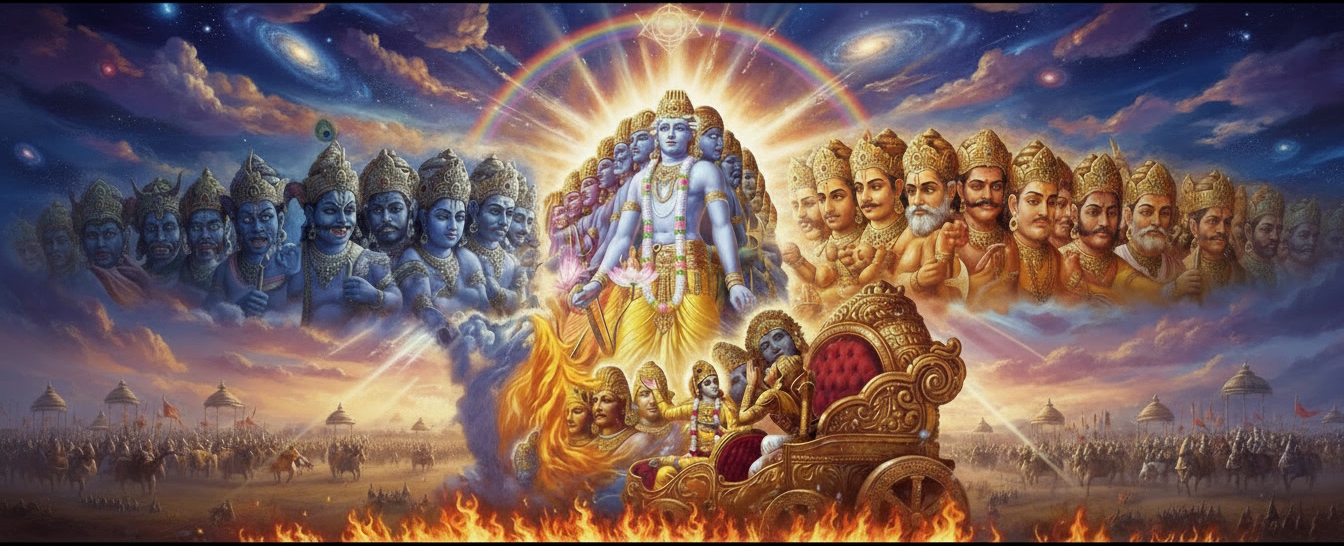
एवं ज्ञात्वा कृतं कर्म पूर्वैरपि मुमुक्षुभिः।
कुरु कर्मैव तस्मात्त्वं पूर्वैः पूर्वतरं कृतम्।।4.15।।
evaṃ jñātvā kṛtaṃ karma pūrvairapi mumukṣubhiḥ|
kuru karmaiva tasmāttvaṃ pūrvaiḥ pūrvataraṃ kṛtam||4.15||
Translation
Having known this, the ancient seekers after freedom also performed action; therefore do thou also perform action, as did the ancients in days of yore.
हिंदी अनुवाद
पूर्वकालके मुमुक्षुओंने भी इस प्रकार जानकर कर्म किये हैं, इसलिये तू भी पूर्वजोंके द्वारा सदासे किये जानेवाले कर्मोंको ही (उन्हींकी तरह) कर।
Commentaries & Translations
Swami Ramsukhdas
व्याख्या-- [नवें श्लोकमें भगवान्ने अपने कर्मोंकी दिव्यताका जो प्रसङ्ग आरम्भ किया था उसका यहाँ उपसंहार करते हैं।]
'एवं ज्ञात्वा कृतं कर्म पूर्वैरपि मुमुक्षुभिः'--अर्जुन मुमुक्षु थे अर्थात् अपना कल्याण चाहते थे। परन्तु युद्धरूपसे प्राप्त अपने कर्तव्य-कर्मको करनेमें उन्हें अपना कल्याण नहीं दीखता, प्रत्युत वे उसको घोर-कर्म समझकर उसका त्याग करना चाहते हैं (गीता 3। 1)। इसलिये भगवान् अर्जुनको पूर्वकालके मुमुक्षु पुरुषोंका उदाहरण देते हैं कि उन्होंने भी अपने-अपने कर्तव्य-कर्मोंका पालन करके कल्याणकी प्राप्ति की है, इसलिये तुम्हें भी उनकी तरह अपने कर्तव्यका पालन करना चाहिये।तीसरे अध्यायके बीसवें श्लोकमें जनकादिका उदाहरण देकर तथा इसी (चौथे) अध्यायके पहले-दूसरे श्लोकोंमें विवस्वान्, मनु, इक्ष्वाकु आदिका उदाहरण देकर भगवान्ने जो बातें कही थी, वही बात इस श्लोकमें भी कह रहे हैं।
शास्त्रोंमें ऐसी प्रसिद्धि है कि मुमुक्षा जाग्रत् होनेपर कर्मोंका स्वरूपसे त्याग कर देना चाहिये; क्योंकि मुमुक्षाके बाद मनुष्य कर्मका अधिकारी नहीं होता; प्रत्युत ज्ञानका अधिकारी हो जाता है (टिप्पणी प0 238)। परन्तु यहाँ भगवान् कहते हैं कि मुमुक्षुओंने भी कर्मयोगका तत्त्व जानकर कर्म किये हैं। इसलिये मुमुक्षा जाग्रत् होनेपर भी अपने कर्तव्य-कर्मोंका त्याग नहीं करना चाहिये, प्रत्युत निष्कामभावपूर्वक कर्तव्य-कर्म करते रहना चाहिये।कर्मयोगका तत्त्व है--कर्म करते हुए योगमें स्थित रहना और योगमें स्थित रहते हुए कर्म करना। कर्म संसारके लिये और योग अपने लिये होता है। कर्मोंको करना और न करना--दोनों अवस्थाएँ हैं। अतः प्रवृत्ति (कर्म करना) और निवृत्ति (कर्म न करना) दोनों ही प्रवृत्ति (कर्म करना) है। प्रवृत्ति और निवृत्ति--दोनोंसे ऊँचा उठ जाना योग है, जो पूर्ण निवृत्ति है। पूर्ण निवृत्ति कोई अवस्था नहीं है।
चौदहवें श्लोकमें भगवान्ने कहा कि कर्मफलमें मेरी स्पृहा नहीं है, इसलिये मुझे कर्म नहीं बाँधते। जो मनुष्य कर्म करनेकी इस विद्या-(कर्मयोग-) को जानकर फलेच्छाका त्याग करके कर्म करता है, वह भी कर्मोंसे नहीं बँधता; कारण कि फलेच्छासे ही मनुष्य बँधता है--फले सक्तो निबध्यते (गीता 5। 12)। अगर मनुष्य अपने सुखभोगके लिये अथवा धन, मान, बड़ाई, स्वर्ग आदिकी प्राप्तिके लिये कर्म करता है तो वे कर्म उसे बाँध देते हैं (गीता 3। 9)। परन्तु यदि उसका लक्ष्य उत्पत्ति-विनाशशील संसार नहीं है, प्रत्युत वह संसारसे सम्बन्ध-विच्छेद करनेके लिये निःस्वार्थ सेवा-भावसे केवल दूसरोंके हितके लिये कर्म करता है, तो वे कर्म उसे बाँधते नहीं (गीता 4। 23)। कारण कि दूसरोंके लिये कर्म करनेसे कर्मोंका प्रवाह संसारकी तरफ हो जाता है, जिससे कर्मोंका सम्बन्ध (राग) मिट जाता है और फलेच्छा न रहनेसे नया सम्बन्ध पैदा नहीं होता।
Sri Harikrishnadas Goenka
मैं न तो कर्मोंका कर्ता ही हूँ और न मुझे कर्मफलकी चाहना ही है ऐसा समझकर ही पूर्वकालके मुमुक्षु पुरुषोंने भी कर्म किये थे। इसलिये तू भी कर्म ही कर। तेरे लिये चुपचाप बैठ रहना या संन्यास लेना यह दोनों ही कर्तव्य नहीं है। क्योंकि पूर्वजोंने भी कर्मका आचरण किया है इसलिये यदि तू आत्मज्ञानी नहीं है तब तो अन्तःकरणकी शुद्धिके लिये और यदि तत्त्वज्ञानी है तो लोकसंग्रहके लिये जनकादि पूर्वजोंद्वारा सदासे किये हुए (प्रकारसे ही ) कर्म कर नये ढंगसे किये जानेवाले कर्म मत कर।
Sri Anandgiri
Having raised the doubt, "In the absence of any connection between You and action or its result, and similarly given the absence of such connection for a knower of Truth, what use do I have for action?"—He [Krishna] conveys through "na mam" etc., that action must indeed be performed by you like a seeker of liberation (Mumukshu), without entertaining the ego of doership in the action or desire for its fruit.
"I am not the doer," etc., is referred to by the word "evam" (thus); the meaning is: by that reason, namely, because it was practiced by previous seekers of liberation. He explains the meaning of the restrictive particle 'eva' (only) in 'karmaiva' with "na" etc. The word 'tvam' (you) is connected with the verb.
He clarifies what was stated by 'tasmat' (therefore) with 'purvaih' (by the ancients). Regarding the objection raised—"what use is action to me"—are you ignorant or a Knower of Truth? If ignorant, then perform action for the purification of the mind; thus He says with "yadi" (if). To the second [possibility], He answers with "tattvavid" (knower of Truth). The connection is with "perform action."
Raising the doubt, "Just because it was practiced by previous deluded persons, why should it be done by me, a person of discrimination?"—He refers to "Janaka and others." Raising the doubt, "They performed action having attained this state, but it is not to be practiced now due to lack of authority," He says "purvataram" (more ancient).
Sri Dhanpati
Having known thus—"I am not the doer, nor do I have desire for the fruit of action"—action was performed even by ancient seekers of liberation (Mumukshus) for the sake of Knowledge through the purification of the mind; therefore, you too perform action only.
Neither sitting silently nor renunciation [should be resorted to].
Because even by those anterior to you, the Knowers like Janaka and others, action was performed "more anciently" for the sake of holding the world together (Loka-sangraha), due to it being established without beginning.
The intention is: if you are ignorant and a seeker of liberation, then perform action for the purification of the mind; if you are a Knower of Truth, then for the sake of holding the world together.
Sri Madhavacharya
He states that there is also precedent (conduct) for performing action after having known thus, with the words "evam" (thus).
"Purvataram karma" (more ancient action) means that which exists prior (pre-existing).
Sri Neelkanth
He makes [Arjuna] accept this very point by demonstrating the conduct of the virtuous, with the words "evam jnatva" (having known thus).
"Purvataram" (more ancient) means [it is authoritative] because it is stated in the Vedas, not invented by anyone in present times.
Or, the meaning of "purvataram" is "done first of all," because of its absolute necessity.
Sri Ramanuja
Having known Me thus, the action characterized as described was performed by the ancient seekers of liberation who were freed from sins.
Therefore, you—whose sins have been cleansed by the knowledge concerning Me in the manner described—perform only that action which is 'purvataram'—meaning ancient—performed by the ancients like Vivasvan, Manu, and others, declared by Me at that very time, and whose form is to be described [hereafter].
He speaks of the difficulty in understanding the action that is to be described [in the next verse].
Sri Sridhara Swami
Having dispelled the incidental [doubt regarding] partiality of the Lord through the four verses beginning with "Ye yatha mam prapadyante" (In whatever way they surrender unto Me), He reminds [Arjuna] with "evam" in order to elaborate on the very Karma Yoga stated earlier.
Knowing thus that action performed without egoism etc., does not become a cause of bondage, action was performed "purvataram"—meaning even in other epochs—by ancient seekers of liberation like Janaka and others for the purification of their being.
Therefore, you too perform action first.
Sri Vedantadeshikacharya Venkatanatha
And because of the requirement of subsequent sentences, when a restriction is to be made, the specific point suitable to the context is this alone; with this intention, it was stated 'by those opposing the commencement of Karma Yoga,' etc. Regarding being an obstruction, the intermediate operation is stated as 'by causes such as attachment to fruit.' Or, the idea is: because it is performed with attachment to fruit etc., they are opponents to the commencement of Karma Yoga through the fruit, etc. Here, by the word 'prachina' (ancient/former), the non-clinging of subsequent sins for one who has accomplished worship is intended. Regarding the objection, 'For one already bound by former [actions], how can there be non-binding by them?'—here the meaning is 'I am liberated.' Thus, by the two verses, the cause for the destruction of sins that oppose the commencement of Karma Yoga as described, is stated. ...
Strengthening the Karma Yoga preceded by that [knowledge] by demonstrating the practice of disciplined persons, He instructs Arjuna with the verse 'Evam'. 'Evam' (Thus)—meaning in the manner described regarding agency, non-agency, etc. By saying 'action performed having known,' the causality of knowledge for the performance of action is indicated. 'He is not bound by actions' (4.14) was stated earlier. Therefore, to imply that knowledge is the cause of action through the removal of obstructing sins, it is said 'even having known, by those freed from sins.' The word 'Karma' here, because it concerns the duty of a seeker of liberation (Mumukshu), refers to the principal subject matter 'Karma Yoga' even though it is separated [in the text]; with this intention, [Ramanuja] said 'of the described characteristic.' The word 'tvam' (you) indicates one who has grasped the instruction of His true nature; with this intention, it is said 'you, whose sins are washed away by knowledge regarding Me in the manner described.'
The performers cited in 'Imam vivasvate' (4.1) etc., are referred to by 'purvaih' (ancients); with this intention, it is said 'by Vivasvan, Manu, and others.' To reject 'purvataram' being an adverb of action, he explains it as 'puratanam' (ancient [adjective]). He states the intention of that: 'declared by Me at that very time.' Thus, the beginninglessness of the stream (tradition) is intended here. Since this is in the form of an introduction to the determination of the nature of Karma Yoga, it is said 'whose form is to be described'.
Swami Chinmayananda
परमात्मा में कर्तृत्व तथा फलासक्ति का अभाव है और उस आत्मस्वरूप का साक्षात् अनुभव कर लेने पर साधक में न इच्छा रहती है और न अहंकार जनित अन्य वृत्तियाँ। पूर्व अध्याय में वर्णित कर्मयोग का आचरण प्राचीन समय में अनेक बुद्धिमान मुमुक्ष पुरुषों ने किया था। अर्थ यह हुआ कि यह मार्ग कोई नवीन नहीं है।आपके उपदेशमात्र से मैं कर्मयोग का पालन करूँगा किन्तु इसमें पूर्व के मुमुक्षुओं का सन्दर्भ देने की क्या आवश्यकता है इसके उत्तर में भगवान् कहते हैं क्योंकि कर्म क्या है इस विषय को समझने में कठिनाई है कैसे कहते हैं
Sri Abhinavgupta
Therefore,
purified by this understanding, you too perform actions that are certainly to be done.
Sri Jayatritha
Objection: The phrase "having known thus" is a repetition, because the practice of performing action has already been stated earlier. To this, He replies with "evam" (thus). Raising the doubt—"If a Knower (Jnani) is not bound by actions, then since I am also a Knower and possess an absence of karmic bondage, why is action ordained for me?"—it is stated here that the practice of performing action applies even to Knowers, out of a desire for "adhika-moksha" (greater beatitude in liberation). The sentiment is that while the status of Janaka, Vivasvan, and others as Knowers existed previously, it was not intended to be emphasized by the Lord [in the earlier context]. For this reason, the Commentator (Madhvacharya) stated there, "only by performing action."
For Knowers, action is not the cause of liberation through [the generation of] knowledge. In the word "mumukshubhih" (by seekers of liberation), the suffix 'u' is used in the sense of "one who does it well/habitually" (Panini Sutra 3.2.13).
Objection: Since "done by the ancients" already expresses "anteriority," isn't "purvataram" (more ancient) a repetition? To this, He says "purvataram." The meaning is: action that existed even prior to them was performed by them.
Since action is momentary, how can "that very same" action be performed? Hence it is stated in the Veda [or stated here]: that which is like the previous one is "purvabhavi" (pre-existing type); therefore, "action" is a restatement/reference.
Sri Madhusudan Saraswati
Since one is not bound by actions due to the knowledge "I am not the doer, I have no desire for the fruit of action," therefore, having known the Self to be a non-doer and untainted by action in this manner, action was performed even by the "purva" (ancient/previous) seekers of liberation of this Yuga, such as Yayati, Yadu, and others who have passed away.
Therefore, you too perform action only; do not sit silently, nor resort to renunciation.
If you are not a Knower of Truth, then [act] for self-purification; and if you are a Knower of Truth, then [act] for the holding together of the world (Lokasangraha). Action was performed "purvataram"—meaning very anciently, even in other Yugas—by the ancients like Janaka and others.
By this, He shows that action must necessarily be performed by you, because it was performed by the "former" (purva) and "more ancient" (purvatara) ones in this Yuga and in other Yugas respectively.
Sri Purushottamji
Even by ancient seekers of liberation and by the learned, action was performed having known My nature thus; the sentiment is that it was done because it constitutes My command.
They acted by My command; [therefore] you too perform action only by My command in the manner described in the previous chapter—this He states with "evam jnatva" (having known thus).
Therefore, simply because of the absence of bondage in this manner, action was performed by ancient seekers of liberation; you perform action because it is My command.
What kind of action? "Purvataram" (more ancient)—that which was performed even by those who are [now] liberated through tradition, when they were in the state of seekers (Mumukshu).
Sri Shankaracharya
Having known thus, action was performed even by the ancient—meaning past—seekers of liberation. Therefore, you perform action only; neither sitting silently nor renunciation should be resorted to. Therefore, since it was practiced even by the ancients: if you are a non-knower of the Self, [act] for self-purification; if you are a Knower of Truth, [act] for the sake of holding the world together. Action was performed "purvataram" (more anciently) by the ancients like Janaka and others; it is not something "adhunatan" (modern/recent) that has been done or created.
[Introduction to next verse:] "If action is to be done, I shall do it simply on Your word; what is the use of qualifying it as 'done more anciently by the ancients' (Gita 4.15)?" To this, it is said: Because there is great difficulty/complexity regarding action. How so?
Sri Vallabhacharya
Having stated this incidentally, He reminds [Arjuna] with "evam jnatva" (having known thus) in order to elaborate on the action to be performed in the previously mentioned Yoga.
Knowing that action performed by the Lord in the state of a Yogi, in the manner previously described, is not binding, action known as 'Svadharma' (one's own duty) was performed even by ancient seekers of liberation—such as Kakshivan, Narada and others, or Manu and others, or Janaka and others—in the manner to be described.
Therefore, you too perform action only.
And this is not modern, but 'purvataram' (more ancient) and performed by the ancients.
Thus, the duty is taught through the conduct of the virtuous (Shishtachara).
Swami Sivananda
एवं thus? ज्ञात्वा having known? कृतम् (was) done? कर्म action? पूर्वैः by ancients? अपि also? मुमुक्षुभिः seekers after freedom? कुरु perform? कर्म action? एव even? तस्मात् therefore? त्वम् thou? पूर्वैः by ancients?,पूर्वतरम् in the olden time? कृतम् done.Commentary Knowing thus that the Self can have no desire for the fruits of actions and cannot be tainted by them? and knowing that no one can be tainted if he works without egoism? attachment and expectation of fruits? do thou perform your duty.If your heart is impure? perform actions for its purification. If you have attained AtmaJnana or the knowledge of the Self? work for the wellbeing of the world. The ancients such as Janaka and others performed actions in the days of yore. So do thou also perform action.
Swami Gambirananda
Jnatva, having known; evam, thus, that 'I am not an agent; I have no desire for the results of actions'; karma, duties; krtam, were undertaken; api, even; purvaih, by the ancient; mumuksubhih, seekers of Liberation. Tasmat, therefore; tvam, you; kuru, undertake; karma, action; eva, itself. You ought not to sit ietly, or even renounce. Therefore, you (undertake actions) because they were performed by the ancients as well-if you have no Self-knowledge, then (undertake actions) for self-purification; or, if you have Self-knowledge, then (undertake actions) in order to prevent people from going astray-, as were krtam, performed; purvataram, earlier; purvaih, by the ancient ones, Janaka and others; not actions as are undertaken in the present day. [This last portion of the sentence is translated by some as follows: You should not undertake actions which are done in the present manner (i.e. do not perform actions in the manner undertakne by people nowadays, which neither purifies the mind nor helps people). (See G1. Pr. p. 114.)
'If action has to be undertaken here, then I shall do so following Your instruction itself. What is the use of specifying that it was done earlier by the ancient ones?' 'The answer is: Because there is a great difficult as regards actions.' How?
Swami Adidevananda
Actions of the kind described above were performed even by the aspirants of old for liberation, who have become free from evil after knowing Me in this way. Therefore, after having got rid of the sins by knowledge of Me in the aforesaid way, perform actions in the same way as they were performed by those ancients like Vivasvan, Manu etc., in olden times, in the way in which their performance was taught by Me even then. I shall declare it again in what follows.
Sri Krsna stresses the difficulty of undertaking the type of Karma that is going to be taught now.