Bhagavad Gita - Chapter 4 - Shloka (Verse) 16
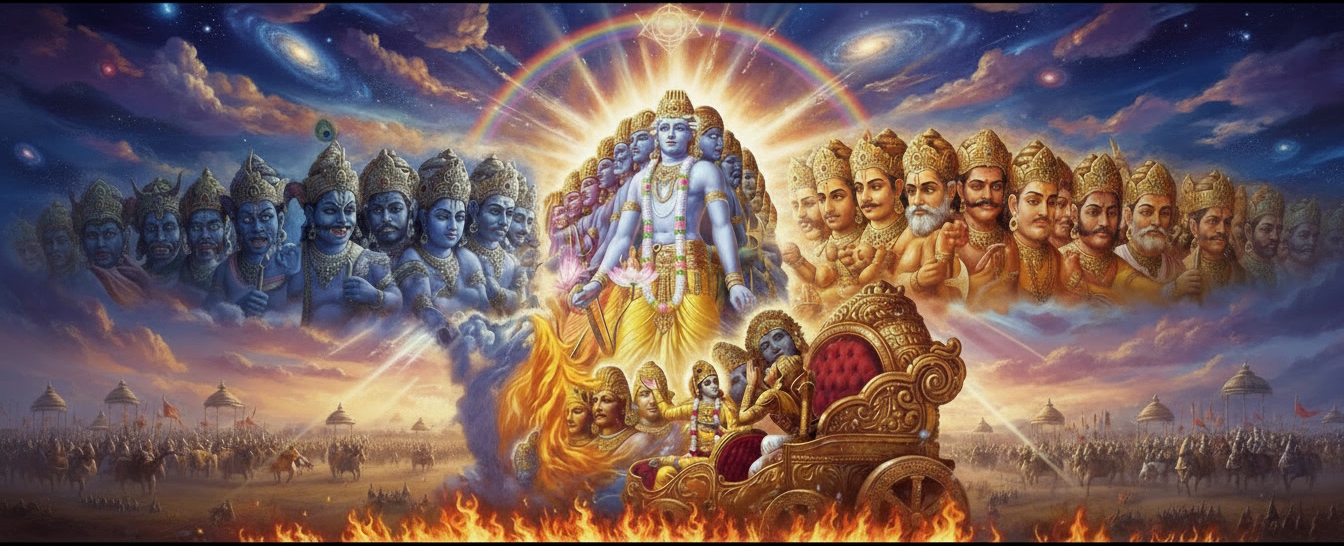
किं कर्म किमकर्मेति कवयोऽप्यत्र मोहिताः।
तत्ते कर्म प्रवक्ष्यामि यज्ज्ञात्वा मोक्ष्यसेऽशुभात्।।4.16।।
kiṃ karma kimakarmeti kavayo'pyatra mohitāḥ|
tatte karma pravakṣyāmi yajjñātvā mokṣyase'śubhāt||4.16||
Translation
What is action? What is inaction? As to this even the wise are confused. Therefore I shall teach thee such action (the nature of action and inaction) by knowing which thou shalt be liberated from the evil (of Samsara, the wheel of birth and death).
हिंदी अनुवाद
कर्म क्या है और अकर्म क्या है -- इस प्रकार इस विषयमें विद्वान् भी मोहित हो जाते हैं। अतः वह कर्म-तत्त्व मैं तुम्हें भलीभाँति कहूँगा, जिसको जानकर तू अशुभ- (संसार-बन्धन-) से मुक्त हो जायगा।
Commentaries & Translations
Swami Ramsukhdas
व्याख्या--'किं कर्म'--साधारणतः मनुष्य शरीर और इन्द्रियोंकी क्रियाओँको ही कर्म मान लेते हैं तथा शरीर और इन्द्रियोंकी क्रियाएँ बंद होनेको अकर्म मान लेते हैं। परन्तु भगवान्ने शरीर वाणी और मनके द्वारा होनेवाली मात्र क्रियाओँको कर्म माना है--'शरीरवाङ्मनोभिर्यत्कर्म प्रारभते नरः' (गीता 18। 15)।भावके अनुसार ही कर्मकी संज्ञा होती है। भाव बदलनेपर कर्मकी संज्ञा भी बदल जाती है। जैसे कर्म स्वरूपसे सात्त्विक दीखता हुआ भी यदि कर्ताका भाव राजस या तामस होता है तो वह कर्म भी राजस या तामस हो जाता है। जैसे कोई देवीकी उपासनारूप कर्म कर रहा है जो स्वरूपसे सात्त्विक है। परन्तु यदि कर्ता उसे किसी कामनाकी सिद्धिके लिये करता है तो वह कर्म राजस हो जाता है और किसीका नाश करनेके लिये करता है तो वही कर्म तामस हो जाता है। इस प्रकार यदि कर्तामें फलेच्छा ममता और आसक्ति नहीं है तो उसके द्वारा किये गये कर्म अकर्म हो जाते हैं अर्थात् फलमें बाँधनेवाले नहीं होते। तात्पर्य यह है कि केवल बाहरी क्रिया करने अथवा न करनेसे कर्मके वास्तविक स्वरूपका ज्ञान नहीं होता। इस विषयमें शास्त्रोंको जाननेवाले बड़ेबड़े विद्वान् भी मोहित हो जाते हैं अर्थात् कर्मके तत्त्वका यथार्थ निर्णय नहीं कर पाते। जिस क्रियाको वे कर्म मानते हैं वह कर्म भी हो सकता है अकर्म भी हो सकता है और विकर्म भी हो सकता है। कारण कि कर्ताके भावके अनुसार कर्मका स्वरूप बदल जाता है। इसलिये भगवान् मानो यह कहते हैं कि वास्तविक कर्म क्या है वह क्यों बाँधता है कैसे बाँधता है इससे किस तरह मुक्त हो सकते हैं इन सबका मैं विवेचन करूँगा जिसको जानकर उस रीतिसे कर्म करनेपर वे बाँधनेवाले न हो सकेंगे।यदि मनुष्यमें ममता आसक्ति और फलेच्छा है तो कर्म न करते हुए भी वास्तवमें कर्म ही हो रहा है अर्थात् कर्मोंसे लिप्तता है। परन्तु यदि ममता आसक्ति और फलेच्छा नहीं है तो कर्म करते हुए भी कर्म नहीं हो रहा है अर्थात् कर्मोंसे निर्लिप्तता है। तात्पर्य यह है कि यदि कर्ता निर्लिप्त है तो कर्म करना अथवा न करना दोनों ही अकर्म हैं और यदि कर्ता लिप्त है तो कर्म करना अथवा न करना दोनों ही कर्म हैं औरबाँधनेवाले हैं।
Sri Harikrishnadas Goenka
यदि कर्म ही कर्तव्य है तो मैं आपकी आज्ञासे ही करनेको तैयार हूँ फिर पूर्वैः पूर्वतरं कृतम् विशेषण देनेकी क्या आवश्यकता है इसपर कहते हैं कि कर्मके विषयमें बड़ी भारी विषमता है अर्थात् कर्मका विषय बड़ा गहन है। सो किस प्रकार कर्म क्या है और अकर्म क्या है इस कर्मादिके विषयमें बड़ेबड़े बुद्धिमान् भी मोहित हो चुके हैं इसलिये मैं तुझे वह कर्म और अकर्म बतलाऊँगा जिस कर्मादिको जानकर तू अशुभसे यानी संसारसे मुक्त हो जायगा।
Sri Anandgiri
He objects to the qualification of action with "tatra" (regarding that). "World of men" is the meaning of the locative case [referring to 'atra' in the verse]. Since great difficulty (complexity) exists in action, if it is qualified as "practiced by ancients" and "more ancient," your engagement in it becomes easier; therefore, the qualification is appropriate—He answers this with "uchyate" (it is said).
He raises a doubt with "katham" (how): "In action which is well-known in the world as the movement of the body etc., there is no difficulty." He replies with "kim karma" (what is action), meaning: "Even for the wise, delusion arises regarding the subject of action etc.; therefore, it is all the more possible for you to have delusion regarding it. To remove that, reliance on the words of a trustworthy authority is needed; hence, there is difficulty in action." In the phrase "tat te karma" (that action to you), the word split should also be made by connecting the letter 'a' [implying 'karma' and 'akarma'].
He states the purpose of expounding on action etc., with "yaj jnatva" (knowing which). The connection is "that action and inaction." The meaning is: because even the wise have delusion regarding the subject as described.
Restating the objection that "Since action and inaction are well-known, there is nothing to be understood regarding them," He refutes it with "na cha" (and not so).
Sri Dhanpati
"If action is to be performed, I will do this action simply on Your statement, having considered it with my own intellect; what is the use of qualifying it as 'done more anciently by the ancients'?" Anticipating this doubt, and with the intention that since there is great complexity in action, your engagement in it would be easier if it is qualified as 'by the ancients' etc., He speaks of the difficulty in understanding action with "kim" (what) etc.
As for what is said [by some]: "That should be performed after deliberating with Knowers of Truth, not merely by following worldly tradition"—that is questionable (chintyam). Because, having Himself stated with great emphasis "Therefore, you perform only the action performed more anciently by the ancients," if the Supreme Lord were to again speak of non-insistence (or open deliberation) regarding that very same point, there would be a contradiction between the former and latter statements.
'Atra'—meaning in this subject of action etc.—even 'kavayah', i.e., the wise, have attained 'moha' (delusion), meaning doubt regarding "what is action and what is inaction." Therefore, I shall explain to you 'action' and—by the coalescence of the letter 'a'—'inaction' (akarma). Knowing which 'action etc.', you shall be liberated from the inauspicious Samsara.
Sri Madhavacharya
"Perform action"—this was stated. [Now,] in order to explain it properly, He speaks of the difficulty in understanding that action with the words "kim karma kim akarma" (what is action, what is inaction).
Sri Neelkanth
Even though action is necessary, it should not be performed in a mechanical fashion (following the crowd blindly); rather, in accordance with the statement "One should perform actions having known," He introduces the topic with "kim karma" (what is action) to inform [Arjuna] of a specific distinctive feature based on action.
Since action and inaction are difficult even for the wise to determine, therefore, I shall explain to you 'action' and—by the coalescence of the letter 'a'—'inaction'.
I shall explain both of them to you; knowing which pair, you shall be liberated from the inauspicious Samsara.
Sri Ramanuja
What is the nature of the action to be performed by a seeker of liberation? And what is 'akarma' (inaction)? Action performed as worship of the Lord, devoid of desire for fruits; and 'akarma' refers to the knowledge of the true nature of the self, the agent.
Regarding the nature of the action to be performed and the knowledge included within it—in both these matters, even 'kavayah', i.e., the learned, are deluded; meaning they do not know it correctly.
I shall explain to you that action which includes knowledge within it; knowing and practicing which, you shall be liberated from the inauspicious bondage of Samsara.
For, the result of the knowledge of duty is its practice. [Next,] He states why this is difficult to know.
Sri Sridhara Swami
And that [action] should be performed after deliberating with the Knowers of Truth, not merely by [following] worldly tradition; this He states with "kim karma" (what is action).
"What is action"—i.e., of what nature is the performance of action? "What is inaction"—i.e., of what nature is the non-performance of action? Regarding this matter, even the discriminating ones are deluded.
Therefore, that action and inaction, knowing and practicing which you shall be released—will become free—from the inauspicious Samsara, I shall explain to you; listen.
Sri Vedantadeshikacharya Venkatanatha
In the verse "Kim karma" (What is action), the words 'karma' and 'akarma' might create the misconception that these two are to be known separately. To dispel this, [Ramanuja] stated "of the action to be described."
For, by verses like "He who sees inaction in action" (4.18), it will be stated that both action and inaction are parts of a single Karma Yoga. In this verse also, it is said "I shall explain that action to you" [singular]; keeping this in mind, [Ramanuja] used the phrase "of the action to be described."
To indicate its incomprehensibility, he said "to be performed by a seeker of liberation." To refute the idea that 'akarma' means absence of action etc., he explained it as "knowledge of the true nature of the self." To indicate its utility in practice, he used the word "of the agent" (referring to the self).
Although 'kavayah' is famously known as 'seers/poets', that other famous meaning is not useful here, so he interpreted it as "learned men" (vidvamsah). In "are deluded," both ignorance and incorrect knowledge are intended; to include both, he said "do not know correctly." "Are deluded"—by scattered (conflicting) scriptures; this is implied.
Although both 'what is action' and 'what is inaction' are the subject matter, by considering the context of preceding and succeeding statements like "I shall explain action," "Perform action only," and "The course of action is mysterious" (4.17), the primacy of 'action' and 'inaction' being a qualification of it is intended. With this intention, he reveals the distinctiveness implied by the word 'tat' (that) as "thus, which includes knowledge within it."
With the intention of the supreme purpose such as [freedom from] bondage of Samsara, it is said "knowing which you shall be liberated." When only this much ("having known") was specified, from where was "having practiced" (anushthaya) derived? To this, he says "knowledge of duty [results in practice]."
Here, the word "jnatva" (having known), through 'ajahallakshana' (inclusive implication), grasps the performance of action along with the knowledge of action. This is because "Therefore, you perform action only" (4.15) was stated just immediately before; otherwise, the injunction to perform action would become meaningless—this is the sentiment.
Swami Chinmayananda
सामान्य दृष्टि से हम किसी भी प्रकार की शारीरिक क्रिया को कर्म और वैसी क्रिया के अभाव को अकर्म समझते है। दैनिक जीवन के कार्यकलापों के सन्दर्भ में यह परिभाषा योग्य ही है। परन्तु दर्शनशास्त्र के दृष्टिकोण से कर्म और अकर्म के लक्षण भिन्न है।आत्मविकास की दृष्टि से कर्म का तात्पर्य केवल उसका स्थूल रूप जो शरीर द्वारा व्यक्त होता है नहीं समझना चाहिये किन्तु उसके साथ ही उसी कर्म के पीछे जो सूक्ष्म उद्देश्य है उसे भी ध्यान में रखना आवश्यक है। कर्म अपने आप में न अच्छा होता है और न बुरा। कर्म के उद्देश्य से कर्म का स्वरूप निश्चित किया जाता है। जैसे किसी फल की सुन्दरता से ही हम नहीं कह सकते कि वह खाने योग्य है अथवा नहीं क्योंकि वह तो उस फल में निहित तत्त्वों पर निर्भर करता है। उसी प्रकार अत्यन्त श्रेष्ठ प्रतीत होने वाले कर्म भी अपराधपूर्ण हो सकते हैं यदि उनका उद्देश्य निम्नस्तरीय और पापपूर्ण हो।इसलिये यहाँ कहा गया है कि कर्मअकर्म का विवेक करने में कवि लोग भी मोहित होते हैं। आजकल कविता लिखने वाले व्यक्ति को ही कवि कहा जाता है किन्तु पूर्व काल में उपनिषदों के मन्त्र द्रष्टा ऋषियों के लिये अथवा बुद्धिमान् पुरुषों के लिये यह शब्द प्रयुक्त होता था। प्रेरणा प्राप्त कोई भी पुरुष जो श्रेष्ठ सत्य को उद्घाटित करता था सिद्धकवि कहा जाता था।कर्मअकर्म की कठिन समस्या की ओर संकेत करके श्रीकृष्ण अर्जुन को आश्वासन देते हैं कि वे उसे कर्मअकर्म का तत्त्व समझायेंगे जिसे जानकर मनुष्य स्वयं को सांसारिक बन्धनों से मुक्त कर सकता है।यह सर्वविदित है कि कोई भी क्रिया कर्म है और क्रिया का अभाव शान्त बैठना अकर्म है। इसके विषय में और अधिक जानने योग्य क्या बात है इस पर कहते हैं
Sri Abhinavgupta
Now, if it is argued that perfection arises simply from non-performance [of action], that is not correct. Because [of the question] "What is action?". The distinction between action and inaction is difficult to comprehend.
Moreover, even within prescribed action, there exists faulty action, like the killing of an animal in the Agnishtoma sacrifice. And even in opposed (prohibited) action, there exists auspicious action; for instance, in the killing of violent beasts, there is the absence of suffering for the subjects.
Furthermore, even in non-performance, there is auspicious and inauspicious action, because actions performed by speech and mind are inevitable, and without Knowledge, they are difficult to avoid. Therefore, because of its profundity, action is not understood even by the skillful, thinking "by this auspicious action good will come to us, and by the non-commencement of actions, our liberation will occur."
Thus, the Lord's intention is that the "fire of special knowledge" (Vijnana) to be described hereafter, which alone is capable of consuming the fuel of all auspicious and inauspicious actions, must be sought as the refuge.
Sri Jayatritha
The connection of the verse "Kim karma" (What is action) is not apparent, so he explains with "Karma" etc. [Meaning:] Of that action which was stated as a duty. For what purpose? "To explain it properly." This indeed is "explaining properly"—stating what is desired to be known; and the desire to know arises when the difficulty in understanding is mentioned—this is the sentiment. Therefore, He says "pravakshyami" (I will tell you elaborately/excellently).
Objection: Since "vikarma" (forbidden action) is also included in the next verse, and here too the word "akarma" implies that [vikarma], it should have been stated as "of actions, etc." [plural/group]; how is it stated as "of action" [singular]? Answer: Because it is what is to be performed (practiced). Akarma and the rest are to be known as things to be rejected/avoided. That is why He said, "I shall explain that action to you." Even there, it implies akarma and the rest.
Sri Madhusudan Saraswati
Objection: Is there really any doubt regarding the subject of action, for which reason You are insisting so much on "done more anciently by the ancients"? He replies that there certainly is.
Just as one seated in a boat perceives the illusion of motion in stationary trees on the bank, and conversely, just as one perceives the illusion of non-motion in men who are actually walking when they are not too far from the eyes [but seen from a distance], similarly, regarding what is "action" in reality and what is "inaction" in reality, even "kavayah"—the wise/intelligent—are "deluded" in this subject; meaning they have attained confusion, or the inability to reach a conclusion. The meaning is: because it is extremely difficult to determine.
"Tat"—therefore, I shall explain to you "action" and, by the coalescence of the letter 'a' (akara-prashlesha), "inaction" as well—I will speak "prakarshena" (excellently), destroying all doubts. Knowing which nature of action and inaction, you shall be released—you will become free—from the inauspicious Samsara.
Sri Purushottamji
Objection: If one argues that "the form of action is simply that which accomplishes worldly results," then to this He says "kim karma" (what is action).
What is action—meaning what kind of action is a duty? What is inaction—meaning what kind of inaction is non-duty? Here, in the knowledge of this, even "kavayah"—meaning those who know the meanings of words—are "deluded," meaning they have attained confusion.
"Tat"—for that reason, I shall explain to you the duty (action) "pravakshyami"—meaning I will tell you excellently, with a complete absence of doubt. Knowing which action, you shall be liberated from the "inauspicious"—meaning from inaction (or wrong action) that accomplishes [mere] worldly results.
Sri Shankaracharya
What is action and what is inaction—regarding this subject of action, etc., even 'kavayah', meaning the intelligent, are deluded (have attained confusion).
Therefore, I shall fully explain action and inaction to you, knowing and understanding which action, etc., you shall be released from the inauspicious Samsara.
Nor should you think this: "Action is the activity of the body, etc., which is well-known in the world; and inaction is the non-activity of that, meaning sitting silently. What is there to be understood in that?"
[Asking] "Why" [should it be known], He states [in the next verse].
Sri Vallabhacharya
That [action] should be performed only after deliberation, not merely by worldly tradition," for this reason He states "kim karma kim akarma" (what is action, what is inaction).
What is stated as prescribed (vihita) and what is non-prescribed (avihita)? Regarding this, even the 'kavayah' are deluded.
That I shall explain to you clearly, knowing which action, you shall be released from the third [type]—from vikarma (forbidden action)—which is inauspicious.
Swami Gambirananda
Kavayah api, even the intelligent; mohitah, are confounded in this subject of action etc.; iti atra, as to; kim karma, what is action; and kim akarma, what is inaction. Therefore, pravaksyami, I shall tell; te, you; of karma, action; akarma ca, as also of inaction; jnatva, by knowing; yat, which-action etc.; moksyase, you will become free: asubhat, from evil, from transmigration.
'And you should not think thus: What is called karma is the movement of the body etc. as are well-known in the world; and akarma, inaction, is not doing those, (i.e.) sitting ietly. What is there to understand (further) in that regard?' 'Why?' The answer is:
Swami Adidevananda
What is the form of the action which should be done by an aspirant for liberation? And what is non-action? Knowledge about the true nature of the acting self, is spoken of as non-action. The wise, even the learned scholars, are puzzled, i.e., do not truly know, both these - the proper form of the actions to be performed and the proper form of knowledge included in it. I shall teach you that action which includes knowledge within itself. Knowing, i.e., following it, you will be released from evil, i.e., from the bondage of Samsara. Knowledge about the work to be performed results in its performance.
Why is it so difficult to know this Karma? Sri Krsna replies: