Bhagavad Gita - Chapter 4 - Shloka (Verse) 33
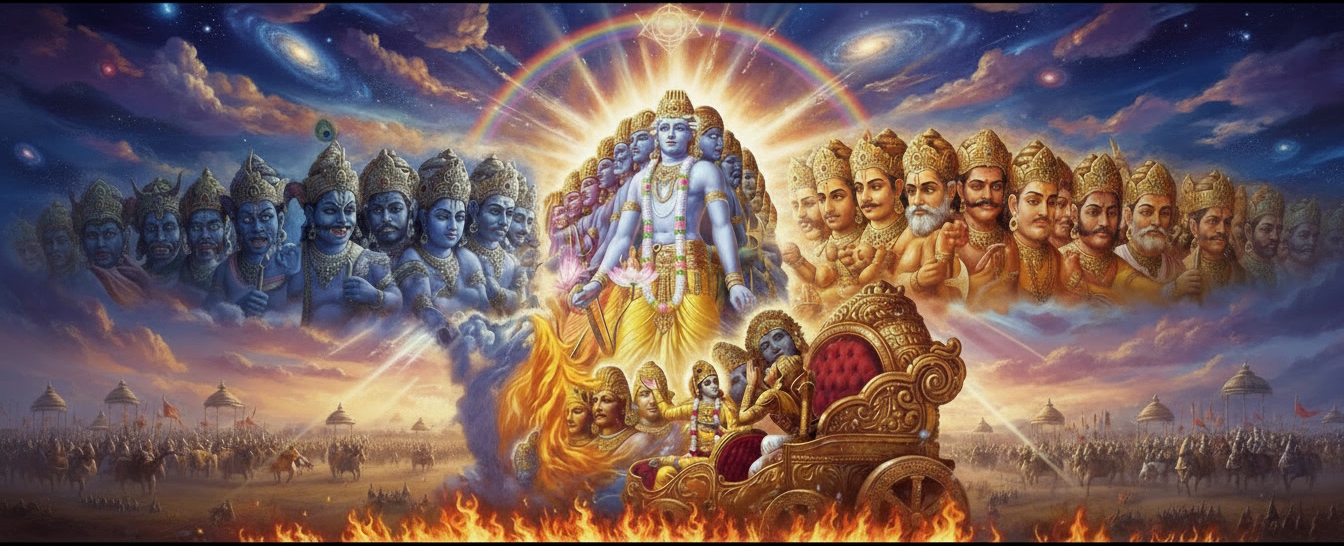
श्रेयान्द्रव्यमयाद्यज्ञाज्ज्ञानयज्ञः परन्तप।
सर्वं कर्माखिलं पार्थ ज्ञाने परिसमाप्यते।।4.33।।
śreyāndravyamayādyajñājjñānayajñaḥ parantapa|
sarvaṃ karmākhilaṃ pārtha jñāne parisamāpyate||4.33||
Translation
Superior is wisdom-sacrifice to the sacrifice with objects, O Parantapa (scorcher of the foes). All actions in their entirely, O Arjuna, culminate in knowledge.
हिंदी अनुवाद
हे परन्तप अर्जुन ! द्रव्यमय यज्ञसे ज्ञानयज्ञ श्रेष्ठ है। सम्पूर्ण कर्म और पदार्थ ज्ञान-(तत्त्वज्ञान-) में समाप्त हो जाते हैं।
Commentaries & Translations
Swami Ramsukhdas
व्याख्या--'श्रेयान्द्रव्यमयाद्यज्ञाज्ज्ञानयज्ञः परंतप'--जिन यज्ञोंमें द्रव्यों (पदार्थों) तथा कर्मोंकी आवश्यकता होती है, वे सब यज्ञ 'द्रव्यमय' होते हैं। 'द्रव्य' शब्दके साथ 'मय' प्रत्यय प्रचुरताके अर्थमें है। जैसे मिट्टीकी प्रधानतावाला पात्र 'मृन्मय' कहलाता है, ऐसे ही द्रव्यकी प्रधानतावाला यज्ञ 'द्रव्यमय' कहलाता है। ऐसे द्रव्यमय यज्ञसे ज्ञानयज्ञ श्रेष्ठ है; क्योंकि ज्ञानयज्ञमें द्रव्य और कर्मकी आवश्यकता नहीं होती।
सभी यज्ञोंको भगवान्ने कर्मजन्य कहा है (4। 32)। यहाँ भगवान् कहते हैं कि सम्पूर्ण कर्म ज्ञानयज्ञमें परिसमाप्त हो जाते हैं अर्थात् ज्ञानयज्ञ कर्मजन्य नहीं, है प्रत्युत विवेक-विचारजन्य है। अतः यहाँ जिस ज्ञानयज्ञकी बात आयी है, वह पूर्ववर्णित बारह यज्ञोंके अन्तर्गत आये ज्ञानयज्ञ (4। 28) का वाचक नहीं है, प्रत्युत आगेके (चौंतीसवें) श्लोकमें वर्णित ज्ञान प्राप्त करनेकी प्रचलित प्रक्रियाका वाचक है। पूर्ववर्णित बारह यज्ञोंका वाचक यहाँ 'द्रव्यमय यज्ञ' है। द्रव्यमय यज्ञ समाप्त करके ही ज्ञानयज्ञ किया जाता है।अगर सूक्ष्मदृष्टिसे देखा जाय तो ज्ञानयज्ञ भी क्रियाजन्य ही है, परन्तु इसमें विवेक-विचारकी प्रधानता रहती है।'सर्वं कर्माखिलं पार्थ ज्ञाने परिसमाप्यते'-- 'सर्वम्' और 'अखिलम्'-- दोनों शब्द पर्यायवाची हैं और उनका अर्थ सम्पूर्ण होता है। इसलिये यहाँ 'सर्वम् कर्म' का अर्थ सम्पूर्ण कर्म (मात्र कर्म) और 'अखिलम्' का अर्थ सम्पूर्ण द्रव्य (मात्र पदार्थ) लेना ही ठीक मालूम देता है।जबतक मनुष्य अपने लिये कर्म करता है, तबतक उसका सम्बन्ध क्रियाओँ और पदार्थोंसे बना रहता है। जबतक क्रियाओँ और पदार्थोंसे सम्बन्ध रहता है, तभीतक अन्तःकरणमें अशुद्धि रहती है, इसलिये अपने लिये कर्म न करनेसे ही अन्तःकरण शुद्ध होता है।अन्तःकरणमें तीन दोष रहते हैं--मल (संचित पाप), विक्षेप (चित्तकी चञ्चलता) और आवरण (अज्ञान)। अपने लिये कोई भी कर्म न करनेसे अर्थात् संसारमात्रकी सेवाके लिये ही कर्म करनेसे जब साधकके अन्तःकरणमें स्थित मल और विक्षेप--दोनों दोष मिट जाते हैं, तब वह ज्ञानप्राप्तिके द्वारा आवरण-दोषको मिटानेके लिये कर्मोंका स्वरूपसे त्याग करके गुरुके पास जाता है। उस समय वह कर्मों और पदार्थोंसे ऊँचा उठ जाता है अर्थात् कर्म और पदार्थ उसके लक्ष्य नहीं रहते, प्रत्युत एक चिन्मय तत्त्व ही उसका लक्ष्य रहता है। यही सम्पूर्ण कर्मों और पदार्थोंका तत्त्वज्ञानमें समाप्त होना है।
Sri Harikrishnadas Goenka
ब्रह्मार्पणम् इत्यादि श्लोकद्वारा यथार्थ ज्ञानको यज्ञरूपसे सम्पादन किया फिर बहुतसे यज्ञोंका वर्णन किया। अब पुरुषका इच्छित प्रयोजन जिन यज्ञोंसे सिद्ध होता है उन उपर्युक्त अन्य यज्ञोंकी अपेक्षा ज्ञानयज्ञकी स्तुति करते हैं। कैसे सो कहते हैं हे परन्तप द्रव्यमय यज्ञकी अपेक्षा अर्थात् द्रव्यरूप साधनद्वारा सिद्ध होनेवाले यज्ञकी अपेक्षा ज्ञानयज्ञ श्रेष्ठतर है। क्योंकि द्रव्यमय यज्ञ फलका आरम्भ करनेवाला है और ज्ञानयज्ञ ( जन्मादि ) फल देनेवाला नहीं है। इसलिये वह श्रेष्ठतर अर्थात् अधिक प्रशंसनीय है। क्योंकि हे पार्थ सबकेसब कर्म मोक्षसाधनरूप ज्ञानमें जो कि सब ओरसे परिपूर्ण जलाशयके समान है समाप्त हो जाते हैं अर्थात् उन सबका ज्ञानमें अन्तर्भाव हो जाता है। जैसे ( चौपड़के खेलमें कृतयुग त्रेता द्वापर और कलियुग ऐसे नामवाले जो चार पासे होते हैं उनमेंसे ) कृतयुग नामक पासेको जीत लेनेपर नीचेवाले सब पासे अपनेआप ही जीत लिये जाते हैं ऐसे ही जिसको वह रैक्व जानता है उस ब्रह्मको जो कोई भी जान लेता है प्रजा जो कुछ भी अच्छे कर्म करती है उन सबका फल उसे अपनेआप ही मिल जाता है। इस श्रुतिसे भी यही सिद्ध होता है।
Sri Anandgiri
Observing that since Karma Yoga has been described in manifold ways, Arjuna might misunderstand all means of welfare to be of the nature of action (Karma) and disregard Knowledge alone, he states the purport of the following verse beginning with "Brahma" etc., restating what has passed.
"Siddha..."—By those sacrifices whose purpose is the "Siddha" (accomplished) human goal, i.e., possessing the characteristics desired by the person. This implies "by those taught immediately before."
He reveals the mode of praise preceded by a question with "Katham" (How), etc.
He states the reason for the Knowledge-sacrifice being more praiseworthy than the material sacrifice with "Sarvam" (All). "Accomplished by material means"—this is an Upalakshana (implication) for Svadhyaya (self-study) etc. as well. Since Knowledge-sacrifice is superior (shreyas) to even that, he elaborates on the greater praiseworthiness of Knowledge-sacrifice compared to material sacrifices etc. with "Dravyamayo hi" (For the material...).
[Material sacrifice is the originator] of the fruit, i.e., of prosperity (abhyudaya). [Knowledge] is not the originator of a fruit, i.e., not the producer of any [new] fruit, but is the manifester of the eternally established Liberation; this is the meaning.
He states another reason for its greater praiseworthiness with "Yatah" (Because). By "Samastam karma" (All action), Agnihotra etc. are mentioned. "Akhilam"—that of which there is no "khila" or remainder existing; meaning not small, i.e., greater/complete. The use of the two words "Sarvam" (all) and "Akhilam" (entire) is to indicate non-restriction.
Regarding "All action is included in Knowledge," he cites the Chandogya Shruti as authority with "Yatha" (Just as). In the game of dice with four marks, a certain throw having four marks is called by the word "Krita"; for that "conquered" Krita—due to their being for its sake (or subservient to it)—the lower throws having three, two, and one marks, named Treta, Dvapara, and Kali, "Samyanti"—go together/merge into it. In the throw of four marks, the inclusion of throws of three, two, and one marks indeed occurs, because the inclusion of intermediate numbers in a great number is inevitable. "Evam"—In this very way, everything "Sameti"—goes to/merges with—this man of knowledge, due to its facing towards him.
What is that "all" which is included in the wise person? He states that with "Yat kinchit" (Whatever). Whatever good action all beings perform, "all that"—this is the meaning.
He qualifies that very man of knowledge mentioned in "Enam abhisameti" (goes to him) with "Yastad" (Who that...). Clarifying "what is that?" which was mentioned, he says "Yatsa" (What he...), etc. Whatever Reality that (Raikva) knows, whoever else also knows that Reality, all good actions go to this one—this is the construction.
Sri Dhanpati
By the statement "Know them all to be born of action," since the Knowledge-sacrifice (Jnana-yajna) was also mentioned among "all," anticipating the doubt of its equality with the others, He says "Shreyan" (Better). The Knowledge-sacrifice, having Liberation (Moksha) as its fruit, is exceedingly superior to the Material-sacrifice (Dravya-yajna), which is accomplished by materials like the body and senses and has Samsara (worldly existence) as its fruit. Addressing him as "Parantapa" (Scorcher of foes), He indicates: "Having attained Knowledge through the purification of the mind, you will become capable of scorching—destroying—the enemy in the form of ignorance, not merely by action."
He states the reason for that with "Sarvam" (All) etc. Anticipating a restriction [of meaning] due to the context—that "Sarvam" refers only to the action consisting of the twelve previously described sacrifices—He says "Akhilam" (Entire). The stated and unstated, the Shrauta and Smarta, and that consisting of meditation (Upasana) etc., culminates—is included—in Knowledge, i.e., in the direct realization of Reality which is the means to Liberation. Because it is said: "As much use [there is in a small reservoir] when there is water flooding from all sides..." (Gita 2.46).
Or, [it means] it culminates [in Knowledge] through the destruction of obstacles; because of the Shruti "The Brahmins desire to know this very Self through the study of Vedas, by sacrifice..." etc., and because of the logic/maxim "And there is expectation of all [works] like the horse" (Brahma Sutra 3.4.26).
In this view, since only desireless actions are utilized there, the purpose of [using] either one of the two words "Sarvam" (all) and "Akhilam" (entire)—which prevent restriction—in the phrase "Sarvam karma akhilam" is to be considered.
Just as Yudhishthira and Bhimasena are also included in "Partha" (Son of Pritha), similarly, echoing the Shruti "Of this very Bliss, other beings enjoy a fraction," He implies that the fruit of the other Section (Karma-kanda) is included in the fruit of the Knowledge Section (Jnana-kanda)—i.e., the direct realization of Reality—and thus addresses him as "Partha."
Sri Madhavacharya
"Akhilam" means accompanied by auxiliaries like meditation (Upasana).
The meaning is that it has Knowledge alone as its fruit.
Sri Neelkanth
He praises that Knowledge-sacrifice (Jnana-yajna), for the sake of which these sacrifices were introduced, with "Shreyan" (Better).
"Dravya" (Material) is external and internal; compared to the sacrifice consisting of material, which is accomplished by the body, senses, etc., the Knowledge-sacrifice—which is of the nature of the cessation of activity of speech, mind, and body without remainder—is "Shreyan," i.e., more praiseworthy.
By the comparative suffix Iyasun, the praiseworthiness of those (material sacrifices) is also indicated. The reason for that is "Sarvam" (All). Action and the fruit of action, "Sarvam" (all) and "Akhilam" (entire)—combined with the withdrawal of all limbs/parts—"Parisamapyate," i.e., is included, in Knowledge.
[As the Shruti says:] "Just as for the conquered 'Krita' throw, the lower throws merge together, exactly so does all this go to him—whatever good people do; he who knows that, what he knows..."
Sri Ramanuja
In action which possesses a dual nature, the component consisting of Knowledge is "Shreyan" (superior) to the component consisting of material. Because "Sarva" (all) action, and everything else that is "Akhila" (entire) and worthy of being undertaken, culminates in Knowledge.
Thus, Knowledge, which is the goal to be attained by all means, is practiced as being included within action.
For that very [Knowledge], being practiced, attains the state of the Goal (Prapya) in due course.
Sri Sridhara Swami
He states that the Knowledge-sacrifice is superior to the Action-sacrifice with "Shreyan" (Better). The Knowledge-sacrifice is "Shreyan"—superior—to the material sacrifice (Dravyamaya) consisting of Daiva-yajna etc., which is born of the activity of the non-Self.
Although the Knowledge-sacrifice is indeed dependent on mental activity, still, there is only the manifestation of Knowledge—which is the very nature of the Self—in the modification of the mind, and not origination from it; this is the distinction from the material [sacrifice].
The reason for the superiority: All action, "Akhilam"—entirely, along with its fruit—"Parisamapyate"—culminates in Knowledge. The meaning is that it is included [in it]. As per the Shruti: "Whatever good people do, all that goes to him."
Sri Vedantadeshikacharya Venkatanatha
Explaining the meaning of the section dealing with Knowledge, starting from "Shreyan" up to the end of the chapter, after establishing its connection, he says "Antargata" (Included/Internal). It has a direct connection with the earlier section that established the nature of action as Knowledge, preceding the intermediate section that propounded the specific varieties.
[Objection:] Since it is stated that "Knowledge-sacrifice is superior to material sacrifice," it is appropriate to accept the primacy of Jnana Yoga which is the internal means to Self-realization. By "All action entirely, O Partha, culminates in Knowledge," the inclusion of the entire fruit of action in Knowledge is understood. Also, instructions like "Even if you are the most sinful..." (4.36), "Fire of knowledge..." (4.37), "Renounced actions by Yoga" (4.41) appear immediately after. Even verse 4.38 "There is no purifier like knowledge" seems to imply the excess purity of Jnana Yoga over Karma Yoga. Verse 4.39 "Having obtained knowledge... attains peace" reveals the quick effect of Jnana Yoga as an internal means versus the delayed fruit of the other. Even the description of the nature of knowledge in 4.35 "By which you will see beings..." strengthens the case for Jnana Yoga. Indeed, everything is not directly realized merely by the Self-knowledge included within Karma Yoga. Also, in 4.28, Jnana-yajna is mentioned separately from material sacrifice. Therefore, this should be taken as a section praising Jnana Yoga.
[Reply:] Here it is said: In "Better than material sacrifice," simply because of the primacy of Knowledge, it is not proper to speak of the intention of Jnana Yoga. Because in "Action is superior to inaction" (3.8) etc., everywhere, the primacy of Action (Karma) which is contrary to that [pure Jnana Yoga] has been elaborated. Even in the next chapter, since "But of the two, Karma Yoga is better than renunciation of action" (5.2) will be stated, it is illogical to propound a contrary meaning in the middle. Therefore, here the word "Knowledge-sacrifice" refers to the part/component of Karma Yoga.
...
And in the concluding verse of the chapter (4.42) "Cutting the doubt with the sword of knowledge... stand up," by the injunction of enthusiasm for war, Karma Yoga and the knowledge included within it are clearly perceived. Indeed, if Jnana Yoga were the superior one, "Stand up for war" would not be consistent.
"Sarvam karma" (All action) is intended only as a reason for the primacy of the knowledge-component included within Action. ... Even in "Yogasannyastakarmanam" (4.41), only the attainment of the "form of knowledge" by action—being devoid of attachment to fruits etc.—is intended.
In the verse "Jnanam labdhva" (4.39), the mature state consisting of direct realization of the knowledge-component included in Karma Yoga is spoken of; because the mature state is clarified immediately after "Tat svayam yogasamsiddhah" (4.38) and "Shraddhavan labhate" (4.39).
... Intending all this, he says "Ubhayakare"—meaning in Action (Karma), i.e., in Karma Yoga. The word "Karma" here refers to what is to be practiced. "Dravyamayat amshat" (Than the material part)—the purport is that the word "Yajna" here refers to a part of the sacrifice. ... Regarding "Taditarasya" (Of the other than that): What else other than Action is worthy of being undertaken here? And how do Action and that [other] culminate in Knowledge? To this he says "Tadeva" (That very...). By "Sarvaih sadhanaih" (By all means), the display of what is worthy of undertaking other than that [Action] is made. By "Prapyabhutam" (Being the goal), the culmination of it therein is made known. He explains the culmination of Action therein with "Tadeva abhyasyamanam" (That very thing being practiced...). By the emphasis/restriction (Avadharana), it is intended that the relation of means and end is based merely on a difference of state. By this, it is said that the culmination of Action in the Knowledge included within itself is with the intention of the "accomplished state" characterized by direct realization.
Swami Chinmayananda
भगवान् श्रीकृष्ण कहते हैं कि आत्मोन्नति के लिए अनेक द्रव्य पदार्थों के उपयोग से सिद्ध होने वाले यज्ञों की अपेक्षा ज्ञानयज्ञ ही श्रेष्ठ है। दूसरी पंक्ति में भगवान् उसके श्रेष्ठत्व का कारण भी बताते हैं। कर्मकाण्ड में उपादिष्ट द्रव्यमय यज्ञ ऐसे फलों को उत्पन्न करते हैं जिनके उपभोग के लिए कर्तृत्वाभिमानी जीव को अनेक प्रकार के देह धारण करने पड़ते हैं जिनमें और भी नएनए कर्म किये जाते रहते हैं। कर्म से ही कर्म की समाप्ति नहीं होती। अत कर्म की पूर्णता स्वयं में ही कभी नहीं हो सकती।इसके विपरीत ज्ञान के प्रकाश में अज्ञान जनित अहंकार नष्ट हो जाता है। अज्ञान से कामना और कामना से कर्म उत्पन्न होते हैं। इसलिए ज्ञान के द्वारा कर्म के मूल स्रोत अज्ञान के ही नष्ट हो जाने पर कर्म स्वत समाप्त हो जाते हैं। सम्पूर्ण कर्मों की परिसमाप्ति ज्ञान में होती है।यदि केवल ज्ञान से ही पूर्णत्व की प्राप्ति होती हो तो उस ज्ञान को हम कैसे प्राप्त कर सकते हैं जिससे कि सब कर्मों का क्षय तत्काल हो जाये इसका उत्तर है
Sri Abhinavgupta
Here, however, is this distinction: "Shreyan" (Better). The sacrifice illumined by Knowledge is superior to the mere material sacrifice.
The "mere-ness" is indicated by the suffix Mayat.
Because all action attains its culmination in Knowledge.
Sri Jayatritha
Since "all action" (sarvam karma) has been stated, "akhilam" (entire) is a repetition; to this objection, he says "Akhilam". Upasanas (meditations) intended for the prosperity/perfection of action are spoken of in the Veda itself. "Khilam" means with remainder (incomplete); that which is not so is "Akhilam" (without remainder/complete); this is the meaning.
Regarding "terminates in knowledge" (jnane parisamapyate)—to prevent the misinterpretation that "once knowledge arises, action is not to be done/obligatory," he states the purport with "Jnanena" (by/with knowledge). "Parisamapti" means completion or fruitfulness; and that, because of the proximity to "when knowledge exists," is implied to be through the fruit characterized as knowledge; this is the purport.
Sri Madhusudan Saraswati
Since equality of Action and Knowledge might be inferred due to their being mentioned equally, He says "Shreyan"—more praiseworthy. Because it has Liberation as its direct fruit, the Knowledge-sacrifice alone is superior to the material sacrifice—and all implies [sacrifices] devoid of knowledge indicated by that [term]—which have Samsara as their fruit, O Partha.
Why is this so? Because "Sarvam Karma"—all Shrauta action in the form of Ishti, animal, Soma, and piling of fire altar; and "Akhilam"—all Smarta action without exception in the form of meditation etc.—that action "Samapyate"—culminates in Knowledge, i.e., in the direct realization of the unity of Brahman and the Self, through the destruction of obstacles.
This is based on the Shruti: "Brahmins desire to know Him by the study of Vedas, by sacrifice, charity, austerity, and fasting," and "By Dharma one drives away sin"; and also by the logic/maxim: "And there is expectation of all [works] like the horse."
Sri Purushottamji
"Nanu"—Anticipating the objection: "Since I do not desire the fruit of this, and since those duties are to be performed by command for the sake of holding the world together (Loka-sangraha), what is the fruit of Knowledge [for me]?" To this, He says "Shreyan" (Better).
O Parantapa—worthy of knowledge! In the absence of knowledge, for one belonging to God, performing action with the forbidden motive of fruits like heaven etc. is improper; therefore, the Jnana-yajna—sacrifice consisting of knowledge or sacrifice performed with knowledge—is "Shreyan" (better) than the Dravyamaya (material) sacrifice; meaning it is superior.
Moreover, the material sacrifice is not the best because it lacks completeness, whereas the one consisting of Knowledge becomes complete; He states this with "Sarvam" (All).
O Partha, "Sarvam karma" (all action) "Parisamapyate"—culminates—"Akhilam" (completely) in Knowledge; the meaning is that it becomes complete near Me.
Sri Shankaracharya
"Shreyan"—The Knowledge-sacrifice is better than the Dravyamaya sacrifice—that which is accomplished by material means—O Parantapa. For, the material sacrifice is the originator of a fruit (result), but the Knowledge-sacrifice is not the originator of a [new] fruit; therefore, it is "Shreyan"—more praiseworthy.
How? Because "Sarvam karma" (all action)—entire, "Akhilam" (unobstructed/complete)—O Partha, "Parisamapyate"—culminates, i.e., is included—in "Jnana" (Knowledge), which is the means to liberation and is analogous to "water flooding from all sides" (sarvatah-samplutodaka). As per the Shruti: "Just as for the conquered 'Krita' throw, the lower throws merge together, exactly so does all this go to him—whatever good people do; he who knows that, what he knows..." (Chhandogya Upanishad 4.1.4).
... Then, by what means is this specific Knowledge attained? This is stated.
Sri Vallabhacharya
He states the superiority of the Brahmatmakatva-jnana-yajna (the sacrifice of the knowledge of the Self being Brahman) over all sacrifices with "Shreyan" etc.
The Brahmatmakatva-jnana-yajna, which constitutes the identical import of both Sankhya and Yoga, is superior to the other. Because therein, "Akhilam" (entire) action along with its fruit "Parisamapyate"—culminates, i.e., is included. As per the Shruti: "All that goes to him, whatever good people do..." (Chhandogya Upanishad 4.1.4).
Swami Sivananda
श्रेयान् superior? द्रव्यमयात् with objects? यज्ञात् than sacrifice? ज्ञानयज्ञः knowledgesacrifice? परन्तप O Parantapa? सर्वम् all? कर्म action? अखिलम् in its entirely? पार्थ O Partha? ज्ञाने in knowledge? परिसमाप्यते is culminated.Commentary Sacrifices with material objects cause material effects and bring the sacrificer to this world for the enjoyment of the fruits? while wisdomsacrifice leads to Moksha. Therefore wisdomsacrifice is superior to the sacrifice performed with material objects. Just as rivers join the ocean? so do all actions join knowledge? i.e.? they culminate in knowledge. All actions purify the heart and lead to the dawn of knowledge of the Self.All actions that are performed as offerings unto the Lord with their fruits are contained in the knowledge of Brahman. (Cf.IX.15X.25XVIII.70)
Swami Gambirananda
O destroyer of enemies, jnana-yajnah, Knowledge considered as a sacrifice; is sreyan, greater; dravyamayat yajnat, than sacrifices reiring materials [Including study of the Vedas, etc. also.] For, a sacrifice performed with materials is an originator of results, [Worldly prosperity, attaining heaven, etc.], but Knowledge considered as a sacrifice is not productive of results. [It only reveals the state of Liberation that is an achieved fact. (According to Advaitism, Liberation consists in the removal of ignorance by Illumination. Nothing new is produced thery.-Tr.)]. Hence it is greater, more praiseworthy.
How?
Because, sarvam, all; karma-akhilam, actions in their totality, without exception; O son of Prtha, parisamapyate, culminate, get merged (attain their consummation); jnane, in Knowledge, which is a means to Liberation and is comparable to 'a flood all around' (cf.2.46). This is the idea, which accords with the Upanisadic text, 'As when the (face of a die) bearing the number 4, called Krta, wins, the other inferior (numbers on the die-faces) get included in it, so whatever good actions are performed by beings, all that gets merged in this one (Raikva). (So it happens) to anyone who knows what he (Raikva) knew' (Ch. 4.1.4).
In that case, by what means is this highly estimable Knowledge acired? The answer is being given:
Swami Adidevananda
Karma Yoga has two aspects - knowledge and material ingredients. Of these two, the component of knowledge is superior to the component of material ingredients. Knowledge is the culmination of all actions and of everything else, accessories and other things helpful. This knowledge alone, which is to be obtained by all means, is practised as comprehended in Karma Yoga. And this knowledge being regularly practised, reaches gradually what is ultimately attainable i.e., the vision of the self.