Bhagavad Gita - Chapter 4 - Shloka (Verse) 9
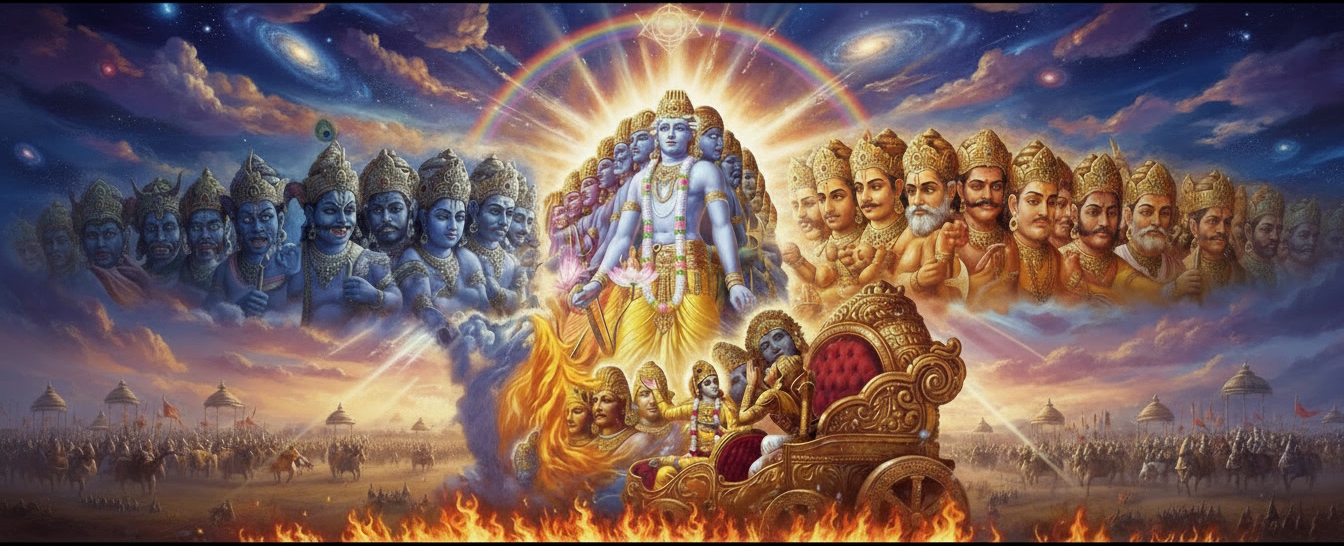
जन्म कर्म च मे दिव्यमेवं यो वेत्ति तत्त्वतः।
त्यक्त्वा देहं पुनर्जन्म नैति मामेति सोऽर्जुन।।4.9।।
janma karma ca me divyamevaṃ yo vetti tattvataḥ|
tyaktvā dehaṃ punarjanma naiti māmeti so'rjuna||4.9||
Translation
He who thus know, in their true light, My divine birth and action, having abandoned the body, is not born again, he comes to Me, O Arjuna.
हिंदी अनुवाद
हे अर्जुन ! मेरे जन्म और कर्म दिव्य हैं। इस प्रकार (मेरे जन्म और कर्मको) जो मनुष्य तत्त्वसे जान लेता अर्थात् दृढ़तापूर्वक मान लेता है, वह शरीरका त्याग करके पुनर्जन्मको प्राप्त नहीं होता, प्रत्युत मुझे प्राप्त होता है।
Commentaries & Translations
Swami Ramsukhdas
व्याख्या--'जन्म कर्म च मे दिव्यम्'--भगवान् जन्म-मृत्युसे सर्वथा अतीत--अजन्मा और अविनाशी हैं। उनका मनुष्यरूपमें अवतार साधारण मनुष्योंकी तरह नहीं होता। वे कृपापूर्वक मात्र जीवोंका हित करनेके लिये स्वतन्त्रतापूर्वक मनुष्य आदिके रूपमें जन्म-धारणकी लीला करते हैं। उनका जन्म कर्मोंके परवश नहीं होता। वे अपनी इच्छासे ही शरीर धारण करते हैं (टिप्पणी प0 226)।भगवान्का साकार विग्रह जीवोंके शरीरोंकी तरह हाड़-मांसका नहीं होता। जीवोंके शरीर तो पाप-पुण्यमय, अनित्य, रोगग्रस्त, लौकिक, विकारी, पाञ्चभौतिक और रज-वीर्यसे उत्पन्न होनेवाले होते हैं, पर भगवान्के विग्रह पाप-पुण्यसे रहित, नित्य, अनामय, अलौकिक, विकाररहित, परम दिव्य और प्रकट होनेवाले होते हैं। अन्य जीवोंकी अपेक्षा तो देवताओंके शरीर भी दिव्य होते हैं, पर भगवान्का शरीर उनसे भी अत्यन्त विलक्षण होता है, जिसका देवतालोग भी सदा ही दर्शन चाहते रहते हैं (गीता 11। 52)।भगवान् जब श्रीराम तथा श्रीकृष्णके रूपमें इस पृथ्वीपर आये तब वे माता कौसल्या और देवकीके गर्भसे उत्पन्न नहीं हुए। पहले उन्हें अपने शङ्ख-चक्र-गदा-पद्मधारी स्वरूपका दर्शन देकर फिर वे माताकी प्रार्थनापर बालरूपमें लीला करने लगे। भगवान् श्रीरामके लिये गोस्वामी तुलसीदासजी कहते हैं--
Sri Harikrishnadas Goenka
वह मेरा मायामय जन्म और साधुरक्षण आदि कर्म दिव्य हैं अर्थात् अलौकिक हैं यानी केवल ईश्वरशक्तिसे ही होनेवाले हैं। इस प्रकार जो तत्त्वसे यथार्थ जानता है। हे अर्जुन वह इस शरीरको छोड़कर पुनर्जन्म अर्थात् पुनः उत्पत्तिको प्राप्त नहीं होता ( बल्कि ) मेरे पास आ जाता है अर्थात् मुक्त हो जाता है।
Sri Anandgiri
The Lord's birth is illusory (consisting of Maya), not real; and the action of protecting the world belongs to Him alone, not to another—showing the attainment of the supreme good for one who knows this, He indicates the adverse consequence in the opposite case (of not knowing) with "Tat janma" (My birth...) etc. "Yathoktam" (As described) means consisting of Maya, i.e., imagined/projected. The "correctness" of the knowing means that the object to be known (birth, etc.) does not deviate from the described nature.
If, however, it is asserted that the Lord's birth is real (material) and the protection of the virtuous, etc., is merely the action of another Kshatriya, then the Samsara consisting of birth etc., caused by the ignorance of the Truth, would become unavoidable—this is the purport.
Sri Dhanpati
My birth is Mayic (illusory/divine). My action is the protection of the virtuous, etc.
He who knows in truth that Mine—the Supreme Lord's—(birth and action) are divine and non-material (supernatural), he, having abandoned the body, does not attain rebirth, but attains Me, the Supreme Self. The meaning is that he is liberated.
By addressing him as 'Arjuna' (meaning pure/white), He indicates that having attained the non-difference between the 'Tvam-pada' (the individual self) purified by the true knowledge of My birth and actions, and the 'Tat-pada' (the Supreme Self), one is liberated.
Sri Madhavacharya
The separate mention of liberation (here) is indeed to demonstrate the rule regarding 'all knowledge'. It is not that liberation is attained by that much alone (knowledge of birth and action only), as stated in (Gita) 3.20.
And because it is stated in the Maha-Kurma Purana: "He who, having known all that is stated in the Vedas etc., always worships Me, into his path of vision alone do I enter, and not of anyone else."
The import of what is said here is that "only by knowing this (along with other attributes)" one does not attain birth. There is no other way to interpret the other sentences. Due to the qualification "not of anyone else" and the qualification "Tattvatah" (in truth/principle), all knowledge is implied.
Where it is so, there is no contradiction in the qualification "Tattvatah". And it is stated in the Skanda Purana: "Without omniscience, even a person like Mahendra (Indra) is not capable of knowing even one thing in truth (Tattvatah); therefore, one should have the desire to know regarding everything.
Sri Neelkanth
'Janma Mayamayam' means (My) birth is made of Maya (illusory/divine). 'Karma Sadhutranam' means (My) action is the protection of the virtuous. He who knows this to be 'Divyam', i.e., non-material (supernatural), upon abandoning the body, does not attain rebirth, but 'Mameti', i.e., comes to Me—attains Me alone.
By this, it is shown that the births and actions of the Lord should be sung by one who desires to attain the Lord.
Sri Ramanuja
Thus, he who knows in truth My birth and activities—which are free from birth of the nature of contact with the contemptible Prakriti consisting of three Gunas and rooted in Karma; which are endowed with all auspicious qualities like Lordship over all, Omniscience, True Resolve, etc.; whose sole purpose is the protection of the virtuous and taking refuge in Me; which are divine, non-material, and unique to Me—he, having abandoned the current body, does not attain rebirth again, but attains Me alone.
By the true knowledge of My divine birth and activities, having all sins destroyed that oppose taking refuge in Me, taking refuge in Me in this very life in the manner described, holding Me as his sole dear one and having his mind fixed on Me alone, he attains Me alone.
He speaks of that [in the following verses].
Sri Sridhara Swami
He states the fruit of knowing such births and actions of the Lord with 'Janma karma' etc.
My birth is performed by My own will, and My action is of the nature of protecting Dharma; it is divine, meaning supernatural; and 'in truth' it is solely for the sake of grace upon others—he who knows this, having abandoned identification with the body, does not 'come to' rebirth, i.e., does not attain it, but attains Me alone.
Sri Vedantadeshikacharya Venkatanatha
That the incidental narration of the reality of the Incarnation is useful for the ultimate topic of Moksha is stated by the verse 'Janma karma'.
'Evam' (Thus)—meaning, in the manner described in 'Ajo'pi' (4.6) etc. The meaning of 'Divyam' is indeed 'Aprakritam' (non-material). By 'Madasadharanam' (unique to Me), the [ordinary] birth described as 'May I become many, may I be born' (Chandogya 6.2.3 / Taittiriya Aranyaka 6.2) is excluded.
The purport is: just as heat in fire is established by the very proof that grasps the substance (Dharmi-grahaka-pramana), similarly, this mode [of divine birth], though unseen in other entities, is not contradicted by logic. When it is said 'My birth and action are divine,' a doubt might arise: 'Like one who has birth, is there also 'merit' (Punyam) which is the cause of it?' To dispel this doubt, it (Karma) is interpreted as 'Cheshthitam' (activities/exploits).
'Tattvatah' means devoid of doubt and error. When it is said 'abandoning the body,' the common understanding might be 'abandoning the body at the termination of Prarabdha Karma'; to exclude that, [the Bhashya] says 'abandoning the current body.'
And this meaning results from the negation of rebirth relative to the state of the 'knower' in the phrase 'He who knows... does not attain rebirth.' By 'does not attain rebirth,' the cessation of the obstacle is stated; by 'comes to Me,' the attainment of the desired goal is stated. It is not merely the experience of the bliss of one's own self (Kaivalya) through the mere cessation of obstacles, but the knower of the secret of Avatar 'attains Me alone'—this is the meaning of the emphasis/restriction (Eva).
(Objection): Saying 'abandoning the current body' is incorrect. For it is determined in the Shariraka (Brahma Sutras) that Moksha occurs at the end of Prarabdha Karma; and there is no rule regarding how many births are to be effected by Prarabdha Karma, as irregularity is seen in cases like Vyasa etc. Nor can it be said that Moksha is attained merely by the knowledge of birth and action; for that would lead to the futility of the purport of the Scripture of Upasana (meditation), which involves extremely difficult actions and knowledge practiced with respect, continuity, and for a long time. To this, he answers 'Madiya' (My divine...).
Because all sins that oppose Upasana are destroyed by the knowledge of the divine birth and activities, and because 'Pushkala Upasana' (perfect/abundant meditation)—capable of quelling the portion of sins that originate future births—is accomplished in this very life, there is no acceptance of another birth. And the Smritis remember: 'He whose Samadhi is perfectly accomplished attains liberation in that very life' (Vishnu Purana 6.7.35). Thus, since this (knowledge) is mentioned as the cause for the perfection of Upasana, it is the means to Moksha through tradition (Parampara/sequence); therefore, there is no futility of the Upasana scriptures—this is the purport.
'Taking refuge in Me in the manner described'—this describes the state of perfect meditation. 'Madekapriya' (I being his sole dear one)—this is the expression of having attained the form of Bhakti. He for whom I alone am the 'Priya'—object of love—is 'Madekapriya'; as will be said, 'For I am excessively dear to the Jnani' (7.17). By this, those devoted to other goals (Purusharthas) are excluded.
'Madekachitta' (Mind solely on Me)—this is the state of Samadhi. He whose mind is on Me alone is 'Madekachitta'.
Swami Chinmayananda
अवतार कैसे होता है तथा उसका प्रयोजन भी बताने के पश्चात् श्रीकृष्ण यहाँ कहते हैं कि जो पुरुष उनके दिव्य जन्म और कर्म को तत्त्वत जानता है वह सब बन्धनों से मुक्त होकर परमात्मस्वरूप बन जाता है। तत्त्वत शब्द से यह स्पष्ट किया गया है कि इसे केवल बुद्धि के स्तर पर जानना नहीं है वरन् यह अनुभव करना है कि अपने ही हृदय में किस प्रकार परमात्मा का अवतरण होता है। आज निसन्देह ही हम एक पशु के समान जी रहे हैं परन्तु जब कभी हम निस्वार्थ इच्छा से प्रेरित हुए कर्म करते हैं उस समय परमात्मा की ही दिव्य क्षमता हमारे कर्मों में झलकती है।इस श्लोक में सूक्ष्म संकेत यह भी है कि आत्मविकास के लिये भगवान् के आनन्दरूप की उपासना करना निराकार आत्मा के ध्यान के समान ही प्रभावकारी है। कुछ वेदान्त विचारक ऐसे भी हैं जो भगवान् के सगुणसाकार होने की कल्पना को स्वीकार नहीं करते। अत वे अवतार को भी नहीं मानते। वास्तव में यह युक्तियुक्त नहीं है। पूरी लगन से जो पुरुष साधना करता है वह सगुण अथवा निर्गुण उपासना के द्वारा लक्ष्य को प्राप्त कर लेता है।यहाँ उस पूर्णत्व की स्थिति का संकेत किया गया है जिसे प्राप्त करके जीव का पुनर्जन्म नहीं होता। वैदिक साहित्य में अनेक स्थानों पर इसका संकेत अमृतत्त्व शब्द से किया गया है तो दूसरे स्थानों पर पुनर्जन्म के अभाव के रूप में। ऐसा प्रतीत होता है मानो पहले लोग मृत्यु से डरते थे इसलिये पूर्णत्व की स्थिति मे उसका अभाव बताया गया है। अन्य विचारकों ने यह अनुभव किया होगा कि मृत्यु से अधिक दुखदायी जन्म है क्योकि उसके पश्चात् दुखों की एक शृंखला प्रारम्भ हो जाती है। अत मोक्ष का लक्षण पुनर्जन्म का अभाव कहा गया है।जिनका जन्म होता हैउसी का नाश भी होता है इस कारण अमृतत्त्व और पुनर्जन्म के अभाव से पूर्णत्व की स्थिति का ही संकेत किया गया है। तथापि दूसरे शब्द से विचारकों की परिपक्वता स्पष्ट दृष्टिगोचर होती है।यह मोक्षमार्ग केवल वर्तमान में ही प्रवृत्त नहीं हुआ बल्कि प्राचीनकाल में भी अनेक साधकों ने इसका अनुसरण किया था राग भय और क्रोध से रहित मन्मय (मेरे में स्थिति वाले) मेरे शरण हुए बहुत से पुरुष ज्ञानरूप तप से पवित्र हुए मेरे स्वरूप को प्राप्त
Sri Abhinavgupta
From "Bahuni" up to "Arjuna" (the purport is): The Blessed Lord, indeed, because of the fullness of the six attributes (Shadgunya), although devoid of mere contact with a body, creates a 'portion of Himself' (Atmamsha) out of compassion, being the Maintainer of the universe. The Self is full of the six attributes; where the 'portion', being auxiliary, is subordinate—He assumes that 'Atmamsha' body; this is the meaning.
Therefore, His birth is 'divine' (Divyam), because it is initiated by His own Maya—by Yoga-wisdom (Yoga-prajna), by His own power of absolute freedom (Svatantrya-shakti)—and not by Karmas. His action (Karma) too is divine, because it is incapable of yielding binding fruit.
And he who knows this truth in this manner, and thinks the same way regarding the Self, he certainly knows the truth of Lord Vasudeva.
Sri Jayatritha
"Janma karma cha" etc. To refute the impression that liberation is stated to result merely from the knowledge of the Lord's birth etc., [the Bhashyakara] says "Separately" (Prithak). The meaning is: [to show it is not] by partial knowledge. "Darshanartham" means for the sake of implication (Upalakshana).
(Objection): Why should the meaning not be exactly as it appears (that knowledge of birth/karma alone gives liberation)? To this, he says "Na tu" (But not so), as stated in the third chapter. And he cites another proof "Vedadi" (Vedas etc.).
(Objection): Since both are valid sentences, why does this (Purana text) block/override the Gita? To this, he answers with "Atra" (Here) based on the principle of 'Savakasha' (having scope elsewhere) and 'Niravakasha' (having no scope elsewhere/specific rule). The meaning is that it refers merely to the exclusion of non-connection (Ayoga-vyavachchheda). And this should be known as a different meaning from the aforementioned.
(Objection): Since other sentences could be valid (Savakasha) relative to specific qualified aspirants, why is there "no other interpretation"? To this, he says "Na" (No). "Visheshanat"—because of the qualification (i.e., "of no one else"), the alternative view is excluded.
That 'all knowledge' must be accepted here is stated by "Tattvatah" (in truth). By the word "Apatati" (befalls/follows), he implies 'presumption' (Arthapatti). He extends this very logic to another applicable context with "Yatra" (Where...).
It happens thus: even when 'all knowledge' is established as the requirement, there is sometimes mention of 'partial knowledge' (for emphasis). How does knowledge "in truth" imply omniscience? To this, he says "Uktam cha" (It is also said). "Jijnaset" means "Jijnaseta" (one should desire to know). Elsewhere also it is said: "By whom one entity is seen in truth, by him all entities are seen in truth." It should be understood that omniscience (Sarvajnya) according to one's capacity is intended everywhere.
Sri Madhusudan Saraswati
"Janma" (Birth)—the imitation of such (human birth) through Lila (sport) by Me, the eternally established mass of Existence-Consciousness-Bliss; and "Karma" (Action)—the protection of the world through the establishment of Dharma; "Me"—of Me, the eternally established Lord; these are "Divyam"—meaning supernatural/divine, impossible to be performed by others, unique to the Lord alone.
Thus, he who knows "Tattvatah" (in truth)—by the removal of delusion—what has been propounded in verses like "Ajo'pi san" (4.6) etc... (Explanation): For fools, due to the delusion of Him being human, superimpose upon the Lord a birth consisting of dwelling in the womb etc., and actions meant for His own enjoyment, due to ignorance of His absolute nature as the pure mass of Existence-Consciousness-Bliss. Dispelling that, he who knows that even though He is Unborn, it is an imitation of birth through Maya, and even though He is a non-doer, it is an imitation of action for the grace of others—he, due to the manifestation of the Truth of the Self, having abandoned this body, does not attain rebirth, but comes to Me—Lord Vasudeva, the mass of Existence-Consciousness-Bliss.
The meaning is that he is liberated from Samsara. O Arjuna!
Sri Purushottamji
He explains that very same thing with "Janma karma cha". "Me" (My) "Janma" means manifestation, and "Karma" (action) is "Divyam", meaning of the nature of play (sport). The meaning is "I become manifest for the sake of Lila." The purport is that when the Lila is performed, the protection of the Sadhus—meaning the devotees—occurs through actions like the subduing of Kaliya, etc.
Since My manifestation is for sport, he who knows this "in truth," having abandoned the body—having performed service (Seva) in the Lila with a body created for service, and upon incapacity for that, having abandoned the body—O Arjuna, he does not attain "rebirth"—worldly birth—as before. "Mameti"—he attains Me. The purport is that he attains Me excellently in the Lila with a supernatural body.
That is why it is said "Mam" (Me), and not "My abode" or "My state," because, due to the rarity of such a one, the singular "Sah" (he) is used.
Sri Shankaracharya
Janma (Birth) meaning of the nature of Maya (illusion), and Karma (Action) meaning the protection of the virtuous etc. Me meaning Mine—is Divyam, that is, non-material (supernatural) and Divine (pertaining to the Lord). He who knows this Evam—as described—Tattvatah—in principle or truly as it is; having abandoned the body—this present body—Punarjanma—rebirth or future birth—he Na eti—does not attain. He Mam eti—comes to Me; O Arjuna, he is liberated.
(Introduction to next verse): This path of liberation has not commenced just now. What then? Even in the past...
Sri Vallabhacharya
Moreover, 'Origination' is of three kinds. As stated in the Vaishnava Tantra: 'Birth is in the non-eternal; Samagama (union/entry) is in the eternal-limited; and Prakatya (Manifestation) is in the Eternal-Unlimited Body—thus it is of three kinds.'
Therefore, this coming-to-be (Sambhava) of Mine is not Karma-born like that of a natural being (Prakrita) nor illusory (Mayika), but is Volitional and Divine—with this intention, regarding the knowledge of His own birth and action, He states the fruit with 'Janma karma' etc.
Since 'birth' here has the meaning of 'manifestation', divinity is obvious; then what to speak of the Body! And 'action' is similarly 'divine', meaning supernatural; he who knows this in reality, he too, having attained the fruit of birth, having abandoned the natural body—meaning having attained the divine Satchidananda nature related to the non-world (Aloka)—does not attain rebirth, but attains Me; this is the meaning.
Here, some accept that the body which is the basis of birth is 'Prakrita' (material) in the Lord; that is false, because there is no division of body and soul there. The rule of 'being made of five elements' and 'being generated' applies to the 'Prakrita' subject; in the non-material (Aprakrita), it is established as being the subject of Will, as per Shruti. Otherwise, due to the rule of impermanence of knowledge, desire etc. (in the material world), the 'Eternal Knowledge' etc. accepted by the opponent would also not be established there.
(Objection) Now, since creatorship of the world is explicable by knowledge etc. alone, and since there is perceptual contradiction (body is not seen), why should a body made of Bliss be accepted? If you say this, (Answer) No; for the very execution of creatorship, by the force of invariable concomitance (Vyapti), just as Eternal Knowledge is accepted, such a Body is accepted; and because 'Manifestation' of the Eternal-Unlimited Body alone constitutes 'Birth', there is absence of 'being generated' (Janyatva).
'From Bliss indeed...', 'Eternal Consciousness and Bliss is Brahman' (Brihadaranyaka 3.9.28), 'He is like a mass of salt' (Brihadaranyaka 4.5.13), 'Full of Bliss, because of repetition' (Brahma Sutra 1.1.12), and it is said 'That only...', 'Hands, feet, face, belly etc. made of Bliss only...'—by such sentences of Shruti, Nyaya, and Purana, accept without obstruction that the Supreme Person (Purushottama) is Full indeed, is of the very nature of Body, Senses, Prana, Inner Organ, and Self, is always of the form of Bliss, of the form of Knowledge, and not merely 'Atman' (abstract Self).
(Objection) Still, there is contradiction between 'being Bliss' and 'possessing a body'? (Answer) No; because of the absence of contradiction due to proof in their respective loci, or due to the establishment/non-establishment of both in one place (by scriptural authority).
(Objection) Still, when Bliss is the Substrate (Dharmi), how can it be the Attribute (Dharma)? (Answer) No; like 'He is like a mass of salt' and 'He who is Omniscient' (Mundaka 1.1.9)—by these Shrutis, just as 'being of the nature of Knowledge' and 'being the locus of Knowledge' (are compatible), so are 'being of the nature of Bliss' and 'being the locus of that' non-contradictory. And because He is the substratum of contradictory attributes, He possesses Bliss etc.—this is the direction.
By this, it should be concluded from the Lord's statement teaching the real fact that 'The form that is seen there, He alone is directly the Supreme Person, of body assumed by His own will, made of Bliss, and none else.'
'This Lord Gopalanandana, the Supreme Person Himself, shows his Imperishable nature consisting of His Lordship etc. and His support of contradictory attributes here and there for the fulfillment of the faith of His own people; Hari possesses a visible body and is the Self propounded by the Vedas.' The specific details will become clear later.
Swami Sivananda
जन्म birth? कर्म action? च and? मे My? दिव्यम् divine? एवम् thus? यः who? वेत्ति knows? तत्त्वतः in true light? त्यक्त्वा having abandoned? देहम् the body? पुनः again? जन्म birth? नः not? एति gets? माम् to Me? एति comes? सः he? अर्जुन O Arjuna.Commentary The Lord? though apparently born? is always beyond birth and death though apparently active for firmly establishing righteousness? He is ever beyond all actions. He who knows this is never born again. He attains knowledge of the Self and becomes liberated while living.The birth of the Lord is an illusion. It is Aprakrita (beyond the pale of Nature). It is divine. It is peculiar to the Lord. Though He appears in human form? His body is Chinmaya (full of consciousness? not inert matter as are human bodies composed of the five elements).
Swami Gambirananda
Yah, he who; evam, thus, as described; vetti, knows tattvatah, truly, as they are in reality; that divyam, divine, supernatural; janma, birth, which is a form of Maya; ca karma, and actions, such as protection of the pious, etc.; mama, of Mine; na eti, does not get; punarjanma, rirth; tyaktva, after casting off; this deham, body. Sah, he; eti, attains, comes to; mam, Me-he gets Liberated, O Arjuna.
This path of Liberation has not been opened recently. What then? Even in earlier days-
Swami Adidevananda
He who knows truly My life and actions, super-natural and special to Me, which are intended solely for the protection of the good and to enable them to take refuge in Me, - Me who am devoid of birth, unlike ordinary beings whose birth is caused by Karma associated with Prakrti and its three Gunas producing the evil of bondage, and who is endowed with auspicious attributes such as Lordship over all, omniscience, infallible will etc., - such a person after abandoning the present body will never be born, but will reach Me only. By true knowledge of My divine birth and acts, all his sins that stand in his way of taking refuge in Me are destroyed. In this birth itself, resorting to Me in the manner already described, and loving Me and concentrating on Me alone, he reaches Me.
Sri Krsna speaks of the same thing: