Bhagavad Gita - Chapter 9 - Shloka (Verse) 23
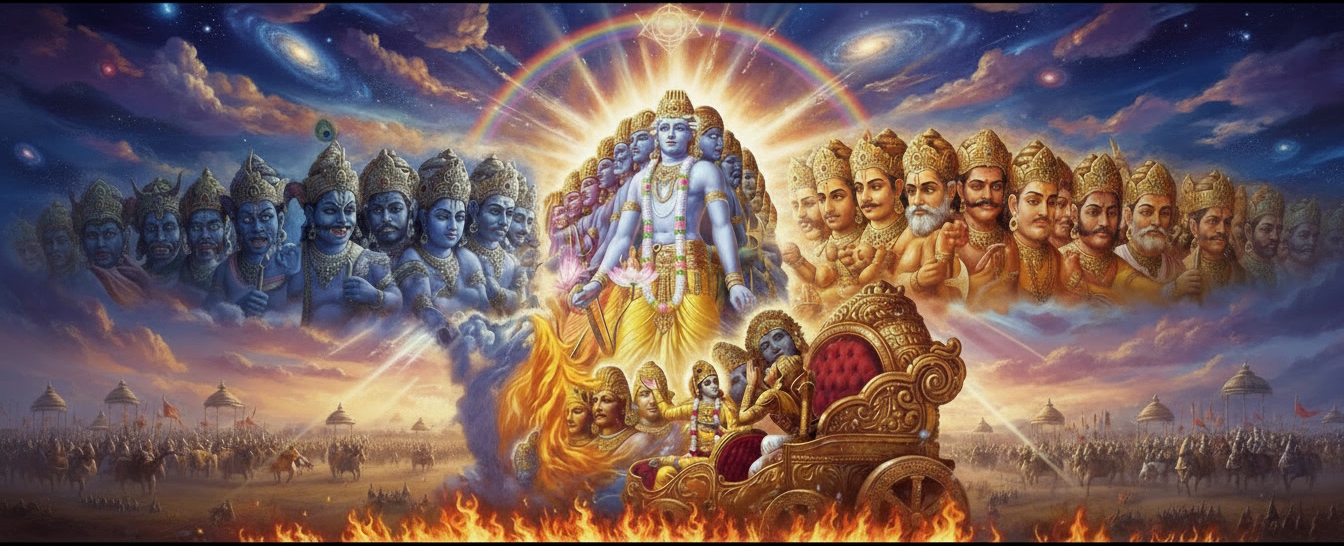
येऽप्यन्यदेवता भक्ता यजन्ते श्रद्धयाऽन्विताः।
तेऽपि मामेव कौन्तेय यजन्त्यविधिपूर्वकम्।।9.23।।
ye'pyanyadevatā bhaktā yajante śraddhayā'nvitāḥ|
te'pi māmeva kaunteya yajantyavidhipūrvakam||9.23||
Translation
Even those devotees who, endowed with faith, worship other gods, worship Me alone, O Arjuna, b the wrong method.
हिंदी अनुवाद
हे कुन्तीनन्दन! जो भी भक्त (मनुष्य) श्रद्धापूर्वक अन्य देवताओंका पूजन करते हैं, वे भी करते हैं मेरा ही पूजन, पर करते है अविधिपूर्वक
Commentaries & Translations
Swami Ramsukhdas
व्याख्या--'येऽप्यन्यदेवता भक्ता यजन्ते श्रद्धयान्विताः' -- देवताओंके जिन भक्तोंको 'सब कुछ मैं ही हूँ' ('सदसच्चाहम्' 9। 19) -- यह समझमें नहीं आया है और जिनकी श्रद्धा अन्य देवताओंपर है, वे उन देवताओंका ही श्रद्धापूर्वक पूजन करते हैं। वे देवताओंको मेरेसे अलग और बड़ा मानकर अपनी-अपनी,श्रद्धाभक्तिके अनुसार अपनेअपने इष्ट देवताके नियमोंको धारण करते हैं। इन देवताओंकी कृपासे ही हमें सब कुछ मिल जायगा-- ऐसा समझकर नित्य-निरन्तर देवताओंकी ही सेवा-पूजामें लगे रहते हैं।
'तेऽपि मामेव कौन्तेय यजन्त्यविधिपूर्वकम्' -- देवताओंका पूजन करनेवाले भी वास्तवमें मेरा ही पूजन करते हैं, क्योंकि तत्त्वसे मेरे सिवाय कुछ है ही नहीं। मेरेसे अलग उन देवताओंकी सत्ता ही नहीं है। वे मेरे ही स्वरूप हैं। अतः उनके द्वारा किया गया देवताओंका पूजन भी वास्तवमें मेरा ही पूजन है, पर है अविधिपूर्वक। अविधि-पूर्वक कहनेका मतलब यह नहीं है कि पूजन-सामग्री कैसी होनी चाहिये? उनके मन्त्र कैसे होने चाहिये? उनका पूजन कैसे होना चाहिये? आदि-आदि विधियोंका उनको ज्ञान नहीं है। इसका मतलब है -- मेरेको उन देवताओंसे अलग मानना। जैसे कामनाके कारण ज्ञान हरा जानेसे वे देवताओंके शरण होते हैं (गीता 7। 20), ऐसे ही यहाँ मेरेसे देवताओंकी अलग (स्वतन्त्र) सत्ता मानकर जो देवताओंका पूजन करना है, यही अविधिपूर्वक पूजन करना है।
इस श्लोकका निष्कर्ष यह निकला कि (1) अपनेमें किसी प्रकारकी किञ्चिन्मात्र भी कामना न हो और उपास्यमें भगवद्बुद्धि हो, तो अपनी-अपनी रुचिके अनुसार किसी भी प्राणीको, मनुष्यको और किसी भी देवताको अपना उपास्य मानकर उसकी पूजा की जाय, तो वह सब भगवान्का ही पूजन हो जायगा और उसका फल भगवानकी ही प्राप्ति होगा; और (2) अपनेमें किञ्चिन्मात्र भी कामना हो और उपास्यरूपमें साक्षात् भगवान् हों तो वह अर्थार्थी, आर्त आदि भक्तोंकी श्रेणीमें आ जायगा, जिनको भगवान्ने उदार कहा है (7। 18)।
वास्तवमें सब कुछ भगवान् ही हैं। अतः जिस किसीकी उपासना की जाय, सेवा की जाय, हित किया जाय, वह प्रकारान्तरसे भगवान्की ही उपासना है। जैसे आकाशसे बरसा हुआ पानी नदी, नाला, झरना आदि बनकर अन्तमें समुद्रको ही प्राप्त होता है (क्योंकि वह जल समुद्रका ही है), ऐसे ही मनुष्य जिस किसीका भी पूजन करे, वह तत्त्वसे भगवान्का ही पूजन होता है (टिप्पणी प0 509)। परन्तु पूजकको लाभ तो अपनी-अपनी भावनाके अनुसार ही होता है।
सम्बन्ध --देवताओंका पूजन करनेवालोंका अविधिपूर्वक पूजन करना क्या है? इसपर कहते हैं --
Sri Harikrishnadas Goenka
यदि कहो कि अन्य देव भी आप ही हैं? अतः उनके भक्त भी आपहीका पूजन करते हैं तो यह बात ठीक है --, जो कोई अन्य देवोंके भक्त -- अन्य देवताओंमें भक्ित रखनेवाले? श्रद्धासे -- आस्तिकबुद्धिसे युक्त हुए (उनका ) पूजन करते हैं? हे कुन्तीपुत्र वे भी मेरा ही पूजन कहते हैं ( परंतु ) अविधिपूर्वक ( करते हैं )। अविधि अज्ञानको करते हैं? सो वे अज्ञानपूर्वक मेरा पूजन करते हैं।
Sri Anandgiri
Believing that since the Supreme Self is accepted as existing in the form of those respective deities, and thus even those devoted to other deities are not different in terms of taking refuge in the Lord, therefore exclusive devotion to Him is of no consequence — thinking thus, he raises a doubt with 'Nanu' etc.
Accepting what was said, He answers with 'Satyam' etc.
He states the distinction of those sacrificing to other deities from those sacrificing to the Lord with 'Avidhi' etc.
He explains that with 'Avidhih'.
Sri Dhanpati
Because of the absence of the knowledge that 'others are not different from Vasudeva,' there is a distinction between them and My devotees; this He states with 'Ye'pi'.
Those who are devotees of other deities like Indra, and endowed with faith—meaning theistic intelligence—sacrifice to (worship) other deities, they too, in reality, sacrifice to Me alone.
Just as, 'O Son of Kunti, you are also, in reality, the grandson (daughter's son) of our grandfather,' is the purport of the address.
Nevertheless, the knowledge that 'in My worship there is no object other than Vasudeva' is the rule (vidhi), and the absence of that is the non-rule (avidhi); they sacrifice with that (ignorance) preceding it; this is the meaning.
Sri Madhavacharya
Then is the statement 'I am the ritual (kratu)' [9.16] etc., untrue? To this, He says —
'Ye'pi'.
Sri Neelkanth
'Avidhipurvakam' (Not according to the rule) — The rule (vidhi) is the understanding of non-difference;
due to being devoid of that, their worship is 'avidhipurvakam' (without proper method).
Sri Ramanuja
Those also who are devotees of other deities—meaning those devoted to deities like Indra and steadfast only in the three Vedas—and who, endowed with faith, sacrifice to Indra and others; they too, by the logic previously stated—because everything is My body and has Me as its Self, and because words like Indra etc. refer to Me—in reality sacrifice to Me alone; but they sacrifice without proper rule (avidhipurvakam).
That deities like Indra are connected to rites as objects of worship, as Vedanta texts like 'Where the four priests go to the attainment with the gods' (Taittiriya Aranyaka 4) ordain—they do not sacrifice with that (knowledge) preceding it.
The collection of Vedanta texts, while ordaining the worship-worthiness of Indra and others who exist as the body of the Supreme Person, ordains the direct worship-worthiness of the Supreme Person alone who is their Self.
'Chaturhotarah' (The four priests) means those performing rites like Agnihotra, Darsha, and Paurnamasa; 'where'—in the Supreme Self situated as the Self—they attain the wealth/fruit along with the gods like Indra who are His body. 'These rites, which are worship of Indra and other gods, have Me as their object' — thus they attain Me as the wealth; this is the meaning.
Therefore, the knowers of the three Vedas do not know that 'These rites are worship of the Supreme Person whose body is Indra and others, and He alone is the object of worship'; thus they become partakers of limited results and are of a nature to fall. He says this —
Sri Sridhara Swami
Objection: Since, in reality, there is no other deity apart from You, even those serving Indra and others are Your devotees alone; so how do they obtain 'coming and going' (rebirth)? To this, He says — 'Ye'pi'.
Being endowed with faith, those devotees who sacrifice to other deities in the form of Indra etc. by means of sacrifice, they too sacrifice to Me alone—this is true. However, they sacrifice 'avidhipurvakam' — without the rule that brings about liberation; therefore, they return again.
Sri Vedantadeshikacharya Venkatanatha
Since all deities are the body of the Lord, as stated in 'The knowers of the three Vedas... Me' [9.20], implying 'In reality, it is My worship alone'—knowing this, why do You not grant the yoga-kṣema in the form of Moksha even to mere ritualists? The answer to this is given in two verses beginning with 'Ye tu'.
The word 'tu' is for dispelling the doubt. 'Devotees of other deities' — by the context of collocation, this implies 'Indra and others'. 'By the logic previously stated' — meaning, from 'All this is strung on Me' [7.7] etc., and in this very chapter 'All this is pervaded by Me' [9.4] etc.; this is the idea. Up to 'sacrifice to Me alone' is the translation of the doubt (reinstatement of the objection), and the rest is the predicate (the answer); with this intention, he says 'Api tu' (But rather).
'Vidhi' (Rule): That which has its cause previously through knowledge of Him is 'Vidhipurvam'; that which is different from that is 'Avidhipurvakam'. How can prescribed rites be 'avidhipurvakam'? To this he says 'Indradinam' etc. 'Tatpurvakam' — meaning, preceded by the contemplation of such a rule. He explains 'as they ordain' with 'Vedanta' etc. In the enjoyment of ritual results, only the worship-worthiness of Indra etc. is propounded, while in the Vedanta texts, their true nature as it is (as the body of God) is propounded; so there is no contradiction.
'Sakshat' (Directly) means unconditional, or primarily. The entry of Indra etc. into the object (of worship) is as a qualification/attribute of the Supreme Person who is the object of the oblation, just as the entry of the object of meditation in the Pratardana Vidya etc.; this is the idea.
How is the quoted sentence 'Chaturhotarah' relevant to the present meaning? To this he says 'Chaturhotarah' etc. Implying it as a synecdoche, it is said 'Agnihotra, Darsha, Purnamasa, etc.'.
The meaning of the word 'Yatra' (Where), famous in texts like 'Entered within, the ruler of people, the Self of all' [Yajur Veda 3.10.2], is stated by 'Paramatmani' (In the Supreme Self) etc. By contemplating sentences like 'Whose body is the Sun' [Brihadaranyaka Upanishad 3.7.9] etc., 'Taccharirabhutaih' (By those who are His body) etc. is said.
The wealth achievable by the gods through rites is merely the excellence in the form of their worship, and that ultimately culminates in the mode of being the means to the fruit; with this intention, he says 'Indradidevanam' (Of the gods like Indra) etc.
Swami Chinmayananda
विश्व के सभी लोग एक ही पूजास्थल पर पूजा नहीं करते। न केवल शारीरिक दृष्टि से यह असम्भव है? वरन् मनोवैज्ञानिक दृष्टि से भी यह तर्कसंगत नहीं है? क्योंकि सब लोगों की अभिरुचियाँ भिन्नभिन्न होती हैं।भक्तगण जब भिन्नभिन्न देव स्थानों पर पूजा करते हैं? तब ये एक ही चेतन सत्य की आराधना करते हैं? जो इस परिवर्तनशील सृष्ट जगत् का अधिष्ठान है। जब वे विभिन्न देवताओं की पूजा करते हैं? तब भी वे उस एक सनातन सत्य का ही आह्वान करते हैं? जो उनके इष्ट देवता के रूप में व्यक्त हो रहा है। जब हम यह स्वीकार करते हैं कि अनन्त सत्य एकमेव अद्वितीय है? जो भूत? वर्तमान और भविष्य काल तीनों में एक समान रहता है? तब यह स्पष्ट हो जाता है कि सभी ऋषिमुनियों? साधुसन्तों? पैगम्बरों और अवतारों की उपाधियों में व्यक्त होने वाला आत्मचैतन्य एक ही है।सहिष्णुता हिन्दू धर्म का प्राण है। हम पहले भी विचार कर चुके हैं कि परमार्थ सत्य को अनन्तस्वरूप में स्वीकार करने वाले अद्वैती किस प्रकार सहिष्णु होने के अतिरिक्त कुछ और नहीं हो सकते हैं। असहिष्णुता उस धर्म में पायी जाती है? जिसमें किसी देवदूत विशेष को ही ईश्वर के रूप में स्वीकारा जाता है। हिन्दुओं में भी प्राय भिन्नभिन्न पंथों एवं सम्प्रदायों के मतावलम्बी निर्दयता की सीमा तक कट्टर पाये जाते हैं। असभ्यता के कुछ ऐसे उदाहरण भी मिलते हैं? जिनमें एक भक्त की यह धारणा होती है कि अन्य लोगों के देवताओं की निन्दा करना? अपने इष्ट देवता की स्तुति और भक्ति करना है परन्तु इस प्रकार के मत विकृत? घृणित और अशिष्ट हैं? जिन्हें हिन्दू धर्मशास्त्र में कोई स्वीकृति नहीं है? और न ही ऋषियों द्वारा प्रवर्तित सांस्कृतिक परम्परा में उन्हें कोई स्थान प्राप्त है।उदार हृदय? करुणासागर? प्रेमस्वरूप भगवान् श्रीकृष्ण घोषणा करते हैं? ये भक्त भी वास्तव में मुझे ही पूजते हैं? यद्यपि वह पूजन अविधिपूर्वक है।बाह्य जगत् में व्यावहारिक जीवन की दृष्टि से इस श्लोक का अभिप्राय यह है कि परमानन्दस्वरूप आत्मा की प्राप्ति को त्यागकर जो लोग सांसारिक विषयों की प्राप्ति के लिए ही प्रयत्न करते हैं? वे भी आत्मकृपा का ही आह्वान करते हैं? परन्तु अविधिपूर्वक।अत्यन्त विषयोपभोगी पुरुष भी जब धन के अर्जन? रक्षण और व्यय की योजनाएं बनाता है? जिससे कि वह नित्य नवीन विषयों को प्राप्त कर उनको भोग सके? तब वह भी स्वयं में स्थित अव्यक्त क्षमताओं का ही आह्वान करता है। आत्मा के बिना कोई भी व्यक्ति न पापकर्म कर सकता है और न पुण्य कर्म। आत्महत्या जैसे कार्य में भी जीवनी शक्ति की आवश्यकता होती है? परन्तु शस्त्र उठाने में वह पुरुष आत्मचेतना का दुरुपयोग कर रहा होता है।इस सन्दर्भ में अविधिपूर्वक का अर्थ अज्ञानपूर्वक है? जिसका अन्तिम परिणाम दुख और विषाद् होता है? तथा साधक आत्मा के परम आनन्द से वंचित रह जाता है।इन भक्तों के पूजन को अविधिपूर्वक क्यों कहा गया है इसके उत्तर में कहते हैं --
Sri Abhinavgupta
From 'Ye'pi' up to 'Prayatatmanah'. Even those who worship using other names, worship Me alone. For there is no object of worship distinct from Brahman. But 'avidhina' (without rule) is the distinction. 'Avidhi' means 'another rule'. That is, by various types of rules, 'I alone, whose nature is the existence of Supreme Brahman, am to be sacrificed to' — (they worship without this knowledge).
It is not as interpreted by others—who are stained by the filth of great sins acquired by condemning other philosophies—that 'avidhina' means 'by wicked rule'. If that were so, the statements 'they sacrifice to Me alone' and 'I alone am the enjoyer of all sacrifices' would become inconsistent. So, enough of conversation with those befouled by sin.
But our Teachers demonstrate thus: Accepting that 'another' implies a deity distinct from one's own Self, devoid of the nature of Brahman according to the doctrine of duality, those who sacrifice to that (deity) alone, they too in reality sacrifice to Me, who am the form of their own Self; but by 'avidhi', meaning by a defective method which takes the form of grasping duality.
Therefore He says — They do not know Me, their own Self, in truth as the form of the Deity and as the Enjoyer; therefore they move away (fall) from My form. What? 'Vowed to the gods, they go to the gods,' etc. This indeed is the 'moving' (or falling).
Those who do not know My nature through non-difference (or know the difference of nature?), they sacrifice to Me alone even through sacrifices to gods, ghosts, and ancestors. And being My sacrificers, they go to Me alone; thus He will conclude.
Objection: It is said that a deity is intended for the sake of abandoning the substance (offering). So how can the own Self-principle be the object of sacrifice without being intended? In 'Adityah prayaniyah charuh', the deity is a subsidiary to this injunction; that intention is indeed influenced by another injunction regarding the object. And there is no injunction regarding one's own Self? With this intention, He says 'Avidhipurvakam mam' (Me without rule).
In a deity distinct from one's own Self, a 'rule' (vidhi) is required, because it is of the nature of obtaining what is not obtained. But one's own Self, the Supreme Lord, is not 'subject to rule' (vidhipurvaka), because of the absence of being obtained through a rule. Nothing proceeds without reference to Him. Therefore, in all intentions of deities like Indra obtained by rule, that own Self, whose nature is to illumine the universe, acting as the foundation (wall/screen) for the appearance of that intended deity, shining constantly with the sense of 'I-I', is constantly intended like the thread in a garland — this is established by logic: 'they sacrifice to Me alone, because of being without rule' [or: despite being without rule].
There is no intention of the agent towards the fruit of attaining Me which is the main element; but rather, their fulfillment is merely by the attainment of the status of Indra etc., which stands in place of a limited dakshina (fee), like a priest (yajaka) — to proclaim this, the Parasmaipada (yajanti) is used.
Sri Jayatritha
The answer to the stated question has been given? Then what is the use of the (further) answer? To this, stating that this answer unveils the intention of the question, he says 'Tarhi' (Then) etc.
The Lord's enjoyment is indeed the cause of the fruit? If He is present everywhere (as enjoyer), then at that time there should be equality of fruit for all.
If that (equality) is absent, then the enjoyment of the Lord everywhere mentioned in 'I am the ritual' [9.16] is also untrue; this is the meaning (of the doubt).
Sri Madhusudan Saraswati
Objection: Other deities are also You, because there is an absence of any object distinct from You; and thus, even devotees of other deities worship You alone, so there should be no distinction.
Then why is it said that the 'desire-seekers' devoted to Vasu, Rudra, Aditya, etc., obtain 'coming and going,' while those thinking of Me with no other focus (are successful)? To this, He says — 'Ye'py anya' etc.
Just as My devotees sacrifice to Me alone, so do those who are devotees of other deities like Vasus, endowed with faith and theistic intelligence, sacrifice through rites like Jyotishtoma; they too are My devotees alone, O Son of Kunti! They sacrifice to (worship) Me alone situated in the form of those respective deities.
'Avidhipurvakam' — Avidhi means ignorance; that (ignorance) precedes it. Not knowing Me as the Self of all, and imagining Vasus etc. as distinct from Me, they sacrifice; this is the meaning.
Sri Purushottamji
Objection: Even those who perform worship of other gods, being parts of You, perform worship of You alone; so why is Your grace not upon them, and why does their worship (fruit) perish merely by enjoyment? To this, He says —
'Ye'pi' etc. Those who are endowed with faith—meaning possessed of faith and attached to that dharma—worship other deities through means like sacrifices, as the presiding deities, due to ignorance of them being My parts; because of My part being in them, they worship Me alone. However, due to ignorance of My true nature, they worship 'avidhipurvakam' (without proper rule). Therefore, the fruit corresponding to their worship is perishable, and I do not bestow (special) grace; this is the meaning.
Therefore, in the Smritis, non-rule (avidhi) is prohibited: 'That which is devoid of rule, wicked in intention, and done without faith—the demons snatch that away from the deluded, unrefined soul.'
Sri Shankaracharya
'Ye'pi anyadevatabhaktah' — Those who are devotees of other deities, being devotees of other deities, sacrifice (worship), endowed with faith, i.e., theistic intelligence;
O Son of Kunti! They too sacrifice to Me alone, 'avidhipurvakam'. Avidhi means ignorance; they sacrifice with that (ignorance) preceding it; this is the meaning.
Why is it said that they sacrifice without proper rule? Because —
Sri Vallabhacharya
Objection: In the doctrine of Brahman, since You are the Self of all, even in the worship of other deities, Your worship alone takes place; then why do they obtain 'coming and going'? If this is asked, He says — 'Ye'pi' etc.
Devotees of other deities — 'The Sun, Ganesha, Chandi, Shiva, and Vishnu as the fifth; are worshipped in order, but in deviation there is great fear' — even those intent on the Panchayatana puja (worship of five deities) mentioned thus by Sri (Lakshmi?), worshiping endowed with faith, they too, meditating on Me alone as Brahman in the Sun etc., sacrifice. Or, some say 'api' is used in the sense of 'tu' (but). 'They too... Me alone' — By the stated logic, since everything is a part of Me and is My own form, and words like Indra denote Me alone, in reality, they sacrifice to Me alone.
But 'avidhipurvakam' — their sacrifice is ordained in the Veda to be preceded by the knowledge of the indwelling Self (Adhisthana); contrary to that (with ignorance) is not ordained; thus they sacrifice without proper rule, therefore they obtain 'coming and going'; this is the idea.
Or, according to the statement 'Vishnu is indeed the root of the gods' [Bhagavatam 10.4.39], worshiping by abandoning the root and watering the branches, leaves, etc., is not ordained; this is said to strengthen exclusive devotion. Since Vedic sentences in the form of 'Where the four priests go to attainment with the gods' clearly state that worship of gods has Me as its essence/object, it is rightly said — 'they sacrifice without proper rule.'
Swami Sivananda
ये who? अपि even? अन्यदेवताः other gods? भक्ताः devotees? यजन्ते worship? श्रद्धया with faith? अन्विताः endowed? ते they? अपि also? माम् Me? एव alone? कौन्तेय O Kaunteya? यजन्ति worship? अविधिपूर्वकम् by the wrong method.Commentary They worship Me in ignorance. Their mode of worship is contrary to the ancient,rule. Hence they return to this world.People worship Agni? Indra? Surya? Varuna? the Vasus? etc. Even they attain Me? because I am everywhere. But their devotion is not pure. It is vicarious. Water should be given to the root and not to the branches. If the root is satisfied? the whole tree must be and is satisfied. Even so? if I (the root of this world and all the gods) am satisfied? all the gods must be and are satisfied. Though the messages from the five organs of knowledge reach the one consciousness? will it be right and useful to place a sweetmeat in the ear and a flower in the eyes The function of eating must be done by the mouth alone and the function of smelling by the nose alone. Therefore I should be worshipped in My own nature. They should know Me as the Self in all beings. They should recognise Me in other worship. I am the root. I am the source of all the gods and of this whole world. (Cf.IV.11VII.20)
Swami Gambirananda
Api, even; ye, those who; anya-devata-bhaktah, being devoted to tother deities; and anvitah sraddhaya, endowed with faith; yajante, worship (them), te api, they also; O son of Kunti, yajanti, worship; mam, Me; eva, alone; (though) avidhi-purvakam, following the wrong method. Avidhi implies ignorance. So the idea is that they worship (Me) ignorantly.
'How it is that they worship (Me) ignorantly?' [i.e. the worshippers of other deities worship them knowingly, and hence, how can the estion of their ignorance arise?] This is being answered: Because-
Swami Adidevananda
Those, however, who are devoted to Indra and other divinities, who rely on the three Vedas alone, and who, possessed of faith, worship Indra and other divinities - they too worship Me actually in the light of the truth that all existing things constitute My body and have Me for their selves. In the light of this principle, terms like Indra denote Me only. The worshippers of Indra and other deities therefore worship Me only, in ways not sanctioned by the Sastras. They do not worship Indra and other divinities with a proper understanding of the place of these deities in the light of the Vedanta texts. An example is 'Wherein (i.e., in the Supreme Self) the sacrifices known as the Caturhotri attain their fulfilment through the divinities' (Tai. Ar., 4) etc. These texts say in what way these forms of worship apply to these divinties. For all Vedanta texts lay down that the Supreme Person alone is to be worshipped directly when they enjoin the worship of Indra and other divinities, as they form the body of the Supreme Person. The meaning is that in the Caturhotri sacrifice like Agnihotra, the full moon and the new moon sacrifices etc., it is the Supreme Self only that is worshipped, as He abides as the self in Indra etc., who are the ostensible objects worshipped in these sacrifices by which these worshippers obtain their fulfilment through them.
Therefore, the votaries of the three Vedas do not understand that these rituals form the worship of the Supreme Person and that He alone is to be worshipped. As they do not do so, they become experiencers of limited results, and they are again liable to fall into Samsara. Sri Krsna gives expressions to this: