Bhagavad Gita - Chapter 9 - Shloka (Verse) 5
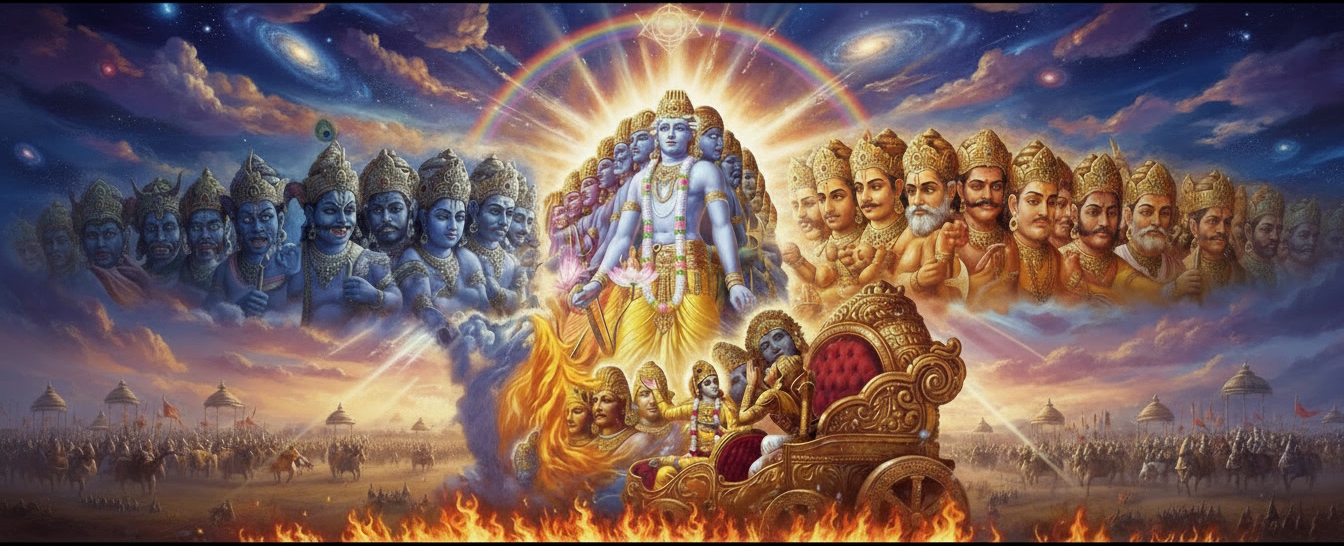
न च मत्स्थानि भूतानि पश्य मे योगमैश्वरम्।
भूतभृन्न च भूतस्थो ममात्मा भूतभावनः।।9.5।।
na ca matsthāni bhūtāni paśya me yogamaiśvaram|
bhūtabhṛnna ca bhūtastho mamātmā bhūtabhāvanaḥ||9.5||
Translation
Nor do beings exist in Me (in reality); behold My divine Yoga, supporting all beings, but not dwelling in them, is My Self, the efficient cause of beings.
हिंदी अनुवाद
यह सब संसार मेरे निराकार स्वरूपसे व्याप्त है। सम्पूर्ण प्राणी मुझ में स्थित हैं; परन्तु मैं उनमें स्थित नहीं हूँ तथा वे प्राणी भी मेरेमें स्थित नहीं हैं -- मेरे इस ईश्वर-सम्बन्धी योग-(सामर्थ्य-) को देख ! सम्पूर्ण प्राणियोंको उत्पन्न करनेवाला और उनका धारण, भरण-पोषण करनेवाला मेरा स्वरूप उन प्राणियोंमें स्थित नहीं है।
Commentaries & Translations
Swami Ramsukhdas
व्याख्या--'मया ततमिदं सर्वं जगदव्यक्तमूर्तिना'--मन-बुद्धि-इन्द्रियोंसे जिसका ज्ञान होता है, वह भगवान्का व्यक्तरूप है और जो मन-बुद्धि-इन्द्रियोंका विषय नहीं है अर्थात् मन आदि जिसको नहीं जान सकते, वह भगवान्का अव्यक्तरूप है। यहाँ भगवान्ने 'मया' पदसे व्यक्त(साकार) स्वरूप और,'अव्यक्तमूर्तिना' पदसे अव्यक्त-(निराकार-) स्वरूप बताया है। इसका तात्पर्य है कि भगवान् व्यक्तरूपसे भी हैं और अव्यक्तरूपसे भी हैं। इस प्रकार भगवान्की यहाँ व्यक्तअव्यक्त (साकारनिराकार) कहनेकी गूढ़ाभिसन्धि समग्ररूपसे है अर्थात् सगुणनिर्गुण, साकारनिराकार आदिका भेद तो सम्प्रदायोंको लेकर है, वास्तवमें परमात्मा एक हैं। ये सगुणनिर्गुण आदि एक ही परमात्माके अलगअलग विशेषण हैं, अलगअलग नाम हैं।
गीतामें जहाँ सत्असत्, शरीरशरीरीका वर्णन किया गया है, वहाँ जीवके वास्तविक स्वरूपके लिये आया है-- 'येन सर्वमिदं ततम्' (2। 17) क्योंकि यह परमात्माका साक्षात् अंश होनेसे परमात्माके समान ही सर्वत्र व्यापक है अर्थात् परमात्माके साथ इसका अभेद है। जहाँ सगुणनिराकारकी उपासनाका वर्णन आया है, वहाँ बताया है -- 'येन सर्वमिदं ततम्' (8। 22), जहाँ कर्मोंके द्वारा भगवान्का पूजन बताया है, वहाँ भी कहा है -- 'येन सर्वमिदं ततम्' (18। 46)। इन सबके साथ एकता करनेके लिये ही भगवान् यहाँ कहते हैं --'मया ततमिदं सर्वम्'। 'मतस्थानि सर्वभूतानि'-- सम्पूर्ण प्राणी मेरेमें स्थित हैं अर्थात् पराअपरा प्रकृतिरूप सारा जगत् मेरेमें ही स्थित है। वह मेरेको छोड़कर रह ही नहीं सकता। कारण कि सम्पूर्ण प्राणी मेरेसे ही उत्पन्न होते हैं, मेरेमें ही स्थित रहते हैं और मेरेमें ही लीन होते हैं अर्थात् उनका उत्पत्ति,स्थिति और प्रलयरूप जो कुछ परिवर्तन होता है, वह सब मेरेमें ही होता है। अतः वे सब प्राणी मेरेमें स्थित हैं।'न चाहं तेष्ववस्थितः'-- पहले भगवान्ने दो बातें कहीं -- पहली 'मया ततमिदं सर्वं जगदव्यक्तमूर्तिना' और दूसरी 'मत्स्थानि सर्वभूतानि।' अब भगवान् इन दोनों बातोंके विरुद्ध दो बातें कहते हैं।
Sri Harikrishnadas Goenka
मैं असंसर्गी हूँ? इसलिये --, ( वास्तवमें ) ब्रह्मादि सब प्राणी भी मुझमें स्थित नहीं हैं? तू मेरे इस ईश्वरीय योग -- युक्ति -- घटनाको देख? अर्थात् मुझ ईश्वरके योगको यानी यथार्थ आत्मतत्त्वको समझ। संसर्गरहित आत्मा कहीं भी लिप्त नहीं होता यह श्रुति भी संसर्गरहित होनेके कारण ( आत्माकी ) निर्लेपता दिखलाती है। यह और भी आश्चर्य देख कि भूतभावन मेरा आत्मा संसर्गरहित होकर भी भूतोंका भरणपोषण करता रहता है परंतु भूतोमें स्थित नहीं है। क्योंकि परमात्माका भूतोंमें स्थित होना सम्भव नहीं? यह बात उपर्युक्त न्यायसे स्पष्ट दिखलायी जा चुकी है। पू0 -- ( जब कि आत्मा अपनेसे कोई अन्य वस्तु ही नहीं है ) तो मेरा आत्मा यह कैसे कहा जाता है उ0 -- लौकिक बुद्धिका अनुकरण करते हुए देहादि संघातको आत्मासे अलग करके फिर उसमें अहंकारका अध्यारोप करके मेरा आत्मा ऐसा कहते हैं? आत्मा अपने आपसे भिन्न है ऐसा समझकर लोगोंकी भाँति अज्ञानपूर्वक ऐसा नहीं कहते। जो भूतोंको प्रकट करता है -- उत्पन्न करता है या बढ़ाता है उसको भूतभावन कहते हैं।
Sri Anandgiri
Even though the Supreme Lord is not situated in beings, the situation of beings is affirmed there (in Him), so how is there 'non-attachment'? To this, He says -- 'ataeva', etc. In 'na cha', the particle 'cha' is for emphasis.
Regarding the point that beings are certainly not situated in the Lord, He states the reason -- 'paśya' (behold), etc.
He cites proof that non-attachment is the very nature of the Self -- 'tathā cha', etc.
If the Lord is unattached, then why was it said 'beings are situated in Me', and having said so, why is the contradictory statement 'and beings are not situated in Me' uttered? Raising this doubt, he says -- 'idaṃ cha' (and this).
Then, is there a connection with beings? He says no -- 'na cha', etc. By the logic already stated; meaning, due to non-attachment. The idea is that although in reality there is no connection with beings due to non-attachment, there is no contradiction with (the previous statement based on) imagination; hence there is no mutual contradiction.
Since the Self cannot be different from the Self, whence comes the mention of a relationship? Raising this doubt, he says -- 'asau' (this), etc. (Dividing): Just as people in the world, not knowing the reality of things, superimpose difference and experience a relationship like 'this is mine', the mention of relationship here is not like that, because there is inherently no difference in the Self; therefore, following the observation of the notion of relationship in the world even when difference is unreal, the Lord divides Himself from the aggregate of the body etc., superimposes ego upon it, and designates a difference saying 'this is My Self'. And thus, by designating the aggregate as 'Mama' (My) and referring to the essential nature extracted from it by the word 'Atma', the meaning is 'He is not situated in beings'.
He says that the Self supports/produces beings only by accepting the aforementioned non-attachment -- 'tathā', etc.
Sri Dhanpati
Therefore, in Me, the Supreme Self who am devoid of all attachment, in reality, even all beings are not situated. 'Behold My divine Yoga'.
-- Yoga means device, occurrence, My divine state of reality. And the Shruti says: 'The Unattached is indeed not attached'.
And behold this other Yoga -- the skill in making the impossible happen (aghatita-ghatanā-paṭīyastvam). 'Bhūtabhṛn na cha bhūtasthaḥ' -- My Self does not stay in beings because of being unattached, thus it is 'so'; although being such in reality, He 'bibharti' i.e., supports and nourishes the beings, moving and unmoving, and is thus 'bhūtabhāvanaḥ' -- He manifests or produces the beings. The usage 'My Self' (Mama Atma) is by superimposing difference, like saying 'the head of Rahu' (where Rahu is nothing but the head).
Sri Madhavacharya
Even though situated in Me, they are not so as things situated on the earth by touching it; this He says by -- 'na cha', etc.
For it is said in the Moksha-dharma: 'He is not visible to the eye, nor tangible to the touch' (Mahabharata 12.339.21). And also 'Samjnasamjna' (12.338.47).
'My Atma' means the Body itself is the 'Bhutabhavana' (creator/sustainer of beings). As said in the Moksha-dharma: 'The body of the Great Glory is Majesty itself' (Mahabharata 12.338.174/175).
Sri Neelkanth
एवमभ्युपगतमानन्दस्य जगद्विवर्ताधिष्ठानत्वं तदप्यपवदति -- न च मत्स्थानीति। अयंभावः -- अस्य द्वैतेन्द्रजालस्य यदुपादानकारणम्। अज्ञानं तदुपाश्रित्य ब्रह्मकारणमुच्यते इति वार्तिकोक्तेरज्ञानमेव जगत्कारणं तच्च तुच्छम्। अहं चासङ्गः। ततश्च तुच्छतरेण तत्कार्येण भूतसंघेन न ममासङ्गस्याधाराधेयभावसंबन्धोऽनिर्वचनीयोऽप्यस्ति। आवृतं हि रज्ज्वादिकमनिर्वचनीयेन सर्पादिना संबध्यते। अहं तु सर्वदानावृतः साक्षिरूपत्वात्तत्संबन्धशून्य इति न च मत्स्थानि भूतानीत्युक्तमिति।
ननु साक्षिणस्तव ब्रह्मणो युवा सुखी चेति प्रतीत्येव भूतसंबन्धानुभवात्कथं न च मत्स्थानीत्युक्तिरित्याशङ्क्याह -- पश्य मे योगमैश्वरमिति। मे मम भूतैः सह योगं युक्तिघटनां पश्य। ऐश्वरं ईश्वरेण मायाविना निर्मितं गगने गन्धर्वनगरमिव। अतएव मम कारणशरीरस्यात्मा प्रत्यगानन्दे भूतभृदपि भूतस्थो न। चकारोऽप्यर्थे भिन्नक्रमश्च। खमिव गन्धर्वनगरभृदपि तत्स्थं न। तस्य तदाकारेण परिणामासंभवात्।
एवंरूपोऽपि परानन्दरूपो ममात्मा स भूतभावनः भूतानां वृद्धिकरः।एतस्यैवानन्दस्यान्यानि भूतानि मात्रामुपजीवन्ति। को ह्येवान्यात्कः प्राण्याद्यदेष आकाश आनन्दो न स्यात् इत्यादिश्रुतिभ्यः। आकाशेऽव्याकृताख्ये स्वाधिष्ठानभूत आनन्दोऽनुस्यूतो न स्यात्तर्हि प्राणापानक्रियां कश्चिदपि न कुर्यात् कारणगतं जाड्यं कार्येऽपि स्यात्। आकाशे आनन्दानुबन्धे तु कारणस्य चेतनत्वात्कार्यमपि चेतनावत्स्यादिति श्रुत्यर्थः।
बृहदारण्यकेऽपियदूर्ध्वं गार्गि दिवो यदवाक् पृथिव्या यदन्तरा द्यावापृथिवी इमे यद्भूतं च भवच्च भविष्यच्चेत्याचक्षत आकाश एव तदोतं च प्रोतं च इति मायाविनि सर्वस्योतप्रोतत्वमुक्त्वाकस्मिन्नु खल्वाकाश ओतश्च प्रोतश्च इत्यस्योत्तरम्एतस्मिन्खल्वक्षरे गार्गि आकाश ओतश्च प्रोतश्च इत्यस्थूलादिलक्षणस्याक्षरस्याकाशाधारत्वमुक्तम्। तस्माद्युक्तमुक्तमाकाशशरीरेण भगवता कारणोपाधिनिष्कृष्टचिन्मात्राभिप्रायेण ममात्मा भूतभावन इति।
Sri Ramanuja
'And beings are not situated in Me' -- My support is not like that of water etc. for pots etc. How? By My Will (Sankalpa).
'Behold My divine Yoga' -- Behold My wonderful Yoga which is impossible elsewhere and is unique to Me. What is that Yoga? 'Bhūtabhṛn na cha bhūtasthaḥ mamātmā bhūtabhāvanaḥ'.
I am the supporter of all beings, and yet there is no help/benefit derived by Me from them. My Self alone is the 'Bhutabhavana'; meaning My Will, which is of the nature of the mind, is the producer, supporter, and controller of beings.
To show that the existence and activity of all this depends on His own Will, He gives an illustration --
Sri Sridhara Swami
Moreover -- 'na cha', etc. And beings are not situated in Me, precisely because of My non-attachment.
(Doubt): In that case, the pervasiveness and status of being the support mentioned earlier would be contradictory? Raising this doubt, He says -- 'yatha' (behold/as), etc. Behold My divine, extraordinary Yoga -- My device, My skill in making the impossible happen (aghatita-ghatana-chaturya). Since the glory of My Yogamaya is beyond logic/conjecture, nothing is contradictory; this is the meaning.
Behold another wonder too, He says -- 'bhuta', etc. He supports ('bibharti') beings, so He is 'Bhūtabhṛt'. He nourishes/protects ('bhavayati') beings, so He is 'Bhūtabhāvanaḥ'. Even being so, 'My Atma' i.e., My Supreme Nature, is not situated in beings.
The idea is: Just as the Jiva (soul), while supporting and nourishing the body, remains attached to it due to ego, I, even while supporting and nourishing beings, do not stay in them; because of being free from ego.
Sri Vedantadeshikacharya Venkatanatha
Thus, the greatness of the 'Means' (Prapaka) which is the principal subject of the chapter has been stated. Now, with the intention that the same is stabilized through the greatness of the 'Goal' (Prapya), He says 'Listen then'. The phrase 'Idam sarvam' (this all) refers to all objects established by valid means of knowledge; with this intention, he explains it as 'consisting of sentient and insentient'. Since 'avyaktamūrtinā' (by unmanifest form) is not used here in the sense of a physical body, it is a metaphorical usage referring to His nature; to show this, he says 'by the unrevealed nature'. To rule out pervasion merely as proximity like space, the term 'mayā' implies the mode of pervasion established by many proofs; so he says 'by the Inner Controller'.
He shows the purpose and basis of such pervasion with 'asya' (of this), etc. Here, support is established by the subsequent text, and therefore control is also implied. For support is heard to be dependent on administration. Mastership (Sheshitvam) has been mentioned before, and is also implied by the status of being the Ensoled (Shariritva). He shows this universal pervasion in the Shruti as unrevealed nature and as Controller with 'yatha' (just as). The example of earth is to imply all insentient things mentioned in that context.
By saying 'matsthāni' (situated in Me) due to such all-pervasiveness, the independent existence of the world is refuted; with this intention, he says 'tataḥ' (therefore). In chapters like the Vishvarupa, it is said that everything rests in His body, but here it refers to resting in His Essence; to avoid repetition, he says 'In Me, the Inner Controller'. He states that support and control are also studied along with pervasion with 'tatraiva' (in that very place). 'Sthiti-niyamane' means existence and activity. By the mention of the body-embodied relationship, support and mastership are implied there; with this intention, he says 'and Mastership'.
Having said 'By Me all this is pervaded', the statement 'And I am not situated in them' seems contradictory, and also opposed to Shrutis like 'He who dwelling in the earth'; to this he says 'But I'. The type of situation presented in 'all beings are in Me' is negated here (for Him). 'In what is He established? In His own glory, or not even in glory' (Chandogya 7.24.1) - this is the idea. He explains the statement with 'matsthitau' (in My existence). 'Na kashchit' means not by nature, will, or unseen merit (karma), etc. The contradiction between 'matsthāni' (in Me) and 'na cha matsthāni' (not in Me - next verse) is addressed with 'na ghaṭādīnām' (not like pots, etc.). A material thing holds another material thing by contact that prevents falling; it is not so here.
Thinking that what is contrary to worldly experience is not possible, a doubt is raised -- 'katham' (how). Implying that it is possible like the soul and body, he says 'by My Sankalpa' (Will). Being a supporter dependent on one's own will is prescribed. Being a supporter due to lack of independence is negated, so there is no contradiction. By 'Aiśvaram' (Divine), extraordinary nature is implied. 'Paśya' (Behold) indicates wonder; with this intention, he says 'anyatra' (elsewhere/unique).
'Yoga' means armor, means, meditation, contact, logic, etc. (Amara Kosha); here Yoga is meditation in the form of Will, or the nature of being united, etc. Upon saying 'Behold My Yoga', the nature of that Yoga must be stated immediately; showing this expectation, he asks 'ko'sau' (what is that).
in 'bhūtabhṛn na cha bhūtasthaḥ', 'Aham' (I) is the subject due to propriety of meaning. Or, like 'bhūtabhāvanaḥ', even if 'mamātmā' (My Self) is the qualification of the Will specified, the resultant meaning is 'I am the supporter of all beings', etc. The specific mention 'Atma' is to exclude any other auxiliary by the logic of Parisankhya; with this intention, he says 'My Atma alone'. Explaining the meaning of the word Atma established by the flavor of the non-coordinate reference 'My Atma', he says 'My mental Will'. By this, Shankara's statement that 'My Atma is a figure of speech based on worldly understanding by superimposing ego on the aggregate of body etc.' is refuted. Sankalpa (Will) itself is known elsewhere as a function of the mind, and here it is designated by the word 'Atma' which denotes the mind. Or, the word Atma here refers to the mind in the form of Will, as in 'Creation of world by mind alone' (Vishnu Purana), 'The Mind created, let me be embodied (atmanvi)' (Brihadaranyaka), etc. To make that known, the word 'manomaya' is used.
Since support and control are the context, and are being pointed out in the next verse, and creation is to be spoken of even later, 'bhūtabhāvanaḥ' here implies existence, dependence, control, etc.; with this intention, he says 'Supporter and Controller'. Or, this is the meaning of 'bhūtabhṛn na cha bhūtasthaḥ' itself.
Swami Chinmayananda
पूर्व श्लोक में भगवान् श्रीकृष्ण ने कहा है कि समस्त भूत अर्थात् सम्पूर्ण चराचर सृष्टि उनमें स्थित है? परन्तु वे उसमें नहीं हैं। उसी विषय के तर्क की अगली कड़ी बताते हुए वे अब कहते हैं कि वस्तुत? वे भूत मुझमें स्थित नहीं हैं? अर्थात् अनन्त से सान्त की उत्पत्ति कभी नहीं हुई स्तम्भ और प्रेत के दृष्टान्त का पुन उपयोग करते हुए? भगवान् की उक्ति स्तम्भ के इस कथन के तुल्य होगी कि? वास्तव में? मुझ विद्युत् स्तम्भ में प्रेत का अस्तित्व कदापि नहीं था। अनन्त स्वरूप शुद्ध चैतन्य परमात्मा में इस नानाविध जगत् का अस्तित्व न कभी था? न अब है और न कभी होगा। जाग्रत पुरुष के लिए स्वप्न के भोग कभी उपलब्ध नहीं होते। संक्षेप में? आत्मानुभव में इस नानाविध सृष्टि का दर्शन नहीं होता। वर्तमान में इसकी प्रतीति का कारण अज्ञानरूप आत्मविस्मृति है।यह आत्मा भूतमात्र को उत्पन्न करने वाला और उसका धारकपोषक है? जैसे? समस्त तरंगों का जन्मदाता और धारणपोषण करने वाला समुद्र है और फिर भी? मैं उनमें (भूतों में) स्थित नहीं हूँ। कैसे जैसे? समुद्र तरंगों में नहीं रहता अर्थात् उसके परिच्छेदों से सदा मुक्त रहता है। समस्त घटों की उत्पत्ति? स्थिति और धारण मिट्टी से ही है? तथापि उनमें से कोई एक घट अथवा घटसमुदाय न तो मिट्टी को परिभाषित कर सकता है और न उसके सम्पूर्ण ज्ञान को करा सकता है। दिव्य? सनातन शुद्ध चैतन्य स्वरूप परमात्मा ही वह अधिष्ठान है? जो इस नित्य परिवर्तनशील विविधरूप सृष्टि के विस्तृत हृदय को धारण और प्रकाशित करता है।ज्ञानेन्द्रियों के द्वारा बाह्य विषयों के ग्रहण से मन में विषयाकार वृत्तियाँ उत्पन्न होती हैं? जिन्हें सर्वरूपों में स्थित चैतन्य आत्मा प्रकाशित करता है। यदि यह चैतन्य न होता तो हमें अखण्ड अनुभवों की धारा के रूप में जीवन का कभी भान भी नहीं हो सकता था। जैसे कपड़े में कपास है? आभूषणों में स्वर्ण और अग्नि में उष्णता है? वैसे ही क्षर सृष्टि में अक्षर तत्त्व है। जाग्रत पुरुष के बिना स्वप्नद्रष्टा नहीं हो सकता जाग्रत पुरुष स्वप्न जगत् को व्याप्त किये रहता है? परन्तु वह स्वप्न से कभी दूषित या लिप्त नहीं होता और? जाग्रत पुरुष की दृष्टि से स्वप्न का अस्तित्व कभी होता ही नहीं।भगवान् श्रीकृष्ण यह अनुभव करते हैं कि विरोधाभास की यह भाषा अर्जुन जैसे सामान्य पुरुषों के लिए एक पहेली सिद्ध हो रही है? इसलिए करूणासागर भगवान् अपने शिष्य के लिए एक दृष्टान्त देते हैं --
Sri Abhinavgupta
'Na cha', etc. 'And beings are not situated in Me' -- because Reality is not seen by those blinded by ignorance. For the deluded do not consider the Supreme Lord, whose nature is unbroken Consciousness, to be the foundation/abode of the limitations of all objects. Rather, 'I am the thin Devadatta, I know this, this is situated on the ground' -- thus they see only the limited nature as the foundation.
(Doubt): How is this contradictory statement made? Raising this doubt, He says -- 'paśya yogam aiśvaram' (Behold My divine Yoga).
Yoga means Power (Shakti), because it is ever-united (yujyamāna). This indeed is My sovereignty (Aishvarya); meaning, this Freedom (Svātantrya) which functions in an unsurpassed and wonderful manner.
Sri Jayatritha
Having said 'All beings are in Me' (9.4), why is the contradictory statement 'And beings are not in Me' made again? To this He says -- 'matsthatve'pi', etc. 'Spṛṣṭvā' (touching) -- meaning having known it through the sense of touch and attained the mutual transfer of attributes.
He cites proof that the Supreme Lord is not knowable by touch etc. -- 'na', etc. 'Samjnasamjna' means He whose perfect knowledge (samjna) is by the word (samjna) alone.
Since 'situated in Me' etc. was already said, isn't 'supporter of beings' (bhūtabhṛt) etc. a repetition? To this He says -- 'mama', etc. Previously His status as the support of beings etc. was stated; here, since the form/image was mentioned by 'avyaktamūrtinā', to remove the delusion that His form is different (from His Self) like ours, the specific characteristic of His own Body is being stated; this is the meaning. And since 'Bhūtabhāvana' (creator of beings) is stated additionally, there is no repetition; with this idea, he says -- 'bhuta', etc.
This explanation would hold if this were about the Lord's Body. How is that established? To this He says -- 'mahāvibhūteḥ', etc. He whose body is Majesty/Glory itself is the one so described.
Sri Madhusudan Saraswati
Therefore, just as the movement of water etc. is imagined in the sun situated in the sky, the beings imagined in Me do not exist in Me in reality.
You, Arjuna, casting aside the natural human intellect, 'paśya' i.e., consider/reflect. 'Me yogam' -- My power, My sovereignty, My skill in making the impossible happen (aghatana-ghatana-chaturya); behold Me like a magician; this is the meaning.
I am neither contained in anyone nor the container of anyone, yet 'I am in all beings and all beings are in Me' -- this is a great Maya.
Since He 'bibharti' i.e., supports and nourishes all beings (effects) as the material cause, He is 'Bhūtabhṛt'; and since He produces all beings as the agent (efficient cause), He is 'Bhūtabhāvanaḥ'.
Thus, even though He is the undifferentiated efficient and material cause, 'My Atma' -- My Essence which is Supreme Reality and Mass of Existence-Consciousness-Bliss -- because of its unattached and non-dual nature, is 'na bhūtasthaḥ' (not situated in beings); in reality, He has no connection with beings, just as a dreamer is not in reality connected with his imagined dream; this is the meaning.
In 'Mama Atma' (My Self), the genitive case is used by imagination, like in 'Rahu's head'.
Sri Purushottamji
By the statement 'All beings are in Me' (9.4), lest there be a delusion regarding His pervasiveness due to the understanding 'they must be different from the Lord', He says -- 'na cha matsthāni', etc. 'Cha' means again. Those beings, even though born, are not situated in Me as separate/different; but they are essentially My own Self; this is the meaning.
(Doubt): Then how is difference perceived? To this He says -- 'paśya me yogam aiśvaram' (Behold My divine Yoga). Behold My divine, sportive Yoga which is the capacity to do, not do, and do otherwise (kartum-akartum-anyathakartum). The meaning is -- Difference is made to be perceived by Me for the sake of sport, even where there is non-difference.
He clarifies this very point -- 'bhūtabhṛt', etc. He supports beings as their substratum and nourishes them for the sake of His own Juice/Joy (Svarasa), so He is 'Bhūtabhṛt'. He protects beings and 'bhavayati' -- infuses them with their nature, so He is 'Bhūtabhāvanaḥ'. Even being such, 'My Atma' -- My essential Self -- is not 'Bhūtasthaḥ' (situated in beings).
The idea is -- Even while sporting in them, unlike them who are created for sport and stay there situated separately due to their ego, I do not stay like that.
Sri Shankaracharya
'And beings are not situated in Me' -- beings like Brahma etc. 'Behold My Yoga' -- the device, the occurrence; 'aiśvaram' -- belonging to Me, the Lord; this Divine Yoga; meaning the essential nature (yāthātmya) of the Self.
And indeed the Shruti shows His non-attachment due to lack of contact -- 'The Unattached is indeed not attached' (Brihadaranyaka 3.9.26).
And behold this other wonder -- 'Bhūtabhṛt', though being unattached, He supports the beings; 'and not situated in beings', because it has been shown by the aforementioned logic that His being situated in beings is not reasonable.
Then how is it said 'My Atma' (My Self) as if dividing it? Superimposing ego on the aggregate of the body etc., and following the common understanding of the world, He designates it as 'My Self'; not out of ignorance like the common people thinking 'the Self of the Self is different'.
And 'Bhūtabhāvanaḥ' -- He manifests, i.e., produces or causes to grow the beings, so He is Bhūtabhāvanaḥ.
Substantiating the meaning stated in the two aforementioned verses with an illustration, He says --
Sri Vallabhacharya
By that, 'beings' -- the five great elements and the multitude of living beings, consisting of name, form, knowledge, and action, are 'matsthāni' -- situated in Me alone, the Imperishable, who shines as Existence, Consciousness, Bliss (Asti-Bhati-Priya) and Name, who am the Inner Controller of all and the material cause.
In the second view, 'beings are situated in Me' means they depend on Me for their existence. But I do not depend on them for existence, this He said by 'na cha ahaṃ teṣu' (9.4).
Being such -- of Me who am the abode of all attributes, the prime source, and beyond the Mutable and Immutable (Kshara-Akshara) -- this is My sovereignty and glory; this He teaches by 'na cha matsthāni' (and beings are not situated in Me). Due to being untainted, He speaks of being the abode of all contradictory attributes. In reality, 'and beings are not in Me' -- for there is no coating/holding by Me like water holds pots etc.; their existence is solely due to My sustaining power, not otherwise; this is My inconceivable Yoga of sovereignty, so He says 'paśya me yogam aiśvaram' (Behold My divine Yoga).
That is thus -- My Will (Sankalpa) of the nature of mind is the supernatural Yoga capable of doing everything; that alone is deluding to others, and is sometimes designated by the word 'Maya';
and that is My 'Atma' -- of Imperishable nature, called Adhyatma-dharma, the producer and controller of beings. Behold this (Yoga), consider My being the abode of contradictory attributes. What is He like? 'Bhūtabhṛn na cha bhūtasthaḥ'.
He is not of the same species as them, but dwelling within earth etc., He is the protector and originator.
Swami Sivananda
न not? च and? मत्स्थानि dwelling in Me? भूतानि beings? पश्य behold? मे My? योगम् Yoga? ऐश्वरम् Divine? भूतभृत् supporting the beings? न not? च and? भूतस्थः dwelling in the beings? मम My? आत्मा Self? भूतभावनः bringing forth beings.Commentary Brahman or the Self no connection with any object as It is very subtle and attributes and formless and so It is unattached (Asanga). There cannot be any real connection between matter and Spirit. Saakara (an object with form) can have no connection with Nirakara (the formless). How could this be Devoid of attachment It is never attached. (Brihadaranyaka Upanishad? III.9.26) Though unattached? It supports all beings It is the efficient or instrumental cause It brings forth all beings but It does not dwell in them? because It is unconnected with any object. This is a great mystery. Just as the dreamer has no connection with the dream object? just as ether or air has no connection with the vessel? so also Brahman has no connection with the objects or the body. The connection between the Self and the physical body is illusory.The Adhishthana or support (Brahman) for the illusory object (Kalpitam) superimposed on,Brahman has no connection whatsoever with the alities or the defects of the objects that are superimposed on the Absolute. The snake is superimposed on a rope. The rope is the support (Adhishthana) for the illusory snake (Kalpitam). This is an example of superimposition or Adhyasa. (Cf.VII.25X.7.XI.8)
Swami Gambirananda
Na ca bhutani, nor do the beings, beginning from Brahma; matsthani, dwell in Me. Pasya, behold; me, My; aisvaram, divine; yogam, Yoga, action, performance, i.e. this real nature of Myself. The Upanisadic text, too, similarly shows the absence of association (of the Self) due to Its being free from contact: '৷৷.unattached, for It is never attached' (Br. 3.9.26). Behold this other wonder: I am the bhuta-bhrt, sustainer of beings, though I am unattached. Ca, but; mama atma, My Self; na bhutasthah, is not contained in the bengs. As it has been explained according to the logic stated above, there is no possibility of Its remaining contained in beings. How, again, is it said, 'It is My Self? Following human understanding, having separated the aggregate of body etc. (from the Self) and superimposing eoism of them, the Lord calls It 'My Self'. But not that He has said so by ignorantly thinking like ordinary mortals that the Self is different from Himself.
So also, I am the bhuta-bhavanah, originator of beings, one who gives birth to or nourishes the beings.
By way of establishing with the help of an illustration the subject-matter [Subject-matter-that the Self, which has no contact with anything, is the substratum of creation, continuance and dissolution.] dealt with in the aforesaid two verses, the Lord says:
Swami Adidevananda
And yet 'beings do not abide in Me,' as I do not support them as a jug or any kind of vessel supports the water contained in them. How then are they contained? By My will. Behold My divine Yoga power, namely, My wonderful divine modes, unie to Me alone and having no comparison elsewhere. What are these modes? 'I am the upholder of all beings and yet I am not in them - My will sustains all beings.' The meaning is I am the supporter of all beings, and yet I derive no help for Myself whatever from them. My will alone projects, sustains and controls all beings.
He gives an illustration to show how all beings depend on His will for their being and acts: