Bhagavad Gita - Chapter 9 - Shloka (Verse) 25
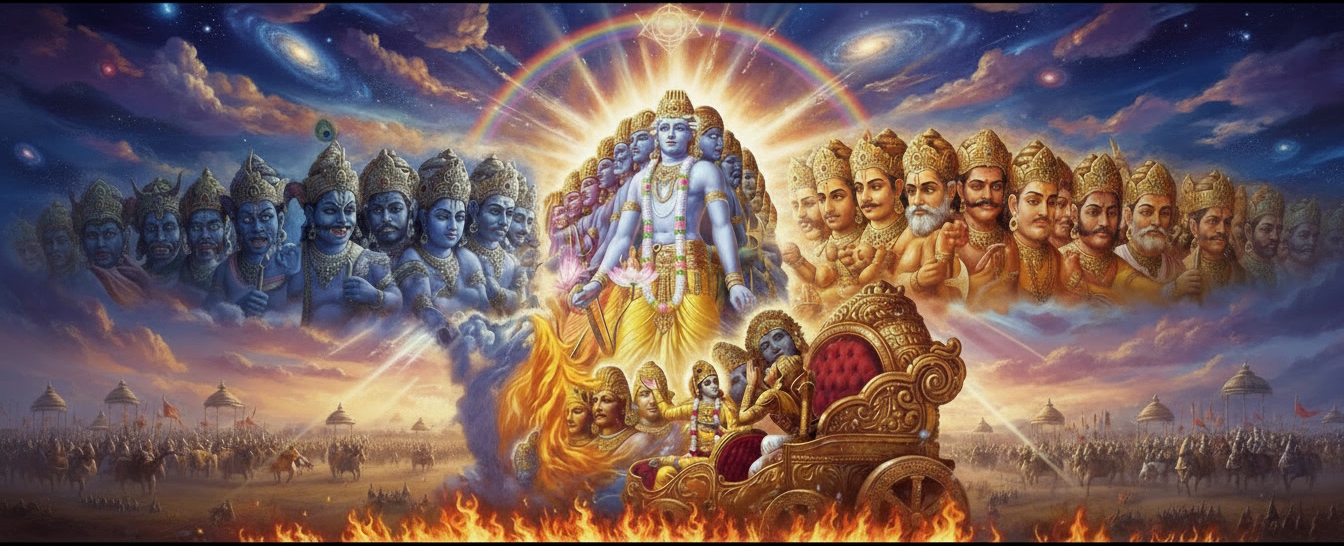
यान्ति देवव्रता देवान् पितृ़न्यान्ति पितृव्रताः।
भूतानि यान्ति भूतेज्या यान्ति मद्याजिनोऽपि माम्।।9.25।।
yānti devavratā devān pitṛ़nyānti pitṛvratāḥ|
bhūtāni yānti bhūtejyā yānti madyājino'pi mām||9.25||
Translation
The worshippers of the gods go to them; to the manes go the ancestor-worshippers; to the deities who preside over the elements go their worshippers; but My devotees come to Me.
हिंदी अनुवाद
(सकामभावसे) देवताओंका पूजन करनेवाले (शरीर छोड़नेपर) देवताओंको प्राप्त होते हैं। पितरोंका पूजन करनेवाले पितरोंको प्राप्त होते हैं। भूत-प्रेतोंका पूजन करनेवाले भूत-प्रेतोंको प्राप्त होते हैं। परन्तु मेरा पूजन करनेवाले मुझे ही प्राप्त होते हैं।
Commentaries & Translations
Swami Ramsukhdas
व्याख्या--[पूर्वश्लोकमें भगवान्ने यह बताया कि मैं ही सम्पूर्ण यज्ञोंका भोक्ता और सम्पूर्ण संसारका मालिक हूँ, परन्तु जो मनुष्य मेरेको भोक्ता और मालिक न मानकर स्वयं भोक्ता और मालिक बन जाते हैं, उनका पतन हो जाता है। अब इस श्लोकमें उनके पतनका विवेचन करते हैं।]
Sri Harikrishnadas Goenka
जो भक्त अन्य देवताओंकी भक्ितके रूपमें अविधिपूर्वक भी मेरा पूजन करते हैं उनको भी यज्ञका फल अवश्य मिलता है। कैसे ( सो कहा जाता है -- ) जिनका नियम और भक्ित देवोंके लिये ही है वे देवउपासकगण देवोंको प्राप्त होते हैं। श्राद्ध आदि क्रियाके परायण हुए पितृभक्त अग्निष्वात्तादि पितरोंको पाते हैं। भूतोंकी पूजा करनेवाले विनायक? षोडशमातृकागण और चतुर्भगिनी आदि भूतगणोंको पाते हैं तथा मेरा पूजन करनेवाले वैष्णव भक्त अवश्यमेव मुझे ही पाते हैं। अभिप्राय यह कि समान परिश्रम होनेपर भी वे ( अन्यदेवोपासक ) अज्ञानके कारण केवल मुझ परमेश्वरको ही नहीं भजते इसीसे वे अल्प फलके भागी होते हैं।,
Sri Anandgiri
If devotees of other deities fall from the fruit of action due to ignorance of the Lord's true nature, is their worship of other deities useless? Anticipating this doubt, He says 'Ye'pi' etc. The meaning is that even though there is no fruit of non-return (liberation) for those who worship other deities, it is not useless because the attainment of fruits corresponding to those specific sacrifices is certain.
He illustrates the necessary fruit for worshippers of other deities, anticipating the doubt, with 'Katham' etc. 'Niyama' (rule/vow) means offerings, gifts, circumambulation, bowing down, etc.
Having stated that the fruit of worshipping other deities is finite, He states the infinite nature of the fruit of worshipping the Lord with 'Yanti'.
Anticipating the thought that since the fruit of worshipping the Lord is infinite, it is proper to worship only the Lord and abandon the worship of other deities—given that the effort is equal but the fruit is excessive—He says 'Samane'pi'.
He shows the inferiority in fruit of those worshipping other deities due to their dependence on ignorance with the word 'Tena' (by that).
Sri Dhanpati
He states that the fruit is inevitable even for those who sacrifice irregularly with 'Yanti'. 'Devavratah' means those who have vows regarding gods—rules like offerings, gifts, circumambulation, bowing down, and devotion—they go to (attain) their worshippable gods like Indra, Vasus, etc. The Sruti says: 'As one worships Him, so he becomes.'
Similarly, those who have vows regarding Ancestors (Pitris) like Agnishvattas—rules of rites like Sraddha and devotion—go to the Ancestors.
Similarly, those whose sacrifice (ijya/worship) is towards Beings (Bhutas) like Vinayaka, the Matriganas, the sixty-four Yoginis, etc., those worshippers of Bhutas go to the Bhutas.
And 'Madyajinah'—those whose nature is to worship Me—go to Me, Lord Vasudeva, alone. The intention is to express: Alas, the foolishness of the people! Even though the effort is equal, due to ignorance, they abandon worshipping Me which yields immense fruit, and accept the worship of other gods, thereby becoming partakers of small fruit.
Sri Madhavacharya
Discriminating the fruit, He says -- 'Yanti'.
Sri Neelkanth
All devotees attain proximity to their own object of worship according to their worship, He says -- 'Yanti'.
Those whose sacrifice (ijya) is for the sake of Bhutas (beings/spirits) are 'Bhutejyah'.
Sri Ramanuja
The word 'Vrata' denotes resolve (Sankalpa). 'Devavratah': Those who have the resolve to worship Indra etc., thinking 'We sacrifice to Indra and others through rites like Darsa and Paurnamasa', they go to Indra and other gods. And those who have the resolve to worship Ancestors, thinking 'We sacrifice to Ancestors through Pitriyajna etc.', they go to the Ancestors. And those who have the resolve to worship Bhutas, thinking 'We sacrifice to Yakshas, Rakshasas, Pisachas and other beings', they go to the Bhutas. But those who, with those very sacrifices, worship Me with the resolve 'We sacrifice to Lord Vasudeva, the Supreme Self, who has gods, ancestors, and beings as His body', they are 'Madyajinah' and attain Me alone.
Those devoted to gods etc., having attained the gods, enjoy limited pleasure with them and at the time of their destruction are destroyed along with them. But My worshippers, having attained Me—who am without beginning or end, omniscient, of true resolve, the great ocean of infinite, unsurpassed, innumerable auspicious qualities, and of infinite unsurpassed bliss—do not return again. This is the meaning.
There is this distinct feature also for My worshippers, He says --
Sri Sridhara Swami
He explains that very point -- 'Yanti'. Those who have a vow (rule) regarding gods like Indra etc., they go to the finite gods; therefore, they return again.
Those who have a vow regarding Ancestors, who are devoted to rites like Sraddha, go to the Ancestors. Those whose sacrifice (worship) is towards Bhutas like Vinayaka, Matrikas etc., go to the Bhutas.
Those whose nature is to sacrifice to Me are 'Madyajinah'; they go to Me, the Imperishable, of the nature of Supreme Bliss, Narayana.
Sri Vedantadeshikacharya Venkatanatha
How can the very same action be the means for conflicting fruits like enjoyment and liberation? To this, the answer is that it is justified by the diversity of the auxiliary cause known as 'Sankalpa' (resolve). The disparity in the goal attained is shown by the verse 'Yanti', with this intention He says 'Aho Mahat'. That diversity of fruit arises from difference in Sankalpa is established even in rites like Jyotishtoma. The word 'Vrata' denotes Sankalpa; the idea is that the difference in fruit is due to the specific Sankalpa.
In 'Devavratah' etc., worship (Yajana) is implied, and in 'Bhutejyah', Vrata is implied, by mutual expectation. The word 'Bhuta' here excludes mere living beings and refers to the Rajasic and Tamasic class of objects of worship like Yakshas, etc. To inform that there is no difference in the nature of the action itself, unlike the difference between Deva-yajna and Pitri-yajna, the phrase 'Taireva' (by those very sacrifices) is used. It is explained with the 'Yat-Tat' (relative pronoun) structure to indicate that a specific fruit is being shown by restating the worship of gods enjoined in other sentences, and not that an injunction of means for a fruit is being made as in sentences like Jyotishtoma.
Those who have a vow regarding gods are Devavratas; those whose sacrifice is intended for Bhutas are Bhutejyas. The mention of different goals attained indicates equality in place, time, and enjoyment with those respective deities, as shown by 'Devadivrata'.
By 'Anadinidhana' (beginningless and endless), return caused by the non-eternity of the goal is refuted. By 'Sarvajna' (omniscient), return caused by contradictory ignorance is refuted. By 'Satyasankalpa' (true resolve), return caused by inability or doubt about the Lord's independence is refuted. The idea is that His resolve 'I shall not make the devotees return' is also true. To remove the pettiness of enjoyment caused by being finite in nature, the two adjectives starting with 'Anavadhika' (unlimited) are used. By this, since it causes thirstlessness for other things, return based on one's own will is also refuted.
Swami Chinmayananda
जीवन का यह नियम है कि जैसे तुम विचार करोगे वैसे तुम बनोगे। जैसी वृत्ति वैसा व्यक्ति। समयसमय पर किये गये विचारों के अनुसार व्यक्ति के भावी चरित्र का रेखाचित्र अन्तकरण में खिंच जाता है। यह एक ऐसा तथ्य है? जिसकी सत्यता का अनुभव प्रत्येक व्यक्ति को अपने जीवन में ही हो सकता है। मनोविज्ञान के इस नियम को आत्मविकास के आध्यात्मिक क्षेत्र में प्रयुक्त करते हुए भगवान् श्रीकृष्ण कहते हैं? देवताओं के पूजक देवताओं को प्राप्त होते हैं इत्यादि। देवता? पितर? भूतों के पूजक लोग जब दीर्घकाल तक एकाग्रचित्त से अपने इष्ट की पूजा और भक्ति करते हैं? तब उसके परिणामस्वरूप उनकी इच्छायें पूर्ण होती हैं।देवता ज्ञानेन्द्रियों के अधिष्ठाता हैं। हमें जगत् का अनुभव ज्ञानेन्द्रियों के द्वारा ही होता है। यहाँ देवताओं से आशय इन्द्रियों के द्वारा अनुभूत सम्पूर्ण भौतिक जगत् से है। जो लोग निरन्तर बाह्य जगत् के सुख और यश की कामना एवं तत्प्राप्ति के लिए प्रयत्न करते हैं? वे अपने इच्छित अनुभवों के विषय और क्षेत्र को प्राप्त होते है।पितृव्रता शब्द का अर्थ है? वे लोग जो अपने पितरों की सांस्कृतिक शुद्धता और परम्परा के प्रति जागरूक हैं? तथा जो उन्हीं आदर्शों के अनुरूप जीवन जीने का उत्साहपूर्वक प्रयत्न करते हैं। जो व्यक्ति आध्यात्मिक भारत की प्राचीन सांस्कृतिक परम्परा के अनुसार जीने का सतत प्रयत्न करता है? वह? फलत? इस शुद्धता एवं पूर्णता के अत्युत्तम जीवन की सुन्दरता और आभा प्राप्त करता है।हमारी भारत भूमि के प्राचीन ऋषियों ने इस तथ्य की कभी उपेक्षा नहीं की कि किसी भी समाज में? आध्यात्मिक आदर्शों के अतिरिक्त? वैज्ञानिक अन्वेषण तथा प्रकृति के गर्भ में निहित अनेक नियमों एवं वस्तुओं का अविष्कार भी होता रहता है। भौतिक विज्ञानों के क्षेत्र में होने वाले अन्वेषण और अनुसंधान मानव मन की जिज्ञासा का ही एक अंग हैं। अत भूतों के पूजक से तात्पर्य उन वैज्ञानिकों से है? जो प्रकृति का निरीक्षण करते हैं और निरीक्षित नियमों का वर्गीकरण कर उस ज्ञान को सुव्यवस्थित रूप देते हैं। आधुनिक युग में प्रकृति? वस्तु? व्यक्ति एवं प्राणियों के अध्ययन का ज्ञान जिन शाखाओं के अन्तर्गत किया जाता है? वे भौतिकशास्त्र? रसायनशास्त्र? यान्त्रिकी? कृषि? राजनीति? समाजशास्त्र? भूगोल? इतिहास? भूगर्भशास्त्र आदि हैं। इन शास्त्रों में भी अनेक शाखायें होती हैं? जिनका विशेष रूप से अध्ययन करके लोग उस शाखा के विशेषज्ञ बनते हैं। अथर्ववेद के एक बहुत बड़े भाग में उस काल के ऋषियों को अवगत प्रकृति के स्वभाव एवं व्यवहार के सिद्धांत दिये गये हैं। भगवान् श्रीकृष्ण द्वारा यहाँ कथित मनोविज्ञान का नियम मनुष्य के सभी कर्मों के क्षेत्रों में लागू होता है। वह नियम है किसी भी क्षेत्र में मनुष्य द्वारा किये गये प्रयत्नों के समान अनुपात में उसे सफलता प्राप्त होती है।इस प्रकार? यदि देवता? पितर और भूतों की पूजा करने से अर्थात् उनका निरन्तर चिन्तन करने से क्रमश देवता? पैतृक परम्परा और प्रकृति के रहस्यों को जानकर भौतिक जगत् में सफलता प्राप्त होती है? तो उसी सिद्धांत के अनुसार हमें वचन दिया गया है कि? मेरे भक्त मुझे ही प्राप्त होते हैं। एकाग्र चित्त से आत्मस्वरूप पर सतत दीर्घकाल तक ध्यान करने पर साधक अपने सनातन? अव्यय आत्मस्वरूप का सफलतापूर्वक साक्षात् अनुभव कर सकता है। सतत आत्मानुसंधान के फलस्वरूप अन्त में जीव की आत्मस्वरूप में ही परिणति को वेदान्त के प्रकरण ग्रन्थों में भ्रमरकीट न्याय द्वारा दर्शाया गया है।गीता का प्रयोजन और प्रयत्न ज्ञान के साथ विज्ञान अर्थात् अनुभव को भी प्रदान करता है। इस श्लोक का प्रयोजन साधक को यह विश्वास दिलाना है कि यहाँ कथित प्रारम्भिक साधना के द्वारा परम पुरुषार्थ की भी प्राप्ति हो सकती है। जिस प्रकार समर्पित होकर भौतिक जगत् में कार्य करने पर भौतिक सफलता मिलती है? वही नियम आन्तरिक जगत् के सम्बन्ध में भी सत्य प्रमाणित होता है। इसका पर्यवसान आध्यात्मिक साक्षरता में होता है। सतत ध्यान अवश्य ही फलदायक होगा। भगवान् के इस आश्वासन का तर्कसंगत कारण इस श्लोक में दिया गया है।क्या भक्ति पूर्वक की गई पूजा मात्र से ऐसे परमार्थ की प्राप्ति हो सकती है क्या हमको वेदोक्त कर्मकाण्ड के अनुष्ठान की आवश्यकता नहीं है? जिसके पालन के लिए प्राय वेदों में आग्रह किया गया है इस पर भगवान् कहते हैं --
Sri Abhinavgupta
From 'Ye'pi' to 'Prayatatmanah'. Even those who worship with other names, worship Me alone. Indeed, there is nothing worthy of worship other than Brahman. But the distinction lies in 'Avidhina'. 'Avidhi' means another rule (anyo vidhih). I, whose nature is the existence of Supreme Brahman, am to be sacrificed to by various kinds of rules. Not as explained by others—who are polluted by great sins accumulated by condemning other philosophies—that 'Avidhina' means 'by wicked/bad rules'.
If that were so, the visible statements 'they worship Me alone' and 'I am the enjoyer of all sacrifices' would become inconsistent. Enough of conversation with those filled with sins.
Our teachers, however, explain it thus: Thinking that there is some other deity distinct from one's own Self, devoid of Brahman-nature according to the doctrine of dualism, those who worship that deity, they too in reality worship Me alone, who am of the nature of their own Self, but by 'Avidhi', i.e., by a wicked rule which is of the form of grasping duality. Therefore, He says: 'They do not know Me, their own Self, in reality as the deity and the enjoyer; therefore they fall from My form.' What is that? Being 'Devavrata', they go to the gods, etc. This itself is the 'falling' (chalanam).
But those who know My nature non-different from themselves, they worship Me alone even through sacrifices to gods, beings, ancestors, etc. And they, My worshippers, go to Me alone; this He will conclude.
Objection: A deity is defined as that intended for the abandonment of a substance. So how can the Self-principle be the object of sacrifice without being explicitly intended? In injunctions like 'Aditya is the oblation for the introductory rite', the intending of the deity which is subsidiary to the rule is caused by another rule regarding the intention. And there is no rule regarding one's own Self; with this intention He says 'Avidhipurvakam mam'.
For a deity distinct from one's own Self, a rule (Vidhi) is required/expected, because it involves attaining what is not attained. But the Self, the Supreme Lord, is not subject to rules, because He is not something to be established by rules. Indeed, nothing proceeds without intending Him. Therefore, in all intentions towards Indra and other deities established by rules, that Self, whose nature is to illumine the universe, standing as the background (wall) for the manifestation of those intended deities, shining continuously as 'I, I', is continuously intended like the thread in a garland. This is established by logic: 'They worship Me alone' because it is 'Avidhipurvakam' (not based on injunctions).
The fruit of attaining Me, which is the main thing, is not the intention of the agent (worshipper) in their case; rather, their fulfillment is only in attaining the mere position of Indra etc., which takes the place of a limited sacrificial fee (Dakshina), like a hired priest—to make this known, the Parasmaipada form is used.
As said by me: 'He knows the Vedas but knows not the Shambhav state... All streams of the essence of action, the rivers of consciousness, do not find full stability without reaching the great ocean of the bliss of the Self.' Thus, he who knows in the said order, his sacrifice to Indra and other deities is also a sacrifice to the Supreme Lord.
Sri Jayatritha
Since the difference in fruit has already been stated in 'Te punyamasadya' (9.20) and 'Yogakshemam vahamyaham' (9.22), what is the purpose of 'Yanti' etc.? To this He says --
'Phalam' (The fruit...). The idea is that this is just an elaboration of that same point.
Sri Madhusudan Saraswati
Stating that even though there is no fruit of non-return for those who sacrifice to other gods, the attainment of paltry fruits corresponding to those specific sacrifices to gods is certain, He states the distinction of the Lord's sacrificers from them. Indeed, those who sacrifice irregularly are of three kinds, based on the difference of the three Gunas serving as adjuncts to the inner instrument.
Among them, the Sattvic are 'Devavratas'; Gods are Vasus, Rudras, Adityas etc.; those who have a vow related to them—worship in the form of offerings, gifts, circumambulation, bowing, etc.—go to those very gods. According to the Sruti: 'As one worships Him, so he becomes.'
The Rajasic are 'Pitrivratas'; worshippers of Ancestors like Agnishvattas through rites like Sraddha, they go to those very Ancestors. Similarly, the Tamasic are 'Bhutejyas'; worshippers of Bhutas like Yakshas, Rakshasas, Vinayaka, Matriganas etc., they go to those very Bhutas.
Here, the compound of the words Deva, Pitri, and Bhuta is with their related attribute (worship) according to the 'Ushtramukha-nyaya' (Camel-face logic/maxim). This is because the 'Madhyamapadalopi' (deletion of middle term) compound is not accepted, and due to the absence of a modification-source relationship, the 'Tadarthya-Chaturthi' (Dative for the sake of) compound is not applicable. Since the word 'Ijya' denoting worship is used at the end, the word 'Vrata' in the previous two synonyms also refers to worship alone.
Thus, having stated that the fruit of worshipping other deities is finite and of the nature of those deities, He states the infinite fruit of worshipping the Lord, which is of the nature of the Lord -- 'Madyajinah', those whose nature is to sacrifice/worship Me, God; seeing the presence of God in all deities and devoted to the worship of God, they go to Me, the Lord alone.
Even though the effort is equal, due to ignorance, not worshipping the Inner Controller Lord who gives infinite fruit, and worshipping other deities to attain finite fruit—oh, this is the majesty of misfortune or ignorance! This is the intention.
Sri Purushottamji
Objection: If those who sacrifice being ignorant of Your partial manifestation fall, then what is the fruit for those who perform sacrifice to those gods with the knowledge that they are Your parts? To this He says -- 'Yanti'.
'Devavratah': Those who are disciplined regarding Indra etc. in their forms, with the knowledge of My part in them. They go to/attain those very gods. 'Pitrivratah': Sacrificers to Ancestors through rules like Sraddha, attain the Ancestors. 'Bhutejyah': Worshippers of Vinayaka, Durga etc., go to those very Bhutas.
Here the meaning is: Having attained those respective gods, through their association, they attain Me 'Paramparaya' (sequentially/indirectly). 'Madyajinah': Those who sacrifice to Me in My Adhidaivika (divine) form through actions etc., also attain Me. Those (the former) attain Me sequentially; these (the latter) attain Me directly—this is the distinction.
By the word 'Api', the special feature of attaining Him, which is of the nature of liberation, is implied even when worship is performed as a subsidiary to action.
Sri Shankaracharya
'Yanti' means go. 'Devavratah'—those who have a vow, rule, and devotion regarding gods—go to the gods. 'Pitrivratah'—those devoted to rites like Sraddha and devoted to Ancestors—go to the Ancestors like Agnishvattas. 'Bhutejyah'—worshippers of Bhutas—go to the Bhutas like Vinayaka, Matriganas, the Four Sisters (Chaturbhagini), etc. 'Madyajinah'—Vaishnavas whose nature is to worship Me—go to Me alone.
The meaning is: Even though the effort is equal, they do not worship Me due to ignorance; therefore, they become partakers of small fruits.
Not only is the fruit for My devotees infinite, characterized by non-return, but I am also easy to propitiate. How? --
Sri Vallabhacharya
Explaining 'Yanti Devavratah'. 'Vrata' means Sankalpa (resolve), which is a mental action; that indeed is denoted by the word 'Bhava' (feeling/attitude). Those who have made the resolve 'We sacrifice to Indra and other gods through rites like Darsa and Paurnamasa', go to the gods; they attain Sayujya (union) with them.
Similarly, Sankalpa is the cause everywhere. 'Pitrivrata' are those with Rajasic nature. 'Bhutejya' are those with Tamasic nature; Bhutas mean Yakshas, Rakshasas, Pisachas, etc.
Those who, with those very sacrifices, worship Me with the resolve 'We sacrifice to the Supreme Self Sri Vasudeva, who is the substratum of gods, ancestors, and beings', having pure Sattvic nature and Nirguna nature, they attain My Sayujya (union with Me). This is the meaning.
Swami Sivananda
यान्ति go? देवव्रताः worshippers of the gods? देवान् to the gods? पितृ़न् to the Pitris or ancestors? यान्ति go? पितृव्रताः worshippers of the Pitris? भूतानि to the Bhutas? यान्ति go? भूतेज्याः the worshippers of the Bhutas? यान्ति go? मद्याजिनः My worshippers? अपि also? माम् to Me.Commentary The worshippers of the manes such as the Agnisvattas who perform Sraaddha and other rites in devotion to their ancestors go to the manes. Those who worship the gods with devotion and vows go to them.Bhutas are elemental beings lower than the gods but higher than human beigns they are the Vinayakas? the hosts of Matris? the four Bhaginis and the like.Those who devote themselves to the gods attain the form of those gods at death. Similar is the fate of those who worship the manes (their own ancestors) or the Bhutas. The fruit of the worship is in accordance with the knowledge? faith? offering and nature of worship of the devotee.Though the exertion is the same? people do not worship Me on account of their ignorance. Conseently they get very little reward.My devotees obtain endless fruit. They do not come back to this mortal world. It is also easy for them to worship Me. How (Cf.VII.23)
Swami Gambirananda
Deva-vratah, votaries of the gods, those whose religious observances [Making offerings and presents, circumambulation, bowing down, etc.] and devotion are directed to the gods; yanti, reach, go to; devan, the gods. Pitr-vratah, the votaries of the manes, those who are occupied with such rites as obseies etc., who are devoted to the manes; go pitrn, to the manes such as Agnisvatta and others. Bhutejyah, the Beings such as Vinayaka, the group of Sixteen (divine) Mothers, the Four Sisters, and others. And madyajinah, those who worship Me, those who are given to worshipping Me, the devotees of Visnu; reach mam, Me alone. Although the effort (involved) is the same, still owing to ingorance they do not worship Me exclusively. Thery they attain lesser results. This is the meaning.
'Not only do My devotees get the everlasting result in the form of non-return (to this world), but My worship also is easy.' How?
Swami Adidevananda
The term 'Vrata' in the text denotes will, intention or motive. Those who intend to worship gods, like Indra and others with the resolution, 'Let us worship Indra and other gods by ceremonies like the new moon and full moon sacrifices' - such worshippers go to Indra and other gods. Those who intend worshipping manes, resolving 'Let us worship the manes through sacrifices,' - such worshippers go to the manes or others resolving - 'Let us worship the Yaksas, Raksasas,' Pisacas and other evil spirits' - they go to them. But those who, with the same rites of worship, worship Me with the intention, 'Let us worship Lord Vasudeva, the Supreme Self, whose body is constituted of gods, the manes and the evil spirits' - they are My worshippers and they reach Me only.
Those who intend worshipping gods etc., attain gods etc. After sharing limited enjoyment with them, they are destroyed with them when the time comes for their destruction. But My worshippers attain Me, who has no beginning or end, who is omniscient, whose will is unfailingly effective, who is a great ocean of innumerable auspicious attributes of unlimited excellence and whose bliss too is of limitless excellence. They do not return to Samsara. Such is the meaning.
Sri Krsna continues to say, 'There is also another distinguishing characteristic of My worshippers.'