Srimad Valmiki Ramayana
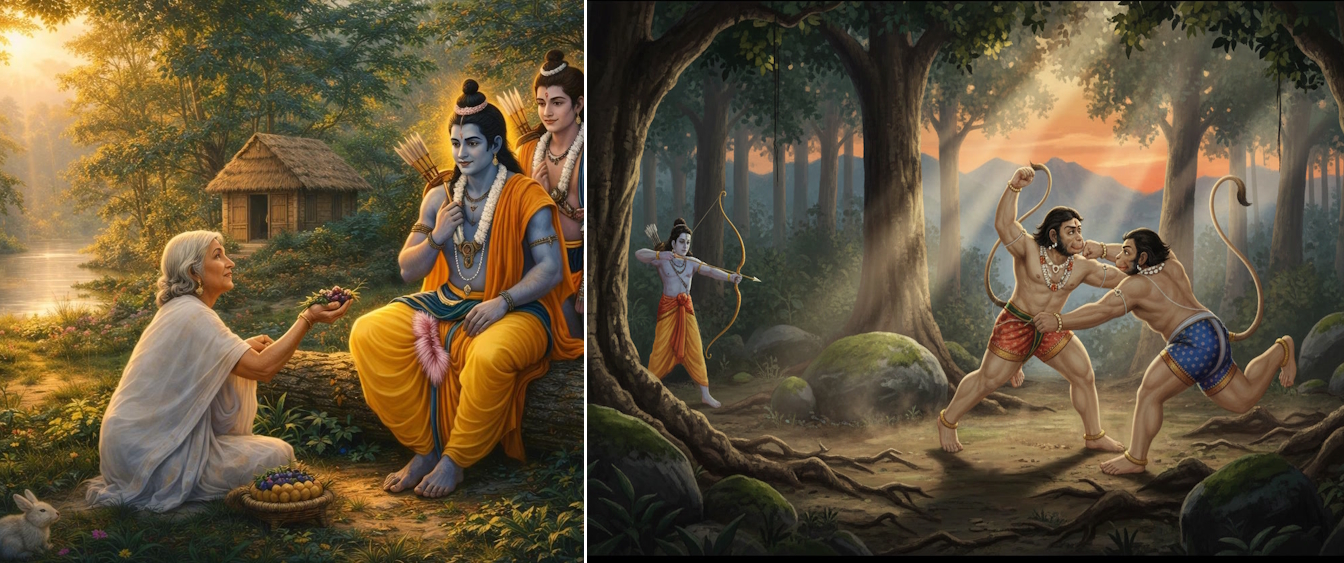
आदित्यम् इव कालेन युगान्ते भुवि पातितम् ।
महेन्द्रम् इव दुर्धर्षम् उपेन्द्रम् इव दुस्सहम् ॥ ॥४-१७-१०॥
Ādityam iva kālena yugānte bhuvi pātitam |
Mahendram iva durdharṣam upendram iva dussaham ॥4-17-10॥
Translation
He looked like the Sun hurled down to earth by Time at the end of the Yuga. He was invincible like Mahendra (Indra) and irresistible like Upendra (Vishnu).
हिंदी अनुवाद
वह (वाली) ऐसा लग रहा था मानो युग के अंत में काल ने सूर्य को धरती पर गिरा दिया हो। वह महेन्द्र (इन्द्र) के समान दुर्धर्ष (जिसे दबाया न जा सके) और उपेन्द्र (वामन/विष्णु) के समान असह्य पराक्रमी था।
English Commentary
The magnitude of Vali's power is elevated to cosmic proportions. He is compared to the Sun, Indra ('Mahendra'), and Vishnu ('Upendra'). These comparisons serve two purposes: they honor the fallen king's prowess, acknowledging he was 'durdharṣam' (difficult to assault) and 'dussaham' (unendurable/irresistible); and they implicitly glorify Rama, as only a supreme power could fell a warrior possessing the attributes of the Sun and Indra.
हिंदी टीका
वाली की शक्ति का वर्णन करने के लिए कवि ने सर्वोच्च उपमाओं का प्रयोग किया है। उसे 'सूर्य', 'महेन्द्र' और 'उपेन्द्र' (विष्णु) के समान बताया गया है। यह दर्शाता है कि राम ने किसी साधारण वानर को नहीं, बल्कि देवताओं के समान शक्तिशाली योद्धा को हराया है। 'युगान्ते' (प्रलयकाल) शब्द सूचित करता है कि वाली का गिरना कोई सामान्य घटना नहीं, बल्कि एक प्रलयकारी घटना है।