Srimad Valmiki Ramayana
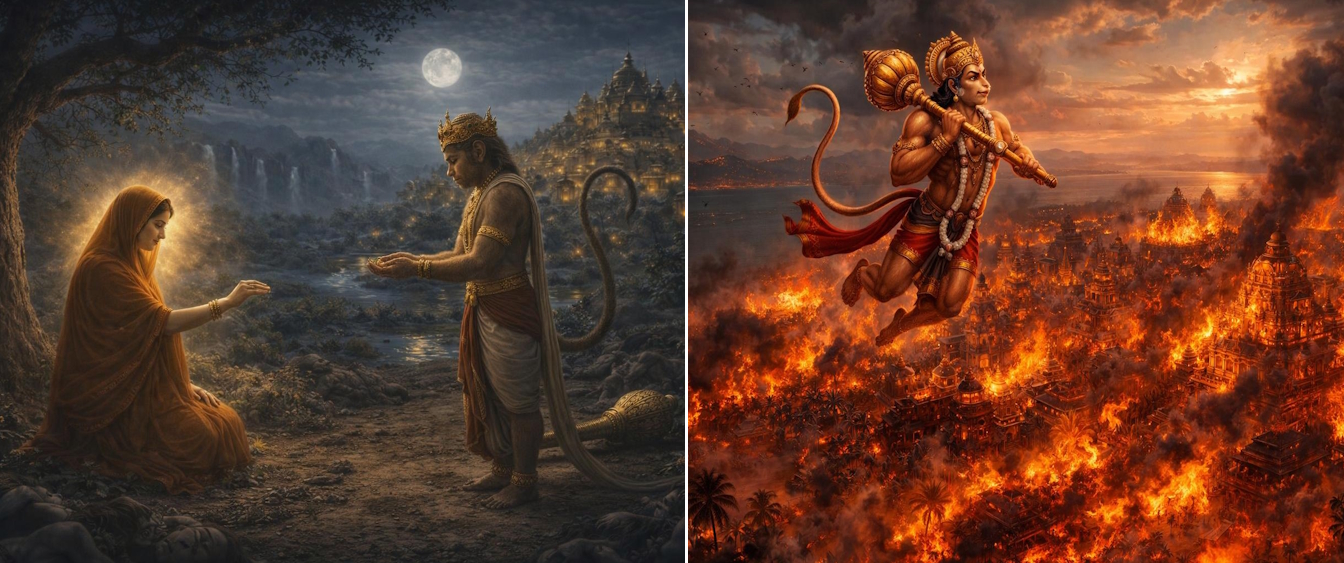
ततः स लम्बस्य गिरेः समृद्धे ।
विचित्रकूटे निपपात कूटे ।
सकेतकोद्दालकनालिकेरे ।
महाभ्रकूटप्रतिमो महात्मा ॥ ॥५-१-२०८॥
tataḥ sa lambasya gireḥ samṛddhe । vicitrakūṭe nipapāta kūṭe । saketakoddālakanālikeरे । mahābhrakūṭapratimo mahātmā ॥ ॥5-1-208॥
Translation
Then, that high-souled one, resembling a massive peak of clouds, landed on the rich and wondrous peak of the Lamba mountain, which was abounding with Ketaka, Uddalaka, and coconut trees.
हिंदी अनुवाद
तब महान बादलों के शिखर के समान प्रतीत होने वाले महात्मा हनुमान, 'लम्ब' नामक पर्वत के उस समृद्ध और विचित्र शिखर पर उतरे, जो केतकी, उद्दालक और नारियल के वृक्षों से भरा हुआ था।
English Commentary
The specific botanical references—Ketaka (screw pine), Uddalaka (a type of honey-tree), and Nālikera (coconut)—firmly ground the narrative in the ecology of Southern India and Sri Lanka. Hanuman lands on a peak of the Lamba mountain. The epithet Mahābhrakūṭapratimo (resembling a peak of great clouds) maintains the imagery of his celestial descent. Even as he lands, he carries the momentum and majesty of the sky from which he descended, transitioning from the fluid element of air to the solid element of earth.
हिंदी टीका
हनुमान जी का 'टचडाउन' (Landing) यहाँ वर्णित है। वे 'लम्ब' पर्वत पर उतरे जो त्रिकूट का ही एक भाग माना जाता है। यहाँ की वनस्पति—केतकी, उद्दालक और नारियल—यह पुष्टि करती है कि वे एक उष्णकटिबंधीय तटीय क्षेत्र (Tropical coastal region) में हैं। हनुमान जी को 'महाभ्रकूटप्रतिमो' (विशाल मेघ-शिखर के समान) कहा गया है, जो दर्शाता है कि यद्यपि उन्होंने रूप छोटा करने का निर्णय लिया था, उतरते समय उनका प्रभाव (Impact) और आभा (Aura) अभी भी बादलों जैसी विशाल और गंभीर थी।